Introduction
Muscle strength increases throughout childhood and reaches a peak in early adulthood before declining in later life.Reference Sayer, Syddall and Martin 1 Lower grip strength – a marker of total muscle strengthReference Wind, Takken, Helders and Engelbert 2 – has been shown to be associated with functional impairment,Reference Al Snih, Markides, Ottenbacher and Raji 3 falls,Reference Sayer, Syddall and Martin 4 impaired glucose tolerance and type 2 diabetes,Reference Sayer, Dennison and Syddall 5 as well as with all-cause mortality rates in adults.Reference Cooper, Kuh and Hardy 6 Epidemiological studies show that poor intrauterine growth, as characterized by birth weight, is associated with reduced grip strength in adolescenceReference Ericson and Kallen 7 – Reference Rogers, Fay, Whitfield, Tomlinson and Grunau 10 and adult life.Reference Inskip, Godfrey and Martin 11 – Reference Sayer, Cooper and Evans 13 Such relationships typically attenuate but remain significant when adjusted for height.Reference Sayer, Syddall and Martin 1 This has been considered to suggest an effect of prenatal development not only on muscle quantity (as approximated by height) but also on the quality of muscle tissues.
Evidence for the influence of birth weight on grip strength in childhood is more limited. A study of 5-year-old Australian children showed that those with very low birth weight (<1500 g, presumably in the setting of low gestational age) had lower grip strength than normal birth weight controls.Reference Ford, Kitchen and Doyle 14 More recently, birth weight has been found to be associated with grip strength in a general population sample of 9-year-old Indian children.Reference Barr, Veena and Kiran 15 In this study, adjustment for body size (height and body mass index) appeared to explain the association of birth weight with grip strength, in contrast to the findings in adult life. Our objective was to assess the relationship between birth weight and grip strength in a sample of young UK children who were taking part in a prospective general population birth cohort study, including the role of body size (height and weight).
Methods
Participants
The children were recruited from those born to women who had participated in the Southampton Women's Survey (SWS), a study of 12,583 women aged 20–34 years recruited between 1998 and 2002. The women were not pregnant at recruitment but were characterized in detail at this time (health, lifestyle, body build, social class, educational attainment, physical activity) and during subsequent pregnancies to assess the effect of preconceptional and antenatal factors on the foetus and then the child. Similar data were collected for the fathers. Full details of this study, including attrition, have been published previously.Reference Inskip, Godfrey and Robinson 16 Children were followed up at several points, including a sub-sample at the age of 4 years. There were no exclusion criteria for the children who could undergo follow-up.
Measurements
Birth weights were recorded by midwives attending the birth using hospital digital scales (Seca Ltd, London) that were regularly calibrated. At the age of 2 years, the social class of both parents was established by asking the mothers about their current or most recent occupation and about that of the child's father. At the age of 4 years, children were invited back for assessment of health and growth. Their height (using a Leicester height measurer) and weight [in underpants only, using calibrated digital scales (Seca Ltd, Birmingham, UK)] were measured. They also had their grip strength measured to the nearest 0.5 kg using a Jamar handgrip dynamometer (Promedics, Blackburn, UK) using a standard protocol. Each child was seated in a standard chair with the arm bent at the elbow and resting on the chair arm. The child sat with his or her body as close to the relevant chair arm as possible. With encouragement, three measurements of each hand were taken and the maximum of all six were used in the analysis.
To adjust for sex and gestational age, as well as to compare with reference values for the population, birth weight measurements were expressed as standard deviation scores compared with the 1990 British Growth Charts data, obtained from the Child Growth Foundation (CGF).Reference Cole, Freeman and Preece 17 The same approach was used with the children's height and weight measurements at the 4-year assessment, this time adjusting for sex and age.
Statistical methods
Baseline characteristics of the children with grip strength measurements were compared with those without grip strength measurements. Multiple regression analysis was used to relate birth weight to grip strength at the age of 4 years, examining the influence of covariates (child's height, weight, gender, gestational age and socioeconomic position).
Ethics committee approval
The study was approved by Southampton and South West Hampshire Local Research Ethics Committee. Written consent was obtained from the mothers at initial interview and from the parent or guardian of all the children who participated.
Results
Characteristics of the study sample
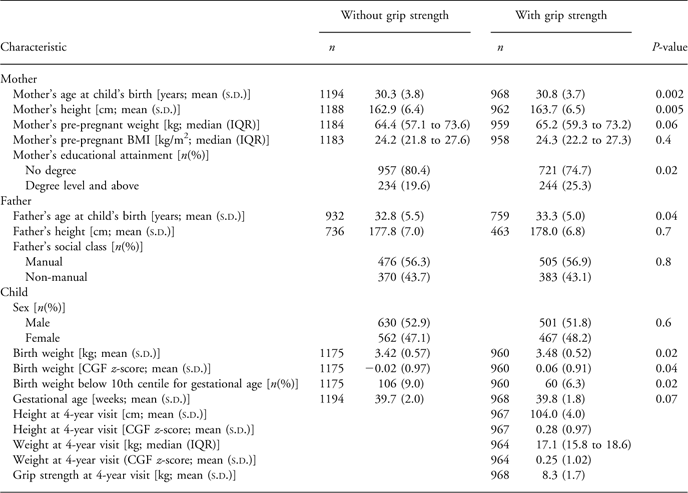
From 2162 children eligible for follow-up, grip strength measurements were made in 968 children. Compared with those for children born in the same time period as those measured, but who did not have grip strength measurements at the age of 4 years, participants had higher birth weights and were more likely to have mothers who were educated up to degree level or above (see Table 1). Among participants, mean birth weight was slightly higher in boys than in girls (3.54 and 3.40 kg, respectively; P < 0.001) as was the mean grip strength (8.5 and 8.1 kg, respectively; P = 0.004).
Characteristics of SWS parents and their children by whether or not the children had grip strength measurements at 4 years of age

SWS, Southampton Women's Survey; IQR, interquartile range; BMI, body mass index; CGF, Child Growth Foundation.
Univariable analysis
Unadjusted birth weight was statistically significantly positively associated with grip strength. A 1 s.d. increase in unadjusted birth weight was associated with a 0.26 kg (95% CI 0.16, 0.37) increase in grip strength. Gestational age was also associated with grip strength (β = 0.07 kg per additional week of gestation; 95% CI 0.01, 0.13). Adjustment of birth weight for sex and gestational age using CGF data (Table 2) slightly attenuated the relationship with grip strength (β = 0.22 kg grip strength per s.d. increase in birth weight; 95% CI 0.11, 0.34; P < 0.001). We found no evidence of a non-linear relationship between birth weight and grip strength.
Multiple regression analysis for the relationship between grip strength (kg) at age 4 years and birth weight, social class and body size at age 4 years

Birth weight, and child's height and weight at 4 years standardized using the Child Growth Foundation standards.
Social class is the highest social class of the mother and the father when the child was 2 years of age (lower values indicate higher social class).
Height and weight at 4 years of age were also significantly positively associated with grip strength, independent of sex and age (Table 2). Higher social class (the highest of the mother's and father's class) predicted higher grip strength, but maternal education did not.
Multivariable analysis
Birth weight was strongly correlated with height (r = 0.27; P < 0.001) and weight (r = 0.30; P < 0.001) at 4 years of age. Inclusion of height and weight in a multivariable model attenuated the relationship between birth weight and grip strength so that it became non-significant (Table 2), suggesting that the relationship was largely explained by the associations between birth weight and body size at 4 years of age. The inclusion of height and weight separately in the model (data not shown) suggested that they both had similar effects. The effect of social class also attenuated and became non-significant once body size was included in the multivariable model. The regression models were run separately for boys and girls and no differences were found.
Discussion
Main findings
We have shown, after adjustment for age and sex, an association between birth weight and grip strength at the age of 4 years, with an average 0.22 kg (0.14 s.d.) increase in grip per extra s.d. of birth weight. This was largely explained by the positive association between birth weight and childhood body size.
Comparison with other research
These results are similar to those observed in 9-year-old Indian children by Barr et al.Reference Barr, Veena and Kiran 15 who reported a 0.40 kg (0.18 s.d.) unadjusted increase in grip strength per s.d. increase in birth weight, after adjustment for gender and gestational age. Further, in a similar manner to our results, Barr et al. also found that adjustment for body size attenuated and made non-significant the association between birth weight and grip strength. This may suggest that the main driver is the quantity of muscle in childhood. This would be consistent with studies of body composition in childhood, showing that the amount of lean mass is predicted by birth weight at 7 and 14 years of ageReference Singhal, Wells, Cole, Fewtrell and Lucas 18 and that changes in lean mass appear to explain the age-related increase in grip strength from 5 to 15 years of age.Reference Marrodan Serrano, Romero Collazos and Moreno 19 , Reference Sartorio, Lafortuna, Pogliaghi and Trecate 20
Our results and those of Barr et al. are in contrast with studies of adults where adjustment for current size typically attenuates the relationship between birth weight and grip strength but does not remove it,Reference Sayer, Syddall and Martin 1 with the remaining association seen as evidence of a separate effect of intrauterine growth on the quality of muscle tissue. This is supported by the findings of altered muscle fibre composition in youngReference Jensen, Storgaard, Madsbad, Richter and Vaag 21 and olderReference Patel, Jameson and Syddall 22 men with low birth weight, as well as reduced myofibre density in sheep with poor prenatal nutrition.Reference Costello, Rowlerson and Astaman 23 It is possible that there are biological explanations for the differences in associations between intrauterine growth and muscle strength in childhood compared with adulthood, or, alternatively, that the differences in associations are explained statistically by the smaller effect size and narrower range of grip measurements in children.
Strengths and limitations
We have studied a large community-based sample of 4-year-old children participating in the SWS. We are not aware of any studies that have examined a UK general population sample at such a young age and this reflects an advantage of the study design: the recruitment of non-pregnant women and follow-up of subsequent births. As previously described,Reference Inskip, Godfrey and Robinson 16 the setting of Southampton is more deprived and has more white residents than average for the United Kingdom. There was also evidence of higher maternal education and birth weight comparing the participants and non-participants in this study. However, we would not expect any of these differences to substantially alter the internal associations we have found.
Conclusions
We have shown an association between birth weight and muscle strength in early childhood, which appears to be mediated via body size, adding to the existing evidence for the effect of intrauterine development on muscle strength at different ages across the life course. Ongoing follow-up of the study participants and use of body composition data would allow us to characterize this effect further, including whether the amount of lean mass explains any relationship found between birth weight and grip strength throughout childhood. This would be with the aim of improving our understanding of the aetiology of poor muscle strength in later life.
Acknowledgements
We thank the parents and children in the SWS who participated and the SWS staff who collected and processed the data. The study was funded by the Medical Research Council, the University of Southampton, British Heart Foundation, Arthritis Research Campaign, National Osteoporosis Society, International Osteoporosis Foundation, Cohen Trust and NIHR Musculoskeletal Biomedical Research Unit, Oxford. Participants were drawn from a cohort study funded by the Medical Research Council and the Dunhill Medical Trust. The funding agencies had no role in the conduct or reporting of this research.
K.G. is supported by the National Institute for Health Research through the Southampton Nutrition, Diet & Lifestyle Biomedical Research Unit.