Creativity is considered one of the most complex human behaviors (Ward, Reference Ward2007). It is a key human feature for the adaptation, performance, and resolution of problems of daily life. In addition, it is considered as a component of high intellectual ability (Sastre-Riba & Pascual-Sufrate, Reference Sastre-Riba and Pascual-Sufrate2013) and is related to school achievement (Gajda, Reference Gajda2016), which can influence work performance and real-world performance (Rindermann & Neubauer, Reference Rindermann and Neubauer2004). A definition commonly used in literature for creativity is the ability to produce something new or original that proves to be appropriate or useful for the task (Sternberg & Lubart, Reference Sternberg and Lubart1995; Ward, Reference Ward2007).
Most theories developed on creativity (e.g., Guilford, Reference Guilford1967; Mednick, Reference Mednick1962) agree on the idea that creative thinking involves the simultaneous activation of different and often unrelated concepts of distant categories. Two fundamental components of creativity are divergent and convergent thinking. According to Guilford (Reference Guilford1967), creative thinking implies an active process of multiple divergent and convergent thinking cycles. Convergent thinking is the ability to reduce all possible alternatives to a single solution to a problem, while divergent thinking involves a great search for information, establishing remote associations that unite concepts from distant categories and generating multiple new and alternative responses to problems (Guilford, Reference Guilford1967). This author has associated this last skill with four main characteristics: Fluency, flexibility, elaboration, and originality. In turn, creativity can manifest itself in different domains, such as verbal or figural (Kharkhurin, Reference Kharkhurin2010).
When researching creativity, most studies consider the type of creativity they evaluate from two main approaches: Eminent creativity, also known as Big-C, or everyday creativity, known as Little-c (Kaufman & Beghetto, Reference Kaufman and Beghetto2009). Kaufman and Beghetto (Reference Kaufman and Beghetto2009) have proposed a model in which, in addition to these two conceptualizations, they include Mini-c, which refers to the creativity inherent to the learning process, and Pro-c, which goes beyond Little-c and represents professional experience in any creative area. Creative ability would be a characteristic of the general population that can gradually evolve to different phases (Kaufman & Beghetto, Reference Kaufman and Beghetto2009).
This model is consistent with one of the most predominant approaches to creativity: Creative cognition. According to this model, creative ability is an essential property of normative human cognition and, therefore, creative people use the same cognitive processes as the general population (Ward, Reference Ward2007). According to this approach (Ward, Reference Ward2007), creative ability can be improved by the increase in general cognitive functioning. Moreover, it is believed that this ability may be favored by other factors, such as bilingualism (Kharkhurin, Reference Kharkhurin2011).
Scientists suggest that learning more than one language establishes specific structures in the brain that are likely to promote better cognitive functioning (Kharkhurin, Reference Kharkhurin2017). Specifically, at present, the predominant idea is that bilingualism can be beneficial for some cognitive functions, such as creativity (Kharkhurin, Reference Kharkhurin2017). Kharkhurin (Reference Kharkhurin, Kecskes and Albertazzi2007) has suggested that bilinguals have a greater ability to activate a longer network of associations and, therefore, can exhibit greater divergent thinking, compared to monolinguals. This author (Kharkhurin, Reference Kharkhurin, Kecskes and Albertazzi2007, Reference Kharkhurin2017) has indicated that this advantage can be explained through the idea of language mediated concept activation. When thinking about a concept, both monolinguals and bilinguals activate multiple conceptual units through associations mediated by language. However, the knowledge of several languages has an impact on the structure and functioning of the individual’s memory (Kharkhurin, Reference Kharkhurin, Kecskes and Albertazzi2007). The memory structure of bilinguals provides a more extensive concept activation than that of monolinguals and, therefore, a greater ease for divergent thinking (Kharkhurin, Reference Kharkhurin, Kecskes and Albertazzi2007). In addition, other cognitive processes, such as selective attention, also seem to be involved in bilinguals’ advantage in creative ability (Kharkhurin, Reference Kharkhurin2011).
Although multiple studies have found a positive relationship between bilingualism and creativity (Altamimi, Reference Altamimi2016; Ghonsooly & Showqi, Reference Ghonsooly and Showqi2012; Kharkhurin, Reference Kharkhurin2011, Reference Kharkhurin2017; Lasagabaster, Reference Lasagabaster2000; Lee & Kim, Reference Lee and Kim2011; Leikin, Tovli, & Malykh, Reference Leikin, Tovli and Malykh2014; Ricciardelli, Reference Ricciardelli1992a; Ródenas Ríos, Fernández Canca, & Ródenas Ríos, Reference Ródenas Ríos, Fernández Canca and Ródenas Ríos2016), some researchers have not found any significant difference between bilinguals and monolinguals (Sehic, Reference Sehic2016) and others have found a superiority in bilinguals in figural creativity, but an inferiority in verbal creativity (Kharkhurin, Reference Kharkhurin2010). This difference in the performance of verbal and figural creativity may be because bilinguals have worse language skills, which can hinder the performance of a creative task if it is framed in a verbal context (Kharkhurin, Reference Kharkhurin2010). However, studies are inconsistent regarding the bilingual advantage or disadvantage depending on whether the creative task is verbal or figural (Ricciardelli, Reference Ricciardelli1992b). In Ricciardelli’s review (1992b), two studies found a superiority in monolinguals in figural creativity, while 14 studies found a better performance in bilinguals in verbal creativity and 12 in figural creativity.
This inconsistency can be explained through the Cummins Threshold Theory (Cummins, Reference Cummins1983), which suggests that, for bilinguals to develop better cognitive and creative control, it is necessary to achieve a certain level of competence in both languages. In fact, if the bilingual individual does not reach a certain level of linguistic competence in at least one of the languages, it can have negative cognitive effects. These negative cognitive effects are observed mainly in linguistic tasks, specifically in linguistic performance tests, such as verbal fluency (Kharkhurin, Reference Kharkhurin2010). This idea has been demonstrated by several studies in which those with greater dominance in both languages have shown higher levels of creativity than those with a lower level in one of the languages (Kharkhurin, Reference Kharkhurin2011, Reference Kharkhurin2017; Konaka, Reference Konaka1997; Lee & Kim, Reference Lee and Kim2011; Ricciardelli, Reference Ricciardelli1992a).
When studying creativity, it is necessary to consider other factors. Although some studies suggest that age is a determining factor in the performance of creativity tasks, results in this area are very different (Kim, Reference Kim2011; Krumm, Arán-Filippetti, & Aranguren, Reference Krumm, Arán-Filippetti and Aranguren2015; Krumm, Arán Filippetti, Aranguren, Lemos, & Vargas Rubilar, Reference Krumm, Arán Filippetti, Aranguren, Lemos and Vargas Rubilar2013; Lee & Kim, Reference Lee and Kim2011). In general, studies show an increase in creativity from preschool to adolescence (Jiménez, Artiles, Rodríguez, & García, Reference Jiménez, Artiles, Rodríguez and García2007a, 2007b; Krumm et al., Reference Krumm, Arán-Filippetti and Aranguren2015), but it seems that there are also oscillations within that period of time. In fact, creativity follows an inverted U pattern (Runco, Reference Runco2007). Around the age of 8–9, there is a sudden drop in creative expression which is called fourth-grade slump (Runco, Reference Runco2007). After this decrease, there is an increase in creativity at 10–11 years of age, accompanied by a decrease in the pre-adolescence stage (12–13 years) and followed by another increase in the second phase of adolescence (Kim, Reference Kim2011; Lau & Cheung, Reference Lau and Cheung2010; Reference Sastre-Riba and Pascual-SufrateSastre-Riba & Pascual-Sufrate, 2013).
Various explanations have been proposed for this phenomenon that have to do with the stages of development. Specifically, it is suggested that Kohlberg’s conventional reasoning stage, in which the pressure of conventionality is experienced (Runco, Reference Runco2007), and the development of logical and rational thinking (Kim, Reference Kim2011), as well as peer pressure and fear to be evaluated by others (Lau & Cheung, Reference Lau and Cheung2010) can curb creative expression. According to Piaget and Vygotsky, creativity does not decrease at the beginning of adolescence, but when integrated with intelligence and reasoning, the productivity of creativity can be negatively affected (Ayman-Nolley, Reference Ayman-Nolley1992).
Another factor that can influence creativity performance is gender. However, the results on this relationship are disparate and contradictory (Baer & Kaufman, Reference Baer and Kaufman2008; Ricciardelli, Reference Ricciardelli1992b). Baer and Kaufman (Reference Baer and Kaufman2008) conclude in a review that there are no gender differences in the performance of creativity tasks or in creative achievements, but that in those studies in which one gender exceeds the other, it is usually women who show greater creativity (Konaka, Reference Konaka1997; Krumm et al., Reference Krumm, Arán-Filippetti and Aranguren2015; Lee & Kim, Reference Lee and Kim2011).
Therefore, the main objective of the present study is to compare the performance of both figural and verbal creativity tasks among boys and girls with different levels of bilingualism. To date, only one study has analyzed the relationship between bilingualism and creativity in the Basque Country with Basque as one of the languages (Lasagabaster, Reference Lasagabaster2000). However, Lasagabaster (Reference Lasagabaster2000) only evaluated verbal creativity, thus, the present study would be the first study to explore the relationship between bilingualism and verbal and figural creativity in the Basque Country with Basque as one of the languages. This is relevant as the Basque language, being an ergative and pre-Indo-European language, has a very peculiar structure, and thus, can influence the structure of brain networks differently from other languages (Laka, Santesteban, Erdocia, & Zawiszewski, Reference Laka, Santesteban, Erdocia, Zawiszewski, Salaburu and Alberdi2012). Based on the approach of creative cognition, the main hypothesis is that those with a higher level of bilingualism will obtain better results in creativity tasks than those with a low or medium level of bilingualism. In addition, as age can influence creativity, the second objective is to analyze differences in creativity among students in fifth (9 to 11 years old) and sixth (10 to 12 years old) grade and observe whether grade moderates the relationship between the level of bilingualism and creativity. In relation to this objective, the hypothesis is that the differences between the levels of bilingualism in the tasks of creativity will vary according to the school grade. Differences in creativity will be also analyzed according to gender, given the inconclusive results found in the previous literature (Baer & Kaufman, Reference Baer and Kaufman2008).
Method
Participants
The sample consisted of 224 students residing in the Basque Country (Spain). The participants were 111 girls and 113 boys aged between 9 and 12 years (M = 10.35, SD = 0.64). It is a convenience sample selected taking into account the characteristics of the linguistic models of the schools. Specifically, the students were recruited from two schools in Vizcaya. Ninety-eight belonged to a school with a trilingual linguistic model in Spanish, Basque and English. The remaining 126 attended a school with a D linguistic model, studying everything in Basque except for the subjects of Spanish and English, in their respective languages, and the subject of Art, which they studied in English. One hundred and twelve participants, 54 girls and 58 boys, were in fifth grade with an average age of 9.87 (SD = 0.42) and the other 112 participants, 57 girls and 55 boys, were in sixth grade with an average age of 10.82 (SD = 0.41).
The fact that in the Basque Country there are two official languages, Spanish and Basque, has promoted schools in this territory to work with different linguistic models. Therefore, there is a great diversity in the linguistic competences of these children. While most children in this area have a good level of Spanish, the level of Basque varies greatly depending on the linguistic model of the school in which they study. Although the vast majority of schools work with a bilingual (Spanish and Basque) or trilingual linguistic model (Spanish, Basque and English), the reality is that not all of these students acquire adequate linguistic competence in Basque. Those who tend to acquire a high level of competence in Basque tend to be those who study with a D linguistic model (in Basque).
Instruments
The students from the school that followed a trilingual model carried out all the tests in Spanish, since it was the language they most dominated. On the other hand, the students of the school that studied in Basque carried out the tests in Basque. Specifically, 50 sixth-grade students and 48 fifth-grade students completed the tests in Spanish and 62 sixth- and 64 fifth-grade students completed them in Basque. The tests were translated into Basque by a bilingual person in Basque and Spanish and were reviewed by two other people who were also bilingual in these languages.
Creativity
Several subtests of the figural and verbal part of the Torrance Creative Thinking Test (Torrance, Reference Torrance1966), adapted by Jiménez et al. (Reference Jiménez, Artiles, Rodríguez and García2007a, Reference Jiménez, Artiles, Rodríguez and García2007b), were used. The figural part included three subtests: Picture construction, picture completion, and parallel lines. The picture construction test consists of creating a drawing using an oval figure as part of it. In the picture completion task, unfinished drawings must be completed, generating as many drawings as possible. The parallel lines task involves drawing as many different drawings as possible that involve using pairs of parallel lines. In addition, in all three tests, it is necessary to write a title for each drawing. In the picture construction task, two dimensions of divergent thinking (originality and elaboration) are measured, while in the two remaining tasks, four dimensions are measured (originality, elaboration, fluency, and flexibility).
From the verbal part, two subtests were used: Unusual questions and unusual uses. In the unusual questions task, participants were asked to write as many questions as they could about a plastic bottle. In the unusual uses task, participants were asked to write all the unusual uses for a plastic bag that they could think of. In both tasks, the dimensions of originality, fluency, and flexibility were measured.
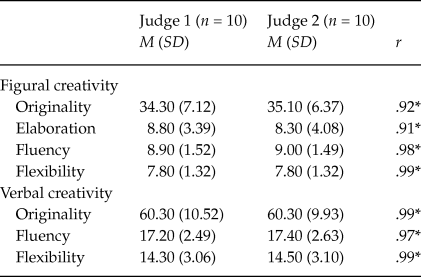
In this study, participants were given a total of 30 minutes to complete all the creativity tests, which is less time than that given in the original test, as some of the subtests had been shortened. An independent evaluator evaluated and codified the results of the creativity tests for a random subsample of 10 boys and girls (see Table 1). In Jiménez et al.’s (Reference Jiménez, Artiles, Rodríguez and García2007a, Reference Jiménez, Artiles, Rodríguez and García2007b) adaptation of the Torrance Creative Thinking Test (Torrance, Reference Torrance1966), a coefficient of .71 was obtained for the total of the figural creativity tests through Guttman’s split-half procedure and a Cronbach’s alpha coefficient of .81 for the total of verbal creativity tests. In the present study, a coefficient of .74 was obtained for the total score of figural creativity through Guttman’s split-half procedure and a Cronbach’s alpha coefficient of .70 for verbal creativity.
Inter-judge Reliability of the Creativity Tests

* p < .001.
Linguistic dominance
To assess the level of bilingualism of the participants, two variables were taken into account: On the one hand, the linguistic model in which each student was studying and, on the other hand, a questionnaire with various questions about the frequency of use and the level of each language in different modalities.
The participants were classified into three levels of bilingualism: Low, medium and high. In order to assign a level of bilingualism to each participant, the following procedure was carried out. The starting premise was that every participant had a good level of Spanish, as indicated in the self-assessment. Two variables were created, one regarding the use of the language and another regarding the level of the language. These two variables were also created for the Basque language, the English language, and the Others categories. These variables were scored on a scale from 0 to 3 (highest score). In relation to the score of the use variable, both the school they attended and the self-assessment of linguistic proficiency that they had completed were considered. Thus, in this variable, no participant obtained a score of 0 in the languages of English and Basque, since both schools taught subjects in those languages. In addition, those who studied in the D linguistic model, that is, everything in Basque, obtained a score of 3 in the use variable for the Basque language. For the rest of the languages and for those of the trilingual linguistic model, the self-evaluation was also taken into account. Finally, in order to evaluate the level variable, the self-assessment answered by the students themselves was considered, in which they indicated the level they thought they had in each language.
Once the use and level variables were created in each language (Basque, English, and Others), three groups of levels of bilingualism were created, depending on the score obtained: Low level, medium level, and high level. All those who obtained a score of 3 points either in use or level for any language (Basque, English, or Others) were assigned to the high-level group. Those who obtained a score of 2 points either in use and level for any language were considered as medium level. Finally, the rest, that is, those who only had a score of 0, 1 or only a 2 in any language, either in use or level, were assigned to the low level, which would be the equivalent to the monolingual group of many studies (e.g., Lasagabaster, Reference Lasagabaster2000). Following these criteria, 53 participants were assigned to the low-level bilingualism group, 37 to the medium-level group and 134 to the high-level group. All the participants in the low and medium levels of bilingualism completed the tests of the study in Spanish, while 8 participants in the high level of bilingualism group completed them in Spanish and 126 in Basque.
Procedure
A passive informed consent was used in which the details of the study were reported and that should be signed by the parents or legal guardians in the case that they were not taking part in the study. In addition, on the day of the evaluation, the objective and main characteristics of the study were explained to the students that were participating. The data obtained for this study were totally confidential, following an anonymous data collection, as participants did not include any identifying information such as the name or surname on the tests. The present study is part of another study in which, in addition to creativity, other cognitive variables such as attention or executive functions are evaluated, thus, the evaluation of creativity was carried out in the same session as the cognitive evaluation. The participants completed the full evaluation in approximately 50 minutes in a classroom in their school, with the evaluation included in the present study lasting for approximately 30 minutes.
Statistical analyses
Variance Analyses (ANOVA) were carried out to analyze the differences in the different creativity variables according to groups of bilingualism and grade. Moreover, the t-test was used to verify whether there were any gender differences among the creativity variables. The statistical program used was IBM SPSS Advanced Statistics (version 23).
Results
Differences in creativity according to gender
Gender differences among the different creativity variables were tested for, but statistically significant differences were only obtained for the figural originality and elaboration variables. In fact, boys scored higher in figural originality, t(222) = 2.32, p = .021, and girls scored higher in figural elaboration, t(213.4) = 3.23, p = .001.
Differences in figural creativity according to bilingualism and school grade
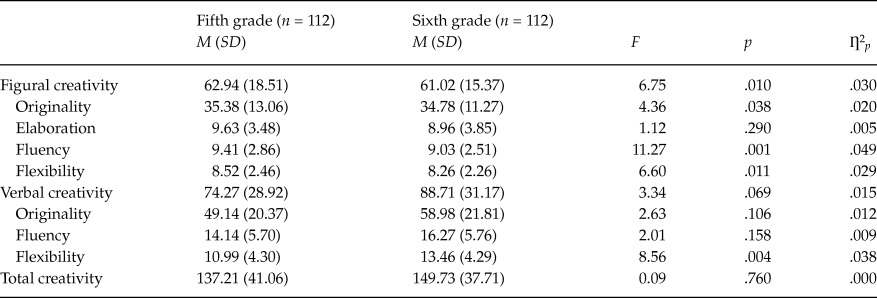
An analysis of variance was performed including as factors the level of bilingualism (low, medium, and high) and the school grade (fifth and sixth) to evaluate the differences in the four variables of figural creativity (originality, elaboration, fluency, and flexibility). The ANOVA results showed statistically significant differences according to the level of bilingualism, the school grade and the interaction between grade x bilingualism for originality, fluency and flexibility. Regarding school grade, the fifth-year students performed the figural creativity tasks better than the sixth-year students, with these differences being statistically significant for all variables except for elaboration (Table 2). The effect size was small for all variables.
Differences in Creativity according to School Grade. Results of the Variance Analysis

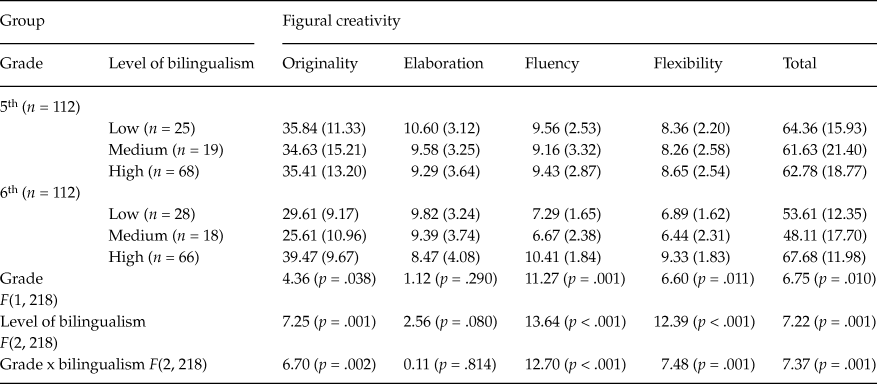
In the case of the level of bilingualism, statistically significant differences were found for all creativity variables, except for elaboration. Post hoc tests (Tukey method, p < .05) were performed to determine the differences between groups. These tests showed that students with a high level of bilingualism scored significantly higher than those with a low or medium level in originality (high vs. low: p = .028, high vs. medium: p = .003), fluency (high vs. low : p < .001; high vs. medium: p < .001), and flexibility (high vs. low: p < .001; high vs. medium: p < .001), but not in elaboration (high vs. low: p = .075; high vs. medium: p = .653). There were no statistically significant differences between the low and medium level for any of the variables (originality p = .623, fluency p = .710, flexibility p = .899, and elaboration p = .643) (Table 3). The effect size was moderate for the total score (Ƞ2p = .062), for originality (Ƞ2p = .062), fluency (Ƞ2p = .111), and flexibility (Ƞ2p = .102) and small for elaboration (Ƞ2p = .023).
Differences in Figural Creativity according to School Grade and the Level of Bilingualism. Results of the Variance Analysis

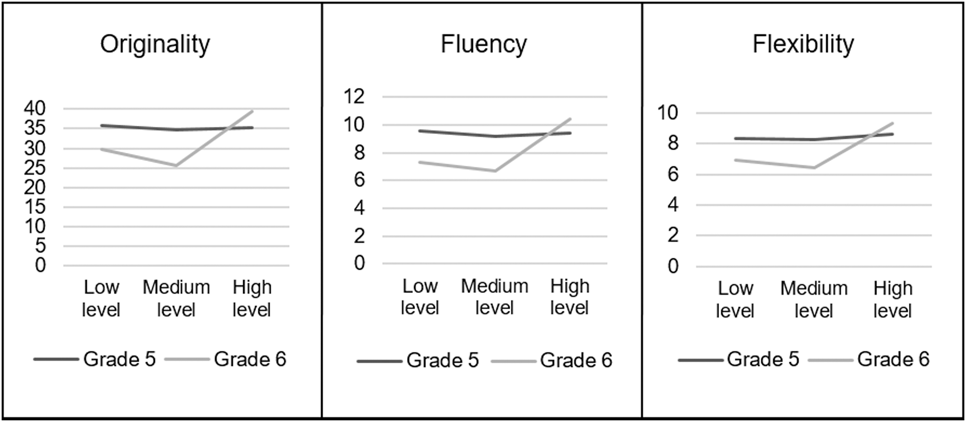
Finally, a statistically significant effect was obtained for the interaction between level of bilingualism x grade for the same variables. That is, the level of bilingualism was related to figural creativity in a different way depending on the school grade. To interpret this interaction, the results are shown in Figure 1. As can be observed, the difference in creativity between the different levels of bilingualism was more pronounced in sixth grade than in fifth grade. While in fifth grade, there were hardly any differences found according to the level of bilingualism for any of the variables, in sixth grade the high bilingual group obtained higher scores than the medium and low bilingualism groups for all variables and the medium level bilingual group scored lower scores compared to the other two groups.
Differences in Figural Creativity according to School Grade and the Level of Bilingualism. Differences according to the level of bilingualism were more evident in sixth grade.

Differences in verbal creativity according to bilingualism and school grade
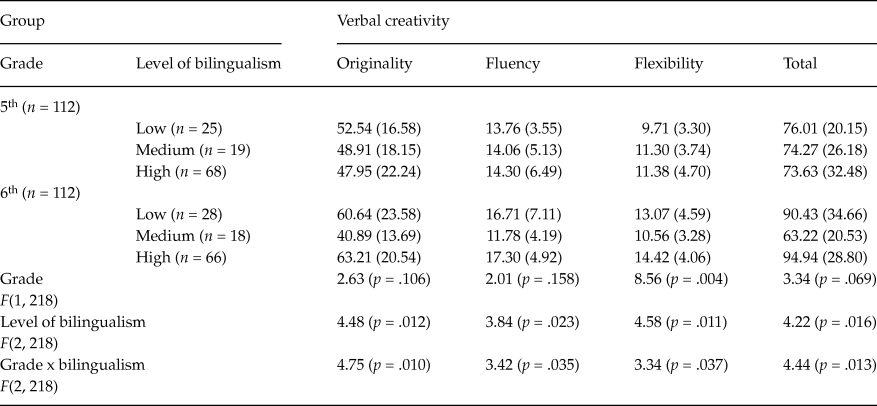
Next, a similar variance analysis was performed for the verbal creativity variables: Originality, fluency, and flexibility (see Table 4). In this case, in relation to school grade, statistically significant differences were only obtained for verbal flexibility, a variable in which sixth-grade children scored higher (see Table 2).
Difference in Verbal Creativity according to School Grade and Level of Bilingualism. Results of the Variance Analysis

In the case of the level of bilingualism, statistically significant differences were observed for the three verbal creativity variables. Post hoc tests indicated that students with a high level of bilingualism scored significantly higher than those with a medium level in originality (p = .018), fluency (p = .019), and flexibility (p = .035). The low-level group scored significantly higher than the medium-level group for the originality (p = .021) variable, but not for fluency (p = .120) or flexibility (p = .815). No statistically significant differences were obtained between the low- and high-level groups for any of the three variables (originality p = .913, fluency p = .869 and flexibility p = .102). The effect size was small for originality (Ƞ2p = .039), fluency (Ƞ2p = .034), flexibility (Ƞ2p = .040), and for the total score (Ƞ2p = .037).
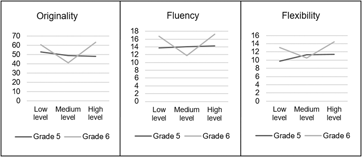
Finally, the interaction between grade x bilingualism was found to be statistically significant for the three variables. As shown in Figure 2, the difference in creativity between the different levels of bilingualism was also more evident in sixth grade than in fifth grade. While in fifth grade there were hardly any differences between the levels of bilingualism, in sixth grade, a similar score was observed in the high and low bilingualism groups, and a lower score was obtained for the medium bilingualism group.
Differences in Verbal Creativity according to School Grade and the Level of Bilingualism. Differences according to the level of bilingualism were more evident in sixth grade.

Discussion
The objective of the present study was to examine the differences in the performance of verbal and figural creativity tasks in children with different levels of bilingualism. The main hypothesis was that those with a higher level of bilingualism would obtain better results in creativity tasks than groups with medium or low levels of bilingualism.
To date, several studies have found an advantage of bilingualism in different components of verbal and figural creativity: Originality, fluency, and flexibility (e.g., Kharkhurin, Reference Kharkhurin2011, Reference Kharkhurin2017; Lasagabaster, Reference Lasagabaster2000; Leikin et al., Reference Leikin, Tovli and Malykh2014; Ródenas Ríos et al., Reference Ródenas Ríos, Fernández Canca and Ródenas Ríos2016). Consistently, the results of the present study largely confirm the main hypothesis. On the one hand, students with a high level of bilingualism obtained significantly better scores than those with a low or medium level in figural creativity (originality, fluency, and flexibility); however, this did not occur for figural elaboration. These results are similar to those obtained by Leikin et al. (Reference Leikin, Tovli and Malykh2014), who found significant differences in all variables of figural creativity, except for elaboration. On the other hand, students with a high level of bilingualism also scored significantly higher than those with a medium level of verbal creativity (originality, fluency, and flexibility). However, students with a high level did not significantly exceed the scores of those with low level in the variables of verbal creativity. Precisely, Kharkhurin (Reference Kharkhurin2010) found a superiority in tasks of verbal creativity in monolingual people with basic knowledge of another language, who would be comparable to the participants with a low level of bilingualism in the present study, versus bilinguals. Kharkhurin (Reference Kharkhurin2010) argues that this is because bilinguals tend to show worse verbal skills than monolinguals and, consequently, would perform worse in a creative task if it occurs within a verbal context.
Moreover, those with a low level of bilingualism obtained significantly higher scores in various variables of creativity compared to those of medium level. This phenomenon is compatible with the Cummins’ Threshold Theory (Reference Cummins1983), which states that a minimum competence must be acquired in both languages for the positive effects of bilingualism to be appreciated and, in addition, insufficient competence in either of the two languages can negatively affect the result of creativity.
Regarding the second hypothesis about differences according to the school grade, the difference in the creativity variables between bilingualism levels was more prominent in sixth grade students than in fifth grade students. That is, it seems that the advantage provided by bilingualism becomes more evident in sixth grade students. These results coincide with Lasagabaster’s (Reference Lasagabaster2000) study, in which it is suggested that the positive effect of bilingualism on creativity appears in later stages of education. In addition, given that the number of students in each level of bilingualism was very similar in the two grades, the differences according to the grade in the effect of bilingualism on creativity cannot be because the grade influences linguistic competence.
In relation to age, other relevant data have also been found in this study. While the sixth-year students obtained higher scores in total creativity and verbal creativity, the fifth-year students performed the figural creativity tests better, although these results were only statistically significant in the figural creativity variables. These results coincide with those of Jiménez et al. (Reference Jiménez, Artiles, Rodríguez and García2007a, Reference Jiménez, Artiles, Rodríguez and García2007b), who found statistically significant differences according to the school grade, showing a greater verbal creativity in sixth grade than in fifth grade and a greater figural creativity in fifth grade than in sixth grade. Kim (Reference Kim2011) and Reference Sastre-Riba and Pascual-SufrateSastre-Riba and Pascual-Sufrate (2013) also found differences according to the grade, specifically a slight decrease in the different components of figural creativity from sixth grade onwards. Precisely, although in general, creativity tends to increase with age throughout childhood and adolescence, it is believed that fourth-grade students and pre-adolescents between 11–12 years experience a decrease in creativity, which increases again in the middle of adolescence (Lau & Cheung, Reference Lau and Cheung2010). This may be due to the fact that children who are entering the adolescent stage experience certain changes that inhibit creative expression (Lau & Cheung, Reference Lau and Cheung2010), such as peer pressure or the pressure of conventionality that occurs during Kohlberg’s conventional thinking stage.
Finally, the differences in creativity were analyzed according to gender and although no significant differences were found, higher scores were obtained in figural originality in boys and in figural elaboration in girls. The fact that, in general terms, no gender differences have been found in the performance of creativity coincides with the results of Baer and Kaufman’s (Reference Baer and Kaufman2008) review. With respect to the gender differences found in the two aforementioned variables, these coincide with the results of other studies that have found greater figural originality in men (Matud, Rodríguez, & Grande, Reference Matud, Rodríguez and Grande2007) and greater figural elaboration in women (Krumm, Arán-Filippetti, & Vargas-Rubilar, Reference Krumm, Arán-Filippetti and Vargas-Rubilar2014; Lee & Kim, Reference Lee and Kim2011). However, the findings on gender differences in creativity are very contradictory and inconclusive, possibly because environmental factors are not being controlled (Baer & Kaufman, Reference Baer and Kaufman2008).
Despite the interesting results found in this study, several limitations must be noted. On the one hand, it was not possible to analyze differences in creativity between monolinguals and bilinguals, because currently, several languages are studied in all schools in the Basque Country. However, the participants with a low level of bilingualism in this study are comparable to the monolinguals of other studies who report having basic knowledge of a second language (Christoffels, de Haan, Steenbergen, van den Wildenberg, & Colzato, Reference Christoffels, de Haan, Steenbergen, van den Wildenberg and Colzato2015; Kharkhurin, Reference Kharkhurin2010; Lasagabaster, Reference Lasagabaster2000). In addition, to assign students to one of the different levels of bilingualism, a self-questionnaire of linguistic proficiency and the linguistic model of the school were used, instead of using a more objective test (e.g., picture naming). However, several studies that have used this type of subjective self-evaluation along with other more objective ones have found high correlations between the results of both types of tests in children aged between 10 and 12 years (Konaka, Reference Konaka1997; Lee, Reference Lee2007; Wang, Reference Wang1982). Thus, it seems that subjective self-evaluations adequately reflect the linguistic abilities of students.
On the other hand, due to the time limit that was available for the evaluation, many of the tests had to be shortened, which made it difficult to compare the results with other studies. Another limitation is that the cognitive ability of the participants was not evaluated, thus, it was not possible to control whether it was cognitive ability itself that partially determined both the level of bilingualism achieved and the creativity performance. Moreover, in the present study, the participants completed the tests in two different languages, which could have biased the results, as the language used to perform a cognitive task may influence its performance. However, based on this idea, it would be expected that the performance of verbal and figural tasks would be different, as the bias would only act on the verbal test. In the present study, a better performance of the group with high level of bilingualism was found, which had mostly performed the tests in Basque, compared to the group with medium level, in both verbal and figural creativity, so it seems unlikely that the language used to perform the tasks created an important bias in the results.
Nevertheless, this study also has several strengths. Firstly, most of the studies on this subject have used the abbreviated version of the Torrance Creative Thinking Test composed only of three subtests. In contrast, in the present study, more subtests of the test were applied (picture construction, picture completion, parallel lines, unusual questions and unusual uses), thus, the results obtained were more adequate to establish a more complete profile of the level of creativity of the participants.
Secondly, the relevance of the present study also lies in the fact that it is the second study to analyze the relationship between creativity and bilingualism in the Basque Country with Basque as one of the languages (Lasagabaster, Reference Lasagabaster2000). Lasagabaster (Reference Lasagabaster2000) only used verbal creativity tests, while the present study used figural and verbal creativity tests. The importance of this study is increased when considering that the Basque language, being an ergative and pre-Indo-European language, has a very different structure in comparison to other languages. This factor must be considered as this peculiarity can influence the structure of brain networks differently from other languages (Laka et al., Reference Laka, Santesteban, Erdocia, Zawiszewski, Salaburu and Alberdi2012), and therefore could also influence the associations between distant concepts of divergent thinking. Other studies in which bilinguals were fluent in an Indo-European language and in a non-Indo-European language have also shown an advantage in creativity in relation to bilinguals (Konaka, Reference Konaka1997; Lee, Reference Lee2007).
In the Basque Country, given that there are two official languages, there are great linguistic differences between individuals. In addition, although in the last decade many schools have begun to implement multilingual linguistic models, these models do not guarantee a good command of all the languages studied. Therefore, it is important to study the implications of the different levels of bilingualism on cognitive functioning.
The findings of this study are of great relevance, as they suggest that there are differences in the creativity performance of students with different levels of bilingualism. The fact that those with an intermediate level of bilingualism obtained a lower performance in creativity supports the idea that an inadequate level in one of the two languages can lead to a worse cognitive functioning. This is something that should not be overlooked when developing educational programs. Precisely, as more and more schools implement multilingual linguistic models, it would be important to carry out strategies that ensure a good learning of two or more languages.
Future lines of research could analyze in more detail what specific cognitive subprocesses are involved in the relationship between the different levels of bilingualism and creativity. In addition, it would be advisable to carry out a more exhaustive evaluation of creativity in future studies, including other indicators such as convergent thinking tasks. Moreover, it would be interesting to carry out a longitudinal study of the effect of bilingualism on creativity performance to see how it varies according to age. Additionally, the differences in creativity performance according to sex should be further studied, by controlling environmental factors, as the findings regarding their possible influence are inconclusive. Likewise, further works should resolve what differences in creative ability can the different types of bilingualism imply according to the type of language, the frequency of use or to the level of dominance.