Introduction
Crop rotation is often a recommended cultural practice in production systems to prevent poor soil fertility, insect and disease infestations, as well as herbicide resistance. In the midsouthern United States where rice is grown, soybean is commonly planted as a rotational crop (Riar Reference Riar, Norsworthy, Steckel, Stephenson, Eubank, Bond and Scott2013; Hardke Reference Hardke2014). Although this is a recommended practice, it is also important to be cautious when rotating crops. Although herbicides are effective at removing and preventing weeds from cropping systems, they can interact with the soil and have the potential to persist (carry over), thereby causing injury to subsequent crops. As soybean and rice are commonly used in rotation, the potential exists that rice herbicides will persist in soils and cause subsequent injury to soybean plants. Aside from soybean, other crops such as cotton, corn, grain sorghum, sunflower, and winter wheat (Triticum aestivum L.) are also grown in southern agricultural production systems. In one example, Grey et al. (Reference Grey, Braxton and Richburg2012) reported carryover injury from applications of sulfosulfuron in winter wheat to subsequently planted cotton or soybean. Similar studies found that simulated carryover of norflurazon at three half-lives resulted in 20% to 56% rice injury 8 wk after planting (WAP) (Zhang et al. Reference Zhang, Webster and Braverman2002).
Soil persistence, or carryover, of herbicides is influenced by soil properties including but not limited to soil pH, organic matter, and soil texture. Renner et al. (Reference Renner, Schabenberger and Kells1998) found imidazolinone herbicides to remain active in the soil for as long as 2 yr following application. Soil persistence of an herbicide can be beneficial by providing residual control of weeds but can also lead to unwanted herbicide carryover. Thus, herbicide persistence can result in disruption in the crop rotation, ultimately leading to injury and potential loss of the subsequent crop. Poor attention to the technologies used each year can also result in significant losses. Marchesan et al. (Reference Marchesan, dos Santos, Grohs, de Avila, Machado, Senseman, Massoni and Satori2010) reported that imazethapyr used in a imidazolinone-resistant rice (Clearfield®, trademark of BASF Corp., Research Triangle Park, NC) can carry over to conventional rice varieties, resulting in reduced grain yield. The recommended plant-back interval of imazethapyr to conventional rice cultivars is currently 18 mo (Anonymous 2017).
With the widespread evolution of herbicide-resistant weed species (Heap Reference Heap2018), new herbicide sites of action (SOAs) are needed to provide effective control. The agrochemical industry has responded to this need through development of new active ingredients. One example is florpyrauxifen-benzyl (Dow AgroSciences LLC, Indianapolis, IN), a new herbicide active ingredient being developed for use in rice. Florpyrauxifen-benzyl is a synthetic auxin herbicide and represents a novel SOA for rice production because of its unique binding site (Lee et al. Reference Lee, Sundaram, Armitage, Evans, Hawkes, Kepinski, Ferro and Napier2013; Epp et al. Reference Epp, Alexander, Balko, Buysse, Brewster, Bryan, Daeuble, Fields, Gast, Green, Irvine, Lo, Lowe, Renga, Richburg, Ruiz, Satchivi, Schmitzer, Siddall, Webster, Weimer, Whiteker and Yerkes2016).
When determining the carryover potential of an herbicide, several chemical characteristics such as solubility, soil organic carbon–water partitioning coefficient (Koc), and half-life should be considered. The chemical properties of florpyrauxifen-benzyl differ from those of other auxin-like rice herbicides. For example, triclopyr is a pyridine carboxylic acid that is highly water soluble (430 ppm L–1), loosely bound to soil (Koc=20 mg L–1), and has a DT50 (time to 50% loss) in soil ranging from 10 to 46 d (Vencill Reference Vencill2002). In contrast, florpyrauxifen-benzyl, the second herbicide active in the newly formed arylpicolinate family, has low water solubility (0.015 ppm L–1), is tightly bound to soil (32,400 ml/g), and has a DT50 in soil of 1 to 8 d in field dissipation studies (M. Weimer, personal communication). Additionally, the primary degradation mechanism of florpyrauxifen-benzyl is through microbial activity (Walker and Welch Reference Walker and Welch1991; Kruger et al. Reference Kruger, Rice, Anhalt, Anderson and Coats1997; Mueller and Senseman Reference Mueller and Senseman2015).
Given the chemical properties of florpyrauxifen-benzyl outlined above, it would be expected that the compound would have little residual activity and be relatively nonpersistent in soils. However, research evaluating its potential to carry over and cause injury to subsequent crops following its application should be examined. It was hypothesized that rotational crops will express a short plant-back interval to florpyrauxifen-benzyl. The objectives of this research were to (1) evaluate the sensitivity of common rotational crops the year following applications of florpyrauxifen-benzyl and (2) determine soybean injury and quantify the persistence of florpyrauxifen-benzyl applied the same growing season prior to planting soybean.
Materials and Methods
Evaluating the Sensitivity of Common Rotational Crops the Year Following a Florpyrauxifen-benzyl Application
In 2014 and 2015, a field experiment was conducted at two locations: the University of Arkansas–Rice Research and Extension Center (RREC) near Stuttgart, AR (34.4755° N, 91.4184° W), and the University of Arkansas–Pine Tree Research Station (PTRS) near Colt, AR (35.1315° N, 90.8112° W). At both locations, the experiment was conducted as a randomized complete block design with four replications. The soil texture at the PTRS site consisted of a Calloway silt loam soil (fine-silty, mixed, active, thermic Aquic Fraglossudalfs) composed of 12% sand, 70% silt, 18% clay, with 1.3% organic matter and a pH of 7.5. At the RREC, the soil texture was a DeWitt silt loam (fine, smectitic, thermic Typic Albaqualfs) composed of 8% sand, 75% silt, 17% clay, with 1.8% organic matter and pH of 5.0. In 2014, fields at each location were selected and left fallow throughout the season. Each plot measured 6.1 m by 18.3 m to have ample room the following year to plant rotational crops.
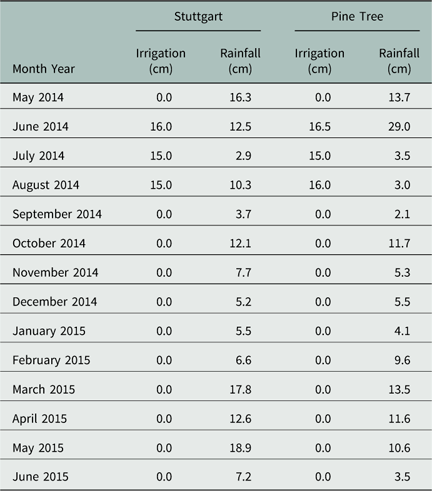
Herbicide treatments consisted of florpyrauxifen-benzyl applied at 40 followed by (fb) 40 g ai ha–1 or 80 fb 80 g ai ha–1, and a nontreated control was included. At the time this research was conducted, the proposed 1× use rate (40 g ai ha–1) and maximum use rate per season (80 g ai ha–1) were used. At the RREC, the first application timing was on May 20, 2014, to simulate an early postemergence (POST) application, whereas the second application was approximately 2 wk later (June 2, 2014) to simulate a pre-flood application. Similar timings were also performed at PTRS, with the first application made on May 22, 2014 and the second on June 4, 2014. Although no rice was planted in the experiment at either location, immediately following the pre-flood timing, levees were established around each plot and a flood was maintained throughout the traditional rice-growing season. Rainfall and irrigation amounts throughout the duration of the experiment are reported in Table 1. All herbicide treatments were applied with a CO2-pressurized backpack sprayer fitted with 110015 AIXR flat-fan nozzles (Teejet Technologies, Springfield, IL) calibrated to deliver 140 L ha–1 at 4.8 km h–1. No other herbicide was applied to the experiment area in 2014.
Rainfall and irrigation amounts observed after florpyrauxifen-benzyl applications near Stuttgartand Pine Tree, AR.a–c

a Treatments applied by location: May 20, 2014 and June 2, 2014 (Stuttgart); May 22, 2014 and June 4, 2014 (Pine Tree).
b Irrigation type at both locations utilized polypipe on a levee-based system to deliver water to the experimental area.
c Flood initiation and destruction date by location: June 4, 2014 and September 10, 2014 (Stuttgart); June 5, 2014 and September 12, 2014 (Pine Tree).
In 2015, fields were mowed and cultivated to prepare for planting. The same cultivar for each crop was planted at each location, with varying seeding rates due to different row spacing and equipment across locations. The cultivars included were DeKalb® ‘DK46-36 RIB’ (corn), DeKalb® ‘DKS53-67’ (grain sorghum), Asgrow® ‘AG4733’ (soybean), Stoneville® ‘ST 4946 GLB2’ (cotton), and ‘Hunters’ (sunflower). At the RREC, seeding rates included corn at 115,000 seeds ha–1, sorghum at 300,000 seeds ha–1, soybean at 340,000 seeds ha–1, cotton at 115,000 seeds ha–1, and sunflower at 110,000 seeds ha–1, with all crops planted on a 97-cm wide row spacing on May 27, 2015. Seeding rates at the PTRS included corn at 90,000 seeds ha–1, sorghum at 240,000 seeds ha–1, soybean at 275,000 seeds ha–1, cotton at 120,000 seeds ha–1, and sunflower at 86,000 seeds ha–1, with all crops planted on a 76-cm wide row spacing on June 5, 2015. Plots were visually evaluated for injury 28 d after planting (DAP) on a scale of 0% to 100%, where 0% represented no injury and 100% represented death. Plant heights for each crop were also measured 28 DAP. Aboveground biomass was collected for each herbicide treatment and crop combination, dried at 32 C or higher for 72 h, and converted to a percentage dry weight reduction relative to the nontreated control for each crop.
Data were subjected to ANOVA using the MIXED procedure in JMP Pro 12 (JMP Pro 12, SAS Institute Inc. Cary, NC). Herbicide treatments were analyzed as fixed effects, whereas locations and replications nested within locations were analyzed as random effects. Where the ANOVA indicated significance, means were separated using Fisher’s protected LSD (α=0.05).
Field Dissipation and Plant-Back Interval for Soybean
A field experiment was conducted in 2014 and repeated in 2015 at the University of Arkansas–Agricultural Research and Extension Center in Fayetteville, AR, to evaluate potential plant-back restrictions to soybean following an application of florpyrauxifen-benzyl. The soils each year included a mix of Captina silt loam (fine-silty, siliceous, active, mesic Typic Fragiudults) and Leaf silt loam (fine, mixed, active, thermic Typic Albaqults) composed of 35% sand, 52% silt, 13% clay, with 1.7% organic matter and pH of 5.8. The experimental design was a randomized complete block with a two-factor factorial treatment structure comprising two rates of florpyrauxifen-benzyl: 30 and 60 g ai ha–1 applied at four timings: 56, 28, 14, and 0 d before planting (DBP) soybeans. Each experimental plot contained four 0.92-m rows, resulting in an overall plot size of 3.7 m wide by 7.62 m long. Each year, Pioneer® ‘95L01’ (Pioneer Hi-Bred International, Inc., Johnston, IA) soybeans were planted at approximately a 2-cm depth at 296,000 seeds ha–1 using a tractor-mounted John Deere 7200 MaxEmerge planter.
After planting and throughout the growing season, plots were irrigated four to six times as needed using an overhead irrigation system, and standard soybean production practices typical for the region were followed. Rainfall and irrigation amounts from the time the experiment was initiated (56 DBP) until planting were recorded. All herbicide treatments were applied with a CO2-pressurized backpack sprayer fitted with 110015 AIXR flat-fan nozzles (Teejet Technologies, Springfield, IL) calibrated to deliver 140 L ha–1 at 4.8 km h–1. In 2014, the trial was initiated on April 11 with the 56-DBP treatment. Remaining applications were performed on May 9, May 23, and June 6 for the 28-, 14-, and 0-DBP timings, respectively. The following year (2015), applications were applied on March 25, April 22, May 6, and May 19, for the 56-, 28-, 14-, and 0-DBP timings, respectively.
The concentration of florpyrauxifen-benzyl and its primary metabolites present in soil at the time of planting were determined each year by collecting five soil cores at a 15-cm depth and 10-cm diameter in each plot immediately following the 0-DBP application and planting. Following collection, each of the five core samples was dried at approximately 40 C for 24 h, ground to remove any unwanted debris, and a 5-g subsample for each plot collected. Samples were then frozen at 0 C until the time of extraction. Residues of florpyrauxifen-benzyl (ester) and its three primary metabolites (acid, hydroxy acid, and benzyl hydroxy) were extracted from soil using a 90/10 solution of acetonitrile/0.1 N HCl (Figure 1). The extracts were decanted, collected in one vial, and the volume adjusted to 70 ml. An aliquot of the extract was then evaporated to 200 to 300 μl using an automated evaporation system (TurboVap®, trademark of Biotage USA LLC, Charlotte, NC). The samples were then reconstituted with a 5/25/50 acetonitrile/methanol/water solution containing 0.1% formic acid by volume and transferred to high-pressure liquid chromatography vials. Samples were analyzed for the presence of florpyrauxifen-benzyl and its primary metabolites through liquid chromatography with a positive-ion electrospray ionization tandem mass spectrometer (LC-MS/MS; Agilent 1290 Infinity LC System, AB SCIEX API 6500 LC/MS/MS System with a Phenomenex Kinetiex 2.6u, PFP 100A column). In addition, stand count, crop injury, and plant height data were collected 4 and 8 WAP. Grain yield was also collected at crop maturity by harvesting the two center rows from each plot with a small-plot combine. Grain yield was converted to 13% moisture prior to analysis.
Degradation pathway for florpyrauxifen-benzyl parent and primary metabolites. Source: Dow AgroSciences.

Data gathered from florpyrauxifen-benzyl and its primary metabolites recovered from soil, stand count, crop injury, plant height, and yield data were subjected to ANOVA using the MIXED procedure in JMP Pro 12 (JMP Pro 12, SAS Institute Inc. Cary, NC). Factors were analyzed as fixed effects, whereas replication was analyzed as a random effect. No significant differences were observed between years; therefore, year was included as a random effect. Where the ANOVA indicated significance, means were separated using Fisher’s protected LSD (α=0.05).
Results and Discussion
Evaluating the Sensitivity of Common Rotational Crops the Year Following a Florpyrauxifen-benzyl Application
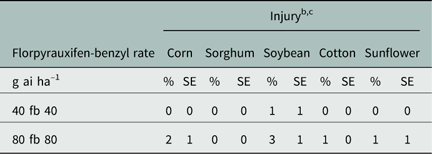
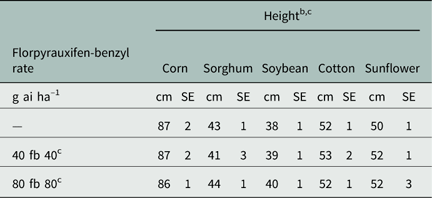
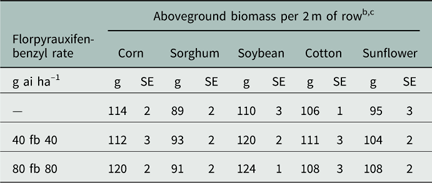
Regardless of the rate applied, visible injury symptoms were minimal for all crops evaluated (Table 2). Injury symptoms appeared as minor stunting but dissipated quickly after crop emergence. At the highest rate tested of 160 g ai ha–1, no more than 3% injury was observed for corn, sorghum, cotton, soybean, or sunflower. In addition, no significant differences were observed among the treatments for plant height or aboveground biomass, indicating rotational flexibility for commonly rotated crops the year following a florpyrauxifen-benzyl application (Tables 3 and 4).
Crop injury 28 d after planting the subsequent season after an application of florpyrauxifen-benzyl on a silt loam soil near Stuttgart and Pine Tree, AR, averaged over locations.Footnote a

a Abbreviation: fb, followed by (see text for details).
b Mean and the standard error (SE) of the mean.
c Injury amounts are reported as means followed by the standard error (SE) of the mean.
Height of crops 28 d after planting the subsequent season after an application of florpyrauxifen-benzyl on a silt loam soil in Stuttgart and Pine Tree, AR, averaged over locations.Footnote a

a Abbreviation: fb, followed by (see text for details).
b Mean and the standard error (SE) of the mean.
c Height is reported as means followed by the standard error (SE) of the mean.
Aboveground biomass of crops 28 d after planting the subsequent season after an application of florpyrauxifen-benzyl on a silt loam soil in Stuttgart and Pine Tree, AR, averaged over locations.Footnote a

a Abbreviation: fb, followed by (see text for details).
b Mean and the standard error (SE) of the mean.
c Biomass is reported as means followed by the standard error (SE) of the mean.
The lack of injury present in this experiment is probably due to the chemical characteristics of the compound, which favor an overall short persistence in soil. However, this is not the case with other commonly applied rice herbicides, such as imazethapyr, which requires an 18-mo plant-back restriction for rotational crops such as cotton, sorghum, and sunflower (Anonymous 2017). Also, florpyrauxifen-benzyl will be registered at 30 g ai ha–1, with a maximum allowable amount per season of 60 g ai ha–1 (H. Miller, personal communication). Hence, the florpyrauxifen rates evaluated in this experiment are more than twice as high as those that will be labeled in rice.
Field Dissipation and Plant-Back Interval for Soybean
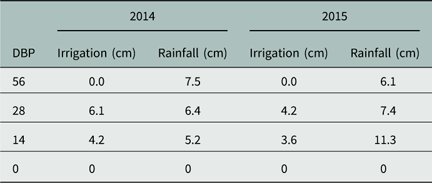
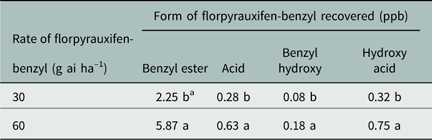
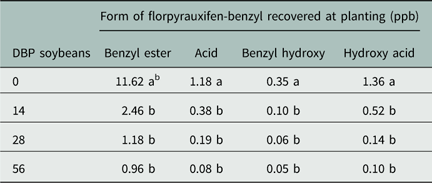
Total rainfall amounts for 2014 and 2015 were collected (Table 5). In both years, rainfall was received after planting but supplemental irrigation was applied on an as-needed basis. There was no significant interaction between the rate of florpyrauxifen-benzyl applied and the amount of time before planting for the recovery of the parent compound and its primary metabolites from soil. However, significant main effects were observed (Tables 6 and 7). The greatest amount of the parent molecule and its primary metabolites were recovered from soil treated with 60 g ai ha–1 of the herbicide compared to 30 ai g ha–1. Likewise, more of the parent molecule and its metabolites were recovered from the 0-DBP timing compared to the applications made 14, 28, or 56 DBP––a result that can be attributed to its short half-life in soil. Calculated half-lives of florpyrauxifen-benzyl applied at 0, 14, 28, and 56 d indicate that the herbicide expressed a DT50 of 2 to 4 d. Other auxinic herbicides such as aminopyralid (Milestone, Dow AgroSciences LLC, Indianapolis, IN) can exhibit a much longer half-life in soil ranging from 32 to 533 d and thereby cause injury to rotational crops such as soybean (EPA 2005). Mikkelson and Lym (Reference Mikkelson and Lym2011) reported that soybean yield was reduced when the auxin herbicide aminopyralid was applied at 120 or 240 g ae ha–1 20 or 23 mo before planting. Although aminopyralid is not labeled for use in rice, it represents an example of an auxinic herbicide whose chemical characteristics differ from those of florpyrauxifen-benzyl.
Rainfall and irrigation amounts observed after florpyrauxifen-benzyl applications up to planting soybean in 2014 and 2015 at Fayetteville, AR.Footnote a – Footnote c

a Abbreviation: DBP, d before planting.
b Treatments applied by year: April 11, 2014 (56-DBP treatment); May 9, 2014 (28-DBP treatment); May 23, 2014 (14-DBP treatment); June 6, 2014 (0-DBP treatment); March 25, 2015 (56-DBP treatment); April 22, 2015 (28-DBP treatment); May 6, 2015 (14-DBP treatment); May 19, 2015 (0-DBP treatment).
c Overhead sprinkler irrigation.
Effect of florpyrauxifen-benzyl rate on recovery of the parent molecule and its primary metabolites from a silt loam soil in Fayetteville, AR, averaged over 2014 and 2015.

a Means within columns followed by different letters are significantly different using Fisher’s protected LSD (α=0.05).
Effect of application timing on recovery of the parent molecule and its primary metabolites from a silt loam soil in Fayetteville, AR, averaged over 2014 and 2015.Footnote a

a Abbreviation: DBP, d before planting.
b Means within columns followed by different letters are significantly different using Fisher’s protected LSD (α=0.05).
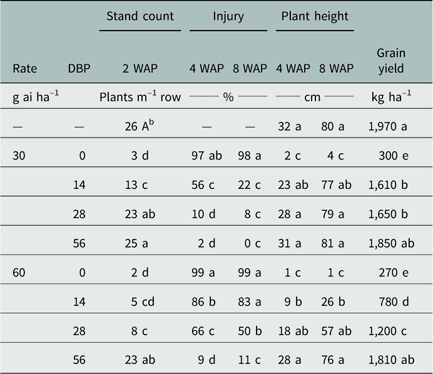
Further analysis of the parameters evaluated indicated a significant two-way interaction between the rate of florpyrauxifen-benzyl applied and the amount of time before planting for stand count, visible injury, plant height, and grain yield (Table 8). Visible estimates of soybean injury were greater 4 WAP when florpyrauxifen-benzyl was applied 0 DBP. These injury assessments corresponded to the highest concentration of florpyrauxifen-benzyl recovered from soil at the time of planting. Conversely, soybean injury was reduced when florpyrauxifen-benzyl was applied at increasing intervals before planting. At 8 WAP, soybean plants injured by florpyrauxifen-benzyl had not recovered, with the primary visible symptoms occurring as stunting and stand loss. Soybean plant height was also reduced 4 and 8 WAP following 30 or 60 g ai ha–1 applied 0 DBP. Soybean yield was similar to the nontreated control when 30 or 60 g ai ha–1 of florpyrauxifen-benzyl was applied 56 DBP, whereas all other treatments significantly lowered yield.
Effect of florpyrauxifen-benzyl rate and application on soybean injury, plant height, and grain yield in Fayetteville, AR, averaged over 2014 and 2015.Footnote a

a Abbrevations: DBP, d before planting; WAP, wk after planting.
b Means within columns followed by different letters are significantly different using Fisher’s protected LSD (α=0.05).
Soybean plant-back intervals for rice herbicides such as triclopyr (Grandstand, Dow AgroSciences LLC, Indianapolis, IN) and quinclorac (Facet L, BASF Corp., Research Triangle Park, NC) can range from 4 to 10 mo (Barber et al. Reference Barber, Norsworthy and Scott2014). Florpyrauxifen-benzyl will be registered at 30 g ai ha–1, with a maximum allowable amount per season of 60 g ai ha–1. Therefore, data indicate that a 2-mo plant-back interval is suggested. Based on the rates evaluated and the environmental conditions that occurred during these experiments, the data support a relatively short replant interval for soybean after florpyrauxifen-benzyl application compared to other herbicides commonly used in rice.
Practical Implications
The results collected from these experiments indicate that the 60 g ai ha–1 maximum allowable use rate per season to be well within the acceptable tolerance of common field crops the year after a florpyrauxifen-benzyl application. It appears unlikely that there will be strict rotational crop restrictions when planting common row crops the year following a florpyrauxifen-benzyl application in rice.