Introduction
Overall treatment time (OTT) is an important factor in successful tumour control for squamous-cell carcinomas (SCCs) of the head and neck. Accelerated repopulation, predicted to occur 3–4 weeks from the start of radiotherapy, becomes a significant factor in prolonged treatment schedules.Reference Withers, Taylor and Maciejewski1 Such tumour-cell repopulation could compromise the local control particularly if the OTT goes beyond the intended duration.Reference Hendry, Bentzen, Dale, Fowler, Wheldon, Jones, Munro, Slevin and Robertson2, Reference Slevin, Hendry, Roberts and Agren-Cronqvist3 Accelerated fractionation has been shown to improve tumour control.Reference Overgaard, Hansen and Specht4, Reference Fu, Pajak, Trotti, Jones, Spencer, Phillips, Garden, Ridge, Cooper and Ang5
In the United Kingdom, there are a variety of radical radiotherapy schedules in use including the accelerated hypofractionation schedule, 55 Gy in 20 fractions for 4 weeks, which aims to complete treatment before accelerated radiotherapy becoming a significant factor. The reduction in the number of fractions spares resources and this may help to reduce waiting times, another factor in local tumour control.
Predictable gaps in treatment may occur owing to bank holidays and machine service days. In addition, there may be less predictable gaps owing to patient illness and machine breakdown. The Royal College of Radiologists, United Kingdom, issued guidelines for dealing with such gaps6 and each department should have a local policy to follow in such situations. Ideally, compensation of some description should be planned at the outset for predictable gaps. A recent survey confirmed that most departments in the United Kingdom have a policy in place to handle such interruptions.Reference Dale, Jones, Sinclair, Comins and Antoniou7 A common practice is to compensate gaps with either two treatments in the same day or, assuming treatment is confined to 5 days/week, an extra treatment at the weekend. If this is not practical, then radiobiological modelling should be used to prevent prolongation of schedules.Reference Dale, Hendry, Jones, Robertson, Deehan and Sinclair8
When a gap occurs during a hypofractionated schedule, the safety of further acceleration to maintain the OTT is unknown. The use of large doses per fraction when administering more than 5 fractions in 1 week and, in particular, 2 fractions in the same day raises the concern of acute and late toxicity.
The aim of this study was to assess whether safe compensation is possible for patients experiencing a gap during hypofractionated radiotherapy for head and neck cancer. In this article, the term “gap” will encompass both predictable breaks in treatment, such as bank holidays, and non-predictable breaks, such as those arising through patient toxicity.
All patients were treated with radical intent in a beam-directional shell using either conventional or CT planning. Two lateral fields were used to treat the upper neck with a matched anterior field where appropriate. Electrons were used to treat the posterior neck after the first 12 fractions. The intended radiotherapy dose to the primary tumour and involved nodes was 55 Gy in 20 fractions; 50 Gy in 20 fractions to the neck after preoperative neck dissection; 41.25 Gy in 15 fractions as a prophylactic dose to clinically negative nodal areas. During the study period, patients with locally advanced disease were considered for chemotherapy concurrently with radiotherapy. Earlier, patients were treated with methotrexate in which two doses of methotrexate 100 mg/mReference Hendry, Bentzen, Dale, Fowler, Wheldon, Jones, Munro, Slevin and Robertson2 were planned for day 1 and day 14 of radiotherapy. Later, patients were treated with two doses of carboplatin, given on day 1 and day 21.Reference Withers, Taylor and Maciejewski1
Methods
Data collection
All patients under the care of a single consultant (AH) receiving accelerated hypofractionated radiotherapy for SCC of the head and neck, between November 2002 and January 2005, were identified. The tumour sites included were oral cavity, oropharynx, larynx and hypopharynx. Oral cavity and oropharynx were grouped together as were hypopharynx and larynx. Acute-toxicity data were collected prospectively.
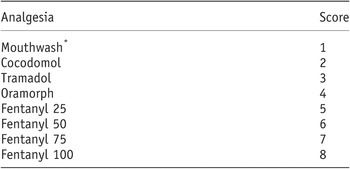
The main outcome measures were acute toxicity, OTT and degree of compensation. Toxicity was evaluated according to the National Cancer Institute common toxicity criteria.Reference Trotti, Byhardt and Stetz9 Acute toxicity was determined by the incidence of grade 3 mucositis, prolonged grade 3 mucositis, grade 3 dysphagia and pain. Patients were reviewed weekly and prolonged grade 3 mucositis was defined as lasting for 4 weeks or longer. Mucositis grade was confirmed using weekly naso-endoscopic examination in the case of laryngeal and hypopharyngeal tumours. Pain was scored by use of analgesia (see Table 1). Other data collected included age, site of primary tumour, length of field and use of concurrent chemotherapy.
Pain scoring system used based on analgesic use

*Aspirin, glycerine and sucrulfate mouthwash.
Analysis
Each of the above end points was assessed independently against OTT, field length, total dose, concurrent chemotherapy and site of primary tumour: oral versus laryngeal. Associations were assessed by Pearson’s χReference Hendry, Bentzen, Dale, Fowler, Wheldon, Jones, Munro, Slevin and Robertson2 test and the Wilcoxon test. Linear regression was used to identify factors affecting the pain score and logistic regression to analyse the presence of grade 3 toxicity.
Results
Patients
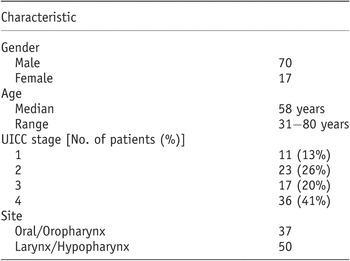
Table 2 shows the patient characteristics. Eighty-seven patients meeting the above criteria were identified and analysed. The median age of patients was 58 years (range 31–80 years). The distribution of primary disease was as follows: oral/oropharynx, 37 patients and larynx/hypopharynx, 50 patients. Concurrent chemotherapy was administered in 35 patients.
Patient characteristics

The stage distribution, according to the sixth edition of UICC TNM classification of malignant tumours, is also given in Table 2 and was as follows: stage I, 11 patients; stage II, 23 patients; stage III, 17 patients and stage IV, 36 patients.
Radiotherapy dose, treatment time and field length
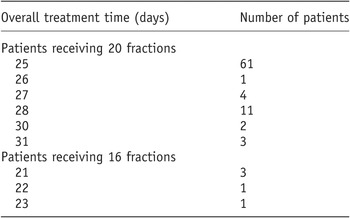
The total dose administered was as follows: 55 Gy in 20 fractions in 81 patients, 50 Gy in 16 fractions in 5 patients and 50 Gy in 20 fractions in 1 patient. The median field length was 9.7 cm (5.9–15.5 cm) and this remained unchanged when excluding patients receiving 50 Gy in 16 fractions. The median time taken to complete treatment was 25 days (20–29 days). Of the 82 patients receiving 20 fractions, 77 (94%) completed treatment within 28 days and 61 (74%) within 25 days. The median time for those receiving 16 fractions was 21 days (range 21–23 days). The details of the time taken to complete treatment are given in Table 3.
Treatment time for patients receiving 20 fractions

Interruptions to radiotherapy and compensation
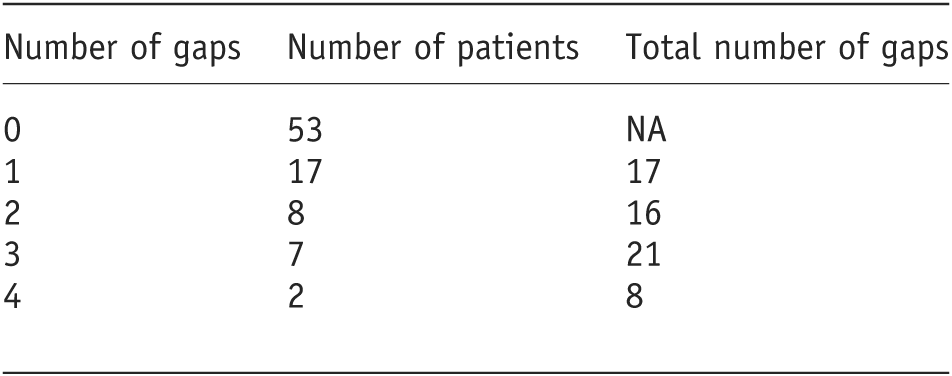
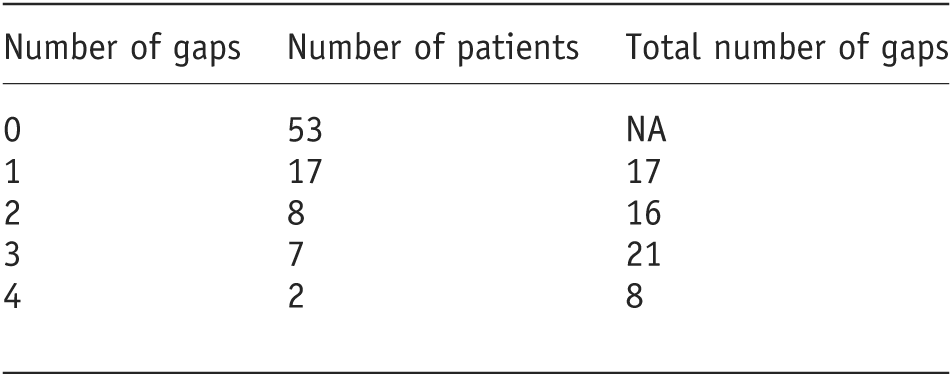
Fifty-three patients completed treatment without any gap occurring while a total of 62 gaps occurred in the remaining 34 patients (see Table 4). In those patients experiencing a gap, the distribution was as follows: single gap, 17 patients; 2 gaps, 8 patients; 3 gaps, 7 patients; and 4 gaps, 2 patients. No patient had more than 4 gaps. Compensation, in the form of an extra fraction of the same dose to prevent prolongation of the OTT, was performed in 25 of the 34 patients experiencing a gap. Thirty-five such fractions were delivered to compensate for the 62 gaps occurring and thus 56% were compensated for overall. Details of compensation are given in Table 5. No patient received any further altered fractionation as a method of compensating for a gap.
Overall number and distribution of gaps during radiotherapy
Details of compensatory fractions* administered to prevent prolongation of overall treatment time

*Compensatory fractions were all delivered at the same dose per fraction as the original prescription.
Of the 61 patients receiving 20 fractions and completing within 25 days, 47 did not have a gap while 14 required compensation to complete on time. Twenty-one patients having an interruption to their therapy did not complete on the time.
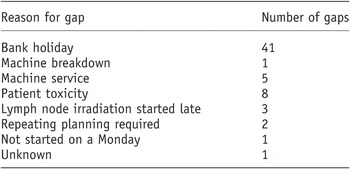
The reasons for gaps are detailed in Table 6. The most common reason for a gap was a bank holiday occurring during treatment. Therapy was interrupted in only 8 patients owing to illness or toxicity.
List of reasons for gaps in treatment

Toxicity
Acute-toxicity data are available for all patients and is given in Table 7. There were no treatment-related deaths.
Details of acute toxicity

The median pain score was 3 (range 1–8). There was no significant difference in analgesia requirement between patients with oropharyngeal tumours and those with laryngeal tumours, mean pain scores were 3.73 and 3.06, respectively. The addition of chemotherapy was significantly associated with an increase in pain score (p = 0.008). OTT was associated with an increase in pain score of 0.21 for each extra day (p = 0.03).
Grade 3 mucositis was seen in 56 patients (64%). It was more frequent in patients having chemotherapy (89% versus 48%), giving an odds ratio of 11.1. As expected, a higher incidence of grade 3 mucositis was seen with a higher radiotherapy dose (p = 0.02). No significant associations were seen between the incidence of grade 3 mucositis and administering 2 fractions in 1 day, 6 fractions in 1 week or OTT. Prolonged grade 3 mucositis was seen in 10 patients (11%). None of the patients having prolonged mucositis received >5 fractions in 1 week/1 fraction in a day. Grade 3 dysphagia was seen in 34 patients (39%) with no statistical difference between different groups.
Compensatory acceleration and toxicity
Receiving 6 fractions in 1 week, to compensate for a gap, was associated with a lower pain score (p = 0.003). In line with this, administration of >1 fraction in a single day was associated with a lower pain score (p = 0.0004). There were no associations between compensation and dysphagia or mucositis.
Discussion
This audit confirms that accelerated hypofractionated radiotherapy is tolerable and a high proportion of patients can complete this schedule on time. When interruptions occur, further acceleration to avoid prolongation of OTT in selected patients is possible. A negative association of pain with compensation for a gap suggests that physician selection for compensation was appropriate.
Reduced OTT has been shown to increase local controlReference Overgaard, Hansen and Specht4, Reference Bourhis, Overgaard and Audry10 and local control may be increased when delays are reduced, both before starting and during radiotherapy.Reference Huang, Barbera, Brouwers, Browman and Mackillop11, Reference Robertson, Robertson, Hendry, Roberts, Slevin, Duncan, MacDougall, Kerr, O'Sullivan and Keane12 The schedule described earlier employs a reduced OTT and completes therapy before accelerated repopulation becoming a significant factor. In this study, 94% of patients were able to complete radiotherapy within 28 days achieving this goal in practice. The ability of this shorter schedule to deliver most of the therapy before toxicity becoming a significant problem may be one reason why such a high proportion of patients complete treatment within 1 month. Efficacy data from such an accelerated hypofractionated regimen have recently been published in locally advanced head and neck tumours but is yet to be subjected to prospective randomised comparison.Reference Sanghera, McConkey, Ho, Glaholm and Hartley13, Reference Sykes, Slevin, MacDougall, Ironside and Mais14
Prolongation of OTT by 5 days or more occurs in up to one in four patients within randomised clinical trials.Reference Khalil, Bentzen, Bernier, Saunders, Horiot, Van Den Bogaert, Cummings and Dische15 Consideration of the proportion of patients able to complete a schedule is seldom discussed but is an important issue. There is no currently described model to radiobiologically compare different schedules which takes into account the proportion of patients actually completing treatment on time within a given schedule. Having a high compliance rate within a schedule could increase the overall rates of local control.
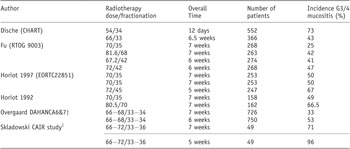
Acceleration has shown to be limited by toxicity so care must be taken when adopting shorter schedules. Within the CAIR study, a reduction in dose per fraction was required to render the schedule tolerable when reducing OTT from 7 to 5 weeks.Reference Skladowski, Law, Maciejewski and Steel16 The hypofractionated schedule studied here has an acceptable acute-toxicity profile with incidences of grade 3 toxicity consistent with other published data. When considering trials not using concurrent chemotherapy, the reported incidence of minimum grade 3 mucositis ranges from 25 to 96%;Reference Overgaard, Hansen and Specht4, Reference Fu, Pajak, Trotti, Jones, Spencer, Phillips, Garden, Ridge, Cooper and Ang5, Reference Skladowski, Law, Maciejewski and Steel16–Reference Horiot, Le Fur and N'Guyen19 details are given in Table 8. When considering only patients receiving altered fractionation and excluding the CAIR study, which had an unacceptable level of acute toxicity before a reduction in the dose per fraction, this range is 41–73%. The incidence of interruption due to toxicity was also very low supporting the tolerability of the schedule.
Incidence of minimum grade 3 acute mucosal reaction in published studies using radiotherapy alone*

*Different studies may use different grading systems.
†Concurrent Nimorazole administered.
‡Fraction size altered part way through trial from 2 Gy to 1.8 Gy due to a high incidence of grade 4 reaction in accelerated arm.
This study shows that should unplanned interruptions occur then compensation is tolerable without prolongation of the OTT. This is important information for clinicians faced with the difficult decision of how to manage patients who have an unexpected interruption in therapy. Being able to compensate for missed therapy during treatment, and before accelerated repopulation, means the total dose can remain the same, which is the preferred method of compensation.Reference Dale, Hendry, Jones, Robertson, Deehan and Sinclair8 If however the treatment time is extended beyond the prescribed overall time, and is also beyond the point of accelerated repopulation, then the iso-effect dose has to be increased to compensate for the repopulation. Such a dose increase risks increased normal-tissue toxicity.
Late toxicity reactions are a particular concern with high doses per fraction. When employing radiobiological modelling based on the linear quadratic model, the estimated late biological effective dose (BED) of 55 Gy/20 in 25 days is only 105.4 Gy, well below the accepted 117 Gy calculated when using 70 Gy in 35 fractions (BED for late effects calculated using an α/β = 3).Reference Fowler20 There is also evidence to suggest that late mucosal and skin damage occurs as a consequence of acute loss of squamous epithelium.Reference Bentzen and Overgaard21–Reference Withers, Peters, Taylor, Owen, Morrison, Schultheiss, Keane, O'Sullivan, van Dyk and Gupta24 The rate of prolonged grade 3 mucositis (a surrogate marker for consequential damage) within this study is acceptable at 11%. Although more detailed late toxicity data are desirable, no unexpected late toxicity was seen within this group of patients.
The repair of sub-lethal DNA damage is likely to be slower in some normal tissues and caution needs to be employed when using multiple daily fractions for compensation. An adequate time interval has to be allowed to minimise the incidence of late toxicity and this may be particularly important when using large doses per fraction. Where required, the administration of an extra fraction for compensation should be done with a minimum gap of 6 hours and ideally, if resources permit, on a Saturday/Sunday. Demonstrating such benefits in a clinical study may prove difficult and in the absence of such data we have to rely on the radiobiological modelling.
The hypofractionated schedule discussed offers many practical benefits in terms of administration and resource utilisation. This study has demonstrated that when using this schedule a high proportion of patients complete treatment on time, compensation is safely possible for selected patients and there is an acceptable acute reaction rate.
Conflict of interest
No sources of funding or conflicts of interest to declare.