Introduction
Trauma is the leading cause of death for people ages one year to 44 years in the United States.1 Helicopters play an important role in transporting critically injured patients to trauma centers. Air medical transport has been shown to reduce mortalityReference Hannay, Wyrzykowski, Ball, Laupland and Feliciano2–Reference Stewart, Cowan, Thompson, Sacra and Albrecht4 and expand access to Level I trauma centers.Reference Branas, MacKenzie and Williams5 However, this comes with a cost—both in terms of the safety risks and the expense of helicopter transport.
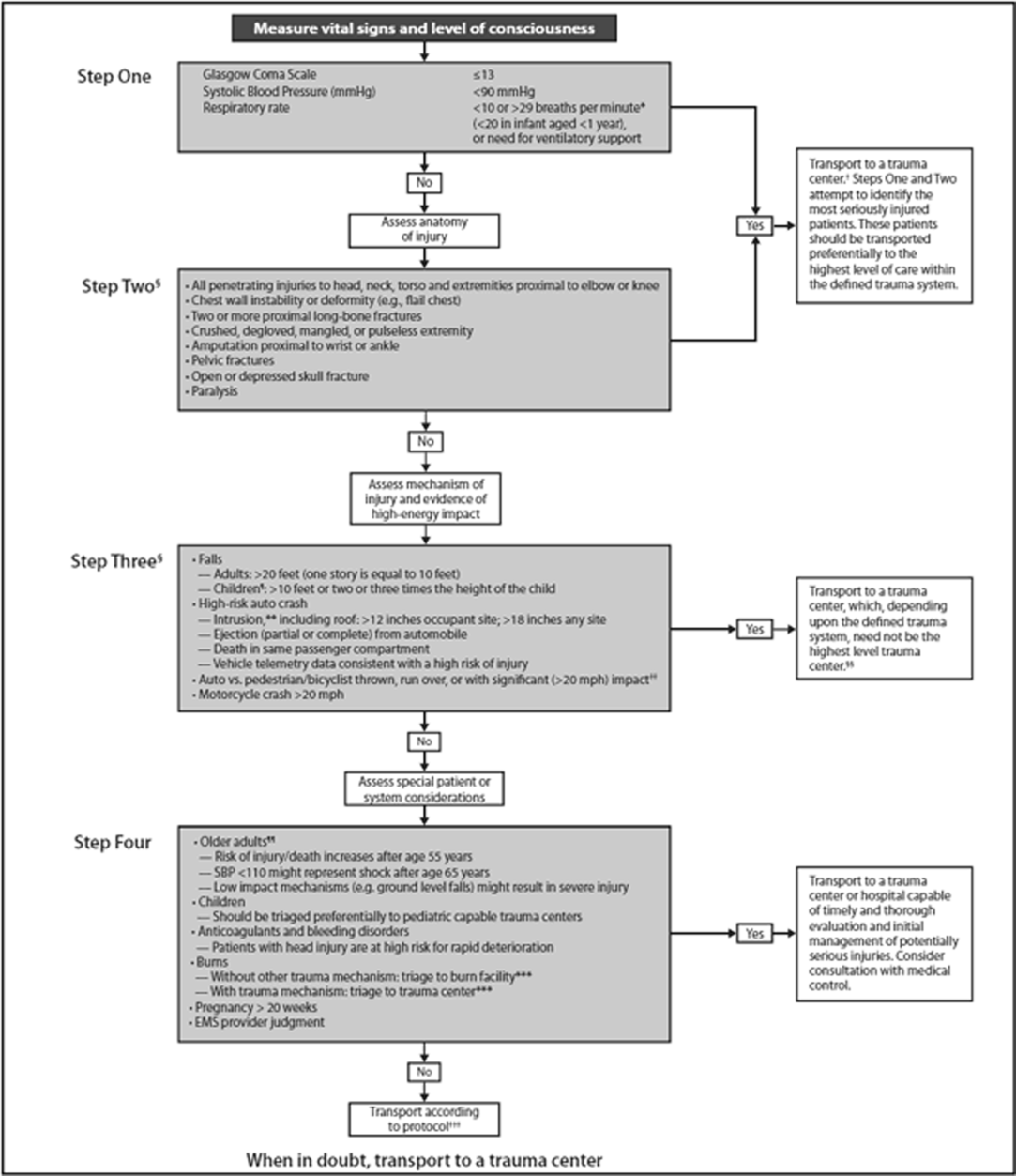
Scene requests for air medical transport by Emergency Medical Services (EMS) providers follow expertly developed consensus guidelines for field triage promulgated by the Centers for Disease Control and Prevention (CDC; Atlanta, Georgia USA; Figure 1).Reference Sasser6 These guidelines enable providers to make rapid decisions about the seriousness of a patient’s injuries and match the patient’s illness with the medical care needed. The goal in trauma care is to deliver critically injured patients to appropriately-resourced trauma centers while allowing less severely injured patients to be managed locally.
CDC Field Trauma Triage Criteria 2011.Reference Sasser6

Given the burdens of cost7 and safetyReference Bledsoe and Smith8 for helicopter transport, it is important to improve the accuracy of trauma triage criteria. BledsoeReference Bledsoe, Wesley, Eckstein, Dunn and O’Keefe9 showed that approximately 60% of trauma patients may be over-triaged to trauma centers by EMS providers calling for air medical transport at a trauma scene. Thus, it is imperative to strive to develop triage criteria for air transport that reduces the transport of patients who do not require the services of a trauma center (over-triage), while maintaining appropriate triage of those who do require those services in order for air medical transport to be most cost-effective in trauma.Reference Delgado, Staudenmayer and Wang10 Clearly, a more detailed analysis to determine the specific factors that contribute to over-triage of trauma patients using air medical transport is necessary. In their important work, Madiraju and colleaguesReference Madiraju, Catino, Korkaram, Genuit and Bukur11 found that trauma patients transported directly from an accident scene by helicopter who were discharged directly from the emergency department, admitted to a medical service due to lack of injuries, or admitted under observation status resulted in $1.3 million in additional costs to their trauma system. They found that 52% of patients arriving by helicopter fell under their limited definition of over-triage. While the classic definition of over-triage has used parameters such as an Injury Severity Score (ISS) >15, the current study chooses to focus on a more obvious target: those patients who are discharged alive within 24 hours of admission. BledsoeReference Bledsoe, Wesley, Eckstein, Dunn and O’Keefe9 reported that among those studies in his meta-analysis that reported patients discharged within 24 hours, 26% of patients were discharged within this timeframe.
The purpose of the current investigation is to determine which factors, if any, available to EMS providers in the field are strong predictors of early discharge by air medical transport to a trauma center.
Study Design and Methodology
Study Design
A retrospective chart review of all scene trauma patients transported by MedFlight, a helicopter EMS service, to the Ohio State University Wexner Medical Center (OSUWMC; Columbus, Ohio USA), a Level I Trauma Center, was conducted from January 1, 2013 through December 31, 2014. The sample included adult (age >17 years) trauma patients who were flown directly from the accident scene to the OSUWMC by MedFlight for trauma care. Burn patients, incarcerated patients, scene transports for medical conditions, and pediatric patients (age <16 years) were omitted from this analysis. Interhospital trauma transfers and patients transported by means other than helicopter were excluded.
MedFlight is a critical care air and ground transport program serving central and southeastern Ohio. The program operates eight air medical bases throughout its service region and completes approximately 3,200 air transport missions annually. Twenty-five percent of these missions are direct responses to accident scenes with approximately 380 being transported to the OSUWMC. This facility is an American College of Surgeons (Chicago, Illinois USA) Level I verified trauma center with approximately 2,800 trauma admissions annually.
Data Collection
All prehospital data were retrospectively abstracted from patient charts located in the MedFlight database in accordance with the methodologic standards of Worster, et al.Reference Worster, Bledsoe, Cleve, Fernandes, Upadhye and Eva12 Each electronic chart was completed by medical crews at the conclusion of the transport (electronic patient care record [ePCR]; Zoll Medical Corporation; Chelmsford, Massachusetts USA). The analysis focused on data that would have been available to prehospital providers at the time of request for air medical transport. Data points collected included patient age, gender, scene location, loaded miles, and transportation costs. The data in the ePCR are validated in the following manner. They are entered into the record by either being directly populated from the computer-aided dispatch record or entered manually by the clinical crews. Each record is then reviewed by the on-coming crew the following day for accuracy, and is then further reviewed by a quality assurance officer at each base. Any data that are absent or missing are corrected in the official record. Additionally, traditional triage factors including physiologic measures, anatomic injuries, and mechanism of injury as identified in the 2011 CDC Guidelines for Field Triage of Injured PatientsReference Sasser6 were collected (Figure 1). The specific criteria met or not met for each request was determined by one author (HM) after reviewing each patient care record. Author HM spent time becoming familiar with the CDC Field Trauma Triage Criteria. Each of the first 10% of records were reviewed by a second reviewer (HW) to assure 100% concurrence in the triage criteria met. Thereafter, all controversial cases were discussed until agreement was reached. No kappa statistics were assessed due the nature of the study design. Trauma type was characterized as either blunt or penetrating. The mechanism of injury was categorized as fall, automobile crash, motorcycle crash, or auto versus pedestrian accident. Anatomic injuries included penetrating injuries of the head, neck, torso, or extremities proximal to the elbow or knee; chest deformity; crush injury; suspected pelvic fracture; amputation; skull fracture; or injury associated with paralysis. The physiologic criteria included a Glasgow Coma Score (GCS) <13, systolic blood pressure <90 mmHg, or a respiratory rate of less than 10 or more than 28 breathes per minute. Special considerations for triage to a trauma center included geriatric falls, patients on anticoagulants, pregnancies >20 weeks, and EMS judgment of severe injury. Other factors were analyzed including those patients who were intubated in the field, the volume of fluids administered, and the Revised Trauma Score (RTS) on admission.Reference Champion, Sacco, Copes, Gann, Gennarelli and Flanagan13 The RTS is a physiologic scoring system yielding values between zero and 12 with lower scores indicating higher mortality risk. The RTS is made up of three parameters—GCS, systolic blood pressure, and respiratory rate. The GCS is weighted heavier than the other two parameters to account for serious head injuries.
The primary outcome of the study was early discharge, defined as those patients who were discharged alive and had a length-of-stay (LOS) of 24 hours or less. Appropriate triage was also defined as those patients who suffered an in-hospital death, had an ISS >15, were taken to the operating room (OR) within 24 hours of admission, were admitted to an intensive care unit (ICU), or who received blood products in the first 24 hours.
The trauma database at Level I trauma center (TraumaBase, Version 9; Clinical Data Management; Golden, Colorado USA) was used to retrospectively determine the following patient outcomes: survival to discharge, LOS, ICU LOS, administration of blood products, ISS, and operative intervention within the first 24 hours. The database is maintained by a professional trauma registrar who is responsible for data entry and validation of the trauma registry data in compliance with the American College of Surgeons verification process. All data were available for the charts included in this study.
The study was reviewed and approved by the institutional review board (IRB) at the Ohio State University (2015H0014).
Data Analysis
Data were entered into an Excel spreadsheet (Microsoft Corporation; Redmond, Washington USA) and analyzed using STATA (Version 10; STATACorp LP; College Station, Texas USA). Patient characteristics were compared between the over-triaged patients (LOS <24 hours) and those who did not meet the definition of over-triage. The student’s t-test was used to compare continuous variables and the Chi-Square test was used to compare categorical variables. A P value <.05 was deemed to be statistically significant.
Simple logistic regression was performed comparing individual triage criteria against early discharge. A multiple logistic regression model was constructed using the results of the simple logistic regression with inclusion of those variables showing a statistically significant correlation with early discharge. Finally, various prehospital parameters were combined to determine the positive predictive value, negative predictive value, sensitivity, and specificity in predicting early discharge.
Continuous numerical data are reported as means (standard deviations). Categorical data such as mechanism of injury and gender are reported as absolute numbers and percentages.
Results
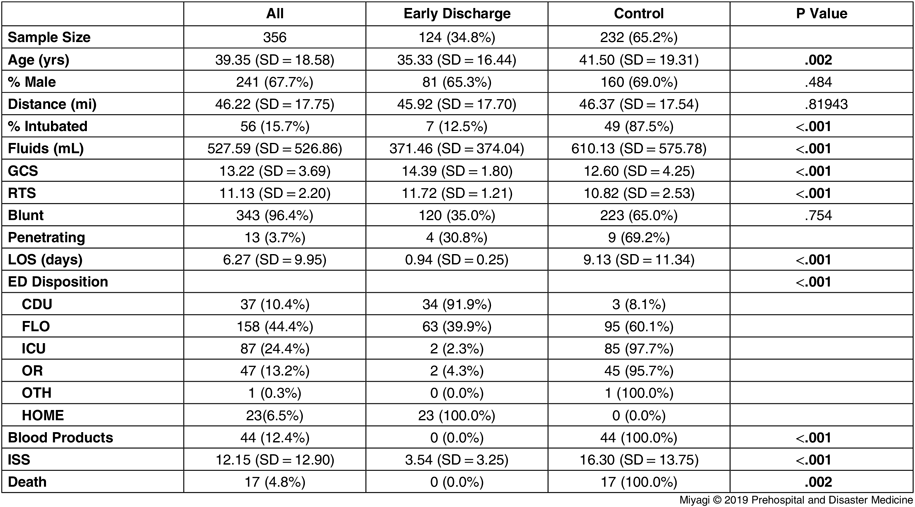
Three hundred and fifty-six trauma scene responses transported to the OSUWMC met eligibility criteria and were retrospectively examined for this study. Of the 356 patients evaluated, 124 (35%) of them were considered as an early discharge based on a LOS of 24 hours or less in survivors. The comparison of demographic, injury, and outcome data for the early discharge group and control (LOS >24 hours) group is shown in Table 1. There was no significant difference in gender, mean distance travelled, or type of injury between the groups. However, a significant difference was found in age, intubation status, volume of fluids received, GCS, RTS, and ISS between the groups.
Comparison of Demographic Factors Predicting Early Discharge

Abbreviations: CDU, observation unit; ED, emergency department; FLO, floor; GCS, Glasgow Coma Scale; ICU, intensive care unit; LOS, length-of-stay; OR, operating room; OTH, other; RTS, Revised Trauma Score.
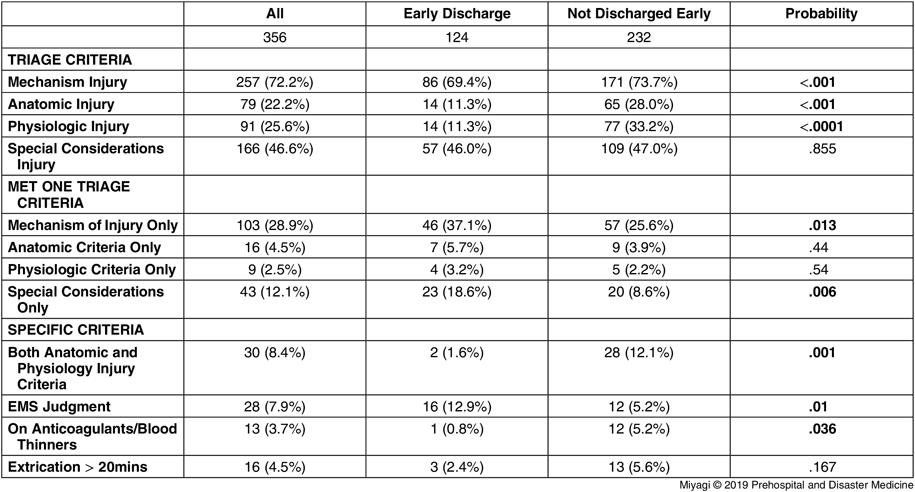
Table 2 shows the relationship between trauma triage criteria and the primary outcome, early discharge. Patients who met either physiologic or anatomic criteria, either individually or in combination, were less likely to be discharged early. Of the 30 (8%) patients who met both anatomic and physiologic triage criterion, only six percent of this group were discharged within 24 hours.
Comparison of Triage Criteria in Predicting Early Discharge

Abbreviation: EMS, Emergency Medical Services.
Furthermore, an investigation into specific special considerations such as EMS judgment, patients taking anticoagulation agents, or extrication time greater than 20 minutes was performed. Of the 28 patients that were flown to the Level I trauma center for trauma care based solely on EMS judgment, 16 (57%) were discharged early. Of the 13 patients taking anticoagulants or blood thinners, only one (7%) was hospitalized for 24 hours or less. Prolonged extrication did not distinguish between the patients who were discharged early and those who had a LOS of more than 24 hours.
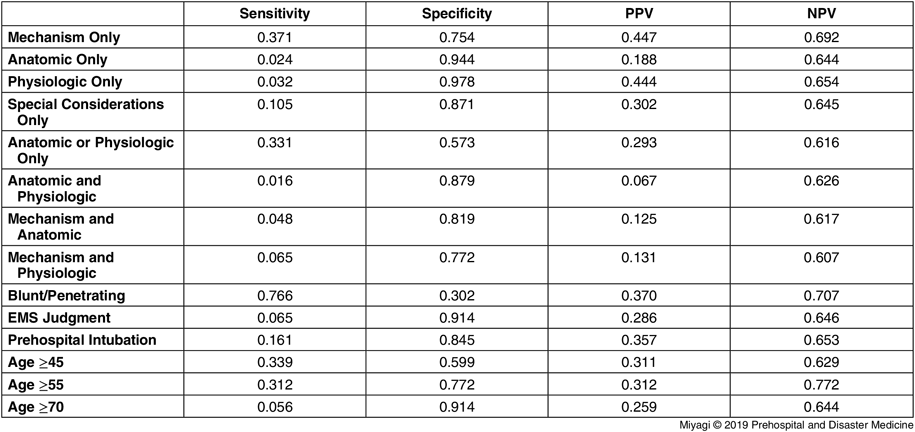
Table 3 shows the sensitivity, specificity, positive predictive value, and negative predictive value for various trauma triage factors in predicting discharge within 24 hours. It appeared that the positive predictive value for patients who were triaged based solely on their mechanism of injury or special considerations was not able to identify patients who were discharged within 24 hours with proper discrimination. Patients who were triaged based solely on their mechanism of injury had a hospital stay longer than 24 hours in over 55% of cases. Those triaged based on special considerations, EMS judgement, or age did not adequately discriminate between those discharged early and the control group. The sensitivities for anatomic criteria only, physiologic only, or meeting both anatomic and physiologic criteria were extremely low, suggesting that patients meeting these criteria rarely stayed less than 24 hours. Interestingly, the same was true for those patients triaged based on EMS judgment.
Sensitivity, Specificity, Positive Predictive Value (PPV), and Negative Predictive Values (NPV) for Early Discharge

Abbreviation: EMS, Emergency Medical Services.
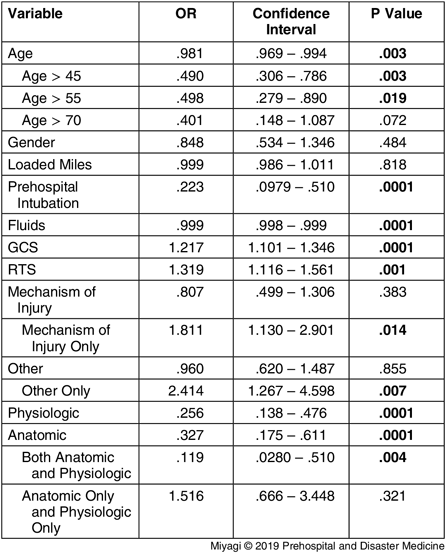
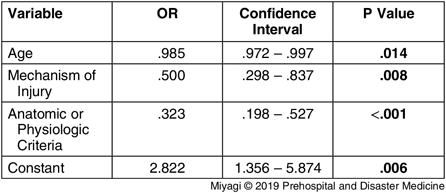
Table 4a shows the odds ratios, confidence intervals, and P values for demographic and triage criteria as a predictor of a LOS of 24 hours or less. The odds ratio of patients who were aged 45 and older was 0.49, indicating that patients younger than 45 years were more likely to be discharged within 24 hours when compared to patients older than 45 years. Age as a continuous variable significantly contributed to early discharge, as did the dichotomous age cutoffs of 45, 55, or 70 years. Other factors that were significantly predictive of early discharge (either positively or negatively) were prehospital intubation, increasing prehospital fluid infusions, a declining GCS or RTS, patients with either mechanism of injury only or special considerations only, and those with physiologic criteria, anatomic criteria, or the combination of physiologic and anatomic criteria. However, when the multiple linear regression model was developed (Table 4b), only age in years, mechanism of injury, and anatomic or physiologic criteria were significantly associated with a LOS of 24 hours or less.
Odds Ratios of Individual Variables Predicting Early Discharge as Determined by Simple Logistic Regression

Abbreviations: GCS, Glasgow Coma Scale; RTS, Revised Trauma Score.
Odds Ratios of Individual Variables Predicting Early Discharge as Determined by Multiple Logistic Regression

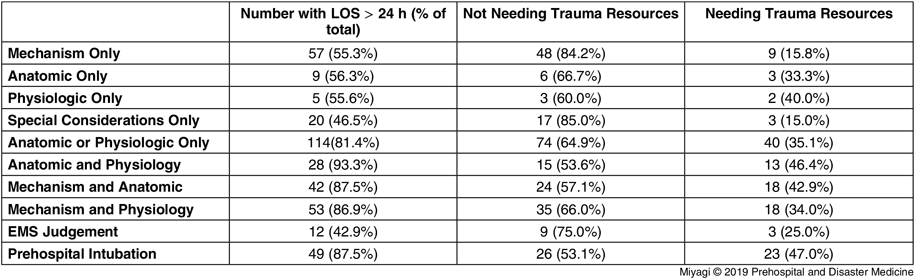
Table 5 shows the number of patients meeting individual trauma triage criteria with a LOS more than 24 hours and whether or not they met the requirements for immediate trauma resources in the hospital. The number of patients with a LOS more than 24 hours who were triaged solely based on mechanism only was found to be 57 patients. Out of the 57 patients, 48 (84%) did not require urgent trauma resources. Evaluation of individual factors revealed that a significant number of patients who had a LOS more than 24 hours still did not require immediate trauma resources after arriving at the trauma center. The one exception was EMS judgment, in which all patients who stayed longer than 24 hours required urgent trauma resources. It appeared that no individual criteria adequately predicted the need for trauma center resources in those patients whose LOS was greater than 24 hours.
Patients with LOS >24 Hours and their Trauma Resource Requirements

Abbreviation: EMS, Emergency Medical Services, LOS, length-of-stay.
Discussion
Air medical transport is a significant component of the trauma system, extending the benefits of trauma care to areas that are not in immediate proximity to a trauma center. Air medical transport has extended access to a trauma center within one hour to an additional 81.4 million US citizens. Reference Branas, MacKenzie and Williams5 The use of air medical transport has been shown to improve outcomes in properly selected trauma patients. Baxt and Moody first demonstrated a 52% reduction in predicted trauma mortality in those patients transported by air medical transport when compared to ground. Reference Baxt and Moody14 Since that time, several studies have demonstrated improvement in trauma outcomes among patients transported by air medical transport when compared to ground transport. Reference Hannay, Wyrzykowski, Ball, Laupland and Feliciano2–Reference Stewart, Cowan, Thompson, Sacra and Albrecht4,Reference Thomas, Harrison and Buras15–Reference Brown, Stassen, Bankey, Sangosanya, Cheng and Gestring18
On the other hand, over-triage of trauma patients leads to several important negative consequences. Over-triage reduces the overall efficiency of the trauma system. Transfer of less-injured patients leads to expensive bills for both the patient and the treating hospital. Newgard, et al reported spending $5,590 more per trauma patient in a Level I trauma center compared to a non-trauma hospital. Their findings suggested that minimizing over-triage of patients to Level I trauma centers could save up to $136.7 million annually in their system alone. Reference Newgard, Staudenmayer and Hsia19 In addition, during a trauma activation, emergency physicians, surgeons, nurses, and residents are removed from their primary work duties, leaving other patient care to be put on-hold to care for the trauma patient. Reference DeKeyser, Paratore, Seneca and Trask20,Reference Cook, Muscarella, Praba, Melvin and Martin21 Lastly, the over-triage of minimally injured patients results in inappropriate use of vital resources such as computed tomography machines and ORs which could be freed up by reducing the number of over-triaged patients.
The current study evaluated each of the CDC’s field triage criteria used by EMS providers to summon air medical transport. Rather than focusing on the broader issue of over-triage, this study focused on those patients who were discharged early, defined as a hospital stay of less than 24 hours in a patient who survives their injuries. In reviewing the current literature, this may be the first study to examine the impact of field triage criteria on this specific population.
Under this conservative definition, the early discharge rate at this Level I trauma center was found to be 35%; if more stringent criteria were used including death, ISS >15, patient taken to OR or ICU, or receipt of blood products, the over-triage rate was over 80%. This is higher than the study by Bledsoe which reported over-triage rates exceeding 60% Reference Bledsoe, Wesley, Eckstein, Dunn and O’Keefe9 and is comparable to other studies by Uleberg Reference Uleberg, Vinjevoll and Eriksson22 (78%), Shawhan Reference Shawhan, McVay, Casey, Spears, Steele and Martin23 (79%), and O’Rourke (74%). Reference O’Rourke, Bade and Drezner24 Madiraju Reference Madiraju, Catino, Korkaram, Genuit and Bukur11 also identified an increasing over-triage rate of 77% over time and noted that if over-triage were eliminated, a savings of $1,316,036 could be realized annually. Interestingly, Michailadou Reference Michailidou, Goldstein and Salazar25 found that 28% of children transported to their pediatric trauma center were discharged within 24 hours.
Efforts to identify field triage criteria which were universally predictive of early discharge indicate that there were no field criteria that unequivocally predicted early discharge. Sensitivities for patients meeting anatomic criteria only, physiologic criteria only, or both were very low, suggesting that these criteria may be useful in eliminating those who will be discharged within 24 hours. Following an investigation into single variable predictors of early discharge, combinations of trauma triage criteria (ie, patients with mechanism and physiologic injuries) were studied to further identify whether grouping two factors together can provide more insight into reducing the number of patients discharged within 24 hours. The study done by Uleburg, et al supports the fact that patients with both anatomic and physiologic factors should be taken to a trauma center since only a small percentage of these patients were over-triaged. Reference Uleberg, Vinjevoll and Eriksson22 A prospective study done by Lehmann, et al has shown that relying solely on physiologic and anatomic criteria can aid in reducing over-triage while maintaining under-triage at an acceptable level. Reference Lehmann, Brounts and Lesperance26
Similarly, patients taking anticoagulants were nearly universally hospitalized for more than 24 hours (12 of 13), suggesting that these patients should be considered “high-risk.” The impact of newer oral anticoagulants and their specific antagonists which are typically available in tertiary centers only emphasizes the need to have these individuals evaluated in a trauma center. The use of anticoagulants has been shown to worsen outcomes in trauma patients, Reference Lecky, Omar and Bouamra27,Reference Bonville, Ata and Jahraus28 particularly among elderly patients. Reference Nishijima, Shahlaie, Sarkar, Rudisill and Holmes29,Reference Tollefsen, Vik and Skandsen30
The findings with regards to those patients who were triaged based on EMS judgement were perplexing. Of the 28 patients who were triaged based on EMS judgement, 16 were discharged within 24 hours of transport; on the other hand, all of the 12 patients who stayed longer than 24 hours required the resources of a Level I trauma center based on the defined criteria. Fries Reference Fries, McCalla, Levitt and Cordova31 found that the judgement of paramedics was as accurate as the Trauma Triage Rule in predicting the need for trauma care and that the combination of both had a sensitivity of 100%. Similarly, Mulholland Reference Mulholland, Cameron and Gabbe32 found that paramedic judgement was 98% sensitive in identifying major trauma, although the sensitivity was 28% and the ability to identify individual system injuries was poor. Qazi, Reference Qazi, Kempf, Christopher and Gerson33 however, found that paramedic judgement was poor for identifying the need for trauma team activation in pediatric trauma. The current findings suggest that EMS judgement results in significant over-triage, but does identify a significant group of patients who require trauma center resources.
Lastly, patients were examined who were admitted for longer than 24 hours but still did not require trauma resources as defined by in-hospital death, ISS >15, receipt of blood products, early surgical intervention, or ICU care was conducted. This analysis also suggested that a significant number of scene trauma patients transported by helicopter received no additional benefit from their immediate transport to a trauma center. These data are presented in Table 5 where a significant percentage of patients (in every case more than 50%) did not meet the definition for requiring immediate trauma resources. These data indicate that direct transport to a trauma center by air medical transport from the accident scene may not be necessary as the majority of these patients may not be truly “time-sensitive.” Unfortunately, this study was again unable to identify any specific triage criteria or combination of criteria that could reliably predict those patients who could be safely transported locally and not directly to the trauma center. Further investigation into refining secondary triage criteria may be warranted.
The difficulty in using field criteria to establish the need for a trauma center is highlighted by the findings in field intubated patients. It was hypothesized that patients intubated in the field would have a very low likelihood of being discharged within 24 hours of admission; however, the analysis demonstrated that 12% of patients with field intubation were actually discharged within the first 24 hours. It is possible that many of these patients were combative due to the effects of drugs, alcohol, or minor head injuries and thus were sedated and intubated to allow for a safe flight. Nonetheless, not even field intubation is universally indicative of significant injury and a LOS >24 hours.
Of the individual and combination of triage factors examined, none yielded 100% sensitivity that would allow the universal prediction of early discharge. As an example, it has been suggested that air transport of patients who only meet mechanism of injury for triage contributes to high over-triage rates. While true in many cases, nearly 63% of these patients (sensitivity of 0.371) still had a LOS >24 hours in this study. This leads to the conclusion that without risking an increase in under-triage, there are no triage factors or combination of factors that can be eliminated from the field triage protocol to reduce the rate of early discharge.
It should be noted that Brown Reference Brown, Gestring and Guyette34,Reference Brown, Gestring and Guyette35 has developed specific air medical criteria for prehospital triage. According to the initial studies, the Air Medical Prehospital Triage score was able to reliably identify patients with a survival advantage using helicopter for transport to a trauma center. The impact of over-triage has not yet been studied, however.
Limitations
The major limitation of this study is its retrospective design. Charts reviewed were prone to recall bias and documentation deficiencies of EMS providers. It should be noted that some information may have been lost in communication when air transport personnel recorded what they believed to be the major decision point for summoning air medical transport by local EMS providers. The assessment of the specific triage criteria used was based on one reviewer’s (HM) analysis of all patient charts in which an unambiguous history was identified. In cases of ambiguity, a second reviewer (HW) was consulted.
Additionally, there is limited literature on over-triage rates for air medical transport based on specific trauma triage criteria, making it difficult to compare the current results with those of other air medical transport systems.
A few additional factors that could have contributed to the early discharge rate reported in this study are the training level of EMS providers and chart reviewer bias. The EMS providers use field triage protocols to identify the need for transport to a trauma center. One of the criteria listed on the CDC field triage protocol is EMS judgment. The first responders to an accident scene have various levels of training. Less highly trained or experienced providers may err on the side of caution when deciding to call for air medical transport, especially when there are no trauma centers within close proximity. Similarly, triage criteria such as “possible pelvic fracture” are deliberately vague and may lead to over-triage where a definitive diagnosis (established by radiography) is not possible.
One other limitation is the analysis of early discharge, defined as admission to the trauma center for 24 hours or less in survivors. Admittedly, this is not a comprehensive definition of over-triage since other patients may be admitted for longer duration and yet not require any additional resources available at the Level I center. However, the authors felt that these patients did significantly contribute to over-triage and their characterization could lead to be efficient triage, as suggested by Delgado. Reference Delgado, Staudenmayer and Wang10 The authors attempted to broaden the definition to look at those patients who were hospitalized for more than 24 hours but also did not immediately use the resources of the trauma center. Despite the broadening of focus, the study did not find specific criteria that universally predicted over-triage.
Finally, it must be recognized that the study addressed only over-triage but had no information on under-triage as the authors did not have access to all of the trauma patients within the region. It is possible that under-triage is at a low level in this community, thus justifying an early discharge rate of 34%; conversely, the authors could not conjecture on the potential effect of reducing the number of patients discharged within 24 hours might have on under-triage.
Conclusions
Over-triage remains a concerning problem in the use of air medical transport for scene transport of trauma patients. Specifically focusing on those patients with a hospital stay of <24 hours, it was found that almost one-third of patients who were transported from the scene are discharged within 24 hours of admission; a more rigorous definition based on resource utilization found over-triage of over 80% of patients. On the other hand, the study did not identify any individual criteria that universally predicted those patients who could be discharged within 24 hours of admission. Patients who meet both anatomic and physiologic criteria, as well as those patients taking anticoagulants, appear to predict a high likelihood of hospital LOS of more than 24 hours. Future studies should provide a better description of these early discharge patients in the hopes of finding alternative triage factors and should evaluate the impact of air medical-specific triage criteria on early discharge rates.
Conflicts of interest
none