Introduction
Chromolaena odorata (L.) King and Robinson (Asteraceae) is a weedy shrub native to the tropical Americas, which has become a serious invasive weed in the tropics of Africa and Asia (McFadyen, Reference McFadyen1989). Since its accidental introduction into Nigeria in 1937 from Sri Lanka through the importation of contaminated Gmelina arborea Roxb. (Verbenaceae) seeds (Ivens, Reference Ivens1974), the weed has become a threat to agriculture, biodiversity and human livelihoods in the country. Chemical, mechanical and other conventional methods of controlling the weed have proven not to be sustainable.
The first ever project initiated to find and introduce agents for biological control of the weed in the world began in Nigeria during the late 1960s and early 1970s (Ivens, Reference Ivens1974). As a result, Pareuchaetes pseudoinsulata Rego Barros (Lepidoptera: Arctiidae), initially identified as Ammalo insulata (Walker), was released in the early 1970s in Ibadan (7° 23′ 10.97″ N, 3° 53′ 35.05″ E), southwestern Nigeria. However, the insect apparently did not establish (Cock and Holloway, Reference Cock and Holloway1982; Julien and Griffiths, Reference Julien and Griffiths1998), probably because the effort was not sustained. The subsequent introduction of the moth into other countries, where C. odorata was also invasive, recorded variable successes (Dharmadhikari et al., Reference Dharmadhikari, Perera and Hassen1977; Seibert, Reference Seibert1989; Joy et al., Reference Joy, Lyla and Satheesan1993; Julien and Griffiths, Reference Julien and Griffiths1998; Timbilla et al., Reference Timbilla, Zachariades, Braimah, Neuenschwander, Borgemeister and Langewald2003; Bofeng et al., Reference Bofeng, Donnelly, Orapa, Day, Day and McFadyen2004). Since its first and only release in Nigeria in the early 1970s, no reports have documented the establishment of the moth, although it may have been present at undetectably low levels as it has been reported to be an episodic outbreak species (Zachariades et al., Reference Zachariades, Day, Muniappan, Reddy, Muniappan, Reddy and Raman2009). These concerns led to the carrying out of a survey in the southern part of the country to determine whether P. pseudoinsulata was present, and, if so, to study some aspects of its biology and behaviour. These informed the execution of this study. This paper is, therefore, a report on the discovery and some aspects of the biology and behaviour of P. pseudoinsulata based on laboratory and field studies in southern Nigeria.
Materials and methods
Discovery
The survey was conducted between April and May 2009 and between March and April 2010 in chromolaena-infested fields at Uson (6° 14′ 30.77″ N, 6° 04′ 41.37″ E), Evbuabogun (6° 15′ 39.33″ N, 5° 38′ 58.29″ E) and Ekae (6° 15′ 34.90″ N, 5° 37′ 19.75″ E) villages near Benin City (6° 19′ 55.67″ N, 5° 37′ 18.58″ E), southern Nigeria. The presence of P. pseudoinsulata was assessed by means of visual counting of larvae and adults upon careful examination of the plants along three 100 m transects in each location. The distances between each transect were usually more than 30 m. Abundance studies were carried out only at the Evbuabogun site, where insect data were collected along four permanent transects, each 45 m long, on a monthly basis from April to July 2010.
Observations on behaviour and descriptive characteristics
Late-instar larvae of P. pseudoinsulata were collected from 16 to 26 March 2010 from the leaves of C. odorata in the field at Evbuabogun village. The larvae were transferred into plastic cages measuring 25 × 25 × 25 cm and containing tender twigs of C. odorata. The larvae were reared through to adults and were allowed to mate. Twenty-four hours after eclosion, the adults were separated and introduced into plastic containers containing fresh stems of C. odorata and stoppered with cotton wool to prevent desiccation. The eggs laid by a single female were used to study some aspects of the biology of the F1 generation, while eggs from the first generation were used in the study of the F2 generation. The experiment was conducted at temperature and relative humidity ranges of 24–30 °C and 65–80% RH, respectively. The eggs laid on the C. odorata leaves were placed in a 200 ml plastic container, and, 24 h after hatching, the larvae (on the leaves) were transferred individually into aerated 250 ml plastic containers covered at the top with fine muslin cloth held in place with an elastic band and reared until pupation. The larvae were fed with fresh C. odorata leaves every 24 h and their frass was removed at the same interval for hygienic reasons. Pupae of P. pseudoinsulata were sexed using the methods described by Torres et al. (Reference Torres, Vargas, Ritual, Alforja, Muniappan and Ferrar1991), and placed in 25 × 25 × 25 cm plastic cages. The eclosed adults were fed with sucrose solution in cotton wool hung at various points from the top of each cage. Fresh leaves of C. odorata plants whose stems were immersed in a tube containing water were placed in each cage for egg laying. The eggs laid were reared through to adults following the same feeding and sanitary regime applied earlier. Observations were made on the developmental stages and longevity (three times per day), while insect mating behaviour was observed daily at 6 h intervals. Mean resting length (length of the insect when immobile) of each larval instar was measured. Measurements on the male versus female pupal length and the male versus female wing length were made. Adult wing lengths were measured 24 h after emergence. Measurements of the male versus female pupal length, body length and wingspan were compared using Student's t-test.
Results and Discussion
Discovery of Pareuchaetes pseudoinsulata in Nigeria
Larvae and adults of P. pseudoinsulata were found at all the surveyed sites. This is the first confirmed record of P. pseudoinsulata in Nigeria 40 years after its initial release, although it may have been present at undetectably low levels as the moth has been reported to be an episodic outbreak species (Zachariades et al., Reference Zachariades, Day, Muniappan, Reddy, Muniappan, Reddy and Raman2009). On 19 April 2009, three adults were collected from a C. odorata-infested field adjacent to a farm road in Uson village, near Benin City, Nigeria. The collected samples were confirmed to be P. pseudoinsulata after eggs were laid and immature life stages of the insect were reared through to the adult stage on C. odorata. This discovery of P. pseudoinsulata prompted further surveys in and around the study areas, which revealed the presence of late-instar larvae of P. pseudoinsulata. During subsequent surveys, conducted in April 2009 and March to April 2010, larvae and adults were found along roadsides and in abandoned farmlands at Evbuabogun and Ekae villages, about 4 km south of Benin City. The preliminary results of a more recent but detailed survey conducted at the Evbuabogun site showed that the moth is abundant infield with a steady increase in larvae numbers per month (Fig. 1). Population build-up of the moth seemed to be on the increase as the rainy season progressed. In southern Nigeria, the rainy season is usually between the months of April and October while the dry season is between November and March. This is in accordance with the reports of Braimah and Timbilla (Reference Braimah, Timbilla, Zachariades, Muniappan and Strathie2002) and Day and Bofeng (Reference Day, Bofeng, Lai, Reddy and Muniappan2007) that the population of the moth is usually higher during the rainy season. The site of this discovery at Evbuabogun is 65 km northwest of the initial discovery site at Uson. Based on the presence of P. pseudoinsulata at these sites, it is likely that the moth is present elsewhere in southern Nigeria (including the southwest and southeast), with similar climatic conditions. If P. pseudoinsulata did establish from its initial released population in Nigeria, it means that the moth has spread from the establishment site(s) in and around Ibadan (7° 23′ 10.97″ N, 3° 53′ 35.05″ E), in the southwest of Nigeria, travelling over a distance of 300 km to the present recovery sites in Benin City, in the south of the country. Another possibility is that the biological control agent spread from the release sites in Ghana, travelling about 800 km to reach Nigeria following its establishment in Fumesua, central Ghana in the early 1990s (Uyi, Reference Uyi2011).
Temporal distribution (mean ± SE) of Pareuchaetes pseudoinsulata larvae between April and July 2010 at the Evbuabogun study site, southern Nigeria

Observations on the behaviour and descriptive characteristics of Pareuchaetes pseudoinsulata
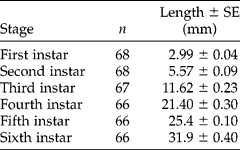
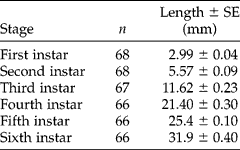
Adult P. pseudoinsulata started oviposition within 2–3 days of eclosion and eggs were laid in batches on the undersides of C. odorata leaves and walls of cages. The number of eggs per batch varied from 40 to 170. A single female if undisturbed was able to lay up to 380 eggs. Muniappan et al. (Reference Muniappan, Sundaramurthy, Viraktamath and Delfosse1989) recorded a maximum of 580 eggs per female in India. Oviposition was usually observed to take place between 04.00 and 11.00 h. The eggs of P. pseudoinsulata are yellowish and spherical in shape and developing eggs turn darker at the upper part, thus making the head of the first-instar larvae readily visible inside the chorion prior to eclosion. Following eclosion, the unfed first-instar larvae of the moth were pale tiny caterpillars of 2.99 ± 0.04 mm mean resting length (Table 1). The young larvae grew rapidly to maturity with continuous feeding on C. odorata leaves, by scraping the epidermal layer of the leaves with preference for the under-surface. They fed in a group up until the third instar, and thereafter solitarily. The mature hairy caterpillar is black with interrupted red and white stripes (Rego Barros, Reference Rego Barros1956; Cruttwell, Reference Cruttwell1972). The mean resting length of the sixth-instar larvae measured 31.9 ± 0.40 mm (Table 1). The older larvae feed voraciously by eating out the leaf lamina and can also inflict damage on the growing tips and flowerbuds of C. odorata plants, and large populations of the larvae can cause large-scale defoliation of C. odorata.
Mean length of various larval instars of Pareuchaetes pseudoinsulata
The pupa possesses a dark brown colouration. The pupae varied in length from 11.25 to 16.75 mm with an average of 13.97 ± 0.13 mm. In this study, we observed that the sexes of the moth could be distinguished on the basis of pupal sizes, as female pupae (mean 15.06 ± 0.11 mm, n = 54) were significantly (P < 0.001) larger than male pupae (mean 12.79 ± 0.11 mm, n = 54). The older instar caterpillars hid during the day in leaf litter under the C. odorata twigs provided for feeding in the cages and eventually pupated in the leaf litter. In the field, the older larvae move from the attacked plant to the leaf debris underneath the vegetation for pupation. This observation conforms to the findings of Cruttwell (Reference Cruttwell1972).
Adults are medium-sized butter yellow moths with an average wingspan and body length of 16.94 ± 0.08 mm (n = 158) and 18.11 ± 0.19 mm (n = 146), respectively. The female wing length (mean 17.68 ± 0.06 mm, n = 79) is characteristically (P < 0.001) greater compared with the male (mean 16.19 ± 0.07 mm, n = 79) wing length. The adult wing and thorax are uniform pale yellow, while the abdomen possesses a deep yellow colour with a dorsal row of black spots. The longevity of the adult moth varied between 3 and 7 days with an average of 4.8 ± 0.10 days (n = 116). This conforms to the findings of Timbilla and Braimah (Reference Timbilla, Braimah, Muniappan and Ferrar1991), who reported an average of 5 days in Ghana, whereas in India, a slightly greater longevity of 7–9 days (Reddy and Jacob, Reference Reddy, Jacob, Ferrar, Muniappan and Jayanth1998) was recorded, while Muniappan et al. (Reference Muniappan, Sundaramurthy, Viraktamath and Delfosse1989) reported the adult moth to have lived for about 10 days. Most adult emergence took place between 05.00 and 18.00 h. During the daylight hours, adults could be seen resting on the undersides of the C. odorata leaves or on the walls of the cages in an inactive state but could fly when disturbed. The moth was usually active at night, particularly on nights with good light intensity, moving between the leaves and the cage walls. Most mating occurred from 02.00 to 06.00 h. Muniappan et al. (Reference Muniappan, Sundaramurthy, Viraktamath and Delfosse1989) recorded mating duration in P. pseudoinsulata to have lasted 60–120 min, while in this study, the observed mating duration varied from 70 to 130 min and oviposition usually occurred within 1 or 2 days after mating. During the study period, which was in the rainy season, adult moths were readily seen in the field and on the walls of residential buildings at dawn and during the early evening.
Conclusions
Following the recent recovery of P. pseudoinsulata in Nigeria, coupled with climatic conditions favouring its proliferation in the wetter southern part of the country, it is recommended that a countrywide survey should be conducted to determine its distribution. Also, field studies on its impact on C. odorata, using techniques such as exclusion experiments, should be carried out. Considering that the problems of this weed are too ecologically and economically significant to ignore, an integrated approach is required for the control and management of this invasive weed in Nigeria. Uyi (Reference Uyi2008) recommended the simultaneous introduction of several biological control agents causing different types of injury for the control of the alien weed. More so, efforts should be made to initiate a new biological control programme against the alien weed with concerted and/or collaborative efforts specifically from countries and institutions that are actively involved in the biological control of C. odorata and other alien weeds.