Intensive care unit (ICU) costs have received some attention recently (Reference Barie and Ho1–Reference Wilcox and Rubenfeld5) largely because of increasing treatment costs. In India, as in many countries, health care is provided both by the public and private sector. In the public sector, although universal health care is guaranteed by the Indian constitution as primary, secondary, and tertiary health care, the focus is largely on primary and secondary care. The limited numbers of good tertiary care teaching hospitals run by the Government are unable to meet the entire healthcare needs of the community. Thus a good portion of curative tertiary health care is provided through private sector providers comprising of a spectrum of hospitals ranging from small nursing homes to large corporate hospitals and teaching institutions.
While healthcare cost in the public sector is met by the Government, in the private sector, costs are often borne by the patient or by the patient's employer or through health insurance schemes. In India, because resource pooling mechanisms are in infancy and most people do not have any health insurance, often treatment costs are met entirely by the family. The low per capita income and limited social security provision further compounds the problem of meeting treatment costs and poses significant challenges to effective health delivery. Although some private hospitals have provision for cost subsidy for unaffordable patients, the extent of such subsidy is limited by the large number of contenders as well as a fixed subsidy pool. Thus treatment cost and the paying capacity of the patient assumes importance. The present study was undertaken to detail the cost of ICU care, assess the family provider's willingness-to-pay (WTP) and the actual amount paid by the patients toward ICU care.
METHODS
Patients and Setting
The study was undertaken in a 2,500-bed university affiliated private teaching hospital in semi-urban India, serviced by patients from all over India. The methods have been previously described (Reference Thomas, Peter and Christina6). During a 1-year period (January–December 2011), adult patients (>18 years) admitted to the 24-bed medical critical care unit were enrolled if they stayed beyond 24-hours in the ICU. Patients with surgical problems, those admitted under specialty units (e.g., hematology, hepatology) and patients not consenting were excluded. Patients in whom the day 2 assessments could not be done as a result of holidays (weekend, public holidays) were also excluded. The study was approved by the Institutional Review Board and Ethics committee (IRB No: 7283 dated 22/09/2010).
Measurements
Data on age, gender, education, socio-economic status (SES), patient and family provider's occupation and income, residence, and marital status were collected. The modified Kuppusamy scale (Reference Mishra and Singh7), validated in the Indian setting was used for assessing SES. SES was categorized as upper, upper-middle, lower-middle, upper-lower, and lower (Reference Mishra and Singh7). ICU admission diagnosis and APACHE-II score within the first 24-hours were recorded. The duration of ICU and hospital stay and hospital outcome were noted.
Willingness-to-Pay (WTP) Assessment
WTP methods are used in healthcare economics to assess patient preferences of different health outcomes, where the patient or their relatives are requested to bid the maximum amount of money that they are willing to pay to reach the target health outcome taking into consideration their present scenario (Reference Frew, Wolstenholme and Whynes8–Reference Cookson10). In this study (Reference Thomas, Peter and Christina6), an initial cost bid was presented on alternate days (day 2 to 8) to the family in a written card. Based on the response (“yes” or “no”) bids were incremented or decremented till a final bid amount was reached. This was taken as the WTP amount. Two investigators were trained by a health economist to assess WTP by the bidding method.
Cost Data
Although different methods of assessing cost are available, we chose to categorize costs as direct medical cost, direct nonmedical cost, and indirect cost (11). Direct medical costs including bed and nursing charge, investigations, oxygen cost, professional fees, and medications were obtained from the hospitals’ computerized billing. Additional cost of medicines obtained from outside pharmacies was collected. Full time research officers interviewed the relatives every day to calculate direct non-medical costs for travel, food, accommodation, and communication. Indirect cost was estimated and included wages lost by the patient and patients’ attendants based on estimated prior daily salary. The total cost of treatment was the sum of direct medical cost, direct nonmedical cost and indirect cost. The amount paid by the family toward the hospital bill (direct medical cost) was collected from the hospital accounts department. The subsidy was calculated as the difference between direct medical cost and the amount paid by the family.
Severity of Illness Assessment
“Utility” score was used to assess global health where a score of 0 indicates death/severe disability and 1 indicates cure/perfect health (Reference Wee, Machin and Loke12–Reference Garza and Wyrwich14). Utility was scored daily by the ICU doctor, the medical doctor under whom the patient was admitted and the ICU nurse. The utility score on day 2 was found to correlate with APACHE-II prediction of outcome (Reference Thomas, Peter and Christina6). Utility score was correlated with cost of treatment.
Data Management
Data were initially entered on data abstraction forms and subsequently transferred to Epidata software. Double entry of data was done to assess for transcription errors. Analysis was done using SPSS v17.0 and STATA v10.
Statistical Analysis
Frequencies and percentages were used to describe data. Chi-square tests were used to compare proportions. Mean and 95 percent confidence interval (CI) were calculated to describe costing and WTP data. Simple linear regression was used to evaluate the determinants of ICU cost (dependant variable) with diagnosis, mean utility score on Day 2 and length of hospital stay (independent variables). One-way analysis of variance (ANOVA) was used to evaluate the effect of different utilities on cost of ICU treatment. The dependent variables were the costs specified and the groups were either utilities or days.
RESULTS
Study Population Characteristics
The study cohort was comprised of 499 patients (288 male) aged 42.3 (16.5) years (Reference Thomas, Peter and Christina6). Common diagnosis included poisoning (21 percent), acute febrile illnesses including scrub typhus (20 percent), bacterial sepsis (6 percent), diabetic complications (5 percent), and pulmonary edema (1.8 percent). Based on the modified Kuppusamy scale, 76 percent belonged to the middle SES class while 6 percent belonged to the lower and 18 percent to the upper SES. The mean APACHE-II score was 13.9 (95 percent CI, 13.3–14.5). Most patients (86 percent) were mechanically ventilated. The duration of ICU stay was 7.8 days (95 percent CI, 7.3–8.3). ICU and hospital mortality were 23.9 percent (119/499) and 27.9 percent (139/499), respectively.
Costing
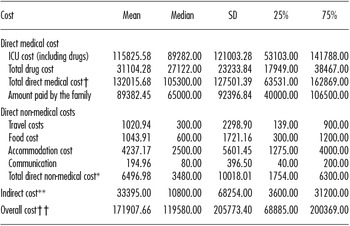
Cost data are summarized in Table 1. Total ICU cost (including drugs) was 67 percent of the total cost of hospitalization (Indian rupees [INR] 115,826/171,908; US$ 1,897/2,815). The average overall ICU cost per day was INR 15,556.00 (US$ 255; 95 percent CI 14808–16303; US$ 243–267), the cost being significantly (p = .0001) higher during the first 3 days of ICU admission (INR 19218; (US$ 315); 95 percent CI 16949–21486; US$ 278–352) than other days (INR 14690 (US$ 241); 95 percent CI, 13957–15424; US$ 229–253). There was no significant difference in cost between days 4 and 7, days 8 and 14, days 15 and 21 and over 21 days (ANOVA p = .97). The mean total drug cost was INR 31,104 (US$ 509; 95 percent CI, 26152–36237; US$ 428–593) and accounted for 18 percent of the total cost.
Summary of Cost DataFootnote a

a All costs are in rupees; * total direct non-medical cost is the sum of travel cost + food cost + accommodation cost + cost incurred for communication; ** wage loss by patient and patient's attendant; † total cost includes the cost of hospitalization along with cost of medications at discharge; †† Overall cost calculated as the sum of total direct medical cost + direct non-medical cost + indirect cost. 25% and 75% indicate the 25th and 75th percentile.
SD, standard deviation.
Willingness-to-Pay and Amount Paid
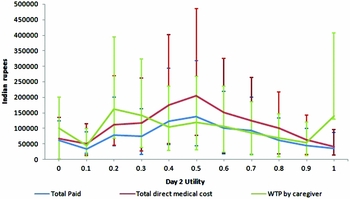
WTP by family provider on day 2 was INR 69,960 (US$ 1,146) 95 percent CI INR 66,486 to 73,434. The mean WTP by the family did not appear to be influenced by the utility score (Figure 1). The WTP by the family provider was substantially less than the average direct medical cost of treatment (INR 132,015; US$ 2,162) resulting in a subsidy burden of 47 percent (INR 62,055; US$ 1,017). The mean WTP for different socio-economic groups was as follows: upper lower was INR 61,155 (US$ 1,001), lower-middle was INR 47269 (US$ 774), upper-middle INR 49788 (US$ 815), and upper INR 48774 (US$ 798). However, this did not reach statistical significance when adjusted for day (p = .08). The final contribution by the family toward the hospital bill was INR 89383 (95 percent CI, 80953–97812) which was 67.7 percent of the direct medical cost. The remaining amount was subsidized by the institution.
Willingness-to-pay by family provider, total direct medical cost, and actual amount paid versus utility. Total direct medical cost, amount paid by the family provider, and willingness-to-pay (WTP) by the family provider were evaluated against utility scores. The total medical cost was highest for utility score of 0.5 and lower at extremes of utility score. The amount paid by the family provider also followed a similar pattern to total medical cost. The WTP was higher than the actual amount paid for lower utility scores (<0.4). For utility scores 0.4 and above, the WTP and amount paid were similar. All values are expressed as mean with 95 percent confidence interval (CI).

Utility
The baseline utility on day 2 varied from 0.1 to 1.0 (median 0.7; mean 0.67; 95 percent CI 0.65–0.68). There was a significant change in the utility score over time (ANOVA p = .0001). The likelihood-ratio to predict mortality increased as utility values decreased (Reference Thomas, Peter and Christina6).
Costing Determinants
There was a significant (ANOVA p = .0001) relationship between severity of illness as measured by day-2 utility score and cost. Those with low utility score (≤0.2) had significantly higher treatment cost/day (>INR 20000; US$ 328) than those with high (≥0.8) score (INR 12,000; US$ 197). Treatment cost was not related to the diagnosis (p = .35). On simple linear regression, direct medical cost was strongly associated with length of ICU stay (p = .0001) and day-2 utility score (p = .001).
DISCUSSION
In this cost descriptive study from a tertiary care private hospital in India, the average total cost of an ICU admission was US$ 2,818. A major part of this cost was direct medical expenses (77 percent) while indirect medical cost and direct nonmedical cost accounted for 19 percent and 4 percent, respectively. Treatment cost was significantly related to illness severity. The WTP amount by the family on day 2 of hospitalization worked out to be 53 percent of the direct medical cost. However, families mobilized, on an average, an additional US$ 319 to finally contribute 67.7 percent of the total direct medical cost. Approximately a third of the treatment cost was borne by the institution.
It is estimated that only approximately 10 percent of the ICU beds in India are in the public hospitals where treatment is free (Reference Divatia15). In the private sector, the daily cost of ICU care may be approximately 100 times the per capita income (Reference Divatia15). This compounded by the lack of health insurance and social security results in significant out of pocket expenses by the patient or the family. Because most patients cannot afford ICU treatment, they often pledge their land or jewelry or borrow at high interest and get into a debt trap. Thus the study of ICU cost and how it can be optimized is of paramount importance.
In India, ICU cost and outcome have received limited attention (Reference Shweta, Kumar, Gupta, Jindal and Kumar16–Reference Ahuja and Goswami20). In a study published in 1999 (Reference Parikh and Karnad18), the cost per patient per day was INR 1,973 (US$ 32) in a public hospital setting in India. In a more recent study in a respiratory ICU in North India published in 2013, cost was INR 10,364 (US$ 222 as per conversion rate at that time) per day (Reference Shweta, Kumar, Gupta, Jindal and Kumar16); similar to the average ICU cost of US$ 255 per day in the current study. It must, however, be emphasized that cost may vary depending on the geographical region, the type of ICU (medical, surgical), case-mix, severity of illness, and how costing was done.
In contrast to the study from North India (Reference Shweta, Kumar, Gupta, Jindal and Kumar16) where the components of costs were calculated as fixed cost (staff salaries, electricity, water) and variable cost (medications, equipment use), in our study direct medical cost was calculated as the sum of bed charges, professional fees (doctor's fee, nursing cost), investigations, and medications. Despite the differences in costing methodology in the two studies from India, treatment cost was similar (US$ 2,081 versus US$ 2,164). The assessment of indirect medical and nonmedical costs in our study, which works out to an additional cost of US$ 644 per patient adds another dimension and provides a more comprehensive estimate of the economic burden of a critical illness.
Cost must also be looked at in the context of family earnings. In our cohort, the family income was less than US$ 2,000 per annum in 62.8 percent; only 20.4 percent earned over US$ 4,000 per annum (Reference Thomas, Peter and Christina6). This probably reflects the setting of the institution in a semi-urban area with only 18 percent belonging to the upper SES class. The direct medical expense of US$ 2,081 was thus well beyond the reach of a majority. This is evident in the WTP assessments and the actual amount paid toward treatment which accounted for 53 percent and 67.7 percent of the total treatment cost, respectively. Although the quantum of subsidy in our hospital (private sector) of 32.3 percent was less than the subsidy in a public hospital (53.6 percent) in India (Reference Shweta, Kumar, Gupta, Jindal and Kumar16), this is likely to be due to differences in resource availability and allocation between public and private hospitals. In most public hospitals, the entire cost of treatment is fully met by the Government. However, in most private hospitals treatment costs are subsidized. The subsidy is usually met by channeling third party charity or through corporate subsidy as part of corporate social responsibility.
Some limitations merit mention. Actual wages lost and income of family provider were recorded as stated by the care-giver and not verified. Wages lost was calculated from previous wages. This limits the evaluation of contribution of house-wives and others who have no formal earning. This may have underestimated “indirect costs.” The results are probably confounded by other patient and family factors which were not accounted for or measured. These results may not be generalized to different ICU types (surgical ICU, coronary care units, trauma ICU, different age groups) and this is another concern.
In conclusion, this study provides a detailed analysis of cost of care in patients admitted to a medical ICU in India. The WTP amount bid by the family provider as well as the actual amount paid for treatment was inadequate to meet the actual cost of ICU treatment. Alternate methods for financing tertiary health care such as resource pooling mechanisms need urgent strengthening. There is need to develop systems for improving efficiency of allocation of scarce available funds to maximize benefit.
CONFLICTS OF INTEREST
There was no conflict of interest or financial disclosure for any of the authors.