1. Introduction
The molecular record indicates that deuterostomes, the animal clade including vertebrates, evolved sometime during the late Neoproterozoic (Erwin et al. Reference Erwin, Laflamme, Tweedt, Sperling, Pisani and Peterson2011; Dohrmann & Wörheide, Reference Dohrmann and Wörheide2017). While possible early deuterostomes have been described from the Fortunian Stage of China (Han et al. Reference Han, Conway Morris, Ou, Shu and Huang2017), and perhaps even the Ediacaran (Gehling, Reference Gehling1987; David et al. Reference David, Lefebvre, Mooi and Parsley2000), it seems that currently the most widely accepted first fossil occurrences of Deuterostomia are consigned to the Cambrian period. In particular, Stage 3 of the Cambrian period contains the first articulated echinoderms (Zamora et al. Reference Zamora, Lefebvre, Álvaro, Clausen, Elicki, Fatka, Jell, Kouchinsky, Jih-Pai, Nardin, Parsley, Rozhnov, Sprinkle, Sumrall, Vizcaino, Smith, Harper and Servais2013), as well as several soft-bodied taxa, including the chordates Shankouclava anningense Chen et al. (Reference Chen, Huang, Peng, Chi, Wang and Feng2003) and Myllokunmingia fengjaoa Shu et al. (Reference Shu, Luo, Conway Morris, Zhang, Hu, Chen, Han, Zhu, Li and Chen1999), and the vetulicolian Didazoon haoae Shu et al. (Reference Shu, Conway Morris, Han, Chen, Zhang, Zhang, Liu, Li and Liu2001b), from the Chengjiang biota.
When it comes to Laurentia, helicoplacoids from the Poleta Formation and equivalent units in western North America (Wilbur, Reference Wilbur2006) and edrioasteroids from Nevada (Durham, Reference Durham1967) comprise the most ancient members of the Deuterostomia. Prior to the present report, the earliest soft-bodied deuterostomes, represented by hemichordates and eldoniids, are found in the Spence Shale (Stage 5) of Utah (Conway Morris & Robison, Reference Conway Morris and Robison1988; Conway Morris et al. Reference Conway Morris, Halgedahl, Selden and Jarrard2015; LoDuca et al. Reference LoDuca, Caron, Schiffbauer, Xiao and Kramer2015). Some possible eldoniids have also been reported from the Echo Shale Member of the Carrara Formation (Series 2: Stage 4) of California (Lieberman et al. Reference Lieberman, Kurkewicz, Shinogle, Kimmig and MacGabhann2017); however, they may also represent cnidarians. If validated as eldonids, they would represent the first occurrence of that clade in Laurentia. Finally, a plethora of deuterostomes, including stem or perhaps crown group cephalochordates, have been found in the Burgess Shale (Smith, Sansom & Cochrane, Reference Smith, Sansom, Cochrane and Ahlberg2001; Caron, Conway Morris & Shu, Reference Caron, Conway Morris and Shu2010). One of these Burgess taxa directly apposite to the present report is Herpetogaster Caron, Conway Morris & Shu, Reference Caron, Conway Morris and Shu2010.
Here we describe the first appearance of the stalked presumptive filter feeder Herpetogaster collinsi Caron, Conway Morris & Shu (Reference Caron, Conway Morris and Shu2010) from the Pioche Formation of Nevada. This discovery not only extends the geographic range of the species to southern Laurentia, but also marks the first appearance of soft-bodied deuterostomes in the fossil record of Laurentia. As part of the work we also revisit the taxonomic affinities of the species.
2. Geological setting
The Pioche Formation is a regionally extensive deeper-water early to middle Cambrian unit in Nevada and Utah (Hintze, Reference Hintze1988; Palmer, Reference Palmer1998; Lieberman, Reference Lieberman2003; Webster, Gaines & Hughes, Reference Webster, Gaines and Hughes2008; Kimmig & Strotz, Reference Kimmig and Strotz2017). It ranges in age from the Arcuolenellus arcuatus biozone (Cambrian Series 2) to the Mexicella mexicana biozone (Cambrian Series 3) (Webster, Reference Webster2011). It was deposited on a west-facing slope, and is separated into six members (Palmer, Reference Palmer1998). The specimens described herein are from the Comet Shale Member.
The early and middle Cambrian (Series 2 – Series 3, Nephrolenellus multinodus – Eokochaspis nodosa biozones) Comet Shale Member of the Pioche Formation of Nevada, USA, contains a diverse soft-bodied fauna in at least two horizons (Lieberman, Reference Lieberman2003). Taxa preserved include the lower and upper stem-group euarthropods (sensu Ortega-Hernández, Reference Ortega-Hernández2016): Anomalocaris Whiteaves, Reference Whiteaves1892; Canadaspis Novozhilov, Reference Novozhilov and Orlov1960; and Tuzoia Walcott, Reference Walcott1912 (see Lieberman, Reference Lieberman2003). The lithostratigraphy and biostratigraphy of this member, which had once been informally referred to as the C-Shale Member, has been discussed in detail by Palmer (Reference Palmer1998), Sundberg & McCollum (Reference Sundberg and McCollum2000) and Lieberman (Reference Lieberman2003), and its taphonomy is discussed in Webster, Gaines & Hughes (Reference Webster, Gaines and Hughes2008) and Moore & Lieberman (Reference Moore and Lieberman2009).
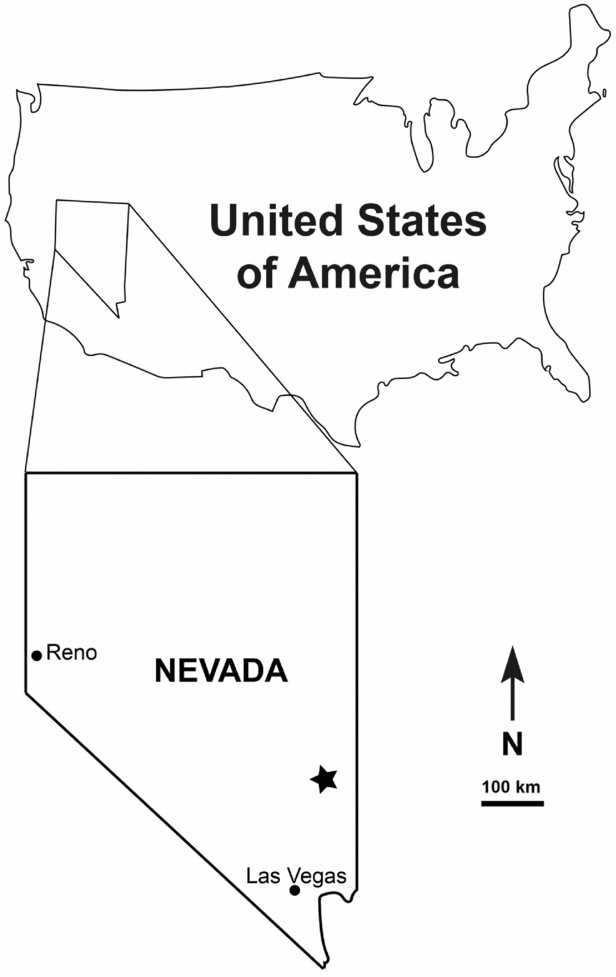
The unit is present in Lincoln County, SE Nevada, and the specimens described herein come specifically from what is known as the Ruin Wash Lagerstätte, on the west side of the Chief Range, 17 km west of Panaca (Fig. 1). The Comet Shale Member is an argillaceous clay shale which includes siltstone lenses and bioclastic limestones and varies in thickness from 17 m to 34 m regionally; the Herpetogaster specimens come from strata referable to the latest early Cambrian (Series 2, Stage 4, Nephrolenellus multinodus biozone).
Location of the Pioche Formation locality (asterisk; 37.774N, 114.694W), Ruin Wash Lagerstätte, on the west side of the Chief Range, 17 km west of Panaca.

Soft-bodied specimens are rare, typically preserved as thin, biomineralized films (Moore & Lieberman, Reference Moore and Lieberman2009; Broce & Schiffbauer, Reference Broce and Schiffbauer2017; Kimmig & Strotz, Reference Kimmig and Strotz2017) and often occur alongside the locally abundant trilobites (Lieberman, Reference Lieberman2003; Webster, Gaines & Hughes, Reference Webster, Gaines and Hughes2008).
3. Material and methods
The 16 specimens of Herpetogaster collinsi described in this paper are housed in the Division of Invertebrate Paleontology, Biodiversity Institute, University of Kansas (KUMIP). Specimens with the prefix ROM are housed in the Royal Ontario Museum, Ontario, Canada.
Specimens were imaged under alcohol with and without polarized light using a Canon EOS 7D Mark II digital SLR camera equipped with a 50 mm macro lens. The contrast, colour and brightness of images were adjusted using Adobe Photoshop. Line drawings were created in Adobe Illustrator.
4. Systematic paleontology
Deuterostomia Grobben, Reference Grobben1908
?Superphylum Ambulacraria Metschnikoff Reference Metschnikoff1881
Unranked Clade Cambroernida Caron, Conway Morris & Shu, Reference Caron, Conway Morris and Shu2010
Herpetogaster Caron, Conway Morris & Shu, Reference Caron, Conway Morris and Shu2010
Diagnosis. As for species.
Herpetogaster collinsi Caron, Conway Morris & Shu, Reference Caron, Conway Morris and Shu2010
Figures 2, 3
Holotype. ROM 58051
Material. KUMIP 482878–482893
Diagnosis. Segmented body, coiled dextrally. Short head bearing prominent bilateral anterior dendritic tentacles of sub-equal length and in two-by-two arrangement with pharyngeal structures, possibly lateral pores. Trunk sub-cylindrical, divided into two subsections, narrowing posteriorly. Ventral and contractile adhesive stolon, sometimes with terminal disc. Digestive tract with anterior mouth, pharynx, voluminous stomach, and narrow intestine with terminal anus. Stomach and intestine of sub-equal lengths, un-looped, with triangular mesenterial insertions. (from Caron, Conway Morris & Shu, Reference Caron, Conway Morris and Shu2010)
Occurrence. Pioche Formation, Comet Shale Member; early Cambrian (Series 2, Stage 4), Nephrolenellus multinodus biozone; Ruin Wash, NW ¼ SW ¼ sec. 15, R65E T2S, 17 km west of Panaca, Lincoln County, Nevada (see Palmer, Reference Palmer1998 and Lieberman, Reference Lieberman2003 for greater discussion of the locality). Burgess Shale and Stephen Shale Formations; middle Cambrian (Series 3, Stage 5); Yoho and Kootenay National Parks, British Columbia, Canada.
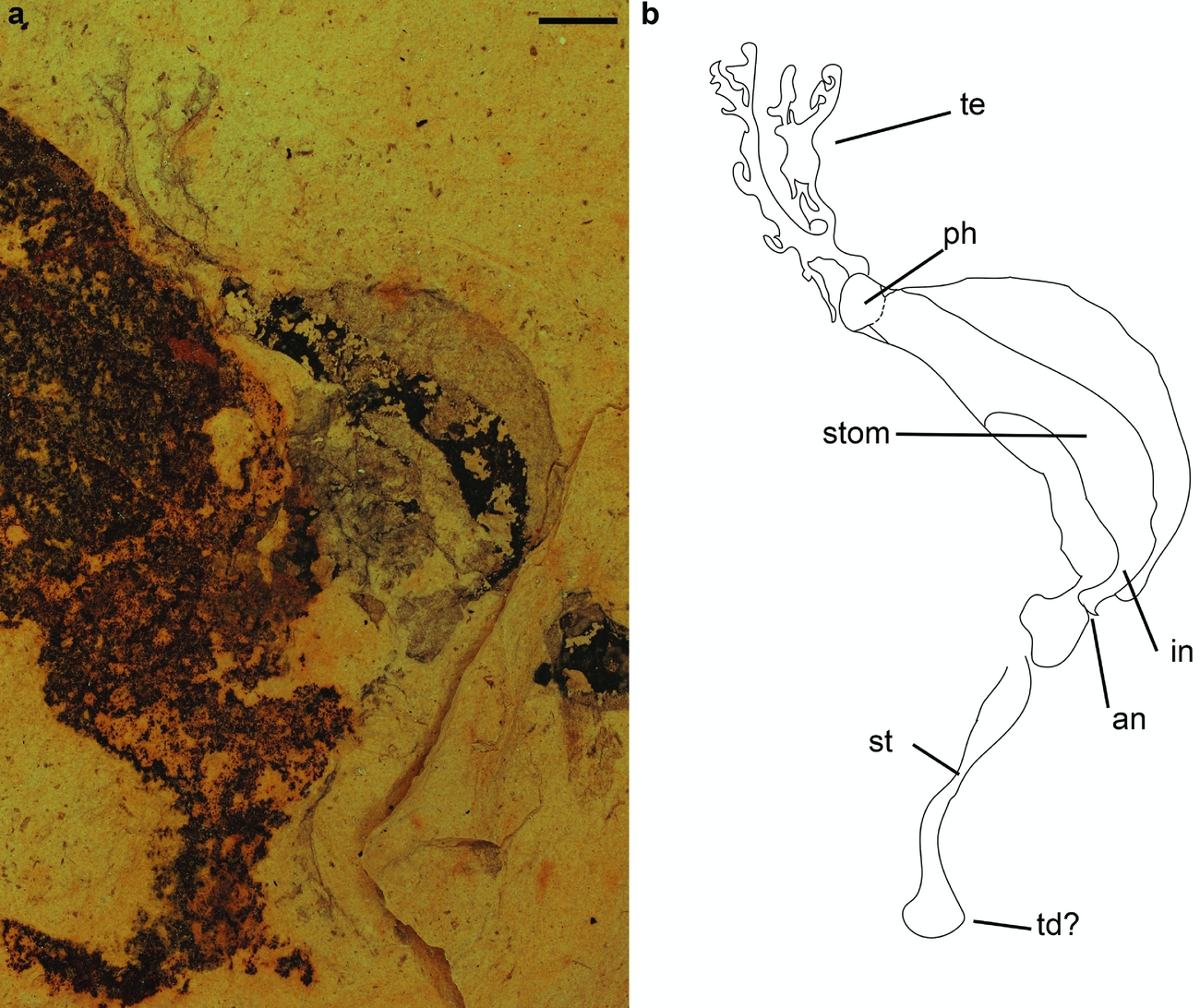
Description. The body of the most complete specimen (KUMIP 482878) is 25 mm long and 10 mm wide; it is the only specimen that preserves the head. The body is curved, shows fine segmentation along the trunk, and ends in an anus.
The head is 4 mm long, 3 mm wide, and preserves part of the pharynx (Fig. 2). A tentacle emerges from the corner of the head; it is 15 mm long, bifurcates at c. 3 mm and preserves at least eight branches. Secondary mineral precipitation is covering the area where the second tentacle should be preserved.
Herpetogaster collinsi from the Pioche Formation (Cambrian, Series 2, Stage 4), Ruin Wash Lagerstätte, Lincoln County, Nevada, USA. (a) The most complete specimen (KUMIP 482878), dorso-ventrally preserved. (b) Interpretative drawing of KUMIP 482878. Scale bar: 5 mm. an = anus; in = intestine; ph = pharynx; st = stolon; stom = stomach; td? = putative terminal disc; te = tentacle.
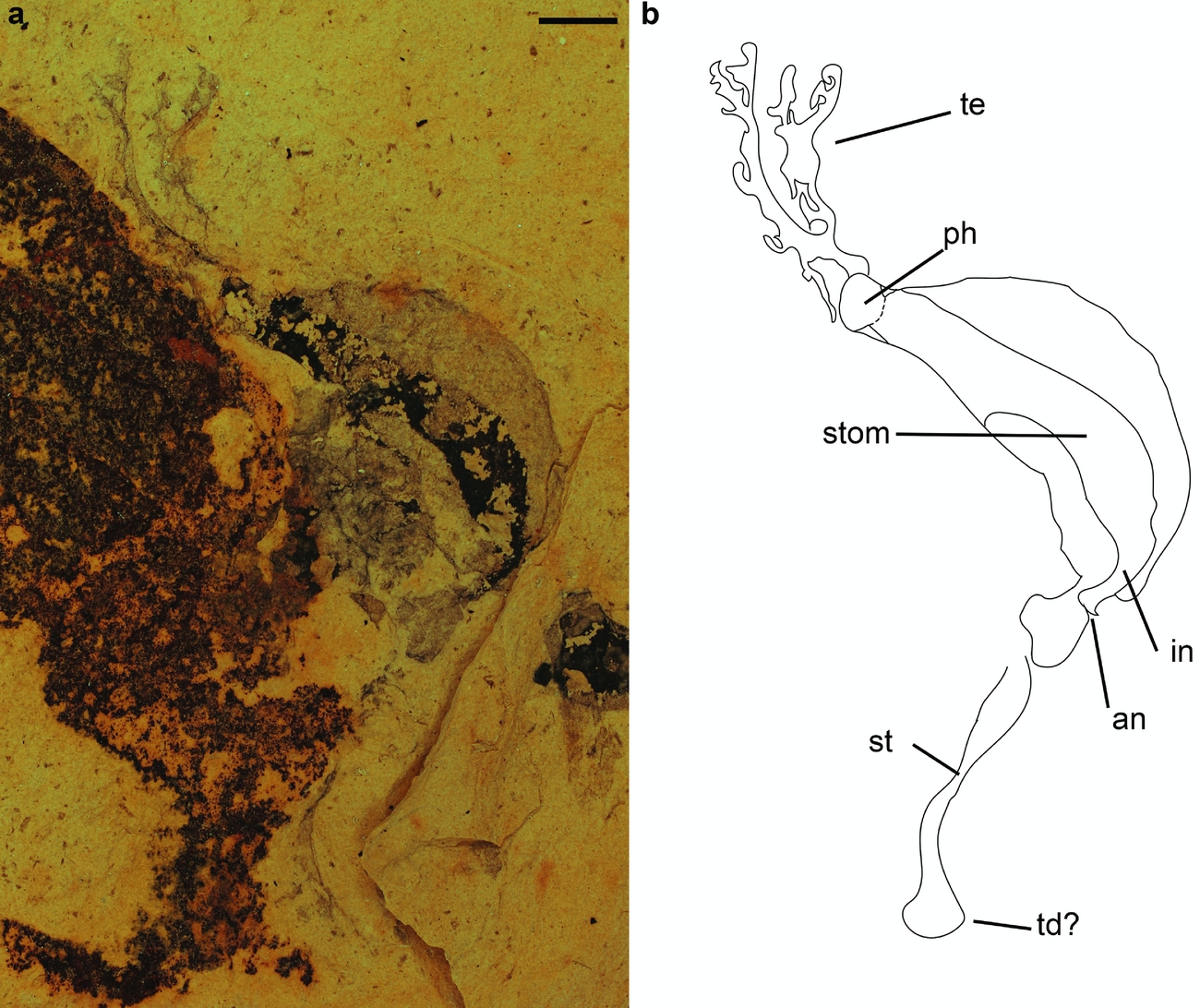
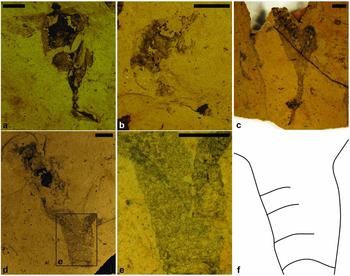
The trunk represents about three-quarters of the animals’ total body length and is dominated by a darker structure, interpreted to be the stomach (Figs 2, 3a, b), which ranges from the pharynx to the last 5 mm of the body and occupies about half the space of the trunk. The darker preservation suggests it was an interior structure. One specimen preserves a thinner dark structure near the distal end, which is interpreted as the intestines (Fig. 2). The lighter mineral film surrounding the stomach preserves little structure, but fine segmentation (Fig. 3e, f) can be observed in four specimens (KUMIP 482878b, 482881, 482883, 482887).
Herpetogaster collinsi from the Pioche Formation (Cambrian, Series 2, Stage 4), Ruin Wash Lagerstätte, Lincoln County, Nevada, USA. All specimens are dorso-ventrally preserved. (a) KUMIP 482879, preserving the lower part of the stomach and parts of the intestine. (b) KUMIP 482880, preserving the central part of the stomach. (c) KUMIP 482885, preserving the lower part of the stomach and the stolon. (d) KUMIP 482883, preserving the lower part of the stomach, segmentation, and parts of the stolon. (e) Close-up of the fine segmentation preserved in KUMIP 482883. (f) Interpretative drawing of (e). Scale bars: 5 mm.

The stolon extends from the last third of the trunk (Fig. 3c, d), is variably wide (1–5 mm) and has no apparent division into an inner and outer layer. There is evidence for a poorly preserved terminal disc in one specimen (Fig. 2).
Remarks. The Pioche specimens appear to be nearly identical to the specimens described from the Burgess Shale by Caron, Conway Morris & Shu (Reference Caron, Conway Morris and Shu2010), as they preserve the dextrally coiled body, anterior dendritic tentacles, pharyngeal structures, stolon, terminal disc and digestive tract. The tentacle of the Pioche specimen preserves fractal-like branching, similar to the Burgess Shale specimens. Although the segmentation is not as prominent, this is likely a diagenetic or taphonomic artefact (e.g. Kimmig & Pratt, Reference Kimmig and Pratt2016), and fine segmentation lines are preserved in four specimens. Alternatively, the fine lines might represent superficial annulations, as can be observed in priapulimorphs or Palaeozoic lobopodians from other exceptional fossiliferous sites (e.g. Yang et al. Reference Yang, Ortega-Hernández, Gerber, Butterfield, Hou, Lan and Zhang2015). It could not be verified that the stolon extends from the ninth trunk segment, as in the Burgess Shale specimens, but it does extend from the same general area of the trunk. The largest slab preserves four specimens (Fig. S1 in Supplementary Material, available online at https://doi.org/10.1017/S0016756818000389), in dorso-ventral profile, and this might suggest a gregarious lifestyle, as has been proposed for the Burgess Shale specimens (Caron, Conway Morris & Shu, Reference Caron, Conway Morris and Shu2010).
5. Discussion and conclusions
5.a. Affinities of Herpetogaster
Stalked filter feeders are problematic Cambrian fossils and represent a polyphyletic assemblage of organisms that have been described from a variety of Burgess Shale-type deposits including: the Chengjiang biota (e.g. Dinomischus venustus Chen, Hou & Hao-Zhi, Reference Chen, Hou and Hao-Zhi1989; Phlogites longus Luo & Hu in Luo et al. Reference Luo, Hu, Chen, Zhang and Tao1999; and Cotyledion tylodes Luo & Hu in Luo et al. Reference Luo, Hu, Chen, Zhang and Tao1999); the Kaili biota (e.g. Dinomischus sp. Peng, Zhao & Lin, Reference Peng, Zhao and Lin2006); the Burgess Shale (e.g. Dinomischus isolatus Conway Morris, Reference Conway Morris1977; Herpetogaster collinsi Caron, Conway Morris & Shu, Reference Caron, Conway Morris and Shu2010; Lyracystis radiata Sprinkle, Reference Sprinkle1973; Priscansermarinus barnetti Collins & Rudkin, Reference Collins and Rudkin1981; and Siphusauctum gregarium O'Brien & Caron, Reference O'Brien and Caron2012); the Wheeler Formation (Thylacocercus ignota Halgedahl et al. in Conway Morris et al. Reference Conway Morris, Halgedahl, Selden and Jarrard2015); and the Spence Shale (Siphusauctum lloydguntheri Kimmig, Strotz & Lieberman, Reference Kimmig, Strotz and Lieberman2017). Some have been treated as arthropods (e.g. P. barnetti, see Collins & Rudkin, Reference Collins and Rudkin1981); others currently have unknown affinities (e.g. Siphusauctum gregarium, see O'Brien & Caron, Reference O'Brien and Caron2012 and Kimmig, Strotz & Lieberman, Reference Kimmig, Strotz and Lieberman2017). However, several have been treated as deuterostomes. Some are inferred to be within the crown of that clade, e.g. the echinoderm L. radiata (see Sprinkle, Reference Sprinkle1973). Others, by contrast, are held to be more basal representatives of the clade, e.g. Phlogites longus and Thylacocercus ignota (see Caron, Conway Morris & Shu, Reference Caron, Conway Morris and Shu2010 and Conway Morris et al. Reference Conway Morris, Halgedahl, Selden and Jarrard2015, respectively).
Herpetogaster collinsi was placed by Caron, Conway Morris & Shu (Reference Caron, Conway Morris and Shu2010) within the unranked primitive deuterostome stem-group Cambroernids, together with Phlogites longus and eldoniids; this interpretation has been followed by others (e.g. MacGabhann, Reference MacGabhann2012; Han et al. Reference Han, Conway Morris, Ou, Shu and Huang2017; Hou et al. Reference Hou, Siveter, Siveter, Aldridge, Cong, Gabbott, Ma, Purnell and Williams2017). While eldoniids are not attached to the seafloor via a stem, they were considered relatives of Herpetogaster collinsi based on the oral tentacles and the curved gut (Caron, Conway Morris & Shu, Reference Caron, Conway Morris and Shu2010). The Pioche specimens support the close relationship between Herpetogaster, Phlogites and eldoniids, as they preserve the clockwise curved gut, as well as the tentacles.
Caron, Conway Morris & Shu (Reference Caron, Conway Morris and Shu2010) also discussed the possibility that Herpetogaster might be related to extant (or extinct) hemichordates, echinoderms or stem group ambulacrarians, such that there is no need to repeat their detailed discussion. However, one additional possible deuterostome affinity for the taxon that does bear mentioning involves urochordates. Although we identify no definitive synapomorphies linking H. collinsi with these, there are some congruences in overall form and in the appearance of particular structures, though at this time any concrete suggestion of affinity would be premature and is not endorsed herein. Consider the urochordate Class Ascidiacea. Among fossil ascidians, Cheungkongella ancestralis Shu et al. Reference Shu, Chen, Han and Zhang2001a from the Chengjiang biota has a club-shaped body encased within a structure that Shu et al. (Reference Shu, Chen, Han and Zhang2001a) interpreted as a tunic; the main body bears a large oral siphon with short tentacles, a pharynx, a small cloacal siphon and a possible larval tail (Shu et al. Reference Shu, Chen, Han and Zhang2001a). The overall shape of the body of H. collinsi differs from that of C. ancestralis; further, the oral tentacles are much larger in the former than the latter. No small cloacal siphon appears to be present in H. collinsi (though see discussion of the siphon below). It is also difficult to determine whether a tunic is present in H. collinsi.
The shape of H. collinsi does resemble that of some modern ascidians, though these modern taxa display tremendous variation in body form (Ruppert & Barnes, Reference Ruppert and Barnes1993; Brusca & Brusca, Reference Brusca and Brusca2003). Further, in H. collinsi no larval tail is visible and the oral tentacles are much longer than would be expected. Indeed, the form of the tentacles in H. collinsi is quite different than what might be expected of an ascidian; for instance, these are extensive and branching in the former, as opposed to the typically shorter fringe of oral tentacles, often in a circlet, expected in the latter (see Ruppert & Barnes, Reference Ruppert and Barnes1993; Brusca & Brusca, Reference Brusca and Brusca2003). The structure interpreted as the stolon of H. collinsi (Fig. 3a–d) is reminiscent of the shape and structure of an ascidian oral siphon. Further, each of these appears to be ringed by a distinctive and prominently visible circular musculature (see Ruppert & Barnes, Reference Ruppert and Barnes1993; Brusca & Brusca, Reference Brusca and Brusca2003). This structure, however, is interpreted to be on the posterior end of the body of H. collinsi, which is inconsistent with an ascidian siphon, so at this time these similarities are not treated as homologous. Still, it bears mentioning that colonial ascidians can have stolons (Brusca & Brusca, Reference Brusca and Brusca2003). Longitudinal muscles expected of ascidians are not visible in H. collinsi. It is also conceivable that the structure interpreted as the gut of H. collinsi could instead be reinterpreted as an ascidian pharynx. (Pharyngeal gill slits are not visible in H. collinsi, but they probably would not be expected to be visible given the preservational style of the material.)
The specimens described herein differ fundamentally from the Cambrian proposed ascidian Palaeobotryllus taylori Müller, Reference Müller1977 from Nevada, and material from N and S China Lehnert, Miller & Cochrane (Reference Lehnert, Miller and Cochrane1999) referred to this species, since it is interpreted as a colonial microfossil, or a rudimentary corallite (Baliński, Sun & Dzik, Reference Baliński, Sun and Dzik2012), and is divided into units of 6–18 irregular, radially arranged individuals (Müller, Reference Müller1977). In addition, the presumed absence of a notochord and tail suggests that H. collinsi does not belong to the urochordate Class Larvacea (Ruppert & Barnes, Reference Ruppert and Barnes1993; Brusca & Brusca, Reference Brusca and Brusca2003). It is also unlikely that H. collinsi belongs to the urochordate Class Thaliacea, as it differs from these in many features, including the fact that it does not appear to have siphons at opposite ends of the body.
5.b. Soft-bodied deuterostomes in Laurentia
Deuterostomes make their first appearance in the fossil record in the early Cambrian (Fig. S2 in supplementary material, available online at https://doi.org/10.1017/S0016756818000389) of Gondwana (Zamora et al. Reference Zamora, Lefebvre, Álvaro, Clausen, Elicki, Fatka, Jell, Kouchinsky, Jih-Pai, Nardin, Parsley, Rozhnov, Sprinkle, Sumrall, Vizcaino, Smith, Harper and Servais2013; Han et al. Reference Han, Conway Morris, Ou, Shu and Huang2017), maybe as early as the Tommotian in the form of conodonts (Azmi & Pancholi, Reference Azmi and Pancholi1983; Mathur et al. Reference Mathur, Shome, Nath and Babu2014). The first undoubted deuterostomes in Laurentia are echinoderms of the helicoplacoid clade from the western United States (Zamora et al. Reference Zamora, Lefebvre, Álvaro, Clausen, Elicki, Fatka, Jell, Kouchinsky, Jih-Pai, Nardin, Parsley, Rozhnov, Sprinkle, Sumrall, Vizcaino, Smith, Harper and Servais2013); conodonts do not appear until Stage 3 or 4 of the Cambrian in Laurentia (Landing, Reference Landing1974; Skovsted & Peel, Reference Skovsted and Peel2001). The oldest soft-bodied deuterostomes occur in the early Cambrian Chengjiang biota of China (Shu et al. Reference Shu, Chen, Han and Zhang2001a, Reference Shu, Conway Morris, Han, Chen, Zhang, Zhang, Liu, Li and Liub; Reference Shu, Conway Morris, Han, Zhang and Liu2004; Caron, Conway Morris & Shu, Reference Caron, Conway Morris and Shu2010; Han et al. Reference Han, Conway Morris, Ou, Shu and Huang2017; Hou et al. Reference Hou, Siveter, Siveter, Aldridge, Cong, Gabbott, Ma, Purnell and Williams2017), while the oldest soft-bodied deuterostomes in Laurentia were thought to have been from the Spence Shale (Series 3, Stage 5 of the Cambrian) of northern Utah (Conway Morris et al. Reference Conway Morris, Halgedahl, Selden and Jarrard2015). However, the specimens of Herpetogaster collinsi from the Pioche extend the range of these animals back to Series 2, Stage 4 of the Cambrian. Thus, they significantly expand the range of the species in time and space (previously they were only known from the Burgess Shale). The specimens also constitute the first appearance of stalked filter feeders in Laurentia (and the first non-echinoderm deuterostomes recovered from the Pioche). The presence of stalked filter feeders in the Pioche suggests that the communities in the late early Cambrian of Laurentia are more similar to their middle Cambrian counterparts than previously thought (e.g. Holmes, García-Bellido & Lee, Reference Holmes, García-Bellido and Lee2018). Notably, it is conceivable that soft-bodied deuterostomes in Laurentia might have an even more ancient first occurrence than H. collinsi, as discoidal fossils from the Echo Shale Member of the Carrara Formation (still within Stage 4 of the Cambrian, but lower stratigraphically) might represent eldoniids (Lieberman et al. Reference Lieberman, Kurkewicz, Shinogle, Kimmig and MacGabhann2017), and eldoniids have been interpreted as primitive deuterostomes by Conway Morris (Reference Conway Morris1993), Caron, Conway Morris & Shu (Reference Caron, Conway Morris and Shu2010) and MacGabhann (Reference MacGabhann2012). Moreover, Caron, Conway Morris & Shu (Reference Caron, Conway Morris and Shu2010) suggested that eldoniids might share close affinities with Herpetogaster collinsi.
Acknowledgements
This research was supported by a Paleontological Society Arthur James Boucot Research Grant to J.K. and NSF grants ADBC-1206757 and DBI-1602067 to BSL. The editor Paul Upchurch is thanked for the handling of the manuscript and the reviewers, Javier Ortega-Hernández and Stephen Pates, are thanked for their comments, which greatly improved the manuscript.
Supplementary material
To view supplementary material for this article, please visit https://doi.org/10.1017/S0016756818000389.