Introduction
Borderline personality disorder (BPD) is a complex and serious mental disorder that is characterized by intense and rapidly changing mood states, impulsivity, self-injurious behaviors, fear of abandonment, unstable relationships and self-image (First et al. Reference First, Spitzer, Gibbon and Williams1997). Patients with BPD often suffer from co-morbid axis I disorders, with mood disorders and anxiety disorders being the most prominent ones (Zanarini et al. Reference Zanarini, Frankenburg, Dubo, Sickel, Trikha, Levin and Reynolds1998). Of note, ‘complex co-morbidity’ (i.e. multiple and shifting co-morbid disorders) was found to have strong predictive power for the borderline diagnosis (Zanarini et al. Reference Zanarini, Frankenburg, Dubo, Sickel, Trikha, Levin and Reynolds1998). Furthermore, patients with BPD frequently report early, multiple and chronic adverse or even traumatic experiences, such as repeated sexual or physical abuse or emotional or physical neglect (Zanarini et al. Reference Zanarini, Williams, Lewis, Reich, Vera, Marino, Levin, Yong and Frankenburg1997; Golier et al. Reference Golier, Yehuda, Bierer, Mitropoulou, New, Schmeidler, Silverman and Siever2003).
Because early life stress and traumatization are major risk factors for the development and persistence of mental disorders, many studies have investigated the functioning of the hypothalamic–pituitary–adrenal (HPA) axis in major depressive disorder (MDD) and post-traumatic stress disorder (PTSD). Although there is evidence for enhanced cortisol release and reduced negative-feedback sensitivity in MDD, PTSD seems to be characterized by reduced cortisol release and enhanced feedback sensitivity (Plotsky et al. Reference Plotsky, Owens and Nemeroff1998; Pariante & Miller, Reference Pariante and Miller2001; Yehuda, Reference Yehuda2002). In BPD there is increasing evidence that alterations in HPA activity may contribute to the disorder (Wingenfeld et al. Reference Wingenfeld, Spitzer, Rullkotter and Löwe2010b). Similarly, enhanced basal cortisol concentrations and reduced feedback sensitivity have been reported for BPD patients (Rinne et al. Reference Rinne, de Kloet, Wouters, Goekoop, DeRijk and van den Brink2002a; Lieb et al. Reference Lieb, Rexhausen, Kahl, Schweiger, Philipsen, Hellhammer and Bohus2004; Wingenfeld et al. Reference Wingenfeld, Driessen, Adam and Hill2007a, Reference Wingenfeld, Hill, Adam and Driessenb). However, the findings are heterogeneous and it has been hypothesized that co-morbid symptomatology might play a role (Wingenfeld et al. Reference Wingenfeld, Spitzer, Rullkotter and Löwe2010b).
Alterations of HPA axis feedback regulation have been interpreted in terms of altered glucocorticoid receptor (GR) function (Holsboer, Reference Holsboer2000; Yehuda, Reference Yehuda2009; Rohleder et al. Reference Rohleder, Wolf and Wolf2010). Cortisol acts by binding to mineralocorticoid receptors (MRs) and GRs (de Kloet, Reference de Kloet2003). These receptors show a high density in the hippocampus and the prefrontal cortex (Lupien & Lepage, Reference Lupien and Lepage2001; de Kloet, Reference de Kloet2003), which are closely related to cognitive functions. In healthy participants there is evidence that acute glucocorticoid (GC) administration impairs memory retrieval (Wolf, Reference Wolf2003, Reference Wolf2009). It has also been observed that cortisol administration leads to poorer working memory performance (Lupien et al. Reference Lupien, Gillin and Hauger1999).
In patients with BPD the effects of cortisol on memory have not yet been investigated. In a recent study we found that in PTSD patients, in contrast to healthy controls, administration of hydrocortisone enhances rather than impairs memory retrieval (Wingenfeld et al. Reference Wingenfeld, Driessen, Terfehr, Schlosser, Fernando, Otte, Beblo, Spitzer, Löwe and Wolf2012). The results were independent from co-morbid borderline features of the patients. Our findings are in line with another study in PTSD patients (Yehuda et al. Reference Yehuda, Harvey, Buchsbaum, Tischler and Schmeidler2007) but others disagree (Bremner et al. Reference Bremner, Vythilingam, Vermetten, Afzal, Nazeer, Newcomer and Charney2004; Grossman et al. Reference Grossman, Yehuda, Golier, McEwen, Harvey and Maria2006; Yehuda et al. Reference Yehuda, Golier, Bierer, Mikhno, Pratchett, Burton, Makotkine, Devanand, Pradhaban, Harvey and Mann2010). We have also shown, in a series of studies with patients with MDD, that cortisol administration did not influence declarative memory retrieval and working memory (Schlosser et al. Reference Schlosser, Wolf, Fernando, Riedesel, Otte, Muhtz, Beblo, Driessen, Löwe and Wingenfeld2010; Terfehr et al. Reference Terfehr, Wolf, Schlosser, Fernando, Otte, Muhtz, Beblo, Driessen, Spitzer, Löwe and Wingenfeld2011a, Reference Terfehr, Wolf, Schlosser, Fernando, Otte, Muhtz, Beblo, Driessen, Spitzer, Löwe and Wingenfeldb).
The aim of the current study was to investigate the effects of cortisol administration on memory in patients with BPD. To test several domains of memory, an autobiographical memory test (AMT) and a word list paradigm to investigate declarative memory were conducted, along with a working memory test. Because of the different patterns of cortisol effects on memory in MDD and PTSD, and given that these co-morbid disorders may contribute to HPA axis dysregulations in BPD, we further aimed to investigate the impact of co-morbid MDD and PTSD. Given the high prevalence of traumatic experiences in BPD, we hypothesized that BPD patients would show enhanced memory retrieval after cortisol, as was shown recently in PTSD patients. On the contrary, BPD patients with co-morbid MDD might show no effects of cortisol on memory, whereas in healthy controls, cortisol administration would lead to an impairment in memory performance.
Method
Participants
Seventy-one women with BPD and 40 healthy control women aged ⩾18 years participated. Thirty-six of the control participants were part of a former study by our group (Terfehr et al. Reference Terfehr, Wolf, Schlosser, Fernando, Otte, Muhtz, Beblo, Driessen, Spitzer, Löwe and Wingenfeld2011b), as were 21 of the patients, that is BPD patients with co-morbid PTSD (Wingenfeld et al. Reference Wingenfeld, Driessen, Terfehr, Schlosser, Fernando, Otte, Beblo, Spitzer, Löwe and Wolf2012). The BPD + PTSD subgroup of our former PTSD study was also included in this study as a comparison group for the 50 BPD patients without PTSD (BPD–PTSD) who were recruited exclusively for this study.
Participants were excluded if they had any of the following medical conditions: central nervous system (CNS) diseases or severe somatic diseases, metabolic diseases, organic shift in cortisol secretion, immune-mediated diseases, medicated hypertension, current infections, or pregnancy. Further exclusion criteria were anorexia, schizophrenia, alcohol or drug dependence, bipolar disorder, schizo-affective disorder, major depression with psychotic symptoms (all assessed by the SCID), attention deficit hyperactivity disorder (ADHD) or cognitive impairment. Intake of antidepressants did not lead to exclusion.
Written informed consent was obtained from all participants. Healthy participants were recruited by local advertisement and received financial remuneration (100 €). The study was approved by the Ethics Committees of the University of Muenster and the Medical Council of Hamburg.
Procedure
To assess psychiatric diagnoses we used SCID-I and SCID-II (First et al. Reference First, Spitzer, Gibbon and Williams1997). PTSD symptoms (patients only) were assessed with the Post-traumatic Stress Diagnostic Scale (PDS; Foa, Reference Foa1995), depressive mood state was measured using the Beck Depression Inventory (BDI; Beck & Steer, Reference Beck and Steer1994) and childhood trauma was assessed with the Childhood Trauma Questionnaire (CTQ; Bernstein et al. Reference Bernstein, Stein, Newcomb, Walker, Pogge, Ahluvalia, Stokes, Handelsman, Medrano, Desmond and Zule2003; Wingenfeld et al. Reference Wingenfeld, Spitzer, Mensebach, Grabe, Hill, Gast and Driessen2010a).
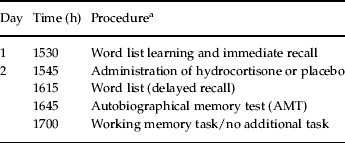
In this placebo-controlled cross-over study, each participant was tested twice with parallel versions of a word list paradigm and an AMT. All tests were taken in the afternoon. The two versions of the tests were counterbalanced across the test conditions. On the first day all participants learned the word list. On the second day, 30 min after administration of 10 mg hydrocortisone (Jenapharm®, Germany) or placebo, the participants were asked to recall the words from the word list, and then the AMT was performed. The working memory task (using the Word Suppression Test, WST; Terfehr et al. Reference Terfehr, Wolf, Schlosser, Fernando, Otte, Muhtz, Beblo, Driessen, Spitzer, Löwe and Wingenfeld2011b) was only tested once in each participant after hydrocortisone or placebo, that is a between-subjects design was realized. The participants were tested in a quiet room and were only allowed to drink water. The same procedure with the alternate test condition (hydrocortisone/placebo) was repeated after 1 week (see Table 1).
Experimental protocol indicating time of cognitive testing
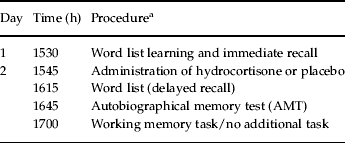
a One week later the study protocol was repeated using the alternate condition (hydrocortisone/placebo) and parallel versions of the memory tests.
Memory tasks
A modified version of the AMT (Buss et al. Reference Buss, Wolf, Witt and Hellhammer2004) was applied. The word list paradigm consisted of 21 words. For a detailed description of the tests see Wingenfeld et al. (Reference Wingenfeld, Driessen, Terfehr, Schlosser, Fernando, Otte, Beblo, Spitzer, Löwe and Wolf2012). To test working memory, we administered the self-developed WST (Terfehr et al. Reference Terfehr, Wolf, Schlosser, Fernando, Otte, Muhtz, Beblo, Driessen, Spitzer, Löwe and Wingenfeld2011b). The WST consists of two parts, one with negative and one with neutral interference words. Each part consists of 14 recorded trials with a series of alternately presented digits and interference words, which are presented verbally. The participants have to memorize the digits but ignore the interference words.
Statistical analysis
Statistical analyses were performed using SPSS version 18.0 (SPSS Inc., USA). Demographic data were analyzed using Pearson's χ2 test for categorical data and Student's t test for continuous data. The effects of hydrocortisone on memory performance (word list, AMT) were analyzed using an ANCOVA with repeated measurements and a univariate ANCOVA (working memory test).
Results
Demographic and clinical data
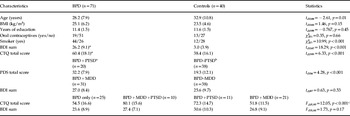
Demographic and clinical data are presented in Table 2. Patients with BPD and healthy controls were comparable in body mass index (BMI), years of education and intake of oral contraceptives. The BPD patients were younger than the controls and there were more smokers in the patient group. Patients had a significantly higher depression score and they reported more childhood trauma. Patients with co-morbid PTSD had higher PDS scores whereas patients with and without co-morbid MDD did not differ regarding BDI scores.
Sociodemographic and clinical characteristics

BPD, Borderline personality disorder; BMI, body mass index; BDI, Beck Depression Inventory; CTQ, Childhood Trauma Questionnaire; PDS: Post-traumatic Stress Diagnostic Scale; PTSD, post-traumatic stress disorder; MDD, major depressive disorder.
a Two patients did not answer the BDI, four patients did not answer the CTQ, one patient with PTSD did not answer the PDS.
b Twenty-two of the patients had no trauma as asked in the PDS.
c Bonferroni post-hoc test: BPD only = BPD + MDD <BPD + PTSD = BPD + MDD + PTSD.
For the second part of our study we examined the effect of co-morbid MDD and PTSD with BPD: 23 BPD patients suffered from co-morbid MDD (BPD + MDD) and 11 from co-morbid PTSD (BPD + PTSD). A further 10 patients had both co-morbid disorders (BPD + MDD + PTSD) whereas 27 had neither MDD nor PTSD (BPD). The subgroup of BPD patients with co-morbid MDD but without co-morbid PTSD had the lowest CTQ score whereas the two subgroups with co-morbid PTSD had the highest scores for self-reported trauma (Table 2). BDI scores did not differ between the groups. In addition, the following axis I disorders were diagnosed: anxiety disorder apart from PTSD (n = 13), pain disorder (n = 1), eating disorder (n = 7), and alcohol abuse (n = 1).
The patients took the following psychiatric medications: selective serotonin reuptake inhibitor (SSRI) n = 22, selective noradrenergic and serotonergic reuptake inhibitor n = 18, neuroleptics n = 17, selective noradrenergic reuptake inhibitor n = 1, tricyclic antidepressant n = 1, anticonvulsive n = 1. Sixteen patients took more than one drug; 31 of the patients were medication free.
Memory retrieval
AMT
A repeated-measures 2 × 2 ANCOVA was conducted with the main factors group (BPD patients versus healthy controls) and condition (placebo versus hydrocortisone). Intake of oral contraceptives (p = 0.40) and smoking (p = 0.36) as additional factors had no effects and were excluded from the analyses. Age was introduced as a covariate because of its significant impact (p = 0.013).
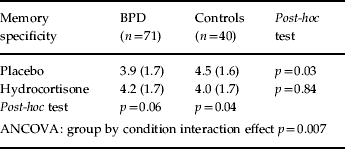
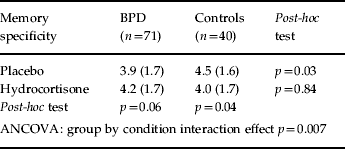
There was a significant group by condition interaction effect (F 1,108 = 7.628, p = 0.007) but no effect of the main factors group (p = 0.22) and condition (p = 0.95). A post-hoc univariate ANCOVA showed that the control group performed better than the BPD patients after placebo (F 1,108 = 4.616, p = 0.03) but not after hydrocortisone (p = 0.84). Post-hoc ANOVAs with repeated measures performed separately for each group revealed a significant effect of condition in the control group (F 1,39 = 4.418, p = 0.04) and a trend significant effect in the BPD group (F 1,70 = 3.610, p = 0.06). Table 3 shows that the specificity of memory retrieval was impaired after hydrocortisone compared to placebo in the control group but enhanced in the BPD group.
Autobiographical memory test (AMT): specificity of memory retrieval in patients with borderline personality disorder (BPD) and healthy controls
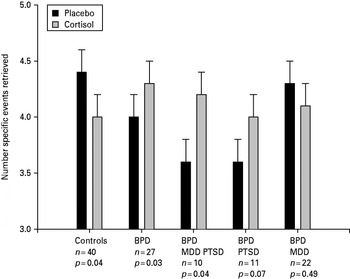
To analyze the impact of co-morbid PTSD and MDD, a repeated-measures 5 × 2 ANCOVA was performed. Age served as a covariate (p = 0.017). Five subgroups were compared: healthy controls (n = 40), BPD patients without PTSD and MDD (n = 27), BPD patients with PTSD and MDD (n = 10), BPD patients with PTSD but without MDD (n = 11) and BPD patients with MDD but without PTSD (n = 23). A significant group by condition interaction effect was revealed (F 4,105 = 4.014, p = 0.005). Post-hoc ANOVAs showed a better memory performance after hydrocortisone in all patient groups except the BPD patients with MDD and no PTSD. The results of the subgroup analyses including the post-hoc tests are shown in Fig. 1. Medication intake (yes/no) was distributed similarly over the patient groups (χ2 = 3.413, p = 0.33).
Memory specificity after placebo and hydrocortisone: analyses of borderline personality disorder (BPD) subgroups with different co-morbid disorders. PTSD, post-traumatic stress disorder; MDD, major depressive disorder; n, sample size of each subgroup; p, post-hoc t test placebo versus cortisol.

Word list paradigm
A repeated-measures 2 × 2 ANCOVA was conducted with the main factors group and condition. The percentage of correctly recalled words relative to the words recalled after the fifth learning trial on the day before was used as the dependent variable. Data were missing for this test in two control participants and five patients.
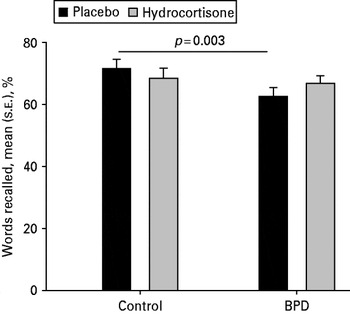
We found a trend for a group by condition interaction effect that marginally failed significance (F 1,101 = 3.328, p = 0.07). Although there was no main effect of condition (F 1,101 = 1.176, p = 0.28), a significant group effect was revealed (F 1,101 = 4.819, p = 0.03). The analysis was controlled for age (F 1,101 = 6.141, p = 0.015). Intake of oral contraceptives (p = 0.26) and smoking (p = 0.67) had no effect and were therefore excluded from the analyses.
A post-hoc ANCOVA revealed a significant difference between patients and controls after placebo (group effect: F 1,103 = 7.818, p = 0.006) but not after hydrocortisone (group effect: p = 0.49). Separate post-hoc ANOVAs with repeated measures for each group revealed no significant effects of hydrocortisone (BPD patients: p = 0.17; controls: p = 0.34). As shown in Fig. 2, the control participants performed better than the patients in the placebo condition but not after hydrocortisone intake.
Percentage of words retrieved in the word list paradigm in relation to the last learning list on the previous day [mean (s.e.)] in patients with borderline personality disorder (BPD) and healthy control subjects after placebo and after administration of 10 mg hydrocortisone. A significant main effect of group (p = 0.03) and a trend towards a condition by group interaction effect was found (p = 0.07).

The analyses of subgroups (5 × 2 ANOVA) did not reveal any significant effects.
Working memory test: the WST
Thirty-three BPD patients and 19 controls performed the WST after hydrocortisone intake, and 34 patients and 21 controls after placebo. A 2 × 2 ANCOVA with the main factors group (BPD versus controls) and condition (hydrocortisone versus placebo) was performed for each test part (neutral and negative).
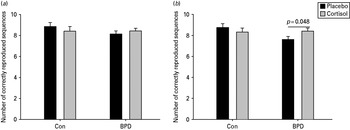
In the test part with neutral interference words, we revealed a significant effect of the covariate age (F 1,102 = 5.821, p = 0.018). There was no effect of condition (p = 0.87) and the group effect also only reached trend significance (F 1,102 = 2.783, p = 0.098), suggesting a slightly better performance in the control group compared to the patients (Fig. 3a). There was no condition by group interaction (p = 0.51).
Number of correctly reproduced sequences [mean (s.e.)] in patients with borderline personality disorder (BPD) and healthy control women after placebo and after administration of 10 mg hydrocortisone in the (a) neutral and (b) negative trials. In the negative test part there was a trend towards a group by condition interaction (p = 0.06).

In the test part with negative interference words, a significant group effect was seen (F 1,102 = 4.056, p = 0.047), showing a better performance in the control participants than the patients. There was no significant effect of condition (p = 0.428) or condition by group interaction effect (p = 0.126). The effect of the covariate age failed to show significance (F 1,102 = 3.123, p = 0.08) and we therefore repeated the analyses without the covariate. Although the group effect diminished (p = 0.12), a trend toward a group by condition interaction effect could be seen (F 1,103 = 3.583, p = 0.06) (Fig. 3b). A post-hoc t test revealed no difference between placebo and hydrocortisone in the control group (p = 0.41) but the BPD patients (t 65 = 2.017, p = 0.048) showed better working memory performance after cortisol.
Because of the between-subject design of this part of the study, the subgroups with different co-morbid disorders (i.e. PTSD and MDD) were relatively small. Thus, we refrained from further subgroup analyses.
Discussion
This is the first study to investigate the effects of cortisol administration on memory in patients with BPD. We not only tested different memory domains (i.e. declarative memory retrieval including autobiographical memory and word list learning) and working memory but also investigated whether the presence or absence of co-morbid MDD and/or PTSD affected the results.
In both declarative memory tasks it could be shown that, in contrast to healthy controls, cortisol had enhancing rather than impairing effects on memory retrieval in BPD patients. A similar effect was seen in the working memory task but only when negative interference words were presented. To summarize, although substantially different memory tasks were used, we found remarkably similar response patterns between the paradigms.
In the AMT we found differential effects with respect to co-morbid mental disorders: BPD patients with and without co-morbid PTSD showed an improvement in memory retrieval whereas in BPD patients with co-morbid MDD hydrocortisone administration had no effect on autobiographical memory retrieval. It is important to mention that the enhancing effects of cortisol on memory retrieval were not only associated with co-morbid PTSD but were also seen in the BPD group without co-morbid PTSD (and MDD). Thus, it seems that BPD and PTSD share similarities in there response to exogenous cortisol on memory retrieval.
Alterations in the reactivity to cortisol administration and their impact on memory have been mostly interpreted in terms of altered GR functioning (Bremner et al. Reference Bremner, Vythilingam, Vermetten, Afzal, Nazeer, Newcomer and Charney2004; Yehuda et al. Reference Yehuda, Harvey, Buchsbaum, Tischler and Schmeidler2007; Wingenfeld et al. Reference Wingenfeld, Driessen, Terfehr, Schlosser, Fernando, Otte, Beblo, Spitzer, Löwe and Wolf2012). In PTSD there is evidence for enhanced GR sensitivity (Rohleder et al. Reference Rohleder, Joksimovic, Wolf and Kirschbaum2004; Yehuda et al. Reference Yehuda, Golier, Yang and Tischler2004) whereas major depression seems to be characterized by a reduced GR functioning (Holsboer, Reference Holsboer2000). No study has directly investigated GRs in BPD patients. However, to understand the results of our study it would be of interest to look at HPA axis findings in BPD.
Compared to studies on MDD and PTSD, there are fewer studies on HPA axis alteration in patients with BPD providing evidence for higher basal cortisol release in these patients (Lieb et al. Reference Lieb, Rexhausen, Kahl, Schweiger, Philipsen, Hellhammer and Bohus2004), but it does seem that depressive and PTSD symptoms influence cortisol secretion in BPD (Wingenfeld et al. Reference Wingenfeld, Driessen, Adam and Hill2007a). Concerning feedback regulation, older studies that used the 1-mg dexamethasone suppression test (DST) found high rates of non-suppressors in BPD populations, but most of these results suggested an association of reduced feedback inhibition with affective dysregulations or even with co-morbid MDD (see Wingenfeld et al. Reference Wingenfeld, Spitzer, Rullkotter and Löwe2010b for review). Using the low-dose DST, a reduced rather than an enhanced cortisol suppression after 0.5 mg of dexamethasone in BPD patients compared to healthy controls has been reported (Lieb et al. Reference Lieb, Rexhausen, Kahl, Schweiger, Philipsen, Hellhammer and Bohus2004). In our own studies we again found evidence for the impact of co-morbid MDD and PTSD (Lange et al. Reference Lange, Wulff, Berea, Beblo, Saavedra, Mensebach, Wingenfeld and Driessen2005; Wingenfeld et al. Reference Wingenfeld, Hill, Adam and Driessen2007b, Reference Wingenfeld, Lange, Wulff, Berea, Beblo, Saavedra, Mensebach and Driessenc), which is also supported by another study using the combined dexamethasone/corticotrophin-releasing factor (DEX/CRF) test (Rinne et al. Reference Rinne, de Kloet, Wouters, Goekoop, DeRijk and van den Brink2002a). In sum, there is no clear picture of HPA axis dysregulation in BPD. There is evidence for both enhanced and reduced feedback sensitivity of the HPA axis and therefore enhanced and reduced GR functioning. One possible explanation is the existence of subgroups with different HPA axis-related disturbances (Wingenfeld et al. Reference Wingenfeld, Spitzer, Rullkotter and Löwe2010b).
The impairing effects of cortisol on memory retrieval are well documented in the literature (Wolf, Reference Wolf2009). This has been shown for declarative memory (Kuhlmann et al. Reference Kuhlmann, Kirschbaum and Wolf2005a, Reference Kuhlmann, Piel and Wolfb) and also for autobiographical memory retrieval (Buss et al. Reference Buss, Wolf, Witt and Hellhammer2004; Young et al. Reference Young, Drevets, Schulkin and Erickson2011) and working memory (Lupien et al. Reference Lupien, Gillin and Hauger1999; Wolf et al. Reference Wolf, Convit, McHugh, Kandil, Thorn, De Santi, McEwen and de Leon2001). Thus, our results regarding the control group are in line with these previous studies. In the current study this effect was strongest in the AMT. Overall, the effects in controls seemed to be weaker than in our previous studies (Schlosser et al. Reference Schlosser, Wolf, Fernando, Riedesel, Otte, Muhtz, Beblo, Driessen, Löwe and Wingenfeld2010; Terfehr et al. Reference Terfehr, Wolf, Schlosser, Fernando, Otte, Muhtz, Beblo, Driessen, Spitzer, Löwe and Wingenfeld2011a, Reference Terfehr, Wolf, Schlosser, Fernando, Otte, Muhtz, Beblo, Driessen, Spitzer, Löwe and Wingenfeldb). One possible reason might relate to the restriction of the sample on women (Kuhlmann et al. Reference Kuhlmann, Kirschbaum and Wolf2005a; Schoofs & Wolf, Reference Schoofs and Wolf2009). Furthermore, compared to other studies we only administered a low dosage of hydrocortisone, which might also be responsible for the weaker effects (Het et al. Reference Het, Ramlow and Wolf2005; Young et al. Reference Young, Drevets, Schulkin and Erickson2011). Nevertheless, cortisol administration in healthy participants typically does not lead to enhanced but to impaired memory retrieval.
Some studies have investigated the effects of GC administration on memory in PTSD patients. In one of our former studies (Wingenfeld et al. Reference Wingenfeld, Driessen, Terfehr, Schlosser, Fernando, Otte, Beblo, Spitzer, Löwe and Wolf2012) we also found an improvement of memory retrieval in PTSD patients. Thus, our previous and present studies both suggest that cortisol improves memory retrieval in BPD and in PTSD patients. This is in line with another study that also showed enhancing effects of cortisol on memory performance in PTSD (Yehuda et al. Reference Yehuda, Harvey, Buchsbaum, Tischler and Schmeidler2007). The results might be interpreted in the context of an enhanced reactivity to exogenous cortisol in these patients compared to healthy participants. However, not all studies confirm these results (Bremner et al. Reference Bremner, Vythilingam, Vermetten, Afzal, Nazeer, Newcomer and Charney2004; Grossman et al. Reference Grossman, Yehuda, Golier, McEwen, Harvey and Maria2006; Yehuda et al. Reference Yehuda, Golier, Bierer, Mikhno, Pratchett, Burton, Makotkine, Devanand, Pradhaban, Harvey and Mann2010), although these studies did not separate memory consolidation from retrieval. Of note, a study that investigated Vietnam veterans with and without PTSD using positron emission tomography (PET) revealed an enhanced reactivity to hydrocortisone administration of the hippocampus in the PTSD group (Yehuda et al. Reference Yehuda, Golier, Bierer, Mikhno, Pratchett, Burton, Makotkine, Devanand, Pradhaban, Harvey and Mann2010). Furthermore, there is evidence for an enhanced GR sensitivity in PTSD (Rohleder et al. Reference Rohleder, Joksimovic, Wolf and Kirschbaum2004; Yehuda et al. Reference Yehuda, Golier, Yang and Tischler2004), which might also contribute to the effect of cortisol on memory in PTSD. However, in a recent study (consisting of a subsample of this study) we found higher cortisol levels before and after dexamethasone administration in BPD patients, but no evidence for alterations concerning feedback regulation (Carvalho Fernando et al. Reference Carvalho Fernando, Beblo, Schlosser, Terfehr, Otte, Löwe, Wolf, Spitzer, Driessen and Wingenfeld2012). Co-morbid PTSD and MDD did not contribute to cortisol release in this study. Thus, the sensitivity of GRs in BPD remains unclear. However, it seems unlikely that an enhanced or a reduced feedback sensitivity of the HPA axis is a unique explanation for the results presented here.
Major depression is characterized by a reduced GR sensitivity (Holsboer, Reference Holsboer2000). In a series of studies we did not find any impairing effects of hydrocortisone administration on memory retrieval, including declarative memory retrieval (Terfehr et al. Reference Terfehr, Wolf, Schlosser, Fernando, Otte, Muhtz, Beblo, Driessen, Spitzer, Löwe and Wingenfeld2011a), specificity of autobiographic memory (Schlosser et al. Reference Schlosser, Wolf, Fernando, Riedesel, Otte, Muhtz, Beblo, Driessen, Löwe and Wingenfeld2010) and working memory (Terfehr et al. Reference Terfehr, Wolf, Schlosser, Fernando, Otte, Muhtz, Beblo, Driessen, Spitzer, Löwe and Wingenfeld2011b). We interpreted these results in MDD in terms of reduced GR functioning. Of note, in the current study, BPD patients with co-morbid MDD but without PTSD also showed this lack of cortisol effect on autobiographical memory. Thus, it seems that patients with MDD and BPD patients with co-morbid MDD share a similar pattern in terms of cortisol effects on memory and, thus, possibly in terms of reduced GR function.
Our main result is that cortisol administration had an enhancing rather than an impairing effect on memory performance in patients with BPD. This suggests an enhanced reactivity to exogenous cortisol in these patients.
Imaging studies with healthy participants show that cortisol administration leads to a reduced activity in the hippocampus during resting-state conditions (Lovallo et al. Reference Lovallo, Robinson, Glahn and Fox2010) and memory retrieval (de Quervain et al. Reference de Quervain, Henke, Aerni, Treyer, McGaugh, Berthold, Nitsch, Buck, Roozendaal and Hock2003; Oei et al. Reference Oei, Elzinga, Wolf, de Ruiter, Damoiseaux, Kuijer, Veltman, Scheltens and Rombouts2007; Weerda et al. Reference Weerda, Muehlhan, Wolf and Thiel2010). Furthermore, a reduced activity of medial temporal regions has been reported along with a reduced activity of prefrontal brain regions (de Quervain et al. Reference de Quervain, Henke, Aerni, Treyer, McGaugh, Berthold, Nitsch, Buck, Roozendaal and Hock2003; Henckens et al. Reference Henckens, Pu, Hermans, van Wingen, Joels and Fernandez2011). The reduced brain activation after cortisol was associated with cortisol-induced memory retrieval impairment (de Quervain et al. Reference de Quervain, Henke, Aerni, Treyer, McGaugh, Berthold, Nitsch, Buck, Roozendaal and Hock2003). In psychiatric patients comparable studies are rare. In PTSD patients a different pattern to the one described above was found in response to hydrocortisone administration, namely an enhanced hippocampal activity (Yehuda et al. Reference Yehuda, Golier, Bierer, Mikhno, Pratchett, Burton, Makotkine, Devanand, Pradhaban, Harvey and Mann2010). Neural activity in other brain regions was not reported in this study. For borderline patients a dysfunctional frontolimbic network including the amygdala, prefrontal areas and other limbic structures (the anterior cingulate cortex, ACC), has been proposed from imaging studies (Schmahl & Bremner, Reference Schmahl and Bremner2006; Wingenfeld et al. Reference Wingenfeld, Spitzer, Rullkotter and Löwe2010b). However, the effects of cortisol administration on brain activity in BPD have not yet been investigated. Thus, there are at least two possible explanations for our results: first, comparable to PTSD patients, hydrocortisone administration in BPD might lead to an activation in the hippocampus that enhances memory retrieval. Alternatively, hydrocortisone might reduce brain activity in regions that are hyperactive in BPD, such as temporal areas. Imaging studies are required to investigate this topic.
Animal studies might also help in understanding our results. The current findings of enhanced memory after cortisol treatment in BPD patients share similarities with recent observations in rodents that have been exposed to stress early in life (Champagne et al. Reference Champagne, Bagot, van Hasselt, Ramakers, Meaney, de Kloet, Joëls and Krugers2008). The early stressed rats displayed an impaired neural plasticity, that is long-term potentiation (LTP), in adulthood. Corticosterone treatment enhanced the LTP in these animals but impaired it in the non-stressed control animals (Champagne et al. Reference Champagne, Bagot, van Hasselt, Ramakers, Meaney, de Kloet, Joëls and Krugers2008). Thus, early adversity seems to influence the response of the hippocampus to GCs adulthood. Early life stress has also been discussed as an important risk factor for the development of BPD (Zanarini et al. Reference Zanarini, Williams, Lewis, Reich, Vera, Marino, Levin, Yong and Frankenburg1997) and early trauma is known to have long-lasting effects on the regulation of the HPA axis (Heim et al. Reference Heim, Newport, Heit, Graham, Wilcox, Bonsall, Miller and Nemeroff2000) and GR functioning, possibly through epigenetic mechanisms (McGowan et al. Reference McGowan, Sasaki, D'Alessio, Dymov, Labonté, Szyf, Turecki and Meaney2009). Of note, the current sample also reported high levels of adverse childhood experiences.
Beneficial effects of cortisol have been shown in the context of prevention of PTSD symptoms after acute trauma experiences (Schelling et al. Reference Schelling, Roozendaal, Krauseneck, Schmoelz, de Quervain and Briegel2006). Thus, there is growing evidence for, in part, beneficial effects of cortisol in PTSD (Aerni et al. Reference Aerni, Traber, Hock, Roozendaal, Schelling, Papassotiropoulos, Nitsch, Schnyder and de Quervain2004). In BPD, which as a personality disorder has an early onset, such studies are lacking, but it would be of interest to investigate whether targeting the HPA axis might be a therapeutic tool. In this connection, treatment with an SSRI was reported to reduce HPA axis hyperactivity in BPD (Rinne et al. Reference Rinne, van den Brink, Wouters and van Dyck2002b). Furthermore, in depression there have been efforts to investigate drugs that influence the HPA axis (Schule et al. Reference Schule, Baghai, Eser and Rupprecht2009). To summarize, the beneficial effects of hydrocortisone in BPD, such as normalization on memory processes, should be investigated further.
Limitations
As there were no additional measurements of HPA axis functioning for this sample (e.g. basal cortisol levels, feedback sensitivity, cortisol bioavailability), interpretation of the data is difficult and remains somewhat speculative. It would be of interest to combine our experimental design with direct measurements of GR functioning, HPA axis feedback sensitivity, basal cortisol levels and neuroimaging. We also have no data on basal cortisol levels or on cortisol levels after drug administration, and therefore no treatment check. Several studies, including our own, have shown that administration of 10 mg hydrocortisone leads to a substantial increase in salivary cortisol concentrations (Buss et al. Reference Buss, Wolf, Witt and Hellhammer2004; Terfehr et al. Reference Terfehr, Wolf, Schlosser, Fernando, Otte, Muhtz, Beblo, Driessen, Spitzer, Löwe and Wingenfeld2011a, Reference Terfehr, Wolf, Schlosser, Fernando, Otte, Muhtz, Beblo, Driessen, Spitzer, Löwe and Wingenfeldb).
Data on menstrual cycle phase were also not obtained. Many patients were medicated, which could also have influenced the results. However, in our previous studies we found no effects of medication intake on the cortisol-induced memory effect (Terfehr et al. Reference Terfehr, Wolf, Schlosser, Fernando, Otte, Muhtz, Beblo, Driessen, Spitzer, Löwe and Wingenfeld2011a; Wingenfeld et al. Reference Wingenfeld, Driessen, Terfehr, Schlosser, Fernando, Otte, Beblo, Spitzer, Löwe and Wolf2012).
For some of our analyses (subgroup analyses, working memory test) the sample size was relatively small leading to a lack of power. Thus non-significant findings, in particular, should be interpreted with caution and our current findings require replication.
Summary
The current results indicate that cortisol has opposing effects on memory retrieval in healthy controls compared to patients with BPD. These enhancing effects were found to be most pronounced for autobiographical memory retrieval. On the contrary, BPD patients with co-morbid MDD but no PTSD did not show any cortisol effects on memory, which is in line with our former studies in MDD patients and the hypotheses of reduced GR function. Thus, it might be that there are at least two subgroups within the BPD population: one predominantly characterized by trauma-associated symptoms and an enhanced sensitivity to exogenous cortisol, and another subgroup with mood disturbances as core symptoms (i.e. co-morbid MDD), showing a resistance towards cortisol effects on memory. Of note, the BPD group with co-morbid MDD but without PTSD reported the lowest CTQ scores, which fits this hypothesis. Possibly, these subgroups may also differ concerning other HPA axis functions as we have hypothesized before (Wingenfeld et al. Reference Wingenfeld, Spitzer, Rullkotter and Löwe2010b). Future studies should investigate whether there are subgroups of borderline patients with different endocrine and psychopathological patterns, in addition to potentially related therapeutic options.
Acknowledgments
This study was supported by a Deutsche Forschungsgemeinschaft grant (WI 3396/1-1) awarded to K.W., O.T.W. and M.D.
Declaration of Interest
None.