




No CrossRef data available.
Article contents
Seasonal dynamics of egg laying and egg-laying strategy of the ectoparasite Argulus coregoni (Crustacea: Branchiura)
Published online by Cambridge University Press: 13 May 2004
Abstract
Substrate preferences, spatial aggregation patterns and seasonal dynamics in the egg laying of ectoparasitic Argulus coregoni were studied at a commercial fish farm in Finland. Pilot experiments showed that A. coregoni females selected specific types of substrates for egg laying. Significantly more A. coregoni eggs were laid on dark substrates than on light ones suggesting the use of visual cues. Therefore, egg-laying plates of dark colour were constructed for further experiments. Most A. coregoni eggs were deposited in locations in shadow and in the deepest water in a 2 m deep farming canal. Relatively more eggs were laid on bottom stones situated near each egg-laying trap than on artificial egg-laying plates indicating a preference for irregular stones in the deeper locations in the canal. The plates were located 20 cm above the bottom. However, a total of 5863 A. coregoni egg clutches, corresponding approximately to 1·5 million unhatched metanauplii, were successfully destroyed with the plates indicating that egg-laying traps can be used as an ecological control method against argulids in certain situations. For traps to be effective, ponds should not contain stones or any other hard substrata attracting female lice. The egg laying of A. coregoni in this study started on 5 July in 2001 and extended over 3·5 months up to mid-October. The egg-laying pattern of A. coregoni population was unimodal, supporting the view that only a single A. coregoni generation occurred annually in Central Finland.
Information
- Type
- Research Article
- Information
- Copyright
- 2004 Cambridge University Press
INTRODUCTION
Reproduction of ectoparasites in the genus Argulus, in northern latitudes, is largely constrained by seasonal variation of temperature, with egg laying and hatching occurring during the warmest months between May and August (Pasternak, Mikheev & Valtonen, 2000; Hakalahti & Valtonen, 2003). Low winter temperature halts both the growth and activity. Of the two Argulus species that occur in Finland, A. coregoni (Thorell) spends the winter period solely in the form of resting eggs (Shimura, 1983; Mikheev et al. 2001; Hakalahti & Valtonen, 2003), whereas A. foliaceus (L.) can remain on fish (Pasternak et al. 2000; Gault, Kilpatric & Steward, 2002). As the harsh winter period is likely to decrease the survival rate of juveniles and adults, eggs are important in ensuring the survival of over-wintering A. foliaceus populations in Finland (Pasternak et al. 2000).
The survival of infective stages over winter and subsequent transmission success are necessary for the growth of Argulus populations inhabiting northern latitudes. Thus, the development and use of control methods that reduce future recruitment could be an effective and novel approach to counteract epizootics of Argulus species at fish farms (Gault et al. 2002). For parasites to complete their life-cycle successfully, their offspring must locate and infect an appropriate host, which for A. coregoni is usually a salmonid (Shimura, 1983; Hakalahti & Valtonen, 2003). In contrast, A. foliaceus has been recorded on many species of freshwater fishes (Valtonen, Holmes & Koskivaara, 1997). Stricter host specificity in A. coregoni coupled with limited energy resources and the time taken to locate a host by an infective metanauplius is likely to put a selective pressure on the egg-laying strategies to help the metanauplii locate a host quickly. If this is the case we should observe A. coregoni females selecting egg-laying sites that will increase the infection rate.
In a previous study, Gault et al. (2002) used floating corrugated plastic boards to attract A. foliaceus to lay eggs on them. They used these boards as a means of capturing the eggs which could be removed from the lice population thus effecting a form of biological control. Unlike A. foliaceus, which prefers shallow water for egg laying (Bauer, 1959), A. coregoni is believed to deposit its eggs in the deepest parts of the pond (Shimura & Egusa, 1980; Mikheev et al. 2001). If this is the case, then the boards used by Gault et al. (2002) would not attract A. coregoni. Thus, to develop a similar control method for A. coregoni we first monitored the substrate preference of gravid lice females and then constructed appropriate egg-laying plates that simulated the preferred substrate. Our aims were (1) to monitor the seasonal dynamics of A. coregoni egg laying and (2) to examine spatial aggregation patterns and substrate preferences in egg deposition.
MATERIALS AND METHODS
This study was carried out at a fish farm in Central Finland during 2 consecutive years (2000 and 2001). The water flows to the farm via 2 separate canals: an inflow canal leading to fishponds and a farming canal. The farming canal is a 1 km long and 8 m wide raceway divided by metal grating and bridges into 9 interconnected sections. Each section is about 100 m in length. The maximum water depth in the canal is 2 m and rainbow trout (Oncorhynchus mykiss) of 2+ years of age are held in this canal. Ponds contain rainbow trout, brown trout (Salmo trutta), Atlantic salmon (S. salar) or whitefish (Coregonus lavaretus) of various age groups. Canals and ponds have both mud and stones on the bottom.
Substrate preference
The preferences for various materials, colours and positions of substrata for A. coregoni egg laying were tested. In a pilot experiment in 2000, three egg-laying traps were placed in a pond with rainbow trout of 2+ years of age. Each of the traps consisted of 2 attached planks, one horizontal, another inclined vertically by ca. 60° into the first plank (Fig. 1) Materials were light coarse wood, dark coarse wood, white plastic and black plastic. Each material was attached to both the horizontal plate and the upper and lower sides of the inclined plate of the traps (16 different surfaces in one trap). Traps were kept on the bottom in the deepest part of the pond (depth of 1·7 m) between 12 and 18 July in such a way that the upper-side of the inclined plate was located facing the water current. During another period, between 23 July and 23 August, traps were located 30 cm off the bottom, due to the high sedimentation of mud during the previous period. Egg clutches were removed and counted and the traps were cleaned once a week.

Fig. 1. Scheme of the traps. (A) Trap placed on the bottom of a pond in 2000; (B) trap type used in the canal in 2001. The trap was floating above the bottom (see the text).
Site preference and seasonal timing of egg laying
During the pilot experiment in August 2000, nearly 87% of egg clutches harvested from the pond were A. foliaceus egg strings. As our main goal was to study A. coregoni, experiments were continued in 2001 with novel traps placed in the farming canal, where A. coregoni was known to be most abundant (Hakalahti & Valtonen, 2003). A total of 8 traps were kept in 2 sections of the farming canal between 29 June and 30 October. Two pairs of traps were located in both sections, of which one trap was located 15 m and another 17 m off the bridge dividing the canal (Fig. 2).

Fig. 2. Schematic representation of 2 of the sections of the farming canal divided by grids and bridges. Letters (a–h) indicate the location of each egg-laying plate and the arrow indicates the direction of water flow.
As the dark substrate was preferred in our pilot experiment in 2000 and the density of A. coregoni egg clutches was noted to be different on different sides of the bottom stones (Mikheev et al. 2001), the traps used in 2001 were made only of dark brown, coarse plywood with a roof-like construction (angles of plates=90 °) with upper and under surfaces. Each of the 4 surfaces (2 under-sides and 2 upper-sides) of the trap was divided into 3×4 sections equal in size (Fig. 1). The total surface area of each trap was 3 m2; each flat area was 0·5 m high and 1·5 m wide. Traps were anchored to the bottom of the canal with bricks and the position was established (20 cm off the bottom and 1·7 m underwater) using floaters and ropes attached to bridges in such a way that flat sides were at right angles to the water current. From 29 June onwards one trap was checked every day until the first egg clutches were found on 5 July. After that, the numbers of egg clutches in each trap were counted every week, their position on the trap was recorded and the trap was cleaned by brushing. The surface area of egg clutches was estimated from their width and length. Egg clutches of A. coregoni were mostly oval in shape, whereas A. foliaceus eggs were laid mostly in strings (e.g. Bower-Shore, 1940; Pasternak et al. 2000).
To compare egg-laying preference of A. coregoni, between bottom stones and egg traps, marked stones (mean surface area 69·4 cm2 (S.D.±26·03)) were kept in the bottom of the canal near the plates for more than a month (29 June–2 August). We had 9 stones in the vicinity of each trap, totalling 72 stones. Stones were collected in early August and surface areas of both egg clutches and stones were determined, excluding the stone surface buried in the bottom mud.
RESULTS
Substrate preference in the pond in 2000
Argulus coregoni females did not prefer any one type of material over any other as an egg-laying substrate during the first monitoring period between 12 and 18 July 2000 (one-way ANOVA: F3,9=3·15, P=0·860, Fig. 3). When substrates were grouped according to their colour, then A. coregoni females laid more eggs on dark substrates (black plastic and dark coarse wood), than on light substrates (white plastic and light coarse wood) (Student's t-test: n=6, t=−2·60, P=0·026). It was found that 71% of egg clutches (n=44) were laid on dark substrates during the first monitoring period in early July (Fig. 3). Due to the high sedimentation of silt on horizontal surfaces of the traps and the underside of the inclined plate, all eggs were laid on the upper-side of the inclined plate. During the first monitoring period, no A. foliaceus egg strings were found.

Fig. 3. Mean number of Argulus coregoni egg clutches laid on 4 different types of substrates on plates located in a fish-pond between 12 and 18 July 2000.
Even though the traps were kept 30 cm above the bottom of the pond during the next period of observation (23 July–23 August 2000), horizontal surfaces were again covered with silt. During this period 86·7% of the eggs were A. foliaceus egg strings (Table 1). There was no difference between the species in the relative numbers of eggs laid in dark and light substrates (Chi-square test with Yates' correction of continuity: χ2=3·196, P=0·074), thus all egg clutches were pooled. Argulids clearly preferred dark substrates on a shadowed side (underside of the inclined plate) for egg laying (t-test: t=−5·99, P<0·001) (Table 1). Although more Argulus eggs were recorded on dark than on light substrates also on the upper-side of the inclined plate, due to low number of eggs, the difference was non-significant (t=−2·35, P=0·059). To see whether A. foliaceus and A. coregoni compete for space, frequencies of single species and double species occurrences on the substrates were calculated. Our results indicated that eggs were laid randomly, independent of species; the frequencies (24 and 27, respectively) did not differ from the ratio of 1[ratio ]1 (P>0·05).
Table 1. Effects of position and substrate colour on egg laying in Argulus coregoni and A. foliaceus (Mean number of all laid egg clutches removed weekly between 23 July and 23 August 2000 and the numbers of deposited A. coregoni (C) and A. foliaceus (F) egg clutches are given.)

Site preference in the canal in 2001
In 2001, Argulus coregoni females laid more eggs on the undersides of the traps than on their upper-sides (Student's t-test: t=−6·01, P<0·001) in the canal (Fig. 4). Among the upper-side surfaces, the sides facing downstream were chosen more often than the sides facing upstream (t=−4·25, P=0·001). There were no significant differences between the two undersides of the trap (t=2·00, P=0·065).

Fig. 4. Mean (±S.D.) percentage proportion of Argulus coregoni egg clutches collected from each side of the trap between 29 June and 30 October 2001. Ud=upper-side, side facing downstream; Uu=upper-side, side facing upstream; Dd=underside, side facing downstream; Du=underside, side facing upstream.
In relation to the depth gradient, the relative number of A. coregoni eggs laid varied between the depth zones of the plates (one-way ANOVA: F2,21=92·73, P<0·001). Most A. coregoni eggs were deposited on the lowest parts (4 adjacent sections of the plates 20–30 cm above the bottom pooled) of the traps at all sides (Fig. 5). These areas near the bottom of the canal were chosen more frequently by A. coregoni females than the middle parts of the trap (P<0·001), which were located 30–40 cm from the bottom. There were no differences (P=0·564) between the relative proportion of eggs laid on the middle and upper parts of the trap (40–50 cm off the bottom). The numbers of A. coregoni egg clutches collected separately from each depth zone in each side of the egg-laying plate showed an aggregated distribution with an average variance to mean ratio (s2/

) of 39·5 (S.D.±34·10).

Fig. 5. Mean (±S.D.) percentage proportion of Argulus coregoni egg clutches collected from all sides of the trap within each distance measured from the bottom of the canal. The canal is 2 m deep.
Less A. coregoni egg clutches (4061) were removed from the egg-laying traps than from the stones (5004), although the surface area of the traps was 10 times greater than that of the stones (Table 2). In addition, the traps were cleaned once a week, exposing new surface areas, whereas the stones were not. This indicates the preference of egg-laying female A. coregoni for stones. However, totally 5863 A. coregoni egg clutches were successfully destroyed with the plates in 2001.
Table 2. Total numbers of Argulus coregoni egg clutches laid on the traps and stones located simultaneously on the flow-through canal of a fish farm between 29 June and 2 August 2001 and the estimated corresponding total surface area covered (Letters (a–h) refer to positions of egg-laying traps (see Fig. 2).)

Seasonal timing of egg laying
The egg laying of A. coregoni females started on 5 July (2001) in the canal (Fig. 6). A. coregoni eggs were laid over an extended period of 3·5 months. The last eggs clutches were found on 18 October, when the water temperature at the farm was around 8 °C. No egg clutches were found on the plates when they were checked at the end of October, when the water temperature was 4 °C. The egg laying of A. coregoni females was most intense between mid-July and mid-August, when 81% of all egg clutches were found.

Fig. 6. Mean (±S.E.) and total cumulative number of Argulus coregoni egg clutches collected with the artificial egg-laying plates at weekly intervals.
DISCUSSION
This study on the seasonal dynamics of Argulus coregoni egg laying was performed during the same year and in the same site as the recent study on the population structure and seasonal cycle of A. coregoni (Hakalahti & Valtonen, 2003). In that study we found that the numbers of A. coregoni on fish declined sharply after mid-July, when the population consisted mostly of males (Hakalahti & Valtonen, 2003). This was the time when most (81%) egg clutches were collected from the plates, thus indicating that A. coregoni females had detached from the fish and were laying their eggs. The distribution of the numbers of eggs laid by the A. coregoni population in relation to time was unimodally skewed towards the autumn. This pattern is consistent with the suggestion that there is a single annual A. coregoni generation with a long recruitment time in Central Finland (Hakalahti & Valtonen, 2003). Although most A. coregoni hatched and immediately infected the fish (Mikheev et al. 2001; Hakalahti & Valtonen, 2003), the egg-laying period was extended over 3·5 months, from early July to mid-October.
Our results reveal an aggregated spatial distribution among the A. coregoni eggs. Of all A. coregoni egg clutches collected in 2001, 71% were deposited on the lowest parts of the plates (less than 30 cm off the bottom in a 2 m deep canal) or on stones. This confirms previous field observations on the spatial distribution of A. coregoni eggs that most egg clutches are deposited on the deepest parts of the ponds (Shimura & Egusa, 1980; Mikheev et al. 2001). Shimura & Egusa (1980) also noted some preference of rough substrate against smooth substrate in egg laying of A. coregoni females. Roughness of irregular stones and their location on the bottom can explain why stones of the present study were more densely covered with A. coregoni egg clutches than the artificial plates. Similarly, another branchiuran, Dolops ranarum, kept in aquaria laid eggs only on stones, but never on the smooth aquarium glass (Avenant, van As & Loots, 1989). However, a total of 5863 egg clutches were successfully collected and destroyed on the artificial egg-laying plates. This corresponds to approximately 1·5 million unhatched metanauplii assuming that A. coregoni females produce an average of 317 eggs and that 80% of females' lay only 1 egg clutch (Hakalahti, Häkkinen & Valtonen, unpublished observations). We conclude that artificial egg-laying plates can be used successfully as an ecological control method against A. coregoni in fish farm conditions. While using artificial egg-laying substrates, ponds should not contain stones or any other hard substrates attracting egg-laying female lice.
We found that dark substrates and sheltered areas of egg-laying plates were more densely covered with both A. coregoni and A. foliaceus egg clutches than light substrates and upper-side surfaces. We suggest that this is a result of active site finding based on the use of visual cues by gravid Argulus females. Both A. coregoni and A. foliaceus have morphologically well-developed eyes suitable for host finding (Meyer-Rochow, Au & Keskinen, 2001) and vision was shown to play a key role in the host searching of A. foliaceus (Mikheev, Valtonen & Rintamäki-Kinnunen, 1998). In contrast, lice juveniles are known to show a positive phototaxis (Herter, 1927) and favoured white areas over dark ones, behaviour that changed during ontogeny (Pasternak, Mikheev & Valtonen, unpublished observation). Why could it be beneficial for females to change their behaviour during the ontogenetic development? In a stochastic environment the optimal genotype may be the one which produces a series of behavioural strategies each of which is best suited for current conditions (Poulin, 1988). The optimal microhabitat for A. coregoni oviposition may be the most sheltered surface and dark substrate to avoid visually-hunting predators such as rainbow trout (Hakalahti, unpublished observation). Although newly-laid A. coregoni eggs are light in colour, they gradually darken, becoming less visible on dark substrates.
Overwintering may be risky, if eggs are laid in shallow water. Changes of water level exposing the eggs to drying or lethal freezing are likely to be higher in shallow than in deep water layers. The proportion of non-viable eggs was higher in shallow than in deep water layers (Mikheev et al. 2001). This can explain why A. coregoni females selected deeper areas for egg laying. All adaptations facilitating the location of a fish host are of crucial importance for newly-hatched lice juveniles. Therefore, by choosing an appropriate microhabitat a louse female may also increase her fitness by increasing offspring's probability to encounter the appropriate host (see Mikheev et al. 2001). A. coregoni is a specialist on salmonids inhabiting clear, running waters (Shimura, 1983). Temperature (Hakalahti & Valtonen, 2003) and illumination have been noticed to affect the hatching dynamics of A. coregoni eggs (Mikheev et al. 2001). Thus, the strong impact of environmental conditions on hatching may also have consequences on host–parasite population dynamics depending on egg-laying decisions of the female.
We appreciate the help received from Heli Häkkinen and the staff of Central Finnish fish farm during the field-work. Thanks are due to Yrjö Lankinen and Viktor Mikheev for valuable advice when planning the experiments. Robert Poulin and Peter Hudson gave useful comments during the preparation of the manuscript. We thank the Foundation for Research of Natural Resources in Finland and the Biological Interactions Graduate School for financial support to T.H. and the Russian Foundation for Basic Research (project 01-04-48701) and the SUNARE research programme of the Academy of Finland for financial support to A.P.
References
REFERENCES
AVENANT, A., VAN AS, J. G. &
LOOTS, G. C.
(1989).
On the hatching and morphology of Dolops ranarum larvae (Crustacea: Branchiura).
Journal of Zoology, London 217, 511–519.CrossRefGoogle Scholar
BAUER, O. N.
(1959).
The ecology of parasites of freshwater fish. In
Parasites of Freshwater Fish and the Biological Basis of their Control. Bulletin of the State Scientific Research Institute of Lake and River Fisheries, vol. XLIX, pp. 3–207.
Translated from Russian: Israel Program for Scientific Translations Jerusalem 1962.
BOWER-SHORE, C.
(1940).
An investigation of the common louse, Argulus foliaceus (Linn).
Parasitology 32, 361–371.CrossRefGoogle Scholar
GAULT, N. F. S., KILPATRIC, D. J. &
STEWARD, M. T.
(2002).
Biological control of the fish louse in a rainbow trout fishery.
Journal of Fish Biology 60, 226–237.CrossRefGoogle Scholar
HAKALAHTI, T. & VALTONEN, E. T.
(2003).
Population structure and recruitment of the ectoparasite Argulus coregoni Thorell (Crustacea: Branchiura) on a fish farm.
Parasitology 127, 79–85.CrossRefGoogle Scholar
HERTER, K.
(1927).
Reizphysiologische Untersuchungen an der Karpfenlaus (Argulus foliaceus L.).
Zeitschrift für Vergleichende Physiologie 5, 283–370.Google Scholar
MEYER-ROCHOW, V. B.,
AU, B. & KESKINEN, E.
(2001).
Photoreception in fish lice (Branchiura): The eyes of Argulus foliaceus Linné, 1978 and A. coregoni Thorell, 1865.
Acta Parasitologica 46, 321–331.Google Scholar
MIKHEEV, V. N.,
VALTONEN, E. T. &
RINTAMÄKI-KINNUNEN, P.
(1998).
Host searching in Argulus foliaceus L. (Crustacea: Branchiura): the role of vision and selectivity.
Parasitology 116, 425–430.Google Scholar
MIKHEEV, V. N.,
PASTERNAK, A. F.,
VALTONEN, E. T. &
LANKINEN, Y.
(2001).
Spatial distribution and hatching of overwintered eggs in a fish ectoparasite Argulus coregoni Thorell (Crustacea: Branchiura).
Diseases of Aquatic Organisms 46, 123–128.CrossRefGoogle Scholar
PASTERNAK, A. F.,
MIKHEEV, V. N. &
VALTONEN, E. T.
(2000).
Life history characteristics of Argulus foliaceus L. (Crustacea: Branchiura) populations in Central Finland.
Annales Zoologici Fennici 37, 25–35.Google Scholar
POULIN, R.
(1988).
Evolutionary Ecology of Parasites. From Individuals to Communities.
Chapman and Hall,
London.
SHIMURA, S.
(1983).
Seasonal occurrence, sex ratio and site preference of Argulus coregoni Thorell (Crustacea: Branchiura) parasitic on cultured freshwater salmonids in Japan.
Parasitology 86, 537–552.CrossRefGoogle Scholar
SHIMURA, S. & EGUSA, S.
(1980).
Some ecological notes on the egg deposition of Argulus coregoni Thorell (Crustacea: Branchiura).
Fish Pathology 15, 43–47. (In Japanese with English summary).CrossRefGoogle Scholar
VALTONEN, E. T.,
HOLMES, J. C. &
KOSKIVAARA, M.
(1997).
Eutrophication, pollution and fragmentation: effects on parasite communities in roach (Rutilus rutilus) and perch (Perca fluviatilis) in four lakes in Central Finland.
Canadian Journal of Fish Aquatic Sciences 54, 572–585.CrossRefGoogle Scholar
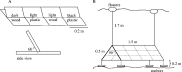
Fig. 1. Scheme of the traps. (A) Trap placed on the bottom of a pond in 2000; (B) trap type used in the canal in 2001. The trap was floating above the bottom (see the text).

Fig. 2. Schematic representation of 2 of the sections of the farming canal divided by grids and bridges. Letters (a–h) indicate the location of each egg-laying plate and the arrow indicates the direction of water flow.
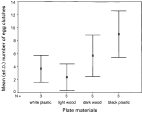
Fig. 3. Mean number of Argulus coregoni egg clutches laid on 4 different types of substrates on plates located in a fish-pond between 12 and 18 July 2000.
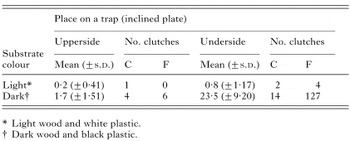
Table 1. Effects of position and substrate colour on egg laying in Argulus coregoni and A. foliaceus
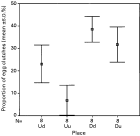
Fig. 4. Mean (±S.D.) percentage proportion of Argulus coregoni egg clutches collected from each side of the trap between 29 June and 30 October 2001. Ud=upper-side, side facing downstream; Uu=upper-side, side facing upstream; Dd=underside, side facing downstream; Du=underside, side facing upstream.
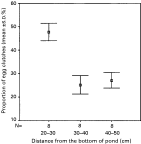
Fig. 5. Mean (±S.D.) percentage proportion of Argulus coregoni egg clutches collected from all sides of the trap within each distance measured from the bottom of the canal. The canal is 2 m deep.
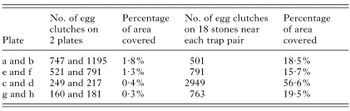
Table 2. Total numbers of Argulus coregoni egg clutches laid on the traps and stones located simultaneously on the flow-through canal of a fish farm between 29 June and 2 August 2001 and the estimated corresponding total surface area covered
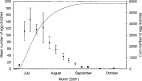
Fig. 6. Mean (±S.E.) and total cumulative number of Argulus coregoni egg clutches collected with the artificial egg-laying plates at weekly intervals.
 You have
Access
- 28
- Cited by