Introduction
There is a steadily increasing number of older adults living with dementia, most cared for by informal carers (McCann et al., Reference McCann, Bamberg and McCann2015). Dementia has been identified as a global health issue posing significant challenges (Moniz-Cook et al., Reference Moniz-Cook, Vernooij-Dassen, Woods and Orrell2011; Prince et al., Reference Prince, Ali, Guerchet, Prina, Albanese and Wu2016). With demographic projections forecasting there will be over 131 million people worldwide with dementia by 2050 (Prince et al., Reference Prince, Wimo, Guerchet, Ali, Wu and Prina2015), the number of carers needed will also increase. In Australia, 92 per cent of people living with dementia in the community were recipients of informal care; 42 per cent of primary carers of people with dementia were a spouse or partner and 44 per cent were adult children (Australian Institute of Health and Welfare, 2012). Two-thirds of people caring for a person with dementia were women, with approximately 50 per cent of these women aged 65 years and over (Australian Institute of Health and Welfare, 2012). This reflects the ongoing societal expectation that care-giving is considered a facet of women's roles (Pinquart and Sorensen, Reference Pinquart and Sorensen2003; Daly et al., Reference Daly, McCarron, Higgins and McCallion2013; Mosquera et al., Reference Mosquera, Vergara, Larrañaga, Machón, Río and Calderón2016).
A diagnosis of dementia represents a point in time where life for the person with dementia and their family changes irrevocably. Lewis (Reference Lewis2015: 488) described the impacts of care-giving as ‘holistic and prolonged’, with many carers having their psychological, physical, social and financial welfare negatively affected by the high care burden (Donnellan et al., Reference Donnellan, Bennett and Soulsby2015; McCann et al., Reference McCann, Bamberg and McCann2015; Nay et al., Reference Nay, Bauer, Fetherstonhaugh, Moyle, Tarzia and McAuliffe2015). As time progresses, there is a growing discontinuity between a carer's life before caring for a person with dementia and the ongoing disruption to belonging, purpose and direction (Daly et al., Reference Daly, McCarron, Higgins and McCallion2013). While carers generally will experience a range of feelings and emotions, symptoms of stress, isolation and social exclusion (Wilks et al., Reference Wilks, Little, Gough and Spurlock2011; Morris et al., Reference Morris, King, Turner and Payne2015; Nay et al., Reference Nay, Bauer, Fetherstonhaugh, Moyle, Tarzia and McAuliffe2015), it is acknowledged that carers of people with dementia can experience this negative affect to a greater extent (Pinquart and Sorensen, Reference Pinquart and Sorensen2003, Reference Pinquart and Sorensen2006; Cuijpers, Reference Cuijpers2005; Brodaty and Donkin, Reference Brodaty and Donkin2009; Nay et al., Reference Nay, Bauer, Fetherstonhaugh, Moyle, Tarzia and McAuliffe2015). In particular, carers of people with dementia experience higher stress as their family member approaches end of life compared to other carers (Vick et al., Reference Vick, Ornstein, Szanton, Dy and Wolff2019).
As the care needs of the person with dementia increase, carers can feel they are on call 24 hours a day, trapped in an inescapable role (Australian Institute of Health and Welfare, 2012; Lewis, Reference Lewis2015). The shift in focus from oneself to the constant and challenging care of a person with dementia can leave a carer devoid of a sense of self outside care-giving (Daly et al., Reference Daly, McCarron, Higgins and McCallion2013; Lewis, Reference Lewis2015). Reduction or removal of the capacity to work, reduced opportunities for social contact, and decreased support from friends or family further contribute to the carer having no functioning identity outside the caring role (Kenny et al., Reference Kenny, Sarma and Egan2012), increasing the negative impact of caring on the individual (Daly et al., Reference Daly, McCarron, Higgins and McCallion2013; Donnellan et al., Reference Donnellan, Bennett and Soulsby2015). Carers may grieve not only for the person they have lost but also for the relationship they used to have with the person with dementia, an important part of their identity construct (Tremont and Davis, Reference Tremont, Davis, Noggle and Dean2014; Lewis, Reference Lewis2015).
The way a carer conceptualises their ability to perform the caring role, their self-efficacy, is an important determinant of how they respond to stressors of the role, during and after caring (Schulz et al., Reference Schulz, Boerner, Shear, Zhang and Gitlin2006; Mattock and McIntyre, Reference Mattock and McIntyre2016). Donnellan et al. (Reference Donnellan, Bennett and Soulsby2015) demonstrated that some carers could achieve resilience while performing the caring role, with the psychological assets of the individual being a primary facilitating factor. Carers exhibiting resilience will successfully adapt to these life changes, leading to hope and expectations of success in the face of future adversity (Wilks et al., Reference Wilks, Little, Gough and Spurlock2011). Carers lacking resilience tend to have a negative outlook and focus on aspects of their life that have become lost or irreparably changed (Donnellan et al., Reference Donnellan, Bennett and Soulsby2015).
While there is a large body of research exploring the impacts of caring for a person with dementia, less attention has been paid to how carers transition into a post-care role after the person with dementia has died (Cronin et al., Reference Cronin, Hynes, Breen, McCarron, McCallion and O'Sullivan2015; Mattock and McIntyre, Reference Mattock and McIntyre2016). As many carers spend years caring, there will be a period of transition in adapting to the change in circumstances following the death of the person with dementia (Larkin, Reference Larkin2009). Studies have shown carers are not uniform in their psychological responses to bereavement, with diverse trajectories and evolution over time (Aneshensel et al., Reference Aneshensel, Botticello and Yamamoto-Mitani2004). Emotionally distressed carers and those suffering role overload before the death of the person with dementia may become particularly distressed after bereavement (Chan et al., Reference Chan, Livingston, Jones and Sampson2013). Carers with higher self-esteem and adequate levels of socio-emotional support while caring tend to do better post-care, as these factors play protective roles (Aneshensel et al., Reference Aneshensel, Botticello and Yamamoto-Mitani2004).
The negative health implications of being a carer for a person with dementia and the need to support carers beyond the death of their family member is now being recognised (Shuter et al., Reference Shuter, Beattie and Edwards2014), with evidence emerging that carers of people with dementia may be at risk of poor bereavement outcomes (Schulz et al., Reference Schulz, Mendelsohn, Haley, Mahoney, Allen, Zhang, Thompson and Belle2003, 2006). While grief is a normal response to loss, it may become complicated grief when the integration of the death of the person with dementia fails to take place in the post-care period (Chan et al., Reference Chan, Livingston, Jones and Sampson2013). The Stress Process Model, which explains how appraisal of loss (stressful event) depends upon a number of contextual, social and personal factors, has been used to conceptualise carer outcomes and guide bereavement research in dementia care-giving (Pearlin et al., Reference Pearlin, Mullan, Semple and Skaff1990). Consideration of the interplay of these factors as potential barriers or facilitators in post-care transition requires further investigation.
The majority of carers of people with dementia show extraordinary resilience in adapting to the death of their family member, with symptoms of depression and grief declining quickly to near normal levels within a year after the death (Schulz et al., Reference Schulz, Mendelsohn, Haley, Mahoney, Allen, Zhang, Thompson and Belle2003). However, some carers continue to experience post-death psychiatric morbidity with 11.5 per cent experiencing major depression six months later (Bradley et al., Reference Bradley, Prigerson, Carlson, Cherlin, Johnson-Hurzeler and Kasl2004), and 30 per cent of carers at risk for clinical depression one-year post-death (Schulz et al., Reference Schulz, Mendelsohn, Haley, Mahoney, Allen, Zhang, Thompson and Belle2003). Schulz et al. (Reference Schulz, Boerner, Shear, Zhang and Gitlin2006) found that being the spouse of a person with dementia who died and experiencing physical or psychological health issues is predictive of negative bereavement outcomes, such as complicated grief. Preparedness for death had a significant influence on post-care bereavement, with up to a third of carers being unprepared for the death of their family member (Hebert et al., Reference Hebert, Qianyu and Schulz2006; Schulz et al., Reference Schulz, Boerner, Shear, Zhang and Gitlin2006; Hovland-Scafe and Kramer, Reference Hovland-Scafe and Kramer2016). There is, however, a lack of consensus among studies on the impact of the emotional and physical health status of the carer while caring on the post-care transition (Aneshensel et al., Reference Aneshensel, Botticello and Yamamoto-Mitani2004; Ume and Evans, Reference Ume and Evans2011; Cronin et al., Reference Cronin, Hynes, Breen, McCarron, McCallion and O'Sullivan2015). The long-term effects of having cared for a family member with dementia can leave carers poorly prepared to transition into a post-care role.
While the significant burden on carers of people with dementia has been well described (Lewis, Reference Lewis2015; McCann et al., Reference McCann, Bamberg and McCann2015), the complex interplay of bereavement, role change and constructing a post-care life is still not fully understood. This study aimed to explore the experience of primary carers of a family member with dementia, following the death of the person with dementia, focusing on facilitators and barriers to a positive transition into a post-care role. This knowledge may provide insight into ongoing issues carers experience as they transition from the carer role, underline ways to improve support mechanisms for carers as they transition post-care and identify areas in which carers can be supported better while in the caring role.
Methods
Methods are reported according to the Consolidated Criteria for Reporting Qualitative Research (COREQ) guidelines (Tong et al., Reference Tong, Sainsbury and Craig2007).
Ethical approval
Ethical approval was obtained from the Central Queensland University Human Research Ethics Committee (H16/05-110).
Design
A qualitative descriptive study design was chosen as we sought to develop an understanding of the individual experience, rather than provide evidence for an existing theory (Bradshaw et al., Reference Bradshaw, Atkinson and Doody2017). This study design is useful where information is required directly from those experiencing the phenomenon of interest and where time and resources are constrained (Bradshaw et al., Reference Bradshaw, Atkinson and Doody2017). We used a subjective, inductive process that recognised the subjectivity of the experience for both participant and researcher (Bradshaw et al., Reference Bradshaw, Atkinson and Doody2017).
Participants
Eligible participants met the inclusion criteria of (a) primary carer for a family member with dementia; (b) aged over 18 years; (c) had performed the role for at least six months; (d) care recipient had passed away at least 12 months prior; and (e) able to communicate in conversational English; and (f) resident in Australia.
Participants were recruited via social media utilising Facebook pages of Dementia Australia and Queensland Carers; listing on Dementia Australia Research Foundation webpage; and direct invitations through the local area dementia support groups. A purpose-built Facebook page called ‘After the care journey has ended’ allowed potential participants to access information about the research and make enquiries without any commitment to participate. Online recruitment has been found to be an efficient and cost-effective method that is suitable for a variety of populations; is ideal for sensitive topics; facilitates access to a diverse range of participants; transcends geographic boundaries; and, when used as part of a diverse range of recruitment strategies, presents no greater risk of bias than traditional methods (Casler et al., Reference Casler, Bickel and Hackett2013; Morgan et al., Reference Morgan, Jorm and Mackinnon2013; O'Dwyer and Moyle, Reference O'Dwyer and Moyle2014; Yuan et al., Reference Yuan, Bare, Johnson and Saberi2014). The variety of methods used was a purposeful strategy designed to ensure a diverse sample of carers. Participants received no remuneration for their participation.
Procedure
Semi-structured, audio-recorded interviews, lasting between 40 and 67 minutes, were conducted between June and September 2016. Semi-structured in-depth interviews, where respondents answer pre-set open-ended questions, are widely used in health-care research (Jamshed, Reference Jamshed2014). Semi-structured interviews allow more flexibility than structured interviews, with guiding questions to keep the interview on track, and the ability to prompt and follow topics of interest during the interview (Wilson, Reference Wilson2012).
Participants who contacted the research team expressing an interest in the study were posted or emailed a participant demographic survey, information sheet and consent form. The information sheet outlined the purpose of the research, nature of participation, how data collected would be used and the point up to when a participant could withdraw. Interviews were conducted 12 months’ (minimum) post-bereavement to reduce participant distress. Details of relevant counselling services and the option for a participant to have a support person present during the interview were made available. The semi-structured interview guide was piloted with one carer, and no major changes were made. The data collected from this respondent were not used in the study.
Prior to interview commencement, an explanation of the interview format was provided, including the protocol if the participant became distressed during the interview, which involved stopping the interview and only recommencing if the participant indicated they wished to continue. The participant was asked to confirm verbally they wanted to proceed with the interview and give their permission for the interview to be recorded. Interviews took place at either the participant's home or over the telephone. Previous research found no significant difference between transcripts from telephone compared to face-to-face qualitative interview (Sturges and Hanrahan, Reference Sturges and Hanrahan2004).
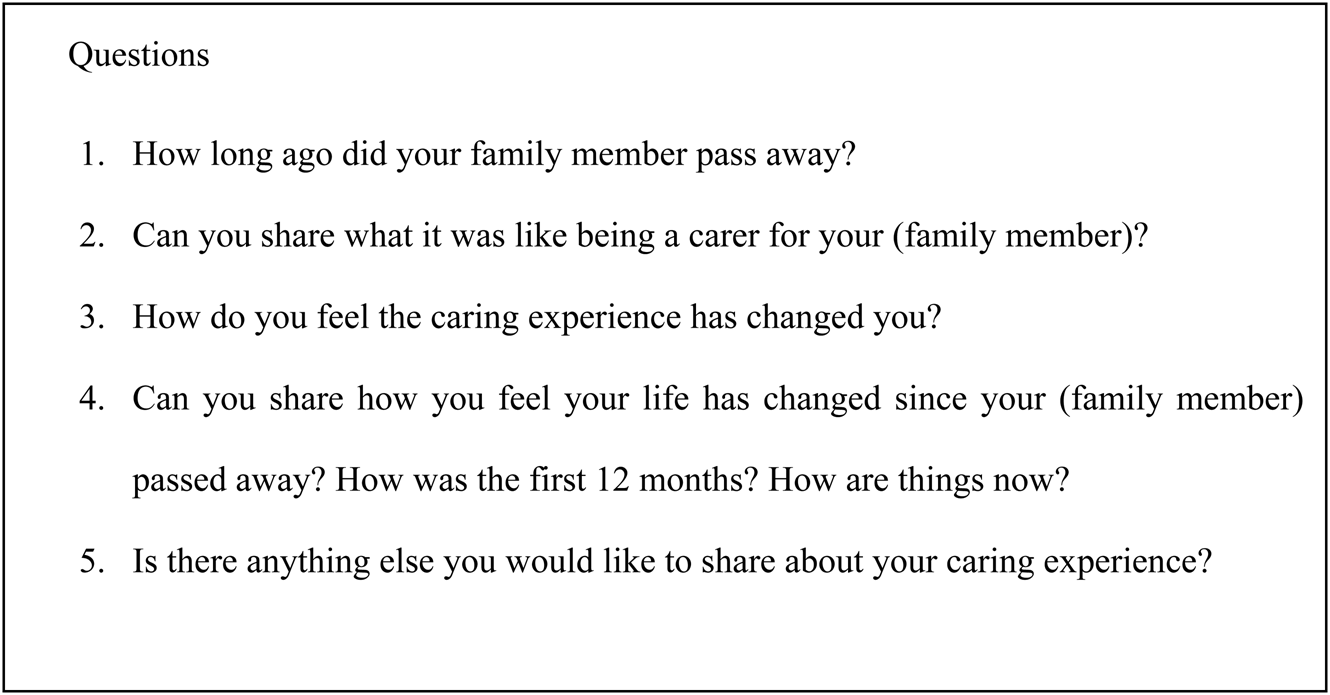
The interview guide is provided in Figure 1. Answers were able to be probed and explored further. The interviewer (SJ) was a Psychology Honours research student who received training and support from an experienced qualitative interviewer (LP); SJ had no prior relationship with the participants. The interviewer repeatedly paraphrased participant responses to confirm their perspective was correctly understood. Interviews were conducted until data saturation was achieved, the point at which no new themes were observed (Guest et al., Reference Guest, Bunce and Johnson2006).
Semi-structured interview guide.

Data analysis
Interviews were transcribed verbatim; participants were de-identified in written transcripts using pseudonyms. Data from the interview transcripts were analysed using an inductive semantic thematic approach, as outlined in Braun and Clarke (Reference Braun and Clarke2006). Interview transcripts were read and re-read to gain a contextualised understanding of each participant's experience. Interviews were then coded line-by-line, and focused codes (meaningful units of text relevant to the research topic) were developed, before identifying themes based on all interviews. Coding was facilitated with NVivo software (version 11, 2015, QSR International). Units of text dealing with the same issue were grouped in analytic categories and given provisional definitions. Data were then systematically reviewed to ensure the name, definition and set of data to support each category were correctly identified.
The initial thematic analysis was undertaken by JS and LP, coding the first interview transcript independently, then meeting to discuss codes identified. This was followed by independent coding of the second and third interview transcripts, meeting after each to discuss codes, until agreement was reached on the final list of codes to be used for the thematic analysis. SJ coded the remaining interview transcripts using the agreed codes and identified the emergent themes. Following an iterative process focusing on data coded to the post-care period, themes evolved when concepts were compared against one another and appeared to pertain to a similar phenomenon (Ryan and Bernard, Reference Ryan and Bernard2003).
Themes identified were strongly linked to the data (Braun and Clarke, Reference Braun and Clarke2006), and represented abstract constructs that link expressions found in texts (Ryan and Bernard, Reference Ryan and Bernard2003). To be considered a theme, the concept had to capture something important about the data in relation to the research aim (Braun and Clarke, Reference Braun and Clarke2006). Although thematic analysis is data-driven, SJ and LP acknowledge the influence of their values and personal experiences (Braun and Clarke, Reference Braun and Clarke2006).
Results
Participants
The sample (N = 9) included five spouses (mean = 73.8 years, standard deviation (SD) = 8.8 years) and four adult children (mean = 58 years, SD = 9.4 years). The majority of carers were female (N = 6). Three wives cared for husbands, two husbands cared for wives, two daughters cared for their mothers, one daughter cared for her father and one son cared for his mother. The mean number of years since the person with dementia had died was 2.96 years (SD = 2.04 years).
Emerging themes
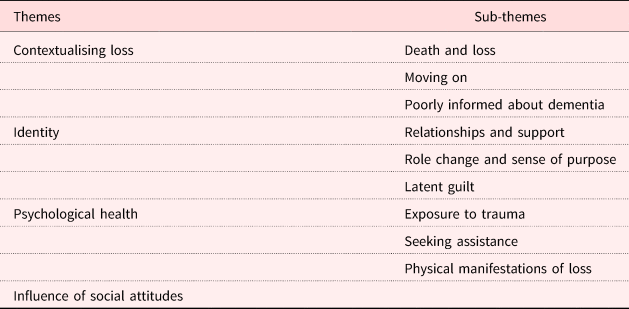
Four themes emerged from the analysis – contextualising loss, identity, psychological health and influence of social attitudes – as shown in Table 1, with sub-themes detailed.
Summary of themes and sub-themes

Contextualising loss
Death and loss
How a carer contextualised the loss of their family member could present as a facilitator or a barrier to the transitioning process. Carers able to reflect positively on the death of the person with dementia or the care journey appeared to be transitioning more successfully into post-care life. Some carers viewed the event of death as a part of life, using a spiritual or faith-based paradigm:
I believe the real world is the spiritual world. I believe we meet again. It [the dementia] was a journey that happened. I thought, God I was so blessed and if it did have that ending, so be it. (Participant 9)
Carers who reflected negatively on the care journey found it more difficult to move forward. One carer was seemingly unable to reconcile the suffering of their family member with their faith, and two carers continued to reflect negatively on the experience of the care journey, including traumatic memories associated with formal care:
I learned to doubt, and that doubt went back to my Christianity. I have lost any faith I've ever had, they talk of a heavenly father who is all powerful, he did nothing for Mary, if it had been me that was struck down, I could understand it. (Participant 5)
For one carer, access to professional support facilitated an understanding of the experience of the person with dementia, the representation of dementia and death, enabling them to reconcile what they had witnessed during the care journey:
I could always run a question past him [doctor], he was always happy to put it into context for me especially after mum died. I needed to know that she wasn't really in pain or suffering … that's the way I can deal with it. (Participant 4)
Moving on
As the caring journey ended with the death of the person with dementia, some carers felt that they could finally grieve for their family member. For some, death represented relief at the ending of the person's suffering but also the termination of the immense burden of responsibility carers felt for the person with dementia:
The whole thing was over, the responsibility I felt … I didn't need to worry about that now. He was safe. (Participant 9)
Carers who felt relief for the person with dementia as their suffering was over, now felt they had the opportunity to be able to focus on good memories of the person with dementia, hence were able to transition more successfully in the post-care period:
I can't stress enough how sad I was but it was actually easier to accept his passing, than it was to accept losing him initially to the dementia … you tell yourself that you're relieved for them and that they're not that sad old man in the nursing home anymore. (Participant 1)
How a carer grieved could also be contextualised against how they felt the person with dementia would have wanted them to move on with their life. Carers capable of reflecting positively on what the person with dementia would have wanted them to do transitioned more successfully as their focus shifted to honouring the person:
Mum would just want me to get on and do things. (Participant 4)
I know that's the only thing I can do in my life now, is to honour him [father] by living as happily and as fulfilling as I can. (Participant 1)
Being able to talk about the person with dementia with family and friends assisted carers in the post-care transition period:
I had long talks with my aunt about that [what mum would have wanted me to do] and she is very supportive of us, just doing what we always did. (Participant 4)
Carers unable to talk about the person with dementia with family or friends felt more isolated with their grief and loss and struggled to transition post-care:
I would love to talk to her [daughter] about Mary, but she doesn't want to. She'll change the subject (cries). (Participant 5)
Being able to say goodbye to the person with dementia before death facilitated post-care transition as carers felt they were able to gain a sense of closure in their care journey:
We got to say everything we wanted to say to him, to say our goodbyes, and we felt that he was lucid enough to actually understand what we were saying. (Participant 1)
Poorly informed about dementia
Carers highlighted issues they experienced with understanding the symptoms and behaviours of dementia. Some carers perceived their lack of exposure to or inability to access information about dementia negatively affected their caring experience, creating a barrier to transition due to feelings of guilt and regret post-care. Some carers felt they could have fulfilled their carer role more adequately if they had been better informed and supported while caring:
There needs to be a course because most people haven't got a clue. They've heard it vaguely … and you can know about Alzheimer's, [but] unless you learn about it, and the different effects it may have, and you've got to be flexible, nobody teaches you that. (Participant 3)
One carer with experience and education about dementia from working in the long-term care sector transitioned better, saying:
If you don't understand it [dementia] when you go into it, you're in trouble I think, because you don't know why they're looking right at you, but they're not seeing you. (Participant 7)
Carers who accessed education and support through organisations such as Dementia Australia or local dementia support groups were able to contextualise the loss of the person with dementia within the framework of dementia:
At first it [symptoms of dementia] was sort of a bit disturbing, but after I had access to the stuff from [Dementia] Australia and got more information about what was going on and what to expect, it became emotionally easier in some ways. It made you go, well, it's not the person, this is the disease. (Participant 9)
Identity
Relationships and support
After the person with dementia died, spousal carers tended to struggle with transitioning out of the carer role. All spouses had been in long-term marriage relationships, but the type and quality of the relationship they had with the person with dementia had changed over the course of the condition, leaving them feeling they had lost their own identity as they became fully immersed in the carer role:
You end up going from a couple to I guess an older brother and a lost little sister. (Participant 3)
For the last three years, she [wife] didn't know me. I became a nonentity to her. I was just somebody else in the room. (Participant 5)
The death of the person with dementia added to the loss of identity for some carers, they were no longer a carer and not part of a couple. Combined with a lack of family support, the carer identity construct was further challenged. The loss of social networks during the care journey created a barrier to post-care transition as many of their former social networks had involved them as a couple:
You don't fit anymore. Everyone's a couple, but you're not. (Participant 3)
Adult children carers transitioned into the post-care role more successfully as the death of the person with dementia represented an opportunity for them to reclaim their original identity of a child of the person with dementia:
I can think about Dad and be happy. I can have happy memories of Dad now … It's the happy memories, from when he was younger and when I was younger, that is stronger now. (Participant 1)
Carers with immediate and extended family support for the entire care journey, including the post-care period, transitioned better than carers who lacked this ongoing support:
I think I've moved on fairly well, but I think that's because I have a lot of [family] support. I have a really good husband who has always been 100 per cent supportive and caring and that has made probably the biggest difference to dealing with it because he's just always there. (Participant 4)
For one carer, family disagreements regarding care of the person with dementia, during the care journey, left them with irreconcilable family conflict creating a barrier to post-care transition:
I have had no contact with him [brother] at all whatsoever since mum's funeral. It will be there forever, it will never change. I don't ever want to see him and his family again. (Participant 7)
Some spousal carers continued to experience the isolation that they had felt while caring during the post-care period:
Everyone else is moving on, but me … we had the funeral and then POW, everybody packed up and went home including the boys, and here I am in this big house. My isolation continues in that I don't see my boys because of distance and their own lives. (Participant 3)
Carers who were able to maintain their social networks during caring transitioned better in the post-care period:
You can't do it without people; you just can't. You can't do it alone … I've been kind of getting help from other people. Just talk about it, just don't hide things, talk about it. (Participant 7)
Sometimes support came from neighbours recognising life had changed for the carer. Recognition of one carer's difficulties with transitioning and the desire to help represented a turning point where post-care transition began:
She said ‘Your house looks really sad.’ I said, ‘Yeah, I know.’ She says ‘Would you mind if I put something in your garden?’ I said, ‘Well, if it makes you feel better, go ahead.’ My house looks the best on the street. That just seemed to do something and I suddenly started to care about the house. So I weeded, and I water and that's helping me physically. (Participant 3)
After the death of the person with dementia, some carers considered it would be inappropriate to access agency support as they were no longer carers:
I think, with the dementia hotline, I didn't feel like I had a right to ring them and talk to them. (Participant 1)
The majority of carers expressed a desire for regular contact from support agencies, feeling the need to talk about their experiences. Online support groups provided an opportunity to share information and receive support, and Dementia Australia was mentioned as a helpful source:
After he [Dad] went, I needed to talk about it and I think that's one of the reasons why I started following the [Dementia] Facebook page … connecting with people that had the same experience. (Participant 1)
One carer, at the encouragement of the dementia support group facilitator, continued to attend weekly meetings and cited this as a place to talk about their care experience and learn new life skills:
It was relief, and it was something different to do. I still go, even though I'm not a carer any longer, I know she is always there for me. She has been a big support … probably the only help I get. (Participant 5)
A number of carers felt their journey would have been easier if individualised agency support had been available to them, expressing they would have wanted support to continue after the death of the person with dementia to make the post-care transition smoother:
I just wish you only had to go to one person, to talk about it, to find out what's out there. That would be my dream that they have this service where you only have to tell your story once and that it continues afterwards, as long as you need it. (Participant 2)
Role change and sense of purpose
For the majority of carers, the role of carer became their entire life's work and identity. Their daily routines were determined by the needs of the person with dementia, including giving up employment to be able to care. After the person with dementia died, carers struggled to adapt to the sudden change in roles, leaving them feeling lost and unsure how to move forward with their life, even if the person with dementia had been in formal care before death:
I was a bit lost, really. In some ways I felt like I've got my life back, but at the same time I didn't quite know what to do. It was almost like I didn't have a purpose anymore … it had very much become my life and I was very much like ‘what do I do now?’ (Participant 8)
Around 12 months’ post-death, some carers appeared to be adjusting to the change in role, reflecting on how the experience of caring had changed them as a person, feeling they could use their experiences to help others and looking for new roles to play. The majority of carers experienced a change in their life perspective, with increasing compassion and forgiveness of human frailties. Carers took on a variety of roles to fulfil the need to give to others, including tertiary education in long-term care, working with charities, providing support to families whose loved one was in care and writing a book to help support carers:
So that's when I started to think I should start studying something. I did reasonably well with caring for mum. It was difficult on an emotional level, that connection with family, but the actual doing part of day-to-day care sort of stuff, that's why I have decided to do the aged care course. (Participant 9)
I always wanted to do something for the community … I'm always driving a bus, that's what you do. I'm feeling good. Things are happening. I'm coming back to life. (Participant 3)
Latent guilt
A significant barrier to post-care transition was latent guilt. Some carers developed a backwards-looking focus, revisiting the care journey to review their performance as a carer. The ongoing appraisal of their adequacy in the caring role created feelings of regret and guilt. Confronted with making important decisions, the uncertainty about the person with dementia's level of suffering and their inability to communicate intensified the feelings of guilt for carers:
It wasn't until two years later, that the guilt started to creep back in. Could we have made his [father] last few years better … you sort of feel like you could have tried a bit harder and you could've fulfilled your role as a child to look after a parent in need. (Participant 1)
Psychological health
Exposure to trauma
Traumatic end-of-life events related to the professional care of the person with dementia resulted in some carers experiencing debilitating grief, creating a significant barrier to transition. Unresolved grief became a source of distress and anguish for one carer, resulting in psychological impacts of depression, post-traumatic stress disorder and suicidal ideation:
It's just rocked me more than the worst horror film you could watch or anything. It was like being in Auschwitz. It's been absolutely terrible … I mean, nightmares, night after night … I've been suicidal, if it hadn't been for my daughter talking me out of it, I would have finished my life. There's not many days I really can get up and go out. (Participant 6)
Seeking assistance
One carer accessed bereavement counselling post-care to deal with their grief, with mixed feelings as to the success of this support. Being male and older was a potential barrier to seeking assistance with male carers saying counselling had been offered to them from the care home or the funeral home, but they considered they did not need this support. Reflecting on this action later, two carers commented they should have taken it up:
They did offer grief counselling services, which I probably stupidly turned down … as well as the funeral parlour people … and the home that Mum was in, which I turned down as well. (Participant 9)
Carers who acknowledged they were struggling in the post-care period sought out assistance from medical professionals. Sometimes it was family support that encouraged a carer to seek assistance, for other carers it was their poor psychological health:
I guess, after about six months, I just suddenly fell into this hole and suddenly realised that he wasn't coming home and that lasted two or three months, that horrible feeling and the doctor put me on antidepressants and that did help. (Participant 2)
Physical manifestations of loss
Carers neglecting their physical health after the person with dementia died was commonly reported. The loss of the caring role and the inability for some carers to grieve their family member left these carers feeling lost and without purpose, resulting in engagement in activities that harmed their health. Maladaptive behaviours created barriers to transition with some carers drinking excessively, over-eating, gaining excessive weight and developing health issues:
My physical health was going down the tubes. I ended up with raging diabetes. (Participant 3)
I was just eating every bit of rubbish you could get your hands on, drinking myself into oblivion, that first year, how I didn't go with alcoholic poisoning, I don't know. (Participant 6)
Influence of social attitudes
The influence of social attitudes on some carers made the post-care transition more difficult. Being single again made it difficult for spouses to feel comfortable when engaging socially, often finding friends felt awkward around them, reinforcing the feeling that they were now different:
I don't feel comfortable … You don't fit anymore. Everyone's a couple, but you're not, and they don't know what to do with you. (Participant 3)
The stigma of dementia still provoked feelings of distress for carers after the death of the person with dementia. One carer was still angry that his wife had to endure the embarrassment of the condition, considering friends had gone from respecting her for her personal attributes, to labelling her as a person with dementia. Another carer experienced ongoing distress that family had not visited the person with dementia, due to their inability to deal with the effects of dementia on them:
They don't go visit them because they can't watch them deteriorate. Well, I loved every minute with my husband, I can tell you. (Participant 6)
Negative role appraisal from outsiders while caring continued to cause distress for carers. One carer spoke of people appraising him during the care journey in a manner that inferred he was wasting his time:
People said to me, ‘Why are you doing that [caring for his wife]?’ I said, ‘I'm doing what I want to do.’ (Participant 5)
Two carers reflecting on their care role during the post-care period had their perspectives negatively influenced by the stigma associated with placing their family member into formal care, creating ongoing feelings of guilt and failure that affected their transition:
I try to avoid it [guilt] nowadays because I need to move on, but there's this stigma with anyone that puts a loved one in a nursing home is dumping them. (Participant 1)
One carer wanted to transition very quickly to avoid being labelled; however, this created a barrier to transition as she failed to deal with her grief and six months after the death of the person with dementia was diagnosed with depression:
I didn't want to be a grief-stricken widow … I wanted to get through that really fast, I sort of wanted to get the grief part over and done with then … It couldn't catch up with me. (Participant 2)
Within the four themes, there were both facilitators and barriers to transition identified. How a carer contextualised loss could be considered both a barrier and a facilitator. Being a spouse was more likely to be a barrier to transition. Maintaining social networks, being able to talk about the person with dementia and accessing support services were facilitators. Poor psychological and physical health, being poorly informed about dementia and negative social attitudes were all barriers to moving into a positive post-care period.
Discussion
The aim of this study was to explore the experiences of family carers of a person with dementia, following the death of the person with dementia, focusing on facilitators and barriers to positive transition in the post-care period. Carers described multiple factors that may affect transitioning through the post-care period. Socio-emotional support from family and friends played an important role in facilitating adjustment to role change and dealing with grief. The acquisition of knowledge about dementia was a facilitator for better transition. A barrier to positive transition was experiencing feelings of guilt in the post-care period associated with the belief the carer could have provided better care for the person with dementia or cared for longer. Spousal carers experienced greater difficulties with transitioning compared to adult children carers, and have been shown to be more prone to complicated grief responses (Schulz et al., Reference Schulz, Mendelsohn, Haley, Mahoney, Allen, Zhang, Thompson and Belle2003, 2006; Chan et al., Reference Chan, Livingston, Jones and Sampson2013).
Being able to say goodbye to the person with dementia before they died had a positive effect on carer post-care emotional state, as has been noted previously (Crespo et al., Reference Crespo, Piccini and Bernaldo-de-Quirós2013). Carers expressed relief the care journey had ended, not for their own sakes, but for the person with dementia, relieved that their suffering had ended and their dignity could be restored, as previously found (Aneshensel et al., Reference Aneshensel, Botticello and Yamamoto-Mitani2004). All carers underwent a period of identity adjustment, as their role changed from carer to a single person or an adult child. Consistent with previous findings, carers described the first 12 months as an emotionally challenging time, characterised by intense feelings of loneliness, isolation and loss of purpose (Larkin, Reference Larkin2009; Cronin et al., Reference Cronin, Hynes, Breen, McCarron, McCallion and O'Sullivan2015).
Social attitudes created barriers to belonging which negatively influenced the post-care transition (Daly et al., Reference Daly, McCarron, Higgins and McCallion2013). Spousal carers experienced difficulty reintegrating with former social networks made up of couples due to change in their social identity; being single meant they did not belong anymore. One carer wanted to avoid being labelled ‘the grief-stricken widow’, wanting to move quickly through the grieving process, resulting in negative outcomes and creating barriers to transitioning. The stigma associated with placing the person with dementia into formal care, as previously described (Alzheimer's Disease International, 2012), created distress for two carers in the post-care period, negatively affecting transition.
Religion and spirituality played an important role in overall wellbeing for some carers in the post-care period. Carers who appeared to have reconciled their beliefs and practices with adverse events of the care journey experienced an easier transition into the post-care role. These carers conceived their current difficult circumstances as manageable, their beliefs providing a framework for understanding why pain and suffering exist, along with the hope in a ‘heaven’ where the person with dementia was ‘free’ and ‘safe’. Conversely, one carer felt abandoned by their ‘god’ and hence their faith, continuing to experience distress, which negatively affected transition in the post-care period. These findings are consistent with past research about the role of religion and spirituality in care-giving (Stuckey, Reference Stuckey2001).
The majority of carers indicated the desire to give something back to the community, citing the caring experience as having transformed their perspective, with a new appreciation of the value of life. Similar post-care attitudes were shown in previous research (Larkin, Reference Larkin2009; Cronin et al., Reference Cronin, Hynes, Breen, McCarron, McCallion and O'Sullivan2015). These carers appeared to be more resilient as they could reflect on the care journey and acknowledge how they had grown through the care experience. While still experiencing feelings of loss, they could remember their family member more positively, and allow themselves time to transition. Conversely, a minority of carers were still experiencing distress, expressing unresolved anger, distrust of the world and ongoing psychiatric morbidity, as previously found by Schulz et al. (Reference Schulz, Boerner, Shear, Zhang and Gitlin2006).
Carers in this study expressed a desire for more support, from the time of diagnosis of dementia through to the post-care transition. They felt that lack of support for carers from caring associations, and limited access to appropriate information and services to help them understand dementia and support them while caring, made the post-care transition more difficult. Carers who acquired knowledge of dementia appeared to transition better in the post-care period, expressing feeling more equipped to deal with the challenges of dementia, allowing them to rationalise the person with dementia's experience as part of the condition. Access to knowledge and education about dementia is a surprising barrier and facilitator, as there are multiple sources of knowledge and education about dementia available in multiple modes (phone support, face-to-face support groups, websites, MOOCs (Massive Open Online Courses) and Facebook pages). A challenge is how to ensure that those with unmet need for knowledge and education about dementia can have access to these resources facilitated. While previous research has found that intervention during care-giving could lessen negative outcomes in the post-care period (Aneshensel et al., Reference Aneshensel, Botticello and Yamamoto-Mitani2004; Schulz et al., Reference Schulz, Boerner, Shear, Zhang and Gitlin2006), this support needs to be readily accessible to all carers in the community. Carers in this study indicated a desire to have a consistent support person through the entire care journey, as retelling their stories added to the trauma of their experience.
Strengths and limitations
A limitation of the study was the lack of ethnic diversity in the sample, so results can only be interpreted based on the participant cohort which was Caucasian Australians. Variations among different ethnic groups with regard to family structure and caring for family members may contribute to different outcomes for carers. Another limitation was participants involved in the study represent a self-selected sample, carers willing to participate may differ from those who chose not to participate. A further limitation is the use of mixed interview modes (face-to-face and telephone). Although previous research found no significant difference between transcripts from telephone compared to face-to-face qualitative interviews (Sturges and Hanrahan, Reference Sturges and Hanrahan2004), social desirability bias may be stronger for telephone interviews (Jäckle et al., Reference Jäckle, Roberts and Lynn2006). Face-to-face and telephone interviews have both been shown to be accurate within acceptable error for qualitative research studies (Rahman, Reference Rahman2015). Telephone interviews cost less and are easier to organise and may be the preferred method unless face-to-face interviews provide significant benefits to the research (Rahman, Reference Rahman2015). Strengths of the study include age and relationship diversity of participants, with the sample being demographically representative of the current population of Australian dementia carers for gender and relationship types. Further strengths include the use of purposive sampling to ensure the sample had the experience of interest, and reaching saturation in data collection.
Conclusion
This study identifies a variety of barriers and facilitators that affect post-care transition: access to knowledge and education about dementia is perhaps the most surprising barrier and facilitator, and challenges researchers, health-care providers and carer associations to find ways to enable easy access to the many resources available. Supporting carers in a way that enables them to cope effectively with the challenges of caring may positively influence carer transition in the post-care period. Interventions that actively engage and support carers, inclusive of the post-care period, such as ensuring a strong and consistent support network, and access to needed information resources, may assist with reducing the negative impacts of caring and increase self-efficacy, resilience and wellbeing post-care.
Author ORCIDs
Lynne Parkinson, 0000-0001-9433-9555
Acknowledgements
The research on which this paper is based was conducted as part of the requirements for Honours Psychology at Central Queensland University, for SJ, with LP as supervisor.
Author contributions
The author contributions were SJ 50 per cent, LP 40 per cent and AB 10 per cent. All authors meet the criteria for authorship, have approved the final manuscript and take public responsibility for it.
Financial support
This research received no specific grant from any funding agency, commercial or not-for-profit sectors.
Conflict of interest
The authors declare no conflicts of interest.
Ethical standards
Ethics approval for the research project (H16/05-110) was obtained from Central Queensland University Human Research Ethics Committee. Participants were fully informed about the study before participation, providing signed, informed consent.