On 22 January 1937, the front page of the Syrian daily newspaper al-Ayyam printed in large letters the following news: “al-Hashimi is Dead: A Painful Calamity Upsets the Arab Nation.” The news about the passing of Iraq's former prime minister was the most important front matter of the Syrian paper, with a large photograph of the deceased in the center of the page and a black margin around the text, which filled two columns from the top of the page to the bottom. Al-Ayyam's writer was sure that this painful news would deprive people of their sleep and shake their souls. It was like a “lightning strike that penetrated the entire Arab fatherland that al-Hashimi had helped to liberate.” A star had gone up with his death in the skies of Arabism, according to the al-Ayyam writer, and its light would not be extinguished as long as there was someone on earth who spoke in the language of the letter ḍād.Footnote 1 Clearly, the Damascus daily considered al-Hashimi's death a matter that concerned the entire Arab nation. The praise became an all-out apotheosis.
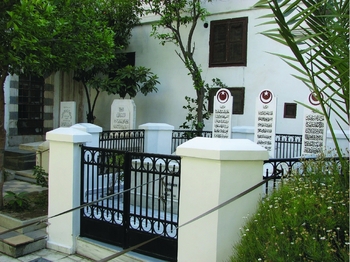
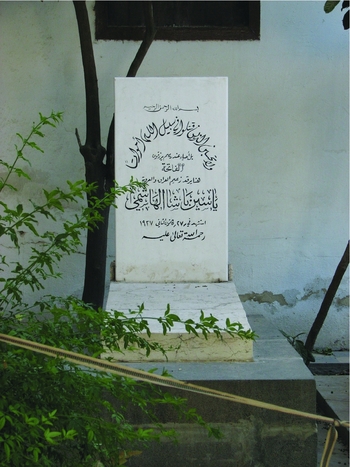
The excitement that the contemporary publicist expressed about Yasin al-Hashimi seems odd today, when his memory—far from what his contemporary had predicted—is certainly diminished if not all but erased. Al-Hashimi is a footnote in the history of Arab nationalism.Footnote 2 Today, a visitor to Old Town Damascus may stumble upon the Iraqi politician's grave on a tourist stop at the mausoleum of Salah al-Din al-Ayyubi, or Saladin, which is framed by the ruins of the medieval Madrasa al-ʿAziziyya adjacent to the walls of the Umayyad Mosque. Next to Saladin's mausoleum, there is a line of 20th-century graves (Fig. 1). To the far right lie three Ottoman Turkish pilots who died in a plane crash in March 1912.Footnote 3 Next to them is the nationalist ʿAbd al-Rahman al-Shahbandar, buried there after his assassination in 1940.Footnote 4 A fifth grave, next to al-Shahbandar and the closest to Saladin, contains the remains of Yasin al-Hashimi (Fig. 2).
Author's photograph of the downscaled Panthéon: the tombs of Yasin al-Hashimi, ʿAbd al-Rahman al-Shahbandar, and the three Ottoman pilots (left to right) next to Saladin's mausoleum in Damascus. [A color version of this figure can be viewed online at journal.cambridge.org/mes]

Author's photograph of Yasin al-Hashimi's tombstone. The Qurʾanic inscription reads: “Think not of those who are slain in Allah's way as dead. Nay, they live, finding their sustenance in the presence of their Lord” (3:169, trans. Yusuf Ali). [A color version of this figure can be viewed online at journal.cambridge.org/mes]

The purpose of this article is to examine Yasin al-Hashimi's funeral in January 1937 and the events of the ensuing week as a case study of the fault lines of interwar Arab nationalism, based on an analysis of the narratives of various Arabic sources, most of them newspapers, read in tandem with French intelligence reports. The latter have an eyewitness quality that makes them quite reliable.Footnote 5 The sources indicate that al-Hashimi's obsequies, his lying in state in Damascus afterward, the eulogies, and the coverage of the events in the press of several Arab countries created a meaningful Pan-Arab community for a period of time—a community, however, that had different meanings for its diverse participants.
Al-Hashimi, who had been in exile in Lebanon since his fall from power in Iraq's first military coup in October 1936, died in Beirut on 21 January, shortly after nine o'clock in the morning, after having suffered two heart attacks. His brother, Taha al-Hashimi, was with him.Footnote 6 One of the doctors sent telegrams announcing the death to important Arab leaders and organizations, including Amir ʿAbdallah of Transjordan; the mufti of Jerusalem, Amin al-Husaini; the Syrian National Bloc; and the Egyptian government. One telegram asked for permission from King Ghazi of Iraq to transfer the body to Baghdad. Lebanese dignitaries who came to offer their condolences suggested a burial in Damascus instead.Footnote 7 The family decided that doctors of the American University of Beirut should embalm the body, and the Syrian government had already started to plan for a burial next to Saladin with solemn festivities when notice arrived from Iraq that the body would be admitted to Baghdad. However, the Iraqi government would not allow the deceased's brother, Taha, to participate. In spite of concerns about the sincerity of the Iraqi government, the family accepted this proposal. The coffin was to be brought from Beirut to Damascus and then—after a funeral ceremony—transported to Baghdad. At the end of the day on which Yasin had died, after the body had been embalmed and placed in a coffin, Taha al-Hashimi finally had the chance to mourn his brother privately in the latter's house, while listening to Qurʾanic recitation.Footnote 8
The tranquility of this final scene stands in stark contrast to the publicity of Yasin al-Hashimi's death. The list of those who received immediate notice via telegraph reads like a who's who of Arab nationalism. It is clear that his death was understood as an event that concerned the entire Arab nation. Newspapers in Palestine remembered al-Hashimi's uncompromising support of the Palestine Revolt and announced that Palestinian delegations would travel to Damascus to participate in the obsequies. “All of Palestine” would hold prayers for the deceased in the mosques, and church bells would ring.Footnote 9Al-Difaʿ bemoaned the tragedy of al-Hashimi's death—“in Beirut, and not in Baghdad. In Syria, and not in Iraq . . .”—as a harbinger of bad times for the Arabs and the Palestinians in particular.Footnote 10 A eulogistic poem printed in the same newspaper a few days later praised him as “. . . the singular hero / al-Hashimi / The genius . . .”Footnote 11 In Egypt, al-Ahram agreed that al-Hashimi's passing away was a calamity for the Arab nation.Footnote 12 Even the Egyptian Islamist journal al-Fath noted that rarely had an Arab leader achieved esteem among the people similar to that of Yasin al-Hashimi, both in life and in death: “the telegraph lines between Egypt, Syria and Iraq trembled from carrying messages of deep sadness.”Footnote 13 There was very little echo of the loss in al-Hashimi's home country of Iraq, however.Footnote 14 In Damascus, al-Qabas claimed to be stunned by Iraq's unfaithfulness to its hero while dignitaries from all over the Arab world gathered in that very city, the “Great Capital of the Arabs,”Footnote 15 and al-Akhbar wrote: “Cain! . . . What have you done to your brother?”Footnote 16
There was clearly a sense of competition over who the better “Arabs” were and where they were located. Although the borders between Syria and Iraq had been drawn after World War I by the colonial powers France and Great Britain, they confirmed in the eyes of the former Ottoman notables the coherence of provincial elites and the local patriotism of the respective capitals and major cities. In Syria, the old elites safeguarded their inherited control over Syrian society by endorsing Arab nationalism, without offering room for any change in patterns of social stratification. Urban notables transformed themselves into a national bourgeoisie, maintaining their paternalistic hegemony over society through existing patron–client networks.Footnote 17 In Iraq, former Ottoman officers such as al-Hashimi allied with old urban and tribal elites to form a new class of landowners who used the Iraqi state to further their interests in spite of their Pan-Arab convictions. In the later 1920s and in the 1930s young professionals, intellectuals, and students of modern institutions of learning—the so-called “young effendiyya”—used their growing influence in the nascent public sphere of both states to challenge the dominance of the elite.Footnote 18 Under these circumstances, the notables-turned-bourgeois nationalists in the Syrian government used Yasin al-Hashimi's funeral in an existing competition over regional leadership and ideological hegemony.
Yasin al-Hashimi's death and funeral, as well as his actual burial in Damascus on 28 January, were “timed” in a peculiar way. The year 1936 witnessed a number of seminal events in Arab politics, including the Iraqi coup, the Anglo–Egyptian treaty, and the Palestine Revolt, and there was great nervousness throughout the Arab world. Moreover, Syria had its own issues. Two months before al-Hashimi's death, a new government of the National Bloc Party entered office after the country's first free elections under French Mandate rule. In the fall of 1936, the bloc, under the command of the bourgeois nationalists, negotiated a treaty with the Popular Front government in Paris. If ratified, it would have given Syria a considerable degree of autonomy, comparable to the 1930 Anglo–Iraqi treaty. In December, after the delegation's return to Damascus and its landslide victory in the November elections, the Syrian parliament ratified the treaty, anticipating that the French National Assembly would follow suit. This, however, never happened because the Popular Front fell soon afterward.
The year 1937 thus began with great excitement in Syria. The recently founded paramilitary youth organization and strike force of the National Bloc, the “Iron Shirts,” commanded the streets of Damascus, celebrating imminent independence from France.Footnote 19 However, only a few days after al-Hashimi's funeral on 22 January, Turkey won a concession from the League of Nations in a territorial dispute over the Sanjak of Alexandretta (Iskenderun), which led to an outbreak of violent protests and large-scale demonstrations against the passivity of the National Bloc with regard to maintaining the territorial integrity of the Syrian state. The students’ unrest brought the government to the brink of collapse. The irony is that al-Hashimi's funeral marked the climax of the National Bloc's popularity, and his burial on 28 January took place when it had reached a low point. Within a few days, the Sanjak affair had led to the evaporation of the credibility won during the funeral.Footnote 20
There were therefore two kinds of demonstrations in late January 1937, a classic “republican funeral”Footnote 21 challenged by a student-led outburst of popular nationalist sentiment in response to the Sanjak affair. The urban topography of Damascus provided a stage for this clash between the old elite and the students, who adopted the populist demands of workers and shopkeepers into their agenda. When the Alexandretta protests filled the streets with angry student demonstrators, the National Bloc tried desperately to recreate the serene atmosphere of the funeral, to no avail. Thus, the bloc lost its hegemony over the civic space of the city to contenders in the public sphere of the young Syrian polity, highlighting the uneasy coexistence of two generations of nationalist activists, as well as populist forces, that was characteristic of Arab nationalism in its formative phase during the interwar period.Footnote 22 One of the bloc's major contenders was the League of National Action, founded in 1933. It represented a new generation of Syrian nationalists, made up largely of students from the university and secondary schools—a group that rejected the bloc's hegemony over Syrian politics and was difficult for the old elite to control.Footnote 23 It is against this background that Yasin al-Hashimi's death and subsequent funeral in Damascus offered the elite nationalists an opportunity to assert their control over the increasingly unruly urban population.
A “GREAT MAN,” BUT FORGOTTEN
Al-Hashimi was born in 1884 into a Baghdadi family of modest means.Footnote 24 His last name points to a rather questionable claim about a distant relation to the Prophet's tribe, the Banu Hashim, that his family indeed upheld. But as a matter of fact, like many of his fellow officers who became influential politicians in Iraq, he adopted his last name only when he enrolled at the Istanbul military academy or even later.Footnote 25 As a high-ranking Ottoman staff officer, he became a hero during World War I. When Faysal ibn Husayn ruled in Syria from 1918 to 1920, al-Hashimi presided over his war council, and when Faysal became king of Iraq in 1921, al-Hashimi joined him once more as a very ambitious politician, mistrusted by his contenders for political power. He held two premierships, from 1924 to 1925 and from 1935 to 1936.Footnote 26 According to Phebe Marr, al-Hashimi was not only opportunistic and ruthless—exploiting his position for status, power, and wealth—but also the most skilled Iraqi politician of his time. He was able to build a constituency based on his opposition to treaty arrangements with the British Mandate power. In 1937, eulogies praised Yasin al-Hashimi as a gifted manager of state finances, and Marr confirms that he was an able administrator. He was instrumental in building a fiscal system and stabilizing Iraqi finances in the 1920s and 1930s, and he also backed legislation that drastically favored large landholders and, thus, his personal economic interests. Al-Hashimi promoted the economic welfare of the ruling class he belonged to because he believed it was the primary condition for the preservation of law and order or, in other words, social discipline in the country. When political infighting and the tribal pressure that he was able to exploit brought al-Hashimi to power in March 1935, he intended, as an admirer of Kemal Atatürk, to form a regime that was more authoritarian, militaristic, and nationalist—if also more efficient—than its predecessors. Al-Hashimi worked toward the creation of a single state party and curtailed freedom of press. The state clamped down on the leftist opposition and instituted military conscription. The government also drafted a new labor law (which never went into effect) that would have banned child labor and allowed the creation of unions, albeit under almost insurmountable restrictions. Oil royalties allowed al-Hashimi to focus on economic development and the improvement of infrastructure. However, he gave a clear priority to military needs. To quell smoldering tribal unrest in the south, he banned Shiʿi Muharram processions. A cornerstone of his regime's disciplinary strategy was the creation of the Futuwwa youth organization.Footnote 27 When the Palestine Revolt broke out in 1936, it propelled Yasin al-Hashimi—as the head of what Arab nationalists in other countries regarded as the only truly independent and nationalist Arab government—into a position as leader of Pan-Arab solidarity with the Palestinian rebels, although he was reluctant to take on this role.Footnote 28
Dissatisfaction with his autocratic style and perceived arrogance fueled the domestic opposition to his rule that led to his downfall in the military coup of October 1936 and, by extension, to his premature death of heart failure only three months later.Footnote 29 Staged by the Iraqi chief of staff Bakr Sidqi, a Kurd, and supported by the left-leaning al-Ahali group, the coup also opposed the Arab nationalist mainstream of the Iraqi political elite.Footnote 30
In the mid-1930s, Yasin al-Hashimi—the war hero, the staunch opponent of British influence in Iraq, the promoter of Palestinian resistance—was an icon of Arab nationalism, inside and outside Iraq, and a point of reference for Pan-Arab nationalists of many different provenances.Footnote 31 His death turned him into a public hero. The funeral in January 1937, its symbolic itineraries, and its speeches illustrate how Arab leaders used the deceased's charisma to turn Pan-Arabism into something to be physically experienced by the people in the streets of Damascus and by the youth groups that escorted the coffin. First-rank politicians used shared Pan-Arab feelings to popularize their own claim to leadership.
From a different vantage point, the funeral was also a transitory rite that turned Yasin al-Hashimi into a “great man.” The topos of the great man, initially a European concept of the Enlightenment, entered the secular discourse of the Arab nahḍa (“awakening”) in the late 19th and early 20th centuries through intellectual journals. Publicists such as Jurji Zaydan and Farah Antun were looking for the great men of Arab history who had propelled Arab civilization to unprecedented heights.Footnote 32 It is arguable that this culte laïc Footnote 33 was a response to the refutation of the traditional Islamic cult of saints by Islamic reformers and secularizing elites. The cult of the Arab nationalist zaʿīm (leader) in the interwar period and beyond was, in this sense, the manifestation of a civil religion.Footnote 34 Cults of both heroes and saints depend on locality and the performance of commemoration to gain meaning in national or religious discourse. Yearly festivals such as a mawlid or a mawsim and the ziyārāt (visits) to the tomb of a saint or a hero (such as the patriotic pilgrimage to Atatürk's mausoleum Anıtkabir) constitute and ritualize memory and thus keep it alive. Without action and public participation, the mnemonic or memory-related quality of a place (such as a tomb) dies. A funeral is therefore a mnemonic festival.Footnote 35
Yasin al-Hashimi's funeral in Damascus in January 1937 provides a case in point. It brought many people to the streets and evoked broad reactions in the Arabic press of various countries. It also left a physical trace, albeit one as mundane as a tombstone in the shadow of a much more prominent historical figure: Saladin. The association between the 20th-century Arab leader and the Ayyubid Sultan, the knight who repelled the crusaders, is no coincidence. The sources do not offer explicit reasons for the choice of location, but the fact that Saladin became a secular saint of Arab nationalism in the 20th century and a great man of the Arabs made the small graveyard next to his mausoleum sacred terrain, like a downscaled Panthéon, ideal for the burial of another great man like al-Hashimi.Footnote 36
THE FUNERAL
The new Syrian government of the National Bloc turned Yasin al-Hashimi's obsequies into a genuine “republican funeral,” as part of a project to build a secular but sanctified community, based on a civil religion, around its heroes and modern-day saints. This canonization was no longer the reward for piety but rather for service to the nation as leader, warrior, or scholar–intellectual who provided legitimacy to the state.Footnote 37 The emerging Arab states, including Syria, were in dire need of these rites because they suffered from the loss of the central symbol of the Ottoman caliphate and had to fend off the colonial embrace of the Mandates. The state funeral “gave the republicans an opportunity to transcend the political sphere, in which their legitimacy was contested, and to identify themselves with the entire nation.”Footnote 38
In 19th-century France, a republican funeral involved an opulently staged lying in state, a cortege through the streets of Paris with mass participation, a religious service at a central church, and meticulous coverage in the press, including reports about the festivities and eulogies that spread the news all over the country. At times, obsequies and memorial services were held concurrently in other major towns of the country.Footnote 39 Yasin al-Hashimi's funeral followed a similar model. The procession of the coffin from Beirut to Damascus, and the subsequent funeral, combined several layers of symbolism, including Arab nationalist references to Saladin and tributes to the 1920 Battle of Maysalun, which sealed French Mandate rule over Syria.Footnote 40 Yasin al-Hashimi's journey started at his house in Ras Beirut on the morning of 22 January. Students from the American University of Beirut entered the house to bring out the coffin on a bier. It was put on a car adorned with Arab flags, wreaths, and flowers. The students formed a guard of honor dressed in “Arab garb,”Footnote 41 distinguished by black shirts and the kūfiyya with the ʿiqāl rope securing it in position. The headgear had particular currency at the time as a symbol of Palestinian defiance during the Revolt.Footnote 42 Some women who belonged to al-Hashimi's house and neighboring houses then started to clamor, “Good bye, Yasin, comrade of King Faysal.” This is the only mention of direct involvement of women in the events of this day, which is unusual considering the particular role that women played as wailing onlookers or participants in, for instance, Egyptian funeral processions of the same period. In January 1937, the Syrian press only noted women again as visitors to al-Hashimi's lying in state after the obsequies.Footnote 43
The procession on 22 January was led by police squadrons and Muslim Boy Scouts on bicycles carrying “Arab flags”—probably the black, white, green, and red banner of the Arab Revolt.Footnote 44 Some had “Faqid al-Umma al-ʿArabiyya” (Deceased of the Arab Nation) written on them.Footnote 45 The coffin was followed by Taha al-Hashimi, Lebanese dignitaries (including the Lebanese state mufti), the Iraqi and Saudi consuls, and a delegation from Damascus led by the renowned nationalist Fakhri al-Barudi, who was a Syrian parliamentary delegate for Damascus and leader of the Iron Shirts and thus a high bloc functionary.Footnote 46 The procession ended at the al-ʿUmari Mosque, where a short prayer was held and a student recited a poem for al-Hashimi. The body was then sent off to Damascus. Folkloristic and Islamic elements as well as new republican customs had turned this into a hybrid event. Next to wailing women, there were Boy Scouts on bicycles. There was a funeral procession, but the bier was put on a motorized vehicle. There was a funerary prayer in the mosque, but representatives of the entire national community, including the former Maronite prime minister Bishara al-Khoury, attended.
The student poet, the guard of honor, and the Boy Scouts represented a future generation of Arab nationalists, yet for al-Qabas, Yasin al-Hashimi's funeral pointed to the past. The paper considered it a reference to the Damascus of Faysal, in the glory days of Yasin's living presence in the city.Footnote 47 On 22 January, al-Hashimi's cortege made a symbolic stop on its way to Damascus to pay homage to the heroes of Faysal's days at the tomb of Yusuf al-ʿAzma, who had commanded the Syrian irregular army during its last stance against the invading French at the Battle of Maysalun. This was a symbolic appropriation of the battle; it ignored, however, that those who had fought under al-ʿAzma in 1920 were in fact patriotic recruits from the city's popular classes and surrounding villages rather than soldiers in Faysal's Sharifian army. The fighters acted in populist defiance of Faysal and his entourage, who, they believed, had sold out Syria to the colonialists. The actual relationship between Faysal and al-Hashimi was also far from harmonious.Footnote 48
When the cortege finally arrived in Damascus, an awesome spectacle unfolded. The strong role played by uniformed youth was meant to signify the bloc's youthful potential in spite of the elite background of its leaders. Already before ten o'clock, thousands of people had started to gather around Damascus’ National Garden.Footnote 49 Troops of Iron Shirts and Boy Scouts lined up around the new building of the Tajhiz school.Footnote 50 At eleven o'clock, students of the Syrian University and the secondary schools joined them, and police squadrons prepared to salute the deceased. After twelve o'clock, government representatives arrived, including Prime Minister Jamil Mardam as well as the Saudi consul, the British vice consul, representatives of the Christian patriarchs, the president of the Jewish community, and other dignitaries. When the truck from Beirut arrived shortly after one o'clock, the Iron Shirts, Boy Scouts, and students stood in formation from the front of the Jabkhana Arsenal to the Victoria Hotel. At the garden, people got off the truck with the bier, and other accompanying vehicles and a cortege formed with a policeman and an Iron Shirt on motorcycles at the head. The procession started to move slowly toward the old town. The motorcycles were followed by police, some marching with swords drawn, some with bayonets pointing downward. More Iron Shirts marched ahead of the youth of the League of National Action, followed by additional Boy Scout troops, a music band of the Orthodox Boy Scouts, and secondary school and university students. Even a troop of Kurdish Boy Scouts took part. Carriers with wreaths preceded the officers of the Iron Shirts and the committee that had organized the procession. Behind the truck with the bier walked Taha al-Hashimi, surrounded by state representatives. Large crowds followed the procession.
Al-Qabas reported that the city had never seen so many people in the streets.Footnote 51Al-Ayyam pointed to the presence of eminent Palestinian nationalist activists, such as Muhammad ʿIzza Darwaza and Akram Zuʿaytar, who had been able to cross the Syrian border in spite of a travel ban issued by the Mandate authority, after the Syrian minister of the interior intervened with the French consul in Jerusalem.Footnote 52 The cortege followed the Barada river, crossed the Victoria Bridge, then continued on Hijaz StreetFootnote 53 and al-Nasr Street to the entrance of Suq al-Hamidiyya. Iron Shirts flanked the suq all the way to the Umayyad Mosque. The procession took more than one and a half hours. At the mosque, Iron Shirts carried the bier—probably through the Western gate and the courtyard—into the prayer hall, placing it in front of the shrine of Imam Yahya.
Jamil Mardam then rose to speak, emphasizing that Yasin al-Hashimi, the hero of Arabism, hailed from a country that had deserted the course of Arabism, while Syria continued to hold up its beacon. Mardam continued: “Damascus . . . wanted that her earth, which is moist with the blood of martyrs, enclose his body, too, and she wanted to build him a grandiose mausoleum at the side of . . . Salah al-Din.”Footnote 54 As in a French republican funeral, those in power used the occasion of a hero's death to assert hegemony over a heterogeneous society. In claiming to be the true representatives of Arabism, the bloc made an attempt to embrace both sides in a generational conflict between old elites and young nationalists that young intellectuals, such as those of the League of National Action, evoked in their debates and writings. The bloc therefore placed the representatives of the modern state and traditional dignitaries of all religious communities, including the Jews, together in the corteges and communal prayers of Beirut and Damascus. The representatives of the modern age were dominant, however, especially in the disciplining forces of the police and paramilitary brigades, virtually absorbing the League of National Action into a bloc-controlled version of modernity. The Boy Scouts made a particularly strong appearance, but the young representatives of the League were placed behind the Iron Shirts, underlining the bloc's hierarchy. The presence of a Kurdish troop counteracted an image of absolute Arab exclusiveness. On the domestic level, the leadership of the National Bloc intended to use the funeral as an expression of its control over the city in a very physical sense. Al-Barudi, the champion of the bloc's youth movement and paramilitary wing, played a significant role in this. The itinerary of the procession linked the nationalist claims of the bloc to the legacy of recent Arab history and the roots of the bloc leaders in the city. It was a symbolic journey crossing a millennium of history: from Lebanon, via Maysalun to the new city of Damascus, past the Hijaz Railway station, and then through the Ottoman Suq toward the heart of the old town, the Umayyad Mosque.
After the eulogy, the Iron Shirts, followed by the mourners, carried the bier into Imam Husayn's shrine in the eastern wall of the courtyard, where the coffin was supposed to lay in state with a guard of honor of policemen and Iron Shirts. The members of government and the deceased's brother exited the shrine, then Fakhri al-Barudi, master of ceremonies, stood up and declared the funeral over. Al-Ayyam lists the associations and individuals who had commissioned the wreaths that were placed around al-Hashimi's coffin. They included the chambers of agriculture, industry, and commerce; the Telegraph and Post Directorate; the Nationalist Youth; the League of National Action; the Iraqi students of the Syrian University; the Tajhiz college; a women's cultural society (Jamʿiyyat Dawhat al-Adab al-Nisaʾiyya); the Jewish community in Damascus; the different governmental districts of Syria; leaders of neighboring Arab countries; and many other individuals and organizations.Footnote 55 This array of institutions and associations of public life put all groups into a mold of Arab nationalism, whether they were members of a particularly Syrian community or of a comprehensive, Pan-Arab one, such as the Palestinian delegation. The fact that not a single wreath from any agency of the Iraqi government is mentioned seems to exclude it from this framework. For the organizers, the limits of Arab nationalism were therefore adaptable to the message they wanted to convey under the particular circumstances of the time.
The choice for the lying in state to be in the shrine of the Umayyad Mosque, where Imam Husayn's severed head had once lain, seems peculiar because Yasin al-Hashimi belonged to the Sunni elite of the Iraqi state. The killing of Husayn in Karbala in 680 and the subsequent presentation of his head to Umayyad Caliph Yazid is a foundational myth of Shiʿi Islam. Yasin's body does not seem to fit into this space. It is not clear, however, if it was considered a site of primarily Shiʿi worship in 1937, and it would be a mistake to project on to the past the exclusive sectarian meanings attached to particular sites of worship today, when the shrine has become a prominent element in Shiʿi pilgrimage itineraries.Footnote 56
The newspapers do not tell why this particular shrine was chosen for al-Hashimi's lying in state, but they do not consider it unusual. Najib al-Rayyis, editor of al-Qabas, wrote in a hardly concealed attack on the Iraqi government:
[S]tanding under the dome of the Umayyad Mosque at the side of the shrine of Husayn ibn ʿAli, Iraq's first ill-treated martyr, the fatherland bemoaned the death of Iraq's second ill-treated martyr! What similarity is harder to bear than the one between the two dead men, and what is unhappier than the end of their stories. Both men's lifeless bodies were carried to Damascus; Iraq and the Iraqis forsook them.Footnote 57
For al-Rayyis, this association signaled al-Hashimi's ascendance to a quasi-divine status. The Iraqi politician met the Prophet's grandson and Shiʿi Imam in the grey zone of a civil religion. There is no information as to whether this was a novelty in the Damascene repertoire of public rituals, but the shrine certainly became the first stop on a pilgrimage of sorts during al-Hashimi's lying in state. The newspapers were full of reports about delegations, including the Palestinian one, visiting the coffin in the days after the funeral, carefully watched over by the guard of honor. Delegations came from all over Syria and filled the shrine with flowers and wreaths. Al-Ayyam mentions the members of women's societies that came to pay homage. Yasin al-Hashimi's wife and daughter went there when they arrived in Damascus on the day after the funeral.Footnote 58 The second stop of the pilgrimage was the Umayya Hotel to console Taha al-Hashimi.Footnote 59 One day, the hotel's lobby became so overcrowded that Taha left his room to accept the mourners’ condolences and to give a short nationalist speech.Footnote 60 The papers also reported that other Syrian towns held memorial ceremonies for Yasin.Footnote 61
CONTESTED HEGEMONY
Up to this point, it seems that the bloc leaders had achieved what they wanted. The first setback was that Yasin al-Hashimi's body did not find the resting place planned for it. The National Bloc formed a delegation to bring the body to Baghdad on the day after the funeral,Footnote 62 but the newspapers claimed that the bad conditions of the roads, caused by heavy rain and snowfall, had delayed his transport.Footnote 63 The real cause was the antagonism between the Iraqi and Syrian governments. The Iraqi government not only refused to let al-Hashimi's brother, Taha, enter the country but also denied entry to all Syrian delegations.Footnote 64 French informants had already suspected that the absence of the Iraqi consul in the Damascus festivities, and the demonstrative presence of a Palestinian delegation, hampered the cause of Arab unity and could be understood as exposing the Iraqi government as unfaithful to the Arab cause.Footnote 65 On 27 January, six days after his death, the family finally decided that Yasin should be buried next to Saladin's mausoleum, and the Directorate for Islamic Pious Endowments gave its consent.Footnote 66 The National Bloc leadership denied that the decision was a consequence of petty infighting between Syria and Iraq over Pan-Arab claims. In a press conference, al-Barudi emphasized the bonds of Arabism between the two countries, regardless of the governments in power.Footnote 67
By this time, the self-confidence of the bloc leadership had already been shattered by the surfacing of reports about the French–Turkish accord on a separate administration of the Sanjak of Alexandretta (Iskenderun) on the 24th and 25th of January 1937, two days after Yasin al-Hashimi's funeral. The Sanjak was to remain under French Mandate control but no longer as a fully integral part of Syria. The strip of land in northwestern Syria had long been a major bone of contention with Turkey, whose claim rested on the presence of a strong Turkish minority there.Footnote 68 With the announcement of the accord, the Syrian government appeared capable of protecting neither the sovereignty of the Syrian state nor the inviolability of Arab land. On 25 January, the same students who had marched in Yasin al-Hashimi's state funeral demanded that the government take a clear position against France and the accord. The nationalist fervor was fueled by the grievances of the general populace about the dire economic situation. Bread prices were soaring again because of a devaluation of the franc, there were strikes because employers were unwilling to raise salaries, and taxi drivers refused to work in several Syrian and Lebanese towns because of the high price of gasoline.Footnote 69 People started to call for a general strike against the new government, which they nicknamed, according to French sources, the “gouvernement de la vie chère.”Footnote 70 This was particularly painful for the bloc, because similar public protests in the previous year had propelled the bourgeois nationalists into negotiations with Paris. Then, street demonstrations, riots, and a general strike, first instigated by the League of National Action, had forced the French government to open treaty negotiations with a Syrian delegation made up largely of bloc members. Now, however, the bloc was the target of the same kind of protests.Footnote 71
Early in the morning of 25 January, an assembly of university students decided to boycott classes. They marched from the Syrian university through Nasir street to Suq al-Hamidiyya, shouting, “Down with the Geneva accord!” In the middle of the suq, they ran into Fakhri al-Barudi, and he improvised a speech. He warned the protestors that Mustafa Kemal Atatürk had a million young men in arms who were ready to defend their country against the slightest impending threat. Then, however, he became caught up in the fury of the moment, called upon the students to respect their national duty as Arabs, and exclaimed that everyone should leave his work place and march toward Iskenderun for its defense. The students cheered and continued their march through the old town, chanting calls to take up arms.Footnote 72
Although al-Qabas suggested that students at the Orthodox School, the Lazariste, and the Ghassaniyya schoolFootnote 73 joined the protesters without further incident, a French informant said that small student groups incited the pupils to force open the door of Lazariste College, climb over the walls, and beat up the concierge. Meanwhile, the youth continued to parade in the streets, flying the Syrian flag. The shouting of nationalist slogans, mixing Arab and Syrian references, filled the air: “Let us die for the fatherland! This is all a French plot, down with Atatürk, the Sanjak is Syrian . . .” In front of the government palace at Marja Square, the students chanted: “Allahu akbar!! Iskenderun is Arab! Take up arms! We are ready to die!” They continued toward the Turkish consulate in Muhajirin, where about 1,500 people gathered, holding up posters saying “Alexandretta for Syria.” A slogan on another flag read: “Death or Iskenderun! Iskenderun is Syrian Arab forever!” The police and gendarmerie held the protesters back. At the same time, other marchers passed Salihie College, threw stones at its façade, broke numerous windows, and beat up and chased the teachers who tried to hold them back.Footnote 74 The merchants of Bab Tuma and the suqs shut their shops to join the students, but when further protests took place in front of the presidential palace, members of the government intervened and managed to calm down and disperse the crowd, promising that they would take measures to meet their demands. The students then reassembled at the Tekkiye to discuss their next steps. The situation remained tense for the rest of the day.Footnote 75
On the surface, the conflict was about Alexandretta. In actuality, it was in part a conflict over control of the urban space between the bourgeois establishment and the students allied with populist forces. The bloc sent Iron Shirts and so-called zgourts (roughs of low-class origin) into the streets to intimidate the protestors and to force shopkeepers to open their shops, which left a bad impression on the population of the city.Footnote 76 The protests were also about the dominance of paternalistic structures in the Mandate state; thus, most of the violence was targeted at representatives of education and not directly at Turkish or French institutions. Both public schools and private Christian schools served as symbols of the paternalistic state because the Mandate power controlled them.Footnote 77 The confrontation between the disciplined youth of the Shirts and the unruly students was awkward because it pitted two factions that saw themselves as embodying modernity against each other. The fact that the students received backing from the defiant small merchants gave the protest a populist touch, highlighting the conflict between state- or elite-sponsored social discipline and spontaneous activism. The inherited bonds of patronage between the bourgeois nationalists and their clients in the city quarters were obviously weakening.Footnote 78 From the protesters’ perspective, the bloc government seemed to care about neither the political nor the dire economic situation, or at least did not have answers for them. It is remarkable that, as French intelligence indicates, the outburst of violence surprised even the League of National Action, which had been sidelined during al-Hashimi's funeral. It was only after the riots had started that the league tried to catch up and gain influence over the student protesters.Footnote 79
The competition between the youngsters of the schools and university and the new nationalist state establishment escalated in the following days.Footnote 80 On the 25th and 26th of January, there were protests in front of the government palace and individual ministers’ houses.Footnote 81 On the evening of 27 January a confrontation took place between students and Minister of the Interior Saʿdallah al-Jabiri. He demanded that they cease demonstrating, whereupon one student interrupted him and accused the government of not conceding to the will of the people. The minister then threatened to use force to disperse further demonstrations. He exclaimed: “Who are you? Do you not know that you are talking to a minister?” The students insisted that they would go ahead with demonstrations the following day, defying the minister's orders.Footnote 82
The government became increasingly nervous. On 27 January, it banned al-Ayyam for one day for its critical stance.Footnote 83Al-Ayyam complained the following day that this retribution did not increase confidence in justice.Footnote 84 Yet the ministers also declared on the evening of the 27th, in front of rebellious students, that they were ready to step down if the situation demanded it.Footnote 85 This was probably in response to allegations that elevation into government had turned the ministers into French yes-men who would rather remain in power than put up a fight against the colonizer. The ministers met privately the same evening, and Fakhri al-Barudi, pointing to broader grievances, accused them of catering to the rich and of handing out administrative positions without respect for the interests of the young people, who continuously harassed him about jobs and the cost of living. The prime minister said he was powerless, and someone else suggested that the government should use the Sanjak affair to divert attention from the economic crisis.Footnote 86 Finally, the decision was made that al-Barudi should issue a call to the general public to participate in an official demonstration the next day.Footnote 87 This demonstration, which started in the courtyard of the Umayyad Mosque, only confirmed, however, that tactical moves were to no avail.
Al-Barudi's position was a reflection of the fault line between the elite and the populace. He played the double game of people's tribune and party functionary. As the leader of the Iron Shirts he had to bolster the impression that the bloc—as a self-declared force of modernity—had strong ties with the inspired youth of the country. At the same time, he was charged to maintain public discipline to bolster the bloc's paternalistic control of the populace. The students therefore boycotted the government demonstration on 28 January and rendered it a complete failure. Most of the actual participants were rallied from public institutions.Footnote 88
Al-Barudi claimed in his speech at the demonstration in the Umayyad Mosque that Arab Syria was a strong and unified nation. Even if the government had not yet issued a clear statement about the Alexandretta crisis, al-Barudi said that people should not accuse the government of being indifferent. This, and his appeal to the protesters to stay calm and orderly during the ensuing protest march to the government palace, showed that he was increasingly uncomfortable with his twofold position. He took the lead of the government-sponsored demonstration, threatening that the people would sacrifice themselves to bring down the government and demolish the parliamentary building with their bare hands if the ministers would not promise to safeguard the Sanjak. But essentially he only demanded lip service to Arab nationalism from the government. Paradoxically, he called for the destruction of the parliament, not the government palace, or even the French consulate, which might have turned out more harmful for the interests of the National Bloc.
At 12:30 p.m., the demonstrators left the mosque for the government palace.Footnote 89 Except for a detour through Sanjaqdar Street, the demonstration took the reverse route of Yasin al-Hashimi's funeral procession. What followed, however, was a farce. Al-Barudi left the crowds and joined the ministers, who stood elevated on the grand balcony of the palace. After having crossed the line separating elite from populace, al-Barudi declared that he had talked to the government and that the prime minister now wanted to make a clarifying declaration about government policy. This was obviously a well-prepared scenario. The bloc functionaries wanted to make the crowds believe that al-Barudi, as a people's tribune, had pressed the government to issue a declaration. Prime Minister Mardam generously conceded to al-Barudi's demand. In his speech, he issued a warning against the student protestors of the previous days and asserted that wrongdoers would be brought to justice. But he also assured them that the government would defend Alexandretta and that it had already expressed its standpoint in telegrams to the League of Nations and France. He would travel to Geneva to protect Syria's interests when the Alexandretta issue was taken up again in March. Mardam also addressed people's concerns about the increase in prices. The government, he promised, would take care of workers’ interests. He closed by urging everybody to go back to work and to trust the government. Al-Barudi then stepped forward again and added: “Let me finish by saying that this government is an example of independence and democracy. It will continue to safeguard our interests, and I ask you to disperse.” This is what the demonstration was about: everybody should trust the government and otherwise keep quiet. Al-Barudi had taken off the cloak of popular spokesman and advocated for the interests of the paternalistic government. The sources record no reference in his speech to patriotic feelings or to the Alexandretta issue, no pathos or grand appeal that one would have expected at the end of such an event: only a call for public discipline. At 1:15 p.m., the demonstrators in fact dispersed without incident. The demonstration had lasted only seventy-five minutes. According to the French report, people ridiculed it as a fiasco. In turn, al-Qabas, which served as a government organ,Footnote 90 claimed that even the Communist Party had participated.
Despite these desperate attempts to regain control over the city, the bloc's paternalistic claim on national leadership had been shattered. There was a stark contrast between Yasin al-Hashimi's funeral procession as a show of government authority on 22 January and the regime's inability to present strength during the demonstrations leading up to 28 January. The week had started with an increase in the popular credentials of the bloc government and ended with a populist assault on that same government. When its representatives buried al-Hashimi on the afternoon of the 28th, they also buried their dreams of unchallengeable leadership. Several members of government and some diplomats, this time including the Iraqi vice consul, attended the burial along with a large number of Damascene and Arab dignitaries. There was also the obligatory presence of police and paramilitary youth. Filastin added that members of al-Hashimi's family, probably his wife and daughters, had taken part.Footnote 91 Shukri al-Quwwatli, the minister of defense and finance, and some paramilitary youth entered al-Husayn's shrine to carry the coffin on their shoulders out of the mosque to Saladin's mausoleum. They were followed by the dignitaries. At the mausoleum, they took out Yasin al-Hashimi's body and lowered it into a freshly dug grave.Footnote 92 But French intelligence did not report public participation in the burial ceremony comparable to the funeral of 22 January.Footnote 93 Only al-Qabas and Filastin reported any popular participation, and no paper printed the news on the front page.
EPILOGUE
Al-Hashimi's long funeral spanned a week of events that illustrate the various changes that public ceremony and representation, as well as the negotiation of urban space, had gone through since the formation of the postwar Arab world. From the vantage point of cultural history, al-Hashimi's funeral is significant as a marker of a secularization process of funerary rites and state representation. The obsequies in both Beirut and Damascus were a mixture of inherited and new practices. The timeframe was at odds with the Islamic rule of a maximum of three days between death and interment. A swift burial in Damascus, as initially suggested, would have concurred with this rule, but the plans for a transfer to Baghdad, its delay, and finally the decision to bury al-Hashimi next to Saladin made this impossible. The available sources do not show concern over this fact. Other aspects of the funeral, such as the embalming of the body and the extended lying in state, were new to Islamic funerals in Syria. Before the telegraph and railway arrived in the 19th century, death was a local affair because relatives who did not live nearby could not be informed quickly, let alone travel to participate in the ceremony. Only rarely were corpses of important personalities moved over long distances for burial at their places of origin. Migrants were sometimes brought back to be buried next to their forefathers but only after burial and exhumation. Normally, burials took place in graveyards extra muros with only religious dignitaries being buried in mosques, madrasas, or churches (a practice that the authorities tried to curb by the late 19th century out of concerns over hygiene).Footnote 94 In Yasin al-Hashimi's case, customs and modern practices flowed together. He was buried like a holy man next to a shrine but as an Arab nationalist saint. His body was preserved to be transferred to his Iraqi homeland—not for the sake of the family but as part of an Arab nationalist festival bridging time and space.
European elements had started to enter Islamic funeral rites during the late Ottoman period.Footnote 95 In Egypt, the funerals of Mustafa Kamil in 1907 and Muhammad Farid in 1920 provide early examples of a republican model. Saʿd Zaghlul's funeral in 1927 in Cairo and especially his reburial in 1936 in a mausoleum may have been direct models for Yasin al-Hashimi's obsequies.Footnote 96 In Syria, Ibrahim Hananu's funeral comes closest to being a predecessor. The head of the Aleppo branch of the National Bloc and popular hero died in November 1935, and his funeral procession attracted about 30,000 people. The markets closed, and both Muslim and Christian dignitaries attended.Footnote 97 The funeral was a manifestation of protest against the Mandate authorities and not an affirmation of a nationalist government, but it does suggest that the Damascene public was familiar with an amalgamation of Islamic and European funeral practices.
As in the French republican funeral, the public festival of Yasin al-Hashimi's obsequies served as a unifying umbrella to give expression to a shared public identity. The explosion of antigovernment sentiment that immediately followed the funeral makes clear, however, that hegemony over the symbolic representation of the nation–state was tenuous. This was not unusual. French republican funerals were often used by opposition forces to disturb the celebrations of hegemonic elites through counterdemonstrations.Footnote 98 The streets of Damascus were similarly contested terrain; public demonstrations were staged already during the Young Turk period and Faysal's postwar interregnum. But street protests were also part of a worldwide repertoire of urban public contention used in the emerging labor movement, student groups, and the militant fascistic youth movements, which entered the Middle Eastern stage forcefully in the second half of the 1930s.Footnote 99 Relying on the image of a disciplined youth ready to strike was, however, playing with fire. In Damascus, the National Bloc not only used its own Iron Shirts to profit from the latter's youthful representation, but it also used the Shirts to curtail the demands of the radical students, who belonged likewise to a young generation that was frustrated with the bourgeois nationalists’ hegemony over the state. This paradox contributed to the radicalization of youth and thus, in the long run, to the downfall of the old elites.Footnote 100 It is questionable therefore how credible it was to young nationalists when the National Bloc tried to use Yasin al-Hashimi's funeral to build nationalist credentials at the expense of the Iraqi government. As shown in this article, some Damascene observers suspected that this was merely petty infighting between rival governments.
In the long run, worries about anti-Arab nationalist trends in Baghdad were unfounded. Bakr Sidqi was overthrown in a second military coup in August 1937. The doors were open for a renewed memory of Yasin al-Hashimi, the deceased leader, and Baghdad newspapers tried to make up for their negligence the previous year. On the first anniversary of his death, al-Istiqlal published an article titled “Remembrance of al-Hashimi and Tears of True Devotion,”Footnote 101 referring not only to a year that had witnessed the great calamity of Sidqi's regime but also to Arab nationalism's new awakening. On the same day, al-Istiqlal printed a special issue dedicated in its entirety to the late prime minister and his immortalization in memory.Footnote 102 This was a rare, if not unique, form of devotion for the paper to bestow upon al-Hashimi. The tide in Iraq's publicized opinion had indeed turned toward a staunch form of Arab nationalism that called for the mythification of Yasin al-Hashimi's leadership. A number of photos adorned the front page, including one that showed him as an Ottoman commander with Mustafa Kemal Atatürk at his side. The articles in this collection included tributes written on the occasion of the anniversary, interviews with Arab personalities, and reprints of articles that had appeared a year earlier in papers such as the Damascene al-Ayyam. The most elaborate of the memorial artifacts was a long, impressionist poem that comes full circle to the symbolism of the location of the grave. In “A Flower Drifted over Yasin al-Hashimi's Grave,” the Baghdadi poet Kamal Ibrahim recalls his emotions during a visit to the grave, interpreting the hero's life as parallel to that of SaladinFootnote 103:
With the humility of an adorer, in awe of death, and mournful contemplation
I stood between the tombs of two heroes: Yasin and Salah al-Din
Oh, what heroism, gathered in one place
. . .
In my imagination, alive is the one who is lowered into this grave, neighbor to Salah al-Din
The final stanza begins: “God's peace to you, oh audacious hero of Arabism / God's peace to you, oh burnished sword of Arabism.” The “you” remains undefined, suggesting that in his imagination the author was so deeply touched by the presence of the two great dead men that they seemed to flow together into one heroic soul sacrificed for the sake of the Arab nation.
This belated Iraqi sanctification integrated Yasin al-Hashimi into a narrative of charismatic nationalist leadership that was widespread in Iraqi Arab nationalist newspapers at the time. Al-Hashimi was the imaginary leader who was superior in his devotion to the nation. The language was one of Pan-Arabism, but the actual inclusiveness of this rhetoric was limited because al-Hashimi was merely a symbol in a conflict over hegemony within the confines of the emerging Arab nation–states, whose individual characteristics were making them drift apart. Iraqi Arab nationalists commemorated al-Hashimi as the “Arab” leader who had been removed by the “anti-Arab” nationalist usurpers of the Bakr Sidqi period. This antagonism between Pan-Arab nationalists and Iraqists would plague the Iraqi political scene for years to come. In Syria, Yasin embodied a mythical image of the early independence period under Faysal's rule from 1918 to 1920. Palestinians venerated al-Hashimi because he stood for Arab solidarity with their own particular cause. The events around al-Hashimi's funeral, however, showed how easily a domestic crisis of a combined political and economic nature could tip the balance against the elites regardless of their efforts to control the public sphere in the spirit of a vague Pan-Arabism. The Damascus street protests of January 1937 ended a couple of days after al-Hashimi's burial,Footnote 104 but the Alexandretta crisis lingered on until the final secession of the Sanjak to Turkey in 1939. The National Bloc government never achieved the sovereignty that the treaty of 1936 had promised and never fully regained legitimacy in the eyes of the Syrian public. The events therefore foreshadowed the erosion of the lead role of the bourgeois nationalists after World War II and with it al-Hashimi's own descent into oblivion.