


1. Introduction
It is well documented in the literature that the present bias has serious implications on consumption-saving decisions. More specifically higher level of present consumption due to the present bias can result in a significantly low level of savings that can be used to finance retirement, to smooth out income shocks, and to leave bequests. The importance of modeling policies in the presence of present-biased has been gaining momentum recently.Footnote 1 In this paper, we analyze the optimal inheritance tax when altruistic agents whose only motivation for saving is leaving bequests have present-biased preferences.Footnote 2 Although there are a number of studies that analyse the implications of the present bias on the capital income taxation and retirement saving decisions, to the best of our knowledge, this is the first study that tries to capture the role of the present bias in determining the optimal inheritance tax.Footnote 3
In this paper, we first establish the relationship between the degree of present bias and the optimal inheritance tax rate through the reduced form expression of optimal inheritance tax rate that can be estimated. Thus, along with the analytical solutions, we provide a direction towards quantitatively evaluating the optimal inheritance tax rate in the presence of present bias. We notice that the relationship between the present bias and the optimal inheritance tax rates also depends on whether agents internalize the effects of the chosen tax rates on the amount of bequests they leave.
In order to study the optimal inheritance taxation and capture altruism through inheritance, we use two frameworks that are prominent in the literature following Piketty and Saez (Reference Piketty and Saez2013) and Farhi and Werning (Reference Farhi and Werning2010). The first one is the ‘bequest in the utility’ (BIU) framework where agents care about the after-tax bequest they leave for their off-springs. Later, we extended this framework to represent a Farhi and Werning (Reference Farhi and Werning2010) (FW) economy. The second is the standard Barro-Becker dynastic (BBD) framework. To capture the present bias, we rely on temptation and self-control preferences as in Gul and Pesendorfer (Reference Gul and Pesendorfer2004).Footnote 4
The negative effects of the present bias and the associated self control problems on savings decisions are empirically well documented (see, e.g., Ameriks et al. (Reference Ameriks, Caplin, Leahy and Tyler2007), Bucciol (Reference Bucciol2012), Huang et al. (Reference Huang, Liu and Zhu2015), and Kovacks et al. (Reference Kovacks, Low and Moran2021)). There are a number of studies showing that the existence of present bias puts downward pressure on the optimal capital income tax rates (see e.g. Krusell et al. (Reference Krusell, Kuruscu and Smith2010) and Pavoni and Yazici (Reference Pavoni and Yazici2017)). There are also studies analysing the implications of the present bias on retirement savings showing that the present bias negatively affects retirement savings (see, e.g. Imrohoroglu et al. (Reference Imrohoroglu, Imrohoroglu and Joines2003), Kumru and Thanopoulos (Reference Kumru and Thanopoulos2008), Moser and Olea de Souza e Silva (Reference Moser and Olea de Souza e Silva2019), and Yu (Reference Yu2021)). In our model, agents save to leave bequests. Given there is a strong evidence that self-control problems affect saving decisions, one can expect naturally that the self-control problems affect bequest decisions as well. Since the inheritance in our model can also be considered as a physical capital, we can relate our findings to a rich set of results related to the optimal capital taxation literature. Hence, our study also complements the studies on retirement income and capital income taxation.
In our dynamic stochastic model, agents are heterogeneous in terms of the bequest motives and the labor productivities. In all the cases we considered, the social planner maximizes the long-run steady-state welfare to derive the optimal tax rates. When we determine the optimal tax rate in the BIU setting, we take the bequest received by the agents as given. In the BBD setup, we make two different assumptions regarding internalizing the chosen tax rates by the other generations. First, we assume that the agents fully internalize (sensitive generations) the effect of the chosen optimal tax rates when they make their bequest leaving decisions. Later we assume that agents completely ignore (ignorant generations) the tax rates when taking their bequest leaving decisions.
Under the BIU setup, we found that the level of temptation and the optimal inheritance tax rate are inversely related, that is, the optimal inheritance tax rate decreases with the level of temptation. When there is severe temptation, a subsidy can also be optimal at some level of bequest received. These results are robust to the different specifications of the BIU model. Furthermore, our results hold true independent of the level of the elasticity of labor supply.Footnote 5 While the absence of temptation suggests that the optimal tax rate can be negative only at a higher level of bequests received, including temptation on the other hand guarantees that a subsidy can be optimal at lower levels of bequests received if the present bias is substantially high.Footnote 6 The negative relationship between the optimal tax rate and the level of temptation implies that the lower tax rates provide an incentive to leave more bequests by making ‘succumbing to temptation less attractive’.Footnote 7 We conducted calibration exercises using the same U.S. micro-data used by Piketty and Saez (Reference Piketty and Saez2013) and show that the effects of temptation are significant at any percentile of bequests received.
We also studied the Farhi and Werning (Reference Farhi and Werning2010) type economy under the BIU setup. In the Farhi-Werning economy, when the society puts a direct weight on off-springs, it is optimal to subsidize bequests. When the society does not care the off-springs, it is optimal not to distort bequests. We extended Farhi and Werning (Reference Farhi and Werning2010)’s model incorporating self-control preferences. We show that if dynamic efficiency holds, providing a subsidy is the optimal regardless of the weights the social welfare function puts on the off-springs.Footnote 8 Thus, the optimal zero bequest tax result is no longer valid when self-control preferences are incorporated to Farhi and Werning (Reference Farhi and Werning2014)’s model. This is because the existence of temptation generates a strong motivation to provide subsidies. More precisely, when the society does not put a direct weight on off-springs, the existence of temptation creates a motivation for providing subsidies. When society puts a direct weight on off-springs, the existence of temptation leads to an increase in subsidies. Note that the motive for reducing taxes is so strong under temptation that any positive tax rate is never a solution.
Under the BBD setup, the negative relation between the tax rate and the level of temptation as we observed under the BIU setup is not the only outcome. Here the results crucially depend on a particular fact: whether or not the generations react to the chosen tax rates. First we assume that the government believes that all other generations including the generation that left bequest respond optimally to the chosen tax rates (sensitive generations). In this case, we have the same results as in the BIU setting. However, if agents leave bequests independent of the tax rate (ignorant generations) to be imposed on the amount of bequest received by their children, the outcome becomes exactly the opposite: a positive relationship between the tax rate and the degree of temptation. More precisely, when the government believes that the bequests left by the current generation do not respond to the optimal taxes imposed on the future generations, the tax rate increases with the level of temptation. In this case, creating incentives for bequest leaving by reducing the tax rate or by providing the subsidy does not work. The intuition is as follows: The fall in bequest levels due to an increase in the present bias, reduces the tax base. Hence, the government needs to increase the tax rate to maintain the tax revenue at the same level. We provide a calibration exercise for the BBD ignorant generations setting and the exercise supports this theoretical finding.Footnote 9 This particular outcome of the paper is in line with that of Pavoni and Yazici (Reference Pavoni and Yazici2016) albeit in a different context who show that the disagreement across generations may imply a positive tax on bequests.Footnote 10
The rest of the paper is organized as follows. Section 2 presents the analysis assuming the bequest in the utility function, Section 3 presents the analysis assuming the dynastic utility, Section 4 presents a calibration exercise, and Section 5 concludes. All the proofs are presented in Appendix A. Appendix B deals with a special case of BIU setting. In Appendix C, we revisit the celebrated Chamley-Judd result.
2. Present bias in BIU
Here we present our results using a BIU setup. In this framework, bequests appear directly in the utility function. It is one of the commonly used frameworks for modelling the altruistic behavior. In line with Piketty and Saez (Reference Piketty and Saez2013), we consider a dynamic economy with a discrete set of generations. Initially, we assume there is no growth. Later, we incorporate the growth in our model economy. Each generation has a unit mass (of measure 1) of agents who live for one period. In the next period, the next generation replaces the present generation. An individual agent
 $ti$
from dynasty
 $i$
living in generation
 $t$
has exogenous pre-tax wage income
 $w_{ti}$
drawn from a stationary distribution. Agents choose the amount of labor
 $l_{ti}$
they will provide endogenously and hence, the pre-tax wage income is given by
 $y_{Lti}=w_{ti}l_{ti}$
. Note that this income is received at the end of the period. Furthermore, individual
 $ti$
receives
 $b_{ti}\geqslant 0$
amount of bequests from generation
 $t-1$
at the beginning of period
 $t$
. It is assumed that the initial distribution of the bequest,
 $b_{0i}$
, is exogenously given. The agents receive an exogenous gross rate of return
 $R$
per generation on the amount of inheritance they receive. At the end of the period, agents allocate their lifetime resources, which consist of the net of tax labor income and the capitalized bequest received, into consumption
 $c_{ti}$
and bequest left
 $b_{t+1i}$
.
Both the labor tax and the tax on capitalized bequests are assumed to be linear. Precisely,
 $\tau _{Lt}$
represents the labor tax rate and
 $\tau _{Bt}$
is the tax rate on capitalized bequests in period
 $t$
. The lump-sum grant that the agents may also receive in period
 $t$
is represented by
 $\Upsilon _{t}$
. Agents receive utility from consumption, leisure, and the net-of-tax capitalized bequest left
 $\underline{b}=Rb_{t+1i}\left (1-\tau _{Bt+1}\right )$
. It should be noted that
 $\tau _{Bt}$
can well be interpreted as a capital tax in our model.
Like
 $w_{ti}$
, the preferences are also drawn from an arbitrary stationary distribution. Thus, agents can draw any productivity and taste independent of the parental productivity and taste. Further, we assume that the agents suffer from temptation and self-control problem as in Gul and Pesendorfer (Reference Gul and Pesendorfer2004). Whenever they suffer from temptation, they consume more which naturally affects the amount of bequest left for the next generation. The decision problem of an individual
 $ti$
on the appropriate budget set (to be mentioned later) can be written as
 \begin{equation} \max _{c_{ti},b_{t+1i},l_{ti}}\left\{ V^{ti}(c_{ti},\underline{b},1-l_{ti})+\widetilde{V}^{ti}(c_{ti},\underline{b},1-l_{ti})\right\} -\max _{\widetilde{c}_{ti},\widetilde{b}_{t+1i},\widetilde{l}_{ti}}\widetilde{V}^{ti}\left(\widetilde{c}_{ti},\underline{\widetilde{b}},1-\widetilde{l}_{ti}\right), \end{equation}
where
 $\widetilde{c}_{ti}$
represents the temptation consumption and
 $V^{ti}$
and
 $\widetilde{V}^{ti}$
represent the commitment and temptation utilities, respectively. For any choice variables
 $c_{ti}$
,
 $b_{t+1i}$
,
 $l_{ti}$
, the cost of disutility from self-control is given by
 \begin{align*} \max _{\widetilde{c}_{ti},\widetilde{b}_{t+1i},\widetilde{l}_{ti}}\widetilde{V}^{ti}\left(\widetilde{c}_{ti},\underline{\widetilde{b}},1-\widetilde{l}_{ti}\right)-\widetilde{V}^{ti}\left(c_{ti},\underline{b},1-l_{ti}\right)\text{.} \end{align*}
Deriving the analytical results with this preference structure turns out to be very complicated. Thus we try to simplify the model keeping the basic idea intact. We have the following three key assumptions as follows:
Assumption 1.
When the agents fully succumb to the temptation, they leave no bequests at all (
 $\underline{b}=0$
) and there is no temptation towards current leisure.
Assumption 2.
 $\widetilde{V}^{ti}=\lambda V^{ti}$
where
 $\lambda \geqslant 0$
is a scale parameter that measures the sensitivity to the temptation alternative.
Footnote
11
Hence, (
1
) takes the following form
 \begin{align*} \max _{c_{ti},b_{t+1i},l_{ti}}\left ( 1+\lambda \right ) V^{ti}(c_{ti},\underline{b},1-l_{ti})-\lambda V^{ti}(\widetilde{c}_{ti},\underline{b}=0,1-l_{ti})\text{.} \end{align*}
Assumption 3.
For further algebraic simplicity, we assume that
 $V_{\widetilde{c}}^{ti}=\alpha V_{c}^{ti}$
where
 $\alpha \in \left ( 0,1\right )$
for all
 $ti$
.Footnote
12
The above three assumptions jointly are capable of representing the present bias in our framework. It is easy to verify that our usual no-temptation case can be generated by setting
 $\lambda =0$
. We denote aggregate consumption in
 $t$
, the labor income of generation
 $t$
and the aggregate bequest received in
 $t$
by
 $c_{t}$
,
 $y_{Lt}$
and
 $b_{t}$
, respectively. Although this paper focuses on the inheritance tax, it is important to note that the aggregate bequest flow in this model is the aggregate capital accumulation. The agents choose the optimal amounts of labor supply, consumption and bequests that they leave.Footnote
13
An agent’s optimization problem can be formally written as
 \begin{equation} \max _{\left \{ c_{ti},l_{ti},b_{t+1i}\right \} _{t=0}^{\infty }}\left ( 1+\lambda \right ) V^{ti}(c_{ti},R\left ( 1-\tau _{Bt+1}\right ) b_{t+1i},1-l_{ti})-\lambda V^{ti}(\widetilde{c}_{ti},\underline{b}=0,1-l_{ti}), \end{equation}
subject to
 \begin{align*} c_{ti}+b_{t+1i} & =R\left ( 1-\tau _{Bt}\right ) b_{ti}+\left ( 1-\tau _{Lt}\right ) w_{ti}l_{ti}+\Upsilon _{t}\text{,}\\[3pt] \widetilde{c}_{ti} & =R\left ( 1-\tau _{Bt}\right ) b_{ti}+\left ( 1-\tau _{Lt}\right ) w_{ti}l_{ti}+\Upsilon _{t}\text{.}\\[-20pt] \end{align*}
An example: Before proceeding to the derivation of the optimal inheritance tax rate, we present a simple example to understand the mechanism at work. In this example, for simplicity, we assume that the labor supply is inelastic with
 $l_{ti}=1$
and the utility function is quasi-linear of the form
 $V^{ti}(c_{ti},\underline{b})=c_{ti}+\psi \underline{b}$
. The agents solve the following problem akin to (2)
 \begin{align*} \max _{\left \{ c_{ti},b_{t+1i}\right \} _{t=0}^{\infty }}\left ( 1+\lambda \right ) \left [ c_{ti}+\psi \underline{b}\right ] -\lambda \widetilde{c}_{ti}, \end{align*}
subject to
 \begin{align*} c_{ti}+b_{t+1i} & =R\left ( 1-\tau _{Bt}\right ) b_{ti}+\left ( 1-\tau _{Lt}\right ) w_{ti}+\Upsilon _{t}\text{,}\\[3pt] \widetilde{c}_{ti} & =R\left ( 1-\tau _{Bt}\right ) b_{ti}+\left ( 1-\tau _{Lt}\right ) w_{ti}+\Upsilon _{t}\text{.} \end{align*}
After incorporating the budget constraints, the maximand above simplifies to
 \begin{align*} & \left ( 1+\lambda \right ) \left [ c_{ti}+\psi \underline{b}\right ] -\lambda \left [ c_{ti}+b_{t+1i}\right ] \\[3pt] & =c_{ti}+\left ( 1+\lambda \right ) \psi \underline{b}-\lambda b_{t+1i}\\[3pt] & \underset{\;\text{standard utility term}\;}{=\underbrace{V^{ti}(c_{ti},\underline{b})}-}\underset{\;\text{temptation effect}\;}{\underbrace{\lambda b_{t+1i}\left [ 1-\psi R\left ( 1-\tau _{Bt+1}\right ) \right ] }}. \end{align*}
We have used the fact that
 $\underline{b}=Rb_{t+1i}\left ( 1-\tau _{Bt+1}\right )$
. When the temptation effect exists (
 $\lambda \gt 0$
), the planner faces an additional incentive to use
 $\tau _{Bt+1}$
for redistribution through the inheritance tax. It is clear that the temptation effect increases with the value of the parameter
 $\lambda$
. A first order condition with respect to
 $b_{t+1i}$
indicates that as
 $\lambda$
rises,
 $b_{t+1i}$
falls.
We now proceed with the formal derivation of the tax rates for our full-fledged model. Note that the first order condition for bequest left is given by
 \begin{equation} V_{c}^{ti}=R\left ( 1-\tau _{Bt+1}\right ) V_{\underline{b}}^{ti}. \end{equation}
In this analysis, we assume that the economy converges to a unique, steady-state equilibrium independent of the initial distribution of bequests and that a steady-state equilibrium distribution of bequests and earnings exists. To derive the optimal tax rate, the government considers the long-run steady-state equilibrium of the economy where the choice of long-run economic policy is characterized by
 $\Upsilon$
,
 $\tau _{L}$
and
 $\tau _{B}$
maximizes the steady-state social welfare. Social welfare, denoted by SWF, is the weighted sum of individual utilities with Pareto weights
 $\omega _{ti}\geqslant 0$
, subject to a period-wise budget constraint. Here we assume that the generational discount rate,
 $\Delta$
, is equal to 1.Footnote
14
Formally, the government’s long run social welfare function can be written as
 \begin{align*} \mathbf{S}\mathbf{W}\mathbf{F}=\max _{\tau _{L},\tau _{B}}\int _{i}\omega _{ti}\left [ \begin{array} [c]{c}\left ( 1+\lambda \right ) V^{ti}(R\left ( 1-\tau _{B}\right ) b_{ti}+\left ( 1-\tau _{L}\right ) y_{Lti}+\Upsilon -b_{t+1i},R\left ( 1-\tau _{B}\right ) b_{t+1i},1-l_{ti})\\ \\[-9pt] -\lambda V^{ti}(R\left ( 1-\tau _{B}\right ) b_{ti}+\left ( 1-\tau _{L}\right ) y_{Lti}+\Upsilon,\underline{b}=0,1-l_{ti}) \end{array} \right ], \end{align*}
subject to
 $\Upsilon =\tau _{B}Rb_{t}+\tau _{L}y_{Lt}$
, with the given initial
 $\Upsilon$
.
We will show that the optimal inheritance tax rate depends on the size of behavioral responses to taxation through their measured elasticities, combination of social preferences, the distribution of bequests and earnings captured by distributional parameters and importantly by the temptation parameter represented by
 $\lambda$
in this model. In our equilibrium, social welfare is constant over time.
We now focus on the elasticity parameters that will appear in the expression of the optimal
 $\tau _{B}$
. The long-run elasticity of aggregate bequest flow
 $b_{t}$
with respect to the net-of-bequest tax rate
 $1-\tau _{B}$
given
 $\Upsilon$
is represented by
 $e_{B}$
. Thus formally,
 \begin{equation} e_{B}=\frac{db_{t}}{d(1-\tau _{B})}\dfrac{1-\tau _{B}}{b_{t}}\mid _{\Upsilon }. \end{equation}
The long-run elasticity of the aggregate labor supply with respect to the net-of-labor-tax rate
 $1-\tau _{L}$
, denoted by
 $e_{L}$
, is
 \begin{align*} e_{L}=\frac{dy_{Lt}}{d(1-\tau _{L})}\frac{1-\tau _{L}}{y_{Lt}}\mid _{\Upsilon }\text{.} \end{align*}
Next we define the distributional parameters that will also appear in the expression for
 $\tau _{B}$
. The social marginal welfare weight on individual
 $ti$
is denoted by
 $g_{ti}=\omega _{ti}V_{c}^{ti}/\int _{j}\omega _{tj}V_{c}^{tj}$
which is normalized to
 $1$
. Note that
 $g_{ti}$
measures the social value of increasing consumption of an individual
 $ti$
by one dollar relative to distributing one dollar equally across all individuals. Using this
 $g_{ti}$
, we can define the distributional parameters as follows
 \begin{align*} \overline{b}^{\;\text{received}\;}\equiv \frac{\int _{i}g_{ti}b_{ti}}{b_{t}},\overline{b}^{\;\text{left}\;}\equiv \frac{\int _{i}g_{ti}b_{t+1i}}{b_{t+1}},\;\text{and}\;\overline{y}_{L}\equiv \frac{\int _{i}g_{ti}y_{Lti}}{y_{Lt}}\text{,} \end{align*}
where
 $b_{t}=\int _{i}b_{ti}$
. The social marginal weights for
 $ti$
under temptation is
 $\widetilde{g}_{ti}=\omega _{ti}V_{\widetilde{c}}^{ti}/\int _{j}\omega _{tj}V_{\widetilde{c}}^{tj}$
. Given the above assumption that
 $V_{\widetilde{c}}^{ti}=\alpha V_{c}^{ti}$
,
 $\alpha \in \left ( 0,1\right )$
for all
 $ti$
, it is easy to verify that
 $\widetilde{g}_{ti}=g_{ti}$
and therefore we guarantee
 \begin{align*} \overline{b}^{\;\text{received}\;}=\widetilde{b}^{\;\text{received}\;}, \;\overline{b}^{\;\text{left}\;}=\widetilde{b}^{\;\text{left}\;}\;\text{, and}\;\overline{y}_{L}=\widetilde{y}_{L}\text{,} \end{align*}
where
 $\widetilde{b}^{\;\text{received}\;}\equiv \int _{i}\widetilde{g}_{ti}b_{ti}/b_{t}$
,
 $\widetilde{b}^{\;\text{left}\;}\equiv \int _{i}\widetilde{g}_{ti}b_{t+1i}/b_{t+1}\text{,}$
and
 $\widetilde{y}_{L}\equiv \int _{i}\widetilde{g}_{ti}y_{Lti}/y_{Lt}$
.
Thus, in this analysis, the social marginal welfare weight on individual
 $ti$
remains unchanged in the presence of temptation, as do the distributional parameters. In this paper, we assume away the differential effects of temptation on agents due to varying levels of temptation at different levels of income or assets. To capture the pure effect of temptation, we ignore this additional source of heterogeneity due to temptation. Instead, we assume that, independent of the level of assets or income, the level of temptation is the same for everyone and the distributional parameters are unchanged. If the value of the variable is lower for those with higher social marginal weights, all of the above ratios are less than 1. Furthermore,
 $\widehat{e}_{B}$
is the average of
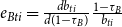 $e_{Bti}=\frac{db_{ti}}{d(1-\tau _{B})}\frac{1-\tau _{B}}{b_{ti}}$
weighted by
 $g_{ti}b_{ti}$
, that is
 $\widehat{e}_{B}\equiv \int _{i}g_{ti}b_{ti}e_{Bti}/\int _{i}g_{ti}b_{ti}$
and
 $\widetilde{e}_{B}$
is the same expression under the temptation, that is
 $\widetilde{e}_{B}\equiv \int _{i}\widetilde{g}_{ti}b_{ti}e_{Bti}/\int _{i}\widetilde{g}_{ti}b_{ti}$
. Note that
 $\widehat{e}_{B}=\widetilde{e}_{B}$
.
To derive the optimal tax rate, we consider a small reform
 $d\tau _{B}\gt 0$
. A balanced budget condition is given by
 $d\Upsilon =Rb_{t}d\tau _{B}+\tau _{B}Rdb_{t}+y_{Lt}d\tau _{L}+\tau _{L}dy_{Lt}$
. Using the elasticities defined above, under the balanced budget condition, we then have
 \begin{equation} Rb_{t}d\tau _{B}\left ( 1-\frac{e_{B}\tau _{B}}{1-\tau _{B}}\right ) +d\tau _{L}y_{Lt}\left ( 1-\frac{e_{L}\tau _{L}}{1-\tau _{L}}\right ) =0. \end{equation}
Given
 $b_{t+1i}$
is chosen to maximize the agent’s utility and by applying the envelope theorem, the effect of reform
 $d\tau _{B}$
and
 $d\tau _{L}$
on the steady state social welfare is given by
 \begin{align} d\mathbf{S}\mathbf{W}\mathbf{F} & =\left ( 1+\lambda \right ) \int _{i}\omega _{ti}\left \{ V_{c}^{ti}\cdot \left ( \left ( 1-\tau _{B}\right ) Rdb_{ti}-Rb_{ti}d\tau _{B}-y_{Lti}d\tau _{L})\right ) -V_{\underline{b}}^{ti}\cdot \left ( Rb_{t+1i}d\tau _{B}\right ) \right \} \\[3pt] &\quad -\lambda \int _{i}\omega _{ti}V_{\widetilde{c}}^{ti}\cdot \left ( \left ( 1-\tau _{B}\right ) Rdb_{ti}-Rb_{ti}d\tau _{B}-y_{Lti}d\tau _{L}\right ) .\nonumber \end{align}
At the optimum, dSWF
 $=0$
implies that
 \begin{align} 0 & =\left ( 1+\lambda \right ) \int _{i}\omega _{ti}\left \{ V_{c}^{ti}\cdot \left ( \left ( 1-\tau _{B}\right ) Rdb_{ti}-Rb_{ti}d\tau _{B}-y_{Lti}d\tau _{L})\right ) -V_{\underline{b}}^{ti}\cdot \left ( Rb_{t+1i}d\tau _{B}\right ) \right \} \\[3pt] &\quad -\lambda \int _{i}\omega _{ti}V_{\widetilde{c}}^{ti}\cdot \left ( \left ( 1-\tau _{B}\right ) Rdb_{ti}-Rb_{ti}d\tau _{B}-y_{Lti}d\tau _{L}\right ).\nonumber \end{align}
Our first proposition is as follows.
Proposition 1.
(a) For a given
 $\tau _{L}$
, the optimum tax rate
 $\tau _{B}^{\;\text{temp}\;}$
which maximizes the long run steady state social welfare function with a period-wise budget balance is given by
 \begin{equation} \tau _{B}^{\;\text{temp}\;}=\dfrac{1-\left ( 1-\frac{e_{L}\tau _{L}}{1-\tau _{L}}\right ) \left [ \dfrac{\overline{b}^{\;\text{received}\;}}{\overline{y}_{L}}\left ( 1+\widehat{e}_{B}\right ) +\dfrac{\left ( 1+\lambda \right ) \overline{b}^{left}}{R\left [ 1+\lambda \left ( 1-\alpha \right ) \right ] \overline{y}_{L}}\right ] }{1+e_{B}-\left ( 1-\dfrac{e_{L}\tau _{L}}{1-\tau _{L}}\right ) \dfrac{\overline{b}^{\;\text{received}\;}}{\overline{y}_{L}}\left ( 1+\widehat{e}_{B}\right ) }. \end{equation}
(b) To incentivize bequests leaving, the optimal tax rate should decrease with the level of temptation.
The above result is interesting in its own right. First, when agents’ preferences are subject to temptation (
 $\lambda \gt 0$
), our reduced form expression of
 $\tau _{B}^{\;\text{temp}\;}$
(the optimal tax rate with temptation) differs from
 $\tau _{B}$
(optimal tax rate without temptation i.e.
 $\lambda =0$
). More precisely,
 $\tau _{B}^{\;\text{temp}\;}\lt \tau _{B}$
. Thus, when individuals are tempted to consume more and leave a lower amount of bequests, the optimal inheritance tax rate should be lower than the rate under no temptation. This implies that, if the agents suffer from temptation, a higher tax rate is detrimental. In the presence of temptation, lowering the tax rate generates an incentive to leave higher amount of bequests by making succumbing to temptation less attractive. Further, in our calibration section we observe that the presence of acute temptation may also justify a subsidy for some economies.
Another interesting observation can be made when we compare our expression of the optimal tax rate with the one derived by Piketty and Saez (Reference Piketty and Saez2013) who recommend a subsidy at a higher percentile of bequest received. Our results confirm that potentially a subsidy can be recommended even for agents in a lower percentile in the presence of an acute lack of self-control. This is also clear from the calibration exercise presented below in Section 4. Thus, our study shows that depending on the severity of present bias, a subsidy may be required. It is clear from the above expression (8) that in the absence of temptation (
 $\lambda =0$
),
 $\tau _{B}^{\;\text{temp}\;}$
coincides with the tax rate derived in Piketty and Saez (Reference Piketty and Saez2013).
When
 $\alpha$
has a higher value, the difference between the marginal utilities under the commitment and temptation consumption levels becomes small. This implies that, for a given value of
 $\lambda$
, the agent sets the commitment consumption level closer to that of the temptation consumption level in order to avoid from the higher self-control cost. In other words, agents leave less bequests. Hence, a lower inheritance tax rate (or subsidy if the value of given
 $\lambda$
is very high) is required to mitigate the adverse effect of temptation on bequest leaving decisions.Footnote
15
Next, we extend our analysis including the labor-augmenting economic growth per generation at a rate of
 $G\gt 1$
. Here, we assume that there is a steady state equilibrium where all of the variables, including the individual wage rate
 $w_{ti}$
, grow at the rate of
 $G$
.Footnote
16
Furthermore, as in Piketty and Saez (Reference Piketty and Saez2013), we incorporate “the wealth loving” motive to capture the fact that people often leave accidental bequests at the time of death. In our calibration exercises, we use the expression that we derive in this more general setting.
We assume that individuals derive utility from four components: personal consumption, after-tax bequests, pre-tax bequests, and leisure. The function
 $V^{ti}$
can be formally written as
 \begin{align*} V^{ti}(c_{ti},R\left ( 1-\tau _{Bt+1}\right ) b_{t+1i},b_{t+1i},1-l_{ti}). \end{align*}
When agents do not care about the post-tax bequests, the tax rates do not affect their utility. However, those who receive the inheritance are definitively affected. The relative importance of altruism in bequests motives for individual
 $ti$
is measured by
 $\nu _{ti}\equiv R\left ( 1-\tau _{Bt+1}\right ) V_{\underline{b}}^{ti}/V_{c}^{ti}$
with a population average
 $\nu \equiv \int _{i}g_{ti}b_{t+1i}\nu _{ti}/\int _{i}g_{ti}b_{t+1i}$
.
The maximization problem of an individual under this setup can be written as
 \begin{align*} \max _{\left \{ c_{ti},l_{ti},b_{t+1i}\right \} _{t=0}^{\infty }}\left ( 1+\lambda \right ) V^{ti}(c_{ti},R\left ( 1-\tau _{Bt+1}\right ) b_{t+1i},b_{t+1i},1-l_{ti})-\lambda V^{ti}(\widetilde{c}_{ti},\underline{b}=0,b_{t+1i}=0,1-l_{ti}), \end{align*}
subject to
 \begin{align*} c_{ti}+b_{t+1i} & =R\left ( 1-\tau _{Bt}\right ) b_{ti}+\left ( 1-\tau _{Lt}\right ) y_{Lti}+\Upsilon _{t}\text{,}\\ \\[-9pt] \widetilde{c}_{ti} & =R\left ( 1-\tau _{Bt}\right ) b_{ti}+\left ( 1-\tau _{Lt}\right ) y_{Lti}+\Upsilon _{t}\text{.} \end{align*}
The first order condition with respect to
 $b_{t+1i}$
is given by
 \begin{align*} V_{c}^{ti}=R\left ( 1-\tau _{Bt+1}\right ) V_{\underline{b}}^{ti}+V_{b}^{ti}\text{.} \end{align*}
Therefore the government’s long run social welfare function is as follows:
 \begin{align*} \mathbf{S}\mathbf{W}\mathbf{F}=\max _{\tau _{L},\tau _{B}}\int _{i}\omega _{ti}\left [ \begin{array} [c]{c}\left ( 1+\lambda \right ) V^{ti}(R\left ( 1-\tau _{B}\right ) b_{ti}+\left ( 1-\tau _{L}\right ) y_{Lti}+\Upsilon -b_{t+1i},\underline{b},b_{t+1i},1-l_{ti})\\[3pt] -\lambda V^{ti}(R\left ( 1-\tau _{B}\right ) b_{ti}+\left ( 1-\tau _{L}\right ) y_{Lti}+\Upsilon,\underline{b}=0,b_{t+1i}=0,1-l_{ti}) \end{array} \right ], \end{align*}
subject to
 $\Upsilon =\tau _{B}Rb_{t}+\tau _{L}y_{Lt}$
. We derive
 \begin{align*} d\mathbf{S}\mathbf{W}\mathbf{F} & =\left ( 1+\lambda \right ) \int _{i}\omega _{ti}V_{c}^{ti}\cdot \left ( \left ( 1-\tau _{B}\right ) Rdb_{ti}-Rb_{ti}d\tau _{B}-y_{Lti}d\tau _{L}\right ) \\ & -\left ( 1+\lambda \right ) \int _{i}\omega _{ti}V_{\underline{b}}^{ti}\cdot Rb_{t+1i}d\tau _{B}-\lambda \int _{i}\omega _{ti}V_{\widetilde{c}}^{ti}\cdot \left ( R\left ( 1-\tau _{B}\right ) db_{ti}-Rb_{ti}d\tau _{B}-y_{Lti}d\tau _{L}\right ), \end{align*}
and present our next proposition below.
Proposition 2.
(a) For a given
 $\tau _{L}$
, the optimum tax rate
 $\tau _{B}^{\;\text{temp}\;}$
which maximizes the long run steady state social welfare with a period-wise budget balance is given by
 \begin{equation} \tau _{B}^{\;\text{temp}\;}=\dfrac{1-\left ( 1-\dfrac{e_{L}\tau _{L}}{1-\tau _{L}}\right ) \left [\dfrac{\overline{b}^{\;\text{received}\;}}{\overline{y}_{L}}\left ( 1+\widehat{e}_{B}\right ) +\dfrac{G\nu \left ( 1+\lambda \right ) \overline{b}^{\;\text{left}\;}}{R\left [ 1+\lambda \left ( 1-\alpha \right ) \right ] \overline{y}_{L}}\right ]}{1+e_{B}-\left ( 1-\dfrac{e_{L}\tau _{L}}{1-\tau _{L}}\right ) \dfrac{\overline{b}^{\;\text{received}\;}}{\overline{y}_{L}}\left ( 1+\widehat{e}_{B}\right ) }. \end{equation}
(b) To incentivize leaving bequests, the optimal tax rate should decrease with the level of temptation.
The equation (9) has two additional parameters compared to the equation (8):
 $G$
and
 $\nu$
. These two parameters negatively affect the optimal tax rate, as expected. As in the equation (8), in the equation (9), an increase in the strength of temptation suggests a lower optimal tax rate. All the explanations we made regarding Proposition 1 also apply to Proposition 2. Furthermore, it is clear that
 $R$
in the equation (8) has been replaced by
 $R/G$
in the equation (9). This means
 $G$
times larger relative bequest
 $b_{t+1i}/b_{t+1}$
needs to be left making the relative cost of bequest leaving
 $G$
times larger. As the gap between the return to capital and the growth rate increases, the optimal inheritance tax rate as well as inequality increases as in Piketty (Reference Piketty2011) and (2014). It is clear that incorporating temptation into the model, does not affect the aforementioned results. Notice that while the inverse relationship between
 $R/G$
and the optimal inheritance tax rate is unchanged, at any level of
 $R/G$
, temptation reduces the optimal tax rate independent of the level of bequests received. Farhi and Werning (Reference Farhi and Werning2014) provide a political economy model of bequests taxation where they show that their finding is broadly consistent with the above claim that higher values of
 $R-G$
result in higher and more progressive optimal taxes on bequests as well as higher level of wealth inequality.
The Farhi and Werning (FW) setup
Let us now discuss the link between our paper and Farhi and Werning (Reference Farhi and Werning2010) in the presence of temptation and a lack of self-control. As mentioned by Piketty and Saez (Reference Piketty and Saez2013), their results regarding a positive inheritance tax depend crucially on the fact that labor income is no longer the single source of resources in an individual’s life as in Farhi and Werning (Reference Farhi and Werning2010). One more source of inequality is inheritance. We now compare our model with that of Farhi and Werning (Reference Farhi and Werning2010) when this flow of inheritance is affected by the presence of temptation and self control behavior. In a two period model of Farhi and Werning (Reference Farhi and Werning2010) in which each dynasty survives for two generations, working parents begin with no bequests but have earnings, whereas the children receive bequests but never work. While a formal extension of our model could include preferences
 $\mathcal{U}^{ti}(c,\widetilde{c},\underline{b},l_{ti})=\left ( 1+\lambda \right ) V^{ti}(c,\underline{b},l_{ti})-\lambda V^{ti}(\widetilde{c},\underline{b}=0,l_{ti})$
for the parents and
 $V^{ti}(c)$
for children, we refrain from this formal analysis. For a general case, Farhi and Werning (Reference Farhi and Werning2010) focused on a weakly separable utility
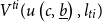 $V^{ti}(u\left ( c,\underline{b}\right ),l_{ti})$
of parents with nonlinear taxation. By assuming the subutility
 $u\left ( c,\underline{b}\right )$
homogeneous of degree one in line with Piketty and Saez (Reference Piketty and Saez2013), we can obtain the linear tax counterpart of their results. A crucial observation from this analysis is presented in the following proposition.
Proposition 3.
Regardless of whether the social welfare function puts zero or positive direct weight on children,
 $\tau _{B}\lt 0$
is always optimal.
We observe that when temptation is present and parents do not inherit any asset but take the decision of leaving bequests whereas children are the receiver without any work and bequest leaving decision, optimality always recommends a subsidy. The intuition behind this result is as follows. According to Farhi and Werning (Reference Farhi and Werning2010), when the society puts a direct weight on the offspring, it is optimal to subsidize bequests. When the society does not put a direct weight on the offspring, it is optimal not to distort bequests. However the existence of the present bias requires subsidizing bequests as we discussed earlier. Hence, the existence of present bias leads to subsidising inheritances when the society does not care about descendants and strengthens the case for the subsidies when the society cares about descendants. Note that the motive for reduction in taxes is so strong under present bias that no positive tax rate is optimum.
This result has another important implication in the capital tax literature. In the Farhi and Werning (Reference Farhi and Werning2010) type model with inheritance if preferences are subject to present bias, a subsidy on capital is the only recommendation, no positive tax on capital is warranted.
3. Present bias in BBD
Since the BBD setup is another significant way of modeling altruism, we present our results in this setup as well. While deriving the optimal tax results, we assume that the bequest leavers have the full knowledge of the future tax implementation and they act accordingly. In other words, the bequest leaving generation knows that the amount of assets that they leave will be subject to a tax and it will be collected from their next generation. This implies that the parental generation optimally chooses the levels of bequest left,
 $b_{ti}$
knowing that an optimal tax rate set by the planner will be imposed on their children’s bequest income. We call this parental generation as a sensitive generation and we analyse this case in Subsection 3.1. By using this setup, we revisit the celebrated Chamley (Reference Chamley1986) - Judd (Reference Judd1985) zero capital tax result in Appendix C showing the the zero capital tax result holds even when agents have the present-biased preferences.Footnote
17
Afterwards, we assume that the parental generations ignore the chosen optimal tax rates while making the bequest leaving decisions, that is, they do not internalize the effect of the chosen tax rates on their bequest leaving behavior. We call this parental generation as ignorant and analyse this case in subsection 3.2.
3.1 Sensitive generations
Instead of enjoying the utility directly from the net bequest left as in the BIU setup, an individual
 $ti$
derives her utility from the utility of the next generation
 $\mathcal{U}^{t+1i}$
in the BBD setup. This, in turn, generates the following recursive utility function
 \begin{align*} \mathcal{U}^{ti}=V^{ti}\left ( c_{ti},1-l_{ti}\right ) +\delta \mathcal{U}^{t+1i}\text{,} \end{align*}
where
 $\delta \in \left ( 0,1\right )$
represents the discount factor. When
 $V^{ti}$
is assumed to follow the Gul-Pesendorfer preferences, the utility function of an individual
 $ti$
can be written as
 \begin{equation} \mathcal{U}^{ti}=\left ( 1+\lambda \right ) u^{ti}(c_{ti},1-l_{ti})-\lambda u^{ti}(\widetilde{c}_{ti},1-l_{ti})+\delta \mathcal{U}^{t+1i}\text{.} \end{equation}
We restrict ourselves to the same set of tax instruments. Individual maximizes the utility function in (10) subject to the budget constraint
 $c_{ti}+b_{t+1i}=R\left ( 1-\tau _{Bt}\right ) b_{ti}+\left ( 1-\tau _{Lt}\right ) w_{ti}l_{ti}+\Upsilon _{t}$
. Notice that
 $E_{t}\mathcal{U}^{t+1i}$
is the expected utility of
 $t+1i$
agent based on the information available in period
 $t$
. Thus the utility maximization problem can be written as follows:
 \begin{align*} \max _{\left \{ c_{ti},l_{ti},b_{t+1i}\right \} _{t=0}^{\infty }}\left ( 1+\lambda \right ) \sum _{t=0}^{\infty }\delta ^{t}E_{t}u^{ti}(c_{ti},1-l_{ti})-\lambda \sum _{t=0}^{\infty }\delta ^{t}E_{t}u^{ti}(\widetilde{c}_{ti},1-l_{ti}), \end{align*}
subject to
 \begin{align*} c_{ti}+b_{t+1i} & =R\left ( 1-\tau _{Bt}\right ) b_{ti}+\left ( 1-\tau _{Lt}\right ) y_{Lti}+\Upsilon _{t}\text{,}\\[3pt] \widetilde{c}_{ti} & =R\left ( 1-\tau _{Bt}\right ) b_{ti}+\left ( 1-\tau _{Lt}\right ) y_{Lti}+\Upsilon _{t}\text{.} \end{align*}
The optimization problem formulated above can be rewritten as
 \begin{align*} \max _{\left \{ l_{ti},b_{t+1i}\right \} _{t=0}^{\infty }}\left \{ \begin{array} [c]{c}\left ( 1+\lambda \right ) \sum _{t=0}^{\infty }\delta ^{t}\Upsilon _{t}u^{ti}(R\left ( 1-\tau _{Bt}\right ) b_{ti}+\left ( 1-\tau _{Lt}\right ) y_{Lti}+\Upsilon _{t}-b_{t+1i},1-l_{ti})\\ \\[-9pt] -\lambda \sum _{t=0 }^{\infty }\delta ^{t}\Upsilon _{t}u^{ti}(R\left ( 1-\tau _{Bt}\right ) b_{ti}+(1-\tau _{Lt})y_{Lti}+\Upsilon _{t},1-l_{ti}) \end{array} \right \} \text{.} \end{align*}
The first order condition with respect to
 $b_{t+1i}$
is therefore given by
 \begin{equation} u_{c}^{ti}(c_{ti},1-l_{ti})=\delta R\left ( 1-\tau _{Bt+1}\right ) \Upsilon _{t}u_{c}^{t+1i}(c_{t+1i},1-l_{t+1i}). \end{equation}
For analytical tractability, we assume that at the maximum level of temptation, no future generations leave any bequests to their children. Note that since
 $b_{t+1i}$
is known at the end of
 $t$
, the equation (11) can be essentially expressed as
 $\overline{b}_{t+1}^{\;\text{left}\;}=\delta R(1-\tau _{B_{t+1}})$
 $\overline{b}_{t+1}^{\;\text{received}\;}$
, where
 $\overline{b}_{t}^{\;\text{received}\;}=\int _{i}\omega _{0i}u_{c}^{ti}(c_{ti},1-l_{ti})b_{ti}/b_{t}\int _{i}\omega _{0i}u_{c}^{ti}(c_{ti},1-l_{ti})$
and
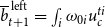 $\overline{b}_{t+1}^{\;\text{left}\;}=\int _{i}\omega _{0i}u_{c}^{ti}$
 $(c_{ti},1-l_{ti})b_{t+1i}/b_{t+1}\int _{i}\omega _{0i}u_{c}^{ti}(c_{ti},1-l_{ti})$
. Notice that
 $\omega _{0i}$
is a dynastic Pareto weight.Footnote
18
Once again we focus on the equilibrium where individual outcomes are independent of the initial positions in the long run.
All other assumptions of the previous section are intact here. Furthermore, as the periods in which individuals will leave no bequests are equally likely to the government, we assume that the government chooses
 $\tau _{B}$
as if everyone inherits bequests in all periods. We solve the optimal tax rates under the assumption of a steady-state dynasty.Footnote
19
Our study reveals that the same negative relationship between the tax rate and the degree of temptation exists, although the magnitudes of the changes in the tax rate due to a change in the level of temptation are different.
As in the earlier cases, we focus on the steady state with a constant tax policy
 $\tau _{B}$
,
 $\tau _{L}$
and
 $\Upsilon$
such that the government budget constraint
 $\Upsilon =\tau _{B}Rb_{t}+\tau _{L}y_{Lt}$
holds in every period. When the optimal tax policy is calculated at the steady state, the equilibrium constant tax rates that obey the government’s balanced budget constraint maximize the social welfare. This analysis also considers a small deviation in
 $\tau _{B}$
so that
 $\tau _{L}$
changes in such a way that
 $d\Upsilon =0$
holds. The social welfare function (SWF) is as given below:
 \begin{align*} \mathbf{S}\mathbf{W}\mathbf{F}=\max _{\tau _{B}}\left \{ \begin{array} [c]{c}(1+\lambda )\sum _{t=0}^{\infty }\delta ^{t}\int _{i}u^{ti}\left ( R(1-\tau _{B})b_{ti}+(1-\tau _{L})y_{Lti}+\Upsilon -b_{t+1i},1-l_{ti}\right ) \\ \\[-9pt] -\lambda \sum _{t=0}^{\infty }\delta ^{t}\int _{i}u^{ti}\left ( R(1-\tau _{B})b_{ti}+(1-\tau _{L})y_{Lti}+\Upsilon,1-l_{ti}\right ) \end{array} \right \}. \end{align*}
The government maximizes the SWF subject to a period-wise budget constraint. Assuming
 $b_{t+1i}$
and
 $l_{ti}$
are chosen to maximize the individual utility, the effect of a small tax rate change on the steady state social welfare is given by
 \begin{align*} \mathbf{d}\mathbf{S}\mathbf{W}\mathbf{F}=\begin{array} [c]{c}(1+\lambda )\left [ \begin{array} [c]{c}\int _{i}u_{c}^{0i}\cdot (R(1-\tau _{B})db_{0i}-Rb_{0i}d\tau _{B})-\\ \\[-9pt] \sum _{t=0}^{\infty }\delta ^{t+1}\int _{i}Ru_{c}^{t+1i}\cdot b_{t+1i}d\tau _{B}-\sum _{t=0}^{\infty }\delta ^{t}\int _{i}u_{c}^{ti}\cdot y_{Lti}d\tau _{L}\end{array} \right ] \\ \\[-9pt] -\lambda \int _{i}u_{\widetilde{c}}^{0i}\cdot \left ( R(1-\tau _{B})db_{0i}-Rb_{0i}d\tau _{B}\right ) +\lambda \sum _{t=0}^{\infty }\delta ^{t}\int _{i}u_{\widetilde{c}}^{ti}\cdot y_{Lti}d\tau _{L}\end{array} \text{.} \end{align*}
Once again, we observe that as the level of temptation increases, the optimal inheritance tax rate under the dynastic setup,
 $\tau _{B}^{\;\text{temp}\;}$
, decreases.
PROPOSITION 4.
(a) For a given
 $\tau _{L}$
, the optimal tax rate
 $\tau _{B}^{\;\text{temp}\;}$
which maximizes the long-run steady state social welfare with a period-wise budget balance is given by
 \begin{equation} \tau _{B}^{\;\text{temp}\;}=\dfrac{1-\left [ 1-\dfrac{e_{L}\tau _{L}}{1-\tau _{L}}\right ] \left [ \dfrac{(1-\delta )\bar{b}^{\;\text{received}\;}}{\bar{y}_{L}}(1+\hat{e}_{B})+\dfrac{1+\lambda }{1+\lambda (1-\alpha )}\dfrac{\bar{b}^{\;\text{left}\;}}{R\bar{y}_{L}}\right ]}{1+e_{B}-\left [ 1-\dfrac{e_{L}\tau _{L}}{1-\tau _{L}}\right ] \dfrac{(1-\delta )\bar{b}^{\;\text{received}\;}}{\bar{y}_{L}}(1+\hat{e}_{B})}\text{.} \end{equation}
(b) The optimal tax rate
 $\tau _{B}^{\;\text{temp}\;}$
should decrease with the level of temptation.
3.2 Ignorant generations
Now we deviate from the assumption made in the previous subsection where the bequest leaving agents internalize the effect of taxes paid by their children on the inherited assets. Here, we assume that the agents do not necessarily respond to the tax rates on inheritance that they leave, that is, bequest leaving decisions are independent of the taxes their children pay. This has been brought in our model by assuming
 $b_{ti}$
is given for all
 $ti$
instead of assuming
 $b_{ti}$
is optimally chosen.Footnote
20
Technically, this change in assumption appears through the envelope condition. If
 $b_{ti}$
is chosen optimally, we omit the derivative with respect to
 $b_{ti}$
when applying the envelope theorem. This is no more the case when the generations are assumed to be ignorant. Hence,
 $b_{ti}$
is assumed to be given instead of optimally chosen. All other assumptions are same as in the Subsection 3.1. We now proceed to derive the results. Our SWF is defined as follows:
 \begin{align*} \mathbf{S}\mathbf{W}\mathbf{F} & =\max _{\tau _{B},\tau _{L}}\left ( 1+\lambda \right ) \int _{i}\overset{\infty }{\sum _{t=0}}\delta ^{t}u^{ti}\left ( R\left ( 1-\tau _{B}\right ) b_{ti}+\left ( 1-\tau _{L}\right ) y_{Lti}+E-b_{t+1i},1-l_{ti}\right ) \\ & -\lambda \int _{i}\overset{\infty }{\sum _{t=0}}\delta ^{t}u^{ti}(R\left ( 1-\tau _{B}\right ) b_{ti}+\left ( 1-\tau _{L}\right ) y_{Lti}+E,1-l_{ti}), \end{align*}
The government maximizes the SWF subject to a period-wise budget constraint. Therefore,
 \begin{align*} \mathbf{d}\mathbf{S}\mathbf{W}\mathbf{F} & =\left ( 1+\lambda \right ) \int _{i}u_{c}^{0i}\cdot \left ( R\left ( 1-\tau _{B}\right ) db_{0i}-Rb_{0i}d\tau _{B}\right ) -\left ( 1+\lambda \right ) \overset{\infty }{\sum _{t=0}}\delta ^{t+1}\int _{i}Ru_{c}^{t+1i}\cdot b_{t+1i}d\tau _{B}\\ & -\left ( 1+\lambda \right ) \overset{\infty }{\sum _{t=0}}\delta ^{t}\int _{i}u_{c}^{ti}\cdot y_{Lti}d\tau _{L}-\lambda \overset{\infty }{\sum _{t=0}}\delta ^{t}\int _{i}u_{\widetilde{c}}^{ti}\cdot (R\left ( 1-\tau _{B}\right ) db_{ti}-Rb_{ti}d\tau _{B}-y_{Lti}d\tau _{L})\text{.} \end{align*}
In this setup, the modified expression for
 $\tau _{B}^{\;\text{temp}\;}$
is given by
 \begin{equation} \tau _{B}^{\;\text{temp}\;}=\dfrac{1-\left [ 1-\dfrac{e_{L}\tau _{L}}{1-\tau _{L}}\right ]\left [ \dfrac{1-\delta +\lambda \left ( 1-\alpha -\delta \right ) }{1+\lambda \left ( 1-\alpha \right ) }\dfrac{1+\widehat{e}_{B}}{\delta }+\dfrac{1+\lambda }{1+\lambda \left ( 1-\alpha \right ) }\right ]\dfrac{\overline{b}^{\;\text{left}\;}}{R\overline{y}_{L}}}{1+e_{B}}\text{.} \end{equation}
With this change in the assumption we observe that the relationship between the tax rate and the level of temptation is positive that is,
 $\tau _{B}^{\;\text{temp}\;}$
increases with the level of temptation. This is in contrast to the results we showed so far in our paper. Note that the inheritance in our model can be interpreted as a physical capital and a link between our paper and the optimal capital tax literature can be established. Hence, our result here is also in contrast to the results of the literature that analyses the optimal capital tax literature under the present bias.Footnote
21
Our finding is intuitive. If the generations are ignorant about the tax rates while leaving bequests for their children, there is no point of subsidizing bequest. Subsidizing bequest makes succumbing to present bias less attractive but that works only when the agents are sensitive to the tax rates. When ignorant agents suffer from present bias, the amount of bequests that they leave fall reducing the tax base. To keep the tax revenue at the same level, the only option that a planner has is to increase the tax rate. The reduction in the tax base and the accompanying increase in the tax rate of course depend on the degree of present bias. Note that incentivizing bequest leaving by reducing the tax rate or by providing a subsidy fails to work here. Hence, the optimal tax rate increases with the level of present bias. The proposition below summarises our finding.
PROPOSITION 5. In the presence of present bias, incentivizing bequest leaving works only when generations are sensitive to the chosen tax rates. If the generations are ignorant, there is no need to provide an incentive to encourage bequest leaving by lowering the taxes or by providing a subsidy. Since bequest leaving depletes with present bias and lowers the tax base when agents are ignorant, the optimal tax rate has to increase with the degree of present bias.
4. Calibration
This section aims to show the impact of various parameters on the optimal tax rate that supports our derived theoretical results. Since the theoretical results of the BIU setting and BBD setting with sensitive generations are at the same direction, we provide numerical results for the BIU setting only. We also provide the numerical results for the BBD setting with ignorant generations. In this part, we keep our presentation similar to that of Piketty and Saez (Reference Piketty and Saez2013) so that the results can be compared. Yet, unlike them we do not provide any numerical results for the French economy since the order of magnitudes moves in the same direction as in the US economy. When we present our results, we set the lower bound of the tax rate at 0 percent since the optimal tax rate can be quite large number for the certain percentile of the distribution of bequest received following Piketty and Saez (Reference Piketty and Saez2013).
4.1 Present bias in BIU
We use the steady-state equilibrium tax rate presented in the equation (9) to calculate the numerical values of the optimal tax rates for the US economy. In the benchmark model, following Piketty and Saez (Reference Piketty and Saez2013), we set
 $e_{B}=\widehat{e}_{B}=e_{L}=0.2$
,
 $\tau _{L}^{Temp}=30\%$
, the capitalisation factor
 $r-g=2\%$
, and the period of length
 $H=30$
years. Notice that
 $r-g=2\%$
implies that
 $G/R=1/e^{(r-g)H}=0.55$
. Following Kopczuk and Lupton (Reference Kopczuk and Lupton2007), we set the altruism strength parameter
 $\nu =0.7$
. The values of the distributional parameters
 $\overline{b}^{received}$
,
 $\overline{b}^{\;\text{left}\;}$
, and
 $\overline{y}_{L}$
are also taken from Piketty and Saez (Reference Piketty and Saez2013).Footnote
22
We also assume that distributional parameters and the interest rate
 $r$
are not affected by the level of the inheritance tax. There is a stream of literature that shows the link between capital taxation and capital accumulation (see e.g. Conesa et al. (Reference Conesa, Kitao and Krueger2009)) endogenizing the capital rate of return parameter
 $r$
. Since the inheritance in our model is equivalent to the capital stock accumulation, a complete model requires endogenizing the rate of return
 $r$
in our setting as well. This is however out of the scope of this paper.
There is a number of estimates for the value of the temptation strength parameter.Footnote
23
In our experiments we set the value of
 $\lambda$
to
 $0.1$
,
 $0.3$
, and
 $0.9$
respectively. Note that our choice of
 $\lambda =0.1$
and
 $\lambda =0.3$
are at the close range of estimates. Since the optimal tax rates we calculated include the ratio of the marginal utilities of the commitment an temptation consumption, we needed to have a fixed parameter value for this ratio. Hence, we choose the of values of
 $\alpha$
arbitrarily and conduct a sensitivity analysis with various values of
 $\alpha$
to show that the directions of the results do not change with it. Note that for a given value of
 $\lambda$
, higher value of
 $\alpha$
implies a higher level of temptation.
Figure 1 examines the implications of the changes in the strength of temptation parameter
 $\lambda$
on the optimal inheritance tax rates from the perspective of each percentile p of the distribution of the bequest received. We set
 $\alpha =0.9$
, and varied the values of
 $\lambda$
. As we explained earlier, the optimal inheritance tax rate can be a quite large negative number for the higher percentiles. Hence, we set the lower bound at
 $\ 0\%$
for the ease of exposition. The optimal linear inheritance tax rate varies from
 $57\%$
to
 $56\%$
for the lower
 $75\%$
of the population in a no temptation economy, in keeping with Piketty and Saez (Reference Piketty and Saez2013).Footnote
24
When individuals face minor temptation, as captured by
 $\lambda =0.1$
, the optimal linear inheritance tax rates do not much deviate from the case of no temptation. When individuals face mild temptation, as captured by
 $\lambda =0.3$
, the optimal tax rate varies from
 $50\%$
to
 $51\%$
, for the lower
 $75\%$
of the population. This result clearly shows that the existence of temptation puts downward pressure on the optimal tax rate calculated for each percentile of the distribution of bequest received. When individuals face severe temptation, the optimal linear tax rates for each percentile of the distribution of bequest received decrease substantially. On average, the optimal linear inheritance tax rates are lower by 18% for the lower 75% of the population in the severe temptation economy. These results show that, in a case of severe temptation, the optimal linear inheritance tax rates will be significantly lower. For the lower
 $75\%$
of the population, the optimal inheritance tax rate decreases substantially and becomes negative for the upper
 $15\%$
of the population in both temptation and no temptation economies. The optimal bequest tax rate is quite stable across the lower
 $70\%$
because inherited wealth is highly concentrated.Footnote
25
The lower
 $70\%$
receive a very low amount of bequests (
 $\overline{b}^{\;\text{received}\;}$
is quite close to
 $0\%$
). The lower
 $50\%$
of bequest receivers make approximately
 $90\%$
-
 $95\%$
of average earnings
 $\overline{y}_{L}$
but leave substantially smaller bequest at around
 $60\%$
-
 $70\%$
of the average bequest
 $\overline{b}^{\;\text{left}\;}$
. In both the economies, the lower
 $70\%$
of the population leaves some amount of bequests but prefer higher inheritance tax rates to minimize their burdens on the labor tax.
Optimal linear inheritance tax rates, by percentile of
 $\bar{b}^{\;\text{received}\;}$
(
 $\lambda$
varies,
 $\alpha$
is fixed at 0.9).

In our model, the strength of temptation is governed by the two parameters,
 $\alpha$
and
 $\lambda$
. In this experiment, we fix
 $\lambda$
at
 $0.3$
and vary the values of the parameter
 $\alpha$
(see Figure 2). For the given value of
 $\lambda$
, higher values of
 $\alpha$
imply relatively severe temptation. Hence, when
 $\alpha =1$
, the optimal inheritance tax rate is significantly lower for all income percentiles compared to the cases in which
 $\alpha$
takes relatively lower values. Both exercises support our theoretical findings and show that the existence of temptation puts a downward pressure on the optimal inheritance tax rate for all income percentiles. In the case of severe temptation implied by higher values of
 $\lambda$
and
 $\alpha$
the temptation economy prescribes significantly lower optimal linear inheritance tax rates.
Optimal linear inheritance tax rates, by percentile of
 $\bar{b}^{\;\text{received}\;}$
(
 $\alpha$
varies,
 $\lambda$
is fixed at 0.3).

Next, we conduct a sensitivity analysis for temptation (Temp) and no temptation (No temp) economies using the equation (9). In the benchmark temptation and no temptation economies,
 $e_{B}=\widehat{e}_{B}=e_{L}=0.2$
,
 $\tau _{L}^{Temp}=30\%$
,
 $r-g=2\%$
, the period of length
 $H=30$
years, and the altruism strength parameter
 $\nu =0.7$
as above. In the benchmark temptation economies, we set
 $\alpha =0.9$
and
 $\lambda =0.3$
. In the no temptation economy,
 $\lambda =0$
. We run three experiments holding everything else remaining the same. In the first experiment, we vary the value of the capitalization factor
 $r-g$
, in the second experiment, we vary the value of the bequest strength parameter
 $\nu$
, and in the last experiment, we vary the value of the labor income elasticity. In each simulation (both benchmark and experimental), we display the optimal tax rates for
 $e_{B}=\widehat{e}_{B}=0$
,
 $0.2$
,
 $0.5$
, and
 $1$
. Table 1 presents the simulation results of the optimal inheritance tax rate for temptation and no-temptation economies.
This table presents simulations of the optimal inheritance tax rate
 $\tau _{B}$
using formula (9) for temptation and no-temptation economies. We set the labor income tax rate to 30%. Parameters
 $\bar{b}^{\;\text{received}\;},\;\bar{b}^{\;\text{left}\;},\;\;\text{and}\;\;\bar{y}_{L}$
are taken from Piketty and Saez (Reference Piketty and Saez2013)

When the long run elasticity of the bequest flow
 $e_{B}$
approaches to 1, the bequest becomes more sensitive to the changes in the tax rate and hence, the optimal inheritance tax rates in both economies decrease as expected. Notice that the tax rates are always lower in temptation economies compared to no temptation economies for each value of
 $e_{B}$
indicating that the existence of temptation reduces the optimal tax rate independently from the value of
 $e_{B}.$
Although narrowing the gap between the rate of return
 $r$
and the growth rate
 $g$
(i.e., smaller value of
 $r-g$
) leads to the lower optimal rates in both economies, increasing this gap yields the higher optimal rates. Notice that the optimal rates in the temptation economies are relatively low for each value of
 $r-g$
. This indicates that the existence of temptation reduces the tax rates regardless of the value of
 $r-g.$
The changes in the labor supply elasticity
 $e_{L}$
have a moderate effect on the tax rates. As expected, a higher labor supply elasticity prescribes higher tax on inheritance, both under the economy with or without temptation. Exactly the opposite happens when it is lower.
In our benchmark economies, we set the bequest strength parameter to
 $\nu =0.7$
. When this is set to
 $1$
, optimal rates are relatively low compared to the benchmark economies. In contrast, when we assume a complete absence of bequest motives (i.e.
 $\nu =0)$
,
 $e_{B}$
becomes the only limiting factor for tax rates in both temptation and no temptation economies. Hence, optimal tax rates are higher. This is the only case in which the existence of temptation does not affect the results.
There is an interesting interaction between the altruism parameter
 $\nu$
and the temptation parameters. In Figure 3, we set
 $\alpha =0.9$
, and
 $\lambda =0.3$
and vary the value of the parameter
 $\nu$
to explore this interaction. The figure demonstrates that optimal inheritance tax rates are substantially lower in economies in which individuals are more altruistic and/or lack self-control. Interestingly, optimal rates in the temptation economy when
 $\nu =0.7$
are almost identical to optimal rates in the no temptation economy when
 $\nu =1.$
This result shows that a high degree of substitution exists between altruism and temptation parameters. This is a novel result that is not much explored in the literature indicating the strong altruistic motives can mitigate the adverse effects of the present bias.
Optimal linear inheritance tax rates, by percentile of
 $\bar{b}^{\;\text{received}\;}$
(
 $\nu$
varies, temptation is fixed at
 $\alpha$
= 0.8 and
 $\lambda$
= 0.2).

4.2 Present bias in BBD (ignorant generations)
Since the theoretical findings of the BIU and BBD with sensitive generations’ settings are at the same direction, we present the numerical results for the BBD with ignorant generations setting only. In particular, we use the steady state equilibrium tax rate presented in the equation (13) to calculate the optimal tax rates for the US economy. The common parameter values are set to the same values as in the previous subsection’s benchmark economies. In this setting, the tax rate formula does not contain the economic growth rate
 $g$
. Hence, setting the rate of return
 $r=2\%$
implies that the return factor
 $R=1.82$
. The formula in this setup contains the time-discount parameter
 $\delta$
, and we set it to 0.5 in the benchmark economies.
Figure 4 examines the implications of the changes in the strength of temptation parameter
 $\lambda$
on the optimal inheritance tax rates from the perspective of each percentile p of the distribution of the bequest received. As in above, we set
 $\alpha =0.9$
, and vary
 $\lambda$
by setting it to
 $0.1$
,
 $0.3$
, and
 $0.9$
respectively. In this economy, an increase in the strength of temptation puts an upward pressure on the optimal linear inheritance tax rates. This is the exact opposite finding of what we have shown in the previous subsection. In the case of severe temptation which is captured by setting
 $\lambda =0.9,$
the optimal liner inheritance tax rates on average 100% higher than that of the economy in which individuals do not suffer from temptation.
Optimal linear inheritance tax rates, by percentile of
 $\bar{b}^{\;\text{received}\;}$
(
 $\lambda$
varies,
 $\alpha$
is fixed at 0.8 ).

We also run experiments varying the value of the parameter
 $\alpha$
keeping the value of
 $\lambda$
at
 $0.3.$
These experiments also verify the above results. Higher levels of temptation imposed by the higher values of the parameter
 $\alpha$
lead to higher optimal linear inheritance tax rates (see Figure 5).
Optimal linear inheritance tax rates, by percentile of
 $\bar{b}^{\;\text{received}\;}$
(
 $\alpha$
varies,
 $\lambda$
is fixed at 0.3 ).

Finally, as in the previous subsection, we run a sensitivity analysis by varying the value of
 $r$
(we set
 $r$
to 1% and 3%),
 $\delta$
(we set
 $\delta$
to 0.3 and 0.7), and
 $e_{L}$
(we set
 $e_{L}$
to 0 and 0.5) by keeping the everything else the same. In all the cases, we observe that temptation economies prescribe higher optimal liner inheritance tax rates (see Table 2).
This table presents simulations of the optimal inheritance tax rate
 $\tau _{B}$
using formula (9) for temptation and no-temptation economies. We set the labor income tax rate to 30%. Parameters
 $\bar{b}^{\;\text{received}\;},\;\bar{b}^{\;\text{left}\;},\;\;\text{and}\;\;\bar{y}_{L}$
are taken from Piketty and Saez (Reference Piketty and Saez2013)

In sum, in this case, the existence of temptation puts an upward pressure on the optimal tax rates regardless of the changes in the values of the other parameters.
5. Conclusion
We model an economy where altruistic agents’ preferences are subject to temptation and self-control issues. First, in the BIU setup, we derive the reduced form expression for the optimal inheritance tax rate and then we show that a negative relationship exists between the optimal inheritance tax rate and the level of temptation. This also leads to the possibility of a subsidy at lower percentiles of bequest received compared to the no temptation economy since subsidy on inheritance provides an incentive to leave more bequest and makes surrendering to temptation less attractive.
We then use the standard BBD setup to derive the expression for the optimal tax rates. We observe that if the agents are sensitive and respond to the taxes their next generation pays on the amount of bequest they leave, the present bias and optimal taxes are negatively related as is established in the BIU setting. In other words, incentivizing bequest leaving through curtailing the temptation works perfectly. However if the agents are ignorant, they do not internalize the taxes paid by their descendants on the inheritance they leave and in that scenario optimal tax rates increase with the level of present bias. This is because the present bias reduces the tax base and to generate the same revenue through the taxation, the government has to increase the tax rate to compensate the change in the level of present bias. In short, the rationale of providing incentives by reducing taxes or extending subsidies fails in this case.
We also provided calibration exercises for BBD and BIU with ignorant generations setup. All our numerical results support the theoretical findings and we quantify the optimal tax rates under various cases.
Laibson (Reference Laibson1997)’s quasi-hyperbolic discounting model is often used to explore the implications of the present bias on different model settings. Our current model is concerned with calculating the optimal inheritance tax rate when the present bias is modeled by Gul and Pesendorfer (Reference Gul and Pesendorfer2004) type self-control preferences. Exploring optimal inheritance tax rates when present bias is captured by quasi-hyperbolic discounting is left for future research.
Appendix A
Proof of Proposition 1. (a) Equation (5) implies that
 \begin{align*} -y_{Lt}d\tau _{L}=\frac{Rb_{t}d\tau _{B}\left ( 1-\dfrac{e_{B}\tau _{B}}{1-\tau _{B}}\right ) }{\left ( 1-\dfrac{e_{L}\tau _{L}}{1-\tau _{L}}\right ) }\text{.} \end{align*}
Given (3), the above relationship, and dividing (7) by
 $\int _{i}\omega _{ti}V_{c}^{ti}$
yields
 \begin{align*} & \left ( 1+\lambda \right ){\int _i}\dfrac{\omega _{ti}V_{c}^{ti}}{\int _{i}\omega _{ti}V_{c}^{ti}}\left \{ -Rb_{ti}d\tau _{B}\left ( 1+e_{Bti}\right ) +\dfrac{\left ( 1-\dfrac{e_{B}\tau _{B}}{1-\tau _{B}}\right ) }{\left ( 1-\dfrac{e_{L}\tau _{L}}{1-\tau _{L}}\right ) }Rb_{t}d\tau _{B}\dfrac{y_{Lti}}{y_{Lt}}-\dfrac{b_{t+1i}}{1-\tau _{B}}d\tau _{B}\right \} \\ & =\lambda{\int _{i}}\dfrac{\omega _{ti}V_{\widetilde{c}}^{ti}}{\int _{i}\omega _{ti}V_{\widetilde{c}}^{ti}}\left \{ -Rb_{ti}d\tau _{B}\left ( 1+e_{Bti}\right ) +\dfrac{\left ( 1-\dfrac{e_{B}\tau _{B}}{1-\tau _{B}}\right ) }{\left ( 1-\dfrac{e_{L}\tau _{L}}{1-\tau _{L}}\right ) }Rb_{t}d\tau _{B}\dfrac{y_{Lti}}{y_{Lt}}\right \} \dfrac{\int _{i}\omega _{ti}V_{\widetilde{c}}^{ti}}{\int _{i}\omega _{ti}V_{c}^{ti}}\text{.} \end{align*}
Now by dividing the above equation by
 $Rb_{t}d\tau _{B}$
and using the relationship
 $V_{\widetilde{c}}^{ti}=\alpha V_{c}^{ti}$
, we get
 \begin{align*} & \left ( 1+\lambda \right ) \left \{ -\overline{b}^{\;\text{received}\;}\left ( 1+\widehat{e}_{B}\right ) +\frac{\left ( 1-\dfrac{e_{B}\tau _{B}}{1-\tau _{B}}\right ) }{\left ( 1-\dfrac{e_{L}\tau _{L}}{1-\tau _{L}}\right ) }\overline{y}_{L}-\frac{\overline{b}^{\;\text{left}\;}}{R\left ( 1-\tau _{B}\right ) }\right \} \\ & =\alpha \lambda \left \{ -\widetilde{b}^{\;\text{received}\;}\left ( 1+\widetilde{e}_{B}\right ) +\frac{\left ( 1-\dfrac{e_{B}\tau _{B}}{1-\tau _{B}}\right ) }{\left ( 1-\dfrac{e_{L}\tau _{L}}{1-\tau _{L}}\right ) }\widetilde{y}_{L}\right \}. \end{align*}
Given
 $\overline{b}^{\;\text{received}\;}=\widetilde{b}^{\;\text{received}\;};\overline{b}^{\;\text{left}\;}=\widetilde{b}^{\;\text{left}\;};\;\overline{y}_{L}=\widetilde{y}_{L}$
; and
 $\hat{e}_B = \tilde{e}_B$
guarantee that
 \begin{align*} \tau _{B}^{\;\text{temp}\;}=\dfrac{1-\left ( 1-\dfrac{e_{L}\tau _{L}}{1-\tau _{L}}\right ) \left [\dfrac{\overline{b}^{\;\text{received}\;}}{\overline{y}_{L}}\left ( 1+\widehat{e}_{B}\right ) +\dfrac{\left ( 1+\lambda \right ) \overline{b}^{\;\text{left}\;}}{R\left [ 1+\lambda \left ( 1-\alpha \right ) \right ] \overline{y}_{L}}\right ]}{1+e_{B}-\left ( 1-\dfrac{e_{L}\tau _{L}}{1-\tau _{L}}\right ) \dfrac{\overline{b}^{\;\text{received}\;}}{\overline{y}_{L}}\left ( 1+\widehat{e}_{B}\right ) }\text{.} \end{align*}
(b) It is easy to verify that
 $\dfrac{d\tau _{B}^{\;\text{temp}\;}}{d\lambda }\lt 0$
and hence the proof.
Proof of Proposition 2. (a) Set
 $d\mathbf{S}\mathbf{W}\mathbf{F}=0$
. Using the envelope theorem, the equation (5), and the relation
 $V_{\widetilde{c}_{ti}}^{ti}=\alpha V_{c}^{ti}$
, we get an equation. Dividing the equation by
 $Rb_{t}d\tau _{B}\int _{i}\omega _{ti}V_{c}^{ti}$
yields the following:
 \begin{align*} 0 & =-\left ( 1+\lambda \left ( 1-\alpha \right ) \right ) \int _{i}\frac{g_{ti}b_{ti}}{b_{t}}\left ( 1+e_{Bti}\right ) +\left [ 1+\lambda \left ( 1-\alpha \right ) \right ] \\ & \frac{\left ( 1-\dfrac{e_{B}\tau _{B}}{1-\tau _{B}}\right ) }{\left ( 1-\dfrac{e_{L}\tau _{L}}{1-\tau _{L}}\right ) }\int _{i}\frac{g_{ti}y_{Lti}}{y_{Lt}}-\frac{1+\lambda }{R\left ( 1-\tau _{B}\right ) }\frac{\int _{i}g_{ti}b_{t+1i}\nu _{ti}}{b_{t}}. \end{align*}
Simplifying the above equation and using
 $b_{t+1}=Gb_{t}$
, we get
 \begin{align*} \left ( 1+\lambda \left ( 1-\alpha \right ) \right ) \overline{b} ^{\;\text{received}\;}\left ( 1+\widehat{e}_{B}\right ) +\frac{1+\lambda }{R\left ( 1-\tau _{B}\right ) }\nu G\overline{b}^{\;\text{left}\;}=\left [ 1+\lambda \left ( 1-\alpha \right ) \right ] \overline{y}_{L}\frac{\left ( 1-\dfrac{e_{B}\tau _{B}}{1-\tau _{B}}\right ) }{\left ( 1-\dfrac{e_{L}\tau _{L}}{1-\tau _{L}}\right ) }. \end{align*}
Using the above equation, we can derive the desired expression for the optimal tax rate as follows:
 \begin{align*} \tau _{B}^{\;\text{temp}\;}=\dfrac{1-\left [ 1-\dfrac{e_{L}\tau _{L}}{1-\tau _{L}}\right ] \left [ \dfrac{\overline{b}^{\;\text{received}\;}}{\overline{y}_{L}}\left ( 1+\widehat{e}_{B}\right ) +\dfrac{G\nu \left ( 1+\lambda \right ) \overline{b}^{\;\text{left}\;}}{R\left [ 1+\lambda \left ( 1-\alpha \right ) \right ] \overline{y}_{L}}\right ]}{1+e_{B}-\left ( 1-\dfrac{e_{L}\tau _{L}}{1-\tau _{L}}\right ) \dfrac{\overline{b}^{\;\text{received}\;}}{\overline{y}_{L}}\left ( 1+\widehat{e}_{B}\right ) }\text{.} \end{align*}
(b) It is easy to verify that
 $\dfrac{d\tau _{B}^{\;\text{temp}\;}}{d\lambda }< 0$
. Hence, the proof.
Proof of Proposition 3. The proof is straightforward. With
 $u\left ( c,\underline{b}\right )$
homogeneous, bequest decisions are linear in lifetime resources i.e.,
 $b_{t+1i}=s(1-\tau _{L})y_{Lti}$
, which guarantees that
 $E\left ( \omega _{ti}V_{c}^{ti}b_{t+1i}\right )/b_{t+1}=E\left ( \omega _{ti}V_{c}^{ti}y_{Lti}\right )/y_{Lt}$
. This means that
 $\overline{b}^{\;\text{left}\;}=\overline{y}_{L}$
. The level of
 $\lambda$
does not change this. At the same time, since the inequality is one dimensional, the bequest taxes are equivalent to the labor taxes on the distributional grounds, even under temptation. Hence, shifting away from the bequest taxes has zero net effect on the labor supply. Since parents receive nothing in this model, social welfare is only the parents’ welfare and
 $\overline{b}^{\;\text{received}\;}=0$
. Tax calculated in the equation (14) given
 $\overline{b}^{\;\text{received}\;}=0$
and
 $e_{L}=0$
confirms that
 $\tau _{B}\lt 0$
since
 $\left ( 1+\lambda \right )/1+\lambda \left ( 1-\alpha \right ) \gt 1$
. If children are also considered in the social welfare function and weights are put on them,
 $\overline{b}^{\;\text{received}\;}\gt 0$
. This in turn (together with
 $\overline{b}^{\;\text{left}\;}=\overline{y}_{L}$
and
 $e_{L}=0$
) implies
 $\tau _{B}\lt 0$
. Hence the proof.
Proof of Proposition 4. (a) First order condition of the individual utility maximization
 $u_{c}^{t+1i}\cdot b_{t+1i}=\frac{u_{c}^{t+i}\cdot b_{t+1i}}{\delta R\left ( 1-\tau _{B}\right ) }$
along with (5), applying the envelope theorem, and assuming
 $u_{\widetilde{c}}^{ti}=\alpha u_{c}^{ti}$
yields
 \begin{align*} \mathbf{d}\mathbf{S}\mathbf{W}\mathbf{F}=\begin{array} [c]{c}-(1+\lambda (1-\alpha ))\int _{i}u_{c}^{0i}\cdot b_{0i}(1+e_{Bi})Rd\tau _{B}-\dfrac{1+\lambda }{1-\tau _{B}}\sum _{t=0}^{\infty }\delta ^{t}\int _{i}u_{c}^{ti}\cdot b_{t+1i}d\tau _{B}\\[3pt]+(1+\lambda (1-\alpha ))Rd\tau _{B}\dfrac{1-\dfrac{e_{B}\tau _{B}}{1-\tau _{B}}}{1-\dfrac{e_{L}\tau _{L}}{1-\tau _{L}}}\sum _{t=0}^{\infty }\delta ^{t}\int _{i}u_{c}^{ti}\cdot \dfrac{y_{Lti}}{y_{Lt}}b_{t}\text{.}\end{array} \end{align*}
Further, setting dSWF
 $=0$
at the optimum
 $\tau _{B}$
and dividing it by
 $Rb_{t}d\tau _{B}\int _{i}u_{c}^{ti}$
, (also note that in the steady state
 $b_{t}=b_{0}$
and
 $u_{c}^{ti}=u_{c}^{0i}$
) we get
 \begin{align*} 0 & =-(1+\lambda (1-\alpha ))\frac{\displaystyle \int _{i}u_{c}^{0i}\cdot b_{0i}(1+e_{Bi})}{b_{0}\displaystyle \int _{i}u_{c}^{0i}}-\frac{1+\lambda }{1-\tau _{B}}\sum _{t=0}^{\infty }\delta ^{t}\frac{\displaystyle \int _{i}u_{c}^{ti}\cdot b_{t+1i}}{b_{t+1}\displaystyle \int _{i}u_{c}^{ti}}+\\ & (1+\lambda (1-\alpha ))\displaystyle \frac{1-\displaystyle \frac{e_{B}\tau _{B}}{1-\tau _{B}}}{1-\displaystyle \frac{e_{L}\tau _{L}}{1-\tau _{L}}}\sum _{t=0}^{\infty }\delta ^{t}\frac{\displaystyle \int _{i}u_{c}^{ti}\cdot y_{Lti}}{y_{Lt}\displaystyle \int _{i}u_{c}^{ti}}, \end{align*}
where
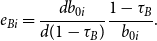 $e_{Bi} =\dfrac{db_{0i}}{d(1-\tau _{B})}\dfrac{1-\tau _{B}}{b_{0i}}\text{.}$
This implies that
 \begin{align*} 0=-(1+\lambda (1-\alpha ))(1-\delta )\bar{b}^{\;\text{received}\;}(1+\hat{e}_{B})-\frac{1+\lambda }{R(1-\tau _{B})}\bar{b}^{\;\text{left}\;}+(1+\lambda (1-\alpha ))\frac{1-\frac{e_{B}\tau _{B}}{1-\tau _{B}}}{1-\frac{e_{L}\tau _{L}}{1-\tau _{L}}}\bar{y}_{L}\text{.} \end{align*}
Simplifying this further yields
 \begin{align*} \tau _{B}^{\;\text{temp}\;}=\frac{1-\left [ 1-\frac{e_{L}\tau _{L}}{1-\tau _{L}}\right ] \left [ \frac{(1-\delta )\bar{b}^{\;\text{received}\;}}{\bar{y}_{L}}(1+\hat{e}_{B})+\frac{1+\lambda }{1+\lambda (1-\alpha )}\frac{\bar{b}^{\;\text{left}\;}}{R\bar{y}_{L}}\right ] }{1+e_{B}-\left [ 1-\frac{e_{L}\tau _{L}}{1-\tau _{L}}\right ] \left [ \frac{(1-\delta )\bar{b}^{\;\text{received}\;}}{\bar{y}_{L}}(1+\hat{e}_{B})\right ] }\text{.} \end{align*}
(b) It is easy to verify that
 $\dfrac{d\tau _{B}^{\;\text{temp}\;}}{d\lambda }\lt 0$
. Hence the proof.
Proof of Proposition 5. Let us first present the steps to obtain the expression for
 $\tau _{B}^{\;\text{temp}\;}$
with the assumption that
 $b_{ti}$
is given. Once the expression for
 $\tau _{B}^{\;\text{temp}\;}$
is derived, showing the rest is straightforward. Using the first order condition of the individual utility maximization
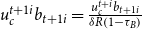 $u_{c}^{t+1i}b_{t+1i}=\frac{u_{c}^{t+i}b_{t+1i}}{\delta R\left ( 1-\tau _{B}\right ) }$
,
 $R\left ( 1-\tau _{B}\right ) db_{ti}-Rb_{ti}d\tau _{B}=-Rb_{ti}d\tau _{B}\left ( 1+e_{Bi}\right )$
, the equation (5), and the relation
 $u^{ti}_{\tilde{c}}=\alpha u^{ti}_c$
, we get
 \begin{align*} \mathbf{d}\mathbf{S}\mathbf{W}\mathbf{F} & =-\left ( 1+\lambda \right ) \int _{i}u_{c}^{0i}\cdot b_{0i}\left ( 1+e_{Bi}\right ) Rd\tau _{B}-\frac{1+\lambda }{1-\tau _{B}}\overset{\infty }{\sum _{t=0}}\delta ^{t}\int _{i}u_{c}^{ti}\cdot b_{t+1i}d\tau _{B}\\ & +\left ( 1+\lambda \right ) Rd\tau _{B}\dfrac{1-\dfrac{e_{B}\tau _{B}}{1-\tau _{B}}}{1-\dfrac{e_{L}\tau _{L}}{1-\tau _{L}}}\overset{\infty }{\sum _{t=0}}\delta ^{t}\int _{i}u_{c}^{ti}\cdot \frac{y_{Lti}}{y_{Lt}}b_{t}\\ & +\lambda \overset{\infty }{\sum _{t=0}}\delta ^{t}\int _{i}u_{\widetilde{c}}^{ti}\cdot b_{ti}\left ( 1+e_{Bti}\right ) Rd\tau _{B}-\lambda \dfrac{1-\dfrac{e_{B}\tau _{B}}{1-\tau _{B}}}{1-\dfrac{e_{L}\tau _{L}}{1-\tau _{L}}}Rd\tau _{B}\overset{\infty }{\sum _{t=0}}\delta ^{t}\int _{i}u_{\widetilde{c}}^{ti}\cdot \frac{y_{Lti}}{y_{Lt}}b_{t}\text{,} \end{align*}
where
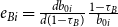 $e_{Bi}=\frac{db_{0i}}{d(1-\tau _{B})}\frac{1-\tau _{B}}{b_{0i}}$
and
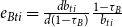 $e_{Bti}=\frac{db_{ti}}{d(1-\tau _{B})}\frac{1-\tau _{B}}{b_{ti}}$
. Setting dSWF = 0 at the optimum
 $\tau _{B}$
, we get the following
 \begin{align*} 0 & =-\left ( 1+\lambda \right ) \frac{\int _{i}u_{c}^{0i}\cdot b_{0i}\left ( 1+e_{Bi}\right ) }{b_{0}\int _{i}u_{c}^{0i}}-\frac{1+\lambda }{R\left ( 1-\tau _{B}\right ) }\overset{\infty }{\sum _{t=0}}\delta ^{t}\frac{\int _{i}u_{c}^{ti}\cdot b_{t+1i}}{b_{t+1}\int _{i}u_{c}^{ti}}+\\ & (1+\lambda )\sum _{t=0}^{\infty }\delta ^{t}\dfrac{1-\dfrac{e_{B}\tau _{B}}{1-\tau _{B}}}{1-\dfrac{e_{L}\tau _{L}}{1-\tau _{L}}}\dfrac{\int _{i}u_{c}^{ti}\cdot y_{Lti}}{y_{Lt}\int _{i}u_{c}^{ti}}\\ & +\lambda \overset{\infty }{\sum _{t=0}}\delta ^{t}\dfrac{\int _{i}u_{\widetilde{c}}^{ti}\cdot b_{ti}\left ( 1+e_{Bti}\right ) }{b_{t}\int _{i}u_{\widetilde{c}}^{ti}}\frac{\int _{i}u_{\widetilde{c}}^{ti}}{\int _{i}u_{c}^{ti}}-\lambda \frac{1-\dfrac{e_{B}\tau _{B}}{1-\tau _{B}}}{1-\dfrac{e_{L}\tau _{L}}{1-\tau _{L}}}\overset{\infty }{\sum _{t=0}}\delta ^{t}\frac{\int _{i}u_{\widetilde{c}}^{ti}\cdot y_{Lti}}{y_{Lt}\int _{i}u_{\widetilde{c}}^{ti}}\frac{\int _{i}u_{\widetilde{c}}^{ti}}{\int _{i}u_{c}^{ti}}\text{.} \end{align*}
From the above equation we have
 \begin{align*} 0=-\left ( 1-\delta +\lambda \left ( 1-\alpha -\delta \right ) \right ) \overline{b}^{\;\text{received}\;}\left ( 1+\widehat{e}_{B}\right ) -\frac{1+\lambda }{R\left ( 1-\tau _{B}\right ) }\overline{b}^{\;\text{left}\;}+\frac{\left ( 1+\lambda \left ( 1-\alpha \right ) \right ) \left ( 1-\dfrac{e_{B}\tau _{B}}{1-\tau _{B}}\right ) }{1-\dfrac{e_{L}\tau _{L}}{1-\tau _{L}}}\overline{y}_{L}. \end{align*}
Using
 $\overline{b}^{\;\text{left}\;}=\delta R(1-\tau _{B})\overline{b}^{\;\text{received}\;}$
and rearranging the terms, we generate the following expression for the optimal tax rate
 \begin{align*} \tau _{B}^{\;\text{temp}\;}=\dfrac{1-\left [ 1-\dfrac{e_{L}\tau _{L}}{1-\tau _{L}}\right ] \left [\dfrac{1-\delta +\lambda \left ( 1-\alpha -\delta \right ) }{1+\lambda \left ( 1-\alpha \right ) }\dfrac{1+\widehat{e}_{B}}{\delta }+\dfrac{1+\lambda }{1+\lambda \left ( 1-\alpha \right ) }\right ]\dfrac{\overline{b}^{\;\text{left}\;}}{R\overline{y}_{L}}}{1+e_{B}}\text{.} \end{align*}
Now it is straightforward to show that
 \begin{align*} \dfrac{d\tau _{B}^{\;\text{temp}\;}}{d\lambda } & =-\dfrac{\left [ 1-\dfrac{e_{L}\tau _{L}}{1-\tau _{L}}\right ] }{1+e_{B}}\left [ -\dfrac{\alpha \delta }{\left [ 1+\lambda \left ( 1-\alpha \right ) \right ] ^{2}}\dfrac{1+\widehat{e}_{B}}{\delta }+\dfrac{\alpha }{\left [ 1+\lambda \left ( 1-\alpha \right ) \right ] ^{2}}\right ] \dfrac{\overline{b}^{\;\text{left}\;}}{R\overline{y}_{L}}\\ & =\dfrac{\left [ 1-\dfrac{e_{L}\tau _{L}}{1-\tau _{L}}\right ] \overline{b}^{\;\text{left}\;}\alpha \widehat{e}_{B}}{\left ( 1+e_{B}\right ) R\overline{y}_{L}\left [ 1+\lambda \left ( 1-\alpha \right ) \right ] ^{2}}\gt 0. \end{align*}
Note that the optimal tax rates increase with the level of temptation. Hence the proof.
Appendix B
Under the assumption of
 $\Delta \leqslant 1$
, we first derive the expression for the optimal tax rate. While the expression for the optimal tax obviously differs, there is no change in the qualitative results. Under this setup, the individual’s utility maximizing problem remains the same as follows
 \begin{align*} \max _{\left \{ b_{t+1i},l_{ti}\right \} _{t=0}^{\infty }}\left \{ \begin{array} [c]{c}(1+\lambda )V^{ti}(R(1-\tau _{Bt})b_{ti}+(1-\tau _{Lt})y_{Lti}+\Upsilon _{t}-b_{t+1i},R(1-\tau _{Bt+1})b_{t+1i},1-l_{ti})\\ \\[-9pt] -\lambda V^{ti}(R(1-\tau _{Bt})b_{ti}+(1-\tau _{Lt})y_{Lti}+\Upsilon _{t},\underline{b}=0,1-l_{ti}) \end{array} \right \} \text{.} \end{align*}
The form of the first order condition with respect to
 $b_{t+1i}$
is therefore similar to the previous case:
 \begin{align*} V_{c}^{ti}=R(1-\tau _{Bt+1})V_{\underline{b}}^{ti}\text{.} \end{align*}
The government’s problem under this new specification is given by
 \begin{align*} \mathbf{S}\mathbf{W}\mathbf{F}=\max _{\tau _{Bt},\tau _{Lt}}\left \{ \begin{array} [c]{c}(1+\lambda )\sum _{t=0}^{\infty }\Delta ^{t}\int _{i}\omega _{ti}V^{ti}(R(1-\tau _{Bt})b_{ti}+\\ \\[-9pt] (1-\tau _{Lt})y_{Lti}+\Upsilon _{t}-b_{t+1i},R(1-\tau _{Bt+1})b_{t+1i},1-l_{ti})\\ \\[-9pt] -\lambda \sum _{t=0}^{\infty }\Delta ^{t}\int _{i}\omega _{ti}V^{ti}(R(1-\tau _{Bt})b_{ti}+(1-\tau _{Lt})y_{Lti}+\Upsilon _{t},\underline{b}=0,1-l_{ti}) \end{array} \right \} \text{.} \end{align*}
In the long run as all the variables converge,
 \begin{align*} d\mathbf{S}\mathbf{W}\mathbf{F}=\begin{array} [c]{c}(1+\lambda )\left ( \begin{array} [c]{c}\sum _{t=T}^{\infty }\Delta ^{t}\int _{i}\omega _{ti}V_{c}^{ti}\cdot ((R(1-\tau _{B})db_{ti}-Rb_{ti}d\tau _{B}-d\tau _{Lt}y_{Lti})+\\ \\[-9pt] \sum _{t=T-1}^{\infty }\Delta ^{t}\int _{i}\omega _{ti}V_{\underline{b}}^{ti}\cdot (-Rb_{t+1i}d\tau _{B}) \end{array} \right ) \\ \\[-9pt] -\lambda \sum _{t=T}^{\infty }\Delta ^{t}\int _{i}\omega _{ti}V_{\tilde{c}}^{ti}\cdot (R(1-\tau _{B})db_{ti}-Rb_{ti}d\tau _{B}-d\tau _{Lt}y_{Lti}) \end{array} \text{.} \end{align*}
Assuming that the period-wise balanced budget holds, we can focus on a small reform
 $d\tau _{B}$
so that
 $d\tau _{Bt}=d\tau _{B}$
 $\forall t\geqslant T$
where
 $T$
is sufficiently large, keeping
 $d\Upsilon _{t}=0$
. Unlike steady state maximization, in this case, it is necessary to sum all of the effects for
 $t\geqslant T$
that are not identical and reform at
 $T$
also affects those leaving bequests in generation
 $T-1$
. Before presenting the expression for the optimal tax rate in this environment, we define three average discounted elasticities as follows:
 \begin{align*} e_{B}&=(1-\Delta )\sum _{t=T}^{\infty }\Delta ^{t-T}e_{Bt},\;\\[3pt] \hat{e}_{B}&=(1-\Delta )\sum _{t=T}^{\infty }\Delta ^{t-T}\hat{e}_{Bt},\;\text{where}\;\hat{e}_{Bt}=\frac{\int _{i}g_{ti}b_{ti}e_{Bti}}{\int _{i}g_{ti}b_{ti}}\text{.} \end{align*}
Discounted
 $e_{L}$
satisfies
 \begin{align*} \dfrac{1-\frac{e_{B}\tau _{B}}{1-\tau _{B}}}{1-\frac{e_{L}\tau _{L}}{1-\tau _{L}}}=(1-\Delta )\sum _{t=T}^{\infty }\Delta ^{t-T}\dfrac{1-\frac{e_{Bt}\tau _{B}}{1-\tau _{B}}}{1-\frac{e_{Lt}\tau _{L}}{1-\tau _{L}}}\text{.} \end{align*}
Having this construction, we express the optimal inheritance tax rate under the social discounting as
 \begin{equation} \tau _{B}^{\;\text{temp}\;}=\frac{1-\left [ 1-\frac{e_{L}\tau _{L}}{1-\tau _{L}}\right ] \left [ \frac{\bar{b}^{received}}{\bar{y}_{L}}(1+\hat{e}_{B})+\frac{1+\lambda }{1+\lambda (1-\alpha )}\frac{\bar{b}^{left}}{\Delta R\bar{y}_{L}}\right ] }{1+e_{B}-\left [ 1-\frac{e_{L}\tau _{L}}{1-\tau _{L}}\right ] \frac{\bar{b}^{received}}{\bar{y}_{L}}(1+\hat{e}_{B})}. \end{equation}
To get the above expression we follow the same steps required to prove Proposition (1). By setting
 $d\mathbf{S}\mathbf{W}\mathbf{F}=0$
, we have
 \begin{align*} 0=\begin{array} [c]{c}-(1+\lambda (1-\alpha ))\sum _{t=T}^{\infty }\Delta ^{t}\left [ \int _{i}\omega _{ti}V_{c}^{ti}\cdot (Rb_{ti}d\tau _{B}(1+e_{Bti}))-\dfrac{1-\frac{e_{Bt}\tau _{B}}{1-\tau _{B}}}{1-\frac{e_{Lt}\tau _{L}}{1-\tau _{L}}}Rb_{t}d\tau _{B}\dfrac{y_{Lti}}{y_{Lt}}\right ] \\[3pt]-(1+\lambda )\sum _{t=T-1}^{\infty }\Delta ^{t}\int _{i}\dfrac{\omega _{ti}V_{c}^{ti}}{R(1-\tau _{B})}Rb_{t+1i}d\tau _{B}\text{.}\end{array} \end{align*}
Dividing the above expression by
 $Rb_{t}d\tau _{B}\int _{i}\omega _{ti}V_{c}^{ti}$
and using the fact that
 $g_{ti}=\frac{\omega _{ti}V_{c}^{ti}}{\int _{i}\omega _{ti}V_{c}^{ti}}$
, we get
 \begin{align*} 0&=-(1+\lambda (1-\alpha ))\sum _{t=T}^{\infty }\Delta ^{t}\bar{b}^{\;\text{received}\;}(1+\hat{e}_{Bt})+(1+\lambda (1-\alpha )){\frac{1-\frac{e_{Bt}\tau _{B}}{1-\tau _{B}}}{1-\frac{e_{Lt}\tau _{L}}{1-\tau _{L}}}}\sum _{t=T}^{\infty }\Delta ^{t}\bar{y}_{L}\\[3pt]&\quad -\frac{1+\lambda }{R(1-\tau _{B})}\sum _{t=T-1}^{\infty }\Delta ^{t}\bar{b}^{\;\text{left}\;}\text{.} \end{align*}
Further simplifying the above we get
 \begin{align*} \tau _{B}^{\;\text{temp}\;}=\dfrac{1-\left [ 1-\frac{e_{L}\tau _{L}}{1-\tau _{L}}\right ] \left [ \frac{\bar{b}^{\;\text{received}\;}}{\bar{y}_{L}}(1+\hat{e}_{B})+\frac{1+\lambda }{1+\lambda (1-\alpha )}\frac{\bar{b}^{\;\text{left}\;}}{\Delta R\bar{y}_{L}}\right ] }{1+e_{B}-\left [ 1-\frac{e_{L}\tau _{L}}{1-\tau _{L}}\right ] \frac{\bar{b}^{\;\text{received}\;}}{\bar{y}_{L}}(1+\hat{e}_{B})}\text{.}\\[-30pt] \end{align*}
Appendix C
We first construct the case of period zero perspective under the BBD setup and then derive the long run optimal inheritance tax rate in the presence of present bias. As mentioned by Piketty and Saez (Reference Piketty and Saez2013), under period zero perspective the bequest behavior of generations changes in advance due to the anticipation of changes in the tax rate, that is, a future tax change in date
 $T$
does affect all the previous generations.
Before figuring out the exact expressions for the inheritance tax rate, we focus on some of the elasticities that will appear in our discussions. As in Piketty and Saez (Reference Piketty and Saez2013), we divide
 $e_{B}^{pdv}$
, the elasticity of the present discounted value of the tax base with respect to a future tax increase into two parts - the usual part measures post-reform elasticity and the additional part under the period-zero case measures the anticipated pre-reform behavioral elasticities. Formally,
 $\left ( 1-\delta \right ) \overset{\infty }{\sum _{t=1}}\delta ^{t-T}e_{Bt}\equiv e_{B}^{\;\text{pdv}\;}=e_{B}^{\;\text{post}\;}+e_{B}^{\;\text{anticip.}\;}$
with
 $e_{B}^{\;\text{post}\;}=\left ( 1-\delta \right ) \overset{\infty }{\sum _{t=T}}\delta ^{t-T}e_{Bt}$
and
 $e_{B}^{\;\text{anticip.}\;}=\left ( 1-\delta \right ) \sum _{t=0}^{T-1}\delta ^{t-T}e_{Bt}$
as
 $e_{B}^{\;\text{post}\;}$
and
 $e_{B}^{\;\text{anticip.}\;}$
are measured as the discounted average of the elasticities
 $e_{Bt}$
. Given the elastic labor supply, the individual’s optimization problem can be written as
 \begin{align*} & \max _{\left \{ b_{t+1i},\;\;l_{ti}\right \} _{t=0}^{\infty }}\left ( 1+\lambda \right ) \overset{\infty }{\sum _{t=0}}\delta ^{t}{E_{t}}u^{ti}\left ( R\left ( 1-\tau _{Bt}\right ) b_{ti}+(1-\tau _{Lt})y_{Lti}+{\Upsilon _{t}}-b_{t+1i},1-l_{ti}\right ) \\ \\[-9pt] & -\lambda \overset{\infty }{\sum _{t=0}}\delta ^{t}{E_{t}}u^{ti}\left ( R\left ( 1-\tau _{Bt}\right ){b_{ti}}+(1-\tau _{Lt})y_{Lti}+{\Upsilon _{t}},1-l_{ti}\right ) \text{.} \end{align*}
Then the government’s optimization problem can be written as
 \begin{align*} \mathbf{S}\mathbf{W}\mathbf{F}=\max _{\left \{ \tau _{Bt},\tau _{Lt}\right \} _{t=0}^{\infty }}\left \{ \begin{array} [c]{c}(1+\lambda )\sum _{t=0}^{\infty }\delta ^{t}\int _{i}u^{ti}(R(1-\tau _{Bt})b_{ti}+(1-\tau _{Lt})w_{ti}l_{ti})+\Upsilon _{t}-b_{t+1i},1-l_{ti})\\[3pt] -\lambda \sum _{t=0}^{\infty }\delta ^{t}\int _{i}u^{ti}(R(1-\tau _{Bt})b_{ti}+(1-\tau _{Lt})w_{ti}l_{ti})+\Upsilon _{t},1-l_{ti}) \end{array} \right \} \end{align*}
subject to a period-wise budget balance,
 $\tau _{Bt}Rb_{t}+\tau _{Lt}y_{Lt}=\Upsilon _{t}$
. It is assumed that
 $b_{t}$
changes in response to an anticipatory change in
 $\tau _{B}$
. Hence, in order to keep the budget balanced, it is necessary to change
 $\tau _{Lt}$
. This definitively changes the labor supply decision of individuals before and after tax changes and is captured in the following equations
 \begin{align*} \forall t & \geq T,\;\;\tau _{Bt}Rdb_{t}+Rb_{t}d\tau _{B}+\tau _{Lt}dy_{Lt}+y_{Lt}d\tau _{Lt} = 0\;\text{, and}\;\\[3pt]\forall t & \lt T,\;\;\tau _{Bt}Rdb_{t}+\tau _{Lt}dy_{Lt}+y_{Lt}d\tau _{Lt} = 0. \end{align*}
This generates the following two equations
 \begin{align*} \forall t & \geq T,\;\;d\tau _{Lt}y_{Lt} = -\frac{1-\frac{e_{Bt}\tau _{B}}{1-\tau _{B}}}{1-\frac{e_{Lt}\tau _{L}}{1-\tau _{L}}}Rb_{t}d\tau _{B}\;\text{,}\\[3pt]\forall t & \lt T,\;\;d\tau _{Lt}y_{Lt} = \frac{\frac{e_{Bt}\tau _{B}}{1-\tau _{B}}}{1-\frac{e_{Lt}\tau _{L}}{1-\tau _{L}}}Rb_{t}d\tau _{B}\text{.} \end{align*}
The above relationship holds because we assume that a small change in
 $\tau _{B}$
occurs on or after period
 $T$
, that is
 $d\tau _{B}$
reform starts at
 $T$
. It can be shown that in this case
 \begin{align*} \mathbf{d}\mathbf{S}\mathbf{W}\mathbf{F}=\begin{array} [c]{c}(1+\lambda )\left [ -\sum _{t=T}^{\infty }\delta ^{t}\int _{i}u_{c}^{ti}\cdot Rb_{ti}d\tau _{B}-\sum _{t=1}^{\infty }\delta ^{t}\int _{i}u_{c}^{ti}\cdot y_{Lti}d\tau _{Lt}\right ] \\ \\[-9pt] -\lambda \left [ -\sum _{t=1}^{\infty }\delta ^{t}\int _{i}u_{\widetilde{c}}^{ti}\cdot y_{Lti}d\tau _{Lt}\right ]{+\lambda \delta ^{T}\int _{i}u_{\widetilde{c}}^{Ti}\cdot Rb_{Ti}d\tau _{B}}\end{array} \text{.} \end{align*}
Using the usual process followed above, we have
 \begin{align*} 0=\begin{array} [c]{c}(1+\lambda )\left [ -\sum _{t=T}^{\infty }\delta ^{t}\dfrac{\int _{i}u_{c}^{ti}\cdot b_{ti}}{b_{t}\int _{i}u_{c}^{ti}}+\sum _{t=T}^{\infty }\delta ^{t}\dfrac{\int _{i}u_{c}^{ti}\cdot y_{Lti}}{y_{Lt}\int _{i}u_{c}^{ti}}\dfrac{1-\frac{e_{Bt}\tau _{B}}{1-\tau _{B}}}{1-\frac{e_{Lt}\tau _{L}}{1-\tau _{L}}}-\sum _{t=1}^{T-1}\delta ^{t}\dfrac{\int _{i}u_{c}^{ti}\cdot y_{Lti}}{y_{Lt}\int _{i}u_{c}^{ti}}\frac{\frac{e_{Bt}\tau _{B}}{1-\tau _{B}}}{1-\frac{e_{Lt}\tau _{L}}{1-\tau _{L}}}\right ] \\ \\[-9pt] -\alpha \lambda \left [ \sum _{t=T}^{\infty }\delta ^{t}\dfrac{\int _{i}u_{c}^{ti}\cdot y_{Lti}}{y_{Lt}\int _{i}u_{c}^{ti}}\dfrac{1-\frac{e_{Bt}\tau _{B}}{1-\tau _{B}}}{1-\frac{e_{Lt}\tau _{L}}{1-\tau _{L}}}-\sum _{t=1}^{T-1}\delta ^{t}\dfrac{\int _{i}u_{c}^{ti}\cdot y_{Lti}}{y_{Lt}\int _{i}u_{c}^{ti}}\dfrac{\frac{e_{Bt}\tau _{B}}{1-\tau _{B}}}{1-\frac{e_{Lt}\tau _{L}}{1-\tau _{L}}}\right ] + \alpha \lambda \delta ^{T}\dfrac{\int _{i}u_{c}^{Ti}b_{Ti}}{b_{T}\int _{i}u_{c}^{ti}}\text{.}\end{array} \end{align*}
This equation can further be simplified to
 \begin{align*} 0=(1+\lambda (1-\alpha ))\left [\! \bar{y}_{L}(1-\delta )\sum _{t=T}^{\infty }\delta ^{t-T}\frac{1-\frac{e_{Bt}\tau _{B}}{1-\tau _{B}}}{1-\frac{e_{Lt}\tau _{L}}{1-\tau _{L}}}-\bar{y}_{L}(1-\delta )\sum _{t=1}^{T-1}\delta ^{t-T}\frac{\frac{e_{Bt}\tau _{B}}{1-\tau _{B}}}{1-\frac{e_{Lt}\tau _{L}}{1-\tau _{L}}}\!\right ]\! -(1+\lambda )\bar{b}^{\;\text{received}\;}\text{.} \end{align*}
Notice
 $e_{B}^{\;\text{pdv}\;}=e_{B}^{\;\text{post}\;}+e_{B}^{\;\text{anticip.}\;}$
, where
 $e_{B}^{\;\text{post}\;}=(1-\delta )\sum _{t=T}^{\infty }\delta ^{t-T}e_{Bt}$
and
 $e_{B}^{\;\text{anticip.}\;}=(1-\delta )\sum _{t=1}^{T-1}\delta ^{t-T}e_{Bt}\text{.}$
Hence,
 $e_{B}^{\;\text{pdv}\;}$
and
 $e_{L}^{\;\text{pdv}\;}$
satisfy the following relationship:
 \begin{align*} \frac{1-\frac{e_{B}^{\;\text{pdv}\;}\tau _{B}}{1-\tau _{B}}}{1-\frac{e_{L}^{\;\text{pdv}\;}\tau _{L}}{1-\tau _{L}}}=(1-\delta )\sum _{t=T}^{\infty }\delta ^{t-T}\frac{1-\frac{e_{Bt}\tau _{B}}{1-\tau _{B}}}{1-\frac{e_{Lt}\tau _{L}}{1-\tau _{L}}}-(1-\delta )\sum _{t=1}^{T-1}\delta ^{t-T}\frac{\frac{e_{Bt}\tau _{B}}{1-\tau _{B}}}{1-\frac{e_{Lt}\tau _{L}}{1-\tau _{L}}}\text{,} \end{align*}
Now, we can write the above equation as follows
 \begin{align*} 0=(1+\lambda (1-\alpha ))\bar{y}_{L}\frac{1-\frac{e_{B}^{\;\text{pdv}\;}\tau _{B}}{1-\tau _{B}}}{1-\frac{e_{L}^{\;\text{pdv}\;}\tau _{L}}{1-\tau _{L}}}-(1+\lambda )\bar{b}^{\;\text{received}\;}\text{.} \end{align*}
Using the first order condition of individual’s utility maximization problem and
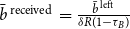 $\bar{b}^{\;\text{received}\;}=\frac{\bar{b}^{\;\text{left}\;}}{\delta R(1-\tau _{B})}$
, we can get
 \begin{align*} 0=(1+\lambda (1-\alpha ))\bar{y}_{L}\left [ 1-\frac{e_{B}^{\;\text{pdv}\;}\tau _{B}}{1-\tau _{B}}\right ] -\left [ 1-\frac{e_{L}^{\;\text{pdv}\;}\tau _{L}}{1-\tau _{L}}\right ] \frac{(1+\lambda )\bar{b}^{\;\text{left}\;}}{\delta R(1-\tau _{B})}\text{.} \end{align*}
This guarantees that the optimal tax rate
 $\tau _{B}^{\;\text{temp}\;}$
is given by
 \begin{equation} \tau _{B}^{\;\text{temp}\;}=\frac{1-\left [ 1-\frac{e_{L}^{\;\text{pdv}\;}\tau _{L}}{1-\tau _{L}}\right ] \frac{1+\lambda }{1+\lambda (1-\alpha )}\frac{\bar{b}^{\;\text{left}\;}}{\delta R\bar{y}_{L}}}{1+e_{B}^{\;\text{pdv}\;}}\text{.} \end{equation}
A few observations are immediate. First, note that
 $\dfrac{d\tau _{B}^{\;\text{temp}\;}}{d\lambda }\lt 0$
. This implies that when
 $e_{B}^{\;\text{pdv}\;}$
is finite and
 $\bar{b}^{\;\text{received}\;}\lt 1$
, a positive tax as recommended under the standard preferences is not necessarily the optimal. The negative relationship between the tax rate and the level of temptation persists, and, it is possible that a subsidy is optimal whenever the commitment consumption is different from that under temptation. Thus, the presence of present bias breaks the result that the optimal tax rate is always positive when
 $\bar{b}^{\;\text{received}\;}\lt 1$
(see Piketty and Saez (Reference Piketty and Saez2013)).
Second, as mentioned before, the inheritance in our model setting can play the role of the capital and hence, our inheritance tax results can be compared to the existing results in the capital tax literature. The most important observation is that the Chamley (Reference Chamley1986) - Judd (Reference Judd1985)’s zero capital income tax result holds as it holds in the absence of temptation and self control behavior.Footnote
26
Let us explain the reason behind generating the Chamley (Reference Chamley1986) - Judd (Reference Judd1985) result in this particular framework. The term
 $e_{B}^{\;\text{pdv}\;}$
that appears in the denominator of the equation (15) plays a crucial role here. As Piketty and Saez (Reference Piketty and Saez2013) pointed out, the elasticity
 $e_{B}^{\;\text{pdv}\;}$
tends to go infinity in the Chamley (Reference Chamley1986) - Judd (Reference Judd1985) model with no uncertainty and, therefore, in the long run, the zero tax result is obtained. Presence of present biased does not change this route. That means
 $e_{B}^{\;\text{pdv}\;}$
is infinite under the Chamley (Reference Chamley1986) - Judd (Reference Judd1985) setup independent of the self-control problem and therefore the expression for the tax rate presented above in (15) goes to zero in the long run even when agents have self-control preferences. Therefore, under the presence of temptation and self-control, the celebrated zero tax on capital result holds and optimality does not demand any subsidy.



