Introduction
Trees and woodlands provide huge benefits to society, supporting our rural economy and biodiversity as well as providing ecosystem services such as flood prevention. Environmental and economic benefits are also complemented by social services that can improve the public's physical health and mental well-being (IPF, 2012). The extent of woodland in the United Kingdom (UK) has increased by 73% since 1947; however, it remains one of the least forested areas in Europe, with just over 13% tree cover (Forest Research, 2018) compared to an average of 38% for the EU (Eurostat, 2015; Defra, 2018). This means that some populations of UK trees are already highly fragmented and at risk of reduced ecological interactions and genetic integrity (Logan et al., Reference Logan, Phuekvilai and Wolff2015).
The effects of increasing population, trade, migration and climate change place greater pressures on ecosystem services and may intensify future effects on biodiversity (UNEP, 2014). In addition, invasive pests and diseases such as Dutch elm disease (Ophiostoma novo-ulmi), red band needle blight (caused by Dothistroma septosporum) and ash dieback (Hymenoscyphus fraxineus) threaten UK woodlands (Woodland Trust, 2011; Defra, 2018). For example, Fraxinus excelsior has mortality rates of up to 85% recorded in Europe due to ash dieback (Coker et al., Reference Coker, Rozsypálek, Edwards, Harwood, Butfoy and Buggs2019), a species which in Great Britain accounts for 12% of broadleaf woodland with an estimated social and environmental value of £230 million a year (Defra, 2019). Threats to plant diversity are apparent on a global scale and require complementary efforts from both in situ and ex situ conservation practices. Seed banking, an ex situ option which may cost as little as 1% of in situ methods, is a space-efficient method to conserve genetic diversity for many seed-bearing species (Li and Pritchard, Reference Li and Pritchard2009). In addition, it has the advantage of removing material from the landscape, protecting it from threats.
The UK National Tree Seed Project (UKNTSP) was established in 2013 with the aim of developing an ex situ multi-provenance seed collection of UK native trees and shrubs. These collections aim to safeguard genetic diversity and provide a resource for conservation and research. Where possible, collections for each species are made in every Forestry Commission seed zone in which it naturally occurs. Furthermore, where possible the seed from individual mother trees are stored separately, allowing studies at the intra-specific level (Kallow and Trivedi, Reference Kallow, Trivedi, Sniezko, Man, Hipkins, Woeste, Gwaze, Kliejunas and McTeague2017; Trivedi and Kallow, Reference Trivedi, Kallow, Sniezko, Man, Hipkins, Woeste, Gwaze, Kliejunas and McTeague2017). These sampling strategies have likely captured 86% of the alleles found in native Taxus baccata populations (Gargiulo et al., Reference Gargiulo, Saubin, Rizzuto, West, Fay, Kallow and Trivedi2019) and at least 90% of the alleles present in Great Britain for F. excelsior (Hoban et al., Reference Hoban, Kallow and Trivedi2018).
Recommendations for conventional seed storage, at −20°C after drying to 3–7% moisture content (MC) (fresh weight) (FAO, 2014; MSB, 2015; CPC, 2018), are based on essential concepts of seed and moisture relations, whereby the longevity of orthodox (desiccation-tolerant) seeds increases as temperature and humidity are decreased (Harrington, Reference Harrington, Frankel and Bennett1970; Roberts, Reference Roberts1973; Ellis and Roberts, Reference Ellis and Roberts1980). Recalcitrant seeds are not suitable for conventional storage as they cannot survive enough desiccation to prevent ice crystallization during freezing (Roberts, Reference Roberts1973). Seeds with variable sensitivity to desiccation and cold temperatures are generally termed intermediate (Ellis et al., Reference Ellis, Hong and Roberts1990; Walters, Reference Walters2015a). Guidelines suggest that stored collections are checked for viability by germination tests shortly after banking and then retested at defined time intervals, usually every 10 years. For collections with unknown germination requirements, viability can be estimated using germination cut tests, with sample sizes considered according to the proportion of full seeds (i.e. with embryos) (Davies et al., Reference Davies, Di Sacco and Newton2015a; Hay and Whitehouse, Reference Hay and Whitehouse2017). Storage of short-lived seed collections in the vapour phase of liquid nitrogen storage (~−186°C) is expected to further extend potential longevity (Walters et al., Reference Walters, Wheeler and Stanwood2004). Choosing appropriate viability testing intervals is crucial for effective seed collection management. Monitoring should aim to detect viability loss before less than 85% of initial viability remains but should be as infrequent as possible to ensure that seed and staff resources are not wasted (FAO, 2014). This is of importance for wild collections, where losses in viability, and possibly genetic variation may not be recoverable by regeneration or recollection (Roos, Reference Roos and Khan1982). However, the potential lifespan of a seed collection may not be known when decisions about duplication to cryo-storage and retest intervals are made.
Seed longevity in conventional storage conditions has been published for relatively few temperate tree species exceeding 10 years (Wang, Reference Wang1974; Simpson et al., Reference Simpson, Wang and Daigle2004; Pritchard et al., Reference Pritchard, Moat, Ferraz, Marks, Camargo, Nadarajan and Ferraz2014). Seeds of F. excelsior from Poland can be stored for at least 10 years at −3 to −5°C and 7 to 10% MC (Suszka, Reference Suszka1987, cited in Chmielarz, Reference Chmielarz2009). Seeds of Fagus sylvatica from Denmark showed no significant decline in germination after 8 years of storage at −8°C and MCs of 4.7 and 8.4% (Poulsen and Knudsen, Reference Poulsen and Knudsen1999), while others report low storage potential (Pukacka and Ratajczak, Reference Pukacka and Ratajczak2007). Variation in desiccation sensitivity in seeds of F. sylvatica is also widely reported, with some seed lots surviving desiccation to 4.75 and 4% MC (Poulsen, Reference Poulsen1993; Poulsen and Knudsen, Reference Poulsen and Knudsen1999; Chmielarz, Reference Chmielarz2007), while other seed lots are sensitive to desiccation below 10% MC (Gosling, Reference Gosling1991; Hong et al., Reference Hong, Linington and Ellis1998). In Canada, Betula and Pinus species stored below 9% MC at −20°C had germination percentages up to 85 and 87%, after 28 and 40 years storage, respectively (Simpson et al., Reference Simpson, Wang and Daigle2004).
Accelerated ageing tests (at 45°C and 60% relative humidity (RH)) indicate which seed collections are likely to be comparatively short-lived (Hay and Probert, Reference Hay and Probert2013; Hay and Whitehouse, Reference Hay and Whitehouse2017). Studies allow comparisons based on species, environment and seed traits including climate (Probert et al., Reference Probert, Daws and Hay2009; Merritt et al., Reference Merritt, Martyn, Ainsley, Young, Seed, Thorpe, Hay, Commander, Shackelford, Offord, Dixon and Probert2014), elevation (Mondoni et al., Reference Mondoni, Probert, Rossi, Vegini and Hay2011; Satyanti et al., Reference Satyanti, Nicotra, Merkling and Guja2018), seed mass (Daws et al., Reference Daws, Garwood and Pritchard2006; Satyanti et al., Reference Satyanti, Nicotra, Merkling and Guja2018), seed maturity and acquisition of desiccation tolerance (Ali et al., Reference Ali, Probert, Hay, Davies and Stuppy2007). Such studies ultimately reduce the cost of viability monitoring in the long term, as only when collections with the shortest longevity ranking from accelerated ageing start to show a decline, would the next lowest-ranked collections require testing. A modification to the ageing protocol has been developed, using fewer seeds, to screen for short-lived seed lots only (Davies et al., Reference Davies, Newton, Hay and Probert2016). Mechanisms behind deteriorative repair in seeds may differ with temperature and moisture conditions, with many predictions yet to be confirmed by long-term storage data (Walters, Reference Walters2015b). Given the absence of sufficient long-term data, we have used accelerated ageing as a reasonable indicator of comparative longevity among collections in long-term storage, as a basis for collection management decisions, including viability monitoring frequency.
The aim of this study was to support the effective management of ex situ seed collections of UK woody species by carrying out accelerated ageing tests on at least one seed collection from each of 22 UK native woody species. An additional aim was to investigate variation in estimated longevity between and within seed collections, including possible correlates.
Materials and methods
Species selection
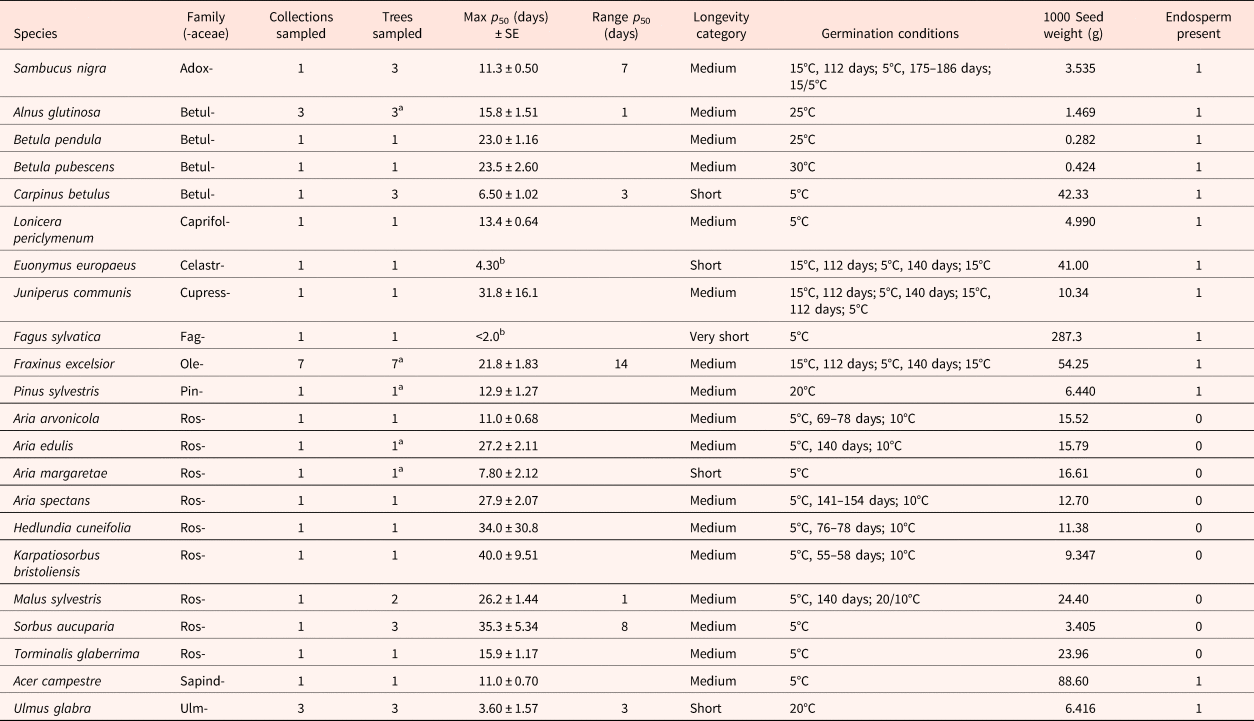
Seeds from 22 UK native woody species were sampled from Millennium Seed Bank (MSB) collections (Table 1). All collections selected had at least 1500 filled seeds (ideally 1500 per tree sampled), verified taxonomy, and were from wild UK material (i.e. not regenerated). Collections were of high viability with known germination requirements (≥85% germination at the last monitoring test), except for Aria margaretae (81% germination) and Juniperus communis (83% germination). Prior to experimental sampling, collections were dried to equilibrium with 15% RH and 18°C and then stored at −20°C, except for F. sylvatica which was dried to 47% RH before storage at −18°C. Seeds of F. sylvatica were only partially dried to ensure minimal loss of viability due to desiccation prior to experimentation, as desiccation sensitivity is known to vary between seeds lots.
Details of the species used in the study.

Taxonomy follows WCVP (2020). Seed trait data are presented as mean 1000 seed weight (g) and endosperm presence (present = 1, not present = 0). Species are ranked by the maximum (Max) p 50 ± standard error (SE) and assigned to approximate longevity categories of very short, short or medium as appropriate. All tests were set on 1% agar with a 12/12 h light/dark cycle and alternating temperatures coinciding with a warmer temperature in the light period. For E. europaeus and F. excelsior, covering structures were removed prior to placing seeds in germination conditions. For H. cuneifolia and K. bristoliensis, the seed coat was removed in the final step.
aSampled from multiple trees within a collection, including two collections of A. glutinosa and one collection of F. excelsior.
bToo few data points for reliable probit analysis.
Thirty-nine samples from 32 collections in total were tested. All seeds used were collected by the UKNTSP between October 2013 and November 2016. For three species (F. excelsior, Alnus glutinosa and Ulmus glabra), multiple geographically separate collections were sampled (see Supplementary Table S1 for further details), and for four species (Sambucus nigra, Carpinus betulus, Malus sylvestris and Sorbus aucuparia), multiple trees within a collection were sampled.
Ageing protocol
The ageing protocol used followed the 150-seed comparative longevity protocol – a reduced seed number screening method for identifying short-lived seed conservation collections (Davies et al., Reference Davies, Newton, Hay and Probert2016). Ageing experiments were carried out on seed samples between 2016 and 2018. Seeds were removed from storage and equilibrated in their storage containers for at least 24 h before opening. A proportional over-sow was calculated, where possible, to account for the varying presence of empty or insect-infested seeds. Where individual trees within one collection had less than 1500 full seeds, samples were taken proportionally across all the trees in that collection above 100 seeds in number (Table 1). Samples were rehydrated at 47% RH and 20°C for 14 days. The RH was controlled by dissolving anhydrous lithium chloride (LiCl, Laboratory Reagent Grade, Fisher Scientific UK Ltd., Leicestershire, UK) in distilled water. After rehydration, samples were transferred to 60% RH and 45°C (ageing conditions). Germination samples of 25 full seeds were taken at days 2 and 30; and 50 full seeds were taken at days 10 and 15. The RH generated by the LiCl solution was tested approximately every 2 weeks using a hygrometer sensor housed in an AW-DIO water activity probe, used in conjunction with a HygroPalm 3 display unit (Rotronic Instruments UK Ltd., Crawley, UK) and remained within 2% of the desired RH. The germination conditions used (Table 1) followed standard MSB procedures (Davies et al., Reference Davies, Di Sacco and Newton2015a,Reference Davies, Di Sacco and Newtonb). Cut tests were performed on ungerminated seeds at the end of the test to confirm they were not viable. Empty and infested seeds were excluded from germination percentage calculations.
Probit analysis
Probit analysis was carried out following the methodology of Davies et al. (Reference Davies, Newton, Hay and Probert2016). Cumulative germination percentages were plotted against germination time and sigmoidal seed survival curves were fitted by Probit analysis using Genstat for Windows, Version 14.2 (VSN International Ltd., Hemel Hempstead, UK), following Roberts (Reference Roberts1973) and using the improved viability equation (Ellis and Roberts, Reference Ellis and Roberts1980):
 $${\rm \nu } = K_{\rm i}-\left({\displaystyle{\,p \over {\rm \sigma }}} \right)\;$$
where ν is the viability (normal equivalent deviates, NED) of seeds after p days in storage; K i is a measure of the initial viability (NED) and σ is the time for viability to decline by 1 NED. Probit analysis was also used to estimate time for viability to fall to 50% (p 50) (Hay et al., Reference Hay, Mead and Bloomberg2014). Zero germination values subsequent to the first zero recorded in ageing tests were excluded from the probit analysis. Data for the first sampling point were excluded where germination increased by more than 10% at the second sampling point.
Species were ranked by p 50 and assigned to the notional longevity categories of very short-lived (p 50 ≤ 2 days), short-lived (p 50 > 2 and ≤ 10 days) and medium (p 50 > 10 and ≤ 100 days). Categories were based on Mondoni et al. (Reference Mondoni, Probert, Rossi, Vegini and Hay2011), except very short was adjusted from p 50 < 1 to <2 days based on current sampling procedure and ability to make predictions of <2 days. Where p 50 could not be calculated due to all viability being lost before 10 days, p 50 was reported as <2 days for tables and a nominal value of 1 day was used for linear and regression analysis. Analysis of deviance was used to compare seed survival curves and an F-test used to test for significance when constraining survival curve data for multiple seed lots to a common intercept and slope (K i and σ, respectively). Residual deviance was tested at tree, collection, genus and family level, where suitable samples were available for comparison. Samples which could be constrained to a common slope are presented (as single lines) in (Fig. 1).
Determination of seed characteristics
The weight of air-dried (15% RH at 18°C) seeds was calculated by weighing 5 lots of 50 seeds for each collection in the study. The presence or absence of endosperm was assigned according to Martin (Reference Martin1946) classifications. Species within the Rosaceae family (Malus and Sorbus), which have only a very thin lining of fleshy endosperm, are included as non-endospermic.
All statistical analysis comparing p 50 to seed characteristics was undertaken in the R statistical platform using ANOVA, T-tests and linear regression as appropriate (R Core Team, 2019).
Conventional storage data
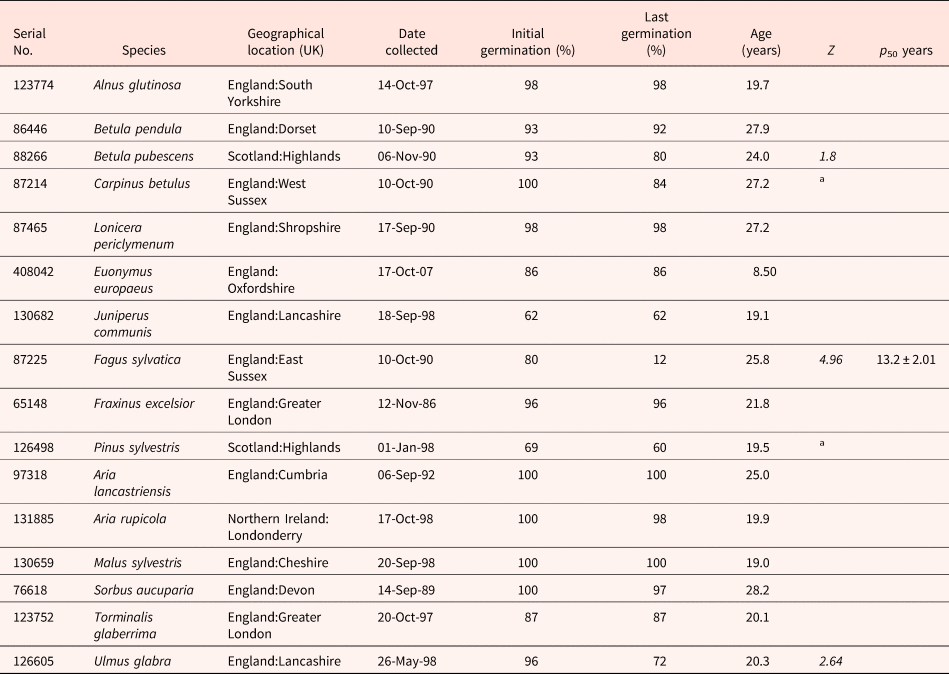
Conventional storage data from seed conservation collections were extracted for 16 species which matched our study species either at the species or genus level (Table 3). The collections presented are independent of those experimentally tested above and were selected based on the length of time they had been banked at the MSB (ideally longer than 10 years), which ranged from 8.5 to 28.2 years. All collections were dried to equilibrium with 15% RH and 15–18°C before storage at −20°C according to standard procedures at the time. A significant decline in viability was monitored in conventional storage by comparing the initial (highest) germination result with the most recent retest.
The value of normal deviate Z was calculated using a two-tailed test (Ellis and Roberts, Reference Ellis and Roberts1985), where a correction factor is applied to enable the normal distribution to be used in the analysis:
 $$Z = \displaystyle{{\lpar {\,p_1\;-p_2} \rpar } \over {\sqrt {\bar{\,p}} \;\lpar {100\;-\;\bar{\,p}} \rpar \;\left({\displaystyle{1 \over {n_1}} + \displaystyle{1 \over {n_2}}} \right)}}$$
where p 1 is ((100 × g 1)/(n 1 − 0.5)); p 2 is ((100 × 2)/(n 2 + 0.5));  $\bar{p}$ is the mean value of p 1 and p 2; g 1 and g 2 are the numbers of germinated seeds; and n 1 and n 2 are the numbers of full seeds sown (where n > 19) for the initial and most recent retest, respectively. The decline was considered significant (P < 0.05), where Z > 1.64 and the lowest result <95%. Where possible, storage data were analysed by probit analysis (to calculate p 50 in years).
Plant health
The material of F. excelsior was held under a Defra plant health licence and handled according to Defra plant health guidelines.
Results
Viability and p 50 summary
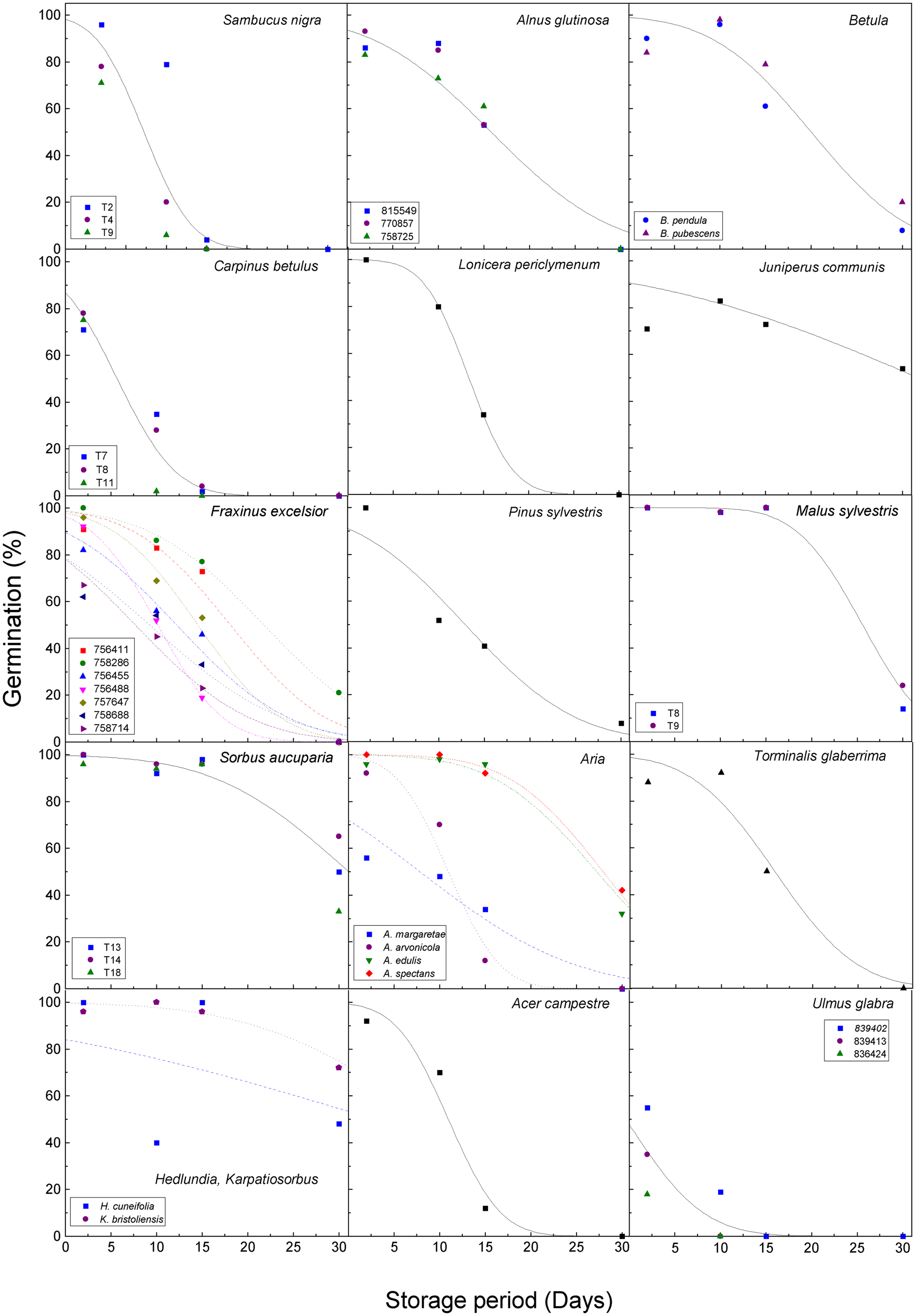
Survival curves were fitted (where data allowed), for 20 of the 22 species (Table 1 and Fig. 1). Based on p 50 estimates, one species (F. sylvatica) was ranked as very short-lived, four species (U. glabra, Euonymus europaeus, C. betulus and A. margaretae) as short-lived and 17 species as medium longevity (Table 1). No collections were ranked above medium longevity. Calculated initial viability (K i) was above 1.04 NED (85% germination) for 30 samples studied. Low initial viability was indicated in eight tree samples from six species (including F. sylvatica, U. glabra (x3), A. margaretae and F. excelsior (x2)). These are considered to have undergone ageing before sampling day 2. The slope (σ) ranged from less than −0.19, for S. nigra, C. betula and Acer campestre, to greater than −0.06, for Karpatiosorbus bristoliensis and J. communis.
Survival curves fitted by probit analysis for seed lots (aged at 45°C and 60% RH). Common slopes are presented (as single lines) where possible (Table 2). Symbols represent individual trees (T), collections or species. For details on collection locations for A. glutinosa, F. excelsior and U. glabra, see collection numbers in Supplementary Table 1.

Samples from three species, F. sylvatica, U. glabra (two collections) and E. europaeus, had only two points available for model fitting, with zero germination recorded at the second sampling point. An increase in germination between the 2- and 10-day samples was observed for six samples, and consequently, the 2-day sample was excluded for Betula pubescens and J. communis, which showed the largest increase in germination (>10%). Considering the limited degrees of freedom, data were not excluded for Torminalis glaberrima & Aria edulis, A. glutinosa and Betula pendula, where the increase was relatively minor and the difference in p 50 estimates would be small (<1 day). The calculated p 50 for Hedlundia cuneifolia may also be slightly underestimated, due to the increase in germination between the 10- and 15-day samples. Despite this, the calculated p 50 remains one of the highest in the study, though the standard error is very high (34.0 ± 30.8 days).
Slope comparisons and F-tests
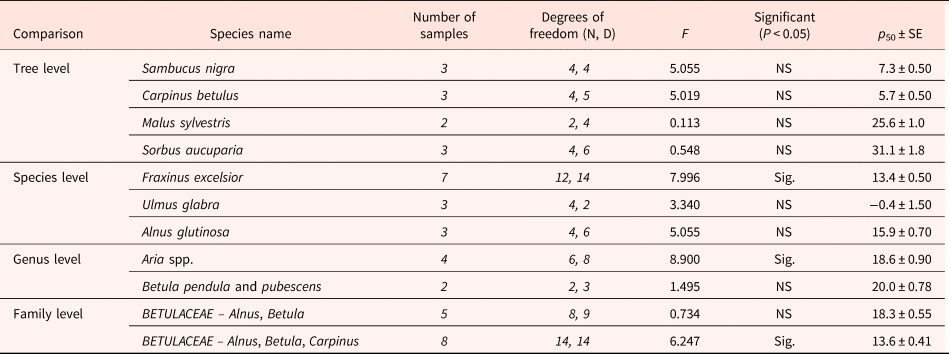
Individual tree samples within collections were investigated for 11 samples from four species. No significant difference in residual deviance was found at a tree level, allowing common slopes to be fitted for all collections investigated (Table 2 and Fig. 1). Estimates of p 50 differed by 1 and 2 days for M. sylvestris (two trees) and C. betulus (three trees) and to 7 and 8 days for S. nigra (three trees) and S. aucuparia (three trees), respectively.
Comparison of fitted slopes

An approximate F-test (F-values shown) was used to test for a significant (Sig.) increase (p < 0.05) in residual deviance when survival curves were constrained to a common slope at a tree, species, genus or family level. Common slopes are presented (as single lines) where not significant (NS), as shown in Fig. 1.
Common slopes were determined for multiple collections of two species, U. glabra (three collections) and A. glutinosa (three collections) (Table 2 and Fig. 1) but could not be determined for F. excelsior (seven collections), which differed in p 50 by 14 days (F 12,14 = 7.996) (Table 2 and Fig. 1). F. excelsior slopes remained significantly different when K i's below 85% (1.04 NED) were excluded (four collections) (F 6,8 = 8.9).
At a genus level, slopes of four species of Aria were found to differ significantly, with a range in p 50 of ~20 days. p 50 ranged from 8 to 11 days for A. margaretae and Aria arvonicola and to 28 days for A. edulis and Aria spectans (F 6,8 = 8.9) (Table 2 and Fig. 1). Both species of Betula could be constrained to a common slope and are plotted as a single line in Fig. 1.
Within Betulaceae, Alnus and Betula samples could be constrained to a common slope, with a combined p 50 of 20 days. However, Carpinus could not, with a significantly shorter p 50 of 6 days (F 14,14 = 6.247) (Table 2 and Fig. 1). Rosaceae was not compared at a family level as collections varied significantly at a genus level.
Geographical location and seed characteristics
No significant correlation was found between F. excelsior longevity and geographical location of seed collections (see Supplementary Table S1 for locations) using a simple linear regression (F 1,5 = 1.988, P = 0.2176 by latitude; P = 0.9371 by longitude), though a trend towards lower p 50 estimates as the latitudinal gradient increased was observed (R 2 = 0.2845 by latitude).
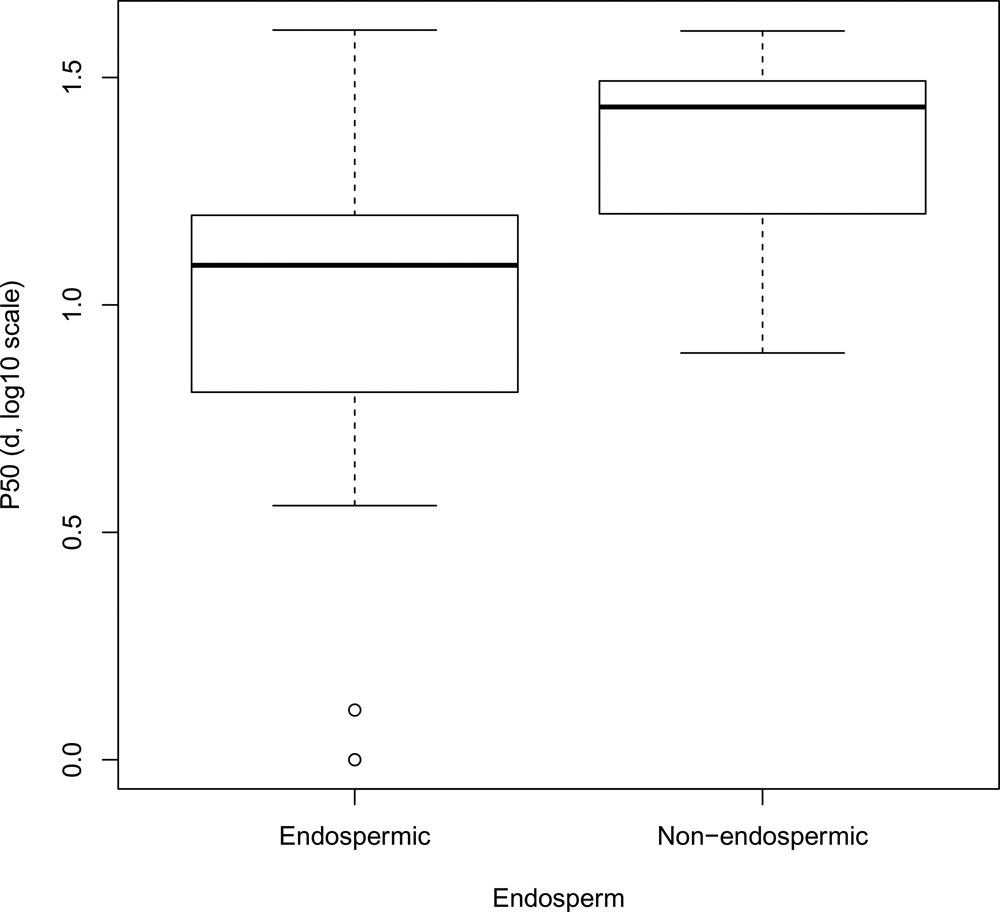
A simple linear regression showed seed mass (1000 seed weight) did not correlate with longevity (F 1,30 = 2.2712, P = 0.1423, log10), though F. sylvatica, which had the smallest p 50 estimate (<2 days) also had the largest 1000 seed weight of 287 g. A two sample T-test showed that endospermic seeds were significantly shorter-lived than non-endospermic seeds (t 30 = −2.5332, P = 0.0168) (Fig. 2, log10 scale).
Box plots comparing p 50 for endospermic and non-endospermic seeds.

Conventional storage data
Germination performance of older collections held in long-term storage of the same species (or genus for Aria) as those in the study is presented for 16 species of UK native trees (Table 3). S. nigra, A. campestre, H. cuneifolia and K. bristoliensis are not represented due to insufficient data or collections of suitable age. Retests were conducted approximately every 10 years with limited test sizes (9–55 seeds) and a maximum of four test intervals. Initial germination was at least 85% for all but J. communis, Fagus sylvatica and Pinus sylvestris, with 62, 80 and 60%, respectively. Significant germination decline was detected (by Z-test) for three species: B. pubescens, F. sylvatica and U. glabra. Fagus sylvatica has a calculated p 50 of 13 years under conventional storage conditions. Reliable estimates of p 50 cannot yet be calculated for the remaining species due to insufficient decline in the collections to date.
Details of collections held in long-term storage of the same species (or genus for Aria sp.) as experimental collections in the study

Species are ordered alphabetically by family and species, as shown in Table 1 and Fig. 1. Initial germination percentage (%) represents the highest result for each collection. Age (in years) is calculated from the date of storage to the date of the last test. Significant germination decline is indicated by Z > 1.64 (P < 0.05).
a Data not suitable for Z-test (n < 20 sown in initial test).
Discussion
In this study, we carried out accelerated ageing experiments and fitted survival curves (where possible) for 22 species of UK native trees and shrubs representing 18 genera and 11 families (Table 1 and Fig. 1). Estimates of p 50 showed that of all species studied, one could be classified as very short-lived, four as short-lived and 17 as medium, with none exceeding the medium category. This range in p 50 is comparable to that found by Mondoni et al. (Reference Mondoni, Probert, Rossi, Vegini and Hay2011) for alpine species (4.7–37.5 days), suggesting that the UK woody species studied also have seeds of short to medium longevity in air-dry storage. Interestingly, it is generally predicted that species from cool wet environments will be more likely to have short-lived seeds (Probert et al., Reference Probert, Daws and Hay2009), to which our results add support. For those species with the shortest longevity predictions, such as F. sylvatica and U. glabra, we recommend retest intervals at least every 5 years and recollection where necessary as well as further research into alternative storage methods such as cryo-storage. Successful cryo-storage has already been reported for seeds of a number of temperate tree species, including A. glutinosa (Chmielarz, Reference Chmielarz2010a), C. betulus (Chmielarz, Reference Chmielarz2010b), B. pendula (Chmielarz, Reference Chmielarz2010c), U. glabra (Chmielarz, Reference Chmielarz2010d), F. excelsior (Chmielarz, Reference Chmielarz2009), M. sylvestris (Michalak et al., Reference Michalak, Plitta-Michalak and Chmielarz2015) and seeds and embryonic axes of F. sylvatica (Chmielarz, Reference Chmielarz2007; Nuc et al., Reference Nuc, Marszalek and Pukacki2016).
A known restriction of the reduced seed number longevity protocol is having too few data points for probit analysis or reduced accuracy due to fewer sampling points (Davies et al, Reference Davies, Newton, Hay and Probert2016). This was the case for samples from three species (F. sylvatica, U. glabra and E. europaeus) where rapid viability decline resulted in only two data points. Although such examples will lead to an increase in standard errors and a reduction in accuracy of the fitted survival curve, comparative ranking into approximate longevity categories and appropriate management decisions could be implemented. Caution is advised however when comparing species data based on relatively few samples, such as for S. nigra.
Across previous studies, multiple factors have been shown to influence, or correlate with, estimated longevity of seeds, with the potential to be used as predictors of longevity in storage. These include seed mass, endosperm presence/absence, maternal environment, habitat type, dormancy mechanisms and seed oil content (Martin, Reference Martin1946; Hong et al., Reference Hong, Linington and Ellis1998; Walters et al., Reference Walters, Walters, Wheeler and Grotenhuis2005; Probert et al., Reference Probert, Daws and Hay2009; Kochanek et al., Reference Kochanek, Buckley, Probert, Adkins and Steadman2010; Long et al., Reference Long, Gorecki, Renton, Scott, Colville, Goggin, Commander, Westcott, Cherry and Finch-Savage2015). In this study, we found no evidence of a correlation between longevity and seed mass; however, we did find that those species which had no (or very thin) endosperm generally had a higher p 50 estimate (i.e. greater potential longevity) (Fig. 2). Both Merritt et al. (Reference Merritt, Martyn, Ainsley, Young, Seed, Thorpe, Hay, Commander, Shackelford, Offord, Dixon and Probert2014) and Probert et al. (Reference Probert, Daws and Hay2009) found similar patterns across the Australian and global species sets studied, respectively, although Mondoni et al. (Reference Mondoni, Probert, Rossi, Vegini and Hay2011) found no relationship between endosperm presence and estimated longevity in Italian alpine species. The exact physiological reason for this relationship is uncertain, and it has been suggested that it may link with embryo size rather than endosperm presence/absence per se (Probert et al., Reference Probert, Daws and Hay2009). It should also be noted that within this study, those species with no endosperm are predominantly Rosaceae species, specifically those which were formerly within Sorbus (Sennikov and Kurtto, Reference Sennikov and Kurtto2017), so it does not represent a taxonomically diverse sub-sample.
In this study, we found no evidence for variation in longevity estimates between individual trees from the same populations for the four species studied (Table 2). Previous studies have found that factors such as different maternal environments (Kochanek et al., Reference Kochanek, Buckley, Probert, Adkins and Steadman2010), seed maturity and post-harvest handling can influence longevity (Hay and Probert, Reference Hay and Probert1995; Hay et al., Reference Hay, Klin and Probert2006; Ali et al., Reference Ali, Probert, Hay, Davies and Stuppy2007; Kalemba et al., Reference Kalemba, Janowiak and Pukacka2009) and so could cause differences between individuals within a population. These impacts were likely minimized for collections in this study, as seed collections for individuals within each population were made on the same day and processed in the same manner. In addition, geolocation data for the maternal trees sampled within each population indicated that the maximum linear distance between any two individuals from the same population was 465 m (183 m average) which is well within both insect (e.g. Oddou-Muratorio et al., Reference Oddou-Muratorio, Klein and Austerlitz2005) and wind pollination distances (Robledo-Arnuncio and Gill, Reference Robledo-Arnuncio and Gill2005) and likely within the same patch of woodland subject to the same environmental variations. Moreover, evidence from genetic studies into UK woody species has generally found little genetic variation within populations (e.g. Logan et al., Reference Logan, Phuekvilai and Wolff2015; Gargiulo et al., Reference Gargiulo, Saubin, Rizzuto, West, Fay, Kallow and Trivedi2019) which could be a factor. However, the sample sizes tested per population here are small (2–3).
At the population level, differences in estimated longevity were not found for U. glabra or A. glutinosa but were found between the seven F. excelsior populations tested (Table 2), with collections in both short and medium longevity categories. Previous accelerated ageing studies have also found evidence of variation between populations in expected seed longevities, for example, Mondoni et al. (Reference Mondoni, Probert, Rossi, Vegini and Hay2011) reported significant differences in estimated longevity between different populations of the same species collected from different altitude zones. However, the geographical factors investigated here could not explain the differences in predicted longevity between Fraxinus populations nor could excluding those collections with low initial viability. Despite this, there was a general trend for a reduction in p 50 as the latitude of collection increased over the 5.6 degrees of latitude studied. The variation observed could also be due to different maternal environments or environmental influences beyond those investigated here. For example, embryo maturity at the point of collection may also influence storage potential of F. excelsior seeds (see Chmielarz, Reference Chmielarz2009) particularly given that the seeds are classified as having morphophysiological dormancy (Wager, Reference Wager1996). Moreover, genetic evidence suggests that although generally there is little differentiation in neutral genetic diversity among British F. excelsior populations, there are unique haplotypes in Scotland and a gradient of allelic diversity from western Scotland to eastern England (Sutherland et al., Reference Sutherland, Belaj, Nier, Cottrell, Vaughan, Hubert and Russell2010); thus, genetic variation could have an influence. It is possible that similarities in estimated longevity between the U. glabra and A. glutinosa populations were due to limited geographic spread. For example, the three U. glabra populations spanned only 2.4 degrees (decimal) of latitude across southern England into the Midlands where conditions are relatively similar. Thus, it is possible that if populations of U. glabra and A. glutinosa from further north and west were to be tested then differences in longevity may be evident.
From a taxonomic perspective, within this study, we found variation between genera in species estimated longevity patterns. For example, both species of Betula (B. pendula and B. pubescens) had similar p 50 estimates and could be fitted to a common slope, whereas the four species within the genus Aria could not, placing them into different estimated longevity categories (Tables 1 and 2). Aria along with Karpatiosorbus and Hedlundia were all formally subgenera within Sorbus, which have recently been raised to the genus rank (Sennikov and Kurtto, Reference Sennikov and Kurtto2017). The whole group are interesting taxonomically in that speciation is believed to be currently ongoing, driven by apomixis as well as hybridization (Hamston et al., Reference Hamston, de Vere, King, Pellicer, Fay, Cresswell and Stevens2018). The three ancestral species, S. aucuparia, A. edulis and T. glaberrima all ranked within the medium longevity category but varied in estimated p 50 from 15.9 to 35.3. The taxonomic relationships between the other species tested are unclear (Hamston et al., Reference Hamston, de Vere, King, Pellicer, Fay, Cresswell and Stevens2018), so at this time, it is not possible to speculate as to taxonomic based trends in p 50 within this complex.
In order to validate some initial conclusions from this study, longevity predictions were compared to the actual performance of collections held in storage, of which all except E. europaeus were banked under conventional storage conditions prior to 2000 (Table 3). Storage data show that many of the species studied can survive without significant viability decline for at least 20 years (Table 3). Collections showing decline after 20 years of storage include F. sylvatica and U. glabra which were also the two shortest-lived species as predicted by accelerated ageing tests in this study. U. glabra, which has declined from 100 to 72% after 20 years of conventional storage, is reported as short-lived (Hong et al., Reference Hong, Linington and Ellis1998). Seeds of F. sylvatica are known to have low storage potential, which is correlated with an increase in the presence of reactive oxygen species and lipid hydroxyperoxides, indicative of damage to the membranes within the seeds (Pukacka et al., Reference Pukacka, Hoffmann, Goslar, Pukacki and Wójkiewicz2003; Pukacka and Ratajczak, Reference Pukacka and Ratajczak2007). Seed maturity, locality and post-harvest handling are likely key factors for maximizing potential longevity for this species (Chmielarz, Reference Chmielarz2007; Kalemba et al., Reference Kalemba, Janowiak and Pukacka2009).
Two species of Betula (B. pendula and B. pubescens) were ranked as medium longevity in the accelerated ageing study (Table 1), while under conventional conditions only B. pubescens is showing decline (from 93 to 80% germination after 24 years), with B. pendula remaining high in viability (92% germination) after nearly 28 years (Table 3). Within the literature, Betula (and Alnus) species are considered short-lived (Hong et al., Reference Hong, Linington and Ellis1998), although conventional storage data from Canadian tree seeds, including Betula species show good survival for up to 40 years (Simpson et al., Reference Simpson, Wang and Daigle2004). Other species ranked as short-lived in this ageing study, including E. europaeus and C. betulus, are currently retaining high viability after 8.5 and 27.2 years in conventional storage, respectively. Additional monitoring is advisable for E. europaeus and C. betulus, which are ranked as short-lived under accelerated ageing conditions. A recent review by Colville and Pritchard (Reference Colville and Pritchard2019) found that for five species which had had both artificial ageing experiments and testing in cold storage, there was no difference in the comparative ranking of life span. However, evidence from Nagel et al. (Reference Nagel, Seal, Colville, Rodenstein, Un, Richter, Pritchard, Börner and Kranner2019) studying wheat genotypes suggests the mechanisms of seed ageing differ under conventional and accelerated ageing situations. Our results, although limited by the potential variation between collections, suggest that accelerated ageing can be a useful method, along with other seed traits, to identify species whose seeds are likely to be relatively short-lived in storage.
Given these findings, while ex situ seed collections form an important resource for conservation and scientific research, particularly given the plant health threats currently facing our woody flora, it does highlight the need to focus on multiple complementary conservation initiatives. For the UK woody flora, this should include other ex situ methods such as living collections and clone banks, alongside in situ methods such as gene conservation units, as recently highlighted in the Strategy for UK Forest Genetic Resources (Trivedi et al., Reference Trivedi, Cavers, Atkinson, Clark and Cottrell2019). This paper also supports the value of accelerated ageing tests for aiding decisions in appropriate monitoring and handling of seed collections in long-term ex situ collections. Increased efforts to understand the mechanisms behind seed ageing will also help to optimize storage procedures for all species (Walters et al., Reference Walters, Ballesteros and Vertucci2010; Ballesteros and Walters, Reference Ballesteros and Walters2011). It is important that current knowledge and assumptions are continuously tested, and data are made available to others.
Supplementary material
To view supplementary material for this article, please visit: https://doi.org/10.1017/S0960258520000215.
Acknowledgements
We thank Udayangani Liu for statistical advice, Rose Newton for helpful discussions and Kirstine Manger for comments on the paper. We acknowledge the work of the UKNTSP partner organizations in collecting the seed for the UKNTSP. This study was undertaken as part of the UKNTSP, funded by players of People's Postcode Lottery, Steele Foundation, John Coates Foundation and others. The Royal Botanic Gardens, Kew, is partly funded by a grant-in-aid from the UK Department of Environment, Food and Rural Affairs.