Introduction
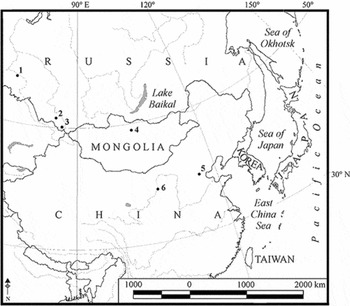
The origin and spread of Initial Upper Palaeolithic (IUP) complexes in East and Central Asia seems, in light of new discoveries, including Palaeolithic human DNA results from China and Siberia (Denisova Cave, Ust'-Ishim, and Tianyuan Cave; e.g. Krause et al. Reference Krause, Orlando, Serre, Viola, Prüfer, Richards, Hublin, Hänni, Derevianko and Pääbo2007; Reich et al. Reference Reich, Green, Kircher, Krause, Patterson, Durand, Viola, Briggs, Stenzel, Johnson, Maricic, Good, Marques-Bonet, Alkan, Fu, Mallick, Li, Meyer, Eichler, Stoneking, Richards, Talamo, Shunkov, Derevianko, Hublin, Kelso, Slatkin and Pääbo2010; Fu et al. Reference Fu, Meyer, Gao, Stenzel, Burbano, Kelso and Pääbo2013, Reference Fu, Li, Moorjani, Jay, Slepchenko, Bondarev, Johnson, Petri, Prüfer, de Filippo, Meyer, Zwyns, Salazar-Garcia, Kuzmin, Keates, Kosintsev, Razhev, Richards, Peristov, Lachmann, Douka, Higham, Slatkin, Hublin, Reich, Kelso, Viola and Pääbo2014; see position of sites in Figure 1), of great significance for understanding human migrations and contacts during the IUP in Eurasia. The IUP has become synonymous with Levallois or Levallois-like blade production, with a highly variable technology and a geographic spread from the Near East to north-west China (e.g. Kuhn & Zwyns Reference Kuhn and Zwyns2014). A link between the spread of IUP technology and early modern humans in north-east and East Asia has yet to be demonstrated however (for more discussion, see Kuhn & Zwyns Reference Kuhn and Zwyns2014).
Location of sites mentioned in the text: 1) Ust'-Ishim (Fu et al. 2014); 2) Denisova Cave and Ust-Karakol 1 (e.g. Kuhn & Zwyns 2014; Rybin 2014); 3) Kara-Bom (e.g. Kuhn & Zwyns 2014; Rybin 2014); 4) Tolbor 4 and 15 (Derevianko et al. 2007); 5) Tianyuan Cave (Fu et al. 2013); 6) Shuidonggou 1 and 2 (Li et al. 2013a); South Temple Canyon (Madsen et al. 2014).

The dates for the Mongolian and Chinese IUP are later than those for the Siberian IUP at the Kara-Bom and Ust-Karakol 1 sites (Figure 1). Similar to the earlier, c. 45 000-year-old European IUP, features of Middle Palaeolithic and Upper Palaeolithic are incorporated in the Mongolian and Chinese sites (e.g. Brantingham et al. Reference Brantingham, Krivoshapkin, Li and Tserendagva2001). In north-east Asia, assemblages assigned to the IUP are limited to a few sites, and these are characterised by a higher frequency of blades, retouched blade tools and other such ‘index fossils’ than in the Middle Palaeolithic. In northern China, the Shuidonggou site complex (SDG) (see Figure 1), specifically the SDG 1 locality in the Ordos Desert (Ningxia Hui Autonomous Region), contains some of the most significant IUP assemblages (e.g. Brantingham et al. Reference Brantingham, Krivoshapkin, Li and Tserendagva2001; Li et al. Reference Li, Gao, Chen, Pei, Zhang, Zhang, Liu, Zhang, Guan, Wang and Kuhn2013a). SDG 1 preserves the oldest evidence of large blade technology in China at c. 41 000 cal BP (Li et al. Reference Li, Gao, Chen, Pei, Zhang, Zhang, Liu, Zhang, Guan, Wang and Kuhn2013a). At the nearby SDG 2 locality, evidence of blade technology is dated to c. 32 600–41 500 cal BP (e.g. Li et al. Reference Li, Gao, Chen, Pei, Zhang, Zhang, Liu, Zhang, Guan, Wang and Kuhn2013a & Reference Li, Kuhn, Gao and Chenb). The main focus of this discussion is two recent papers by Li et al. (Reference Li, Gao, Chen, Pei, Zhang, Zhang, Liu, Zhang, Guan, Wang and Kuhn2013a & Reference Li, Kuhn, Gao and Chenb) regarding the newly proposed SDG 1 and SDG 2 chronology and cultural affiliations.
The original 14C ages are calibrated (with ± 2 sigmas and rounded to the next 100 years) using the IntCal13 dataset (Reimer et al. Reference Reimer, Bard, Bayliss, Beck, Blackwell, Bronk Ramsey, Buck, Cheng, Edwards, Friedrich, Grootes, Guilderson, Haflidason, Hajdas, Hatté, Heaton, Hoffmann, Hogg, Hughen, Kaiser, Kromer, Manning, Niu, Reimer, Richards, Scott, Southon, Staff, Turney and van der Plicht2013), in order to be compared with optically stimulated luminescent (OSL) dates.
Archaeological context
At SDG 1 a sub-prismatic blade core and three narrow-faced blade cores, or what may be termed ‘index fossils’ of the IUP (e.g. Vishnyatsky Reference Vishnyatsky2004; Rybin Reference Rybin2014), were found in cultural layers 6–8 (CL6–CL8) (e.g. Brantingham et al. Reference Brantingham, Krivoshapkin, Li and Tserendagva2001). At SDG 2, Unit 2, a Levallois-like flat-faced blade core was identified in CL5a, and an edge-facetted blade core in CL7 (Li et al. Reference Li, Gao, Chen, Pei, Zhang, Zhang, Liu, Zhang, Guan, Wang and Kuhn2013a: 377, fig. 5:1). The CL7 core can be called a ‘narrow-faced core’ (E.P. Rybin, pers. comm. Reference Rybin2014) and may be compared to a similar core from SDG 1, although Brantingham et al. (Reference Brantingham, Krivoshapkin, Li and Tserendagva2001: 741, fig. 5:a) refer to it as a ‘flat-faced (‘Levallois’) core’.
No other artefacts were found in CL5a and CL7, and no other ‘large blade cores’ were recorded at SDG 2 (Li et al. Reference Li, Gao, Chen, Pei, Zhang, Zhang, Liu, Zhang, Guan, Wang and Kuhn2013a: 376). Li et al. (Reference Li, Gao, Chen, Pei, Zhang, Zhang, Liu, Zhang, Guan, Wang and Kuhn2013a: 374) state that “[b]lade and blade-like flakes as blanks for tools are extremely rare” at SDG 2 (none are listed in their tab. 2 or illustrated, see Li et al. Reference Li, Gao, Chen, Pei, Zhang, Zhang, Liu, Zhang, Guan, Wang and Kuhn2013a: 376). In addition, according to Li et al. (Reference Li, Kuhn, Gao and Chen2013b: 166) large blades were not identified in CL1–CL4, and there is “no evidence of blade production” in CL1–4, CL5b and CL6. Pei et al. (Reference Pei, Gao, Wang, Kuman, Bae, Chen, Guan, Zhang, Zhang, Peng and Li2012: 3617, tab. 5, 3623) refer to 28 blades from SDG 2, and to “a blade component [. . .] of whole flakes [12%] at SDG2” from layers L4, L6, L8 and L10 equivalent to CL1−CL4 of Li et al. (Reference Li, Kuhn, Gao and Chen2013b). No illustrations of these specimens are included. It therefore appears that the ‘macroblade technology’ (Li et al. Reference Li, Gao, Chen, Pei, Zhang, Zhang, Liu, Zhang, Guan, Wang and Kuhn2013a: 381) is based mainly or only on the two cores.
In terms of other lithic specimens diagnostic of the IUP, end scrapers, carinated scrapers and burins at SDG 1 occur in higher frequencies compared to SDG 2, and carinated scrapers were not found at the latter locality (for examples of end scrapers at SDG 2, see Gao et al. Reference Gao, Wang, Pei and Chen2013, pl. 13:8, pl. 14:5–8 and pl. 15:6–7). While a layer origin is not given by these authors, Li et al. (Reference Li, Kuhn, Olsen, Chen and Gao2014: 45) state that a few “Upper Paleolithic tool types” on flakes are found in layer 2 of SDG 2. Data presented in Li et al. (Reference Li, Kuhn, Olsen, Chen and Gao2014) on SDG 1 and SDG 2 in terms of the numbers of end scrapers, carinated scrapers and burins are different from those presented by Li et al. (Reference Li, Gao, Chen, Pei, Zhang, Zhang, Liu, Zhang, Guan, Wang and Kuhn2013a) even though Li et al.'s (Reference Li, Kuhn, Olsen, Chen and Gao2014) frequencies are based on the same excavation report (Gao et al. Reference Gao, Wang, Pei and Chen2013). Retouched blades were not identified at SDG 2 (Pei et al. Reference Pei, Gao, Wang, Kuman, Bae, Chen, Guan, Zhang, Zhang, Peng and Li2012), and most of the artefacts found in CL6, CL5b and CL4–1 are non-prepared cores and informal flake tools of the so-called small-flake tool tradition of northern China (e.g. Li et al. Reference Li, Gao, Chen, Pei, Zhang, Zhang, Liu, Zhang, Guan, Wang and Kuhn2013a). Illustrations published by Gao et al. (Reference Gao, Yuan, Pei, Wang, Chen and Feng2008: 2026, fig. 1) of a range of ‘stone artefacts’ from SDG 1 and SDG 2 provide an indication of the differences between the assemblages from these localities. For instance, while at SDG 2 only two blade cores and a few IUP tools were identified, a number of large blades are shown for SDG 1. For a more realistic assessment of the differences and similarities between these localities, a greater number of better illustrations of artefacts is needed with the layer origin clearly indicated.
A Levallois component is present in the IUP at SDG 1 (80 flat-faced Levallois blade cores were recorded; see Brantingham et al. Reference Brantingham, Krivoshapkin, Li and Tserendagva2001). In neighbouring Mongolia the IUP with blades is dated to c. 41 000 cal BP at the Tolbor 4 site and to c. 38 900 cal BP at Tolbor 15 (Gladyshev et al. Reference Gladyshev, Tsibankov and Kandyba2010, Reference Gladyshev, Olsen, Tabarev and Jull2012; see Figure 1). Sub-prismatic cores are especially frequent at Tolbor 4 (n. 116) and Tolbor 15 (n. 28) (e.g. Derevianko et al. Reference Derevianko, Zenin, Rybin, Gladyshev, Tsibankov, Olsen, Tsevendorj and Gunchinsuren2007; Gladyshev et al. Reference Gladyshev, Tsibankov and Kandyba2010, Reference Gladyshev, Olsen, Tabarev and Jull2012).
Chronological framework
Li et al. (Reference Li, Gao, Chen, Pei, Zhang, Zhang, Liu, Zhang, Guan, Wang and Kuhn2013a & Reference Li, Kuhn, Gao and Chenb) have concluded that the assemblage with characteristic large blades at the SDG cluster is dated to c. 41 500 cal BP. At SDG 1 its age can now be determined as c. 40 400–41 300 cal BP (see also Morgan et al. Reference Morgan, Barton, Yi, Bettinger, Gao and Peng2014); and at SDG 2 as c. 32 600–41 500 cal BP (Li et al. Reference Li, Gao, Chen, Pei, Zhang, Zhang, Liu, Zhang, Guan, Wang and Kuhn2013a: 373), and thus older than the previous ages of c. 27 600–34 100 cal BP (e.g. Madsen et al. Reference Madsen, Li, Brantingham, Gao, Elston and Bettinger2001).
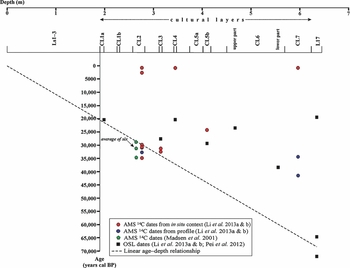
Unfortunately, the publications by F. Li and co-authors (Li et al. Reference Li, Gao, Chen, Pei, Zhang, Zhang, Liu, Zhang, Guan, Wang and Kuhn2013a: 371–72, tab. 1; Li et al. Reference Li, Kuhn, Gao and Chen2013b: 165, tab. 2; see also Nian et al. Reference Nian, Gao and Zhou2014; Peng et al. Reference Peng, Wang and Gao2014) appear to have persistent problems with the dating results, causing a significant number of discrepancies in the age-depth profile for the 14C and OSL dates (Figure 2). For example, at SDG 2 the 14C dates from CL2 vary from c. 985–2520 BP (the context is in situ for both values) to c. 30 360 BP. At CL4 the 14C and OSL values are completely discordant (c. 880 cal BP vs c. 20 500 years ago, respectively; with an in situ context for the former value). At CL7 the 14C value of c. 900 cal BP (from in situ context) is at odds with the two other 14C ages from the site's profile, c. 34 300–41 500 cal BP (Li et al. Reference Li, Gao, Chen, Pei, Zhang, Zhang, Liu, Zhang, Guan, Wang and Kuhn2013a & Reference Li, Kuhn, Gao and Chenb; see Figure 2). There are also some inconsistencies in terms of the context for the 14C dates at SDG 2: while the values Bata[sic]-207935, BA07940 and BA07943 are indicated as from the ‘Profile’ in Li et al. (Reference Li, Gao, Chen, Pei, Zhang, Zhang, Liu, Zhang, Guan, Wang and Kuhn2013a: 371–72), they are specified as from ‘in situ’ in Li et al. (Reference Li, Kuhn, Gao and Chen2013b: 165).
Calibrated 14C ages and OSL ages for the SDG 2 locality (after Madsen et al. Reference Madsen, Li, Brantingham, Gao, Elston and Bettinger2001; Pei et al. Reference Pei, Gao, Wang, Kuman, Bae, Chen, Guan, Zhang, Zhang, Peng and Li2012; Li et al. Reference Li, Gao, Chen, Pei, Zhang, Zhang, Liu, Zhang, Guan, Wang and Kuhn2013a & Reference Li, Kuhn, Gao and Chenb).

Considering the OSL ages only, they are in conflict with the age-depth relationship (Figure 2). This is especially clear for Unit L17 (below CL7), for which three ages were obtained: c. 19 600 years ago, c. 64 600 years ago and c. 72 000 years ago (Pei et al. Reference Pei, Gao, Wang, Kuman, Bae, Chen, Guan, Zhang, Zhang, Peng and Li2012: 3612, tab. 1). Further, there is a large difference (more than 10 000 years) between the OSL values from the lower and upper parts of CL6 (Li et al. Reference Li, Gao, Chen, Pei, Zhang, Zhang, Liu, Zhang, Guan, Wang and Kuhn2013a: 372; see also Figure 2).
Li et al. (Reference Li, Kuhn, Gao and Chen2013b: 165) comment on the age difference for the OSL and 14C values from CL4 as follows: “These two dates are considered to be erroneous because they are so much younger than the age above this layer.” The explanation for the discrepancy of the 14C dates for CL7 is: “The deposit at locality 2 is a coherent, well-ordered sequence, and there is little evidence of significant redeposition [. . .] In view of this, it is reasonable that dates that are significantly younger than the age of layers above can be abandoned.” (Li et al. Reference Li, Kuhn, Gao and Chen2013b: 165).
In our opinion, this situation cannot be resolved as easily as Li et al. (Reference Li, Kuhn, Gao and Chen2013b) suggest, by simply considering outliers as ‘erroneous’ ages that can be ‘abandoned.’ In fact, the ages for SDG 2 are distributed in a helter-skelter pattern (see Figure 2), and the suggestion that “dates from SDG2 are highly coherent” (Li et al. Reference Li, Kuhn, Gao and Chen2013b: 165) is misleading. Therefore, the chronological model for SDG 2, as presented by Li et al. (Reference Li, Gao, Chen, Pei, Zhang, Zhang, Liu, Zhang, Guan, Wang and Kuhn2013a & Reference Li, Kuhn, Gao and Chenb), appears to be both inconsistent and unreliable. This is why we cannot accept the ages of CL3–CL7 as proposed by Li et al. (Reference Li, Gao, Chen, Pei, Zhang, Zhang, Liu, Zhang, Guan, Wang and Kuhn2013a & Reference Li, Kuhn, Gao and Chenb). It seems that the previous 14C values of the IUP from SDG 2 at c. 27 600–34 100 cal BP (e.g. Brantingham et al. Reference Brantingham, Krivoshapkin, Li and Tserendagva2001, Reference Brantingham, Gao, Madsen, Bettinger, Elston, Brantingham, Kuhn and Kerry2004; Madsen et al. Reference Madsen, Li, Brantingham, Gao, Elston and Bettinger2001) still stand as the most secure age estimate for this locality because they are consistent with the site's stratigraphy (Figure 2). Other 14C and OSL values from CL 3–7 are widely scattered, and none of them are close enough to the assumed trend between the age and depth (see Figure 2).
At the SDG 1 site the results of OSL dating severely contradict the 14C dates from the same strata (Li et al. Reference Li, Kuhn, Gao and Chen2013b; see also Nian et al. Reference Nian, Gao and Zhou2014). The only age determination of the IUP complex at SGD 1, which can be tentatively accepted, is the 14C date of Stratum 3, c. 36 200 BP (e.g. Li et al. Reference Li, Kuhn, Gao and Chen2013b), corresponding to a calendar age of c. 40 900 cal BP; confirmation of this age is, however, still needed (e.g. Peng et al. Reference Peng, Wang and Gao2014).
As for the age of c. 44 500 cal BP for the carbonate crust on a flake from the South Temple Canyon 1 site located c. 70km north-west of the SDG cluster (see Figure 2), and where a Levallois blade core and fragment were also found (Madsen et al. Reference Madsen, Oviatt, Zhu, Brantingham, Elston, Chen, Bettinger and Rhode2014), it is, in our opinion, too early to say anything definite because this and the other artefacts are surface finds. Controlled excavation and collection of samples from in situ contexts are necessary to understand the archaeology and chronology of this site.
Conclusion
The implication of the above-mentioned comments is that the conclusions on the age of blade technology at the SDG 2 locality, reached by Li et al. (Reference Li, Gao, Chen, Pei, Zhang, Zhang, Liu, Zhang, Guan, Wang and Kuhn2013a: 373, Reference Li, Kuhn, Gao and Chen2013b: 167), have no grounds to be accepted. By rejecting outright the dating results that do not correspond to the rest of the 14C and OSL values, Li et al. (Reference Li, Gao, Chen, Pei, Zhang, Zhang, Liu, Zhang, Guan, Wang and Kuhn2013a & Reference Li, Kuhn, Gao and Chenb) are discrediting dates that do not ‘fit’ a perceived clear chronological succession, and they are thereby avoiding in-depth analysis of the issue that is crucial for building a coherent chronology of SDG 2. It therefore appears that blade technology at SDG 2 is not as early as proposed by Li et al. (Reference Li, Gao, Chen, Pei, Zhang, Zhang, Liu, Zhang, Guan, Wang and Kuhn2013a & Reference Li, Kuhn, Gao and Chenb). As a result, the archaeological implications of dating the SDG 2 locality for China and greater north-east Asia, as presented by Li et al. (Reference Li, Gao, Chen, Pei, Zhang, Zhang, Liu, Zhang, Guan, Wang and Kuhn2013a & Reference Li, Kuhn, Gao and Chenb), are not convincing. The conclusion that the “Levallois-like technology [lasted] maximally from roughly 41 to 34 kyr (cal BP)” (Li et al. Reference Li, Kuhn, Olsen, Chen and Gao2014: 46) is not supported by either the chronological or archaeological data from SGD 2, leaving it in limbo before more solid information is obtained. Nevertheless, it is possible to suggest, based on the present evidence, that “Levallois-like blade technology is a short-lived intrusion from the west and/or north” at Shuidonggou and north-west China as a whole (Li et al. Reference Li, Kuhn, Olsen, Chen and Gao2014: 51); its replacement by flake technology at SDG 2 may indicate that it was not adaptive.
The current situation with OSL dates at SDG 1 and SDG 2 does not look promising due to the large discrepancies compared with the results of the 14C chronology. This makes all OSL dates from SDG 1 and SDG 2 unreliable, and in our opinion one cannot put any weight on these values.
Despite Madsen et al.'s (Reference Li, Kuhn, Olsen, Chen and Gao2014) opinion concerning the early Upper Palaeolithic age of sites in the Shuidonggou region of c. 41 000 BP (c. 44 500 cal BP), we believe that the Tolbor 4 site represents the earliest IUP complex in the region encompassing Mongolia and north China, dated to c. 41 000 cal BP. We agree with Peng et al. (Reference Peng, Wang and Gao2014: 13), that “the solution for establishing the precise relationships of chronology, stratigraphy, and technology at SDG1 LCL can be resolved only with future excavation.” Before the serious problems with dating and stratigraphy of SDG 1 and SDG 2 are satisfactorily addressed and clarified, perhaps by means of a thorough analysis of the archaeological deposits in order to understand the relationship between the stratigraphy, the formation of matrix sediments and the history of archaeological deposition and the dates produced, it is, in our opinion, impossible to ‘re-examine’ (Li et al. Reference Li, Kuhn, Gao and Chen2013b) the existing archaeological and chronological data for the Shuidonggou complex. A reliable chronology is important in order to understand the relationship of SDG 2 to SDG 1 and to other IUP sites in north-east Asia.
Acknowledgements
We are grateful to Drs Evgeny P. Rybin and Sergei A. Gladyshev (Institute of Archaeology and Ethnography, Siberian Branch of the Russian Academy of Sciences, Novosibirsk, Russia) for valuable suggestions and discussion of issues related to the IUP in north-east Asia. We appreciate the comments by Robin Dennell (University of Exeter, UK), Chris Scarre and two anonymous reviewers on the earlier version of this paper. This research was supported by a grant from the Tomsk State University Academician D.I. Mendeleev Fund Programme in 2014–2015 (Laboratory of Mesozoic and Cenozoic Continental Ecosystems).