Those Situations conventionally described as “political crises” generate uncertainty in their protagonists just as fire generates heat. Fundamentally extraordinary, chaotic, and unpredictable, they are often resistant to interpretation. Confronted with such situations, actors feel disconcerted and lose confidence in their judgment regarding what action to take. At the end of May 1958, when forced to take a stance on Charles de Gaulle’s possible return to power, the members of the French National Assembly’s socialist parliamentary group experienced a similar confusion. On May 13, while France was going through its umpteenth ministerial crisis following the fall of the Gaillard government on April 15, a demonstration was held at the Algiers war memorial in honor of three French soldiers who had been taken prisoner and executed by the Front de Libération Nationale (FLN). This demonstration was also aimed at opposing the Assembly’s possible investiture of Pierre Pflimlin as President of the Council, as they believed he was not taking a firm enough position against the FLN. The demonstration turned into an uprising when the general government building was stormed and ransacked. The rioters quickly formed the Comité de Salut Public (CSP); this was composed mainly of far-right activists and army officers, all of whom were hostile to the Fourth Republic.
General Massu, who was thought to be inflexible in his determination to subdue the FLN, quickly agreed to head the CSP. Initially, Massu demanded that Pflimlin be sidelined. Next, he planned to favor General de Gaulle’s investiture, as the latter was supposedly more in tune with the political agenda of the “ultras” who were close to the CSP.Footnote 1 Acting alongside some military commanders, the CSP was bold enough to threaten the Assembly with military intervention in mainland France so as to install a government that was to its liking. In this challenge to the National Assembly, Massu had credibility on his side: the security forces’ loyalty to the government was notoriously shaky, and had been particularly so since May 24, when parachutists on duty for the CSP had succeeded in taking control of Corsica without a fight. In fact, army officers had planned a military operation dubbed Résurrection, the aim of which was to bring de Gaulle to power through the dissidence of several metropolitan regiments and the parachuting of troops from Algiers into Paris. De Gaulle, although not the instigator of this plan, was informed of it; he obtained Massu’s agreement to suspend it after his first negotiations with Pflimlin on the night of May 26–27 [Lagoueyte Reference Lagoueyte2021]. Lacking sufficient support, the government resigned on the 28th.
The next day, to ward off the risk of a coup d’état and civil war, President René Coty called on de Gaulle to become President of the Council. In so doing, he forced the Socialist deputies to commit to a position. For them, however, the situation was particularly ambiguous, as it was subject to contradictory interpretations. Some affirmed that de Gaulle’s candidacy was “legal” and “republican,” and therefore acceptable; others judged it as unacceptable, incompatible with their party’s principles. In other words, they were concerned about “the current state of affairs” [Boltanski Reference Boltanski2009: 90].
Their trouble was that they were dealing with processes that belonged to the theoretical and empirical class of “ambiguous political events.” To define these, we need first to clarify the meaning of the concept of “political order.” This order has a symbolic side (i. e. inscribed in the thoughts of the actors), which consists of routine conceptions, informed by categories of thought, regarding the identity of its protagonists, their roles, and the actions they must perform. The political order also has a material side, namely the actions and behaviors (e.g. bowing) that embody its symbolic dimension. The class of ambiguous political events is defined by four properties, set out in Figure 1: (1) an actor exercises a political role—i. e. a capacity to influence the rules governing society—by acting in a way that contradicts the existing political order; (2) a person or group exercising a legally defined political role must take a stance regarding these actions; (3) for this second actor, the actions of the first one are ambiguous, in the sense that: (a) contradictory meanings, derived from the categories of thought inherent in the existing order, can be applied to them; (b) these meanings appear to be objectively well founded; and (c) these meanings induce contradictory judgments as to the acceptability of the actions in question, as well as contradictory inclinations to act. Footnote 2 As conceptualized here, the ambiguity in question applies to the actors’ experience. While it is rooted in reality, it resides in their interpretations of it. It is not a property of the situation that is external to the subjectivity of group members.
Ambiguous political events

In the case of an ambiguous political event, the very meaning of the possible choices is not self-evident, since a course of action dictated by one interpretation can have entirely different implications under another. In other words, “the line between transgressive and regulated actions” [Ermakoff Reference Ermakoff2008] becomes blurred. That said, the need to make a choice pushes actors out of their state of cognitive uncertainty. In fact, by the end of May 1958, the ambiguity had been reduced, as deputies had begun to choose between the two contradictory readings of de Gaulle’s candidacy.
The class of objects studied here is linked to the Durkheimian concept of collective consciousness, understood as a set of “shared beliefs and feelings” which, because they are invested with the force of the group, generate a “power” capable of “repressing the representations which contradict [them]” and “command[ing] […] [the] acts which realize [them]” [Durkheim (1912) Reference Durkheim2007]. The interprétations (descriptions, evaluations, and inclinations to act) activated by the situation are expressions of the collective consciousness of the group that must position itself. The incompatibility of these interpretations manifests that none are completely adequate to explain the situation. This article sheds light on the cognitive consequences of such inadequacy. It should be added that the concept of collective consciousness in no way excludes the possibility that the group in question is divided. This possibility is consistent with the Durkheimian idea of collective forces that do not take hold of individuals in their entirety, but come into conflict with the individual forces within each of them [Durkheim (1897) Reference Durkheim2009], and therefore possibly also with the collective currents rooted in subgroups.
The relationship between ambiguity and collective uncertainty needs to be clarified. Undoubtedly, the meanings that make up a collective consciousness are those that most often appear to the actors as immediately valid. In other words, since they are not contradicted by reality, their appearance in individual consciousnesses is not accompanied by any uncertainty. The situation is different in the case of an ambiguous political event: the group’s members are collectively uncertain as to whether the meanings present in their minds correspond to the situation. The ambiguity theorized above amounts to the collective experience of this cognitive uncertainty, and is distinct from other forms of uncertainty, which are linked to a lack of information about a present situation or difficulties in anticipating its evolution [Ermakoff Reference Ermakoff, Benzecry, Krause and Reed2017b: 183].
Nor is ambiguity to be confused with “contingency,” understood as a moment of cognitive and behavioral uncertainty for members of a group who are faced with a decision that will have major repercussions for them and/or others (regarding well-being, physical integrity, distribution of power, or advantages in the political order, etc.) [Ermakoff Reference Ermakoff2015: 114–115]. But everyone is uncertain, because they are aware that their decision depends on those of other members and at the same time perceive the uncertainty of those others. As a result, routine beliefs and behaviors come to be questioned. The outcome of these moments is therefore unpredictable: depending on their individual positions, the group’s members may each decide in favor of contradictory actions. Ambiguous political events are included in the category of contingency situations.Footnote 3 Indeed, when a situation is ambiguous, it is also contingent: the actors are unable to take a position because, on the one hand, the situation is ambiguous in their eyes and, on the other, the other members of the group, on whom their interpretations and positions depend, are also uncertain. However, a situation can be contingent without being ambiguous. This was the case, for example, in March 1933, when the German Zentrum deputies were about to vote in favor of giving Hitler full powers. The situation was contingent, but Hitler’s actions (past, present, and future) were not open to contradictory interpretations: his political identity and agenda were clear [Ermakoff Reference Ermakoff2008: 94–99, 106–107, 277–304]. This article separates the class of contingent situations from that of ambiguous political events, because its aim is to identify and theorize a very particular form of uncertainty, i. e. ambiguity, and the cognitive effects of that uncertainty.
The aim of this article is twofold. On the one hand, it seeks to shed light on the process by which ambiguity is gradually reabsorbed and on the conditions that make this process possible. It should be noted from the outset that the reduction of ambiguity is somewhat paradoxical, since it entails the production of misunderstanding, as the actors lose sight of the contradictory nature of reality. On the other hand, this article aims to produce results that can be compared, in a process of both verification and elucidation, with other cases, not only of ambiguous political events, but more generally of collective uncertainty as to “the current state of affairs.”
It must be emphasized that the purpose of this article is not to explain the Socialist votes on June 1. True, the process of resolving ambiguity inclined people to vote one way rather than another. In this respect, it contributed to the distribution of preferences observed in the group on June 1 (forty-two votes “for” confidence, forty-nine “against”) and thus to the transformation of the political order implemented by de Gaulle (the new constitution). But the relationship between beliefs and positions was less linear and more equivocal this might suggest. In fact, some deputies were opportunistic, claiming to defend their principles while preferring the realpolitik option. However, they were spared from making this choice by the fact that that option was already preferred by the majority, which gave them the opportunity to present themselves in a favorable light. For others, adopting a position that ran counter to their own reading of the situation meant that they could avoid isolation from their peers [Ermakoff Reference Ermakoff2008: 181–208]. At first, it seemed that this pattern of conformity would be upheld. But, unlike elsewhere [Ibid.: 277–304], the interactions between Socialists at the end of May were such that the conditions for collective alignment gradually disappeared, even though subgroup alignments were observed. Moreover, to explain the votes, we need to look at the interdependences between the socialist and the other parliamentary groups. These interactions shaped their perceptions of the options available and their respective costs. Although at first, the Pflimlin government was favored and an appeal to de Gaulle ruled out, later a reversal of perspectives took place. But these explanatory approaches call for theoretical and empirical argumentation that cannot be presented here and will therefore be the subject of a later text.
As we shall see, by the end of May 1958, the collective consciousness that existed in the socialist parliamentary group before these events had disintegrated. At the same time, a new, collectively validated interpretation of the situation had emerged—or in other words, a new “cultural code”, insofar as new meanings were associated with de Gaulle’s candidacy that contradicted people’s original automatic responses [Sewell Reference Sewell2005: 265–266]. Taking this interpretative volte-face as the object of this inquiry reveals the micro-scale processes by which “the violation of order […] seeks to pass itself off, with more or less good faith, as legitimate” [Weber Reference Weber1971: 66].
More generally, the analysis of ambiguous political events provides relevant lessons for researchers wishing to investigate and theorize the processes of interpretation formation and decision-making within groups. It also helps to explain the formation of new political structures, because ambiguity is undoubtedly consubstantial with the transition from one political order to another. Indeed, by definition, those moments when an order is called into question are marked by a widening of the range of actions envisaged by the protagonists beyond those that are merely routine. They then face the possibility of opting for nonroutine actions which are more or less legitimate and intelligible to others—in other words, more or less ambiguous.
A total of ninety-four MPs (average age 52.4) were studied. The results presented here are based on the consultation of twelve archives and fifteen published testimonies. Two main types of documents were used: on the one hand, sources contemporary with the event (verbatim minutes of National Assembly sessions, minutes of Socialist group meetings, notes taken by MPs, newspaper articles, and press statements), and on the other, sources produced after the event (memoirs and explanations of vote).
Analysis of these archives is all the more necessary as existing studies of the events of May 13 do not take an empirical and systematic approach to the subjectivity of Socialist deputies [among many others: Castagnez Reference Castagnez2008; Elgey Reference Elgey2008; Morin Reference Morin1991; Rémond Reference Remond1998; Rudelle Reference Rudelle1988; Winock Reference Winock2006]. In these works, the emergence of the deputies’ beliefs and positions—and a fortiori the factors that conditioned them—remains outside the field of inquiry, because their focus is elsewhere; in most cases, they seek to account for General de Gaulle’s return to power, with particular emphasis on the role of his commitments, the CSP’s threats, and the general disaffection with the Fourth Republic. This literature treats the effects of the threats and the commitments on the parliamentary group as uniform and generalizable, rather than examining how its members react to it. Explaining the process of overcoming ambiguity completes the explanation of the General’s return to power by broadening the range of factors that are usually considered. More generally, this analysis reminds us of the need, when accounting for the outcome of a historical event, to identify the processes by which interpretations are formed within the groups that play a role in it.
To pinpoint the logic of ambiguity reduction, we need to understand the experiences of socialist group members. But do the sources allow this? At best, they contain only traces of the fleeting, relatively elusive mental phenomena of which those experiences were composed. As a result, the historian can only recapture those phenomena through their traces and thus provide an imperfect and fragmentary picture. That said, sources do reveal how the actors defined the situations they faced. As for causal links, which are by their very nature unobservable, the task is undeniably more arduous. However, the mechanisms underlying actors’ interpretations can be approached through inferential reasoning built on the collection of evidence. At several points in this text, cautious formulations are used to highlight that certain assertions are hypothetical.
Sources contemporary with the event have the obvious advantage of temporal proximity, guaranteeing less distortion between experiences and their archival traces. But their content is often less detailed than that of sources produced after the event. A particular critical distance is required when dealing with the latter, due to the temporal distance between the experience and its recollection. This first reason for caution is compounded by another: psychological tendencies can unknowingly get in the way of actors’ efforts to recall the past. For example, they may gloss over any facts that are incompatible with an explanatory narrative they wish to be true [Elster Reference Elster1985: 148–149], or produce teleological discourses that overlook the diversity of interpretations that were valid at the time of the event [Gaïti Reference Gaïti1999: 30]. These reasons for mistrusting sources produced a posteriori make them less than adequate at first glance for pinpointing the uncertainties experienced by the actors at the time, all the more so as the latter may have deliberately omitted certain facts from their written accounts in order to justify their positions and protect themselves against possible criticism.
However, the critical analysis of sources that has been carried out contributes to the robustness of the arguments proposed here. Identifying the limits of the different types of sources is already a way of avoiding being misled by them. Moreover, comparing their contents makes it possible to examine whether the actors’ claims agree. With regard more specifically to sources produced after the event, the choice was made to rely on parts of a posteriori documents only if: (1) they had been confirmed by sources contemporary with the event; (2) they were factual accounts (most often written by authors who took very concise notes, such as Jules Moch or Pierre-Olivier Lapie); or (3) if they were assessments (of people, words, or writings) that neither presented their authors in a favorable light, nor accounted for their votes, nor seemed likely to have been altered by time. For this reason, this article will sometimes use the indications “F” (“for”) or “A” (“against”) to remind us of how certain deputies voted on June 1.
This article began by showing that General de Gaulle’s arrival on the scene the scene after the May 13 insurrection was an ambiguous political event. It then shows that this ambiguity had been reduced by June 1. Hence the third part presents analysis that both explain and theorize this reduction in ambiguity. The article’s last two sections demonstrate the empirical validity of this theoretical proposition.
*
Ambiguity of de Gaulle’s candidacy
De Gaulle’s candidacy was unquestionably ambiguous for Socialist deputies, insofar as the categories of the current political order shaped two contradictory readings of the General’s actions. The first one mobilized the themes of coup d’état, personal power, and abdication, and made rallying to the General seem like a betrayal of the Socialists’ principles. In view of their shared character and their place in the recent history of the party [Lafon and Morin Reference Lafon and Morin1992: 387; Sadoun Reference Sadoun1982: 228–239; Winock Reference Winock and Berstein1999: 180–188], the categories, descriptions, evaluations, and inclinations to act that make up this reading can be seen as expressions of the group’s collective consciousness. The second reading saw supporting the General as a way of safeguarding a democratic and republican form of government. This ambiguity had a historical dimension, even in the short period studied here. From May 13 to 27, the candidacy did not seem equivocal to the Socialists: the betrayal thesis, an expression of the group’s collective consciousness was unanimously accepted. Then, from May 27 onward, the confusion grew, as de Gaulle formulated several commitments, and the risk of armed intervention by the CSP became more threatening. Ambiguity finally lost ground on May 30 and 31.
General de Gaulle’s statements up to May 27 were largely framed by Socialist deputies as condemnable equivocations in the face of insurrection. His equivocation as regards the CSP is already well known: he implicitly endorsed the insurrection by refusing to condemn it, relayed its demands when positioning himself as a possible successor to Pflimlin (May 15), showed understanding for the military leaders in Algiers (May 19), and presented himself as an arbiter between two apparently equally legitimate camps (May 27). Everything suggests that his equivocality stemmed from a concern to appear as a recourse for each camp. Clearly, the category of “coup d’état” played a central role in readings that disqualified de Gaulle’s candidacy. The most convincing evidence is probably the virulent text published by the group on May 27. At a meeting, eighty out of eighty-two Socialist deputies voted in favor of a categorical and unequivocal motion condemning the entire process behind General de Gaulle’s candidacy:
Called by the factionalists […], General de Gaulle has just made it known that he has begun what he calls “the regular process” with a view to forming his government. The Socialist members of Parliament declare […] that they will under no circumstances rally to [his] candidacy […], which in the very form in which it is posed […], is and will remain in any event, a challenge to republican legality.Footnote 4
In addition, the General’s public speeches following May 13 lent credence to the idea that the Fourth Republic was being attacked by a proponent of personal power. De Gaulle essentially reaffirmed his project for constitutional reform, unveiled in the 1946 Bayeux speech (strengthening the powers of the President of the Republic at the expense of those of Parliament, in particular through the right to appoint the government and dissolve the Assembly) and motivated by his rejection of the multiparty system and its related problems (the necessity of frequent coalitions and the tendency toward successive betrayals and governmental instability). Socialist deputies interpreted de Gaulle’s candidacy in terms of “personal power.” On May 15, for example, Felix Gouin referred to his “dangerous […] actions,” and pointed out that he had taken a position that was “critical [of the government], but never positive”Footnote 5 since 1946; on May 23, Charles Lussy asserted that his institutional views were antagonistic to republican principles;Footnote 6 and on May 26, Gaston Defferre described him as a “danger to the Republic.”Footnote 7 Significantly, no one challenged these criticisms. Were the Socialists mistaken in their assessment of General de Gaulle when they failed to see in him the “republican of reason” [Agulhon Reference Agulhon1997: 74]? No doubt their reactions reflected a current of thought on the left “which tends to reserve the qualification ‘republican’ for itself, and to deny it to men on the right,” sometimes wrongly [Ibid.: 76]. But when an analysis focuses on actors’ interpretations, it matters little whether they are wrong or not: the central task is simply to elucidate their points of view.
Moreover, the looming investiture ballot invoked fears of a repeat of the vote of July 10, 1940, when the Chamber of Deputies and the Senate abdicated their constituent power, granting full powers to Pétain to draft a new constitution. There are also several similarities between the two cases that are worth highlighting here: the contexts in which the texts submitted to the assemblies for vote were drawn up (the country was at war); their content (amendment of the constitution and delegation of full powers); their consequences (the chambers would no longer sit if the texts were accepted); and the personal characteristics of their beneficiaries (high-ranking military officers, celebrated for their past victories). These bring the two cases closer together, whatever their differences.Footnote 8 In fact, part of the group drew parallels between the events of 1940 and those of 1958, seeing in it a risk of surrendering the Assembly’s prerogatives. Thus, on May 19, Lapie did not rule out the possibility that the General was seeking to implement a policy similar to that of Pétain in 1940.Footnote 9 On May 26, Mollet told Alain Savary of his wish to see the Socialists “rid themselves of the 80’s complex,”Footnote 10 referring to the eighty deputies who had voted against granting full powers to Pétain. Juskiewenski’s speech to the parliamentary group on May 27 was along the same lines: “in 1940, the Socialist MPs [who voted for full powers] doomed themselves to opprobrium.”Footnote 11
But on the other hand, certain aspects of the situation at the end of May seemed to lend credence to a completely different and contradictory reading: that of the “republican safeguard.” The growing acceptance of this viewpoint reflected the gradual erosion of the collective consciousness that had existed prior to the event. This interpretation saw rallying to de Gaulle as an act of loyalty to the group’s principles, in the sense that his return to power would guarantee the maintenance of democratic and republican institutions, given his institutional projects and his role as a bulwark against the risks of coups de force and the formation of authoritarian regimes. These dangers were obviously embodied by the “ultras” of the Algerian cause, but also by the Communist Party, which, some Socialists feared, could take advantage of political turmoil to seize power. The proponents of this thesis also pointed out that supporting de Gaulle would enable the Socialists to participate in a possible de Gaulle government and, in so doing, control his actions.
This interpretation was obviously based on the General’s glorious past. His fight against Nazi Germany and Pétain’s French state are well known, as is his restoration of a democratic, republican regime after the war. But several of his statements in May 1958 also suggested that he would safeguard republican principles: his declaration of no links with the men of Algiers (May 26), his disavowal in advance of any armed action by the CSP (May 27), his reduction of the duration of full powers from one year to six months (May 30), his proposal to include men from most of the major political parties in his government (May 30), and his commitment to maintaining universal suffrage, the separation of powers, and the head of government’s accountability to the Assembly in the new institutions (May 31). Clearly, some Socialists believed in the republican safeguarding argument. Paul Ramadier stated: “there is no doubt about his intentions. He only wants to be the elected representative, chosen by the regular bodies of the Republic, and to no degree does he accept a mandate, an investiture or an authorization [from the CSP].”Footnote 12 Among other examples, according to George Guille, the Socialist deputies in favor of investiture “want[ed] to try to preserve the essentials of the Republic” and thought that there was “a chance to maintain with him […] the essentials of republican principles”; while Mollet, acting as spokesman for some of his colleagues, spoke of an “opportunity […] to influence de Gaulle.”
So there was indeed an ambiguity in de Gaulle’s candidacy: different understandings of the categories of political order (“Republic”/“republican,” “coup d’état,” “personal power,” “abdication”) supported contradictory but equally well-founded interpretations of the General’s actions. This ambiguity persisted through the end of May, because its objective underpinnings remained. That said, the situation was not ambiguous for the entire group. Indeed, some twenty individuals seemed to hold to the betrayal narrative and did not consider that the General’s return could safeguard the republican and democratic character of the nation’s institutions. Lussy’s example is significant in this respect. On May 23, he described de Gaulle as a threat to the Republic,Footnote 13 and on May 27, he voted in favor of a motion that categorically opposed his return to power. The following day, he took a stand against calling the text of that motion into question,Footnote 14 and on the evening of May 29, he opposed two Socialists who were considering supporting de Gaulle, on the grounds that “a Parliamentary Assembly cannot receive orders from the street.”Footnote 15 Finally, he voted against the investiture on June 1.
A temporary ambiguity
The ambiguity, however, did not persist, at least not as it stood. Several clues suggest that some of the individuals affected by this interpretative confusion ended up giving greater validity to one of the two readings of the event, and consequently adopting a certain position. For example, this was the case for Germaine Degrond, who, shortly after the investiture vote, made the following statement about the arguments in favor of de Gaulle that Ramadier had made at the group meeting on May 31: “this intervention […] decided my vote, because I had the greatest confidence in his judgment.”Footnote 16 Similarly, on June 2, Jeannil Dumortier explained his decision to vote for the investiture by citing, among other reasons, “the General’s extreme goodwill,” which was “confirmed” by Mollet, Deixonne, Ramadier, and Vincent Auriol [Morin Reference Morin1991: 428–429]. Noting this reduction of ambiguity requires us to shed light on its phenomenological content. If we rely on Degrond and Dumortier’s testimonies, this process translated into four elements: (1) greater adherence to the thesis of republican safeguarding; (2) less prevalent doubt about the latter; (3) the likelihood of its stronger salience in MP’s minds; and (4) the thought that de Gaulle’s candidacy was acceptable. Correlatively, the retreat of ambiguity was reflected in the reduced prominence of the betrayal thesis, less support for it, greater doubt about it, and a weakening of the impression that the group’s principles were being disavowed.
This reduction in ambiguity is eminently paradoxical. Clearly, the deputies concerned were ignoring the factors that would prevent them from endorsing the republican safeguard thesis. On the one hand, they initially interpreted rallying to de Gaulle as a betrayal, and for good reason. If de Gaulle’s ties to the CSP were problematic, and if the General had shown an inclination to exercise power in an authoritarian manner, how could his investiture be equated with a guarantee that democratic and republican institutions would be maintained? On the other hand, these interpretative shifts are paradoxical in view of the credulity they imply. To believe that the designated President of the Council could be influenced was to show a certain naivety, as this was an improbable scenario in more ways than one (for example, ministers’ lack of authority over the President of the Council, the General’s proven inclination to exercise power alone, the parliamentary commissions envisaged by de Gaulle which would have no means of compelling him). Verdier stated it clearly: after the event, he justified his opposition on the grounds that, once back in power, “de Gaulle [would be] all-powerful. There [would be] no more Parliament, so no more control.”Footnote 17
In view of these paradoxes, the MPs concerned seem to have been caught up in a logic of self-deception, defined by the rejection of one objectively founded belief and its replacement with another more acceptable one, driven by their desire for reality to conform to the latter [Elster Reference Elster2015: 128–133]. Self-deception is thus analogous to the reduction of ambiguity that was at work among Socialists at this time. In both cases, the actors demonstrated an ability to “change their interpretative framework by minimizing the information they want[ed] to suppress” or, in other words, to “distort what they [knew]” [Ermakoff Reference Ermakoff, Benzecry, Krause and Reed2017b: 189]. By analyzing such paradoxical logics and shedding light on the social conditions under which they can operate, we can contribute to debates on the formation of beliefs and decision-making in risk situations.
Reducing ambiguity: theoretical statements
To grasp the processes at the root of ambiguity reduction, we need to adopt an interactionist focus, which is particularly well suited to understanding the construction of meaning in situations that resist routine interpretations [Ermakoff Reference Ermakoff2010: 545–546; Ermakoff Reference Ermakoff, Benzecry, Krause and Reed2017b: 180–185; McAdam and Sewell Reference McAdam and Sewell2005: 112]. In the present case, there are several arguments in favor of such a focus. Firstly, multiple relationships existed between socialist group members— ideological and personal affinities, political agreements or dissensions, alliances, leadership, respect, camaraderie, etc.—and influenced their interactions. These interactions, which were usually frequent, became even more so after May 13, as deputies were gathered most of the time in the same spaces. Almost every day, and sometimes several times a day, Assembly sessions (during which the deputies sat according to their political affiliations) and group meetings took place at the Palais Bourbon, in addition to informal meetings in the corridors. In fact, to facilitate the opening of sessions, deputies were instructed not to stray far from the palace. These interactions took a variety of forms: the presentation of information, interpretations, or preferences to an audience; confrontational discussions at meetings; public invective; informal discussions; observation (or even surveillance) of colleagues, and so on. This article sets out to show the effects of this system of relationships on individual interpretations. It should be added that an interactionist approach seems all the more appropriate as a logistic regression analysis was conducted on a number of variables relating to MPs’ backgrounds and career profiles (Table 1). It revealed no correlation between these and their individual interpretations on June 1 (approximated by votes in the nomination ballot).Footnote 18
Some biographical features of Socialist deputies

Average age: 52.4.
The theoretical statements set out in this section have been progressively developed through a series of back-and-forth movements between the theoretical and empirical levels. They seek to capture a set of phenomena that are inseparably individual and collective (i.e. specific to a plurality of individuals), namely the distribution of interpretations within the group and its evolutions, but also the interactional mechanisms from which they derive. The degree to which these realities are collective necessarily varies over time, given that not all individuals cease to experience ambiguity at the same moment. Nothing a priori precludes some individuals from emerging from their uncertainty autonomously. However, the most likely possibility is that of cognitive heteronomy [Ermakoff Reference Ermakoff, Benzecry, Krause and Reed2017b: 184] or, in other words, adherence to meanings because of their credibility for other actors [Blumer Reference Blumer1969]. The aforementioned statements by Degrond and Dumortier attest to the reality of these mechanisms, which operate through interactions. The idea here is that the degree of convergence of interpretations within a group depends on the mechanisms of adherence to the meanings put forward by others, which are themselves a function of contextual and situational causes and conditions: the intensity of cleavages within the group prior to the event, the content of the interventions promoting a given interpretation, the properties of their authors, the clues providing information on their reception within the group, and individual thresholds of adherence to the interpretations of others.
Pre-existing cleavages tend to facilitate the emergence of subgroups, whose members are bound together by stronger affinities and more frequent interactions than with other group members. These interactions influence the mechanisms of interpretative adherence, since they reinforce the weight in individuals’ minds of interpretations that members of the subgroup recognize as valid [Katz and Lazarsfeld Reference Katz and Lazarsfeld2008: 66]. This effect may be amplified by a desire for cohesion with the subgroup, which further reinforces the inclination of the individuals in that group to adhere to these interpretations [Fine Reference Fine2012: 71, 87; Katz and Lazarsfeld Reference Katz and Lazarsfeld2008: 67]. These propositions are not self-evident: the role of pre-existing cleavages may be overshadowed by factors endogenous to the event.
The most important divide for understanding the formation of interpretations in May 1958 is undoubtedly the central opposition between the “majority” and the “minority,” which refers to the Algerian policy pursued by the Mollet government after its investiture in February 1956. Broadly speaking, the government’s actions were characterized by an intensification of armed conflict and repression against the FLN, a concern to maintain French colonial control, and a degree of tolerance of army abuses (in particular the practice of torture and the tendency to overstep their authority on the part of certain high-ranking officers). These were all points on which the Minoritaires clashed with the Majoritaires, who were loyal to Mollet. This confrontation reflects their differing relationships with the party’s standards and ideals. The Minoritaires not only found deviations from core Socialist values unacceptable—such as military challenges to civilian political authority, army insubordination and abuses, and opposition to colonized peoples’ aspirations for independence—but they also acted on these principles by openly criticizing the Mollet government’s policies in party meetings. This divide does not invalidate the idea that a collective consciousness was at work in the Socialist group, as all Socialist deputies shared some interpretative tendencies (cf. the group’s initial emphasis on the betrayal narrative).
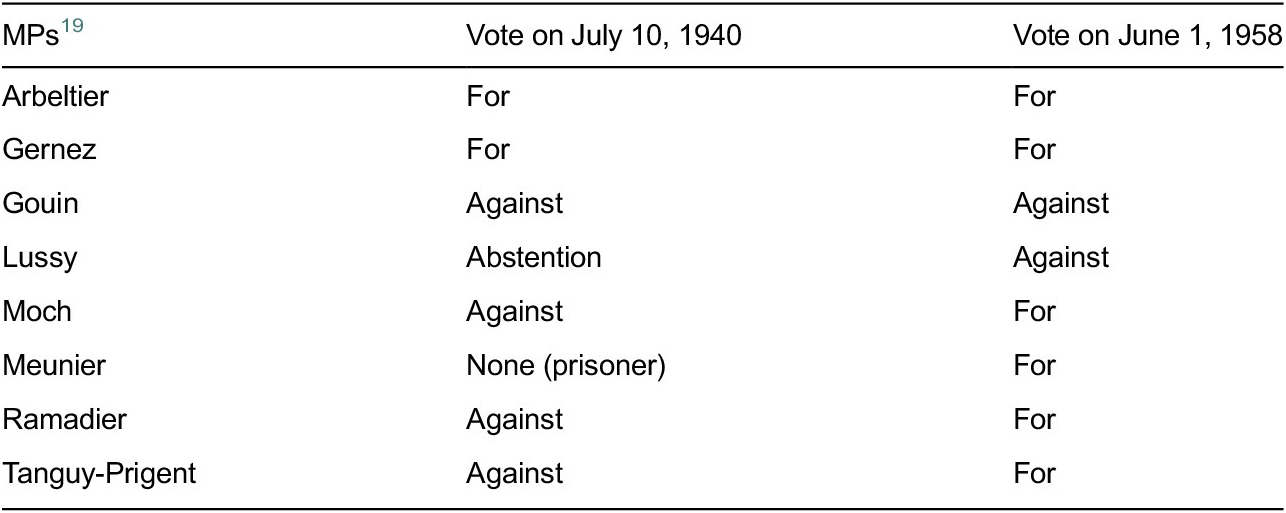
In May 1958, however, the group was no longer torn by divisions over the July 10, 1940 vote or the Collaboration. These episodes were no longer the subject of antagonistic stances: the meaning and consequences of the July 10 vote had become clear, and the Socialist parliamentarians who had consented to Pétain’s demands, a fortiori the supporters of the Collaboration, had suffered dishonor. What is more, there is no evidence of subgroups (and related interactions) that were built around these antagonisms. Could it be, however, that the same tendency that gave rise to the divergence of views in July 1940 manifested itself again in May 1958? This possibility, assessed using Table 2, is unconvincing: not only do the small numbers involved make it impossible to draw firm conclusions, but the votes fail to reveal any coherent pattern of interpretation at first sight.
Votes on July 10, 1940 and June 1, 1958

On the other hand, we must inevitably take into account the role of speeches by individuals who were no longer uncertain and sought to influence the opinions of others. Their content matters: the more these interventions conform to the group’s principles, the more likely they are to be deemed acceptable by a large number of individuals, and consequently the more likely they are to elicit their cognitive support [Calvert Reference Calvert1992: 18; Kahneman Reference Kahneman2012: 102; Katz and Lazarsfeld Reference Katz and Lazarsfeld2008: 83]. Note that past cleavages potentially have direct effects on the reception of the interventions in question, by increasing the likelihood that the latter will be perceived as cleaving, being interpreted with reference to these cleavages. The properties of the speeches’ authors have also to be considered. On the one hand, the more established their authority is, the more likely their statements are to attract the support of many individuals. A leader’s capacity to influence, while seemingly linked to his or her person, must in fact be seen through the prism of his or her relationship with the group [Bourdieu Reference Bourdieu1984: 49; Lahire Reference Lahire2020: 112–113; Weber Reference Weber1971: 345]. In the case of the socialist parliamentary group, the extra esteem, respect, and recognition enjoyed by leaders is probably due to the exercise of high political office or to actions demonstrating loyalty to the principles of the group. These functions and actions give access to high status due to collective beliefs in the value of exercising power or Socialist principles [Lahire Reference Lahire2020: 105]. These leaders’ ability to influence also stems from the fact that the group’s strength is expressed through them [Bourdieu Reference Bourdieu1984: 49–50; Durkheim [1912] Reference Durkheim2007: 313–314]. Indeed, the “moral authority” enjoyed by an individual leads us to follow his or her advice “because the idea we have of [him] is accompanied by a psychic energy,” which comes from the group, “bending our will and inclining it in the direction indicated” [Durkheim (1912) Reference Durkheim2007: 314].
On the other hand, the smaller the degree of affiliation between the author of an intervention and a particular subgroup, the greater their impact on the views of the group as a whole [Gould Reference Gould2003: 47–48; Kahneman Reference Kahneman2012: 75; Katz and Lazarsfeld Reference Katz and Lazarsfeld2008: 102]. Are these statements truisms? From our point of view, this is not the case, insofar as this survey underlines that authority and affiliation are by no means sufficient conditions for the convergence of beliefs within a group: other factors, relating to the content of leaders’ interventions and their reception within the group, can either reinforce or counterbalance their effects. In other words, cannot be taken for granted: it may or may not be actualized in a given situation.
Moreover, support for these public statements depends on how they are received. They have a greater impact on individual interpretations if they have first been endorsed by a sufficiently large number of individuals from different subgroups. This theoretical argument refers to a long-established logic: the public approval of an idea by individuals reinforces that of the group as a whole, and vice versa [see for example Collins Reference Collins2004: 48–49].
Finally, individual “adhesion thresholds” determine the distribution of interpretations within the group. This concept is a cognitive understanding of Mark Granovetter’s “threshold” [Granovetter Reference Granovetter1978]. Although sociological work focuses on its behavioral meaning, i. e. whether an action is carried out depending on the number of individuals who have previously done so, Granovetter also suggests the possibility of applying it to the belief in a rumor [Granovetter Reference Granovetter1978: 1423]. The “adherence threshold” designates the proportion of individuals who must express their belief in a particular interpretation for an actor to believe it him- or herself. This threshold varies from one individual to another, reflecting each one’s idiosyncrasies and particularly his or her cognitive autonomy. It is said to be “relative” when adherence to an interpretation depends on others, and “absolute” in the opposite case. However, as the threshold of adherence is not observable, it gives rise to unfalsifiable propositions. Nevertheless, this tool should not be dismissed: on the one hand, it is a key to understanding the development of interpretation dynamics; on the other, it is based on a robust postulate, that of cognitive autonomy, which varies from one individual to another.
We must now show how the content of the sources supports these theoretical statements. We will examine both the more and less successful attempts of certain leaders to influence the beliefs of their colleagues. In our view, the empirical material we have gathered reveals traces of the causal links set out in the language of theory. This is a response to critics who claim that it is impossible to prove the validity of these logics on the basis of evidence from archival documents.
Interpretative changeover (May 29)
From May 13 to 27, the logic at work in the Socialist group corresponded to that of “joint actions,” as identified by Herbert Blumer [Blumer Reference Blumer1969: 61–67]: its members interpreted the situation on the basis of their shared meanings (constitutive of the betrayal thesis), and their speeches and actions reflected the significance of these interpretations within the group, reinforcing the group’s support for them and fueling its opposition to de Gaulle’s candidacy. In other words, the collective consciousness that united Socialist deputies to a certain extent was apparent. However, on May 28, a statement by Max Lejeune, the Pflimlin government’s Minister of State, revealed that many of them supported the republican safeguard thesis, which turned the consensus displayed the day before into a trompe-l’œil. Footnote 20
The next day, at the start of the 2 p.m. meeting, Le Troquer took the floor. As President of the National Assembly, he had met de Gaulle, as was customary for any candidate for the Presidency of the Council. But the meeting did not go well: Le Troquer expressed his hostility to de Gaulle’s nomination, while the latter regretted having “come for nothing” [Lagoueyte Reference Lagoueyte2021: 191]. In front of his colleagues, Le Troquer said that, although he “couldn’t say anything right away,” the Republic was “really […] in great peril.” He went on to say: “We will therefore have to consider every hypothesis, even that of total sacrifice.” This intervention, according to Lapie (F), suggests that “everything is broken” and “without recourse” with de Gaulle, given his demands [Lapie Reference Lapie1971: 818–819].
Le Troquer’s statement seems to have had an effect on the interpretations of his colleagues. Marius Moutet declared a little later that he wanted to hear more details. But these effects were limited: Moutet was not satisfied with the statement he had heard, judging it to be too vague. What’s more, there was no sign of a consensus emerging around Le Troquer’s intervention. This may be explained by his character traits and how he was viewed by some of his colleagues. Despite his authority as president of the Assembly and former minister, he was perceived as unreliable, as Lapie’s testimony reveals: “Is Le Troquer on his high horse […]? He is quick-tempered, easily hot-headed, often blundering and very full of himself. […] Has he gone crazy?” [Lapie Reference Lapie1971: 819]. These suspicions clearly prevented Lapie from accepting his perception of de Gaulle. It seems this skeptical view was widely shared in the group, since it was mentioned in the newspapers.Footnote 21
Mid-afternoon on May 29, an interpretative shift took place. The group read a letter written by the Socialist Vincent Auriol, former President of the Republic. The letter made several harsh judgments on de Gaulle’s equivocation in the face of a “rebellion against institutions.” But Auriol also endorsed the thesis of republican safeguarding and advocated conditional support: by breaking “all solidarity with those who have created a seditious movement,” de Gaulle could obtain the “confidence of the entire Nation” and “a rapid agreement” from political leaders. The deputies applauded the harsh criticisms of de Gaulle;Footnote 22 however, once the full letter had been read and Auriol’s position revealed, they “acclaimed” the text [Lapie Reference Lapie1971: 822]. Following a proposal by Mollet, the group endorsed Auriol’s position by sixty-two votes to twenty-nine. In other words, the SFIO (Section française de l’Internationale socialiste) adopted a position of conditional support for de Gaulle’s candidacy. The fact that there was still a significant minority against that position suggests that some deputies remained unconvinced. Some accounts written after the fact attest to the influence Auriol’s letter had on the deputies. Albert Gazier recalled it as a text with a “noble tone,” by which “most members of the group” were “struck” [Blondel, Jospin, and Mauroy Reference Blondel, Jospin and Mauroy2006: 251]. Brutelle referred to it as a “clear and harsh” letter, which “there is no doubt” was “one of the elements that will contribute to changing the position of a certain number of comrades.”Footnote 23 For Ramadier, it was a “beautiful letter […], so quivering with republican will and which launched a supreme appeal”Footnote 24 (emphasis added). These assessments seem to indicate that the letter both matched the group’s principles and influenced its members’ interpretations of de Gaulle’s candidacy.
Moreover, the expressions “noble tone” and “supreme appeal” suggest that Auriol’s reputation influenced how deputies received his message. These terms seem to be linguistic manifestations of Auriol’s position, not only in terms of his influence, but also as one who was seen to be above partisan cleavages, which probably added weight to his words. His career supports this analysis. On the one hand, his commitment to a republican form of government, as evinced by his opposition to the transfer of full powers to Pétain in July 1940 and by his previous tenure as President of the Republic (1947–1954), established him as a defender of the Republic’s values and certainly contributed to his authority. On the other hand, among Socialists, Auriol was seen as a “man of compromise and conciliation” who kept his distance from conflicts within the party—in particular that between Minoritaires and Majoritaires [Morin Reference Morin2020].
Moreover, Auriol’s letter seems to have met with collective approval. In addition, three individuals—Augustin Laurent, Lapie, and Mazier—clearly and unreservedly expressed their agreement with the text. Their factional affiliations differed: while Laurent and Lapie belonged to the majority, Mazier was a founding and active member of the minority [Morin Reference Morin1991: 204; Raymond Reference Raymond2018]. These endorsements probably made it clear to the meeting’s participants that support for Auriol’s position transcended the group’s main cleavage. As Laurent was the SFIO’s “political conscience” [Vanneste Reference Vanneste1983: 1975] and leader of the Nord federation, his intervention was perhaps perceived as reflecting a widespread view within the party, especially given his earlier statements that he had been in contact with militants in the North.Footnote 25 It is likely that the perception of an emerging consensus encouraged support for the republican safeguard thesis.
But the consensus was not total. Some deputies were unconvinced; perhaps their interactions had had the opposite effect, reminding them of the symbolic costs of supporting de Gaulle and thereby making that position less appealing to them. Thus, when the question of collective approval of the letter was raised, Charlot, opposed to this possibility, “[went] up to the rostrum [of the Salle Colbert and] literally […] [watched] his comrades.”Footnote 26 Some of the actors seem to have been aware of this logic, as suggested by their attempts to pass themselves off as the more numerous camp, clearly perceptible in an exchange between Arthur Notebart and Laurent during the meeting. Addressing the deputies who had voted in favor of the May 27 motion, the former asserted that “the comrades from the North, who are absent, thank them.”Footnote 27 In doing so, he clashed with the latter, who shouted at him: “You can’t speak for all the comrades in the North.”Footnote 28
Interpretative divergence (May 30–31)
The adoption of Auriol’s letter was not the prelude to the group’s rallying behind de Gaulle, since on May 30, consensus seemed to be waning. Indeed, the betrayal thesis once again appeared to be gaining favor with some of the Socialists. Deixonne and Mollet flew to Colombey at the General’s invitation, before reporting back to the group that evening. Essentially, their interlocutor put forward several commitments, clarifications, and concessions. For example, he proposed to choose his future ministers from the main parties and reduced his request for full powers from one year to six months; he also emphasized his willingness to follow procedure and his respect for the process when it came to reforming the Constitution, submitted new text for a referendum, and underlined his severity when it came to the CSP. According to Mollet, the General’s plans were “no longer as worrying.”Footnote 29
The two leaders’ statements probably gave credence to the republican safeguard thesis among certain majority deputies, as suggested by some of their statements after the May 30 meeting.Footnote 30 The statement Eugène Thomas had made two days earlier speaks volume: “when things are going normally, the Party Secretary is our guide, but […] [he] becomes our leader in serious circumstances.”Footnote 31 From this we can deduce that Mollet’s status led some of the deputies to adopt his point of view. However, it’s difficult to identify all the factors that influenced deputies to accept Mollet’s reading of the event when they interacted with him. It’s quite conceivable that an interest in siding with him (to reap dividends later, for example in the form of a party nomination) contributed to this. Two accounts support this possibility: on the one hand, Albert Denvers claims to have “supported Guy Mollet in his thesis of Gaullism” [Leleu Reference Leleu1991: 206], an expression that suggests a tactical dimension may have been at work; on the other hand, Degrond recalls the “fear of losing their mandate,” which turned MPs’ meetings into “crazy assemblies.”Footnote 32
However, the sources reveal mostly hostile reactions during the meeting. A number of bon mots were uttered, denoting a biting irony about an enthusiasm for de Gaulle that its critics deemed ridiculous, even servile. They were said to have humiliated themselves at “Canossa-les-deux-Eglises.”Footnote 33 Mollet was thought to be in favor of a “passionate marriage” and Deixonne of a “religious marriage” with de Gaulle, while Auriol favored a “marriage of reason”;Footnote 34 Deixonne was described as having returned from Colombey “with his palms open like St. Francis receiving the stigmata” [Lapie Reference Lapie1971: 827–828]. A remark by the Minister of the Interior attests to the collective dimension of this disapproval: “quite a few faces [were] closed, tense, hostile” after Mollet’s report [Moch Reference Moch1971: 303]. Moch, on the other hand, makes no mention of any favorable reaction. The content of the reports by the two Socialist leaders seems to have prevented the formation of a broad consensus within the group: the reports were considered as too positive about de Gaulle, without any acknowledgement of the reservations that had been expressed against him. Through their enthusiasm for de Gaulle and their silence on those aspects of his candidacy that were previously deemed unacceptable, they seem to have turned their backs on their principles.
This episode also confirms the role played by speakers’ social standing in how their words are received. Admittedly, Deixonne and especially Mollet were authoritative figures thanks to their past or present positions (the former is President of the socialist group, the latter is Secretary General of the party and vice-President of the Council, and had been a minister and President of the Council). That said, their authority had been tarnished. Firstly, their decision to go to Colombey without a mandate from the group was heavily criticized.Footnote 35 What’s more, Mollet faced particular criticism for the actions he had taken since May 13 (his failure to provide sufficient information about the ongoing political situation, for exampleFootnote 36) and his previous political choices at the head of the majority, to which Deixonne was also affiliated. The majority/minority divide in all likelihood contributed to the reception of their words, since all the ironic individuals were Minoritaires. It seems safe to assume that their longstanding hostility toward the other side led them to react virulently, and that their opposition to the Secretary General’s Algerian policy was now also directed against de Gaulle.
On May 31, Ramadier took the floor at the group meeting (which was organized in order to decide on a collective position) and affirmed his confidence in de Gaulle.Footnote 37 However, he emphasized that the latter remained “the man [who had been] called by [the] Comité.” Hence Ramadier’s hesitation: he said he was “wavering” and hadn’t “completely made up his mind,” but his “assessment” inclined him to see de Gaulle as the least risky option. Without giving any voting instructions, he gave a tentative indication of his preference, but said he still had to “think things over” and listen to his comrades in the party. The testimonies of Dumortier and especially Degrond, quoted above, attest to the effects of Ramadier’s intervention.
The contents of Ramadier’s speech were a major factor in that impact. He emphasized the acceptability of the General’s demands and his irreproachability. Moreover, his uncertainty, still evident at the meeting, probably reinforced the weight of his remarks, as Moch asserts: “his speech led [to the rally] by the very hesitations it revealed”; it “carried more weight” than that of Mollet, “who gave the impression of being too carried away […] to bring resolute opponents back to him” [Moch Reference Moch1971: 312]. Moch’s testimony reveals how responsive the deputies were to tact on the part of their leaders, and sheds light on the impact of Ramadier’s intervention. Last but not least, Ramadier’s respectful attentiveness to his comrades was in keeping with party traditions and probably reinforced his authority [Sadoun Reference Sadoun1994: 7].
Finally, Ramadier’s career path also confirms the analysis defended here. As a former President of the Council and former minister, he enjoyed a certain authority in the group. His prestige was further enhanced by his opposition to the granting of full powers to Pétain in 1940. Moreover, while he was not a Minoritaire, Ramadier distanced himself from the Majoritaires; he had initially been hesitant to grant special powers to the government in 1957 [Morin Reference Morin1991: 339], and there had also been a strong antagonism between him and Mollet at the end of the 1940s [Vojtovic Reference Vojtovic2010].
By the end of May, the majority–minority divide clearly weighed heavily on the divergence of interpretations within the group. Membership of these subgroups was correlated with a vote either “for” or “against” on June 1 (of the group’s twenty-one minority members, sixteen opposed the nomination and five agreed to it).Footnote 38 We can deduce from this correlation that these affiliations were probably also linked to shared interpretations of the event. Indeed, according to Verdier, “the political crisis that began in April–May 1958” was “only the last act of a play that began […] [in] February 1956 […]. Such [was] the judgment of the Minoritaires who have risen up against abandonment” [Morin Reference Morin1991: 339]. For him, therefore, there was continuity between the Minoritaires’ past struggles and their reactions after May 13, which probably stemmed from their refusal to renounce Socialist principles. Verdier’s comments suggest that this commonality of viewpoint may not have derived exclusively from the similar interpretative tendencies, but also from interactions between these members during the event. Clearly, those interactions were sufficiently numerous to allow Verdier to be able to characterize the Minoritaires’ common reading of the situation. They were also evidenced by the publication on May 25 in Tribune du Socialisme, the minority’s newspaper, of a press release calling on the government to stand firm.
George Brutelle’s testimony confirms the existence of such affinity-based interactions: “by the end of May, there were no more discussions, except between friends or with oneself.”Footnote 39 His words reflect how common such interactions were; this probably applied to Minoritaires as much as Majoritaires. Other testimonies point in the same direction. Denvers declared that he had tried to “understand the situation alone” but had been unable to do so, before adding: “my last recourse, […] which was reciprocal, was my conversation with Camille Delabre” [Leleu Reference Leleu1991: 206]; this conversation led them both to support de Gaulle. At the beginning of June, Dumortier also spoke to a journalist by telephone, explaining why he had voted “for” de Gaulle. André Parmentier was next to him and approved “entirely and totally of [his] words,”Footnote 40 which again suggests the existence of reinforcing interactions that were likely to lend validity to a particular reading of the event. These different examples, in addition to those of Degrond and Dumortier cited above, show once again that individual interpretations emerged from the system of relations between deputies.
One limitation of the proposed theoretical model is that it cannot claim to exhaust the etiology of interpretations. Factors not included in the model may well have been at work in members’ inclinations to interpret the event in a particular way. Some of these factors may be linked to their biographical histories. Jean le Bail is a case in point. Speaking in the Chamber on June 1, he put forward a point of view in line with the betrayal thesis, but was criticized by several deputies, notably the Socialist Just Évrard, who made the devastating remark: “You bastard! You should have said that in 1940.”Footnote 41 This referred to the fact that Le Bail, after his demobilization in 1940, had returned to his job as a secondary school teacher and had not joined the “fighting resistance” [Morin and Raymond Reference Morin and Raymond2021]. His decision was still being criticized in the Chamber when he spoke on June 1. How can we fail to consider the possibility that his reading of the event stemmed from a more or less conscious desire to cleanse himself of the stigma of not having been a member of the Resistance in the 1940s? The hypothesis remains unverifiable, however, given the silence of our sources. It is also likely that actors outside the group, such as newspapers or deputies attached to other parliamentary groups, influenced the members’ interpretations. Both were sources of information and of probabilistic or normative assessments (particularly of the risks of a coup de force, the chances of forming a government without de Gaulle, or the acceptability of his candidacy). These actors would have been able to validate the thesis of republican safeguarding, although the contents of the archives did not allow us to establish this.
The developments described here shed light on how self-deception is possible in such cases. They support the thesis that this phenomenon is rooted in social interactions, which bring about “the adoption of an interpretative frame that downplays the significance of the evidence [the actor wants] to ignore or falsify” by relegating it “to the background of our consciousness” [Ermakoff Reference Ermakoff, Benzecry, Krause and Reed2017b: 187]. Analysis of the May 13 case also identifies the types of group interaction that make self-deception possible.
*
Throughout history, there are political tipping points during which actors, through their decisions, pave the way for large-scale transformations. Without a doubt, these decisions are most often preceded by moments of uncertainty on the part of those actors. These doubts may be related to the consequences of their choices or to the very meaning of the situation facing them, especially when that situation is hard to interpret. In particular, such uncertainty may result from an experience of a contradiction between two interpretations derived from the prevailing political order, both of which appear equally well founded. Understood in this way, such uncertainty is central to ambiguous political events, such as May 13, 1958 as it was experienced by the Socialist deputies. The present investigation has enabled the observation and theorization of several social and cognitive mechanisms that shed light on the reactions of a group whose collective consciousness was faced with an ambiguous political event. More specifically, these mechanisms reveal why and how such ambiguity is collectively overcome when those who were initially troubled by it come to adopt one of the readings of the event, at the expense of competing interpretations, which must then be relegated to the background of the individual’s consciousness.
The approach adopted here could be applied more widely. Examining other cases of ambiguous political events would make it possible to verify the theoretical statements put forward here. It would also enable us to supplement them with other propositions, although verifying these would require a plurality of empirical cases. At first glance, three key events of the French Revolution—namely the proclamation of the National Assembly (June 17, 1789), the storming of the Bastille (July 14), and the abolition of feudal privileges (August 4)— also appear to belong to the class of ambiguous political events (Table 3) (Ermakoff Reference Ermakoff2015: 82–99; Sewell Reference Sewell2005: 225–270; Tackett Reference Tackett2018: 76–84, 165–167], although this article has demonstrated that an assured judgment in this matter requires a more thorough empirical investigation of the actors’ experience. It is therefore worth analyzing the different ways in which people have made sense of ambiguous events in these different cases.
Other cases of ambiguous political events

It should be noted that, in addition to the similarities indicated in the previous table, there are probably also variations in these cases: these may concern the type of ambiguity, the degree of pre-existing homogeneity in the group, its internal life, and the timing of the decision. These variations leads us to formulate a number of theoretical predictions, which we treat as hypotheses to be examined as they relate to the cases in question.
The four predictions are as follows:
-
1) Interpretations that form part of the group’s identity or of a repertoire of well-known meanings, or that are based on unambiguous facts, have more staying power in individual minds, and are therefore less likely to be relegated to the background of the actors’ consciousness. For such relegation to take place, there must be a sufficiently strong countermovement at work; one initiated by sufficiently influential leaders and adopted by a sufficiently large number of individuals.
-
2) Because these interpretations are so salient in actors’ minds, they are even harder to dislodge if the group has little time in which to define its position.
-
3) Given the effect of internal divisions, interpretations are more likely to converge when members of the group share similar opinions (on situations or individuals) before the event takes place; that is, if the group is less divided.
-
4) The convergence of interpretations within the group is more likely when the group has a rich internal life and is more isolated from the outside world, i. e. when its members are rarely exposed to the interpretations of third parties. A survey conducted on these events would therefore allow us to test the robustness of our findings in relation to May 1958, and explore the effects of these variations on the ways in which these groups make sense of ambiguous events.
More broadly, the case of May 13, conceptualized as an ambiguous political event, fulfills a “heuristic function” in that it provides the “magnifying glass […] [which] lays bare processual logics that are particularly difficult to grasp in more banal cases” [Ermakoff Reference Ermakoff2017a: 13]. In other words, the theoretical findings from this case are also likely to make clear the logic of how groups form interpretations of situations that do not meet the definition of ambiguous political events. First of all, they are likely to help us understand the moments when a group experiences cognitive uncertainty because either its collective consciousness, its political views, or simply its own initial interpretations do not match the situation its members are facing. This was the case, for example, between December 25 and 30, 1920, a period marked by particularly heated debates within the SFIO, which led to the split between French Socialists and communists. More specifically, these findings could help explain how such uncertainty is resolved.
This experience is undoubtedly not confined to the political world. Neil Gross and Zackary Hyde argue that social norms should not be conceptualized as rules dictating the behavior of individuals, but rather as “the ‘joint action[s]’ that come about when members of a group mutually adjust their behavior in line with images of proper conduct they hold as collective representations” [Gross and Hyde Reference Gross, Hyde, Benzecry, Krause and Reed2017: 378]. These actions result from interactions within the group that allow each member to interpret the situation according to the supposed point of view of their peers and to anticipate their approval if their supposed behavioral preference is adopted. The present investigation reveals such an interactional underpinning. In so doing, it confirms the conception of norms put forward by Gross and Hyde, extends their theorization by highlighting the type of interaction that may be at work when a group develops representations of acceptable actions, and provides a basis for analyzing other such situations.
Another theoretical implication of this inquiry refers to the question of social order, understood as “a cognitive (including linguistic) phenomenon” that is at once “produced, contested, repaired, organized and displayed” in situations of interaction, rather than as a “normative phenomenon” that “regulates individual action” and integrates society through “common values and moral constraints” [Knorr-Cetina and Cicourel Reference Knorr-Cetina and Cicourel1981: 6–7]. A close scrutiny of the experience of Socialist deputies shows not only how a political order is implemented and how it breaks down through interactions, but also how those interactions contribute to the production of a new order. Therefore, the theoretical statements constructed from the case of May 13 could shed light on other instances of transition from one social order to another that were made possible by interactions. In particular, these statements could complement analyses of moments of collective effervescence that build, through an influx of collective emotional energy, the sacredness of material objects, people, or ideas.Footnote 42
Acknowledgements
This text was produced with the financial support of Labex-Tepsis, which made it possible for me to travel to the archives I consulted. I also thank the Editorial Board and the European Journal of Sociology’s two anonymous reviewers for their critiques and suggestions, which helped improve this article. All errors are my own.