WORKSHOP CONTEXT AND RATIONALE: THE CULTURAL PROPERTY CRIME PROBLEM
Unauthorized damage to graves and heritage sites and the removal of ancestors and their belongings undermine scholarly pursuits, national sovereignties, and local senses of place, identity, cultural continuity, and security. Artifact collecting and commercial trade in cultural property has evolved from a socially acceptable antiquarian pastime into a shadowy aspect of transnational crime with proven ties to drug and weapon trafficking, cultural genocide, and terrorism.Footnote 1 Whether motivated by poverty, greed, paternalism, or perceived cultural superiority, cultural property crime (CPC) irrevocably damages inherently unique and unequivocally sanctified objects, resting places, and heritage sites.Footnote 2 CPC is, in effect, the opposite of a victimless crime; everybody loses, with apex antiquities dealers as the possible exceptions.
The crux of the CPC problem is that motivations (especially financial) are essentially unlimited, while the numbers of unaffected sites and objects are finite and diminishing. The funding and personnel available to detect and investigate CPC are also limited. As an example, rampant CPC in the United States led to the 1979 Archaeological Resource Protection Act (ARPA).Footnote 3 ARPA penalties include prison time, fines as high as $250,000, and property forfeiture. The ARPA is unique on a global scale because it requires coordinated incident response from both archaeologists and law enforcement officers. This requirement—powerful but ponderous—enables site-specific damage assessment and restoration but complicates prosecution unless trained personnel are readily available.Footnote 4 For these reasons, and because of escalating market demand for antiquities, CPC persists despite media campaigns, law enforcement initiatives, and emphatic condemnations by governments, international organizations, and disproportionately harmed descendant communities.
Despite apparent intractability, at least three promising avenues exist for thwarting CPC. First, research at anthropology–criminology interfaces confirms that CPC motivations and methods are often shaped as much by political and cultural factors as they are by financial incentives.Footnote 5 CPC opponents now deploy sharper and more broadly relevant conceptual tools for understanding CPC’s drivers, looters’ modi operandi, and antiquities markets’ dynamics.Footnote 6 Collaborations among heritage experts, law enforcement officers and prosecutors is essential to effective punishment of CPC perpetrators.Footnote 7
Second, Indigenous and local communities in many world regions are reasserting sovereign responsibility for heritage.Footnote 8 Anti-CPC allies are forming partnerships to boost the in situ values of cultural property, to delegitimize CPC operations, and to build local capacities to prevent, detect, investigate, and remediate CPC impacts.
Third, advances in forensic sedimentology directly applicable to CPC now enable cost-effective, high-resolution provenance assignments for “dirt.” Selective and judicious application of methods from the growing battery of analytic tools make it possible to link minute amounts of sediment from objects, tools, vehicles, and persons involved in CPC to looted sites. Unique constellations of clays, silts, and sands as well as strands of DNA and traces of plants, insects, mollusks, and other constituents can be distinguished using complementary methods, including inductively coupled plasma mass spectrometry, neutron activation analysis, petrography, scanning electron microscopy, X-ray diffraction, and X-ray fluorescence spectrometry.Footnote 9 Forensic sedimentology has self-evident potentials to boost CPC prosecutions but has yet to be widely deployed in CPC crime scene management.Footnote 10
Sponsorship of the 2018 Fort Apache Workshop on Forensic Sedimentology Applications to Cultural Property Crime provides an apt reflection of the range of interests and perspectives required to address CPC. The primary sponsor of the workshop, the Wenner-Gren Foundation for Anthropological Research, encouraged explicit attention to cultural and intercultural dynamics underlying CPC. The secondary financial sponsor, the US Bureau of Indian Affairs, is providing significant leadership in ARPA enforcement on Native American lands. Archaeology Southwest, the Arizona-based non-profit dedicated to the preservation and study of cultural heritage places, is cultivating significant staff expertise in CPC prevention, response, and remediation. Simon Fraser University’s Centre for Forensic Research, an institutional bridge between archaeology, criminology, and land and resource management, affords access to diverse forensic expertise and analytic capacities. The White Mountain Apache Tribe’s cultural resources director (Ramon Riley) and tribal historic preservation officer (Mark Altaha) represent an Indigenous community committed to excluding CPC from their lands. The Fort Apache Heritage Foundation, the workshop co-host, is a tribally chartered and place-based non-profit dedicated to Fort Apache’s preservation and redevelopment as a hub for White Mountain Apache community, commerce, and culture.
WORKSHOP PROCESSES AND DYNAMICS: CRAFTING TRANSDISCIPLINARY PROBLEM FOCUS
Driven by the ongoing threats and harms of CPC, and inspired by sponsor mandates, the Fort Apache workshop’s overall goal was to identify collaborative pathways in the effective application of criminological, community stewardship, and forensic sedimentology methods and theories to CPC prevention, investigation, prosecution, and remediation. Success in achieving this goal was premised on integrating four generally partitioned domains of knowledge and expertise:
1. the spectra of CPC drivers, modi operandi, and impacts;
2. recommended practices in public and community engagement and outreach;
3. seasoned tactics and strategies for documenting, investigating, and prosecuting CPC; and
4. state-of-the-art analytic tools from archaeological science applicable to CPC.
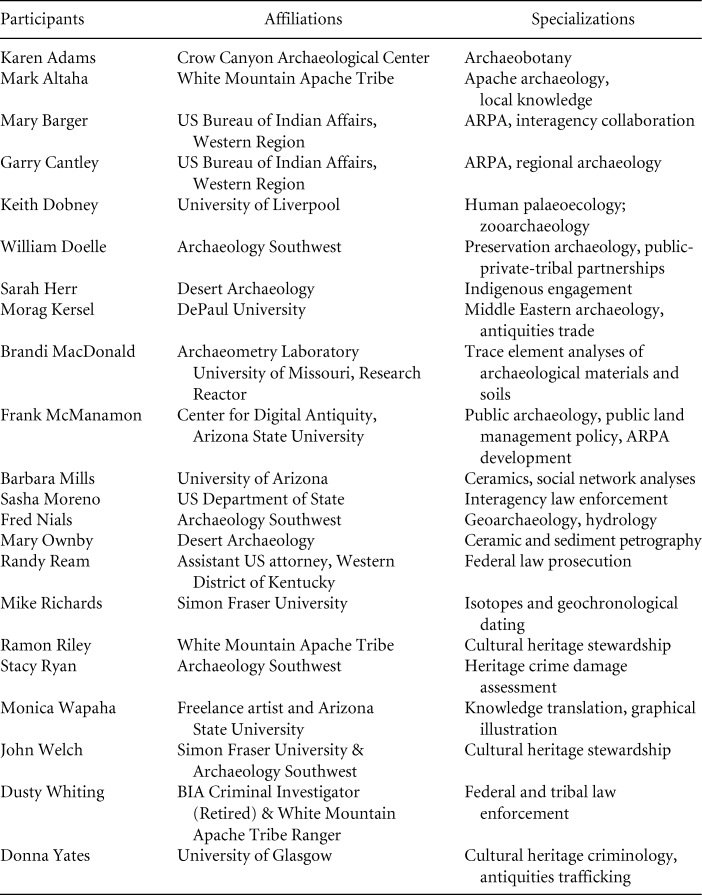
In pursuit of workshop goals and the integration of these four domains, the workshop assembled CPC theorists, investigators, and prosecutors; archaeological scientists; community-based heritage stewards, and an artist/ graphic illustrator (see Table 1). Participation was contingent on subject matter expertise as well as personal commitments to collegiality and collaboration in confronting CPC, especially impacts to Indigenous and place-based communities.
Workshop participants

The three-and-a-half-day workshop convened—amidst upland Arizona’s first major winter storm of 2018 and a prolonged power outage—in the 1890 Commanding Officer’s quarters at the Fort Apache and Theodore Roosevelt School National Historic Landmark. Ramon Riley, the workshop co-convener and an esteemed Apache elder provided the White Mountain Apache Tribe’s official welcome and a blessing. The power outage and absence of PowerPoint capacity and Internet connectivity confirmed and supported the workshop plan to foster interpersonal as well as interdisciplinary dialogues. The workshop plan and agenda excluded academic presentations in favor of open discussion of problems and solutions.
The workshop location was also intentional. We wanted visiting participants to have the opportunity to understand local perspectives on the profound harms heritage crimes inflict on Indigenous people and communities. Riley’s remarks, made as the tribe’s cultural resources director and as an elder, emphasized that
[a]pache culture revolves around a single essential mandate, godińłsįh, with the best English translation as “respect it!” Our elders and medicine people tell us that those who have come before us on the land showed their respect by working closely with the natural world to make their lives and build their communities. Now it’s our turn. Our obligations to show respect mean allowing our forebears, their old graves and homes, to rest in peace. It’s the least we can do for those who gave us this beautiful world. Those who fail to show respect and especially those who dig up graves are going against the natural world as well as against Indian culture. They may not know what they are doing but I have seen the lives they have ruined. They are endangering themselves and their families. My family’s health, too, is threatened when people show disrespect and expose themselves to what’s been put away with prayer. We are all connected.
In honor of Riley’s blessing and remarks, our first and most important order of business was to explore the distinctive motivations and capacities of each of the 22 participants to address CPC. The semi-structured discussion that ensued gave participants the opportunity to grasp the notably broad range of knowledge and perspective assembled for the workshop and the resulting potential for forging real connections among CPC drivers, impacts, and responses. These discussions transitioned, in the second half of the workshop’s first day, into a close examination of the background and results of a recent crime scene investigation and damage assessment process at G-Wash Pueblo, a heritage site located about 10 miles from Fort Apache.
G-Wash is an apartment-style masonry village comprised of over one hundred rooms, occupied in the 1200s and 1300s by ancestors of today’s Zuni and Hopi people. After an earlier visit to the region, Octavius Seowtewa, a Zuni Pueblo religious leader, said, “archaeological sites and petroglyphs provide[s] tangible reflections of the routes traveled and the many hardships endured. … These places need to be protected—they are our living history.”Footnote 11 Stewart Koyiyumptewa, director of the Hopi Cultural Preservation Office, said: “[A]rchaeological resources serve as the ‘footprint’ of Hopi ancestors. … The continued looting and vandalism of these archaeological resources obliterates the Hopi people’s connections to the land and hinders our abilities to be good stewards of Mother Earth.”Footnote 12
Intensive “classroom” discussion of the case study prepared participants to visit the G-Wash crime scene on the workshop’s second day. Discussions led by officer Dusty Whiting and archaeologists Stacy Ryan, Garry Cantley, and Mary Barger sparked productive and critical reviews of the respective roles and potential synergies of law enforcement officials, archaeological scientists, community-based archaeologists, stewardship advocates, and CPC theorists. Randy Ream, an assistant US attorney, played pivotal roles in these discussions, especially through the clarification of distinctions between scientific and legal evidence and the roles these play in prosecutorial decision-making. Ream’s contributions made it clear that clusters of political, financial, and juridical factors lead prosecutors to focus almost exclusively on cases characterized by clear and compelling evidence, social relevance, jury appeal, and other situational factors.
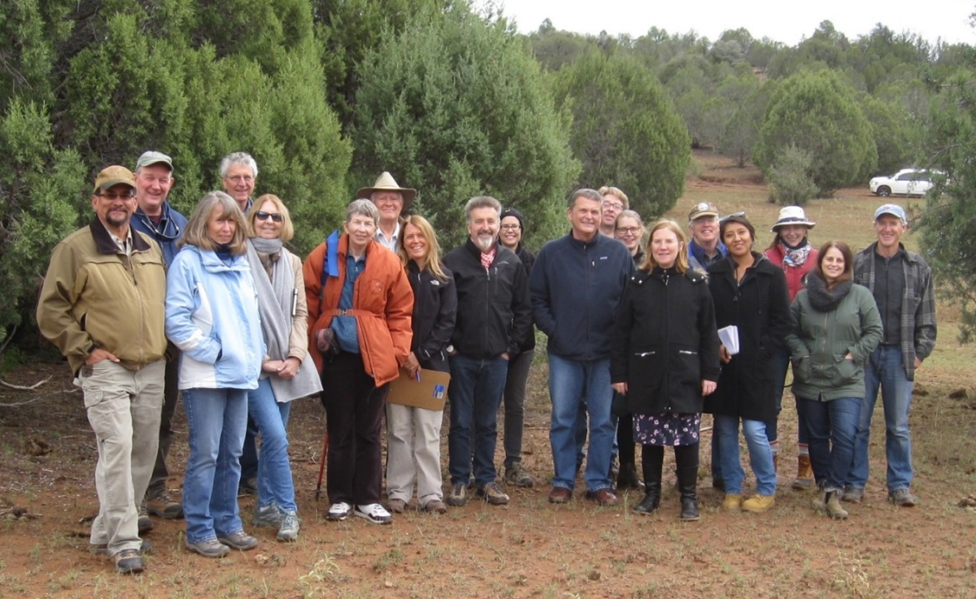
The second day’s field visit to the G-Wash crime scene provided a rich context for appreciating the complex interplay of historical, socioeconomic, political, and legal-jurisdictional attributes affecting CPC detection, investigation, and remediation (see Figure 1). The site visit involved group pauses at different loci impacted by criminal activity. This mode of visitation encouraged close attention by participants to contextualized commentary from those responsible for crime scene investigation, damage assessment, and physical evidence collection. We quickly learned that the technical minutia of in-field CPC incident responses materially and often irrevocably influence the options and strategies for subsequent investigation and prosecution. The rule in archaeological excavation applies equally and perhaps more consequentially to CPC crime scene processing and damage assessment: you only get one chance to do it right!
Workshop participants at G-Wash (left to right): Dusty Whiting, Garry Cantley, Mary Barger, Bill Doelle, Barbara Mills, Karen Adams, Fred Nials, Stacy Ryan, Keith Dobney, Mary Ownby, Randy Ream, Mike Richards, Sasha Moreno, Donna Yates, Frank McManamon, Monica Wapaha, Morag Kersel, Brandi MacDonald, John Welch. Not shown: Ramon Riley, and Mark Altaha (photograph courtesy of Sarah Herr, 16 October 2018).

The G-Wash crime scene stimulated situation-specific contributions from subject matter experts in geology and sedimentology (Fred Nials), sediment sampling (Mary Ownby), ceramic identification (Barbara Mills), human remains protection (Keith Dobney and Sarah Herr), and uses of trail cameras, site stewards, and other crime detection strategies (Whiting, Ryan, Donna Yates, and others). The site visit further catalyzed comparisons between looting on tribal lands and in other regions of the world. Various workshop participants realized that individual looter profiles, their motivations, the types of looting, the looter networks, and the state-based and local responses were often interchangeable. The similarities were sometimes so stark it was as if we were each talking about each other’s sites, even though many of those sites are thousands of miles apart.
In sum, the site visit resulted in emergent interdisciplinary consensus on (1) understanding key dimensions of variation at CPC scenes (for example, environmental-geographical, temporal, impact types and levels, jurisdictional, and so on); (2) appreciating the range of values impacted by CPC in general and at G-Wash, in particular (for example, aesthetic, community health, cultural, educational, scientific, and spiritual); and (3) developing responses to CPC by law enforcement and heritage professionals that are attuned to local community interests and values, prosecutorial standards and priorities, and applicable advances in archaeological science in general and forensic sedimentology, in particular.
We dedicated the second half of the workshop, the two days following the site visit, to breakout sessions intended to allow intensive discussions focused on three sets of tools and strategies for addressing CPC: (1) archaeological science and forensic sedimentology; (2) criminal investigation and prosecution; and (3) communications and public outreach. The breakouts allowed participants to brainstorm with colleagues having similar backgrounds and interests on ways to optimize deployments of existing assets and fill gaps between existing assets and anticipated needs. The breakout sessions, which were complemented by the whole-group reporting and integrating discussions that followed, prompted and ultimately revolved around a suite of interrelated questions, including:
• What should academic, heritage, and law enforcement professionals know about CPC perpetrator motivations and modi operandi? What techniques are available from social network analyses and other sources to define and potentially track distinctive looter methods?
• What types of training would be most useful in thwarting CPC and how can such instruction be developed and delivered to both broad audiences of those interested in, and concerned about, CPC, in general, and, more specifically, to personnel—primarily tribal, state, and federal government staff and contractors—responsible for detecting, investigating, and prosecuting CPC?
• What do non-specialists need to know about the advantages and limitations of analytical methods available to add new types of evidence / levels of precision to CPC investigations (for example, archaeobotany, DNA, isotopic chemistry, neutron activation analysis, palynology, petrography, scanning electron microscopy, X-ray diffraction, X-ray fluorescence spectrometry, and zooarchaeology)? How might a “recommended practice” sampling strategy be developed and deployed to support most CPC investigations and most or all analytic techniques? Are there special interests and concerns relating to chain of custody and data management for analysts not affiliated with official forensic labs?
• What can and should we do to curb CPC? What are the recommended practices for community and media engagement? What are the most appropriate spatial scales and media tools for community outreach campaigns? Could a community-specific stewardship and heritage campaign be effectively integrated with other efforts to improve community health and welfare? How might the disproportional impacts inflicted by CPC on Indigenous and place-based communities be transformed into comparative advantages in detecting, investigating, responding to, and, ultimately, extirpating CPC from culturally and jurisdictionally distinctive communities and lands?
WORKSHOP RESULTS: WHAT WE LEARNED
The above-listed questions are part of what we see as indicators for a potentially paradigmatic shift away from thinking about CPC as a problem to be addressed primarily by national governments and international law enforcement and toward active and consequential participation on the part of individuals, families, communities, academic disciplines, professional organizations, tribes, community health advocates, and innumerable other entities.Footnote 13 Previous approaches, at least in the United States, to expert-centered, state-based, and top-down CPC investigation and prosecution may have missed opportunities to harness context-specific, community-driven, and collaborative strategies and tactics for thwarting CPC.
Experience has now proved that legislation and law enforcement alone are unlikely to halt CPC. These are necessary but not sufficient. Legal frameworks for investigation and prosecution need to be coupled with the expertise of archaeologists and other heritage experts. Whether on Apache tribal lands or at Jordan’s Dead Sea Plain, the incentives for CPC involve deeply entrenched practices, notions of nationalism, resistance, forces of globalism, conflicting preservation and management plans, and legacies of colonialism. CPC is not only about economics and those facing income challenges. A tangible outcome of bringing together a broad cross-section of those dedicated to cultural heritage protection were the discussions that unpacked the varied motivations for CPC. Understanding CPC motivations and methods naturally gave rise to strategic considerations for responses by law enforcement, local communities, national and international organizations, and archaeologists.
The Fort Apache workshop revealed that academics, in general, and archaeological scientists, in particular, are willing and able, even excited, to share their subject matter expertise and other assets in pursuit of public goods—security, cultural heritage conservation, and community health. One workshop participant (Cantley) observed during the discussions that there appear to be “many good-hearted individuals who are responsive to the idea of getting their considerable knowledge and expertise out of the university and into society. We should anticipate that there is a large, untapped resource of individuals in the archeological sciences who would be happy and willing to contribute to combating archeological resource crime. They just need an avenue to do so.” The workshop, itself a case study in situational contingencies and schedule changes, which were required to accommodate changing weather and participant travel schedules, further demonstrated that the social intelligence and level of personal commitments to collegiality contribute greatly to collective enterprises.
All workshop participants also gained awareness that criminal investigators and prosecutors have vast arrays of cases to pursue. Barring not-uncommon political interference, law enforcement professionals select the cases having the highest probabilities of successful prosecution via the lowest investments of time, money, and other scarce resources. All agreed that forensic sedimentology tools have incompletely exploited capacities to enhance CPC investigations, boost convictions, and foster vigorous and constructive communications among criminologists, scientists, and law enforcement and heritage stewardship professionals. As William Doelle explained in his workshop comments, “there is a vast and incompletely tapped reservoir of established, and to some extent cutting edge, scientific technology available to identify, track, and ultimately link cultural property criminals to specific crime scenes. Not all scientific evidence has applications to curbing CPC, but any evidence that is created for use in this arena must be iron clad to obtain convictions.”
WORKSHOP IMPLICATIONS: NEXT STEPS TO CURBING CPC
Perhaps the most important workshop outcome was the shared recognition of the many promising avenues for addressing CPC. Participants agreed to continue and even expand collaborations to apply what we learned at Fort Apache. The archaeological scientists are at work on finalizing and initial testing of a recommended standard sediment-sampling protocol for use in looted contexts. This is based on sediment samples collected from G-Wash that will be subject to sediment and petrographic analyses to determine variation. They will be compared to sediments from another site, Tundastusa, to assess site differences and resolution. In addition, Ownby and Nials are creating guidelines for context sampling grounded in protocols applied in environmental spill response and remediation. Toward this goal, they are coordinating with forensic science labs to better understand procedures and issues for conducting analyses creating prosecutorial evidence. Context sampling of sand holds promise as a means for enabling petrographic analyses that could gather evidence for linking looted sand-tempered potsherds, including plainware sherds and other locally manufactured ceramic objects, back to their site of origin.Footnote 14 The completion of initial analysis of sand samples to support the sand temper research and to enhance the level of confidence in linking plainware potsherds confiscated from suspected looters back to White Mountain Apache Tribe lands is scheduled for February 2019.
Information sharing and personnel training also emerged from workshop deliberations as important follow-up initiatives. John Welch, Cantley, Frank McManamon, Ryan, Whiting, and Yates have initiated discussions with the US Bureau of Land Management and submitted a funding proposal to funnel findings from the workshop into a curriculum development collaboration structured to create training for archaeologists, law enforcement officers, and tribal, federal, and state officials and land managers charged with curbing and prosecuting CPC. At least one online training module—tentatively titled “Introduction to Archaeological Resource Crime: Global Contexts, Local Impacts, ‘Glocal’ Responses”—would enable open access learning by any English language speaker (and create opportunities for translation into other languages and regional contexts). The two other envisioned modules—Archaeological Site Damage Assessment: How to Manage and Document an Archaeological Resource Crime Scene and Forensic Sedimentology Applications to Archaeological Resource Crime Investigations: Analytic Rationales, Sampling Protocols, Physical Evidence Collection, and Data Management—would be available to authorized archaeologists, law enforcement officers, and land managers via password-protected course delivery. The overall goal of the curriculum development initiative is to bring recent scientific and online learning innovations to bear on CPC investigation and prosecution and to expand tribal, federal, and state government capacities to address CPC.
Perhaps the most ambitions and far-reaching bundle of initiatives to emerge from the Fort Apache workshop involves efforts to enlist and mobilize community support for the jurisdiction-by-jurisdiction elimination of CPC. Indigenous and place-based communities are, as mentioned, disproportionately adversely affected by CPC. Communities with values and norms grounded, literally and figuratively, in land and ancestral site stewardship are, with few exceptions, far more exposed to, and affected by, harms resulting from looting and grave robbing. This truth, however lamentable, also prequalifies these communities to host and lead efforts to curb CPC. The challenge involves transforming that which makes communities subject to harm into comparative advantages in curbing CPC. Meeting this challenge means inviting outsiders to recognize cultural and spiritual values embedded in cultural property on par with aesthetic, scientific, and economic values.
As initial experiments toward strategies for public and community outreach, Ryan and her colleagues at Archaeology Southwest have already published a carefully crafted article in Outdoor Adventure, a regional magazine for Arizona tourists and recreators.Footnote 15 White Mountain Apache community values and interests make their beautiful Fort Apache Indian Reservation an auspicious place for expanding collaborations among law enforcement agencies, community health advocates, and political leaders. To this end, the workshop conveners have submitted a summary of the workshop for publication in the Tribe’s newspaper, the Fort Apache Scout.Footnote 16 A week of intensive fieldwork to collect systematic ceramic assemblage characterization data from previously uncharacterized sites on White Mountain Apache Tribe lands is scheduled for early 2019. The April 2019 Society for American Archaeology meeting, conveniently scheduled in Albuquerque, will include an invited forum entitled The End of Cultural Heritage Crime in Indian Country, which will engage many workshop participants and assist in refining plans and partners for further initiatives.
In summation, hope springing from the unlikely source of sediment analysis is driving a measured, but nonetheless ambitious, suite of overdue responses to the pernicious problem of cultural property crime. We think that an effective response to the scourge that is CPC will likely require broad and sustained collaborations to link global-scale theorizing and advances in archaeological science to local action. We see the Fort Apache Workshop on Forensic Sedimentology Applications to Cultural Property Crime as the point of departure for collaborative, democratic, transdisciplinary marshaling of collective commitments to pushing CPC more completely and emphatically into extinction.
ACKNOWLEDGMENTS:
The Fort Apache workshop was supported by a conference grant to Welch and Riley from the Wenner-Gren Foundation for Anthropological Research. Additionally, the workshop received in-kind, staff time, and technical or travel support from seven partners: the US Bureau of Indian Affairs, the US State Department, Archaeology Southwest, White Mountain Apache Tribe, Desert Archaeology, the Center for Digital Antiquity at Arizona State University Simon Fraser University, and the Fort Apache Heritage Foundation.