Many studies in the international political economy (IPE) literature show that individuals’ income levels and exposure to international competition shape their attitudes toward economic globalization, including international trade and foreign direct investment (FDI). Growing evidence supports the presence of a gender gap in individual preference formation regarding international trade, an important aspect of economic globalization (e.g., Burgoon and Hiscox Reference Burgoon and Hiscox2008; Mansfield, Mutz, and Silver Reference Mansfield, Mutz and Silver2015).Footnote 1 The existing studies show consistently that men are more likely to favor free trade than women (Burgoon and Hiscox Reference Burgoon and Hiscox2008; Gidengil Reference Gidengil1995; Guisinger Reference Guisinger2016; Mansfield and Mutz Reference Mansfield and Mutz2009; Mansfield, Mutz, and Silver Reference Mansfield, Mutz and Silver2015). However, research has not addressed whether such a gender gap also exists with respect to individual preferences for FDI, another important component of economic globalization and a main driver of economic growth and tax revenue extraction in the host countries. Evidence implies that women might welcome FDI inflows because the expansion of the service sector in Organization for Economic Co-operation and Development (OECD) countries has increased women's labor force participation and thereby political representation (Iversen and Rosenbluth Reference Iversen and Rosenbluth2006) and FDI has largely driven this expansion through the entrance of multinational corporations (MNCs) into these countries. But do women in developing countries also welcome FDI? This article provides the first systematic analysis of whether gender distinctions in the effects of FDI translate into a gender difference in individual attitudes toward FDI in the developing world.
We propose that the benefits of FDI extend beyond employment: FDI also helps diffuse norms and ideas about gender equality, thus creating a gender gap in FDI preference formation. More specifically, women may be more supportive of FDI than men because MNCs generate more job opportunities, better working conditions, and higher wages than their domestic counterparts for women (Braunstein Reference Braunstein2006; Gray, Kittilson, and Sandholtz Reference Gray, Kittilson and Sandholtz2006). Additionally, MNCs can disseminate norms and values on gender equality from the developed world to developing countries (Potrafke and Ursprung Reference Potrafke and Ursprung2012). Thus, we argue that the gender gap in trade preferences cannot predict FDI preferences and that women do not view FDI more negatively than men. However, women who have not witnessed these effects are unlikely to anticipate them; therefore, we also expect that women in countries that are economically more globalized or less agriculture-dominated have a stronger preference for FDI. Although it is likely that stronger preferences for FDI lead to a higher level of economic globalization, this potential reverse causal relationship should not work differently for men and women. In other words, the effect of gender on FDI preferences hinges on how exposed a country is to the global economy.
This study draws upon survey data from the 2007 Pew Global Attitudes Project, using data from 32 developing countries at varying stages of economic globalization. The results support our hypotheses. In general, women are more likely to support FDI than men, or at least to like FDI as much as men, although the gender gap for the overall sample is very small. Also, as the level of economic globalization increases, or as the level of dependence on the agricultural sector decreases, the gender gap in FDI preferences becomes wider, suggesting that women in economically globalized or less agriculture-dominated countries are more likely to be cognizant of the benefits FDI can bring them.
The rest of the article proceeds as follows. The following section reviews the existing literature on individual attitudes toward economic globalization in general and FDI specifically. Thereafter, we present our theoretical explanations of the gender difference in FDI preferences. The subsequent section introduces the data and the method to test our hypotheses. Next, we present the empirical results, and the final section summarizes the analysis and conclusions.
INDIVIDUAL ATTITUDES TOWARD ECONOMIC GLOBALIZATION
Despite the recent backlash against globalization in some developed countries (The Economist 2017), the trend in globalization continues and seems to be irreversible. A growing number of developing countries are opening their markets to the world and embracing free trade, FDI, and technology transfers. Economic globalization is a macro-level phenomenon, manifested by growing flows of goods, capital, services, etc., that contributes to poverty reduction, job creation, and urbanization in many countries. At the micro level, however, the impact of globalization varies widely among individuals. Thus, it is not surprising that substantial variations in individual preferences exist with respect to economic globalization.
A large body of the IPE literature examines individual preference formation over economic globalization, mostly with regard to international trade and exchange rate policy (Broz, Frieden and Weymouth Reference Broz, Frieden and Weymouth2008; Hainmuller and Hiscox Reference Hainmueller and Hiscox2006; Mayda and Rodrik Reference Mayda and Rodrik2005; Scheve and Slaughter Reference Scheve and Slaughter2001). These studies can be categorized into two strands: those that are economically centered and those that are not. The economically centered approach suggests that the income level and exposure to international competition play a central role in individual preference formation regarding trade (Hainmuller and Hiscox Reference Hainmueller and Hiscox2006; Mayda and Rodrick Reference Mayda and Rodrik2005; Scheve and Slaughter Reference Scheve and Slaughter2001). Studies using this approach highlight the distributional consequences of international trade based on factor endowments and the industry of employment. Because of the abundance/scarcity factor, highly skilled individuals favor international trade, whereas those with less skill oppose trade, and individuals who work in more competitive industries support international trade more than those in less competitive industries. By contrast, the noneconomic approach argues that the public forms their preferences based on nonmaterial factors, such as national pride, culture, identity, and altruism. For example, individuals with strong national pride or identity are more likely to be protectionist (Mansfeld and Mutz Reference Mansfield and Mutz2009; Mayda and Rodrick Reference Mayda and Rodrik2005). Similarly, altruist individuals who have inequity aversion attitudes and other-regarding behavior are more supportive of protectionism because they are concerned about the inequality generated by free trade (Lü, Scheve, and Slaughter Reference Lü, Scheve and Slaughter2012).
Research on individual attitudes toward international trade has not addressed preferences regarding FDI specifically, a primary driver of economic growth in countries that are highly globalized. Studies that examine the determinants of FDI at the macro level abound (e.g., Büthe and Milner Reference Büthe and Milner2008; Jensen Reference Jensen2003; Li and Resnick Reference Li and Resnick2003), but few explore individual attitudes toward FDI at the micro level. In one exception, Pandya (Reference Pandya2010) points to individuals’ skills as a main driver of preference formation with respect to FDI. In a study of workers in Great Britain, Scheve and Slaughter (Reference Scheve and Slaughter2004) suggest that skill levels might predict attitudes toward FDI because FDI activities in the industries where individuals work have a positive correlation with perceptions of economic insecurity for low-skilled workers. Ahmed, Bastiaens, and Johnston (Reference Ahmed, Bastiaens and Johnston2015) also identify individuals’ relative income as a main factor affecting individual preferences with respect to FDI.
Although no research is available on gender and attitudes about FDI, a number of IPE studies on individual attitudes toward trade focus on the influence of gender. These studies universally find that men are more likely to support free trade than women, albeit for different reasons in different studies. One account based on the Heckscher-Ohlin model is that women tend to have lower skill sets than men, so trade liberalization economically hurts women, especially in developed countries. In a related but slightly different context, Burgoon and Hiscox (Reference Burgoon and Hiscox2008) explain that exposure to economic ideas—economic benefits of trade liberalization—explains the gender gap because women on average receive less education in economics than men. Guisinger (Reference Guisinger2016) examines whether differences in knowledge and information processing shape the gender gap in trade using observational and experimental data, and finds that women are more protectionist due to concerns about their own employment. Mansfield and Mutz (Reference Mansfield and Mutz2009) and Mansfield, Mutz, and Silver (Reference Mansfield, Mutz and Silver2015) attribute the gender gap they identify to women's negative attitudes toward competition and active foreign involvement. They explain that women in general are less mobile than men, so trade-related job relocation makes women view trade in a negative way. Gidengil (Reference Gidengil1995) uses the case of the Canada–United States Free Trade Agreement, finding that men support it, citing economic considerations, while women do not, citing social values.
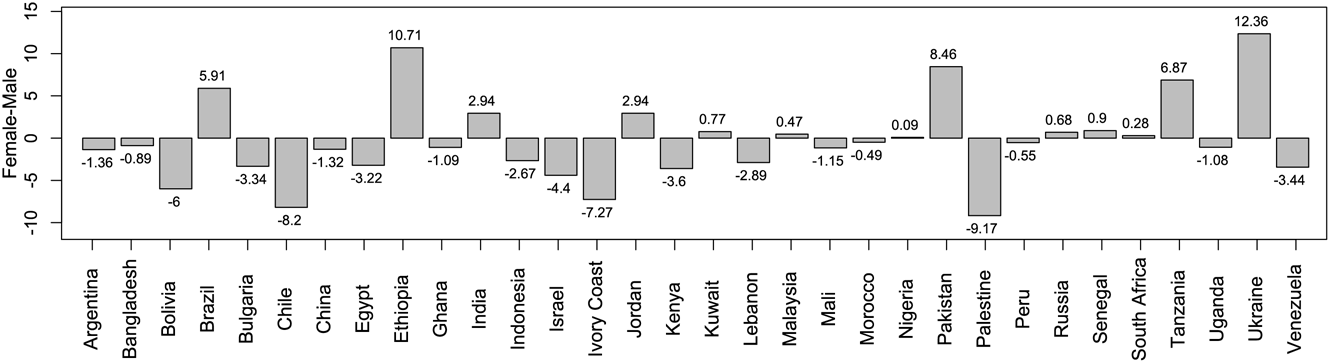
Despite women's opposition to international trade, a poll released by Pew Research Center (2007) shows a different story that women in developing countries do not view FDI more negatively than men (Figure 1). This finding raises a question of why women favor FDI but disfavor international trade, another aspect of economic globalization. This question is especially puzzling given the extensive research showing that a country's level of economic globalization—an aggregated indicator including international trade, FDI, and any other type of capital flows—typically benefits women. Specifically, economic globalization promotes gender equality, including wage and social and economic status (Chaudhuri and Mukhopadhyay Reference Chaudhuri and Mukhopadhyay2014; Gray, Kittilson, and Sandholtz Reference Gray, Kittilson and Sandholtz2006; Neumayer and de Soysa Reference Neumayer and de Soysa2007, Reference Neumayer and de Soysa2011; Oostendorp Reference Oostendorp2009; Potrafke and Ursprung Reference Potrafke and Ursprung2012; Richards and Gelleny Reference Richards and Gelleny2007) and reinforces women's rights. Richards and Gelleny (Reference Richards and Gelleny2007), for example, show that economic globalization improves women's status, whereas Blanton and Blanton (Reference Blanton and Blanton2015) show that women's rights influence FDI flows. If economic globalization helps increase gender equality, then why does evidence show that women do not prefer economic globalization? Or does the gender gap only exist in trade preferences, and not in other aspects of economic globalization, such as FDI?
Gender differences in FDI preferences across 32 developing countries.

Our study addresses the gap in the existing literature by exploring whether gender predicts FDI preference formation beyond international trade policy. By exploring this question, we provide a potential explanation for the paradox regarding the relationship between women and economic globalization: different aspects of economic globalization in fact have different impacts on women's attitudes toward economic globalization. It may be unsound to expect a similar gender difference in FDI preferences as that in trade preferences because trade and FDI have distinct domestic impacts. Pandya (Reference Pandya2010), for example, explains that FDI increases overall wages due to an increase in labor demand regardless of the relative abundance of labor in the host country, which differs from the distributional effects of international trade. In other words, FDI typically leads to job creation, but free trade unavoidably generates winners and losers. Also, as FDI enters a host country, it forces more competition in the local product market, which results in lower product prices and in turn helps increase real income for laborers (Pandya Reference Pandya2010). Thus, FDI in general brings benefits to labor, which makes it substantially different from trade.
FDI is a form of firm-specific capital flows, which makes women more likely to link FDI to employment-related welfare such as job creation, increased wages, and better working conditions. Furthermore, in some developing countries, FDI has concentrated on light industries that tend to hire women. Also, FDI is a particularly suitable area to test the gender gap in international economic policy preferences because of its “foreignness,” which enables women to get exposure to values and norms of gender equality from MNCs more directly. Thus, it is important to explore whether there is any difference in individual preferences for FDI between men and women, an area that has been ignored in the literature thus far. By turning our focus to gender and FDI at the micro level, we can broaden our understanding of the link between economic globalization, especially FDI, and gender equality around the world.
THEORY: GENDER, GLOBALIZATION, AND FDI PREFERENCES
In this article, we argue that gender plays an influential role in individual preference formation over FDI and that this effect is contingent on the country in which individuals live. Building on previous research, we first argue that women are not less open to FDI than men because MNCs create jobs for women and generally provide better working conditions and higher wages than domestic firms. In addition to the material well-being MNCs bring about, MNCs also spread norms and values of gender equality to the society of the host country.Footnote 2 In line with Spilker and Schaffer (Reference Spilker and Schaffer2016), we expect that the effect of gender on FDI preferences is conditional on macro-level factors, specifically, a country's level of globalization and the structure of economy. Women in countries that are more exposed to economic globalization or countries that are less dependent on the agricultural sector are more likely to support FDI because they have witnessed the beneficial effects of FDI on the domestic economy, wage level, and workplace gender equality.
Gender and FDI Preferences
The literature on the political economy of trade shows that international trade generates winners and losers based on individuals’ income levels and exposure to international competition. Because of the distributional consequences, winners favor trade liberalization while losers oppose it. Drawing upon this theoretical framework, scholars have identified a gender gap in trade, showing that women are more protectionist than men (Burgoon and Hiscox Reference Burgoon and Hiscox2008; Guisinger Reference Guisinger2016; Mansfield, Mutz, and Silver Reference Mansfield, Mutz and Silver2015), and the main driver is economic self-interest. The Hecksher-Ohlin model, which suggests that trade expansion benefits the abundant factor (for example skilled workers in developed countries) but hurts the scarce factor (i.e., low-skilled workers), suggests that because women have lower skill sets than men, trade hurts women economically and makes them view trade liberalization negatively.
Our theory builds upon these studies on the gender gap in trade preferences by taking into account skill levels and the level of labor rights, but we argue that women in developing countries may see FDI positively in light of job opportunities for two reasons. The first reason is that FDI flowing to developing countries tends to concentrate on sectors that require low-skilled workers, such as the textile and garment industry, which offer more opportunities for women to join the labor force where women are generally disadvantaged. MNCs also tend to hire more women than men. This reflects the calculation of labor costs, as women are in general paid less than men, as well as perceptions that women are more docile and therefore less likely to engage in strikes, more suitable for tedious work and international production of services, and more reliable and susceptible to training (Braunstein Reference Braunstein2006; Ozler Reference Ozler2000). Therefore, although women tend to have lower skill sets than men, as discussed in the women and trade literature, we argue that women can expect more job opportunities and thus prefer FDI. Second, MNCs mainly operate in a more formal setting and are subject to a higher level of scrutiny and regulations on labor rights than domestic firms which engage in export-oriented trade. Mosely and Uno (Reference Mosley and Uno2007) show that trade, a proxy for outsourced labor, is negatively associated with labor rights while FDI has a positive effect on labor rights. Thus, compared to trade-related jobs, FDI-driven jobs are more likely to link to a higher level of labor or women rights, and thereby women may view FDI more positively than trade.Footnote 3
In addition to employment prospects, MNCs tend to provide more appealing jobs to women than local firms. Even though they employ women because they demand lower wages than men, MNCs tend to pay higher wages to women than domestic companies.Footnote 4 In general, MNCs are less vulnerable to economic cycles, offering better job security and better rights protection codified by local laws and greater benefits manifested by unionized organizations. Studies have documented that job seekers tend to believe that MNCs provide better working conditions and higher wages than local firms (Braunstein Reference Braunstein2006; Davin Reference Davin2001). Thus, FDI offers women greater material well-being. Although Mansfield, Mutz, and Silver (Reference Mansfield, Mutz and Silver2015) find that economic self-interest based on material well-being fails to explain the gender gap in trade preferences, we speculate that FDI is directly linked to job creation and therefore women tend to have a positive view of FDI.
Women in developing economies clearly benefit from FDI inflows. For example, Braunstein (Reference Braunstein2002; Reference Braunstein2006) finds that MNCs have created jobs for women in the labor-intensive, export-oriented assembly and manufacturing sectors in East and Southeast Asia and in parts of Latin America and the Caribbean countries. Although the number of female employees in the manufacturing sectors has decreased over two decades because of technological and international production changes, the share of inward FDI stocks in developing countries has increased in the service sectors, such as banking, education, finance, health, insurance, and telecommunications, which tend to employ women. For instance, more than half of the share of inward FDI stocks in developing countries in 2000 was in the service sectors, mostly export-oriented ones (Braunstein Reference Braunstein2006; UNCTAD 2002, 158). The expansion of service sectors in developing economies to which FDI mainly flows enhances women's employment prospects.Footnote 5
In addition to economic benefits, women benefit from a positive effect on norms and ideas about social and workplace gender equality, leading them to favor FDI inflows. Most capital exporting countries have greater equality between men and women than capital importing countries, and their MNCs carry these values, rules, and norms to their overseas subsidiaries, which therefore outperform local firms in terms of nondiscrimination and affirmative action practices. This logic draws from the so-called “diffusion theory” and its applied works (Bloom, Gilad and Freedman Reference Bloom, Gilad and Freedman2017; Neumayer and De Soysa Reference Neumayer and de Soysa2011; Simmons and Elkins, Reference Simmons and Elkins2004). According to these studies, several mechanisms—coercion, competition, externalities, learning, or emulation—work to spread ideas or norms and thereby change behavior (Simmons and Elkins, Reference Simmons and Elkins2004).Footnote 6
Diffusion mechanisms can be similarly applied to the improvement of women's rights through FDI or international trade. Greenhill, Mosley, and Prakash (Reference Greenhill, Mosley and Prakash2009) demonstrate that the labor standards of a country are affected by those of its trading partners because trade can spread out norms and practices on collective labor rights from importing countries to exporting countries. Similarly, Neumayer and De Soysa (Reference Neumayer and de Soysa2011) find that international trade and FDI bring standards of women's rights from high-standard countries to low-standard ones. The incentive to enhance women's rights—economic and social rights—is stronger when major trading partners and major FDI exporters provide strong rights. Neumayer and De Soysa (Reference Neumayer and de Soysa2011) also suggest several diffusion mechanisms through which FDI affects the improvement of women's rights. These include the coercion mechanism, in which countries such as the United States and the European Union improve labor rights including women's rights as a precondition for market access. Other mechanisms, such as persuasion and pressure, allow women's right organizations to offer more reliable and transparent information to consumers and international organizations, making it possible for low-standard countries to improve their labor and women rights standards. Emulation and learning mechanisms can also help convey practices that support women's rights to other countries.
A range of studies show that FDI has a diffusion effect on women's status. For example, Bhagwati (Reference Bhagwati2004, 270–271) discusses how value diffusion from MNCs changed the views of Japanese women who used to experience a glass ceiling in the workplace. Fontana and Wood's (Reference Fontana and Wood2000) simulation of Bangladesh data also shows that rising FDI leads to a slight wage increase for women. In other words, MNCs respect and protect women's rights and status, and FDI correlates with women's equality. We therefore expect that women are not less likely than men to favor MNCs’ entry into their market because they seek job opportunities as well as increased gender equality.
Gender, FDI Preferences, and Economic Globalization
As described in the previous section, we expect that women tend to favor FDI due to the material well-being—job creation and better working conditions—and norms and values about gender equality that MNCs generate. Based on the positive effects of FDI, it is reasonable to expect the level of globalization in the host country to determine the degree to which women favor FDI. As a country's level of economic globalization increases, more FDI will flow in, and women experience greater job opportunities and benefit from spreading norms and ideas about gender equality. As a result, women will feel the beneficial effect of FDI on gender equality and job prospects in countries that are more exposed to the global economy.
Furthermore, women can expect their countries to improve their rights to attract foreign capital to stimulate economic development. International organizations and developed countries often pressure developing countries to conform to international standards such as human, labor, environmental, and women's rights to build economic ties. Studies also show that membership in international organizations helps diffuse norms and ideas, such as democratic values (Pevehouse Reference Pevehouse2002) or human rights (Greenhill Reference Greenhill2010), which leads to a “race to the top.” Indeed, countries where women have greater equality and access to the labor market more readily attract FDI (Blanton and Blanton Reference Blanton and Blanton2015), and Woo and Payton (Reference Woo and Payton2014) show that countries attempt to enhance their labor rights practices in order to attract foreign capital. This has a clear implication for women's attitudes toward FDI: women can expect better rights in economically more globalized countries, which would lead them to favor FDI. Therefore, we expect that women in more globalized countries tend to have a more positive view of FDI than women in less globalized countries.
By contrast, in a relatively closed and traditional society, women have little chance of enjoying the benefits of FDI, making them less supportive of FDI. We define “traditional” and “closed” societies as ones with low levels of social mobility and of urbanization (Cinar and Ugur-Cinar Reference Cinar and Ugur-Cinar2018), which deter the flows of information and diffusion of norms and values throughout societies. As discussed above, capital exporting countries including the United States and European Union demand developing countries to make adjustments on their local standards in labor and women rights as a precondition for foreign investment. If a country finds no need to integrate itself into the international economy, the government is less likely to improve women's rights intended to conform to international standards. In turn, women are less likely to observe substantial improvements of their rights. Furthermore, women in a more closed and traditional society typically stay at home to take care of their families and thus have a lower social or political status. Ross (Reference Ross2008), for instance, shows that female labor force participation and political representation are lower in oil producing countries where men are more likely to be employed. Similarly, agricultural societies have low rates of women in the labor market and lower female engagement in civil societies or public spheres. As Beer (Reference Beer2009) notes, “countries where agriculture dominates the economy tend to have more traditional social structures and therefore may have less gender equality.” Thus, women may have little expectation of improved rights through FDI. Further, they may not know that FDI can bring about gender equality in developing countries because the low level of social mobility impedes the flow of information. Women may find it difficult to gather, exchange information, and take action together to improve their economic and social status. As a result, we expect that women in more closed economies have little chance of witnessing norms and values on gender equality that MNCs often diffuse through their production networks, which makes them less likely to support FDI.
To sum up, we argue that although women view free trade more negatively than men, their views of FDI will show a different pattern in some developing countries because they expect MNCs to bring them better job prospects, higher wages, and the benefits of norms and ideas that support the equality of women. We also expect that such an effect is stronger in countries with a higher level of economic globalization because women have witnessed the benefits of MNCs and also because these countries are more likely to improve women's rights in an attempt to attract more capital. Women in more traditional societies, on the contrary, are less likely to favor FDI. Our discussions lead to the following three hypotheses:
H1:
Women do not view FDI more negatively than men.
H2:
Women in economically more globalized countries are more likely to view FDI positively than women in economically less globalized countries.
H3:
Women in less traditional societies are more likely to view FDI positively than women in more traditional societies.
RESEARCH DESIGN
Dependent Variable
To test our hypotheses, we draw upon the 2007 survey data from the Pew Global Attitudes Project. Few cross-national surveys include questions about respondents’ opinions about FDI, and most that have such questions are outdated and study a single region.Footnote 7 The Pew Global Attitudes Project, however, covers a wide range of countries. It therefore provides variations across countries, which enables us to examine the effect of country-level factors. In the 2007 survey, which was conducted in April and May of 2007 using face-to-face or phone interviews, one question asks respondents whether they think “the influence of large companies from other countries [is] very good, somewhat good, somewhat bad or very bad on the way things are going” in their country. This question asks respondents about the influence of MNCs on their countries instead of on themselves or their families, but its language is general enough to capture individual preferences regarding FDI. Ahmed, Bastiaens, and Johnston (Reference Ahmed, Bastiaens and Johnston2015) also treat responses to this question about investment as reflecting their own positive or negative feelings about FDI.
We recoded respondents’ answers regarding MNCs into a dichotomous variable equal to 1 for very good or somewhat good and 0 for somewhat bad or very bad. Nonresponses, including “do not know” and “refuse to answer,” were treated as missing data. The 2007 Pew Global Attitudes Survey covers 47 countries, 15 of which are developed countries. Because our theoretical argument focuses on the developing world, we used only data for developing countries.Footnote 8 So our sample consisted of 32 countries. The sample size for each country ranged from 500 to 2,008. To examine the gender gap in FDI preferences at the national level, for each country, we calculated the percentage of male respondents who viewed MNCs positively and that of female respondents who viewed MNCs positively, and we calculated the difference between these two values. A positive value thus indicates that men are more likely to support MNCs than women in that country, and a negative value indicates the opposite. Figure 1 graphically presents the gender difference in each country. As it shows, the gender gap in FDI preferences varies substantially across the sample. In 13 countries, such as Brazil, Ethiopia, and Pakistan, more men support FDI than women. In the other 19 countries, such as Chile, Ivory Coast, and Venezuela, women tend to like FDI more than men. But these differences are so small in some countries, including Nigeria, Peru, and South Africa, that gender may not be significant. Globally, 72.93% of male respondents and 72.85% of female respondents view MNCs positively, and a χ2 test indicates this is not a statistically significant difference (with p = 0.89).
Individual-Level Predictors
To test the effect of gender on FDI preferences, we assigned the key independent variable in our analysis as female, which equaled 1 if the respondent was female and 0 if the respondent was male. In the sample, 50.5% of the respondents were female and 49.5% were male.
We included a battery of individual-level factors as control variables. First, people who view globalization positively may be more likely to support FDI. So we created an ordinal variable economic ties, recoded from the question that asked respondents whether they thought “the growing trade and business ties” between their country and other countries is “a very good thing, somewhat good, somewhat bad or a very bad thing” for their country. This variable ranges from 1 to 4, with 4 indicating a belief that economic ties are a very good thing and 1 a very bad thing.
Second, views on domestic economic performance may also affect people's attitudes toward FDI. Thus, we controlled for economic condition in the question that asks respondents how they “describe the current economic situation” in their country: very good, somewhat good, somewhat bad, or very bad. This variable also has values from 1 to 4, with a higher value indicating a more optimist view of the domestic economy.
Third, labor force participation and forms of employment may affect respondents’ perception of MNCs. Specifically, people employed in FDI driven sectors or in MNCs may view FDI differently than others. Due to the lack of such questions in the Pew data, however, we were unable to control for sectoral employment or employment by MNCs. Instead, we controlled for the respondent's employment status, which is a dummy variable indicating whether the respondent is employed (including full-time employed, part-time employed, and self-employed). People who are employed may have a better understanding of FDI and thus may view FDI more positively. We also controlled for household income level, as Ahmed, Bastiaens, and Johnston (Reference Ahmed, Bastiaens and Johnston2015) show that an individual's relative income is a key predictor of FDI preferences. Coding this variable was a difficult task because the number of options for this question varies largely across countries, from five levels to 30 levels. For the sake of simplicity, for each country, we recoded income levels into five categories.Footnote 9 This variable ranges from 1 to 5, with a higher value indicating a higher income level.
Education is another important socioeconomic variable that may influence individual preferences for international economic issues; the IPE literature shows that more educated citizens are more likely to favor trade (Hainmueller and Hiscox Reference Hainmueller and Hiscox2006) or FDI (Pandya Reference Pandya2010). We coded this variable into an ordinal variable with three categories: did not finish high school, high school completed, and college completed or above. In the sample, 42% of respondents failed to finish high school education, 43% completed high school, and 15% have college or post-graduate degrees.
Lastly, we controlled for the respondent's marriage status and age. Younger or single respondents may prefer to work in MNCs; thus, their attitude toward FDI may have been more positive. Married is a dummy variable equal to 1 if the respondent was married or cohabitating with a partner, and 0 otherwise. In the sample, 66% of the respondents report that they were married or living with a partner. Age (in years) ranges from 18 to 97, with an average of 38.
Country-Level Predictors
To test H 2 and H 3, we included two country-level factors to measure a country's level of economic globalization and the degree to which the country maintains a traditional society. First, we drew upon the KOF Globalization Index (Dreher Reference Dreher2006; Dreher, Gaston, and Martens Reference Dreher, Gaston and Martens2008), which defines globalization as “the process of creating networks of connections among actors at multi-continental distances, mediated through a variety of flows including people, information and ideas, capital and goods.” One dimension of the KOF index is economic globalization, which refers to a country's exposure to “long distance flows of goods, capital and services as well as information and perceptions that accompany market exchanges.” We used the economic globalization index, which ranges from 0 to 100 with a higher value indicating a higher level of economic globalization. In addition, we used a country's agriculture share in GDP to measure how traditional a society is, as agriculture-based countries are usually more self-sufficient and maintain a more closed economy. Women in agricultural societies also have fewer opportunities to participate in civil societies or public spheres. This variable denotes a country's agriculture, forestry, and fishing value added as % of GDP (from the World Development Indicators), an established measure of how traditional or modernized a country is (e.g., Del Monte and Papagni Reference Del Monte and Papagni2007; Lise Reference Lise2006). We used all data on 2006, as the survey was conducted in 2007. In our sample countries, the least economically globalized country was Bangladesh and the most economically globalized country was Chile (with the economic globalization index at 30.04 and 83.1, respectively); the most traditional society was Ethiopia and the least traditional was Israel (with agriculture value added as % of GPD equal to 42.5 and 1.5, respectively).
To test whether the effect of gender on FDI preferences depends on a country's openness, we included interaction terms between female and the two country-level variables: economic globalization and agriculture. Table A1 in the online appendix provides the descriptive statistics for all the variables.
Statistical Models
The dependent variable was dichotomous, so we used a logit model to explore the relationship between gender and the probability of favoring MNCs.Footnote 10 Our fairly diverse sample included 32 countries across different regions, and we thus included dummy variables for regions or countries to control for regional or country-specific characteristics. The results remain unchanged if we use random-effects models to replace fixed-effects models.
RESULTS
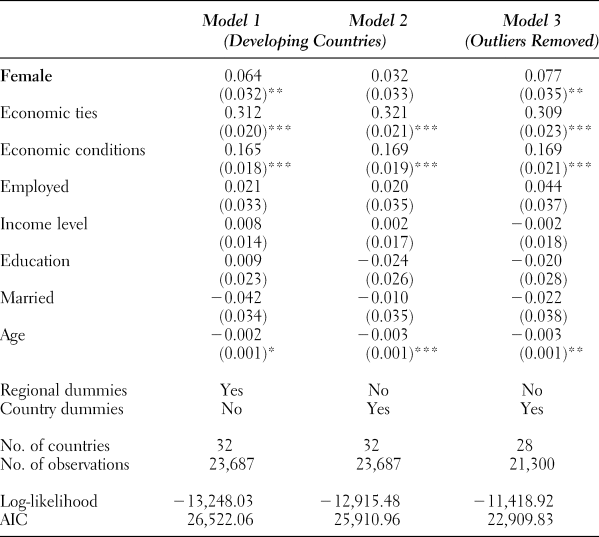
Table 1 presents the empirical results. In model 1, we included the full sample and all individual-level covariates with regional dummies. As the results show, the coefficient for female is positive and statistically significant at the 95% level. Thus, women are more likely to view FDI positively, supporting our H 1.Footnote 11 With other factors set at the observed values (Hanmer and Kalkan Reference Hanmer and Kalkan2013), the predicted probability for women to support FDI (73.8%) is roughly 1.2% higher than that for men (72.6%). Although this difference is very small, it shows at least that the gender gap observed for trade preferences does not translate to preferences with respect to FDI.
In model 2, we included country dummies instead of regional dummies to further control for country heterogeneity. As the results show, when country fixed-effects are included, the coefficient for female remains positive but loses its statistical significance. The difference in the predicted probabilities between women's and men's supportive attitudes toward FDI using the observed-value approach is 0.6%. This finding does not offer strong evidence that women prefer FDI more than men do, but it shows that unlike with free trade, women do not view FDI more negatively than men do, which also supports H 1.
Effects of gender on FDI preferences

Notes. Standard errors are in parentheses. *p < 0.1; **p < 0.05; ***p < 0.01.
Although model 2 suggests that country-specific factors affect individual attitudes toward FDI, we suspected that the existence of outlier countries where men prefer FDI much more than women drives this finding. As Figure 1 reflects, two countries—Ethiopia and Ukraine—are notable outliers in which men favor FDI more than women with a gap larger than 10%. To formally identify outlier countries, we calculated the interquartile range (IQR) and obtained two thresholds: the first quartile minus 1.5 IQR (−9.32%) and the third quartile plus 1.5 IQR (6.88%). Observations with values that fell below the former or above the latter were considered outliers (Agresti and Finlay Reference Agresti and Agresti2008). As can be seen in Figure 1, three countries—Ethiopia, Pakistan, and Ukraine—have gender gaps larger than 6.88%, and one country—Palestine—has a gender gap of −9.17%, which does not fall below but is close to the first threshold, −9.32%. Therefore, we removed these four countries from our sample.Footnote 12 Model 3 shows the results without the four outlier countries: the coefficient for female is positive and statistically significant at the 95% level. Using the observed-value approach, the predicted probabilities for women and men to support FDI are 74.9% and 73.5% respectively, indicating a gender gap of 1.4% in FDI preferences. Thus, in the remaining 28 countries, women tend to view FDI more positively than men, even after we controlled for myriad country-level factors. Overall, the results presented in Table 1 suggest that women are more likely to support MNCs than men, or at least they do not view FDI more negatively than males do.
In addition to gender, some individual-level factors may also influence individuals’ preferences for FDI (Table 1). Respondents who thought economic ties with other countries were a good thing for their countries were more likely to support FDI. People with more optimistic views about their countries’ economic conditions were also more likely to favor FDI. Age had a negative effect on FDI preferences, meaning that young people preferred FDI more than senior people. The results for these three variables are consistent across three models.
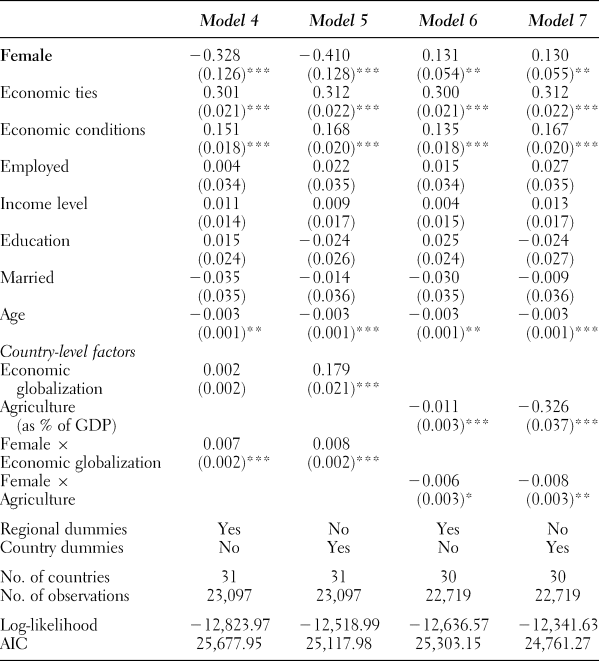
To examine whether the gender gap is conditional on particular national contexts, we included two country-level factors, economic globalization and agriculture, and their interaction terms with female in the models. Table 2 presents the results. Region or country fixed-effects were included throughout all models to control for other unobserved regional or country-level attributes.Footnote 13
Effects of gender on FDI preferences conditional on the level of openness

Notes. FDI, foreign direct investment; GDP, gross domestic product; AIC, Akaike information criterion. Standard errors are in parentheses. *p < 0.1; **p < 0.05; ***p < 0.01.
In model 4, we included economic globalization and its interaction term with female. As the results show, the coefficient for economic globalization is positive but statistically insignificant, and that for female is negative and statistically significant at the 99% level. The coefficient for the interaction term between economic globalization and female, moreover, is positive and statistically significant. This suggests that, as the level of economic globalization rises, the likelihood of women supporting FDI increases. Model 5 included country fixed-effects to replace regional fixed effects. The coefficient for economic globalization is positive and statistically significant at the 99% level. Because an interaction between female and economic globalization was included in the model, this coefficient represents the effect of economic globalization on FDI preferences for men, which suggests that men in economically more globalized countries are more likely to support FDI. More importantly, like model 4, the coefficient for the interaction term in model 5 is positive and statistically significant, meaning that how women view FDI is conditional on the level of economic globalization in their countries.
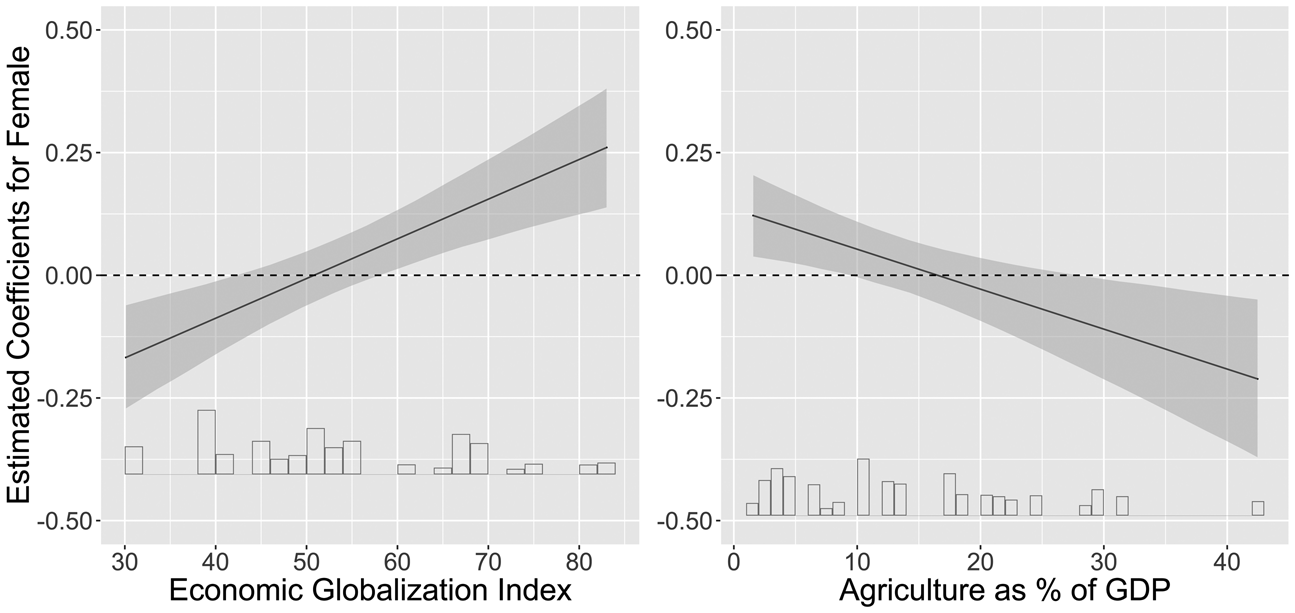
To illustrate this interactive effect, the left panel of Figure 2 presents the estimated coefficients of female conditional on economic globalization based on model 5.Footnote 14 It shows that the effect of female on FDI preferences increases as the level of economic globalization rises. In countries with a very low level of economic globalization (below 41), women are less likely to support FDI than men. In countries with economic globalization index between 41 and 58, the 90% confidence interval covers 0, which means there is no particular gender gap in FDI preferences. In countries with higher levels of economic globalization (above 58), however, the effect of female on FDI preferences is positive and statistically significant.
Effects of female on FDI preferences conditional on the level of openness (with 90% confidence intervals).

In models 6 and 7, we included agriculture and its interaction with female to test whether the gender gap in FDI preferences is the opposite in more closed and traditional economies. Both models produced very similar results. The coefficient for agriculture itself is negative and statistically significant, suggesting that men in agricultural countries are less likely to support FDI. The interaction term between agriculture and female, moreover, also has a negative and statistically significant coefficient, whereas the coefficient for female alone is positive and statistically significant. This means that women are more likely to favor FDI than men when a country has no agricultural sector. As the level of agricultural dependence increases, the effect of female on FDI preferences decreases.
The right panel of Figure 2 presents the effect of female conditional on the size of the agricultural sector. As can be seen, in countries that are minimally dependent on agriculture (i.e., those with agriculture output accounting for less than 9% of the GDP), the effect of female is positive. In countries whose agriculture share in GDP falls between 9% and 29%, the effect of female on FDI preferences is statistically insignificant. The gender gap is reversed in countries that are heavily reliant on the agricultural sector. In other words, in countries with a more traditional social structure, women may benefit less from FDI and thus are less likely to support FDI than men.
In sum, our findings using survey data suggest that in general women are more likely to favor FDI than men, albeit with a small difference. This gender gap, however, is not universal. In countries that are economically more open to the world, women are more likely to have positive attitudes toward MNCs than men, presumably because they benefit from FDI or sense the positive effect of FDI. In more traditional or isolated countries, women do not have the opportunity to enhance their status by economic globalization; therefore, it is less likely that they will view FDI positively.
We also conducted two robustness checks. First, although our theory focuses on developing countries, some mechanisms, especially diffusion of gender equality norms, may be applied to developed countries as well. Therefore, we expanded our sample to both OECD countries and non-OECD countries and perform the same analysis. Due to missing data, only six OECD countries were included in the sample, and the results remained substantially unchanged. Second, although our key dependent and independent variables are at the individual level, we included country-level characteristics in the model. Thus, using a multilevel model is meaningful, which is commonly seen in the cross-national public opinion literature (e.g., Van Erkel and Van Der Meer Reference Van Erkel and Van Der Meer2016; Weldon Reference Weldon2006). We used the multilevel model (by including country random-effects) as an alternative to the fixed-effects model, and the results did not change. The results of the robustness checks are reported in the online appendix.
CONCLUSION
As an important component of economic globalization, FDI stimulates domestic economic growth and job creation; thus, many governments strive to attract FDI. This is not only the case in developing countries where capital is less abundant but also can been seen recently in developed countries, such as the United States, where politicians pledge to create jobs and promote employment. Although the IPE literature has extensively explored country-level determinants of FDI, individual attitudes toward FDI are understudied, especially in comparison to the number of studies on trade.
In this article, we have examined the gender gap in the formation of FDI preferences. Building upon the logic of economic self-interest and FDI's role in diffusing social norms, we have argued that although women in developing countries view trade more negatively than men, MNCs offer more job opportunities, higher wages, and better work environments for women, reducing the gender wage gap and promoting gender equality and that, therefore, the same gap will not exist. The gender gap in FDI preferences, moreover, is conditional on a country's level of economic globalization, as women in countries that benefit more from economic openness are more likely to feel the positive effect of FDI, thus showing more positive attitudes toward FDI. Our empirical findings using survey data in 2007 across 32 developing countries show that women are more likely to view MNCs positively than men and that the effect also depends on a country's economic globalization and openness. Although the gender gap in FDI preferences may not appear in less globalized countries, women in highly globalized countries or countries less dependent on agriculture are more likely to favor FDI than men.
One limitation of this article, however, is that we did not consider sectoral differences, either at the individual level or at the country level. Women who are employed in sectors where FDI is more abundant may view FDI more positively. Different sectors may also have different effects on women's attitudes toward FDI, as not all industries hire more women than men. Although we implicitly tell a sectoral story, we were unable to test the sectoral effects due to data unavailability. Future research might explore the sectoral variation and examine how sectoral employment influences individual attitudes toward FDI or the gender gap in FDI preferences. Another limitation of our study is that the sample is not representative. The limited number of countries and a single year of survey data make our findings far from generalizable. Although this is a common problem in cross-national public opinion research, future works can increase the sample size and rely on a more representative sample.
Our findings contribute to the IPE literature and offer important policy implications. We provide the first analysis on the gender gap in individual preferences for FDI. Unlike studies on trade preferences, which generally show that women are less supportive of trade than men, we point out an opposite gender gap in FDI preferences: women are more supportive of FDI because FDI is directly linked to job creation for women and indirectly to the promotion of gender equality. This study also contributes to a broader body of literature on globalization and gender by showing that women's views on globalization are more nuanced than previous research suggests and are contingent upon the type of globalization that women are linked to. Our findings suggest that governments seeking foreign capital can utilize support from women to gain leverage over MNCs, especially foreign firms that commit to affirmative action practices and workplace gender equality. Governments that successfully attract MNCs are also more likely to win support from female voters, resulting in a win–win–win situation.
SUPPLEMENTARY MATERIAL
To view supplementary material for this article, please visit https://doi.org/10.1017/S1743923X18001058.