Introduction
In early 1967, shortly after the onset of its decade-long Cultural Revolution, China’s civilian political structures collapsed in a wave of rebel power seizures. Armed political factions subsequently fought one another across most provinces until the reimposition of order by military units near the end of 1968. In the course of these armed conflicts and the effort to suppress them and rebuild the political order, the national death toll reached close to 1.6 million (Walder Reference Walder2014; 2019: 188–93). During this brief period, one province stood out as unusually violent: Guangxi, on China’s border with Vietnam.Footnote 1
Guangxi’s experience was distinctive in several ways. First, its documented death toll far surpassed that of any other province, many of which had populations several times larger. Second, the final battles to pacify major cities involved the bombardment of entire neighborhoods with heavy arms and artillery, reducing them to rubble. During the bombardment, thousands were killed, similar numbers were executed afterward, and tens of thousands of the city residents were left homeless (Walder Reference Walder2019: 176–78). Third, the killings were not limited to activists and armed fighters on the losing side; they included large numbers of noncombatants in politically stigmatized households that were uninvolved in the conflicts. This was particularly common in rural areas (Song Reference Song2002; Su Reference Su2011). Fourth, rural killings were frequently carried out with shocking brutality. Later investigations revealed abundant examples of sexual violence, the mutilation and dismemberment of corpses, and even cannibalism (Sutton Reference Sutton1995; Zheng 1996).
What was it about Guangxi that so exaggerated the levels of violence? The collapse of civilian governments in early 1967 and the subsequent period of armed factional warfare was common across China, and the suppression of conflicts and the rebuilding of political order generated far more casualties than the factional warfare (Walder Reference Walder2014). As in Guangxi, violence was concentrated in regions that had languished the longest before reestablishing a local government (Walder and Chu Reference Walder and Chu2020). However, the upsurge of deadly violence during the reimposition of political order was far more intense in Guangxi. Killings of noncombatants in politically stigmatized households did occur elsewhere, but they were rare and limited to one county or a cluster of counties (Song Reference Song2002; Tan Reference Tan2017). They occurred widely across Guangxi and generated an unusually large percentage of the deaths.
The most carefully documented analysis of these events attributes Guangxi’s catastrophic violence to collective behavior in villages of the kind that bred genocidal intergroup violence in other settings (Su Reference Su2011). The violence focused on rural households permanently stigmatized as enemies of the people for their historical associations with exploiting social classes and opponents of the Communist Party. The killings appeared to be disconnected from the factional conflicts that beset Guangxi’s urban areas. They seemed to be touched off inadvertently by rhetoric unleashed against the losing faction in the cities, which portrayed them as conspiring with foreign enemies and historical opponents of the regime to overturn Communist Party rule.
Su further proposed that these collective processes were accelerated by distinctive regional characteristics. The most important was the history of Han migration into the southern reaches of China’s historical empires, which generated traditions of clan warfare and martial self-defense in local communities divided between early Han settlers and culturally distinct later migrants known as Hakka. A second regional characteristic was the remoteness of many of the villages and the relative weakness of local state structures, where it appeared that killings were more likely to spiral out of control. According to this analysis, these two factors worked together to generate death tolls unrivaled elsewhere in China. This explanation draws explicit parallels between the killings in Guangxi’s villages and genocidal intergroup violence in other settings. It pushes well into the background the origins, development, and structure of factional conflicts, which were thought to be restricted to urban areas.
This article draws on unusually detailed sources that document for every city and county in Guangxi during this period the unfolding of factional conflict and its subsequent repression. It pulls into the foreground the origins and structure of the factional conflicts, which penetrated deeply into many rural districts. At the core of the explanation is a military hierarchy that paralleled the civilian structures of the party-state. This hierarchy reached every village in the form of militia forces under the command of the lowest rung in the regional hierarchy of the People’s Liberation Army. These networks overlapped with factional divisions, and local militia were aligned with one of the two province-wide civilian factions. When repression was unleashed against the weaker of the two factions, it extended deeply into rural communities through these networks, which activated village militia. What appeared in some descriptions to be collective action by ordinary villagers was in fact an organized campaign of elimination coordinated through the provincial military hierarchy, which activated militia forces in villages. The picture that emerges more closely resembles the massacres of suspected Communists and other leftists coordinated by the Indonesian army in 1965 (Robinson Reference Robinson2018), and counterinsurgency campaigns in Guatemala and other settings that target noncombatants along with insurgents (Ball et al. Reference Ball, Paul and Spirer1999).
These materials also provide evidence that casts doubt on the notion that Guangxi’s population and history were distinctive in ways that intensified the violence. The most important such distinction appears to be contemporary and geopolitical: Guangxi was a staging area for military support for China’s Vietnamese allies during the period when the American war effort escalated to unprecedented levels. This played a central role in Beijing’s decision to unleash repression in a strategic border region where factional warfare had proven highly resistant to negotiation and compromise.
Regional Characteristics
Before we consider the political processes that led to these killings, we should first note several ways in which Guangxi was distinct from other regions. It was overwhelmingly rural and economically underdeveloped; it had an unusually large and diverse population of ethnic minorities; it had generated successive rebellions against Chinese empires over the centuries; and it was located on the border with Vietnam during the height of the American military campaign against the North. All these might have intensified violence either directly or indirectly.
The first distinctive feature of Guangxi was its backwardness. It was one of China’s least industrialized regions, ranking 25th out of the 29 provinces at the time. Its capital, Nanning, had a population of only 457,000, while other provincial capitals averaged more than 1.5 million. The remaining cities averaged only 188,000 residents. Educational levels were very low. There were only 7,120 university students in the province (Guangxi Local Annals Editorial Committee 1995: 438, 441–45). Beijing’s Tsinghua and Peking Universities both had more students (Walder Reference Walder2009, 20 and 23). In a province of 25 million, there were only 29,312 in high school. With more than 317,000 enrolled in junior high, the odds of advancing to the next level were slim (Guangxi Local Annals Editorial Committee 1995: 209). Mountainous terrain left many villages poorly accessible and isolated. Some who have chronicled these events viewed reports of ritual mutilation and cannibalism as symptoms of the region’s backwardness (Zheng 1996).
Another distinctive feature is Guangxi’s unusually large population of non-Han ethnic groups. Only 60 percent of Guangxi’s population in the mid-1960s were classified as Han Chinese, and just more than one-third were Zhuang, China’s largest ethnic minority.Footnote 2 As an “autonomous region” set aside for the Zhuang, Guangxi was in the same administrative category as Tibet, Inner Mongolia, Ningxia (for Han Muslims), and Xinjiang (for Muslim Uighurs).
The Zhuang are part of a Tai language group distributed across the southern borders of China and northern Thailand, Vietnam, and Laos. Well into the twentieth century they spoke a language distinct from both the Cantonese and Mandarin dialects spoken in Guangxi, and language was the primary marker of their identity. Violence in other minority regions during this period has been attributed to ethnic divisions. Inner Mongolia suffered a brutal campaign against an alleged “Inner Mongolian People’s Party” that generated death tolls rivaling Guangxi’s. One analyst has argued that the campaign was a disguised form of ethnic cleansing (Yang Reference Yang2014). A bloody rebellion in Tibet during this period has been interpreted as mobilization against Han Chinese oppression (Ngagpo Reference Ngagpo1988; Smith Reference Smith1996).
Unlike Mongols and Tibetans, the Zhuang are not marked off from Han by distinctive religious and cultural traits or aspirations for political autonomy in the modern era. The last kingdom identified with the Zhuang was defeated a thousand years ago. By the twentieth century most Zhuang had assimilated into Han culture, and in the 1938 census they were counted as Han (Mackerras Reference Mackerras1994: 44, 130, 144, and 266). It is nonetheless true that Guangxi was a notably unruly part of Chinese empires. It was one of the last to be settled by Han migrants and was one of the most rebellious provinces during the Ming dynasty of 1368–1644. The Taiping Rebellion (1850–67), which came close to overthrowing the Qing Dynasty, originated in northeastern Guangxi (Kuhn Reference Kuhn1978). Many localities with high death tolls during the 1960s were in the region where the Taiping Rebellion was launched (Spence Reference Spence1996: 126–57).
In his carefully documented study of mass killings in Guangxi and neighboring Guangdong Province, Su (Reference Su2011) argued that the link between the region’s history and the events of the late 1960s are to be found in the presence a distinctive Han subgroup known as Hakka, the Cantonese pronunciation of the term “guest people” (kejia). Culturally and linguistically distinct from other Han migrants who settled in the valleys in earlier Chinese empires, they migrated into the region in recent centuries (Hashimoto Reference Hashimoto1973; Leong Reference Leong1997). Settling in marginal hilly lands and mountain districts, they often battled established groups over land and water rights (Cohen Reference Cohen1968). The Taiping rebellion originated among Guangxi’s Hakkas, and its founders and early leaders were all Hakka. The group had a reputation in early modern times for clan warfare and blood feuds. The largest and most dramatic of these battles were the Hakka-Punti wars that raged in parts of Guangdong from 1855 to 1867, claiming the lives of close to one million (Roberts Reference Roberts1969).
Su (Reference Su2011: 79–94) argued that Hakka villages retained a martial tradition of collective self-defense, a legacy that served to intensify the violence in localities where Hakka were concentrated. Drawing on published local histories and population data from 116 counties in Guangxi and Guangdong, he found that counties with larger populations of Hakka had larger death tolls. He found, further, that counties where Zhuang and other minorities were concentrated had lower death counts (Su Reference Su2011: 233–35). The link to the past that accounts for the region’s intense violence, Su argues, runs through the Hakka subgroup.
A final feature of Guangxi clearly distinguished it at this point in history—the geopolitical and military significance of its location on the border of Vietnam. It was during this period—1966 through 1968—that military escalation by US forces reached its peak. There were other border regions where security concerns were important, but only Guangxi was adjacent to an active war zone in which China played a key support role. During the rapid escalation of the war after 1965, there were regular violations of Chinese air space by American aircraft, and Guangxi was the rear base for air support and the movement of engineering and antiaircraft units into Vietnam. Systematic bombing of North Vietnam’s ports, railways, and cities began in late 1965 and intensified through 1968. Guangxi was the main route for shipping military supplies along a railway line that ran through the border town of Pingxiang. In August 1964, the headquarters of the PLA’s 7th Air Force Division was relocated from Guangdong to Nanning to defend Guangxi and the Gulf of Tonkin, and two new airports were built to serve four air divisions relocated toward the border. At the same time, the PLA’s 47th Army Corps was also sent into Guangxi for border defense (Chen Reference Chen1995: 364).
Although these geopolitical considerations were far from the concerns of political factions and villages where mass killings occurred in 1968, they shaped the context in which the conflicts unfolded. They were a key consideration in Beijing’s unusual decision to retain Wei Guoqing, Guangxi’s long-standing top official, to head military control forces after the collapse of civilian government in early 1967. His appointment became the primary source of conflict between rebel factions in Guangxi, and for a long period it was also controversial in Beijing. The escalation in Vietnam also appears to be a key factor in Beijing’s decision to unleash repression against stubborn insurgent holdouts in July 1968. In 1964, when China began to build up its military forces in Guangxi, the United States had close to 24,000 combat soldiers in Vietnam. By 1968, they had more than 500,000 and were intensively bombing the North. The rapid escalation of the war on China’s doorstep, and Guangxi’s role as a staging area, intensified geopolitical and security concerns that became irreconcilable with the disruptions that Mao had encouraged earlier in the Cultural Revolution. As Guangxi’s conflicts wore on, and as the American military campaign escalated beyond all imagination, Beijing’s tolerance for rebel discord in Guangxi evaporated. These concerns were unique to Guangxi, and they shaped the broader context that makes the massacres of 1968 intelligible.
Political Violence as Collective Behavior
Published accounts in China frequently provide detailed chronological narratives of these conflicts, but they are silent about Guangxi’s ethnic composition and do not refer to any other distinctive features of the province (e.g., Guangxi Cultural Revolution Chronology 1990). It is not surprising that official publications would obscure any ethnic dimension to the violence. The regime strives to project an image of national harmony promoted by generous treatment of ethnic minorities. In narrating the flow of events these accounts place overwhelming emphasis on the impact of the “July 3 Orders” (qi.san bugao), a harshly worded 1968 directive from Beijing that mandated the restoration of order by force, designating rebel holdouts as class enemies and agents of foreign powers (Bu Reference Bu2008: 707–15). The narratives condemn these orders and the wave of killings that followed, which are framed as a consequence of an erroneous political line. This implicitly designates the July 3 Orders as the feature that set Guangxi apart from other regions. The orders evidently triggered subsequent events, but they do not explain the severity of the violence by themselves, or the reasons why it focused to such an extent on politically stigmatized households. What were the processes unleashed by the July 3 Orders?
The best documented analysis of the killings in Guangxi interprets the impact of the July 3 Orders from the perspective of social movement theory and research on genocide as a form of intergroup violence (Su Reference Su2011). It focuses on collective processes in rural communities that were inadvertently sparked by civilian and military authorities in their final push to consolidate political control over cities. In this portrayal, official political rhetoric framed violence against rebel insurgents as a righteous defense against the underground conspiracies of class enemies, creating unintended consequences in remote rural communities. Mass killings of noncombatants spiraled out of control in villages, focusing on politically stigmatized households (former landlords, rich peasants, former members of the Nationalist Party or army, and others designated as political enemies). This line of analysis emphasizes the Chinese regime’s practice during this period of formally designating entire households according to political categories that became caste-like identities inherited through the male line (Unger Reference Unger and James1984; Walder Reference Walder2015: 108–12).
Su’s analysis is based on an intensive examination of 116 published local histories for Guangxi and Guangdong provinces. These publications, remarkably frank given political censorship in China, provide considerable detail about killings at the village level, which the compilers of the histories were intent on exposing. Mass killings of stigmatized households were rarely reported in urban areas, and armed conflict between political factions appeared to be restricted primarily to the cities. Based on these sources, it did not appear that there was widespread factional conflict in villages. Su (Reference Su2011: 38) calculated the deaths attributable to armed battles in these materials and found that they comprised only around 14 percent of the total reported deaths. He concluded that the remainder were almost entirely attributable to mass killings in villages, and that almost all of those killed were noncombatants in politically stigmatized categories.
How, then, to explain mass killings in rural regions? In this portrayal, factional warfare was an urban phenomenon separate from the killings in rural communities. The campaign to suppress factional enemies in urban conflicts indirectly spurred members of rural communities to commit collective campaigns of extermination against noncombatants in stigmatized households. Su notes that the July 3 Orders, which mandated the merciless suppression of remaining insurgents in the losing faction, justified this with the charge that these insurgents were in fact part of a counterrevolutionary conspiracy to overthrow Communist Party rule, and that they were working with historical class enemies of the regime both at home and abroad.
This argument draws on a concept from the cognitive branch of the social movement literature known as “framing.” As the July 3 Orders were repeated by authorities and relayed down to recently reestablished governments in counties, those in politically stigmatized households were identified as active coconspirators in an effort to overthrow the existing order. As class enemies, they were portrayed as nonpersons, suitable for extermination in a revolutionary class war. This unleashed a wave of killings in villages, removing inhibitions against inhuman acts (Su Reference Su2011: 188–220). Su draws explicit parallels with genocidal acts by ordinary citizens in Rwanda, Bosnia, and other settings (Strauss Reference Strauss2006; Valentino Reference Valentino2004).
This is the most credible existing analysis of why Guangxi was different. It addresses both of the key puzzles presented by the case—the unusually high death tolls and the reasons why the killings focused on an underclass of politically stigmatized noncombatants. It accounts for the impact of the July 3 Orders. It also specifies regional characteristics that appear to have magnified the violence. And it provides a coherent theoretical argument that draws explicit parallels with the literature on genocide and intergroup violence in other settings.
The analysis is also firmly based on evidence extracted from a large number of published local histories. The key supporting observations, based on these materials, are the following. First, the factional conflicts between Guangxi’s two rebel alliances were limited primarily to cities and to the county seats and did not extend into villages. Second, rural killings were carried out by covillagers who were mobilized by the rhetoric of authorities at the province and county level, inadvertently spurring a largely unintended wave of killings. Third, because armed battles between factions were responsible for only a small portion of the overall death toll, the vast majority of those killed were members of stigmatized households rather than members of a rebel faction. Finally, killings were not carried out by agents of the state, but instead were the product of collective behavior by village residents.
New Sources
In this article I analyze a dataset of political events extracted from classified government investigation reports compiled during the 1980s. The new materials, which have only recently become widely available, provide an opportunity to examine this case in greater depth. They provide far more narrative and statistical detail about the conflicts of this period than the published local histories that have formed the foundation for prior research.
The new materials are from an extraordinary investigation by central government authorities in the 1980s, a period when the post-Mao leadership was determined to expose the violence and injustices of the Cultural Revolution. After it became clear that Guangxi officials were covering up the death tolls and the parties responsible, the Central Committee of the Chinese Communist Party dispatched two waves of investigators to the province in the early 1980s. The first, in 1981, consisted of 20 investigation teams from a range of agencies in Beijing. They bypassed provincial authorities and fanned out across cities and counties, examined local party and government archives, and interviewed more than 700 provincial and local officials, ordinary citizens, and inmates of prisons and labor camps. After this initial foray uncovered evidence of a cover-up, a second team of higher-ranking investigators were sent to the province in 1983 and carried out an even larger and more thorough investigation that involved examination of local archives and interviews with survivors. More than 100 officials on Beijing-led teams employed close to 100,000 local personnel, compiling detailed reports on every county and city (Guangxi Party Committee 1987, 1: 1; Yan Reference Yan2012).
The result was an 18-volume set of paperbound books, encased in blue plastic covers, issued in 1987 and 1988 as “organization-level secrets” (ji mi) (Guangxi Party Committee 1987). Ranging from 394 to 854 pages in length, they detailed local events and the punishments meted out to officials, party members, and others who were found responsible. The volumes have been transcribed and published as 36 volumes of searchable electronic files, 2 per each of the original 18 volumes (Song Reference Song2016).Footnote 3
Extracting Data from Narrative Accounts
Prior research on this period has drawn on datasets compiled by coding information in published local histories. Walder and Su (Reference Walder and Su2003) analyzed data from more than 1,500 rural county histories. Su (Reference Su2011) extracted data from 187 local histories from three provinces, including Guangxi. Walder (Reference Walder2014, 2019), Walder and Lu (Reference Walder and Lu2017), and Walder and Chu (Reference Walder and Chu2020) analyzed a dataset drawn from 2,246 local histories, covering 97 percent of local jurisdictions.
The detail in the internal reports far surpasses the published histories. The Guangxi publications devoted an average of 9.8 pages (defined as 500 Chinese characters per page) to describing events from mid-1966 to the end of 1971. The investigation reports devote an average of 37 pages to events from mid-1966 to the end of 1969. The published histories contain reports of 560 conflict events, an average of 6.5 per jurisdiction. The investigation reports describe 4,938 events, an average of 57 per jurisdiction—nine times more narrative detail.
The resulting dataset contains three types of variables. The first is a range of demographic, organizational, and geographic features of each of the 6 cities and 80 counties, drawn from statistical handbooks and other publications. The second records the timing of political events that occur only once, tracing the evolution of local political processes: for example, the first appearance of a rebel group, a power seizure over a local government, the formation of political factions, the first intervention of military forces, and the reestablishment of local government. Few localities have missing information about such events. The third type of information was more difficult to code because of the richness of the descriptions of events that occurred repeatedly. Coding schemes drawn from the sparse descriptions in local histories employed a small number of broad coding categories (Walder Reference Walder2014, 2019). The much richer account descriptions created dilemmas about assigning a specific event to categories and raised questions about the definition of an event.
To retain in the dataset as much narrative detail as possible, each conflict event was coded along three separate dimensions. The first is a classification of 27 categories that “best characterize” the action described. Narrower categories are reserved for simple actions, while broader categories are reserved for more complicated event sequences. For example, if individuals are seized and imprisoned by an opposed faction, the action is categorized as “arrest/imprisonment.” If arrests are described as taking place in the wake of a battle between armed factions, the action is categorized as “armed battle.” If the arrests are described as taking place as part of a suppression campaign, the action is categorized as one of several types of “campaign.” The general rule is that broader event categories can contain actions that are covered in the narrow categories, but the narrower events are not coded as broader categories. This retains flexibility for analysts to combine different categories according to distinctions that are relevant to a specific question. For each action, the numbers killed, injured, or otherwise harmed are recorded, if such figures are provided. If no figures are provided, 0 is entered.
Each event is also coded on two other dimensions—the actors that carried it out, and who suffered. Because more than one type of actor is often mentioned, up to three types of actors can be recorded for each event. The same is true for “harmed parties.” This permits the analyst to distinguish between types of killings—for example, when the actor is the local militia and the harmed parties are members of a losing faction, or when the actors are members of the community, and the harmed parties are stigmatized households. The first would indicate a coordinated campaign; the second would indicate collective behavior. Third, if the description permits, each event is coded based on location in a town or a village.
Finally, the temporal definition of an event is flexible. Accounts sometimes describe a specific action on one day, a series of days, a week, or an entire month. All are recorded as an action, but to distinguish them the starting and ending dates are recorded. The coding of action types, actors, harmed parties, and starting and ending dates provide flexibility while preserving as much detail as possible. To ensure that an event is counted only once, an additional code indicates whether an event on one day or several days overlaps with a more broadly defined event in the same location. The full dataset contains variables that describe 4,938 events.Footnote 4
The Scale of Violence and Variation in Death Rates
These materials document far more casualties than published histories, which reported a total of 55,651 deaths (Walder Reference Walder2019: 214–16). The confirmed death total, set at 89,810 (Guangxi Party Committee 1987, 7: 127), was 62 percent higher than numbers reported in published histories. This implies a death rate of 3.6 per thousand, 71 percent higher than the national figure (excluding Guangxi) of 2.0 (Walder Reference Walder2019: 191). In addition to the documented deaths, there were close to 20,000 people who disappeared and were unaccounted for, and their deaths could not be confirmed (Yan Reference Yan2012). The strict controls over population movement and rationing make it unlikely that many of them fled and remained undetected. If we assume that roughly half of the “missing” were killed, the overall death toll would be close to 100,000, a provincial death rate of close to 4.0 per thousand, double the death rate for the rest of China.Footnote 5
Before turning to the political processes thought to generate high death tolls, I will briefly revisit Su’s findings, based on published local histories, that large ethnic minority populations were associated with fewer deaths, while large Hakka populations were associated with higher ones. We need to be clear that we are asking not whether violence may have expressed group antagonisms, but why death rates were higher in Guangxi than elsewhere. If death rates in Guangxi were higher due to its mixed population of ethnic and subethnic groups, then these differences should also be apparent within Guangxi. It should be precisely in those subregions of Guangxi where these groups predominated, or where they existed in mixed communities, that the violence was most intense. If this was not the case, then the reasons for Guangxi’s unusually high death rates must rest elsewhere, whatever the micro-level connections between local history, culture, and the manifestation of conflict in thousands of villages.
Prior findings that implicated Hakka were based on evidence that considered Guangxi together with Guangdong (Su Reference Su2011). There are 15 counties in Guangdong that historically have been almost entirely Hakka-speaking. Roughly 35 percent of Guangdong’s population was Hakka.Footnote 6 There were only two counties in Guangxi with a bare Hakka majority, and Hakka constituted only 9 percent of the provincial population.Footnote 7 Even if Hakka communities were prone to more intense group conflict, they could only marginally have inflated Guangxi’s death rates.Footnote 8
Preliminary examination of mean death rates across localities defined by population characteristics (not shown) suggests little support for the idea that violence was more intense in Guangxi due to ethnic diversity. The 10 counties where Hakka were more than 20 percent of the population had considerably lower death rates (2.6 per thousand) than the provincial average of 3.6.Footnote 9 Localities where the Han comprised 70 to 93 percent of the population had higher than average death rates (4.2 per thousand), while localities that were almost completely Han (above 93 percent) had markedly lower death rates (3.0 per thousand). There are wide variations in death rates within each category, cautioning against drawing conclusions based on raw averages. Not surprisingly, in regression models that include each of these categories with a control for local population size (not shown here), none of these categories has a statistically significant impact on local death counts.Footnote 10 I will further consider ethnic diversity in regression models later in this article, but this preliminary analysis suggests that the features that caused Guangxi to depart from other regions are more likely to lie with distinctive political processes that were common across subregions, whatever the composition of their populations.
Political Processes
We now turn to an understanding of the political processes responsible for Guangxi’s higher death rates. The idea that high death tolls across Guangxi were generated by intergroup violence is based on a series of observations drawn from published local histories:
Factional conflicts between Guangxi’s two rebel alliances were limited primarily to urban districts and were largely absent in villages.
Rural killings were carried out by covillagers spurred by the rhetoric of urban authorities, instigating violence against neighbors in stigmatized households.
Armed battles between factions generated a small percentage of the death tolls, and the remainder were unrelated to factional conflicts.
Killings within villages were not carried out by agents of the state but were the product of collective behavior in villages.
Killings were more severe in remote counties with weaker party-state structures, permitting intergroup violence to spiral out of control.
I propose an alternative political process that brings into the foreground the factional conflicts that are obscured in analyses that posit collective killings as intergroup violence in isolated rural communities. The evidence gleaned from investigation reports portrays the killings as part of a coordinated counterinsurgency campaign by the military hierarchy and its village militia, which targeted factional activists and those in stigmatized households, the latter as suspected collaborators. This emerges from the following observations based on the new materials, which contrast with each of those enumerated above
Conflict between Guangxi’s two political factions was present in almost every city and county, and the related conflicts frequently extended into rural districts.
Rural killings were part of an organized province-wide campaign coordinated by government committees and occurring in a concentrated period.
While armed factional battles generated a small percentage of the deaths, many if not most of those killed in villages were active members of factions or their relatives.
Killings in villages were ordered from above and implemented by village militias that were part of the provincial military and political apparatus.
Death rates were lower in remote regions and localities with weaker local party-state structures, places where the reach of the state was more limited.
The idea that stigmatized households were collateral damage in a highly organized counterinsurgency campaign makes better sense of a wave of killings that occurred within a concentrated period in a large region of 25 million. Had these actions depended on thousands of independently generated instances of collective behavior at the village level, it is unlikely that they would have been more common than elsewhere in China.
The Structure of Factional Divisions
Guangxi’s political conflicts involved two factional alliances—the “Allied Command” (lianzhi) and “April 22” (4.22, or si.erer). They originated in March 1967 in Nanning and spread throughout the province by the end of that year. As elsewhere in China, they began as local disputes between rival rebel coalitions in the wake of power seizures over local governments. Power seizures spread rapidly after a January 22, 1967, call issued from Beijing for rebels to “seize power” (Walder Reference Walder2019: 79–107; Walder and Lu Reference Walder and Lu2017). Guangxi closely followed the national pattern. Power seizures spread rapidly, starting with the provincial government on January 23. Within one week, the governments of close to 60 percent of all cities and counties were overthrown by rebels, and by the end of March, 75 percent.
Precisely because power seizures spread rapidly, only a fraction of rebels were included. This led to protests by excluded rebels, and mutual denunciation and conflict (Walder and Chu Reference Walder and Chu2020). Disagreements hardened when military units arrived under orders from Beijing to “support the left” and consolidate new structures of power. This forced military units to intervene in rebel disputes, causing a political realignment. Rebels favored by military commanders aligned with them; rebels not favored challenged them, and they could be met with arrests and bans that declared them “reactionary.” This shifted the axis of conflict: from disputes among rebels over power seizures to alignments of rebel groups for and against military units. It also raised the stakes of conflicts because rebels who lost out could expect to suffer from imprisonment or discrimination by new military-backed authorities (Walder Reference Walder2019: 116–26).
The militarized structure of the Chinese party-state facilitated rapid and thorough intervention, ensuring that rebel cleavages spread widely. China’s armed forces were organized for defense and internal security. Each level of government was paralleled by a military jurisdiction: provinces were generally coterminous with military districts (jun qu) of the People’s Liberation Army (PLA) and prefectures and large cities with military subdistricts (jun fenqu). Counties and small cities were coterminous with People’s Armed Departments (renmin wuzhuang bu), or PAD. The PADs were headed by a serving PLA officer and staffed by a small number of military police. The PAD’s subordinate branches commanded citizen militia forces (min bing) (Dong and Walder Reference Dong and Walder2021: 15–17). In rural counties, military intervention was usually led by a PLA officer who was the head or political commissar of the PAD (Nelsen Reference Nelsen1972). Beijing’s orders for the PLA to “support the left” made the PAD the sole branch of local government immune from overthrow, giving its leaders the authority to rule on the conflicting claims of rival rebels. By the end of April 1967, military intervention had reached almost all localities in Guangxi. These military units assumed the functions of local government in anticipation of the eventual formation of a new power structure—a “revolutionary committee.”
The structure of military forces had direct implications for the factional battles and wave of killings that spread across Guangxi. Civilian rebels aligned with military forces—at the county level, the PAD—had an initial advantage in fighting units, which was concentrated in villages. In many counties the PAD’s favored faction coordinated with them so closely that it was difficult to distinguish the favored rebel faction from the PAD’s rural militias.
The Formation of Factional Alliances
The province-wide alliances that became known as Allied Command and April 22 originated with the disintegration of the provincial power seizure coalition in Nanning in early February. A group of rebels who were part of that power seizure withdrew, denounced the rebels who led it, and mobilized to challenge it. The PLA unit that intervened to “support the left” initially supported the power seizure, but later withdrew that support in favor of the rebels who withdrew (Guangxi Cultural Revolution Chronology 1990: 15–20).
These tensions deepened after Beijing placed Guangxi under military control in late March, awaiting the formation of a new government (Guangxi Cultural Revolution Chronology 1990: 22). The person chosen to head military control forces—Wei Guoqing—had been Guangxi’s Provincial Governor since 1955, and its First Party Secretary since 1961 (Guangxi Organization Department 1995: 423, 426, 430, 514; Organization Department, CCP Central Committee 2004: 805). Guangxi was the only instance in which Beijing designated an incumbent provincial leader to head the military control forces. The civilian government long headed by Wei Guoqing was overthrown in the late January power seizure, and all rebel factions had earlier targeted him as the head of Guangxi’s “bourgeois reactionary line.” Wei’s surprising appointment ran directly counter to the radical Maoism that inspired the rebel campaign across China, and it forced Nanning rebels into difficult choices. Radical figures in Beijing were opposed to Wei’s appointment and worked behind the scenes to mobilize opposition and force his removal. Their emissaries in Nanning made common cause with the rebels whose power seizure had lost the PLA’s initial support, and they mobilized other provincial leaders in the succeeding weeks to declare their opposition to Wei and their support for anti-Wei rebels. The highest-ranking such official, Wu Jinnan, was the third-ranking party official in Guangxi at the outset of the Cultural Revolution, and he became the figurehead of the opposition rebel faction. This opposition was coordinated behind the scenes by members of Beijing’s Central Cultural Revolution Group who objected to the way that military forces were imposing order across China (Guangxi Party Committee 1987, 18: 17–35, 49–53).
There were clear geopolitical motives for the retention of Wei, and they ran counter to the radical impulses that inspired the rebel campaign. The most obvious was that Guangxi bordered Vietnam and was the staging area for China’s efforts to provide support against a rapidly escalating American war effort. Wei Guoqing retired as a General in the PLA in the mid-1950s. Wei was not just any veteran PLA commander. In the final years of his military career, he forged deep ties with Vietnam’s civilian and military leaders. He headed China’s military support group to the Vietnamese Communists during their war against the French in the early 1950s. He is credited with having provided military advice that led to key victories, in particular the strategy that led to the surrender of French forces at Dien Bien Phu (Chen Reference Chen2001: 118–44; Li Reference Li2019: 108–29; Zhai Reference Zhai2000: 45 and 74).
The geopolitical motivations for Wei’s retention were openly stated. When Zhou Enlai appointed Wei to head military control forces, he explicitly mentioned Guangxi’s role in the front line of Vietnam’s struggle against American military aggression (Guangxi Cultural Revolution Chronology 1990: 22). Whatever the domestic agenda of the Cultural Revolution, armed resistance against imperialism was a core element of Maoist ideology, influencing Beijing’s decisions regarding Wei. This forced Guangxi’s rebels to make difficult choices, irrevocably splitting them.
The formation of the Allied Command and April 22 factions followed shortly after a dozen former members of the Guangxi Party Committee, led by Wu Jinnan, declared at a rally on April 19 that they were opposed to the appointment of Wei Guoqing. Wu’s statement was distributed in news sheets and handbills. Inspired by his statement, rebels staged a mass demonstration in opposition to Wei in Nanning on April 22, and the ensuing coalition took that date as its name. Rebel groups across Guangxi who opposed the decisions of local PLA and PAD commanders declared their support for Wu Jinnan, while those favored by local military units pledged support for Wei. These declarations resonated with rebels in rural counties, even though the substance of local disputes had no direct relationship to the political disputes in Nanning. The PADs were part of a provincial hierarchy that reached upward through military subdistricts to the Guangxi Military District, led by Wei Guoqing. They were obligated to declare support for Wei, their superior in the provincial hierarchy. This was the foundation on which province-wide factional alliances were built—rebel groups favored by the local PAD pledged support for Wei and became known as the Allied Command; their rivals pledged support for Wu and became known as the April 22 faction. This structured the factional rivalries across Guangxi.
Beijing acknowledged these splits in early May, ordering delegations of rebel leaders, regional officials, and military officers to come to the nation’s capital to negotiate. These negotiations, and the new orders to the military, legitimized the April 22 faction, which had the support of radical figures in the national leadership. The negotiations dragged on until mid-November 1967, when a compromise settlement was imposed on the factions, who were sent home with orders to finalize arrangements for a Revolutionary Committee. Local factions steadily aligned themselves with either the April or Allied Command faction throughout this period, and by the end of 1967, almost every locality had factions that were openly aligned with either the April or Allied Command coalitions.
The Geographic Distribution of Factional Activity
Were the conflicts between the April 22 and Allied Command factions largely confined to cities and county seats? Data extracted from the investigation reports permit a closer look.
The investigation reports contain accounts of a range of events that involve one or both factions. There were 1,570 such events in the dataset. They include armed battles and a wide range of other kinds of events: protest demonstrations or marches; raids on arms depots, storehouses, or buildings; attacks on government officials or military units; the taking of prisoners; nonviolent confrontations; unarmed street fighting; isolated killings of opponents; and the violent suppression of one or another faction. The defining feature of this group of events is that the April 22 or Allied Command factions are named as participants.
Table 1 indicates that factional activity was widespread in rural counties. Four-fifths of all factional conflicts recorded in these materials occurred in counties, as did two-thirds of the related deaths. More relevant is the distribution of factional activity within rural counties. If the described event took place in the county seat or another large town, it is recorded as urban. If it took place in rural districts or villages, it is recorded as rural. The bottom panel of table 1 reveals that most events took place in urban settings, but that a great many—42 percent—occurred in rural districts. More deaths resulted from the factional conflicts in rural than urban settings. There were 26 events that generated close to half of all reported deaths—these were summary statements for an entire county. If we can assume that the locations in these summary accounts were roughly the same as the more than 1,000 events whose location is known, it appears that most deaths generated by factional activity occurred in rural districts.
Distribution of factional activity and related deaths, urban versus rural locations

Notes: Defined as events in which one or both rebel factions is/are named as an actor or harmed party.
These numbers indicate that factional conflicts reached well into the rural districts of counties. The rural districts were not isolated from the province-wide factional rivalries, despite the impressions derived from published local histories. This overall conclusion, however, raises yet another question. The figures in table 1 are averages, and they surely mask wide variations across counties. How many counties had factional conflict that penetrated well into rural regions, and in how many were these conflicts largely absent?
There are 1,236 events in counties in table 1 whose location is known, which over the 80 counties yields an average of 15.4 per county: 8.8 in urban districts and 6.6 in rural districts. These averages mask wide variations. In the top quarter of the distribution, there were 20 counties with a minimum of 22 events and a maximum of 61. In this group, there was an average of just under 15 factional events in rural districts. In these counties, factional conflict was pervasive and extended deeply into rural districts. In the bottom quarter of the distribution the picture is completely different. In these 20 counties there was a maximum of six events and minimum of one, with an average of less than one event in rural districts (11 reported none). In these counties there was little factional conflict, almost none in rural districts. Suppression campaigns in these counties would have found few factional opponents to target, and presumably the brunt would have fallen on the stigmatized households. Between these extremes are 40 counties that reported a total of between 7 and 22 events, and an average of five to six in rural districts. Factional conflict was evident in these counties, reaching into rural districts to a moderate degree.
In short, it appears that somewhere between one-fifth to one-third of counties had pervasive factional conflict that extended deeply into rural districts. But a roughly equal number of counties had little factional conflict, largely confined to county seats. Between these two extremes was a larger group where factional conflict was common in county seats and somewhat less prevalent in rural districts. This wide spectrum of variation defies simple characterization, but it suggests that in the rural districts of most counties there was ample factional opposition to target in suppression campaigns, while in a substantial minority there was little if any factional activity, potentially leaving the stigmatized households to bear the brunt.
Perpetrators and Victims
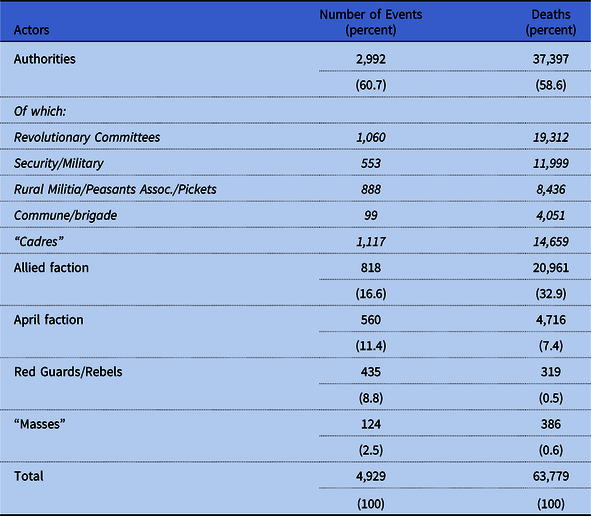
There remain two final questions: Who were the actors named as perpetrators in killings, and who were their victims? Table 2 tabulates the number of times various actors are named in event descriptions. Different actors are named 4,929 times. Up to three actors could be recorded for each event, so these are counts of the total number of times that different actors are mentioned. The overwhelming majority of events and associated deaths are actions by military, security, or government authorities, often in coordination with the Allied faction. Revolutionary committees, People’s Armed Departments, public security departments, rural militia, poor peasants’ associations, leading cadres, and the heads of communes and brigades were named in more than 37,000 killings. The Allied faction was involved in almost 21,000. The April faction was implicated in fewer than 5,000 deaths. Actors under the command of the Guangxi Military District or the Allied faction were involved in more than 90 percent of reported deaths.
Identities of the Killers

Who were the victims? Table 3 indicates that the largest single group by far were individuals associated with the April faction—more than half of those killed. More than three times as many individuals associated with the April faction were mentioned than the second-largest group, the politically stigmatized households. To be sure, it is likely that members of politically stigmatized households were also counted in other categories. They could be charged with membership in counterrevolutionary organizations, or they could be identified as “masses.” However, this is also true for those associated with the April 22 faction. The enormous imbalance in the death tolls of the two factions further reinforces the conclusion that the killings in Guangxi were a coordinated suppression campaign in which one faction was systematically liquidated, with “bad class” households intentionally swept up in the process.
Identities of the Victims

Before we draw broad conclusions about the general character of mass killings in Guangxi, however, we need to keep in mind that these numbers are averages across 80 counties and 6 cities. It is possible that politically stigmatized households may have been the primary targets in many localities. If we sum the numbers displayed in table 3 by jurisdiction, we can calculate the ratio of those killed in the politically stigmatized categories versus the April faction (stigmatized household deaths/[stigmatized household + April faction deaths]). The results show that there are many localities where the killings focused almost exclusively on politically stigmatized households. At the median, 40 percent of the reported deaths were from stigmatized households, but there was wide local variation. In the top quintile, at least 90 percent of the reported dead were identified with the stigmatized households; in the bottom quintile, at least 99 percent were identified with the April faction. In 14 localities, all those killed were in the April faction; in 8 localities, all the reported killed were in politically stigmatized households.
These figures suggest that Su’s (Reference Su2011) portrayal of local pogroms against “bad classes,” although greatly underestimating the impact of factional conflict in rural communities, does characterize a significant proportion of rural counties. However, even in these regions, the killings were part of a province-wide mobilization to suppress the April faction, and the perpetrators were overwhelmingly associated with political and military hierarchies. Politically stigmatized households were explicitly considered part of the April faction’s alleged conspiracy to overthrow the communist regime. If there were few April faction adherents—or if they had been eliminated earlier—the campaign would fall onto stigmatized households, who were present everywhere. If the process spun out of control, it was not intergroup violence, but local militia who were exhorted by their superiors to identify and eliminate suspected conspirators who sought to overthrow the regime.
Escalating Violence as a Political Process
Deadly violence in Guangxi was generated by a flow of events that affected the balance of forces between the Allied and April factions. From May through October 1967 the Beijing negotiations between leaders of the two factions failed to reach a resolution. In August 1967, during a nationwide rebel offensive against military control sanctioned by radical figures in Beijing, the April faction appeared to have gained favor. One of Mao’s radical associates indicated during private meetings in July that the April faction would be vindicated. Zhou Enlai signaled the tilt toward the April faction in a meeting shortly afterward, alarming the Allied Command and causing several local PLA units to withdraw their support for that faction (Guangxi Cultural Revolution Chronology 1990: 44–50).
In September, however, the tide turned. Mao purged the radicals in Beijing who had encouraged attacks on the military (the ones who had favored the April faction). He then leaned decisively toward military commanders and decreed the rapid establishment of revolutionary committees in the 22 provinces still under military control (Schoenhals Reference Schoenhals2005; Walder Reference Walder2015: 253–58). The two sides were pressured to settle their disputes. A document issued in November (Central Committee 1967) pronounced what was intended as the final verdict on the “Guangxi Question.” It stated that both sides had committed errors but had made acceptable self-criticisms. The two sides were now forced to cooperate as a “Preparatory Committee” to establish a revolutionary committee (Guangxi Cultural Revolution Chronology 1990: 55–57). Wei Guoqing remained as head of the Preparatory Committee, which signaled that he would be retained as the head of Guangxi. This was a barely concealed defeat for the April faction.
It would take almost another year before Guangxi’s new government was established. The agreement forged under pressure in Beijing fell apart almost immediately. As it became apparent that new local governments would soon be formed, PAD officers and Allied Command fighters in rural counties, relying on their control of militia forces, moved preemptively to weaken rivals who might gain positions on local revolutionary committees. The first reports of the armed suppression of the April faction reached Nanning near the end of November. The worst incidents were in Yulin Prefecture, where more than 200 were killed in three counties.
The April faction mobilized to resist, and armed battles between the two sides escalated, despite the cease-fire. The April faction staged large protests at the Military District Headquarters in Nanning, demanding a halt to the rural killings. The Preparatory Committee and Military District issued orders calling for them to stop but did nothing to enforce them. Alarmed, the April faction in Nanning escalated their attacks on Wei and the military commanders and seized arms to prepare for battle (Guangxi Cultural Revolution Chronology 1990: 60–63).
The inaction of the Military District and the armed mobilization of the April faction provoked additional suppressions by the Allied faction and PAD in rural counties, to preempt any rebound by the April faction. During January and February 1968, 392 were killed in Fangcheng County and 278 were killed in Hepu County. In February, the brief truce between the two sides collapsed. Instead of acting to curtail the rural suppressions, military officers on the committee blamed the April faction for provoking them, and angrily refuted charges that they were secretly directing the rural killings.
The military officers on the Preparatory Committee then made accusations that would intensify the massacres and cause them to spread further. They charged that the April faction was sabotaging a plan approved by Mao in direct contravention of his instructions. This was a “black line” promoted by the scheming of capitalist roaders in concert with former class enemies overthrown in the revolution. In province-wide meetings of military officers, they announced that traitors, spies, and class enemies were sabotaging local revolutionary committees. The Preparatory Committee sent reports to Beijing that blamed the April faction for the violence, and they seeded the reports with charges that they were acting in concert with former Nationalists and landlords. A propaganda campaign spread these accusations through Guangxi Daily and the provincial radio network (Guangxi Cultural Revolution Chronology 1990: 67–74).
This prompted the April faction to form “field armies” for self-defense, and they denounced the local revolutionary committees as armed coups by the Allied faction. As the fighting and accusations escalated, in March 1968 the Preparatory Committee, relying on People’s Armed Departments and rural militia, accelerated the establishment local revolutionary committees through brute force. The process was accompanied by killings of April faction adherents, their family members, and their alleged supporters in “reactionary” households. By early May, only nine localities had yet to establish revolutionary committees. During this period there were more than 100 killings in 13 counties. The highest death counts were in Tiandeng (1,584), Luchuan (933), Mashan (570), Qinzhou (518), and Hepu (461).
The Preparatory Committee ignored the rising tide of killings and responded to resistance by the April faction by holding mass rallies to denounce them as class enemies. They began to claim that the April faction, in collaboration with historical class enemies, was planning massacres of communists. In dispatches sent to Beijing, the Preparatory Committee claimed that the April faction was seizing weapons and killing large numbers. In mid-May they reported the discovery of a counterrevolutionary organization linked to the Nationalist Party on Taiwan, with connections all over the province, which was plotting to overthrow the Communist Party in coordination with the April faction. In June they launched a campaign to expose and liquidate members of this counterrevolutionary network (Guangxi Cultural Revolution Chronology 1990: 78–90). The final push to rebuild political order in Guangxi would become an offensive against a conspiracy that linked April faction fighters with historical counterrevolutionaries in politically stigmatized households. Stubborn resistance by armed April faction fighters, concentrated in Nanning and Guilin, prevented the establishment of Guangxi’s revolutionary committee. The final nine local revolutionary committees were not established until August, and Guangxi’s Revolutionary Committee, one of the last in China, was not established until August 26.
This was accomplished through a final spasm of violence sanctioned by Beijing. Having lost patience with the course of events, Mao approved the July 3 Orders that instructed the crushing of resistance. They embraced the false claims made in Nanning’s dispatches. Continued resistance was said to be the work of “traitors, spies, counter-revolutionaries along with landlords, rich peasants, counter-revolutionaries, bad elements, and rightists.” The document listed acts of resistance by the April faction, and then observed: “The Center considers these as counter-revolutionary crimes committed by a small group of class enemies to sabotage the dictatorship of the proletariat, sabotage the struggle to resist America and aid Vietnam, and sabotage the Great Proletarian Cultural Revolution” (Central Committee 1968).
Modeling Death Rates
The evidence presented so far indicates that Guangxi’s high death rates were a product of a suppression campaign carried out by local authorities, in particular the village militia under People’s Armed Departments. The campaigns targeted April 22 insurgents where that group was most active and focused on stigmatized households where they were largely absent. The suppressions intensified over time, beginning with the push to establish local revolutionary committees in March 1968. The killings reached a crescendo in July and August in the wake of the July 3 Orders.
This portrayal of the political processes that generated Guangxi’s unusually large death tolls hinges on a claim that the massacres were carried out by actors connected to political and military structures. It implies that death rates increased over time and were related to efforts to establish local revolutionary committees. It also implies that they should be higher where local party-state structures were strong, and lower where they were weak.
In his study of rural killings in Guangxi and Guangdong, Yang Su argued that geographically remote regions (measured as distance from the provincial capital) would be more weakly monitored by party-state authorities, and that it would be in these regions that intergroup violence would spiral out of control. He also offered a direct measure of party-state capacity—the number of party members or government cadres in a locality. Like the measure of geographic remoteness, lower numbers of party members or cadres would indicate a weaker capacity to restrain community violence, and higher death tolls. However, if rural killings were carried out by party-state authorities and their village militia, the prediction for both measures would be the opposite—geographically remote regions, and localities where party-state structures were less well staffed, should if anything have lower death rates.
Geographic remoteness can be indicated by distance from political centers, in this case distance from the prefecture seat, the immediately higher level of administration. This measure varies from 0 (in the case of prefecture seats) to 340 kilometers.Footnote 11 The correlation of this measure with local death rates is close to zero, so any relationship is not linear, and we should examine the most distant localities for differences from the provincial mean.Footnote 12 A second measure of remoteness is more straightforward—whether the jurisdiction is on the provincial border. There are 31 counties and 2 cities that lie along Guangxi’s border with other provinces or Vietnam. Almost all are along mountain ranges and were poorly accessible by modern road networks.
The strength of local party-state structures can be expressed as the number of party members or administrative cadres as a percentage of the local population. The rate of party membership ranged from 1.0 to 3.5 percent. The correlation of this measure with the local death rate is close to zero. Cadre numbers relative to local population range from .09 to 2.7 percent. There is a small positive correlation between this measure and death rates that is not statistically significant. Any detectable differences are likely to be at the extremes of the distributions.
An examination of average death rates in the top quintiles for urbanization, school enrollments, cadres per capita, party members per capita, distance from prefecture seat, and location in a border region (not shown) found that only two of these categories deviate substantially from the provincial average, and both have the same implications. The death rates for localities with the highest numbers of cadres per capita—presumably indicating stronger party-state structures—had average death rates (5.1 per thousand) far above the provincial average. Guangxi’s border regions, presumably where the reach of the party-state was weaker, had average death rates (2.7 per thousand) well below the provincial average. These differences are what we would expect to find if party-state agents in localities mobilized suppression campaigns, and they are the opposite of what we would expect if intergroup violence in rural communities spun out of their control.
Guangxi’s distinctive political trajectory also implies a time trend of escalating death tolls over time. Suppression campaigns were related to efforts to establish and consolidate revolutionary committees. A plausible measure of this time trend would be the timing of a local revolutionary committee’s establishment. Localities that established revolutionary committees earlier would suffer lower deaths rates than localities where they were established later. The timing of a local revolutionary committee, measured as the time lag before it was established, can be considered an indicator of the political processes responsible for high death rates.
Average death rates increased markedly in localities where local revolutionary committees were delayed. The 46 jurisdictions where revolutionary committees were established in March 1968 had average death rates of 2.9 per thousand—well above the average elsewhere in China (2.0) but still below the provincial average of 3.6. In the 31 localities where this occurred in the following month, the average death rate was 3.8, close to the provincial rate. In the final nine jurisdictions where the revolutionary committee was delayed until August, the average death rate reached 6.5 per thousand, almost double the provincial average.
We need to consider more carefully the logical relationship between levels of deadly violence and the timing of a revolutionary committee. I am suggesting that death rates are a consequence of timing—the later that a revolutionary committee was established, the more deadly the violence that was applied, and the higher the local death rates. However, the reverse may be true: that revolutionary committees were established later in localities that were already suffering the worst violence. If so, the timing of a revolutionary committee could be a consequence of levels of deadly violence, not the other way around.
This is essentially a question about when high death tolls occurred. If they were already high in the months before a revolutionary committee was established, then this might have delayed it. If, however, high death tolls were a function of a time trend of increasing violence on the part of authorities, the highest death tolls would be concentrated during the period that the committee was established.
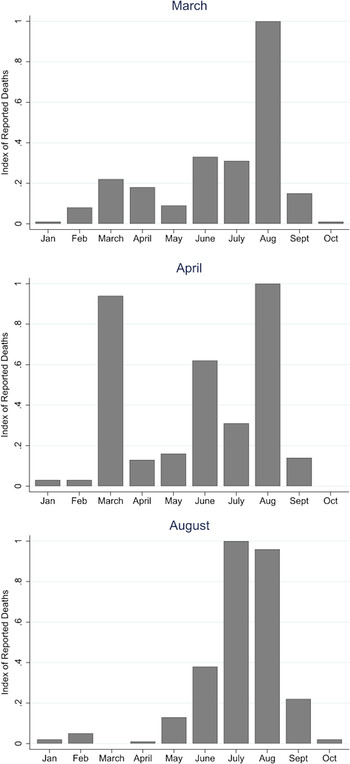
Figure 1 compares monthly death tolls from January to October 1968 across three groups of localities, during the period when almost all the recorded deaths occurred. The numbers are indexed with the largest monthly death count as one, with other months expressed as a proportion of that number.Footnote 13 The three graphs show that the death tolls were highly concentrated later in time in the localities where revolutionary committees were established in August. This group suffered their highest death tolls by far during two consecutive months, July and August, bearing the full brunt of the July 3 Orders. The localities with early revolutionary committees also experienced large spikes in death tolls during August, reflecting the impact of the July 3 Orders. However, both groups suffered far more deaths in the period from February through June than did the August holdouts. The second wave of killings in the places where revolutionary committees were established much earlier is what pushed them, and the rest of Guangxi, to death rates far above the national average.
Index of monthly death tolls by month of Revolutionary Committee, 1968.

What, then, delayed the establishment of a revolutionary committee? The most likely reason is the continued strength of a local April faction insurgency. Recall that factional conflict, whether armed or not, generated only small percentages of the death tolls. As one might expect, the localities that established revolutionary committees late reported more activity by the April faction over the entire period from March 1967 to the end of 1968. Among the localities that established a revolutionary committee in March, there was an average of 10 reported actions by the April 22 faction; in the next month’s group, there was 15; and in the August group, 24.Footnote 14 Although these numbers are surely inflated where the suppression campaigns were delayed, we can be confident that prior high death rates did not delay a revolutionary committee.
Table 4 displays regression results that examine the joint impact of ethnic composition, local state strength, remoteness, and the political time trend. All models include local population, which varies from 41,000 to 800,000, measured as units of 100,000, as a control variable, which turns the other coefficients into measures of a variable’s impact on local death rates. The urban population, which varies from 1,500 to 363,000, is included as a control variable in units of 10,000, because it is correlated with the strength of party and government organizations as well as with location in a border region. The models include two of the variables for local ethnic population and several measures of remoteness. The time trend is defined as the number of days after January 1 that the local revolutionary committee was established. It ranges from 66 (March 7) to 239 (August 27). The variable “lag days to revolutionary committee” is designed to capture the intensifying repression that was applied to their formation.
Negative binomial regression estimates of local deaths (incident rate ratios; z-scores in parentheses)

† p<.1; * p<.05; ** p<0.01; *** p<0.001.
The results indicate that the only characteristic of local populations that has a measurable impact on death rates is level of urbanization, which is a direct measure of nonagricultural development.Footnote 15 The more urbanized the population, the lower the death rate. In the full equation estimated in column 4, each increment of 10,000 in urban population is associated with a 5 percent lower death rate (.95). A county with an urban population of 30,000 at the 75th percentile would have a predicted death rate that is only 85.7 percent as high as a county with 10,000 urban residents at the 25th percentile (.953 = .857). Other things being equal, less developed rural regions had higher death rates.
If the killings were generated by an organized campaign, the death tolls should be lower in more remote regions and where party-state structures were less well staffed. If, however, killings were an expression of intergroup violence, these two indicators should predict higher death tolls. If Guangxi’s violence was driven by political processes that contributed to the intensification of violent suppression over time, delays in the formation of a local revolutionary committee should increase death rates.
The regression estimates indicate that geographic remoteness and the strength of party-state structures both have a large impact on death rates. In the full equation in column 4, the incident rate ratio of 1.27 for number of cadres indicates that for each additional 1,000 government cadres, the predicted death rate increases by 27 percent. A locality at the 77th percentile with 3,000 cadres would have a predicted death rate 61 percent higher than one at the 10th percentile with 1,000 cadres (1.272 = 1.61). Moreover, border regions had predicted death tolls 48 percent lower than interior regions (1 – .521= .479). A remote location cuts the predicted death rate almost by half. These two results indicate that stronger local party-state structures generated higher death tolls, while location in a remote border region spared the residents the worst violence. The confidence levels for both estimates are very high.
The timing of the local revolutionary committee also had a very large impact on death rates. I proposed this as a measure of the escalating intensity of repression documented in the narrative descriptions in previous chapters. The incident rate ratio of 1.0048 indicates that each day after January 1 that a revolutionary committee was delayed added close to half of one percent (0.48) to the predicted death toll. This translates to an increase of 3.4 percent per week (1.00487), or 15.4 percent per month (1.004830). A locality that established a revolutionary committee on August 15 would have twice the predicted number of deaths as one established five months earlier, on March 15 (1.0048150 = 2.05).
The analysis lends additional support for the argument that Guangxi’s large death tolls were a product of top-down mobilization of civilian and military structures that reached down into rural districts. Localities where political structures were more fully staffed generated higher levels of violence, and remote border regions escaped the worst. Localities where the April faction was able to delay the imposition of a revolutionary committee for long periods suffered the deadliest violence in the end.
These results also indicate that Guangxi’s ethnic diversity was not one of the reasons why its death rate was so much higher than other regions of China. There are no detectable differences in death rates across regions with different ethnic profiles, whether they are defined by the presence of non-Han minorities or by the presence of the Hakka subgroup. These results do not rule out the possibility that ethnic antagonisms played a role in local killings. They may have done so in ethnically diverse regions. What we can conclude is that there is no evidence at the county level that ethnic composition has a measurable impact on death rates. Another way of stating this is that death rates were unusually high across Guangxi, regardless of the local ethnic profile, and were instead driven by political processes that distinguished the province from the rest of China. Violence in ethnically diverse regions may have been motivated by group antagonisms, but it was no more severe than the violence in regions with no ethnic diversity.
Conclusions
The material extracted from the investigation reports leaves little doubt that Guangxi’s unusually high death rates were a product of a brief and lopsided civil war between political factions. The violence was implemented by military and civilian hierarchies in an organized campaign of repression against a weaker opponent. It was not until the final wave of killings, unleashed by Beijing’s July 3 directive, that Guangxi’s death tolls rose to levels not seen elsewhere in China. The directive unleashed violence against the April faction, whose status as a legitimate rebel force was now denied, and it also explicitly linked their resistance to subversion by class enemies in stigmatized households. The result was a liquidation campaign that provided a final solution for a strategically located province that had resisted pacification for almost a year after Beijing had decreed a resolution.
The July 3 directive had such widespread consequences because of the militarized structure of the party-state, and the way that factional divisions were embedded within it. The Allied faction had a structural advantage in rural regions because their mutually supportive relationship with the PAD lent them rural militia forces that were part of the military hierarchy and under the direct command of the Guangxi Military District. The escalating massacres of the April faction and stigmatized households were pushed forward by village leaders and rural militia under the exhortation of authorities at the county level, who were preparing the ground for a revolutionary committee or consolidating one that had just been established. It is hard to explain the intensified killing during this brief period without reference to the coordination provided by the military hierarchy and its overlay onto factional divisions at the grass roots.
One can plausibly claim that the scale of the massacres in rural communities—and certainly the instances of cannibalism and mutilation of corpses—were not intended by Beijing or the military authorities in Nanning. Their false charges of counterrevolutionary conspiracy had a threefold purpose: first, to intimidate the April faction into abandoning its stubborn resistance; second, to deflect attention from the massacres by the army’s rural allies; and third, to excuse their failure to curtail them. Whatever their intention, the result was to release any remaining constraints on violence against a stubborn but much weaker opponent, and to unleash established militia networks that reached deeply into rural districts. It is likely that the final death tolls were unanticipated by authorities in Nanning, and surely the worst atrocities were unforeseen and unwanted. What once appeared to be a form of intergroup violence bred by collective antagonisms toward politically stigmatized households is more accurately viewed as coordinated activity mobilized by a militarized hierarchy. This hierarchy urged its local agents to act on the basis of instructions that made anyone who sympathized with the April faction, and anyone in stigmatized households, a potential target for elimination. The process may have escalated out of control, but the lines of causation are now clear.
Acknowledgments
This article is based on research supported by National Science Foundation Grant SBS-1753552, “Political Violence and State Repression.” I am grateful to Qianmin Hu, who led the effort to devise and implement rules for coding events, and James Chu, who wrote programs for recoding events with multiple participants. James Chu, Susan Olzak, Yang Su, and Fei Yan provided fruitful comments on an earlier draft, along with anonymous reviewers for this journal.