





Introduction
Acute respiratory illness (ARI) is a common reason for emergency department (ED) evaluation and unnecessary antibiotic use. Approximately 30% of US ambulatory antibiotic prescriptions were estimated to be inappropriate, often for respiratory conditions. Reference Fleming-Dutra, Hersh and Shapiro1 Guidance discourages antibiotics for uncomplicated bronchitis and nonspecific upper respiratory infections. Reference Harris, Hicks and Qaseem2 Diagnostic uncertainty, limited follow-up, and rapid disposition complicate ED prescribing.
Broad multiplex molecular respiratory panels identify viral and atypical bacterial targets from one specimen. Reference Hanson, Azar and Banerjee3,Reference Ramanan, Bryson, Binnicker, Pritt and Patel4 Their effects on antibacterial prescribing remain inconsistent across trials and meta-analysis. Reference Brendish, Malachira and Armstrong5–Reference Schober, Wong and DeLisle7 Clinical utility may depend on turnaround time, interpretation, and stewardship support.
Patient-level evaluations may be confounded by indication and miss departmentwide changes. We used 10 years of Epic Cosmos data and an outcome-blind adoption algorithm to assess implementation across tested and untested encounters. The primary outcome was same-day ED-discharge antibacterial prescribing. Secondary outcomes included other antibiotic-related measures, antiviral treatment, order-recorded duration, length of stay, and a urinary tract infection negative control.
Methods
Study design and data source
We conducted a retrospective, repeated cross-sectional quasi-experimental study of staggered department adoption of broad multiplex respiratory pathogen panels. Data came from Epic Cosmos, a multi-institutional electronic health record aggregation platform, Reference Tarabichi, Frees and Honeywell8 from January 1, 2016, through December 31, 2025. Analyses occurred within the secure environment, and only aggregate, nonidentifiable results were exported. The analytic plan and adoption algorithm were specified before antibacterial outcomes were reviewed. Reporting followed STROBE and RECORD recommendations. Reference von Elm, Altman and Egger9,Reference Benchimol, Smeeth and Guttmann10
Study population and analytic dataset
Eligible observations were completed acute-care encounters among adults aged 18 years or older during periods of complete site data. The primary analysis included deidentified encounter departments labeled Emergency Medicine or urgent care; all departments were retained for sensitivity analysis. Operational department and source codes did not identify hospitals. ARI was defined by active encounter diagnoses for acute upper or lower respiratory infection, influenza or coronavirus disease 2019, pneumonia, acute bronchitis or bronchiolitis, chronic obstructive pulmonary disease exacerbation, asthma with acute respiratory symptoms, or cough, dyspnea, wheezing, or fever. Encounters with a concurrent clear nonrespiratory bacterial indication were excluded. Reference Fleming-Dutra, Hersh and Shapiro1,Reference Harris, Hicks and Qaseem2
Encounters for the same patient within 30 days were grouped as one ARI case. The first eligible ED-discharged encounter defined the primary prescribing denominator; all eligible ED encounters contributed to panel-use and broader ED outcomes. Measures were aggregated monthly and then quarterly. Annual files required complete calendar coverage, valid denominators, and no duplicate department-month records. Definitions and quality-control rules are provided in Supplementary Tables S1 and S2.
Respiratory panel exposure and adoption
Performed broad upper-respiratory molecular panels were reconstructed from laboratory components because manufacturer and instrument fields were incomplete. Components belonging to the same encounter and test order were grouped and mapped using local names, common names, and Logical Observation Identifiers Names and Codes. Reference Hanson, Azar and Banerjee3,Reference McDonald, Huff and Suico11 Exposure represented performance, not positivity. Strict panels required at least 8 validated pathogen families, 8 valid components, and 3 panel-specific families. Lower-respiratory or nonrespiratory specimens, nonhuman assays, serology-or antigen-only assays, retired assays, and unrelated pathogens were excluded; influenza-virus components were distinguished from Haemophilus influenzae. Moderate and exploratory definitions were sensitivity analyses.
Quarterly strict panel use was the proportion of eligible ARI episode-start encounters with a qualifying panel. Adoption was the first sustained transition from a preceding 4-quarter pooled rate below 2% to at least 10%, with minimum volume, an 8-percentage-point increase, and persistence criteria detailed in Supplementary Table S1. The 10% threshold was prespecified; a 5% fallback was reserved only if fewer than 20 complete-window adopters were identified. The transition quarter was excluded. Adopters required 8 quarters before and after implementation; controls were contemporaneous nonadopters or future adopters not yet treated. Early or always-high and unstable trajectories were excluded. Threshold-specific adopter counts and alternative panel-definition counts are reported in Supplementary Tables S3 and S4.
Outcomes, covariates, and quality control
The primary outcome was a same-day systemic oral or enteral antibacterial outpatient order linked to an eligible ED-discharged ARI encounter. Orders were nonhistorical and began on the encounter date; non-systemic anti-infectives and nonantibacterial products were excluded. Secondary outcomes were any ED antibacterial initiation, broad-spectrum initiation, ED antibacterial administration, ED-discharge ordering through the following day, oseltamivir initiation, order-recorded antibacterial days per 100 ED-discharged encounters, Reference Polk, Fox, Mahoney, Letcavage and MacDougall12 and mean ED length of stay. A directly linked order measure duplicated any ED antibacterial initiation and was omitted. Administration-derived days of therapy and ED-to-inpatient admission were not interpreted after quality control identified scaling or denominator limitations.
Case-mix measures included age, sex, race, Hispanic or Latino ethnicity, payer composition, diagnostic strata, ED length of stay, and mean best-available Social Vulnerability Index. Reference Flanagan, Gregory, Hallisey, Heitgerd and Lewis13 A high-acuity measure was omitted because it was nearly uniformly zero in the ED-discharged denominator. Same-day antibacterial prescribing for uncomplicated urinary tract infection without pyelonephritis, sepsis, another bacterial diagnosis, or concurrent ARI was the negative-control outcome; an ARI-minus-urinary tract infection contrast was also estimated. Reference Lipsitch, Tchetgen Tchetgen and Cohen14 Exposure thresholds were selected before antibacterial outcomes were reviewed.
Statistical analysis
Preimplementation characteristics were summarized across event quarters −8 through −1 as weighted medians and interquartile ranges; standardized mean differences described balance. Reference Austin15 Cohort-stacked event studies accommodated staggered adoption without using already treated departments as controls. Reference Wing, Yozwiak, Hollingsworth, Freedman and Simon16–Reference Callaway and Sant’Anna19 Each stack paired departments adopting in quarter g with contemporaneous eligible controls; future adopters were controls only when adoption occurred after g + 8. Controls required at least 6 preimplementation and 6 postimplementation quarters, and each stack required at least 10 controls. Stack composition is reported in Supplementary Table S5.
The event window spanned quarters −8 through +8; quarter 0 was excluded and quarter −1 was the reference. Treated observations received weight 1, and repeated controls were inverse-weighted across stacks. The primary model used equal department-quarter weighting with stack-by-department and stack-by-calendar-quarter fixed effects; standard errors were clustered by department. Reference Cameron and Miller20 Estimates were absolute percentage-point changes with 95% confidence intervals. The summary effect averaged estimable coefficients for quarters +1 through +8. A joint Wald test assessed quarters −8 through −2. Tests were 2-sided; P < .05 was statistically significant.
Prespecified analyses varied weighting, case-mix adjustment, control group, department universe, pandemic period, source assignment and clustering, implementation threshold, panel definition, and analytic unit. A continuous-intensity model estimated the association per 10-percentage-point higher panel use. Case-mix event studies, the negative control, and the ARI-minus-urinary tract infection contrast were design diagnostics. Analyses used R (R Foundation for Statistical Computing).
Ethics
The analysis used only deidentified Epic Cosmos data and was determined not to constitute human-subjects research. Institutional review board review and informed consent were not required.
Results
National trends and analytic cohort
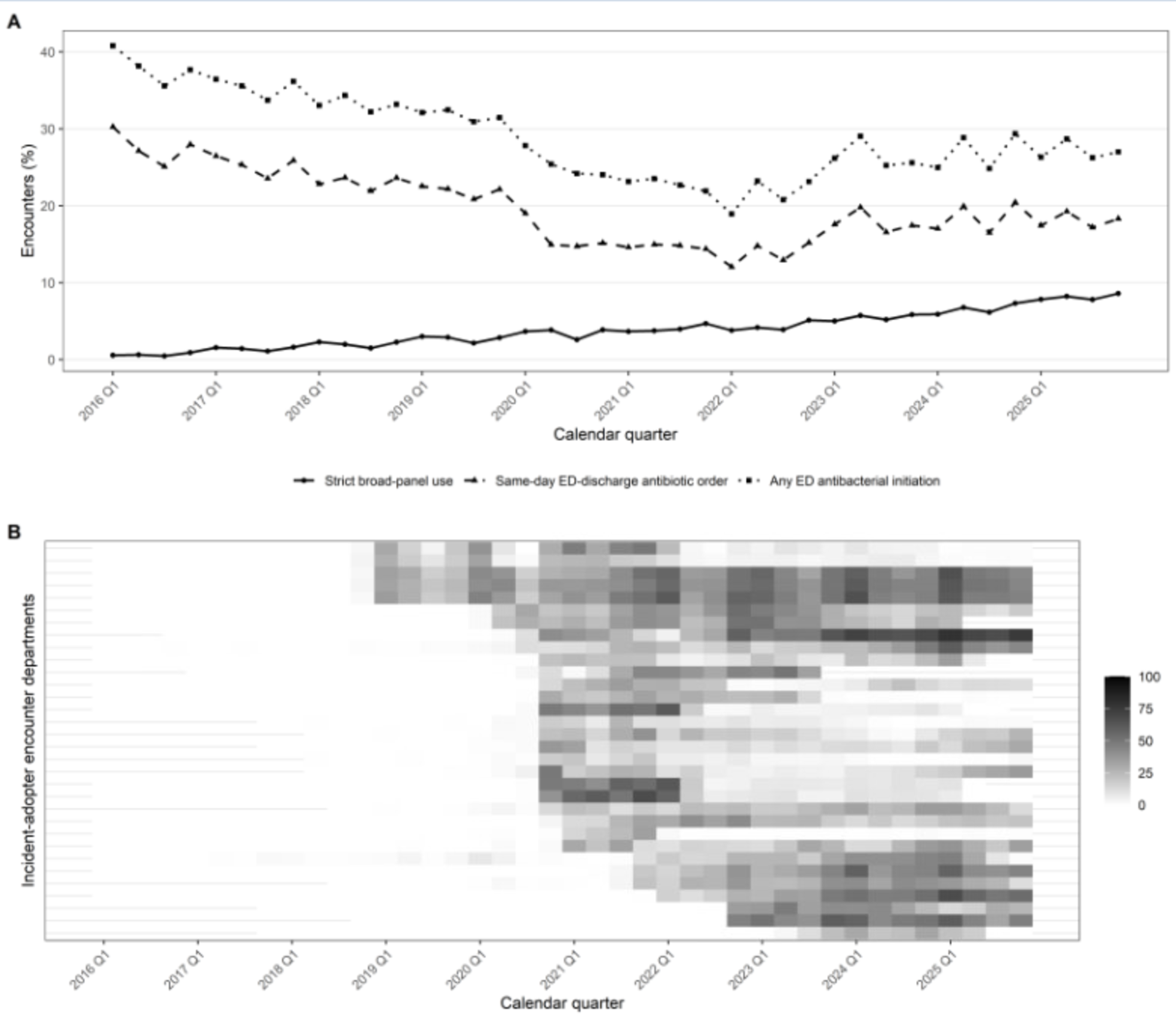
The annual files included 55,059,432 eligible adult ARI encounters, including 43,224,344 first eligible ED-discharged encounters within 30-day episodes. Same-day ED-discharge antibacterial orders occurred in 8,056,645 encounters, and 2,505,167 encounters included a strict panel. National strict panel use increased from 0.64% in 2016 to 8.09% in 2025, whereas same-day prescribing decreased from 27.89% to 18.00%; the lowest annual rate was 13.73% in 2022 (Figure 1, Supplementary Figure S1, and Supplementary Table S2).
National quarterly trends and staggered implementation of broad multiplex respiratory pathogen panels. The upper panel shows national quarterly rates among eligible adult acute respiratory illness episodes. The lower panel shows strict panel-use rates for complete-window incident-adopter encounter departments, ordered by implementation quarter.

Figure 1. Long description
Panel A: A line graph shows national quarterly rates among eligible adult acute respiratory illness episodes from 2016 Q1 to 2025 Q1. The y-axis represents the percentage of encounters, ranging from 0 to 40 percent. Three lines are plotted: one for strict broad-panel use, one for same-day ED-discharge antibiotic order, and one for any ED antibacterial initiation. The strict broad-panel use line shows a slight increase over time, the same-day ED-discharge antibiotic order line shows a decrease, and the any ED antibacterial initiation line fluctuates around 30 percent. Panel B: A heatmap displays strict panel-use rates for complete-window incident-adopter encounter departments, ordered by implementation quarter. The x-axis represents calendar quarters from 2016 Q1 to 2025 Q1, and the y-axis represents incident-adopter encounter departments. The heatmap uses a grayscale color gradient to indicate the rate of strict panel use, with darker shades representing higher rates.
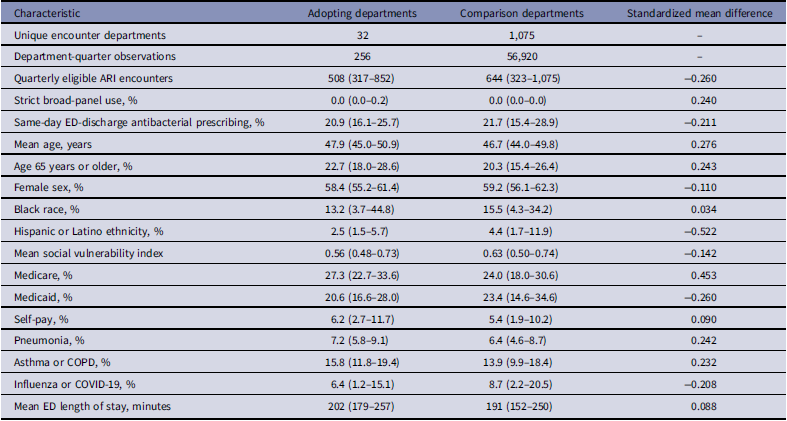
Among 2,212 Emergency Medicine or urgent-care-labeled departments evaluated, 43 crossed the 10% threshold and 32 had complete 8-quarter preimplementation and postimplementation windows. These departments formed 9 adoption cohorts from 2019 Q1 through 2023 Q3 and were compared with 1,075 departments, yielding 114,832 stacked department-quarter observations (Supplementary Tables S3 and S5 and Supplementary Figures S2 and S3). Median preimplementation panel use was 0.0% in both groups; median same-day prescribing was 20.9% among adopters and 21.7% among comparisons. Encounter volume, age, payer mix, and Hispanic or Latino ethnicity differed between groups (Table 1 and Supplementary Table S6).
Preimplementation characteristics of incident-adopter and comparison encounter departments

Table 1. Long description
A table comparing characteristics of adopting and comparison departments. The table has 17 rows and 4 columns. Column headers are Characteristic, Adopting departments, Comparison departments, and Standardized mean difference. Row 1: Unique encounter departments, 32, 1,075, -. Row 2: Department-quarter observations, 256, 56,920, -. Row 3: Quarterly eligible ARI encounters, 508 (317-852), 644 (323-1,075), -0.260. Row 4: Strict broad-panel use, 0.0 (0.0-0.2) percent, 0.0 (0.0-0.0) percent, 0.240. Row 5: Same-day ED-discharge antibacterial prescribing, 20.9 (16.1-25.7) percent, 21.7 (15.4-28.9) percent, -0.211. Row 6: Mean age, 47.9 (45.0-50.9) years, 46.7 (44.0-49.8) years, 0.276. Row 7: Age 65 years or older, 22.7 (18.0-28.6) percent, 20.3 (15.4-26.4) percent, 0.243. Row 8: Female sex, 58.4 (55.2-61.4) percent, 59.2 (56.1-62.3) percent, -0.110. Row 9: Black race, 13.2 (3.7-44.8) percent, 15.5 (4.3-34.2) percent, 0.034. Row 10: Hispanic or Latino ethnicity, 2.5 (1.5-5.7) percent, 4.4 (1.7-11.9) percent, -0.522. Row 11: Mean social vulnerability index, 0.56 (0.48-0.73), 0.63 (0.50-0.74), -0.142. Row 12: Medicare, 27.3 (22.7-33.6) percent, 24.0 (18.0-30.6) percent, 0.453. Row 13: Medicaid, 20.6 (16.6-28.0) percent, 23.4 (14.6-34.6) percent, -0.260. Row 14: Self-pay, 6.2 (2.7-11.7) percent, 5.4 (1.9-10.2) percent, 0.090. Row 15: Pneumonia, 7.2 (5.8-9.1) percent, 6.4 (4.6-8.7) percent, 0.242. Row 16: Asthma or COPD, 15.8 (11.8-19.4) percent, 13.9 (9.9-18.4) percent, 0.232. Row 17: Influenza or COVID-19, 6.4 (1.2-15.1) percent, 8.7 (2.2-20.5) percent, -0.208. Row 18: Mean ED length of stay, 202 (179-257) minutes, 191 (152-250) minutes, 0.088.
Note. Values are weighted median (interquartile range) across event quarters – 8 through – 1 unless otherwise indicated. Repeated control department-quarters are inverse-weighted across stacks. Standardized mean differences compare weighted preimplementation distributions. High ED acuity and ED-to-inpatient admission are not shown because the available fields were nearly uniformly zero within the ED-discharged analytic denominator and were not considered interpretable. ARI, acute respiratory illness; COPD, chronic obstructive pulmonary disease; ED, emergency department.
Panel use and primary antibiotic-prescribing outcome
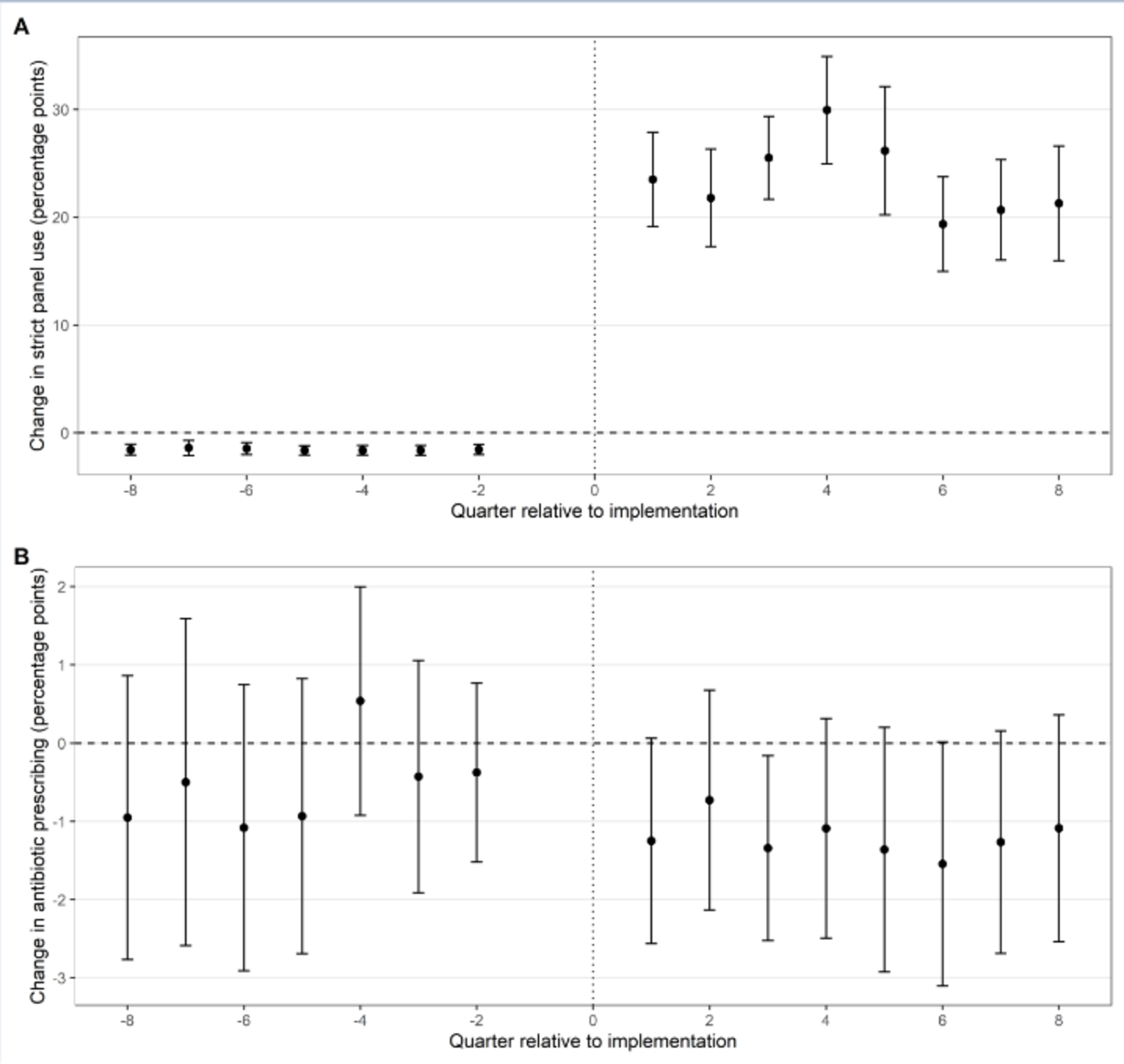
Implementation was associated with a 23.53-percentage-point increase in strict panel use (95% CI, 20.32 to 26.74; P <.001) from a preimplementation mean of 0.41%. Quarter-specific increases ranged from 19.36 to 29.94 percentage points. All 7 preimplementation coefficients were negative (−1.63 to −1.40 percentage points) and jointly significant (Wald statistic, 65.32; P <.001), consistent with gradual ramp-up before the formal adoption quarter (Table 2, Figure 2A, and Supplementary Table S7).
Dynamic association of panel implementation with panel use and same-day ED-discharge antibiotic prescribing. Points are cohort-stacked difference-in-differences coefficients and bars are 95% confidence intervals for Emergency Medicine/urgent-care-labeled encounter departments. Quarter 1 is the reference; the transition quarter is excluded. The upper panel is the first-stage panel-use model, whose preimplementation coefficients were jointly significant (P <.001); the lower panel is the primary prescribing outcome, whose preimplementation coefficients were jointly nonsignificant (P = .374).

Figure 2. Long description
Panel A: A line graph shows the change in strict panel use (percentage points) over quarters relative to implementation. The x-axis represents the quarter relative to implementation, ranging from -8 to 8. The y-axis represents the change in strict panel use, ranging from 0 to 30 percentage points. The graph shows a significant increase in strict panel use starting from quarter 0, with the highest values around quarters 2 and 4. Panel B: A line graph shows the change in antibiotic prescribing (percentage points) over quarters relative to implementation. The x-axis represents the quarter relative to implementation, ranging from -8 to 8. The y-axis represents the change in antibiotic prescribing, ranging from -3 to 2 percentage points. The graph shows fluctuations in antibiotic prescribing with no clear trend, and the changes are relatively small compared to the changes in strict panel use.
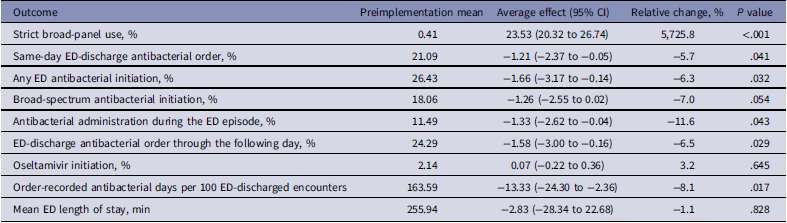
Association between strict multiplex respiratory panel implementation and antibiotic-related outcomes

Table 2. Long description
The table presents data on antibiotic-related outcomes before and after the implementation of a strict multiplex respiratory panel. It has 9 rows and 5 columns. The columns are labeled Outcome, Preimplementation mean, Average effect (95% CI), Relative change, %, and P value. The rows list different outcomes such as Strict broad-panel use, Same-day ED-discharge antibacterial order, Any ED antibacterial initiation, Broad-spectrum antibacterial initiation, Antibacterial administration during the ED episode, ED-discharge antibacterial order through the following day, Oseltamivir initiation, Order-recorded antibacterial days per 100 ED-discharged encounters, and Mean ED length of stay. Each row provides specific values for preimplementation mean, average effect with confidence intervals, relative change in percentage, and P value for each outcome.
Note. Effects are equal-weight averages of dynamic coefficients for event quarters +1 through +8 relative to quarter −1. The implementation quarter is excluded. Unless otherwise indicated, preimplementation means are percentages and effects are percentage points. Order-recorded antibacterial days are expressed as days per 100 ED-discharged encounters; ED length of stay is expressed in minutes. The directly ED-linked order outcome was identical to any ED antibacterial initiation and was not reported separately. ED-to-inpatient admission and administration-derived days of therapy were excluded after quality control, as described in Methods. All rows included 32 treated and 1,075 control departments. Relative changes were calculated from unrounded estimates. CI, confidence interval; ED, emergency department.
Implementation was associated with a 1.21-percentage-point decrease in same-day ED-discharge antibacterial prescribing (95% CI, −2.37 to-0.05; P =.041), a 5.7% relative decrease from the 21.09% preimplementation mean. All 8 postimplementation coefficients were negative (range, −1.54 to −0.73 percentage points). The 7 preimplementation coefficients were jointly nonsignificant (Wald statistic, 7.55; P = .374) (Figure 2B and Supplementary Table S7).
Secondary outcomes
Implementation was associated with lower any ED antibacterial initiation (−1.66 percentage points; 95% CI, −3.17 to −0.14; P = .032), antibacterial administration during the ED episode (−1.33; 95% CI, −2.62 to −0.04; P = .043), and ED-discharge ordering through the following day (−1.58; 95% CI, −3.00 to −0.16; P = .029). There was no statistically significant change in broad-spectrum initiation (−1.26 percentage points; 95% CI, −2.55 to 0.02; P = .054). Order-recorded antibacterial days decreased by 13.33 days per 100 ED-discharged encounters (95% CI, −24.30 to −2.36; P = .017). There was no statistically significant change in oseltamivir initiation (0.07 percentage points; P = .645) or mean ED length of stay (−2.83 minutes; P = .828) (Table 2, Supplementary Table S8, and Supplementary Figures S4 and S5).
Robustness and negative-control analyses
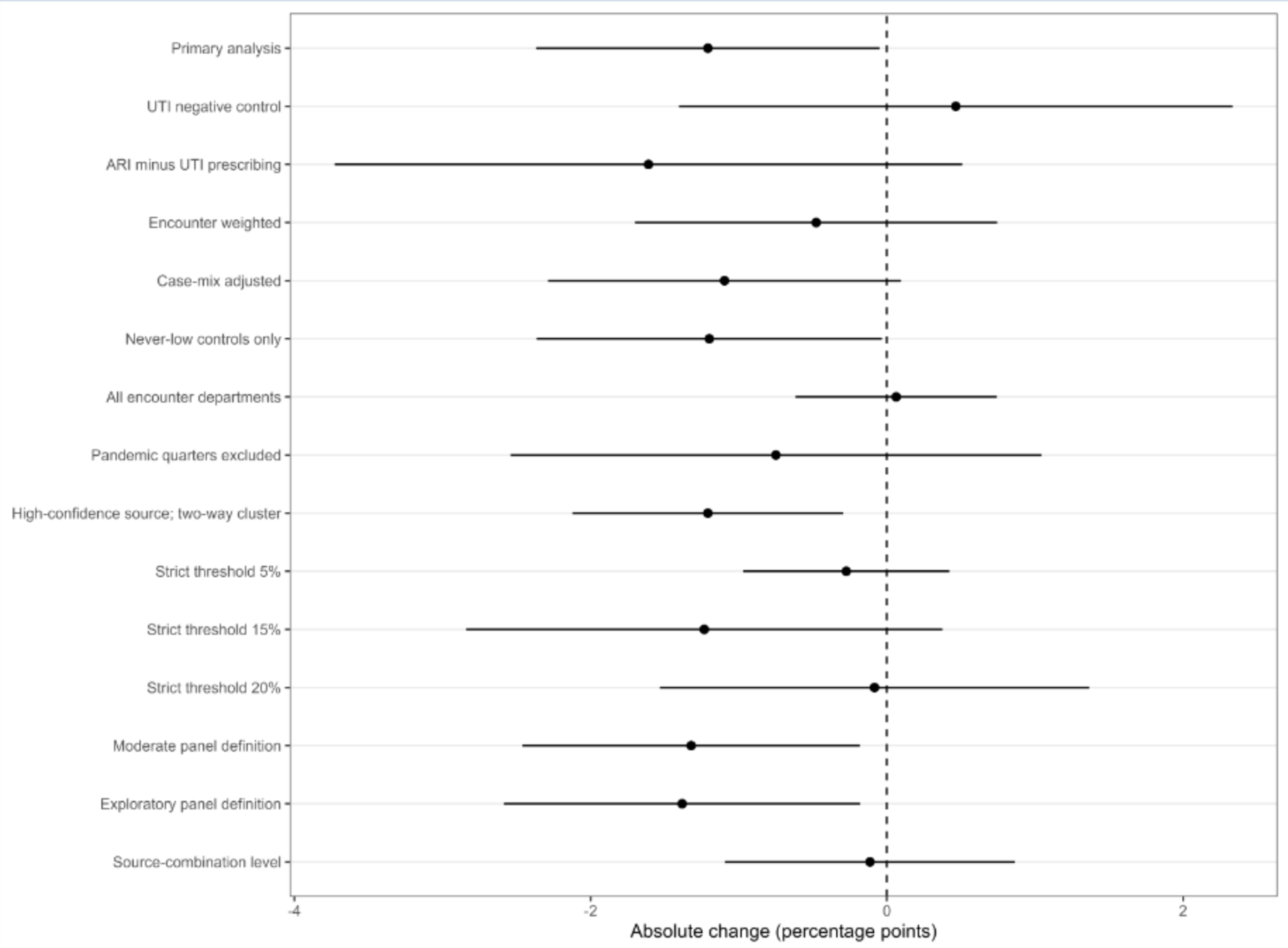
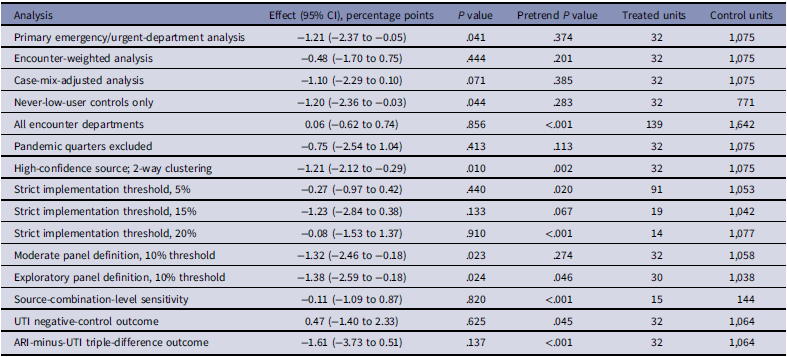
The primary estimate was similar with never-low controls (−1.20 percentage points; 95% CI, −2.36 to −0.03; P = .044) and high-confidence source assignments with 2-way clustering (−1.21; 95% CI, −2.12 to −0.29; P = .010), although the latter had a significant preimplementation test (P = .002). There was no statistically significant change after case-mix adjustment (−1.10; P = .071), encounter weighting (−0.48; P = .444), or pandemic-quarter exclusion (−0.75; P = .413). Unrestricted all-department (0.06; P = .856) and source-combination-level (−0.11; P = .820) analyses likewise showed no statistically significant change and had significant preimplementation tests. Results were sensitive to the strict implementation threshold: effects were −0.27 percentage points at 5% (95% CI, −0.97 to 0.42; P = .440), −1.23 at 15% (95% CI,−2.84 to 0.38; P = .133), and −0.08 at 20% (95% CI, −1.53 to 1.37; P = .910). Moderate and exploratory panel definitions produced decreases of 1.32 and 1.38 percentage points, respectively (Table 3, Figure 3, and Supplementary Tables S9 and S10). Department-specialty summaries are provided in Supplementary Table S11.
Primary emergency/urgent-department and prespecified robustness estimates for same-day ED-discharge antibiotic prescribing. Points are average effects across event quarters +1 through +8; horizontal bars are 95% confidence intervals. Rows include the primary estimate; encounter-weighted, case-mix-adjusted, control-group, all-department, pandemic-excluded, high-confidence source, strict implementation-threshold (5, 15, and 20%), alternative panel-definition, source-combination, and negative-control/triple-difference analyses. The UTI estimate is a negative-control outcome, and ARI minus UTI is the triple-difference sensitivity.

No statistically significant change was identified for the urinary tract infection negative control (0.47 percentage points; 95% CI, −1.40 to 2.33; P = .625) or the ARI-minus-urinary tract infection contrast (−1.61; 95% CI, −3.73 to 0.51; P = .137); both had significant preimplementation tests (Table 3 and Supplementary Figure S6). The continuous-intensity model also showed no statistically significant change (−0.15 percentage points per 10-percentage-point higher panel use; 95% CI, −0.33 to 0.04; P = .116) (Supplementary Table S12).
Prespecified robustness, threshold, panel-definition, source-level, and negative-control analyses

Table 3. Long description
The table presents data on the effects of different analyses on treated and control units. It includes columns for Analysis, Effect (95% CI, percentage points), P value, Pretrend P value, Treated units, and Control units. The table has 16 rows, each representing a different analysis. For example, the first row shows the Primary emergency/urgent-department analysis with an effect of -1.21 (-2.37 to -0.05), P value of .041, Pretrend P value of .374, 32 treated units, and 1,075 control units. Other analyses include Encounter-weighted analysis, Case-mix-adjusted analysis, Never-low-user controls only, and various threshold and panel definition analyses. Each row provides specific values for the effect, P value, Pretrend P value, and the number of treated and control units.
Note. All effect estimates are absolute percentage-point changes. Pretrend P values are from joint Wald tests of the 7 preimplementation coefficients for event quarters −8 through −2, with quarter −1 as the reference. The UTI outcome is a negative control; the ARI-minus-UTI outcome is a triple-difference sensitivity. Threshold, panel-definition, and source-level rows are prespecified sensitivities. Pretrend tests are design diagnostics and were not adjusted for multiple comparisons. ARI, acute respiratory illness; CI, confidence interval; UTI, urinary tract infection.
Preimplementation diagnostics were mixed. Although the primary prescribing outcome did not reject a flat preperiod (P = .374), joint tests rejected flat preperiods for the first-stage panel-use model (P <.001), oseltamivir initiation (P <.001), mean age (P <.001), age 65 years or older (P <.001), Black race (P = .021), Hispanic or Latino ethnicity (P = .005), the urinary tract infection negative control (P = .045), and the ARI-minus-urinary tract infection contrast (P <.001). Several sensitivity models also failed these tests (Supplementary Table S9 and Supplementary Figure S7).
Discussion
In this 10-year national study, sustained department-level implementation of broad multiplex respiratory panels was associated with a modest reduction in antibiotic prescribing for ARI. Panel use increased by 23.53 percentage points, whereas same-day ED-discharge prescribing decreased by 1.21 percentage points (5.7%). Other initiation and order-duration measures also declined, whereas oseltamivir use and ED length of stay did not. Because all eligible respiratory encounters contributed to the denominator, the estimate reflects department practice rather than efficacy among tested patients: approximately 1 fewer same-day order per 83 eligible ED-discharged encounters. Its efficiency would depend on testing intensity, downstream management, and costs, which were unavailable.
The modest effect aligns with mixed patient-level evidence. ResPOC did not reduce antibiotic receipt; Reference Brendish, Malachira and Armstrong5 the randomized ED trial showed only a nonsignificant trend; Reference May, Tatro and Poltavskiy6 a 2024 meta-analysis found no overall reduction; Reference Schober, Wong and DeLisle7 and a 998-adult acute-care trial found no reduction in antibiotic days or length of stay. Reference Saarela, Tapiainen and Kauppila21 Our study instead evaluated sustained department practice. Repeated availability may alter diagnostic norms, whereas inclusion of untested eligible encounters may dilute larger benefits among tested patients.
Clinical actionability may matter more than detection alone. Among hospitalized adults, prescribing was driven more by radiographic suspicion of pneumonia than by noninfluenza panel results. Reference Semret, Schiller and Jardin22 Early multiplex detection was associated with shorter antimicrobial duration and length of stay in a retrospective cohort. Reference Rappo, Schuetz and Jenkins23 Viral testing plus procalcitonin did not reduce use overall, but use fell when findings supported withholding therapy and clinicians followed the algorithm. Reference Branche, Walsh and Vargas24 A recent ED study found less prescribing with viral detection than with no detected pathogen, but no overall difference from matched controls. Reference Meltzer, Payette and Heidish25 Larger effects occurred when testing was embedded in stewardship: a multifaceted ED and urgent-care intervention reduced inappropriate ARI prescribing, Reference Yadav, Meeker and Mistry26 and a 2026 urgent-care cohort combining a 15-pathogen panel with stewardship reduced overall and inappropriate prescribing. Reference Arnold, Furtado, Bang, Harnett and May27 Panels may therefore be enabling infrastructure dependent on rapid results, bacterial-risk assessment, and an explicit management response.
The setting-specific results support this interpretation. The association appeared in Emergency Medicine and urgent-care-labeled departments but not in unrestricted all-department or source-combination analyses. The primary-outcome preperiod test and average urinary tract infection negative control were reassuring. Other diagnostics were not: first-stage leads showed preadoption ramp-up, threshold sensitivities were null, and oseltamivir, several case-mix measures, the negative control, and multiple sensitivity models rejected flat preperiods. None of the alternative strict thresholds reproduced a statistically significant effect, so the 10% threshold should not be viewed as biologically privileged. Adoption may have coincided with broader departmental change, and residual time-varying confounding cannot be excluded. Baseline imbalance and null unrestricted analyses further limit causal interpretation.
Concurrent guideline changes offer another explanation. The 2016 removal of the healthcare-associated pneumonia category, reaffirmed in 2019, could reduce broad-spectrum treatment; emphasis on shorter, clinical-stability-guided pneumonia courses could reduce order-recorded duration. Reference Kalil, Metersky and Klompas28,Reference Metlay, Waterer and Long29 Shorter courses might also alter prescribing thresholds. Calendar-quarter fixed effects account for shared temporal changes but not differential uptake across departments; we could not disentangle these practice changes from panel implementation.
Strengths include more than 55 million encounters over 10 years, heterogeneous US practice spanning the coronavirus disease 2019 pandemic, an outcome-blind adoption algorithm, and a large sustained first-stage change. The stacked design avoided already treated controls. Prespecified analyses varied definitions, thresholds, weights, source restrictions, case-mix adjustment, and the negative-control outcome.
Limitations include nonrandomized implementation and concurrent changes in stewardship, staffing, formularies, or respiratory-care protocols. Deidentified operational identifiers could not capture cross-department policies or within-system spillover. Panel performance was reconstructed from laboratory components, risking exposure misclassification. The department-level analysis could not establish whether results were available or reviewed before prescribing; this temporal precedence is essential for causal attribution and cannot be assumed. Pathogen positivity was unavailable. Orders do not confirm dispensing or adherence; outside care may be incomplete; and diagnosis-based eligibility may misclassify syndromes or bacterial indications. Complete 8-quarter windows yielded only 32 adopters, and several pretrend and threshold diagnostics were unfavorable. Administration-derived days of therapy and admission were not interpreted because quality control identified scaling and denominator problems. Safety, delayed bacterial treatment, adverse drug events, revisits, and total costs were unavailable.
In conclusion, sustained broad-panel implementation in emergency and urgent-care departments was associated with small reductions in antibiotic prescribing and order-recorded duration. Broad testing should be viewed as stewardship infrastructure, not a stand-alone intervention. Mixed threshold and pretrend results warrant cautious causal interpretation. Future studies should pair selective, rapid testing with interpretation support and assess safety, patient-centered outcomes, and cost.
Supplementary material
The supplementary material for this article can be found at https://doi.org/10.1017/ice.2026.10567
Data availability statement
Patient-level data are not publicly available because they are maintained within the secure Epic Cosmos environment. Aggregate results and analytic code may be available subject to applicable data-use restrictions.
Acknowledgements
The authors thank the patients and participating health systems whose deidentified data contributed to Epic Cosmos.
Author contribution
M.A.M.: conceptualization, methodology, investigation, data curation, formal analysis, visualization, project administration, supervision, writing – original draft, and writing – review and editing. K.P. and N.S.T.: methodology, pharmacy and clinical interpretation, validation, and writing – review and editing. T.M.L.: laboratory and clinical microbiology interpretation, validation, and writing – review and editing. All authors approved the final manuscript and accept responsibility for the work.
Financial support
This work was not supported by external funding.
Competing interests
All authors report no conflicts of interest relevant to this article.
Manuscript preparation
Generative artificial intelligence tools assisted with code review, language editing, and manuscript formatting. The authors reviewed and verified all content, analyses, and references.


 Open access

