Introduction
The Janatha Vimukti Peramuna (JVP) is perhaps the most resilient, dynamic and deeply-rooted political force in contemporary Sri Lanka. It occupies a unique position in Sri Lankan political hagiography as an icon of ‘anti-systemic’ rage and youth radicalism.Footnote 1 Formed during 1966–1967 as a small splinter group that emerged out of the Communist Party (Peking), the JVP had by 1971 recruited and trained thousands of young militants to launch the island's first anti-state insurrection for over a century. The April 1971 rebellion was quickly suppressed, with thousands of cadres killed or jailed,Footnote 2 but the JVP survived to re-create itself as a parliamentary electoral party, and had by the early 1980s established itself as the third largest political force in the country.
In the mid-1980s, the JVP once again went underground, and by 1987 launched a second, far more violent and protracted armed insurgency which, for a brief period in early 1989, almost brought the government to its knees.Footnote 3 This in turn invited a far more brutal and exterminationist response from the state security forces and shadowy pro-state militia groups, who, over the second half of 1989, hunted down and summarily executed tens of thousands of JVP cadres and sympathisers (as well as many thousands who were entirely innocent of association with the JVP). Between 1990 and 1993, the JVP appeared to have completely disappeared, and many believed that it would never re-emerge. But, within five years, it sprang back into life, and quickly established itself as a viable electoral party. Starting with one parliamentary seat in 1994, the JVP won ten seats in 2000, 16 in 2001, and 39 in 2004.
The JVP gained enormous prominence in the 2001–2004 period as the principal political force opposing the Norwegian-mediated peace process between the United National Front (UNF) government of Ranil Wickremasinghe and the Liberation Tigers of Tamil Eelam (LTTE). While the constitutional theatrics of toppling the Wickremasinghe government were actually enacted by President Chandrika Kumaratunga between November 2003 and February 2004, it was the JVP that did all the hard work in creating the conditions for the ouster. While Kumaratunga's own party lay dejected and exhausted after its resounding electoral defeat in December 2001, it was the JVP that rose to quickly gather and lead the opposition to the February 2002 cease-fire agreement and the ensuing peace process.
Following the February 2002 cease-fire, the JVP began to articulate a powerful and coherent ideo-political programme of opposition to the internationally-sponsored peace process, which it propagated energetically and relentlessly. It organised a series of massive street demonstrations in Colombo at the rate of almost one a month during 2003 that brought the capital to a complete halt on several occasions. It successfully capitalised on the growing momentum of economic discontent against the UNF's market reform policies and used its influence in the union movement to instigate a series of sequenced public-sector strikes in the health sector and railways in late-2003 and early 2004. In doing so, the JVP played a decisive role in mobilising and coalescing public opinion against the peace process, and provided a growing source of pressure on President Kumaratunga that legitimised her subsequent actions in dismissing the UNF government, which triggered the ensuing mid-term elections. In the course of this energetic and persistent election campaign, the JVP became instrumental in the April 2004 election defeat of the UNF government that destabilised the peace process.
Even after April 2004, the JVP's influence as a stubborn and uncompromising coalition partner within the new United Peoples Freedom Alliance (UPFA) government played a significant, if not decisive part in the failure of all subsequent attempts over the following two years to re-ignite the peace process. They posed impossible pre-conditions to be met before agreeing to support peace talks, refused to tolerate any agreement with the LTTE over joint tsunami aid distribution, and backed the (successful) presidential campaign of Mahinda Rajapakse in November 2005 on an anti-peace process platform. From early 2006 onwards, the JVP openly promoted a military solution to the conflict, goading the government to resume the war—which finally occurred in August 2006.
This paper examines the role of the JVP in the collapse of the 2001–2004 peace process. It is divided into two parts: the first part focuses on the evolution of the JVP between 1994 and 2004, culminating in its role in the collapse of the UNF government; the second part is an historical and analytical exploration of the JVP phenomenon. The fundamental analytical enigma of the JVP lies in explaining its hybrid Marxist-nationalist ideo-political agenda, which permitted it to craft an effective and coherent two-track campaign of opposition to the pro-market, pro-peace UNF government.
This paper advances and elaborates on four features of the JVP's Marxist-Sinhala nationalist ideological mix:
(i) the JVP's Marxist background has been an asset in its emergence as a leading Sinhala nationalist force;
(ii) the mixture of Marxism and Sinhala nationalism is not exceptional to the JVP, but is a long-standing feature of Sri Lanka's Marxist tradition, and is indeed a long-standing issue that Marxism has faced internationally through the twentieth century;
(iii) the JVP's increasingly Sinhala nationalist agenda has occurred in the context of its gradual de-radicalisation and transformation into an electorally-oriented parliamentary party;Footnote 4
(iv) the JVP's ideological mix reflects certain important features of the materiality of Sinhala nationalism within the dynamics of class and the social democratic state.
The research for this paper was conducted during fieldwork between 2002 and 2007. It draws upon primary materials from the JVP's own literature, interviews with a variety of JVP and non-JVP personalities, newspaper coverage between 1993 and 2004, secondary literature, and data from several sources on union and organisational strength.
The Rebirth of the Janatha Vimukthi Peramuna (JVP) in the 1990s
The JVP's second re-emergence in the mid-1990s proved to be an extremely complicated and challenging task. Tens of thousands of party activists, sympathisers and fellow-travellers had been killed in the white heat of the government's counter-insurgency operations between 1987 and 1990. Virtually the entire national and district-level leadership of the JVP, including its iconic founder-leader, Rohana Wijeweera, had been captured and killed in the space of a few months—between late 1989 and early 1990. By mid-1990, when anti-JVP counter-insurgency operations were wound down and redeployed in the renewed war with the LTTE in the eastern theatre, 41 of 42 members of the central committee had been captured and killed, along with most members of the district-level leadership. The only surviving member of the central committee, Somawansa Amarasinghe, fled to exile in Paris, where he was struggling to re-establish his leadership over the party against a rival faction based in London.
Meanwhile, a large portion of those who survived had either abandoned political activism altogether, fled into exile abroad, or were under suspicion of having informed on their comrades. As a result, the decapitated local remnants of the JVP, who remained underground in a state of paralysis and fear between 1990 and 1993Footnote 5, were reluctant to re-emerge into the open, fearful of inviting renewed repression upon themselves. One of the very few historical accounts of the 1987–1990 insurgency, written immediately after its defeat concluded (wrongly):
Among the remnants, there are of course some people who harbour delusions of building up the JVP once more. But this is a pipe dream . . . After what they did in 1987–90, they will never again be able to build up a mass following. Somawansa Amarasinghe [the sole surviving central committee member] is still alive and at large. This too has no significance.Footnote 6
As with the new UNP leader, Ranil Wickremasinghe, the newly re-born JVP was constantly forced to explain that it had indeed made a clean break with its recent violent past. Party leaders and activists found themselves having to refute numerous rumours and accusations that they were secretly rearming for another rebellion, and were highly suspicious that such allegations had been planted to serve as a pretext for a renewed phase of repression. Having just emerged from a decade underground, the JVP leadership in the 1993–1999 period was deeply antagonistic to the military and police hierarchy that had only recently been deployed against them, and which was now engaged in Eelam War III against the LTTE.
Through the second half of the 1990s, the JVP vigorously opposed the imposition of emergency war-time or terrorism-related regulations, and were genuinely concerned that such special measures could be used against them. Indeed, media reports of the time are awash with stories of former JVP activists and defectors accusing the party of preparing for another revolt.
The difficult task of political reincarnation between the years 1993 and 1995 was further complicated by factionalism and rivalry over claims to the JVP brand-name and party electoral logo. The dominant faction, led by the Paris-based Somawansa Amarasinghe, was challenged by a London-based group headed by Chandra Fernando, the brother-in-law of the JVP's late founder-leader, Rohana Wijeweera. Over the course of the next year, the Somawansa faction prevailed and consolidated its hold over party units, seizing control of the party brand-name and electoral logo. Nevertheless, more than a year after they had begun to re-organise openly, and on the eve of parliamentary elections in August 1994, the factional divisions within the JVP forced the Somawansa faction to contest the elections under the banner of another party.Footnote 7
Over the course of the next year, the Somawansa faction consolidated its hold on the loyalties of the party units, and gained control of the party brand name and electoral logo.Footnote 8 Somawansa Amarasinghe himself remained in exile in Paris, and later in London between 1990 and 2004,Footnote 9 so that daily operational control of the party was left under the charge of a new general secretary, Tilvin Silva, one of the few district-level leaders who had managed to survive by being in jail during the 1989–1990 counter-insurgency. In the August 1994 elections, the Somawansa faction managed to elect one of its members to parliament, and by July 1995, had organised a special party conference in Tangalle that established office-bearers and an organizational structure.Footnote 10
Over this critical period preceding the peace process, the JVP focused on creating a competitive electoral political party. Between 1997 and 1999, the JVP gradually established their presence as a mainstream force in electoral politics through their performance in local and provincial council elections, which they contested vigorously and with increasing success. In most localities, the JVP polled between five and ten per cent of the vote—a return to the levels they had achieved in the last district-level elections in which they had competed in 1982. This immediately placed them in third position behind the two main parties, and significantly ahead of all the other smaller, non-minority-based parties.Footnote 11 Under Sri Lanka's system of (modified) proportional representation, this modest share of the vote still translated into a meaningful number of elected representatives, who often controlled the balance of power.
In the course of this reorientation as an electoral party, the JVP reacted skilfully to fashion a fluid ideo-political agenda that could be rapidly calibrated along the continuum from populist Marxism to populist nationalism as circumstances demanded. The party could thus rush to claim the Sinhala nationalist mantle whenever issues of constitutional devolution and minority rights bubbled to the surface, or could just as quickly switch to discussing class and workers’ rights, whenever an issue such as privatization emerged. Indeed, a great deal of the JVP's political momentum between 1997 and 2002 arose from its ability to adroitly mobilise and capture the new spaces that were being ceded to them by others.
For example, much of the JVP's growth in this period related to the specific circumstances of the Kumaratunga government's embrace of both market economics and the devolution agenda. For the first time since the rise of the two-party system in the mid-1950s, both the main parties were in broad consensus on the necessity for state reform regarding the two core issues that had animated Sri Lankan politics: economic policy and ethnic conflict. Both parties advocated market reforms, and both agreed on the necessity for constitutional reforms to address the ethnic conflict. The remaining differences between them on these issues were largely a matter of emphasis, tactics, and personality, rather than principle and direction. But, as a direct consequence of this emerging consensus, there was now an increasingly open and viable space on the populist left for opposition to the market reforms, and on the Sinhala nationalist right for mobilisation directed at preserving the unitary state and opposing the devolution of powers along ethnic lines.
‘The Principal Socialist Party in the Country’
Between 1998 and 1999, the JVP tended to emphasize their Marxist credentials, anti-globalization rhetoric, and worker radicalism over Sinhala nationalism, largely because this was the arena of political opportunity available at the time. Its public pronouncements were often openly critical of Sinhala nationalism, the war, and emergency war-time or terrorism-related regulations. In contrast, there was an increasingly viable space opening on the left, and the renascent JVP was one of the very few forces in the political spectrum that could mount any credible opposition to the government's economic reforms.Footnote 12 Most of the trade union movement was under the control or influence of political parties of the ‘old left’, the Communist Party (CP) and the Lanka Sama Samaja Party (LSSP)Footnote 13, who, after 1994, were compromised by their membership in the ruling People's Alliance (PA) government of President Chandrika Kumaratunga. Kumaratunga came to power in 1994 with the assistance of these left parties, but nevertheless decided to continue and indeed accelerate the market reform agenda introduced by the previous UNP governments. It is during this period that some of the most ambitious privatizations of public sector enterprises were conducted, including the massive plantation sector, Sri Lankan Airlines, and Sri Lanka Telecom.
Despite being coalition partners in government, the LSSP and CP were in reality completely sidelined from economic policy-making and were powerless to affect the pace or direction of the reforms. As one vitriolic critic from the left noted: ‘Instead of being watchdogs, the CP and LSSP became lapdogs adjusting themselves to tail behind the President's vigorous pursuit of UNP policies’.Footnote 14 The LSSP's press releases and party statements of the time are replete with grave ambivalence and much hand-wringing on issues of subsidy withdrawals, privatization, and the renewal of the emergency provisions.Footnote 15 One LSSP leader confessed to the media:
We are against privatisation, but everybody thinks that we are in favour of privatisation. When our party members went to express their protest about the privatisation of the Steel Corporation we were told that it was no use joining protest campaigns after agreeing to it at cabinet level.Footnote 16
Workers from unions attached to pro-government parties were constantly frustrated at the inability of their compromised leadership to translate cabinet level influence into tangible benefits—and began looking for more radical alternatives. As the JVP general secretary Tilvin Silva described:
[The CP and LSSP] betrayed the working classes who for more than half a century had depended on them. After accepting portfolios in the capitalist governments, they have lost both their independence and the confidence of the people. We have come into fill this gap and are today the principal socialist party in the country.Footnote 17
Indeed, it is at this point that the JVP made significant inroads into the union movement for the first time in its history, largely out of defections from left-led unions. As a JVP trade union leader described ‘Our growth was from other unions, not from newly unionised’Footnote 18 —a strategy that a rival non-JVP union leader characterised as an ‘aggressive, unethical stance towards building up unions’.Footnote 19
Emblematic of this phenomenon is a news report from May 2000 of how an LSSP-affiliated union quickly shut down two acrimonious strikes involving over 1,000 workers following the promulgation of new emergency regulations. Following this, ‘Workers resigned en masse from the [LSSP union] in protest over its betrayal of the strike and formed another union affiliated to the Janatha Vimukthi Peramuna (JVP)’.Footnote 20 As the leader of the CP's trade union wing lamented:
Our leadership in the unions was compromised as pro-government. They [the JVP] had a different image. They are better organised. Their cadres are committed, and all over the country.Footnote 21
A newspaper article described how:
The SLFP, LSSP and Communist Party trade union leadership have also complained that all trade union action they organize has been penetrated by the JVP through its members to take over the leadership.Footnote 22
The JVP's growth in the trade unions was so rapid that it became cause for serious concern among both government and business during 2000 and 2001. With the violent insurrection of 1987–1990 still very much in mind, the captains of industry nursed serious concerns that the growth of JVP influence in their unions would signify a return to disruptive and violent worker radicalism.Footnote 23 But most companies have since reconciled themselves to the JVP's presence and have found the party's culture of discipline and firm top-down control of union branches to be a factor for stability rather than unrest in industrial relations.Footnote 24 As JVP spokesman Wimal Weerawansa described:
The employers did not have a good impression about our trade unions at first when we started them after 1994. They had some fears. But . . . those fears were allayed. . . . the employers have realized that our unions are disciplined, trustworthy and capable of implementing agreements. . . . Our unionists are not given to disruptive activities. They will cooperate with the UPFA government to the fullest to help achieve its economic goals.Footnote 25
It is difficult to quantify the extent of the JVP's strength in the unions due to the absence of credible data sources. But the broad trends and their repercussions are substantiated by triangulating between different sources and from interview responses.
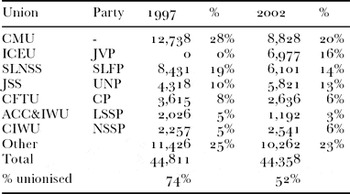
Unpublished data obtained from the Employers Federation of Ceylon's (EFC) annual member survey shows that the ICEU, which had no branches in any of the more than 400 companies surveyed in 1997, had become the fastest growing union in subsequent years, and had captured 16 per cent of all unionised employees by 2002. These trends are corroborated and extended further by data from the Labour Secretariat which show that ICEU membership grew from 9,747 to 35,116 between 2000 and 2005.Footnote 26
Sri Lanka: Union Membership and Party Affiliation of EFC Private Sector Non-Plantation Member Companies27

Source: Employers Federation of Ceylon (EFC)
The EFC data also shows a precipitous drop in the rate of unionisation from 74 to 52 per cent in just five years (1997–2002), caused to some extent by the increasing casualization of the work force, and also by the increasing number of companies which were completely un-unionised. In other words, the rapid growth of the JVP's trade union strength occurred at a time when trade unionism was in a phase of crisis and contraction.
Wasantha Samarasinghe, general secretary of the JVP's private sector trade union federation, the Inter Company Employees Union (ICEU), claimed that his unionFootnote 28 contained 100,000 members in 492 branches, mostly from large corporations, hotels, and manufacturing enterprises. He also gave some candid insights into the party's trade union strategy:
Most of our trade union members are not part of our party—but we are slowly trying to convert them. . . . We don't believe in trade unionism—we want to absorb leaders and talented people to the Socialist Workers Union [the JVP's apex union body].Footnote 29
Indeed, the slow take-over of the CP and LSSP's unions by the JVP is just one example of the way in which the JVP has inherited the mantle of radical politics vacated by the CP and LSSP since the mid-1960s. For example, student activism and campus politics, which had been dominated by the old left since the 1940s, had passed into the hands of the JVP by the early 1980s.
Leaders of non-JVP unions, and left party activists interviewed by the author were all, without exception, hostile to the JVP and singled it out for strong criticism. Bala Tampoe, a veteran Trotskyite and elder statesman of the trade union movement, said: ‘They are not interested in building working class organizations. They just want a vote bank.’Footnote 30 Leslie Devendra of the SLFP affiliated union, Sri Lanka Nidahas Sevaka Sangamaya (SLNSS) said ‘I think their influence in the trade unions is very sad for this country. Their style of militancy is very bad for the trade union movement and for the country.’Footnote 31 M.R. Shah of the non-partisan Ceylon Bank Employees Union (CBEU) charged them with being ‘disruptive elements in the working class’.Footnote 32
The Principal Sinhala Nationalist Party in the Country
From June 1998 to December 1999, the JVP temporarily de-emphasized the Sinhala nationalist component of their agenda, and entered into a broader alliance with three other small parties that positioned themselves to the radical left of the ruling People's Alliance government. In December 1999, this left front put forward the JVP's Nandana Gunathilake as a common candidate for the presidential elections, and won third place with six per cent of the vote. But in the months following the election, the JVP broke ranks completely with these leftist allies and switched ideological emphasis away from Marxism towards Sinhala nationalism. The circumstances of this shift occurred in the context of several factors. Firstly, the LTTE's spectacular military successes since late-1999, particularly in Elephant Pass in early 2000, had completely destabilised the viability of the government's military agenda. It marked Norway's entry and increasing presence as mediator in the conflict, and held out the possibility of ending the war through direct negotiations with the LTTE. Secondly, the government's landmark constitutional reforms and devolution package—which had been under preparation since 1995—were finally presented before parliament, in August 2000.
Both of these issues—constitutional devolution and foreign-mediated negotiations—were a source of great anxiety to Sinhala nationalists, who had long opposed devolution, foreign intervention, and any solution to the ethnic conflict short of outright military victory. Since the UNP, as the main opposition party, was in broad agreement with the government on the need for devolution, foreign mediation, and negotiations, the space for Sinhala nationalist opposition to the emerging peace agenda was left wide open for the JVP to capture and exploit. In the context of the upcoming parliamentary elections of October 2000, the appropriation of the growing Sinhala nationalist space provided the revitalized post-1994 JVP with the first opportunity to translate its carefully cultivated grass-roots strength onto the national stage. It was in fact the first meaningful opportunity for the JVP to compete in parliamentary elections in its entire 35-year history, and it did so with great success, leaching discontented voters from the left-wing of the ruling coalition.Footnote 33
Between early 2000 and late 2005, the JVP staked out its leadership over the Sinhala nationalist landscape in a series of campaigns centred around the peace process. From March 2000 onwards, the JVP initiated a long campaign against the introduction of Norwegian mediators.Footnote 34 A few months later, in August 2000, the JVP was once again at the forefront of nationwide protests against President Kumaratunga's new constitution and devolution proposals. In the aftermath of the December 2001 elections, it was the JVP, rather than the dispirited and dejected SLFP that remained energised and concentrated on coalescing and leading the opposition to the evolving cease-fire and peace process. In the following months, the JVP effectively stole a march over the other opposition parties by taking the initiative to categorically oppose the formal cease-fire agreement (CFA) in February 2002, negotiations with the LTTE between September 2002 and March 2003, the government's interim power-sharing proposals from May to October 2003, and the LTTE's counter-proposals in November 2003. Even after the elections of April 2004, the JVP remained deeply hostile to the resumption of any negotiations with the LTTE during May and December 2004, and were instrumental in scuttling ‘P-TOMS’ (the post-tsunami aid-sharing mechanism) between March and July 2005, which proved to be the last gasp of the peace process.
The JVP's increasing association with Sinhala nationalism post-2000 did not signify an abandonment of activism on traditionally Marxist issues. The insecurities generated by the economic crisis of 2000–2001, and the subsequent UNF government's market reform agenda, provided the JVP with a growing base of support from a variety of sources, including farmers, the unemployed, and public sector workers. At an ideological and practical level, the JVP's success lay in their ability to fold these often spontaneous sources of predominantly economic opposition into component elements of an over-arching and coherent Sinhala nationalist framework. As such, opposition to economic globalization became part of an encompassing movement of resistance against the political machinations of predatory neo-colonial powers, international NGOs, and international capital—all of whom the JVP accused of conspiring to divide and re-colonise the country through the peace process. The international community assisted greatly in the construction and reinforcement of this logic by offering generous quantities of development aid, conditional upon market reforms and progress in the peace process. By campaigning against both the peace process and the UNF government's market reforms, and by ideologically conflating these two elements, the JVP was in effect mirroring the way in which the ruling UNF had similarly ideologised the same two issues. Just as the government envisaged the peace agenda as a component element of an economic development strategy based on market reforms and greater global integration, so the JVP argued that the peace process and market reforms were part of a coherent assault by a constellation of foreign forces and domestic quislings to destabilise, fragment and re-conquer the island. As Tilvin Silva, the JVP's general secretary described it:
On the one side, the country is being sold to transnational corporations through the Regaining Sri Lanka programme while on the other, a separate state is being given to the LTTE.Footnote 35
One factor behind the JVP's success in mobilising on both these issues is that the other elements of the Sri Lankan left, who could have competed for control of the economic opposition, were torn between the two issues. The LSSP, CP, NSSP and a large majority of the non-JVP trade unions were deeply opposed to the government's economic agenda, but nevertheless remained supportive of the peace process. The government of Ranil Wickremasinghe was pursuing a number of extremely controversial reforms on land, labour and privatization, but many non-JVP unions and left-parties held back from capitalising on these issues and mobilising opposition for fear of disrupting the fragile peace process.Footnote 36
On balance, they prioritised peace over economic issues, and many in the Marxist left ultimately decided to support the government. In October 2003, and again in January 2004, when the UNF government (and hence the peace process) appeared in danger of collapsing under the weight of the JVP-led campaign, the main non-JVP left parties met with Prime Minister Ranil Wickremasinghe and agreed to use their influence to defuse trade union pressure on the government, in return for a postponement of the more controversial parts of the economic agenda such as privatization and labour law reform.Footnote 37 In practice, very little came of this effort. The non-JVP left was not strong enough to prevent the collapse of the peace process, but nevertheless laid themselves open to the charge of collaborating in the government's unpopular economic agenda at a time of growing worker unrest.
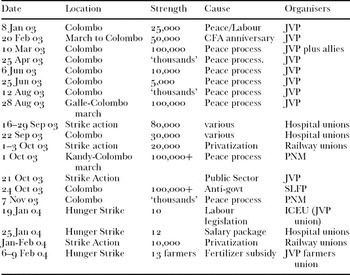
In contrast, the JVP was consistent and unrestrained in its opposition to the government on both peace and economic reforms. Fortuitously for the JVP, the timing of the implementation of both these agenda items closely overlapped, so that controversial economic reform issues were introduced and debated in parliament amidst a parallel escalation of anxieties relating to the peace process. For example, in early January 2003, the government introduced four new bills on labour law reformFootnote 38 on the very day that the critical fourth round of negotiations with the LTTE were initiated in Thailand. Both these issues aroused considerable anxiety in themselves and aroused widespread anti-government demonstrations by a variety of different organizations. But over the course of the following week, the JVP adroitly exploited these distinct sources of tension and fused them together by bringing 25,000 people onto the streets of Colombo in the biggest opposition rally against the government to-date.Footnote 39
Following this, the JVP launched a series of increasingly powerful demonstrations at the rate of almost one every month for the next year that paralysed Colombo. These were also accompanied and interspersed by a wave of strike action in critical public services. Between August and November 2003, the JVP brought anti-government tensions to fever pitch by instigating an almost continuous sequence of high profile strikes, marches through the country, massive demonstrations against the peace process, and a variety of other political actions in the centre of Colombo.
In late-September 2003, 80,000 hospital workers went on strike for 13 days, paralysing health services. As soon as they returned to work, 10,000 railway employees went on strike, causing chaos in the public transport system. Meanwhile, the JVP-affiliated Joint Union of Unemployed Graduates (JUUG) held a continuous protest outside Colombo's Fort railway station for two months, protesting at a lack of public sector jobs. Numerous other government departments and public-sector companies threatened strike action, as did farmers’ unions.
Many of these strikes were directly instigated by the JVP through their new-found influence over the unions, with the explicit intention of destabilising the government. But there was also a considerable independent and spontaneous element involved, fuelled by the growing economic anxieties over the reform agenda. In addition, the IMF-inspired fiscal austerity measures implemented in 2002, including a fertilizer-subsidy cut and public-sector hiring freeze, had predisposed a variety of different socio-economic constituencies against the government. As one independent trade union leader described it: ‘The entire work-force in the country was opposed to Ranil’.Footnote 40
Main JVP Protests and Union Actions, January 2003 to February 2004

Source: Compiled by the author from the Daily Mirror, Sunday Times, Daily News, Tamilnet, The Island.
The growing scale of the JVP's anti-government juggernaut in late 2003 was directed, on the one hand, at the government itself, and on the other, was tactically directed to pressure President Chandrika Kumaratunga to use her constitutional prerogatives to dismiss the UNF government, dissolve parliament, and trigger fresh parliamentary elections. A new wave of strikes erupted in January 2004, just as the final negotiations were underway between the JVP and the President. There was a sudden outbreak of hunger strikes by the JVP unions: protesting against labour legislation outside the labour ministry building; by hospital workers outside the health ministry; and by farmers against the withdrawal of the fertilizer subsidy. Finally, there was another mammoth railway strike that shut down the railways from 27th January to 9th February, 2004. All these strikes converged on Colombo and were brought to a climax in the first week of February 2004. The highly instrumental and political nature of the strike wave, and the extent to which it was under the direct control of the JVP, became very evident when the strikes suddenly ended on 9 February, as soon as President Kumaratunga agreed to dissolve parliament and call elections on 2nd April, 2004.
Marxism and the National Question
Between 2001 and 2004, the JVP became the leading Sinhala nationalist political organisation in Sri Lanka, and also the leading political force that opposed the peace process. Incredibly, it achieved this position without being an explicit advocate of Sinhala nationalism, (and having frequently denounced it). Moreover, it did so in direct competition with other political forces which were far more explicit, outspoken, and authentic advocates of the Sinhala-Buddhist majority. Indeed, the JVP's Marxist origins were a significant asset in its successful mobilisation of Sinhala nationalism providing the party with the ideological sensibility, political tools, and organisational skills to outplay its competitors.
A flexible allegiance to two different ideologies allowed the JVP to tactically bend from one to the other, in line with political circumstance, and to recruit and mobilise as an authentic representative of both doctrines. It also provided command, not only over the JVP's natural social base among educated rural Sinhala-Buddhist youth, but also allowed it to mobilise and draw in supporters from the trade union movement, and from groups who were agitated by the national question. The JVP's Leninist party structure and its strict norms of discipline and collective decision-making provided an unparalleled organisational strength. The JVP has a dedicated cadre-base who remain active and perform constant house-to-house visits and acts of public service, such as tsunami relief, even when there are no elections looming. The JVP remains one of the few parties that has a constant supply of idealistic young ‘full-timers’ willing to sacrifice their own careers for a life as a party organiser. In these respects, the JVP ranks very favourably against the corruption, indiscipline, clientelism, petty rivalries and factionalism displayed within the other parties.
The most critical asset that Marxism has given to the JVP is the ability to convincingly present its opposition to the peace process as inspired by ideals of justice, liberation and equality, rather than by ethnic exclusivism, militarist revanchism or religious zealotry. The JVP angrily and vociferously denies the charge that it is chauvinistic,Footnote 41 and there is very little in the official literature or statements of the JVP that can be described as arousing overt anti-Tamil sentiment. The JVP advocates equal rights for all communities in Sri Lanka and recognises that Tamils have historically suffered discrimination and even violence.
The JVP's 2001 election manifesto, which otherwise bristled with hostility to the upcoming peace process, nonetheless promised to ‘ensure equality and democracy to all nationalities, ethnicities and people of different religious faiths, rejecting all forms of chauvinism and tribalism’.Footnote 42 The manifesto also pledged to rehabilitate Tamils who were displaced by the 1983 riots. As such, although the JVP is indeed a Sinhala nationalist party, such a characterisation is not self-evident and needs to be carefully articulated and qualified.
The JVP is certainly not a Sinhala supremacist party, has not advocated or participated in organised violence or provocations against Tamil civilians, and has not espoused an explicitly Sinhala exclusivist position. This distinguishes it, for example, from the more brash Sinhala nationalism of the Sinhala Urumaya (SU), or its successor, the Jathika Hela Urumaya (JHU)—who are openly sectarian advocates for the Sinhala-Buddhists, and have been associated with provocative and inflammatory campaigns against virtually all the other religious and ethnic minorities.
Indeed, the direct target of the JVP's hostility was not the Tamil population at large, but Tamil nationalism as an ideo-political project, which calls for a substantial measure of regional self-government, if not independent statehood, for the island's north and east. As a result of the JVP's ideological weltanshauung, and the socialisation of its leading cadres in a ‘Sinhala only’ environment, the party has displayed an almost epistemological blind-spot for Tamil nationalism, and it remains a topic that party leaders often find bewilderingly difficult to emote with or engage with at any level. Take for example, the following exchange between an audience member and the officiating JVP cadre at a seminar sponsored by the party on the national question in 1997:
[question by audience member]: ‘Can you succinctly describe your solution to the ethnic conflict in this country?’
‘Socialism’, answered one of the JVP leaders unequivocally and crisply.
‘What should the Tamil people do until socialist rule is established in the country?’ asked another person in the seminar crowd.
‘The Tamils also have to struggle for socialism until then’ replied the JVP.Footnote 43
In its campaign against the peace process, the JVP characterised Tamil nationalism as an undemocratic, chauvinistic ideology of ethnic exclusivism, promoted by a terrorist organisation, and deeply implicated in a neo-colonialist enterprise by foreign powers to divide and re-conquer the island. The JVP's outlook on Tamil nationalism in the 2001–2004 period remained heavily influenced by a thesis developed in the mid-1980s by the party's founder-leader, Rohana Wijeweera.Footnote 44
In an extended polemical engagement within the Marxist debate on the national question, Wijeweera argued that the right to self-determination was not absolute in Lenin: support for a given nationalist movement was conditional on its juxtaposition to world imperialism and to its strategic value to the communist movement. At certain historical moments, nationalist movements can be progressive, democratic and liberatory. But at other times, they can be distinctly dangerous, whether as the refuge of reactionary parochial elites, or as the handmaiden of predatory imperialist forces seeking to divide and re-colonise the Third World. Wijeweera asserted that Tamil nationalism (conflating Tamil Nadu's Dravida movement with Sri Lanka's Tamil Eelam movement), was in the latter category, and deserved to be opposed on grounds of principle.
Actually the aim of the DMK movement is completely in line with the aim of US imperialism and their plan of action. It is very clear that US imperialism gives importance for the active expression of the agitation and struggle of the DMK movement for an independent Dravidian land again, after the partial success it has had in generating separatist movements in the north-eastern, eastern, north-western and western, northern India, and the support and aid, it has been able to mobilise from countries outside the borders like Pakistan, China and Bangladesh. Should Sri Lanka be partitioned on the boundaries of nationality, should an independent Tamil Eelam state be established it would provide a catalyst for this aim. Therefore it can be a secret to nobody why US imperialism and everybody who wants to break up India have such an interest in the Tamil Eelam movement.Footnote 45
Beyond the casual and misleading conflation between Indian and Sri Lankan Tamil nationalisms, Wijeweera's work is arguably an opportunistic mis-reading of the Leninist tradition, which distinguishes between the oppressive and undemocratic nationalism of imperialist and larger nations, and the more democratic character of the nationalism of smaller, colonised nations. In Sri Lankan conditions, it is this legacy of Lenin that has brought the mainstream Marxist left into a position of broad sympathy with Tamil nationalism as the democratic expression of an historically discriminated minority. Wijeweera instead argued that Tamil nationalism, through its alleged complicity with imperialism, was a dangerous and reactionary threat.
In operational terms, this effectively translated into an agenda and tactical programme that was little different to that which successive generations of Sinhala chauvinists have deployed since the mid-1950s: the fetishization of the unitary nature of Sri Lanka's state; a conflation of national interests with the (imputed) sectional interests of its largest community; a stubborn refusal to tolerate any form of regional power devolution to the Tamils; and the hysterical vilification of all those, especially Sinhalese, who would advocate or tolerate such a compromise.
This abiding characterisation of Tamil nationalism as imperialist proxy continued to inform the JVP through the 1990s and formed the substantive framework around which its opposition to the foreign-mediated peace process was constructed in 2001–2004. In effect, the JVP is not itself an open advocate for the exclusive rights of the Sinhala majority, and even maintains a rhetorical denunciation of Sinhala chauvinism. However, through its tireless opposition to even the most moderate versions of the Tamil nationalist agenda, the JVP consciously pandered to, cultivated, and benefited from Sinhala chauvinism, arrived at alliances with outspoken extremists, and became the leading advocate for the issues most central to Sinhala nationalism. On the basis of these actions, the JVP is viewed by large sections of Sri Lankan society, and particularly by the Tamil community, as a Sinhala chauvinist organization. But internally, the self-legitimation of the JVP draws upon Wijeweera's formulation that its opposition to Tamil nationalism arises not from an oppressive majoritarian impulse to dominate a vulnerable minority, but from its underlying commitment to social liberation, ethnic harmony and anti-colonialism.
Marxism with an Indubitably Sinhalese Character
How then does the JVP's Sinhala nationalism relate to the rest of the Sri Lankan Marxist tradition? In practical terms, the JVP's relationship to the Marxist left has been largely derivative of its stance towards the ethnic conflict. Despite having frequently compromised with Sinhala chauvinist forces for electoral expendiency, the Marxist parties are traditionally the most minority-friendly entities in the Sri Lankan political spectrum. The JVP, on the other hand, has frequently adopted a position on the ethnic conflict that is little different in practical terms to that of the Sinhala chauvinist far right. What explains this unusual deviation?
Sri Lanka's ‘old left’, comprising the Communist Party (CP) and the Lanka Sama Samaja Party (LSSP), and even the JVP's contemporaries in the ‘new left’ such as the Nava Sama Samaja Party (NSSP), have historically drawn their support base from the trade union movement.Footnote 46 In most cases, and going back to their founding in the mid-1930s, their leadership has consisted mostly of radicalised urban middle-class intellectuals. In their prime, during the 1950s–1970s, the old left parties contained a sizeable contingent of Tamils among their leadership, cadre, fellow-travellers, and mass fronts.Footnote 47 Since the 1980s, the CP and LSSP have been enthusiastic supporters of a devolved power-sharing mechanism to address the aspirations of the Tamils, while the more radical NSSP has even been willing to accept the Tamils’ right to self-determination.
In complete contrast, the JVP has historically been composed overwhelmingly of Sinhala-Buddhists, both among its rank and file, and at leadership level—who are utterly opposed to any measures to decentralise powers to the Tamil north-east. Until the late-1990s, the JVP had virtually no base in the trade union movement, and relied mainly on its control over university student unions; indeed, most of the traditional left parties questioned the JVP's ideological credentials, accusing them of being closet communalists in Marxist clothing. JVP leaders were said to lack the intellectual depth, cosmopolitan character, and statesmanlike bearing of the distinguished senior ideologues of the old left. The party was accused of having no base (and indeed, no faith) in the working class, were ridiculed for their shallow and weak grasp of Marxist theory, and had at various times, flirted eclectically and erratically with Maoism, Che Guevarism, and Trotskyism. One of the JVP's oldest critics, Dayan Jayatilleka, speaks for many on the old left in his bitter diatribe against them as a Pol-Potist force, espousing a ‘malignant, midget Marxism—a dwarfed, distorted, debased, caricatured Marxism’.Footnote 48
Such criticism of the JVP is to be found not only among the Marxist left, but also among Sinhala nationalists of the Jathika Chinthanaya school such as Dr Gunadasa Amarasekera, or Professor Nalin De Silva, who are sympathetic to the JVP, but nevertheless find their continuing allegiance to Marxism an unnecessary baggage. As Amarasekera frankly explained:
Within the JVP there is a deep feeling for nationalism. I think their understanding of Marxism is not very deep. Marxism is a mask to make it look respectable: Lenin, Mao and so on. Don't misunderstand, they are fine fellows who love this country and come from the grass-roots. At some stage in the past they had to have this mask. This is when it was very fashionable, sophisticated, etc. Now it is very discredited. I tell them, throw this bloody mask away. But a volte face is not possible. They [would have to] must openly say that they are not Marxist. They would have to disown their [dead] leader Rohana Wijeweera, a bloody fool of a Marxist.Footnote 49
But the JVP's adherence to Marxism is not merely an ideological sleight of hand to mask their inner chauvinist core. Neither is it the case that the mixture of these two tendencies represents an uneasy marriage or macro-level coalition arrived at between two distinct factions, for the mixture occurs at a far more molecular level, and is as such impossible to disentangle. Furthermore, the JVP's Sinhala nationalism is by no means unusual or exceptional within the tradition of Sri Lanka's Marxist left, for it has been one of the central, internal tensions within the movement since the mid-1950s, more than a decade before the JVP was founded. Indeed, one can argue that the JVP is the legitimate heir to the tradition of Sri Lankan Marxism initiated by the CP and LSSP.
The traditional left parties are strident opponents of the JVP on a variety of grounds going back to the late-1960s. But it is their divergence on the ‘national question’ that is the most vexatious. Batty Weerakoon, general secretary of the Lanka Sama Samaja Party (LSSP) during the 1990s, described the JVP as ‘a petty bourgeois party with Marxist slogans. They have communal politics only.’Footnote 50 Bala Tampoe of the Ceylon Mercantile Union— an old left-oriented trade union that has lost ground to the JVP's trade unions was characteristically blunt and scathing in his assessment: ‘The JVP are completely degenerated Marxists. In fact they know nothing about Marxism, and are straight forward Sinhala chauvinists.’Footnote 51 D.W. Subasinghe, who heads the trade union wing of the Communist Party remarked similarly ‘JVP is petty bourgeois, and semi-peasant, not working class. Their growth is on the national question, not on working class issues.’Footnote 52
James Jupp's description of the JVP is in many ways typical of those within, or sympathetic to, the left tradition who wish to establish how the JVP represents a fundamental disjuncture with the rest of the Marxist left: ‘the JVP was virtually uninfluenced by the sophisticated and cosmopolitan approach of the LSSP,’Footnote 53 he describes. Later, he explains ‘to the established left the most obnoxious feature of the JVP was its eclectic and nationalist ideology’.Footnote 54 Indeed, unlike the LSSP or CP, the JVP leaders were not members of the westernised middle class, were far less articulate in English, and were mostly of humble, rural origins. Their schooling in Marxist theory was weak, and they had no international connections to speak of. But all this does not amount to conclusive evidence that the JVP is some mutant anomaly that emerged from beyond the pale, for the mainstream Sri Lankan Marxist tradition had, by the 1960s, itself become increasingly tainted by association with Sinhala nationalism.
Indeed the problem is not even limited to Sri Lanka as such, for nationalism has remained one of the abiding intellectual and political challenges confronting the Marxist left internationally since the early twentieth century. As Tom Nairn writes, ‘The theory of nationalism represents Marxism's great historical failure’.Footnote 55 There are some very obvious parallels to be drawn between the experience of the Sri Lankan communist movement, between the 1930s and 1970s, and that of India during the same period, or even as far back as the European parties of the Second International (1889–1916). In the context of their increasing parliamentary representation and steady de-radicalisation, the relationship between European social democracy and nationalism walked a path that began with resistance, but moved rapidly on towards accommodation, compromise, and capitulation. During World War One, most social democratic parties found it impossible to resist the nationalist wave, and most parties ultimately adopted a stance of ‘social patriotism’, lining up to support their respective governments in favour of the war they had previously condemned.
Likewise, it is in the course of their steady march towards de-radicalisation and parliamentary gentrification during the 1950s and 1970s, that the CP and LSSP became closely associated with Sinhala nationalism in the form of the SLFP governments of S.W.R.D. Bandaranaike and Sirimavo Bandaranaike. The SLFP's landmark election victory in 1956, on a wave of Sinhala nationalist sentiment, was in reality accomplished with the assistance of an electoral alliance with the CP and LSSP. In the interests of maintaining and leveraging their electoral relevance through the 1960s and 1970s, both parties drifted into coalitions within openly Sinhala nationalist governments, hoping to use their cabinet positions as a vehicle to bring a left-wing agenda to bear on government policy, and also to introduce a voice of moderation to counteract the Sinhala nationalism of their allies. But what happened more often is that the CP and LSSP were forced into defending policies that they had earlier stood against, and found that Sinhala nationalism was creeping into their own organisations.
When Robert Kearney interviewed LSSP leaders in the 1960s and 1970s in order to understand their increasing collaboration with the Sinhala nationalism that earlier they had fought against, the answers he received were essentially the very same factors that the JVP would pick up on a generation later: (i) that there was a progressive element to Sinhala nationalism; (ii) the fact that it was electorally unbeatable:
The Sinhalese resurgence had galvanised the masses and created the genuine mass movement of the contemporary period. The movement expressed deeply felt popular aspirations and contained ‘progressive’ features, particularly as it represented the class revolt of the Sinhalese-educated rural masses against the English-educated classes, as well as containing ‘reactionary’ divisive and obscurantist features. In the existing circumstances, the Samasamajists claimed, the strength of the movement was so great that opposition to it was futile and progress was possible only by associating with it and guiding it into progressive channels.Footnote 56
The LSSP's respected leader, Dr Colvin De Silva, for example, had in 1956 led his party in vigorous opposition to the Sinhala-only language policy of the SLFP. In a passionate speech to parliament during the language bill debate, he made the remarkably prophetic warning that forcing Sinhala on the Tamil population would pave the way for separatism and violence:
Do you want two languages and one nation or one language two nations? Parity, Mr. Speaker, we believe is the road to the freedom of our nation and the unity of its components. Otherwise two torn little bleeding states may arise of one little state, which has compelled a large section of itself to treason, ready for the imperialists to mop up that which imperialism only recently disgorged.Footnote 57
But in 1972, the very same Dr Colvin De Silva was the cabinet minister for constitutional affairs in charge of drafting what is now an infamous constitution that set the stage for Tamil separatism. The new constitution re-imposed a unitary state that made no concessions to regional devolution, enshrining Sinhala as the sole official language, and according the ‘foremost position’ to the Buddhist religion. This is not to suggest that De Silva or the LSSP had turned communal. But the logic of retaining electoral relevance and parliamentary clout led to its complete de-radicalisation and compelled it towards an ever-closer association with Sinhala nationalism, which had suffused the very idiom of the populist political realm that it inhabited. As Kumari Jayawardena describes:
In terms of parliamentary politics this often meant the adoption of policies and strategies that would evoke a positive response from the general mass of the people; in effect, of the Sinhala majority.Footnote 58
James Jupp describes this process within the LSSP in the early 1960s:
For nearly six years the LSSP leaders resisted the Sinhala Only tide, facing abuse, violence and defection in the process. . . . Within the largest of the Marxist parties there was a constant disciplinary problem created by the tension between adhering to a demanding ideological position and functioning within a society which was making that position electorally untenable.Footnote 59
Consequently, the Marxist left were shoe-horned into increasingly unpleasant compromises that triggered bitter and self-destructive factional disputes within their own parties. They earned themselves a reputation for opportunism, expediency and a willingness to sacrifice militancy, ideology and principle for power, eventually costing them the support of a new generation of radical minded youth, both Sinhala and Tamil, in the 1970s and 1980s.
While these angry young Tamils were mobilised within radical Tamil nationalism and separatism, it is the JVP that came to represent the voice of the angry under-privileged Sinhalese youth.Footnote 60 And it is in supplanting the old left parties from the 1970s onwards that the JVP became heir to an established tradition of grass-roots collaboration and cross-pollination between the popular radical idiom of Marxism and Sinhala nationalism. It is for this reason that the JVP represents what are referred to as the ‘children of 1956’Footnote 61: the populist upsurge in 1956 represented the first coming together of an electoral alliance of Sinhala nationalists and Marxists. The JVP represents the child of that union: a corporeal fusion of Marxism and Sinhala nationalism that exhibits both characteristics in seamless combination. As JVP leader, Somawansa Amarasinghe described upon returning to Sri Lanka in early 2004, ‘We love this country. Before we became Marxists, we were patriots’.Footnote 62 The JVP, he held, ‘did not import Marxism in its outdated, raw form but infused certain Marxist elements with the indigenous Sinhala Buddhist culture, the result of more than 2000 years of an unbroken civilization that existed’.Footnote 63
Electoral Expediency and Institutionalisation
Although the JVP (due to its social basis and unique ideological history) has always contained a latent potential for a Sinhala nationalist deviation, the actual genesis of its extremist stance on the national question was triggered only in the specific circumstances of 1983, in the wake of a humiliating result in the November 1982 presidential elections, and following the sharp escalation of ethnic tensions and violence after the July 1983 riots. Under its previous general secretary, Lionel Bopage, the JVP had between 1975 and 1983, adopted a tolerant, if not entirely sympathetic, attitude towards the growing Tamil nationalist movement. It adopted what was, in essence, a modified reiteration under Sri Lankan conditions of the well established Leninist-Stalinist position on the right of nations to self-determination.Footnote 64 But following the JVP's highly disappointing performance in the presidential elections of September 1982,Footnote 65 and the growing Sinhala communal hysteriaFootnote 66 aroused by the Tamil separatist insurgency in the north, the party was forced to re-evaluate its position in order to retain and expand its popularity in the new polarised circumstances. As Jagath Senaratne describes:
With the ascendancy of ethnic political mobilisation as the chief motor of political mobilisation by the early 1980s, the JVP was compelled to make a reassessment. It has to make clear to the Sinhala masses where it stood on the ethnic conflict and the secessionist insurgency. It came out in strong opposition to the demand for a separate state, strenuously opposed the interventions from India, and conveniently blamed the UNP government for the entire crisis.Footnote 67
Following a sharp disagreement within the politbureau in mid-1983, which ultimately led to the resignation and departure of Bopage, the JVP comprehensively revised its entire position on the national question. Whereas the JVP under Bopage had, in 1977, accepted ‘the right of the Tamil speaking people to self determination’, they had, after the onset of civil war in 1983, become ‘the most anti-Eelamist group in the country’.Footnote 68 Importantly for the ideological evolution of the party a decade later, Chandraprema speculated that it was Somawansa Amarasinghe who led the opposition to Bopage within the central committee in 1983, and it was he who successfully argued for the anti-Eelamist line.
Amarasinghe was also one of the key figures in an intra-party debate on the ethnic issue which took place in mid-1983 before the proscription and went on for some months afterwards. Amarasinghe et al were of the view that the JVP should totally reject its earlier stand on the ethnic issue which held that regional autonomy should be granted to the Tamil people by way of solution. Lionel Bopage and a considerable cross section of the party disagreed and left. Hence Amarasinghe can be identified as one of the main figures behind the JVP's rigid stance against any form of Tamil regional autonomy in the North and East.Footnote 69
In an atmosphere of increasing violence and widespread polarisation, the JVP, which had by then been proscribed, became the party that sought to outbid the government at every turn in its nationalist rhetoric, and that bitterly attacked any hint of peace talks or a compromise solution as a betrayal that would lead to the division of the country.
The JVP's volte face to a radical Sinhala nationalist deshapremi (patriotic) organisation in the mid-1980s led it into a suicidal confrontation with the then UNP government over the first such meaningful attempt at a peace process in the form of the Indo-Sri Lanka Peace Accord. By its own (belated) admission, the JVP was responsible for killing some 6,000 people between 1987 and 1989, in what was in effect a vast campaign of assassination, strikes and public intimidation.
More than a decade later, the JVP engineered another shift from Marxism to Sinhala nationalism in the context of electoral experimentation and in the prelude to another peace process by a UNP-led government. In 1994–1995, and more substantially in 1998–1999, the JVP was in alliance with the NSSP, United Socialist Party and Muslim United Liberation Front (MULF) under the ‘New Left Front’. At the time, despite the fact that the JVP opposed the devolution proposals that the rest of the left accepted, it still consciously projected itself as a socialist party: ‘the JVP is fully committed to socialism and those two parties are capitalist’, declared their fiery new media secretary Wimal Weerawansa.Footnote 70
Throughout this period, party publications condemned the war, opposed the military, denounced Sinhala nationalism, and campaigned against the imposition of emergency war-time legislation. Weerawansa and Tilvin Silva, who were the two most high profile leaders of the JVP during Somawansa's exile between 1990 and 2004, frequently targeted Sinhala extremist organisations such as the National Movement Against Terrorism (NMAT) in their public speeches. The JVP's official organ even accused the NMAT of organising a military coup d'etat.Footnote 71
During this period, the JVP considerably softened or de-emphasized its position on the ‘national question’ in the interests of preserving unity among their leftist allies. Indeed, as a constituent of the New Left Front, the JVP signed a joint manifesto for the December 1999 elections that pledged to end the war by ‘granting the minorities the right of self-determination in a socialist rule based on democracy’Footnote 72 —a position completely at odds with what the JVP advocated both before or after the elections. But in the months following the elections, in which the JVP's candidate performed poorly, the party switched back into Sinhala nationalist mode. By August 2000, the JVP had parted company with the New Left Front. Together with a new set of allies in the Sinhala nationalist camp, the JVP placed itself at the forefront of massive street demonstrations against the Kumaratunga government's devolution proposals. JVP candidates stood for election in the October 2000 and December 2001 elections in an increasingly strident campaign against the looming peace process, and achieved a surge in electoral support.
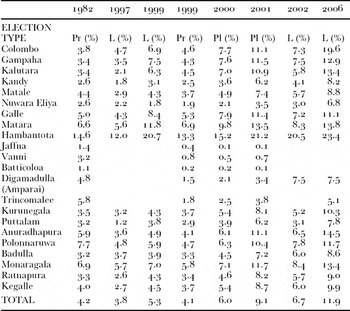
Thus by looking at the actual circumstances of the JVP's programmatic switch from class to nation on two occasions, there are plausible grounds to argue that these have in reality occurred in the context of electoral consolidation, and perhaps (to a smaller extent) were even due to tactical considerations of electoral strategy. Within six months of two separate disappointing elections, first in October 1982, and later in December 1999, the JVP had swung towards a far more vigorous and aggressive Sinhala nationalist posture. The history of its subsequent election performance since 1999 shows that this was actually a successful strategy that markedly increased its vote share.
Table 3 shows that the JVP had, by 1999, succeeded only in restoring its 1982 vote share, such that the measurable expansion in its growth beyond this level (from 4.1 per cent to 9.1 per cent) occurred in the period between December 1999 and December 2001, when it reoriented itself towards a far more strident anti-devolution, anti-peace process, Sinhala nationalist platform.
JVP Election Vote Share, 1982–2006, by District

Source: Sri Lanka Dept. of Elections.
Pr = Presidential L = local government; Pl = Parliamentary.
Beyond issues of electoral strategy and tactics, the JVP's fluid manipulation of its dual identity represents a longer-term internal transformation. Effectively the JVP has, since its inception, followed a slow, uneven, and non-linear trajectory from an insurrectionary communist party to a parliamentary Sinhala nationalist party.Footnote 73 This is not to say that the shift is absolute or complete: elements of Sinhala nationalism have been present in the JVP since its founding, just as its Marxism is likely not to completely disappear. This process is broadly cognate (but under different circumstances) with a similar process that the ‘old left’ underwent in the years after 1956 when they were accused of compromising with communalism for electoral reasons. The JVP spent much of 1977 to 1983, and 1994 to 1999, experimenting with a fairly neutral line on the ‘national question’, just as the ‘old left’ had done between 1956 and 1964. But this stance proved to be electorally unrewarding as the JVP scored lower in the 2000 presidential elections than it had in several local body elections between 1997 and 1999.
As with the CP and LSSP between the 1940s and 1960s, the JVP has gone from being a proponent of armed struggle and the revolutionary overthrow of bourgeois democracy to being a party of exemplary and conscientious parliamentarians, fiercely critical of other groups engaged in armed struggle (such as the LTTE). It has, in short, transformed itself from a party devoted to overthrowing the system from the outside, to a party devoted to cleansing and preserving it from the inside.
Class and Nation
The gradual tendency of Sri Lanka's Marxist parties to swing from class to nation in the course of their de-radicalisation and electoral habilitation does not imply that class is irrelevant, either as a category for political mobilisation or ideo-political analysis. Indeed, the mass appeal of Sinhala nationalism lies in the fact that it is fundamentally rooted in the dynamics of class. This is not to say that the JVP can be reduced to a simple class phenomenon, and neither is it the case that it can be said to represent any one class, for the steady increase in its electoral support during the period 1994 to 2004 clearly signifies its increased appeal among different social groups.
This is also not to equate the popularity of the JVP with the prevalence or depth of poverty as such.Footnote 74 In other words, both in terms of class and poverty, it is necessary to situate the JVP not by studying class in itself, or the extent of deprivation amongst its supporters per se, but by how the JVP's support bases are located and have evolved with respect to the class structure as a whole. As a sociological phenomenon, the JVP's supporters are frequently described as the ‘children of 1956’: that is, they comprise the educated rural Sinhala Buddhist population of poorer backgrounds who are the social products of the expansion of free Sinhala medium secondary and university education. They came of age in the aftermath of the Sinhala nationalist upsurge in 1956, were nurtured in the vernacular cultural renaissance of the time and absorbed the powerful Marxist and Sinhala nationalist anti-systemic ideo-political currents that it unleashed.
At the time of the JVP's 1971 uprising, the social background of the 10,192 surrendered and captured insurgents were recorded in considerable detail by the authorities, and were later published in a paper by Gananath Obeyesekere.Footnote 75 The figures revealed by Obeyesekere are remarkable, not only for the extent to which they provide a unique set of data on a large number of participants in a revolutionary movement, but also for the degree of homogeneity within this group. Of those in custody, 98 per cent were Sinhalese, 95 per cent Sinhala-Buddhist, 89 per cent were aged under 30, and 92 per cent were the children of farmers, labourers, plantation workers, or the low grades of government service, and 86 per cent had attended rural secondary schools.Footnote 76 The JVP's first insurgency can as such, be quite accurately summarised as a movement of secondary school educated, Sinhala-Buddhist youth of under-privileged rural backgrounds. In a very large number of cases, they were the children of small or middle-level farmers from areas that were geographically, economically and psychologically very peripheral to Colombo. As David Rampton describes, the JVP operates within a context characterised by a ‘vast disparity perceived between elites and masses, the capital and the provinces, the urban and the rural, centre and periphery.’Footnote 77
It is within these circumstances of enduring economic, social, political and regional exclusion, reproduced through different generations of development policies, that Sinhala nationalism finds expression as a positional stance of anti-elite protest. In post-colonial Sri Lanka, where the ruling economic and political elite has been characterised by conspicuous cultural westernisation, the articulation of class consciousness and hostility by the lower elements of this order seeking upward mobility, has constantly reverted to an assertion of nativist authenticity and Sinhala nationalism. This is not to say that the ‘elite’ and ‘mass’ describe homogenous, static, stable, or consistent categories, for the internal differentiation within the ‘mass’ is a critical factor in the enduring appeal of Sinhala nationalism, and its continuous re-emergence in the political sphere. Neither are these divisions based on insurmountable ascriptive categories, for they occur in a context of perceived expectation of social, and particularly, upward, inter-generational mobility.
The critical link between class and nationalism is provided by the social democratic state, and to the enduring and critical relevance of the state from late-colonial times in promoting the class transition of upwardly-mobile rural communities. The materiality of nationalism is thus intimately connected to the fact that the state is the largest material benefactor in society; and that Sinhala nationalism is an ideology that connects the people to the state. By providing education and welfare, protecting and promoting domestic entrepreneurs, and generating direct employment opportunities, the social democratic state became the vehicle by which the lives of the rural poor could be completely and permanently transformed.
Sri Lanka's social democratic state, which went through a long phase of expansion from the 1940s to the 1970s, has, since the 1980s, experienced atrophy and compression. Since the early 1990s, however, the only part of the state that has consistently grown has been the military. The war has in effect, preserved the social democratic state and many of the functions of poverty reduction and social mobility that it earlier performed. Considering that many aspects of social policy have been encroached upon by non-governmental organisations and aid donors during this period, there has been an erosion of the public service component of the state and a proportional increase in the military role of the state. In rural (Sinhalese) Sri Lanka, the military performs an important function in employment provision to the collapsing small-holder rural economy. In related research,Footnote 78 this author describes how the military has become the single largest employer of rural youth, accounting for as many as half of all cash-paying jobs in some areas. The preservation of the militarised social democratic state is thus one of the central impulses that continued to provoke Sinhala nationalism during the 1990s, and provided the ideological and social context within which the JVP has re-emerged into electoral relevance.
Sinhala nationalism therefore forms part of the socio-political assertion of a certain segment of the ‘mass’ for whom nationalism is effectively an ideological expression of their material claims upon the social democratic state. Amidst the neo-liberal juggernaut of market de-regulation, privatization and the systematic neglect and under-funding of the state sector for over two decades, the re-assertion of Sinhala nationalism by a party of populist Marxism, the dogged opposition to the devolution of the state's powers, and the widespread appeal of an anti-globalisation ideology all point in the same direction. They characterise the desperate strategies of those close to the bottom of the ladder to preserve and protect the social democratic state, in which lies their only realistic chance of emerging from a life of poverty and of improving their life chances for themselves and subsequent generations.
The JVP's Sinhala nationalism is thus not necessarily a deviation from mobilisation on a class basis—but is in many ways a reversion to class mobilisation through more successful means. The JVP continued to mobilise class-based grievances, but did so not by appealing systematically to class at all, or by appealing to the working-class as such, or even to the most depressed or disadavantaged groups, rather, they successfully tapped into the tremendous vats of discontent from a variety of under-privileged groups in Sinhalese society for whom the preservation of the shrinking social democratic state is a matter of desperate urgency. Lacking independent wealth, they continue to depend on state provision of education, health and employment to sustain themselves and to maintain their standard of living. And it is through the ideological apparatus of Sinhala nationalism that opposition to the diminution of the state—whether through market reform or by devolution—emerges conflated into the political realm. In other words, the JVP has succeeded where other Marxist groups have failed, by mobilising class through the language of the nation. Similarly, they have successfully projected themselves as the defenders of the nation by presenting themselves in the garb of anti-systemic radicals, authentically rooted in class politics.