INTRODUCTION
Sea cucumbers have been widely exploited in the Indo-Pacific region for centuries, but despite this long history, sea cucumbers are still a poorly understood coastal resource (Hornell, Reference Hornell1917; Shelley, Reference Shelley1985; Conand, Reference Conand1990, Reference Conand2004; Lovatelli et al., Reference Lovatelli, Conand, Purcell, Uthicke, Hamel and Mercier2004; Bruckner, Reference Bruckner and Brukner2006). Due to increasing demand for dried sea cucumbers (beche-de-mer) (Choo, Reference Choo, Toral-Granda, Lovatelli and Vasconcellos2008) fishing pressure over this resource has increased tremendously, leaving insufficient abundance of stock in many fisheries to support either commercial harvests or stock recovery (Friedman et al., Reference Friedman, Eriksson, Tardy and Pakoa2010). Hence, the management of sea cucumbers has become a worldwide concern and much attention is now being paid to study the biology (e.g. population parameters of recruitment, growth and mortality), ecology, stock status and level of exploitation to allow for more effective management (Wiedemeyer, Reference Wiedemeyer1994; Mercier et al., Reference Mercier, Battaglene and Hamel1999; Conand & Muthiga, Reference Conand and Muthiga2007; Choo, Reference Choo, Toral-Granda, Lovatelli and Vasconcellos2008).
Fishery independent surveys provide one form of data for understanding stock status and catch statistics are useful to characterize the species composition. In combination, these provide estimates of the level of exploitation, fishing mortality, catch per unit of effort (CPUE) and historical trends in fisheries (Uthicke et al., Reference Uthicke, Welch and Benzie2004; Skewes et al., Reference Skewes, Taylor, Dennis, Haywood and Donovan2006; Purcell et al., Reference Purcell, Gossuin and Agudo2009; Purcell, Reference Purcell, Lovatelli, Vasconcellos and Yimin2010a). Although the level of recruitment is an important parameter in fisheries management, it has not been extensively studied in sea cucumbers due to lack of basic biological information for this multispecies group, scarcity of data on juveniles and various reproductive strategies adopted (Conand, Reference Conand1990; Shiell, Reference Shiell2004). Few attempts have been made to estimate the natural mortality rates of sea cucumbers and most of these estimates have only been derived for the species with low commercial value (Ebert, Reference Ebert1983; Shelley, Reference Shelley1985; Conand, Reference Conand1990; Bonilla & Pérezrul, Reference Bonilla and Pérezrul2003).
In Asia, sea cucumbers are widely exploited in China, Ecuador, Indonesia, Japan, Malaysia and the Philippines. Indonesia, together with the Philippines produces around half of the world sea cucumber landings at present (Shelley, Reference Shelley1985; Conand, Reference Conand1990; Choo, Reference Choo2004, Reference Choo, Toral-Granda, Lovatelli and Vasconcellos2008; Purcell, Reference Purcell, Lovatelli, Vasconcellos and Yimin2010a, Reference Purcellb). Sri Lanka also has a long histry of sea cucumber exploitation and fishing activities have been restricted to the north, east, and north-western coastal waters (Hornell, Reference Hornell1917; Dissanayake et al., Reference Dissanayake, Athukorala and Amarasiri2010). The fishing activities are highly seasonal in these areas and fishing season along the north-west coast starts in late October and continues until April of the following year while it is from May to September in the north and east (Dissanayake & Wijayarathne, Reference Dissanayake and Wijayarathne2007). However, there is no tradition of consuming sea cucumbers in Sri Lanka and the entire production is processed as beche-de-mer and exported to Singapore, Taiwan and China (Kumara et al., Reference Kumara, Cumaranathunga and Linden2005; Dissanayake et al., Reference Dissanayake, Athukorala and Amarasiri2010). As the sea cucumber fishery in Sri Lanka has been developed without routine monitoring, very little historical information is available on the target species and the level of exploitation. However, of the 25 sea cucumber species identified, 21 species are considered as commercially important (Dissanayake & Stefanson, Reference Dissanayake and Stefansson2010a).
The aim of this study is to provide managers information on the status of sea cucumber stocks in relation to current levels of exploitation. This study also establishes and assesses important population parameters such as natural mortality and total mortality of commercial species. The findings of this study are for the use of fishery managers, who wish for greater insights into regulating the fishery for sea cucumber species in the coastal waters of Sri Lanka. Further, this information is important to update the regional statistics and for launching regional management programmes as trends in managing sea cucumber fisheries are towards regional rather than national management.
MATERIALS AND METHODS
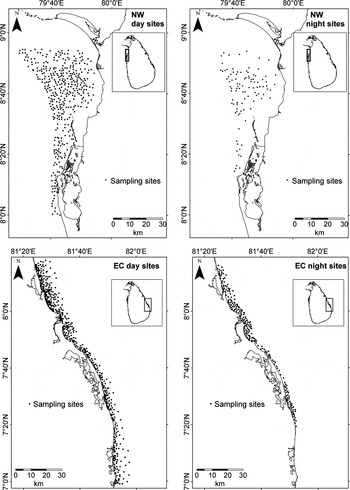
An underwater visual census (UVC) was repeatedly carried out at randomly selected 500 sampling sites off the north-west and the east coasts of Sri Lanka in 2008 and 2009. The east coast survey area was between 8°17′–6050′N and 81025′–820E and the north-west coast study area was between 7055′N–8055′N latitudes and 79035′E–79057′E longitudes. The sampling sites were confined to 1–30 m depth resulting in a survey area of 1307 km2 off the east coast and 1779 km2 off the north-west coast. Both day (400 sites) and night (100 sites) diving activities were carried out off the north-west coast in both years. Due to security constraints only day diving (500 sites) activities were carried out off the east coast during 2008 but additional 210 sampling sites were surveyed at night in 2009 (Figure 1).
Day and night sampling sites used for underwater visual census off the north-west (NW) and the east (EC) coasts of Sri Lanka in 2008 and 2009.

The survey employed rapid marine assessment technique that has been used for sea cucumber surveys in the Torres Strait (Long et al., Reference Long, Skewes, Dennis, Poiner, Pitcher, Taranto, Manson, Polon, Karre, Evans and Milton1996). Field work was undertaken by a team of divers operating from small boats and locating sampling sites using a portable global positioning system device. On each sampling occasion one or two divers swam along a 100 m transect, collecting sea cucumbers on a 1 m strip to each side of the transect line. All the sea cucumbers collected during the surveys were brought to the boats where they were counted and the total length of each individual was measured to the nearest 1 cm. The surveys were carried out at the beginning of each fishing season by temporarily closing the commercial fishing activities. Thus, the east coast survey started in early June and the north-west coast survey was in early October in each year with the survey period extending up to 4 weeks on each occasion.
Catch and effort data were also collected at the major landing sites of these two areas in the season following each survey. In each year, the catch data were collected by making regular weekly field visits to the landing sites. On each sampling day, more than 50% of the total boats operated were sampled on a random basis. Information on fishing gears, details on fishing operations, total catch and its species composition (in numbers) was collected from each sampling boat. In each sampling day it was ensured to be at the landing site before boats were landed and also the landings were completed to get an accurate figure on the total number of active boats. The information on total number of fishing days in each month was collected by interviewing fishers and collectors in each landing site. The body length of selected sea cucumber species was measured to the nearest 1 cm from the samples taken from commercial landings.
Data analysis
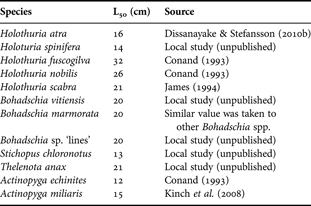
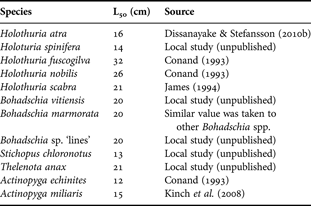
The total abundance of each commercial species was calculated as a product of average density (ind ha−1) and the total survey area. The sea cucumbers collected during the surveys were grouped into adults and juveniles based on the length at first sexual maturity information summarized in Table 1. Adults to juveniles ratio was calculated for each commercial species from the samples collected during the underwater visual census and these ratios were used to calculate the total abundance of adults and juveniles seperately.
Length at first sexual maturity (L50) used to estimate the abundance of adults and juveniles in the coastal waters of Sri Lanka in 2008 and 2009. The information source is also summarized.
In this analysis, the fishing effort is expressed as the mean number of active boats per day and the mean catch in numbers per operation is used as a measure of catch per unit effort (CPUE). The monthly total production (MTP) of each sea cucumber species was estimated as the product of mean catch per boat (CPUE), mean number of active boats per day (NFO) and the total number of fishing days for that particular month (MRD):

The statistical significance of CPUE and the total catch between the species and areas was compared using one-way analysis of variance. The mean length of commercial species was computed in 2008 and 2009 using the length measurments taken from commercial landings. The mean length of each species in two different years was statistically compared using Student's t-test.
The exploitation rate (E) of each sea species was calculated as E = C/N, where C is the total annual catch in numbers and N is the total abundance of adults. Here it is assumed that only adults are representing the exploitable stocks or number of individuals available to the fishery (N).
The total mortality (Z) of each species was calculated as

Here N2 is number of adults in year 2 (2009); N1 is number of adults in year 1 (2008); R1 is number of recruits. It is assumed that juveniles in year 1 (2008) will enter to the fishery in the following year.
It is obvious that some sea cucumber species fetch higher price than the others and fishers always tend to search for such species. As a result the fishing mortality for each species must in some manner be linked to the price. The simplest model would be to assume that fishing mortality (F) is proportional to the price (P) offered for each species. Based on this assumption, the following regression models were constructed to estimate the average natural mortality (M) of sea cucumbers. The total mortality rates (Z) of commercial species in two geographical regions were considered when constructing these regression models




Here j = 1 …….. ji; i = 1, 2, Zij, total mortality of jth species in ith area, M, overall natural mortality, Pij, price of jth species in ith area.
Most of these models can be compared in pairs using appropriate t-tests or F-tests (A–B, A–C, A–D, B–D and C–D) and this was used to select the best model to estimate the overall natural mortality (M) of sea cucumbers.
As an alternative to simple linear regression, the following random effects model was constructed

where M denotes the natural mortality, α1 is random effect due to area, βj is random effect due to species, P is price of jth species, ɛij is within sample error and Zij is total mortality of jth species in ith area.
In this model, area and species are treated as random effects and the price is considered as a linear term. Three reduced models were constructed from this model by dropping one variable at a time and all four models were compared using the Akaike information criterion (AIC) to select the best model to estimate the natural mortality of sea cucumbers. The contribution of species and area to the total variance was estimated using variance component analysis. The random effects αi, βj and ɛij will be assumed independent and thus

Here, σ2A is the variance between areas, σ2S is variance between species and σ2ɛ is the residual variance. The variance component analysis was performed using lmer in R-software package.
RESULTS
Fishery
The fibreglass reinforced plastic boats powered with 9, 15 or 25 Hp outboard motors are the major fishing crafts used for sea cucumber fishery in Sri Lanka. Sea cucumbers are mainly harvested through diving and hand picking. SCUBA diving is carried out by almost all the divers and skin diving is rarely practised. Normal practice was for two divers and a boat operator to be on-board during a fishing trip but sometimes there were three divers on-board. On average, four SCUBA cylinders were used by each diver during a fishing trip and true fishing time varied from 30 to 45 minutes per cylinder.
Both day and night fishing activities were practised in the north-west but night diving predominated in the east as day collection was not profitable due to low catch rates. The fishing crafts left around 0700–0800 hours and returned around 1500–1600 hours when day diving activities were carried out while they left around 1800 hours and came back next day early morning around 0200 hours for night fishing. There were considerable variations in fishing depths with the fishing time. Day diving was carried out down to a depth of 20 m while the night diving was restricted to 10–15 m. However, the effective fishing time ranged from 2 to 2.5 hours per boat per day in both day and night diving activities. Around 280 boats were engaged in sea cucumber fishing activities in the north-west while there were 200 boats in the east. Local migration of fishers took place especially from north-west to east during the respective fishing season.
In each area, around 2000–2500 fishing families were directly or indirectly dependent on the sea cucumber fishery for their livelihoods. Due to religious activities, almost all fishers (Muslims or Catholics) did not go for fishing one day a week (either Friday or Sunday). Hence, the fishing operations were conducted six days per week and the active number of fishing days varied with the climatic conditions as it required clear and calm seas for successful fishing.
Total abundance
Eleven species were predominant in the commercial landings off the north-west coast and nine species were predominant in the east.
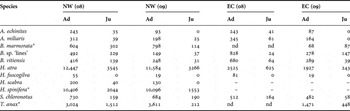
When considering the total abundance of predominant commercial species, it was found that two species (Holthuria scabra and Holothuria spinifera) were totally absent in the east and three species (Bohadschia marmorata, H. spinifera and Thelonota anax) were abundant only at night. In both areas, the highest total abundance was reported for Holothuria atra (Table 2). Holthuria spinifera was the second most abundant species off the north-west coast and T. anax was the second most abundant species in the east. For all the commercial species, the total abundance of adults and juveniles has declined in 2009 when compared with 2008. The lowest abundance was reported for Holthuria fuscogilva in the coastal waters of Sri Lanka and there were no records on the presence of juveniles of this species during the study period. The total abundance of commercial sea cucumber species was significantly higher off the north-west coast than the east coast (P < 0.01).
Estimates of total abundance of juvenile (Ju) and adult (Ad) (103 individuals) off the north-west (NW) and east (EC) coasts of Sri Lanka in 2008 and 2009 (Dissanayake & Stefanson, Reference Dissanayake and Stefansson2010a).

*, nocturnal species; nd, no data; for full species names see Table 1.
Fishing effort, CPUE and total catch
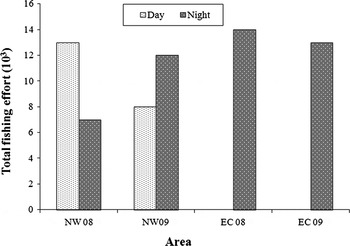
In both 2008 and 2009, the total fishing effort (boat days) was higher in the north-west (20,238 and 19,792, respectively) than the east (14,183 and 13,265, respectively). In the north-west, the total diurnal fishing effort between 2008 and 2009 has declined by 38% while the nocturnal activities have increased by 68% (Figure 2). Only night fishing was operated off the east coast and there was a slight reduction of total fishing effort in 2009 compared to 2008.
Fluctuations of day and night fishing efforts (boat days) off the north-west (NW) and east (EC) coasts of Sri Lanka in 2008 and 2009.

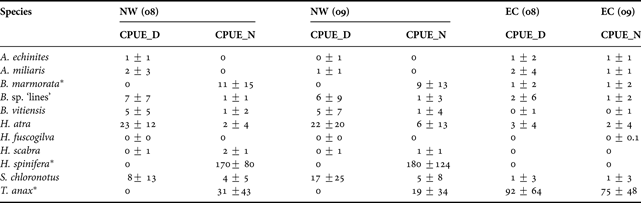
Holthuria spinifera had the highest CPUE (P < 0.01) in the north-west while it was for T. anax (P < 0.001) in the east (Table 3). Off the north-west coast, the average CPUE in night fishing was significantly higher than the day fishing (P < 0.01). The CPUE of commercial sea cucumbers has declined towards 2009 in both areas having three exceptions (H. spinifera, H. atra and Stichopus chloronotus) off the north-west coast.
Catch per boat per day (CPUE) of commercial sea cucumbers estimated in day (D) and night (N) fishing activities off the north-west (NW) and east (EC) coasts of Sri Lanka in 2008 and 2009.
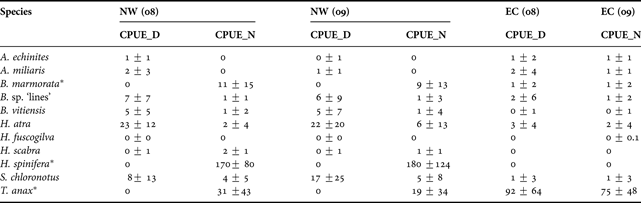
*, nocturnal species; for full species names see Table 1.
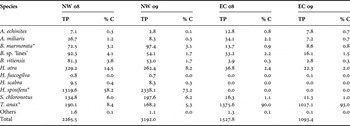
The commercial landings of all the species except for three (Actinopyga echinites, Actinopyga miliaris and T. anax) were higher in the north-west than the east (Table 4). In 2008, the highest percentage contribution to the total production in the north-west was given by H. spinifera (58.2%) and its contribution has increased up to 73.2% in the following year. But in the east, the highest contribution was from T. anax and its average contribution was more than 90% in both years. The contribution of high-value species (H. fuscogilva and H. scabra) to the total production was negligible in both areas. Due to increased landings of nocturnal species, the total sea cucumber production has increased off the north-west coast from 2008 to 2009. However, the total production has declined in the east from 2008 to 2009.
Total production (TP in 103 individuals) of each sea cucumber species and their percentage contribution (% C) to the total landings off the north-west (NW) and the east (EC) coasts of Sri Lanka in 2008 and 2009.

*, nocturnal species; for full species names see Table 1.
Length distribution and mean lengths in the commercial catches
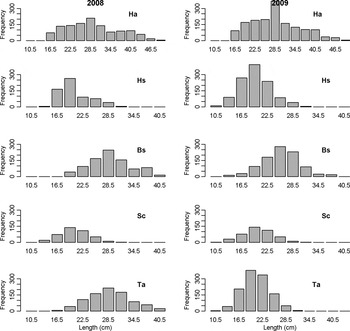
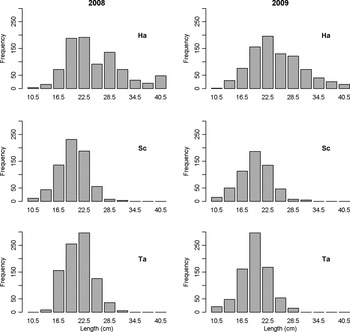
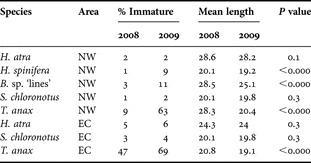
The smaller length-classes which were totally absent in the 2008 fishing season were found to appear in 2009 length distributions especially off the north-west (Figures 3 & 4). Further, in most of the commercial species, harvesting of juveniles (sexually immature individuals) has increased in 2009 compared to 2008. The highest % of immature individuals was reported in T. anax catches off the east coast (Table 5). The mean length of H. spinifera, Bohadschia species ‘lines’ and T. anax has declined significantly (P < 0.000) in 2009 compared to 2008.
Length distribution of major commercial species: Holothuria atra (Ha), Holothuria spinifera (Hs), Bohadschia species ‘lines’ (Bs), Stichopus chloronotus (Sc) and Thelenota anax (Ta) landed by the commercial catches off the north-west coast of Sri Lanka in 2008 and 2009.

Length distribution of major commercial species: Holothuria atra (Ha), Stichopus chloronotus (Sc) and Thelenota anax (Ta) landed by the commercial catches off the east coast of Sri Lanka in 2008 and 2009.

Percentage landings of juveniles (% Immature) and the mean length (ML in cm) of major commercial species off the north-west (NW) and the east (EC) coasts of Sri Lanka in 2008 and 2009. The mean length of each species in 2008 and 2009 was statistically compared using Student's t-test and P value is given.

For full species names see Table 1.
Mortality and price information
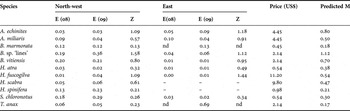
The exploitation rate has varied from species to species off the north-west and the east coasts of Sri Lanka during the study period (Table 6). In 2009, Bohadschia species ‘lines’ had the highest exploitation rate off the north-west coast and it was for T. anax off the east coast. Except for H. atra, T. anax, B. marmorata and two Actinopyga species, the exploitation rates of all the commercial species have increased off the north-west coast in 2009 compared to 2008. However, it is difficult to make any comparison on exploitation rates of commercial sea cucumbers off the east coast due to absence of abundance estimates for nocturnal species in 2008. Although the market price (P) of sea cucumbers varied from species to species, it did not change between areas. Holothuria fuscogilva and H. scabra always had the highest market price while the lowest price was for B. marmorata.
Exploitation rate (E), total mortality (Z), individual price (P in US$) and predicted natural mortality (M) of commercial sea cucumbers off the north-west and the east coasts of Sri Lanka. Exploitation rate (E) of each species is given for 2008 and 2009 seperately.

nd, no data; 1 US$ = 110 LKR; for full species names see Table 1.
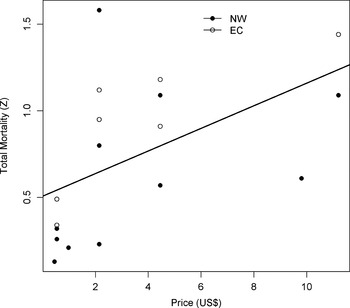
As the regression models were not significantly different from each other, model D (one regression line through entire dataset) was selected to estimate the average natural mortality (M) of commercial sea cucumbers and the estimated M was 0.50 yr-1 (Figure 5).
Simple linear regression on price versus total moratality of commercial sea cucumbers off the north-west and the east coasts of Sri Lanka.

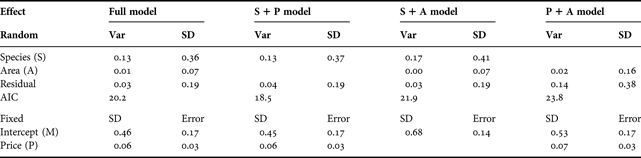
The random effects model given in the methodology is considered as the full model and this model contains price as a linear term and both species and area as random effects. In the full model, species variance was much higher than the area variance and the variance due to species was significant (P < 0.05). Comparison of AIC values indicated that the species and price model (S + P) has a better fit than the other models and this model was selected to estimate the average natural mortality (M) of sea cucumbers (Table 7). The estimated average natural mortality of sea cucumbers (M) was 0.45 yr−1 and this can fluctuate between 0 and 1.18 yr−1. The predicted natural mortality values suggest that nocturnal species have lower natural mortality than most of the diurnal species (Table 6). Bohadschia species ‘lines’ and A. echinites had the highest natural mortality.
Full and reduced versions of random effects models used to estimate the overall natural mortality (M) of commercial sea cucumbers in the coastal waters of Sri Lanka. Variance (Var) and standard deviation (SD) of each random effect and standard deviation and error of linear terms are given.
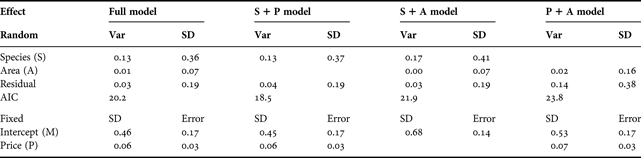
AIC, Akaike information criterion.
Economics of fisheries
Most of the fishing vessels and diving equipments were owned by entrepreneurs who rent them out to the fishers at a fee. At the same time, fuel for the boats was also supplied by entrepreneurs and they were the first level of buyers. All the sea cucumbers were landed in fresh form and sold as pieces at the landing sites. The market price of sea cucumbers varied from species to species (Table 6) and there were fluctuations from time to time. Even within the same species, the price was quite variable depending on the individual size where larger individuals fetch higher price than the smaller individuals. Sixteen small-scale entrepreneurs were involved in the sea cucumber fishery off the north-west coast and there were two major processing plants. As the buyers sell their catches directly to the processing plants, the small- scale domestic level of processing was rare in the north-west. There were 11 buyers in the east and they carried out domestic processing as there was not any large scale processing plant in this region. Processing steps were found to be similar in both areas and the major processing steps involved evisceration, boiling, salting, cleaning and sun drying though there were some modifications from species to species.
At the end of each fishing operation, entrepreneurs deduct the cost for lending boats and usage of fuel and diving equipments out of the total income. Depending on the fishing time there were differences in the net income per operation. Always night fishing generated higher profit than the day fishing. Although net income for day fishing operation has declined from 2008 (10 US$) to 2009 (9 US$) in the north-west, it has increased from 73 US$ to 80US$ per night operation. However, in the east, the net income per night operation has declined from 2008 (30 US$) to 2009 (21 US$).
DISCUSSION
Harvesting and processing of sea cucumbers provide an important means of livelihood to the coastal fishing communities in many parts of the world (Clarke, Reference Clarke2002; Choo, Reference Choo, Toral-Granda, Lovatelli and Vasconcellos2008). According to the present study, around 5000 families are also dependent on sea cucumber fishery in the coastal waters of Sri Lanka. Different fishing methods have been used to exploit sea cucumbers in the world and these include collecting by hand, bottom trawl nets, scallop-drag gear, spears, hooks, scoop nets, SCUBA and hookah (Bruckner et al., Reference Bruckner, Johnson and Field2003; Purcell, Reference Purcell, Lovatelli, Vasconcellos and Yimin2010a). In Sri Lanka, sea cucumbers are currently exploited by SCUBA diving and divers access the fishing grounds using small boats.
Sea cucumber populations are highly vulnerable to overfishing particularly, due to easiness of harvesting, late age at maturity, slow growth and low rates of recruitment (Conand, Reference Conand1990, Reference Conand2004; Lovatelli et al., Reference Lovatelli, Conand, Purcell, Uthicke, Hamel and Mercier2004; Choo, Reference Choo, Toral-Granda, Lovatelli and Vasconcellos2008). Overexploitation of sea cucumbers has been frequently reported in many parts of the Indo-Pacific region during the last few years (Woodby et al,. Reference Woodby, Kruse and Larson1993; Choo, Reference Choo, Toral-Granda, Lovatelli and Vasconcellos2008; Conand, Reference Conand, Toral-Granda, Lovatelli and Vasconcellos2008). This study indicates the decline of adults and juvenile abundance off the north-west and east coasts of Sri Lanka and this could be due to overharvesting of sea cucumber resources in these areas. Recent study revealed that population densities of most of the commercial sea cucumbers were less than 30 ind ha−1in the coastal waters of Sri Lanka (Dissanayake & Stefansson, Reference Dissanayake and Stefansson2010a). Declining of abundance, particularly of juveniles, may be due to existing low population densities because sea cucumbers are broadcast spawners and high population densities are required for successful fertilization and subsequent recruitments (Uthicke & Benzie, Reference Uthicke and Benzie2000). Use of SCUBA diving with motor boats could have some effect on depletion of sea cucumber resources in the coastal waters of Sri Lanka as this method implies an exhaustive search for specimens, including younger ones.
The CPUE values were known to be highly variable in the north-west and the east. The estimated CPUE values were in the similar range of some other countries including the Galapagos Islands (125 individuals per day) where sea cucumber resources are reported to be highly depleted (Shepherd et al., Reference Shepherd, Martinez, Toral-Granda and Edgar2004). However, the degree of confidence in CPUE as an index of abundance varies with the type of behavioural interactions between fish and fishers (Purcell, Reference Purcell, Lovatelli, Vasconcellos and Yimin2010a, Reference Purcellb). Especially in the sea cucumber fishery, divers are more selective towards certain species (high-value species) and sizes of individuals (larger individuals). Further, fishing conditions may have a major impact on the productivity of divers. Hence, the CPUE estimates of this study need to be interpreted with much caution as we have limited information. Time-series data on abundance and CPUE will improve the understanding of this relationship further.
Absence of day diving activities off the east coast might be due to overharvesting of diurnal species and this was in accordance with the anecdotal evidences of fishers in the area. Though there were day fishing operations in the north-west, the decline of day fishing operations was observed from 2008 to 2009. The reason for this observation is not quite clear but this may be a signal of resource depletion.
Collection of juveniles (immature individuals) and temporal shifting of fishing activities were observed in both areas. Further, in both regions, the contribution of high-value species to the total production is negligible and the commercial fishery mainly relies on nocturnal species belonging to the medium-value category. According to Dissanayake & Stefansson (Reference Dissanayake and Stefansson2010a), the population density of high-value species is very low (<2 ind ha−1) off the north-west and east coasts of Sri Lanka and this may be a possible reason for them to have very low contribution to the commercial landings. Immature individuals and observed small size-classes in the commercial catches may be a result of excessive fishing pressure on these stocks over time. Spatial and temporal shifting of fishing activities, declining of high-value species and harvesting of sexually immature individuals have been identified as some signs of resource depletion and these signs have been witnessed in many countries including India, Viet Nam and the Galapagos Islands during last few years (Shepherd et al., Reference Shepherd, Martinez, Toral-Granda and Edgar2004; Conand & Muthiga, Reference Conand and Muthiga2007; Del Mar Otero-Villanueva & Ut, Reference Del Mar Otero-Villanueva and Ut2007; Choo, Reference Choo, Toral-Granda, Lovatelli and Vasconcellos2008; Friedman et al., Reference Friedman, Eriksson, Tardy and Pakoa2010; Purcell, Reference Purcell, Lovatelli, Vasconcellos and Yimin2010a).
The exploitation rate of commercial sea cucumbers was less than 0.5 except for T. anax in the east. The observed exploitation rates could be due to several reasons. The estimated total sea cucumber production may not be accurate due to complexity of the fishery, ghost landings and sampling error. On the other hand, the total abundance may be overestimated for some species because specific habitat preference of each species as well as the volume of different habitat within the survey areas was not taken into account. However, according to Uthicke et al. (Reference Uthicke, Welch and Benzie2004), it is difficult to use exploitation rate as a reliable indicator to assess the stock status of sea cucumbers because harvesting of small percentage (<5%) of standing stock biomass can lead to stock depletion. As sea cucumbers have very low contribution to the total marine fishery production in Sri Lanka, no attention has been paid to reporting the catch statistics so far. Hence, it is difficult to make any inference on the trends of total landings, exploitation rates and changes in stock structure.
Despite the information about the value of sea cucumbers, the level and potential contribution of sea cucumbers to the national economy as well as to the livelihoods of coastal communities is not yet known in Sri Lanka. However, it seems that fishers tend to collect sea cucumbers continuously; even some commercial species were severely diminished in numbers. Friedman et al. (Reference Friedman, Eriksson, Tardy and Pakoa2010) also made the same observation in many remote islands where fishers have searched for new species or expanded the fishing activities into more remote or deeper waters when some commercial species were depleted or ‘economically extinct’. As it is difficult to find alternative job opportunities for these fishers in Sri Lanka, they may have continued fishing activities even though there were scant catches.
Estimation of natural mortality of sea cucumbers is often difficult and subjected to considerable errors (Uthicke et al., Reference Uthicke, Welch and Benzie2004). In this study, two methods (simple linear regression and random effects models) were used to estimate the natural mortality of sea cucumbers and the estimated values were close to each other. Further, the estimated values are consistent with the results from other studies (Ebert, Reference Ebert1983; Conand, Reference Conand1990). Though the predicted M value has high variance due to limited data, this is a useful finding especially in the field of sea cucumber stock assessment. The random effects model predicted lower natural mortality for nocturnal species than for the diurnal species and this could be due to low level of predation on former species or differences in biological and genetic characteristics of larval life stages of these two groups. However, further studies need to confirm this hypothesis and use of time-series data will validate the prediction further.
As there are some signs of sea cucumber resource depletion, it would appear timely to implement a management plan to avoid further depletion and even a collapse of the Sri Lankan sea cucumber fishery. Limiting the total allowable catch (TAC) could be considered, as has been implemented in the Northern Territory, Torres Strait and Queensland (Kinch et al., Reference Kinch, Purcell, Uthicke, Friedman, Toral-Granda, Lovatelli and Vasconcellos2008). However, to implement a system of TAC for the sea cucumber fishery in Sri Lanka more work is required including regularization of reporting and monitoring of commercial landings.
This study provides the first detailed information on stock status of commercial sea cucumber species in the coastal waters of Sri Lanka and the necessary basis for resource management.
However, further research and analysis of growth, recruitment and survivorship on longer time-scales is needed to understand the population ecology of these species to determine the potential yield and sustainable utilization of this resource. Tagging experiments can be considered to collect more precise biological parameters.
ACKNOWLEDGEMENTS
The authors wish to thank all the staff members of Marine Biological Resources Division of NARA for their assistance in the field and laboratory work. Thanks to Dr Brian Long, Dr C. Amarasiri, Mr H.S.G. Fernando, Ms S. Athukorala and all the colleagues who gave enormous support during this study. This research was financially and technically supported by the Canadian International Development Agency (CIDA), the International Fund for Agricultural Development (IFAD) and Food and Agriculture Organization (FAO). The PhD scholarship provided for the first author by the UNU Fisheries Training Programme is gratefully acknowledged.