Introduction
Stroke is a major emergency that requires immediate medical attention. It is considered the leading cause of morbidity with significant mortality secondary to its medical complications.Reference Feigin, Krishnamurthi and Parmar1 Stroke can happen to everyone no matter when; it is an interruption in the brain’s blood flow to a given area.2 Furthermore, strokes can be subdivided into Hemorrhagic, Ischemic, and Transient Ischemic Attack.3 Ischemic stroke, which is a blockage or narrowing of arteries either by a clot of thrombus or emboli, is the most common type of stroke.4
This type of stroke has established treatments—in particular, the administration of recombinant tissue plasminogen activator (rtPA), which is one of the most effective treatments for ischemic strokes; rtPA is a man-made tissue plasminogen activator that deliquesces blood clots.5 Patients must present to a medical facility that is capable of administering the drug within 4.5 hours from the appearance of stroke symptoms.Reference Marler, Tilley and Lu6
There has been considerable evidence that patients who have strokes are not transferred by an ideal method of transportation, and that most either come in via private transportation or via a friend/family member.
In Saudi Arabia, the standard methods of stroke patient transportation are private transportation and walk-in patients. Private, non-medical transportation of stroke patients poses a risk to the patient and a delay in emergency room (ER) triage. In addition, a majority of these patients could not recognize the symptoms of stroke and under-estimated the importance of Emergency Medical Services (EMS) activation; such behaviors resulted in missing the window period to administer rtPA.
This research is conducted to investigate whether EMS transportation of stroke patients could shorten stroke team activation, time to computed tomography (CT) scan, and time to receive rtPA.
Methods
Study Design and Setting
A prospective cohort study of all adult patients presented to King Abdulaziz Medical City (KAMC; Riyadh, Saudi Arabia) with stroke symptoms was conducted. Ethical approval was obtained from the King Abdullah International Medical Research Center (KAIMRC; Riyadh, Saudi Arabia) Institutional Review Board. Subjectively, KAMC is an academic, non-profit, tertiary medical facility with more than 1,000 beds. It has one of the largest ERs in the Middle East, with 105 beds (15 designated resuscitation beds) operated under board-certified emergency physicians. The medical facility has a designated stroke team, and KAMC is one of only two stroke centers in Riyadh that serve the capital of Saudi Arabia. There were 229 stroke team activations in 2016.
Sample Size Calculation
According to the study setting data, 200 patients were reported to have stroke team activation in 2016. The study compared two independent means to calculate the sample size, assuming that the reference group (patient received by private car) mean time to stroke team activation was 13 minutes, the test group (patients received by ambulance) mean time to stroke team activation was 10 minutes, and standard deviation was five minutes. The calculated sample size for this study was 63 patients/stroke team activations in each group (n = 126), with a power of 80% and a 95% confidence level.
Patients Selection
One year of data (from September 1, 2017 through August 31, 2018) were collected, and details of patients with stroke team activation who met the inclusion criteria specified below and who were received at ER were included.
The inclusion criteria were:
Adult patients (14 years or older are classed as adults according to KAMC policies);
Prehospital onset of stroke symptoms; and
Stroke team activation from the KAMC ER.
Patients were excluded in the case of one of the following:
Pediatrics (defined as less than 14 years old);
In-hospital stroke team activation; or
Patients presented with stroke symptoms that started >24 hours prior to the ER visit.
Data Collection
Patients’ data were collected anonymously on-site using paper forms. The data were then transferred to a computer where they were encrypted and saved in an Excel spreadsheet (Microsoft Corp.; Redmond, Washington USA). The data extracted included patient demographics: the patient’s age, sex, and mode of arrival. The time was determined using a standardized clock within the hospitals electronic patient care system. The triage nurse will enter the patient data (chief complaint and patient identification information) before an identification bracelet can be printed (the system will initiate the time); then, vital signs can be taken. The following times and data were also collected: time of symptom onset, time to CT (first image taken), time to stroke team activation (stroke team activation is done electronically), patient suitability for thrombolytic therapy, and time to receive rtPA.
Method of Measurements
The primary outcome was the difference in time to stroke team activation. Secondary outcomes were the difference in time to CT, the proportion of patients who received thrombolytic therapy, and the time to receive intravenous rtPA.
Statistical Analysis
All collected data were analyzed using IBM SPSS version 22 (IBM Corp.; Armonk, New York USA). Continuous characteristics of patients, such as age, were summarized using mean and standard deviation. Categorical characteristics, such as gender, were summarized by reporting the count and percentages in each category. To compare the difference in time between the two methods of arrival, a Mann-Whitney U test was utilized. Significance was indicated if P ≤.05.
Results
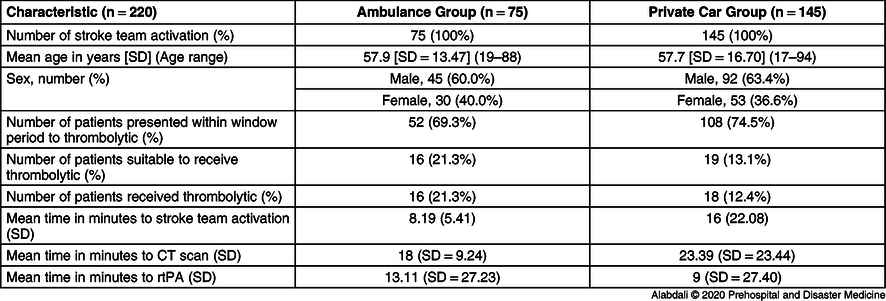
During the study period, 220 adult patients met the inclusion criteria and received stroke team activation. The characteristics of the patients are provided in Table 1.
Characteristics of Patients with Stroke Team Activation

Abbreviations: CT, computerized tomography; rtPA, recombinant tissue plasminogen activator.
There were 75 (34.1%) patients who had been received by ambulance, while 145 (65.9%) patients came via private transportation methods (private car or with a friend/family member). The mean time to stroke team activation, time to CT, and time to receive thrombolytic therapy for the ambulance group were: 8.19 (95% CI, 6.97 - 9.41) minutes; 18 (95% CI, 15.9 - 20.1) minutes; and 13.1 (95% CI, 6.95 - 19.3) minutes, respectively. Those for the private car group, on the other hand, were: 16 (95% CI, 12.4 - 19.6) minutes; 23.39 (95% CI, 19.6 - 27.2) minutes; and nine (95% CI, 4.54 -13.5) minutes, respectively.
There were 52 (69.3%) patients received via ambulance who presented within the window of rtPA (4.5 hours after the onset of symptoms), whereas 108 (74.5%) patients from the private car group were within the window. There were 16 (21.3%) patients suitable for rtPA from the ambulance group, while 19 (13.1%) of the patients who arrived by private car were suitable. The patients who received rtPA were 34 (15.9%) of all stroke team activations.
There was a significantly shorter time to stroke team activation to patients coming via ambulance compared to private car (P ≤.00), but no significant differences were found in time to CT (P = .259) or time to receive rtPA (P = .100). The time difference is provided in Table 2.
Time Difference between Ambulance Group and Private Car Group

Abbreviations: CT, computerized tomography; rtPA, recombinant tissue plasminogen activator.
Discussion
In this prospective study of adult patients with stroke who arrived at the tertiary hospital either by an ambulance or via a private car, the study found that patients delivered by ambulance had a significantly shorter time to stroke team activation (8.19 minutes versus 16 minutes). In addition, they had a non-statistically significantly shorter time to CT scan (18 minutes versus 23.39 minutes). Nevertheless, there was no difference in the rate or time for receiving rtPA (16 versus 18 minutes and 13 versus nine minutes, respectively).
Transportation via EMS of stroke patients is still under-utilized. This study’s results showed that only 34.1% of Saudi population utilized EMS. In other words, more than one-half of the patients were transported via a private method, which was usually non-medical. The rate of EMS transportation of stroke patients was higher than that reported in China,Reference Wangqin, Laskowitz and Wang7 and the rate had improved compared to a previous qualitative study done using the same settings.Reference Al Khathaami, Mohammad, Alibrahim and Jradi8 However, the majority of population is still dependent on private methods of transportation, which is consistent with the general population practice regarding stroke in the Middle East and North Africa.Reference Tran, Mirzaei, Anderson and Leeder9
There is an urgent need to enhance public education in terms of utilizing appropriate medical transportation of stroke patients. The common practice of transferring stroke patients with unsuitable vehicles and without a medical escort might impose a risk to the patients. Numerous research papers highlight that many stroke patients and families/friends failed to recognize stroke signs and symptoms, which led to a delay in ER presentation.Reference Kothari, Jauch and Broderick10,Reference Yu, San Jose, Manzanilla, Oris and Gan11 As a consequence, patients missed the opportunity to receive intravenous rtPA. Additionally, patients and the general public must be familiarized with the processes that are usually taken during the presentation of stroke patients (for instance, stroke team activation, the need for CT, and other imaging studies). These processes require time, and late presentation will increase the time consumed before a patient can be eligible to receive appropriate medical interventions.
Limitations
One important limitation of this study is the risk of unmeasured confounding variables. Equally important is the narrow outcomes measured in the study—this study reported the difference in time. Other outcomes, such as mortality, morbidity, and length of stay, were not measured. The majority of study participants were Saudi citizens transferred by the Saudi EMS system, so generalizing the results to other health care systems might be challenging.
Conclusion
Stroke patients transferred by EMS had a shorter time to stroke team activation, and they were triaged quicker and transferred to CT in a more suitable timeframe compared to patients who arrived via private transportation. There was no significant statistical difference in the time to CT or time to receive intravenous rtPA; however, patients received through EMS had a shorter time to CT. Transportation via EMS of stroke patients to a stroke center can significantly accelerate time to triage stroke patients and improve the time to receive appropriate medical consultation.
Conflicts of interest
The authors report no conflicts of interest. The decision to publish was made by the authors alone; therefore, the authors accept full responsibility for the contents of this paper.