I. INTRODUCTION
A growing need is felt for the use of materials with special capabilities and characteristics, including high mechanical and thermal properties. A single material cannot satisfy these requirements. Therefore, due to their multifunctionality, hybrid materials have received increasing attention by various industries. Reference Naglieri, Gludovatz, Tomsia and Ritchie1,Reference Ashby and Bréchet2 Multilayered clad metal is a type of hybrid multilayered material that includes two or more dissimilar metallic alloys. These structures can make the materials have better comprehensive selective properties such as mechanical, thermal, and electromagnetic characteristics. Currently, various technologies of fabricating clad metals have been developed, such as diffusion bonding, Reference Shao, Guo, Han, Lu, Qin and Zhang3,Reference Liu, Long, Ma and Wu4 hot rolling, Reference Lee, Yoon, Kim, Kwon and Lee5–Reference Gali, Shafiei, Hunter and Riahi7 resistance seam cladding, Reference Verstraete, Helbert, Brisset, Benoit, Paillard and Baudin8 explosive bonding, Reference Hoseini Athar and Tolaminejad9–Reference Bina, Dehghani and Salimi12 and fusion welding. Reference Qi and Liu13 Among them, the roll-bonding process and the explosive welding process are widely used. Explosive welding avoids the generation of intermetallic compounds. Reference Findik14 The roll-bonding process enables cost-effective continuous fabrication. It is known that the mechanism of interface bonding during warm roll bonding is divided into three stages: (i) initiation of physical contact, (ii) surface activation during contact, and (iii) interactions between the dissimilar parent metals. Recently, lightweight aluminum and magnesium alloys have been actively considered, Reference East, Gibson, Liang and Nie15–Reference Jeon, Han, Joo, Van Tyne and Moon17 which are desperately required in the automotive industry and for household appliances. Magnesium alloys are known as the lightest-weight metal materials due to their low density, high specific strength, dimensional stability, and damping capacity. Reference Seetharaman, Blawert, Ng, Wong, Goh, Hort and Gupta18 However, due to their poor room temperature ductility and corrosion resistance, the industrial application of magnesium alloys are quite limited. To overcome these drawbacks and extend the applications, various types of clad Mg alloys have been developed by being bonded with other alloys such as Al alloys. Liu et al. Reference Liu, Liang, Li, Zhao, Zhang and Wang19 reported that the corrosion resistance of Mg could be improved by Al coating. Direct solid-state bonding of Mg alloys and Al alloys is seriously restricted due to limited formability of Mg alloys at low and intermediate temperatures. Reference Çetin, Krebs, Durussel, Rossoll, Inoue, Koseki, Nambu and Mortensen20
Various solid-state bonding processes can be used to fabricate Mg/Al composite plates. Explosive welding is a very useful technology for metal welding and metal composite production. Reference Akbari Mousavi, Al-Hassani and Atkins21,Reference Lysak and Kuzmin22 However, work hardening is generated by the impact of joining plates during explosive welding process, and the microstructures on the interface are deteriorated and distorted by the tremendous force induced by the effect of the explosion. Yan et al. Reference Yan, Zhang, Shen, Wang, Zhang and Chin23 have investigated the microstructure and properties in explosive welded AZ31B/7075 composite plate. The results showed that there were adiabatic shear bands (ASBs) and twin structures in the AZ31B Mg alloy side. Also, Song et al. Reference Song, Kostka, Veehmayer and Raabe24 have reported that ASBs occur in the vicinity of the bonding interface. Besides, warm roll bonding could be used to circumvent the poor room-temperature formability of Mg alloys by annealing treatment to control the mechanical properties of clad sheets. Brittle reaction phases are inevitably formed along the solid-state-bonded interface in the form of intermetallic compounds, like Mg17Al12 and Al3Mg2 phases, Reference Chen, Hsieh and Wu25–Reference Kim, Lee, Kwon, Lee, Chang and Lee27 deteriorating overall mechanical properties as well as interfacial bonding strength. This means that mechanical contact or interlocking followed by considerable metallurgical bonding is a prerequisite to obtain sound joints at the interface. To improve the interfacial bonding strength of Mg/Al clad sheets, the size, morphology, and thickness of reaction phases should be optimally controlled. However, previous studies usually used one kind of solid-state bonding process to improve the properties of Mg/Al clad sheet. In this study, Mg/Al clad sheets were fabricated by explosive welding and roll-bonding process. The aim of this study is to identify the influence of hot rolling on the microstructural evolution and relevant mechanical properties of Mg/Al explosive composite sheet.
II. EXPERIMENTAL PROCEDURES
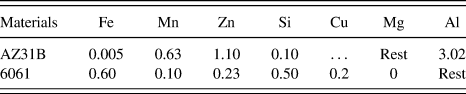
Commercial AZ31B Mg alloy and 6061 Al alloy sheets were selected as explosive welding materials. The chemical compositions of the materials used are given in Table I. The initial dimensions of 6061 Al and AZ31B sheets were 300 × 300 ×10 mm and 300 × 300 × 2 mm, respectively. The initial AZ31B/6061 composite plates were fabricated by explosive welding process. To choose the proper rolling temperature, a resistance furnace was used for the heat treatment at 300, 350, 400, 450 °C for 5 min. To evaluate the local mechanical properties of the explosive composite sheet, the tests to investigate microhardness were conducted on cross sections of the samples, which were set at a load of 25 g and a dwell time of 15 s by using a Vickers indenter. To observe the microstructure evolution of the constituent AZ31B Mg alloys, the samples were etched using 10 mL of acetic acid, 4.2 g of picric acid, 70 mL of ethanol, and 10 mL of H2O for 5–7 s.
Chemical compositions of AZ31B and 6061 (mass%).

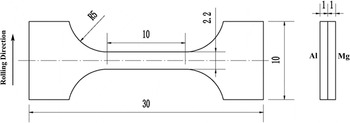
Several pieces of the samples were cut from the center of the explosive welded Mg/Al composite plates with a size of 30 × 70 mm. The samples were subjected to preheating at 400 °C for several minutes followed by single-step hot rolling with reduction of 20%, 30%, 40%, 50%, respectively. A schematic description of the explosive welding, heat treatment, and single-pass hot rolling is shown in Fig. 1. Uniaxial tensile tests were conducted on a screw-driven-type Instron 4206 testing machine with an initial strain rate of 10−3 s−1 at room temperature. Dog-bone-shaped tensile specimens with a gage length of 10 mm were prepared along the direction perpendicular to the rolling direction. The dimensions of tensile specimens are given in Fig. 2. The specimens for microstructure analysis were cut parallel to rolling direction. Microstructural observations were performed by optical microscope, and the presence of intermetallic phases was characterized using scanning electron microscopy (SEM) equipped with an energy dispersive spectroscope (EDS).
Experimental schematic of the explosive welding, heat treatment, and single-pass hot rolling for Mg/Al composite plates.

Schematic view of the specimens for tensile test.

III. RESULTS AND DISCUSSION
A. Microstructure and microhardness of the heat-treated specimens
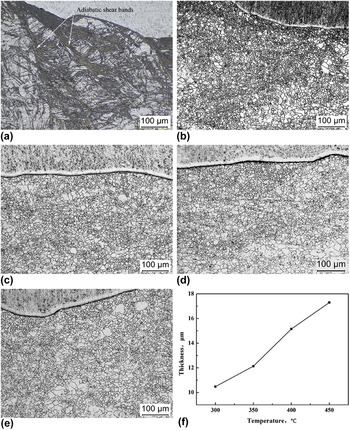
Figure 3 exhibits the optical microstructure of AZ31B Mg alloys near the interface from the explosive welding composite plates. As shown in Fig. 3(a), ASBs can be easily identified from initial explosive welding composite plates. The ASBs appear inclined at about 45° to the explosive direction and near the interface. Yan et al. Reference Yan, Zhang, Shen, Wang, Zhang and Chin23 reported that the ASB consisted of fine equiaxed grains which is due to the deformation caused by the large number of twins. Under the explosive welding conditions, high-velocity oblique collision produces high strain under collision loading which can lead to a large amount of twins. Figure. 3(b)–3(e) show the microstructure of samples after thermal treatment at different temperatures. The ASBs disappeared completely due to static recrystallization. With the increase of temperature, the degree of recrystallization increased significantly. The amount of fine grains increased and more uniform distribution of grain sizes. The thickness of diffusion layer after heat treatment at different temperatures is shown in Fig. 3(f). The diffusion layer thickness and diffusion coefficient in solids increased with increase in heat treatment temperature, the result is a considerable increase of the thickness of the intermetallic layer. Reference Lee, Yoon, Kim, Kwon and Lee5,Reference Luo, Liang, Chen, Zhang, Chi and Yang28 Due to the brittle and hard intermetallic compounds which is shown in Fig. 4, diffusion layer thickness had a certain influence on the subsequent rolling.
Optical micrographs of AZ31 Mg alloys near the interface in the explosive welding plates: (a) initial, (b)–(e) 300 °C, 350 °C, 400 °C, and 450 °C for 5 min, (f) the diffusion layer thickness of the interface after heat treatment at different temperatures.

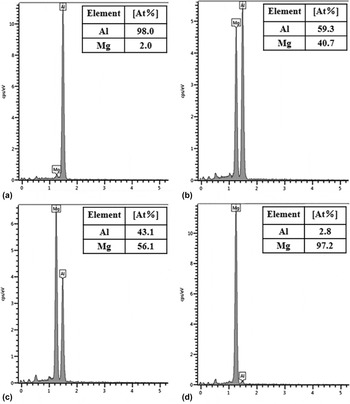
EDS spectra from layers marked by letters A (a), B (b), C (c) and D (d) in Fig. 6(a).

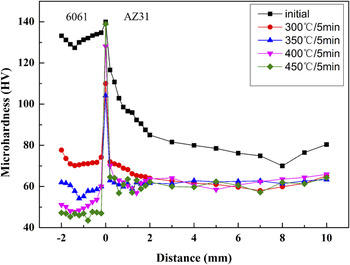
Figure 5 exhibits the microhardness distribution through the thickness of the AZ31B/6061 composite plate. It is obviously found that the initial composite plate has a higher average hardness value than the heat treated composite plates. It indicates that the heat treatment can effectively eliminate the residual stress after the explosive welding. The presence of the abnormal hardness value was caused by the intermetallic compound (in Fig. 4) located at the Mg/Al interface. This means that the microhardness of each constituent alloys is obviously decreased and then kept at a constant value with the increasing of heat treatment temperature. The ASB can be effectively eliminated by the heat treatment before hot rolling. It is clearly shown that the grain structure of the samples heat treated at 350 and 400 °C was more refined compared with those of heat treated at other temperatures. But when rolling at 350 °C, tearing occurred in the interface of the composite plate. Take into account the effect of the thickness of the diffusion layer, the heat treatment temperature was finally selected at 400 °C.
Vickers microhardness distribution along the thickness of the Mg/Al composite plate.

B. Interface of explosive welded composite plate
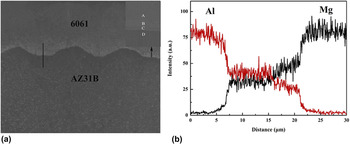
Figure 6(a) shows SEM micrograph of the AZ31B/6061 explosive welded composite plate after heat treatment at 400 °C for 5 min. The wavy interface was achieved by explosive welding technique. The wavy interface and the mechanism under explosive welding were reported by Akbri Mousavi. Reference Akbari Mousavi and Farhadi Sartangi29 Due to the effect of variations in the velocity distribution at collision point and periodic disturbances of materials, wavy morphology has appeared on the bonding interface. Reference Akbari Mousavi and Al-Hassani30 M. Asemabadi Reference Asemabadi, Sedighi and Honarpisheh31 showed that the bonding interface of clad metals has a wavy morphology. Also, Ahmet Durgutlu et al. Reference Durgutlu, Okuyucu and Gulenc32 reported that the bonding interface can be transformed from smooth to wavy shape by increasing the stand-off distance. Moreover, no pores and flaws were observed in interface of the composite plate. This indicates that the initial AZ31B/6061 composite plate fabricated by explosive welding yielded a sound interfacial bonding. An element line scan of Mg and Al elements was conducted by EDS to determine elements distribution across the bonding interface. Figure 6(b) shows the EDS line analysis across the interface of AZ31B/6061 composite plate. It is seen that the concentration of the Al elements decreased from 6061 Al alloy side to AZ31B Mg side while the concentration distribution of the Mg elements was on the contrary. There are two different diffusion layers observed distinctly at the AZ31B/6061 interface in the upper right corner, as shown in Fig. 6(a).
(a) SEM images of the composite interface after annealing at 400 °C/5 min and (b) EDS line scan across the composite interface as indicated by line.

To identify these layers, EDS point analysis was performed on four points in the vicinity of AZ31B/6061 interface after annealing at 400 °C for 5 min as shown in Figs. 4 and 6(a). According to the Mg–Al binary phase diagram Reference Brennan, Bermudez, Kulkarni and Sohn26 and the measured chemical composition, it can be seen that Al3Mg2 and Mg17Al12 intermetallic compounds distribute in region B and C. Al3Mg2 phase was adjacent to Al side, and the Mg17Al12 phase was close to Mg side. Lee et al. Reference Lee, Yoon, Kim, Kwon and Lee5 have also reported the intermetallic compound phases were generated at the interface between the constituent Mg and Al of a roll-bonded STS-Al-Mg 3-ply clad sheet after heat treatment.
C. Characterization after hot rolling
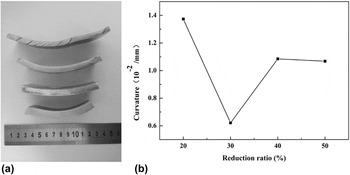
Figure 7(a) shows the macrocosm appearance of the AZ31B/6061 composite plate after hot rolling with average reduction ratios of 20%, 30%, 40% and 50%. Experimental results demonstrated that the AZ31B/6061 composite plates had different degrees of warp and edge cracks appeared with the increasing of reduction ratio after rolling. Figure 7(b) exhibits the curvature of the composite plate at different reduction ratios. With increasing the rolling reduction, the curvature of the AZ31B/6061 composite plate decreased firstly, and then increased. Under the reduction rate of 30%, the composite plate had a minimum curvature value of 6.2 × 10⁻³ mm−1.
(a) The macroscopic appearance of the Mg/Al clad plates after hot rolling and (b) the curvature of the clad plates at different reduction ratios.

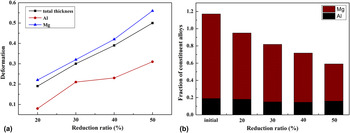
To explore the coordination deformation of AZ31B/6061 composite plate at different rolling reduction ratios, the relative deformation and the fraction of the constituent alloys were plotted in Figs. 8(a) and 8(b), respectively. The deformation of the constituent Mg alloys was consistent with the composite plates, while there was no obvious feature in the Al alloys. The results indicated that the reduction ratio had a significant effect of on the fraction of the constituent alloys. At 30% reduction ratio, the constituent alloys of AZ31B/6061 composite plate had a good coordination deformation. This implies that the flow stresses between AZ31B Mg and 6061 Al were quite different at different reduction ratios.
(a) The deformation and (b) the fraction of the constituent alloys after hot rolling.

D. Microstructural evolution of constituent AZ31B Mg alloy
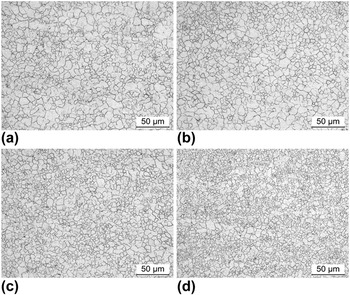
Figure 9 illustrates the optical micrographs of the Mg alloys near the interface of clad plates after rolling at different reduction ratios. It can be seen from Fig. 9 that hot-rolling reduction has a significant influence on the microstructure evolution of Mg alloys. In Fig. 9(a), a small amount of fine grains can be observed at the original grain boundaries. As the hot-rolling reduction increased from 40% to 50%, the proportion of fine recrystallization grains increased significantly, and the microstructure was homogenized and refined. Hong-Yu Song et al. Reference Song, Liu, Lu, Li, Liu, Zhang and Wang33 have reported the same phenomenon in their work, the microstructure of all the hot rolling strips was gradually refined with increasing hot-rolling reduction.
Microstructure of the AZ31B near the interface from the composite plates at different reduction ratios: (a) 400 °C + 20%, (b) 400 °C + 30%, (c) 400 °C + 40%, and (d) 400 °C + 50%.

E. Microstructural evolution of interface on rolled composite plates
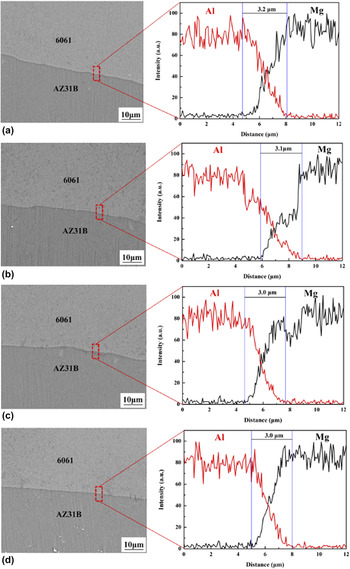
Backscattered electron micrographs of the interface from the AZ31B/6061 composite plates after hot rolling at different reduction ratios were observed by SEM. The results with the EDS line analysis of Mg and Al in the right side are shown in Figs. 10(a)–10(d). It was found that there were no pores, lateral delamination, or cracks in the interface of Mg/Al composite plate. This implies that the integrity of the interfaces remained sound in terms of interfacial debonding by single-pass hot rolling. It is clearly found that the intermetallic layer with a thickness of ∼18 μm after heat treatment distribute in Fig. 6. The EDS line scan of the intermetallic layer thickness under different rolling reduction ratios was observed in Fig. 10. With the increase of the reduction ratio, the thickness of intermetallic layer keeps ∼3 μm. The result indicated that rolling reduction ratio had no significant effect of on the thickness of the intermetallic layer of Mg/Al composite plate.
Backscattered electron images of the Mg/Al composite plates after hot rolling at different reduction ratios: (a) 20%, (b) 30%, (c) 40%, and (d) 50%.

F. Mechanical properties
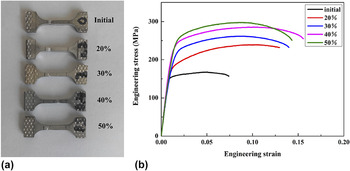
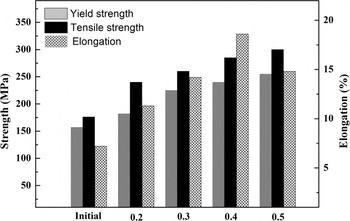
A series of uniaxial tensile tests were conducted on the AZ31B/6061 composite plates. Figure 11(b) shows the engineering stress–strain curves obtained from the tensile tests. The tensile strength and elongation of the composite plates are summarized in Fig. 12. Also, macroscopically fractured feature of the tensile-tested specimens is shown in Fig. 11(a). The initial explosive welding composite plate had a tensile strength of 176 MPa and an elongation percentage of 7.2%. It is clear that the tensile strength of the composite plates increased with the increasing of rolling reduction ratio as shown in Fig. 11(b). The sample at reduction ratio 50% showed the highest tensile strength up to 300 MPa. It can be seen that the tensile strength of the composite plates at reduction ratio 20% significantly increased comparing with the initial specimens shown in Fig. 12, and the yield strength and tensile strength of specimens increased with the increase of the rolling reduction ratio. The specimen at reduction ratio 20% had an elongation percentage of 14.2%, and the maximum elongation was up to 19%, which were higher than 7.2% of initial Mg/Al explosive welding composite plate. The tensile properties of the samples subjected to the hot rolling were better because of the thickness reduction of brittle intermetallic compound layer from 18 μm to 3 μm, as shown in Fig. 10. Lee et al. Reference Lee, Yoon, Kim, Kwon and Lee5 reported that the intermetallic compound layer had a positive effect on the metallurgical bonding between magnesium and aluminum alloys with the thickness less than 5 μm.
(a) Macroscopic feature of the tensile-tested Mg/Al specimens. (b) Engineering stress–strain curves of composite plate after rolling with different reduction ratios 20%, 30%, 40%, and 50%.

Tensile properties of the composite plates under various rolling reduction ratios.

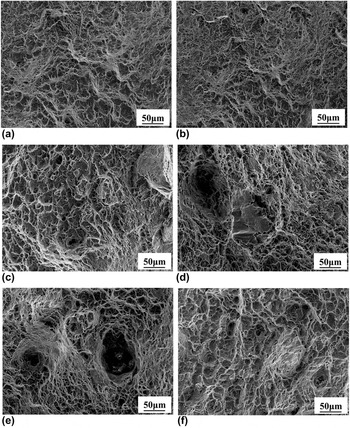
The yield strength, the tensile strength, and the elongation of the specimens at different reduction ratios were obviously superior to those of the initial ones. This is due to the progress of recrystallization in the constituent alloys and the evolution of the diffusion layer at the interface. The role of intensified recrystallization in the AZ31B alloy on the tensile properties of the Mg/Al composite plate can be confirmed by observing the tensile fractured surfaces. Figure 13 shows the SEM fractographs of the constituent Mg alloys after hot rolling. It is can be seen in Figs. 13(a) and 13(b) that the fracture surface of the constituent Mg alloys of the initial composite plates consists of a certain amount of small-scale dimples. As shown in Figs. 13(c)–13(f), a large amount of small-scale dimples and a small amount of large-scale dimples can be observed in the fracture surface, which is correlated with the improved plasticity upon the hot rolling. Interestingly, the brittle intermetallic compound layer thickness of the samples were about 3 μm after hot rolling compared with the initial composite plate, as shown in Fig. 10. This implies that the drastic increase of elongation of the Mg/Al composite plates by hot rolling was strongly attributed to the evolution of the diffusion layer at the interface during hot-rolling process and the progress of dynamic recrystallization in the constituent Mg alloys which can be confirmed by the grain morphology shown in Fig. 9.
SEM fractographs of the constituent AZ31B alloys from the tensile tested (a), (b) initial, (c) 20%, (d) 30%, (e) 40%, and (f) 50% specimens.

IV. CONCLUSIONS
In this work, the AZ31B/6061 composite plates, fabricated first by explosive welding process, were subsequently followed by a single-pass hot rolling at different reduction ratio. The microstructural evolution and mechanical properties of the Mg/Al composite plates were investigated. The following conclusions can be deduced:
-
(1) The work-hardening phenomenon of the Mg/Al composite plate produced by explosive welding can be eliminated effectively by heat treatment at 400 °C. With the increasing annealing temperature, the dynamic recrystallization of the constituent AZ31B alloy and the intermetallic compound layers thickness increased, and the microhardness of the constituent alloys decreased significantly and then maintained a constant value.
-
(2) The composite plates presented different degrees of warping and edge cracking after hot rolling. At the reduction ratio of 30%, the coordination deformation ability of the constituent Mg and Al alloys is consistent with the composite plate, and the curvature value was 6.2 × 10⁻³ mm−1.
-
(3) With the increase of the rolling reduction ratios, the degree of the dynamic recrystallization increased and the grains were refined significantly. Compared with the heat treatment composite plates, the thickness of intermetallic compound layers after hot rolling decreased dramatically and then maintained at ∼3 μm.
-
(4) The elongation of the composite plates after rolling at reduction ratio 40% was up to 20%. Due to dynamic recrystallization and grain refinement, the tensile strength was dramatically increased.
ACKNOWLEDGMENT
This work is supported by the Natural Science Foundation Project of China (51375328), Research Project Supported by Shanxi Scholarship council of China (2016036), Shanxi Province Science Foundation for Youths (2016021063), Fundamental Research Funds by Taiyuan University of Technology (tyut-rc201523a) and (2015QN011).