To survive, authoritarian regimes must often be able to successfully control the political opposition.Footnote 1 Autocrats commonly use co-optation to limit anti-regime mobilization among key groups in society.Footnote 2 They may attempt to appease the opposition with policy concessions or increased influence in policy making,Footnote 3 yet they frequently focus their efforts on co-opting individual opposition party leaders.Footnote 4 They appoint opposition leaders to political positions, through which they grant access to patronage resources and the spoils of office.Footnote 5 In exchange for these incentives, opposition leaders are expected to co-operate with the government and, more importantly, demobilize their supporters.Footnote 6 Thus by buying off individual leaders, dictators seek to control entire parties that pose a threat to their political survival.
Indeed, the co-optation of opposition parties often helps prolong non-democratic regimes. For instance, opposition parties were conspicuously absent during the Arab Spring protests, helping numerous dictators to remain in power despite the regional unrest.Footnote 7 Countries such as Algeria avoided large-scale demonstrations due in part to the effectiveness of co-optation.Footnote 8 Dictators, however, do not attempt to control all opposition parties; in some cases, they are unable to co-opt parties that pose a threat to their regime. The Algerian Government has successfully bought off dozens of opposition parties: over thirty parties supported President Abdelaziz Bouteflika’s bid for re-election to a fourth term in 2014.Footnote 9 Yet the regime has not attempted to co-opt, or even negotiate with, other opposition parties.Footnote 10 Moreover, some parties in Algeria refused to be co-opted when they received offers from the regime. For example, the Socialist Forces Front and the Workers’ Party have both rejected offers of multiple ministerial positions from Bouteflika.Footnote 11 Therefore, given their attempts to control the opposition, which parties do autocrats co-opt? Why do some opposition parties resist co-optation?
I answer these questions by examining the dynamics of political survival faced by opposition leaders. While co-optation is a strategy of regime survival, it requires the consent of opposition leaders who have their own political concerns. These leaders face well-documented external pressures in authoritarian settings, such as repression, unfair electoral rules and poor access to resources, which threaten their party’s ability to endure conflicts with the government. Yet demobilizing and acquiescing to the regime can also undermine opposition leaders. Existing accounts often treat co-opted elites as atomized individuals rather than leaders of political organizations who must maintain support from party insiders. Instead, opposition leaders’ political survival, to varying degrees, relies on support from party activists who are alienated when their leader colludes with the incumbent. Thus ‘selling out’ to the regime may cause activist defections or, in parties with divided leadership, competition over control of the party. Therefore, the strength of a party’s activist base and its internal leadership structures influence whether a party can be controlled through co-optation.
I provide a formal framework that demonstrates the impact of these internal party dynamics on negotiations with the regime and identifies the conditions under which a party receives and accepts co-optation offers. The results show that the presence of party activists leads opposition leaders to require increased concessions in order to co-operate. Incumbents are often able to meet these increasing demands, which suggests that leaders with a large activist base can generate more significant rents. However, the consequences of an activist rebellion are so high for some parties when acquiescing to the regime that the leader cannot agree to be co-opted, since doing so would undermine her political survival. Therefore, parties that are less reliant on activists are more likely to be co-opted. This result suggests that internal political concerns of the party leader serve to weaken authoritarian control, but may push some parties to engage in unnecessary conflicts with the government.
The baseline model makes the central assumption of unitary party leadership. While some parties are certainly personalistic and rely on the charisma or popularity of a single leader, many comprise a coalition of secondary leaders and supporting elites.Footnote 12 When these parties co-operate with the regime, activists are likely to support an alternative leader instead of leaving the party altogether. I formalize this dynamic between activists and a divided leadership in an extension of the baseline model, in which an internal rival must mount a leadership challenge in order for activists to remove a co-opted leader. The rival leader is more likely to succeed when supported by a powerful base, but faces few rent collection opportunities if he becomes party leader given his strong accountability to activists. Thus a strong activist base actually discourages leadership challenges in response to co-optation in parties with divided leadership. This leadership structure gives activists a more limited influence, which may facilitate collusion between the existing party leader and the incumbent.
This analysis addresses the key puzzle of why incumbents successfully co-opt some opposition parties and not others. This variation in co-optation is often attributed to ideological differences. Formal work suggests that ideological proximity facilitates the co-optation of individuals.Footnote 13 However, these individual-level predictions contrast with evidence that the ideology of opposition parties is not exogenous,Footnote 14 and does not predict whether a party mobilizes or acquiesces to the regime.Footnote 15 My argument suggests that these contradictions can be attributed to the variation in a party’s underlying reliance on activists. Ideologically motivated activists will not necessarily support the most radical political parties, since moderate or catch-all opposition parties may be more effective at achieving reforms or regime change. Therefore, activist accountability can occur in parties regardless of ideology, suggesting that ideology plays an indirect role in cross-party patterns of co-optation.
Secondly, this analysis provides an explanation of co-optation failures, which has implications for the study of protest in authoritarian regimes. Existing explanations suggest that there should always be an equilibrium at which the opposition is either bought off or the incumbent steps down, leading to a democratic transition.Footnote 16 However, in some cases, party-based mobilization occurs when incumbents are unable to devise an offer tempting enough for the opposition.Footnote 17 My analysis suggests that these co-optation failures can be caused by the internal dynamics of opposition parties. Pursuing power through conflict may be more efficient for opposition leaders than accepting even large-scale rents, since it is still possible that activists will become disaffected and abandon the leader. Therefore, in some cases, the leader’s own concerns about political survival prevent more peaceful political transitions. This conclusion is consistent with the recent conflict literature on the role of group structure. This work shows that internal factions undermine negotiations with the state, leading to the initiation or extension of civil conflicts,Footnote 18 and that internally divided separatist groups are more likely to receive concessions.Footnote 19 However, my analysis suggests that in the context of opposition parties, the effect of leadership divisions is conditional on the strength of the party’s activist base. When activism is weak, for instance, elite rivals may be more co-operative and actually facilitate negotiations with the state.
The final contribution of this analysis is its implications for the study of authoritarianism. The contemporary literature on authoritarian rule has tried to more deeply understand the intra-regime dynamics between incumbents and their supporting elites.Footnote 20 This line of research has been extremely fruitful. Since the fate of autocrats is also significantly influenced by the strategies chosen by regime outsiders,Footnote 21 I argue that it is worth studying the opposition in the same manner. This article shows that an examination of the internal workings of the opposition helps explain the decision to mobilize or co-operate, which has implications for authoritarian control. Yet, as the results of the model underline, this requires not only analyzing the party leadership’s incentives, but also understanding the intermediary actors within the party. Party activists play a central, yet often overlooked, role in non-democratic politics, and this article shows that these grassroots actors can have an important macro-political influence.
The next section discusses the challenge of political survival for opposition leaders in authoritarian regimes. I then formalize the opposition leader’s trade-offs into, first, a baseline model of opposition co-optation and, second, a model that introduces a leadership rival as a strategic actor. I then conclude by discussing the significance of this analysis in understanding authoritarian control, regime change and opposition dynamics in non-democracies.
THE CHALLENGES OF OPPOSITION LEADERSHIP
Deciding how best to achieve political power without undermining their own political survival is a central challenge for opposition leaders in authoritarian regimes. While opposition parties are able to legally operate and contest elections in nearly all modern non-democracies, they face a host of obstacles that render the competitive arena unfair and, ultimately, serve to undermine their political viability. Limited economic liberalization and biased electoral laws ensure that opposition parties have restricted access to party-building resources.Footnote 22 Additionally, the regime often has a vast resource advantage that helps minimize and marginalize support for the opposition through patronage distribution.Footnote 23
In addition to resource disadvantages, opposition leaders often encounter repression that undermines their political survival. Unlike in democracies, where civil liberties are generally protected, mobilized opposition parties are frequently targeted by repression. While incumbents face costs of using coercion,Footnote 24 they often engage in repression against regime opponents in order to reduce their capacity and willingness to mobilize against the state.Footnote 25 Electoral mobilization can incite especially strong responses from the incumbent. In the aftermath of post-election protests in Ethiopia (2005) and Iran (2009), thousands of opposition party activists were arrested and imprisoned.Footnote 26 Even when they do not face violence or imprisonment, opposition supporters – particularly the many who lack economic autonomy – are vulnerable to material punishment.Footnote 27
These external pressures provide a host of incentives for opposition leaders to avoid mobilization strategies. Political appointments provide leaders with political power and a respite from repression, which entices many to be co-opted. Yet opposition activists pose an important counter to such pressures to cave in to the regime. Leaders with a strong activist base are better able to endure state repression, which makes parties more capable of forcing regime openness and achieving electoral gains. Activists are uniquely valuable when mobilizing since they offer their labor to the party and serve as crucial intermediaries in individual localities. Collective action problems are well documented in non-democracies, and activists play a key role in facilitating coordination. Activists convey local information and demands to the party leadership, while implementing party strategy on the ground, such as mobilizing ordinary citizens for protests and elections. Such grassroots members are valuable for opposition leaders, who can mobilize with greater confidence that their base will not collapse under pressure from the regime. This makes opposition leaders more likely to pursue power through confrontation rather than co-operation.
Crucially, party activists require opposition leaders to invest in mobilization strategies for the base to remain intact. Without mobilizing, activists quickly become disengaged and the loss of grassroots support renders the leader politically vulnerable. Thus the leader faces disincentives to pursuing political power through collusion with the incumbent since, from an organizational perspective, co-optation requires the party to demobilize against the regime. Political mobilization, such as staging protests and organizing other forms of dissent, is a key party-building strategy that keeps activists loyal and engaged in the party.Footnote 28 Thus striking co-operative deals with the regime forces activists to acquiesce to the status quo and disengage politically. This may halt the party’s organizational momentum, severing active ties with citizens and halting party-building activities, which undermines the leader’s ability to re-mobilize activists in the future. Consider, for instance, the government of national unity following the 2008 elections in Zimbabwe, which were widely viewed as stolen by the government. The main opposition party, Movement for Democratic Change, received key political positions in the power-sharing deal, including the premiership and nearly a majority of ministerial portfolios. However, this co-operation with the regime led to a de-emphasis on mobilization and protest politics within the organization, which ultimately eroded the party’s activist base and produced significant electoral losses in the next election.Footnote 29
Furthermore, co-optation produces concessions that are qualitatively different than the political gains achieved through mobilization. Incumbents frequently use political appointments to gain the co-operation of other elites.Footnote 30 Even though these positions are accompanied by some access to state resources, they signal an alignment with the regime that weakens the leader’s reputation as a loyal agent of the grassroots. Accounts show that party activists are often alienated when party leaders are aligned with the government.Footnote 31 Co-operation with the regime has caused activists to abandon their party in long-standing non-democracies such as Gabon.Footnote 32 In cases like the Democratic Republic of the Congo (2014) and Togo (2010), party members even expelled opposition leaders for accepting political appointments.Footnote 33 Even in more democratic dominant party regimes, party leaders are fundamentally concerned with their base’s reaction to deals with the ruling party. In South Africa, the small opposition party, Freedom Front Plus, extensively consulted with its grassroots organizations to ensure that supporters would not be alienated if it accepted a deputy minster position in the government.Footnote 34 Hence, co-optation only serves to discourage activist engagement, due to both organizational demobilization and activist backlash from aligning with an unpopular regime. This provides opposition leaders with incentives to posture against the regime and resist co-operation, even when doing so may result in significant rent distribution.
A BASELINE MODEL
Elements of the Model
Consider an infinite-horizon game with an incumbent (I; pronoun ‘he’) and an opposition leader (L; pronoun ‘she’). Also assume a non-strategic activist base of size ϕ∈[0,1]. The strength of the leader’s activist base is observed by both players and in each period t, the leader maintains activist support. I assume a political regime in which the incumbent maintains a monopoly on the spoils of office, normalized to 1.Footnote 35 He retains these spoils unless he offers concessions that are accepted by the opposition leader, denoted by x t ∈[0,1]. The incumbent is also characterized by some vulnerability to opposition mobilization, z∈[0,1]. The opposition leader’s decision to mobilize at time t is denoted by m t =1, while m t =0 represents co-operation with the regime. In each period, the sequence of events is as follows:
1. The incumbent chooses some level of concessions, x t , to offer to the opposition leader.
2. The opposition leader can choose to reject the offer and mobilize against the government (m t =1) or accept the concessions and agree to be co-opted by joining the government (m t =0).
3. If the party mobilizes, the opposition forces some concessions from the incumbent, equal to z. The party leader survives into the next period with probability ϕ and the party succumbs to repression with probability 1−ϕ. If the party collapses, the leader leaves the game permanently.
If the opposition leader accepts x t and is co-opted, the party leader survives into the next period with probability 1−ϕ and activists leave the party, leading to a collapse in support with probability ϕ. If party support collapses, the leader leaves the game permanently.
If the two sides engage in conflict, the incumbent must expend resources to address opposition protests, c I ∈[0,1]. This corresponds to the costs of transferring power to the security apparatus and expending resources on coercion. Thus the incumbent’s pay-off from conflict in the current period is 1 – z−c I , compared to 1−x t following co-optation. The opposition leader has no access to executive power, unless she accepts x from the incumbent or forces z from mobilizing. Mobilization, however, is also costly for the opposition leader, who must spend resources to organize anti-regime protests at some cost c L ∈[0,1]. Therefore, the opposition leader’s pay-offs in any period in which she does not mobilize depends on the offer from the incumbent, x. When engaging in conflict, the leader receives z−c L .
Ultimately, the pay-offs for the actors from both conflict and co-operation are determined by the strength of the activist base. A strong activist base helps the leader survive following mobilization, yet increases the probability of a collapse in support following co-optation. If the opposition leader exits the game following either mobilization or co-optation, the incumbent receives 1 in all future periods. The neutralized opposition leader receives 0. When calculating the actors’ continuation values, the common discount factor for both actors is denoted by δ.
This pay-off structure makes several key assumptions about the motivations of the actors in the model. First, it suggests that concessions received from co-optation can act as a substitute for the increased political openness achieved through mobilization. In the model, the opposition leader is simply concerned about access to state resources, regardless of how it is achieved. Secondly, I assume that activists are disaffected by all outcomes that keep the incumbent in power, and that activist loyalty cannot be increased through co-optation.
In analyzing the game, attention is restricted to stationary strategies. Using these strategies, in any period the incumbent makes the same offer and the opposition leader applies the same decision rule when deciding whether to accept a co-optation offer, regardless of the previous history of play. Thus the two actors play the strategy that is in their best interest for the future, regardless of past offers or actions. First, the incumbent’s strategy simply consists of a level of concessions x∈[0,1] to offer the opposition. The actions of the opposition leader also consist of a decision to mobilize, m(x). This decision is conditioned on the offer made by the incumbent at the start of each period, so m is a function, m:[0,1]→{0,1}. Hence, a stationary subgame-perfect equilibrium is a strategy combination {x, m}, such that these strategies are best responses to each other conditional on the strength of the activist base.
Analysis
First, consider the level of concessions that is required to co-opt the opposition leader,
 $\hat{x}$
. The incumbent can secure the co-operation of the opposition leader as long as he makes an offer that meets or exceeds this threshold of concessions. Intuitively, the amount demanded depends largely on the value of ϕ, which influences the expected utility of mobilizing and the likelihood that the party will collapse when activists abandon the party following co-optation.
Lemma 3.1. For any concession offer x, the opposition leader accepts if
 $x\geq \hat{x}, \,{\rm where}\,\,\,\,\, \hat{x}={{(z{\minus}c_{L} )(1{\minus}\delta {\plus}\delta \phi )} \over {1{\minus}\delta \phi }}.$
Hence, the concessions required to co-opt the opposition are largely driven by the regime’s vulnerability to mobilization and the costs of conflict, in addition to ϕ. In some cases, these factors can create conditions in which the opposition leader does not require political positions in order to co-operate. Specifically,
 $\hat{x}\,\lt\, 0$
when c
L
>z. When the costs of conflict exceed the benefits of mobilizing against the incumbent, such as when the regime is invulnerable to opposition protests, the opposition leader is willing to co-operate even when she does not receive concessions from the incumbent. Under these conditions, the incumbent’s choice of x is equal to 0 and the opposition leader unilaterally co-operates. However, in other cases, the opposition leader’s optimal demand can exceed the maximum level of rents that the incumbent can offer. For instance, for very high levels of ϕ, the opposition leader prefers to engage in conflict with the regime rather than accept the regime’s maximum offer and risk the high probability of a collapse in support. Specifically, the opposition leader rejects all offers when
 $\phi \,\gt\, \bar{\phi }$
, where
 $$\bar{\phi }={{1{\minus}(z{\minus}c_{L} )(1{\minus}\delta )} \over {\delta (1{\plus}z{\minus}c_{L} )}}.$$
Therefore, given the presence of a strong activist base above some threshold
 $\bar{\phi }$
, the opposition leader rejects all possible offers from the incumbent and mobilizes against the regime. For the incumbent, any offer x∈[0,1] is optimal since it is inconsequential. In this case, the political gains from mobilizing exceed even large-scale rent distribution from the incumbent. This equilibrium is more easily sustained when the regime is highly vulnerable to opposition mobilization and the leader faces low costs to entering a conflict. Under these circumstances, a strong activist base pushes leaders to reject negotiated settlements and pursue regime change through confrontation with the existing regime.
Assuming that the value of ϕ is sufficiently small so that
 $$\hat{x}\in [0,1]$$
, the opposition leader will accept concessions from the incumbent. Yet, for the incumbent to meet these demands and offer
 $$\hat{x}$$
, the value of a co-operative opposition must exceed the value of engaging in a conflict. This depends on the concessions demanded by the opposition leader. The incumbent prefers to make an unacceptable offer, leading to conflict, only when
 $$\hat{x}\,\geq\, {{(z{\plus}c_{I} )(1{\minus}\delta {\plus}\delta \phi )} \over {1{\minus}\delta \phi }}.$$
When substituting the result from Lemma 3.1 for
 $\hat{x}$
, this inequality is never true. Therefore, the incumbent always prefers to offer
 $\hat{x}$
over making an unacceptable offer, as long as
 $\hat{x}\in [0,1]$
. Given this result, I can characterize the game’s cooptation equilibrium.
Proposition 3.1: When the activist base is sufficiently weak, where
 $\phi \leq \bar{\phi }$
, then an equilibrium of the game exists in which the incumbent offers
 $x=\hat{x}$
and the opposition leader is co-opted, choosing m=0.
This strategy combination is an equilibrium since it survives a one-shot deviation (all proofs are available in the online appendix). This equilibrium ultimately relies on the activist base being weak enough that the incumbent can meet the opposition leader’s demands. In some instances, when c
L
>z,
 $\hat{x}$
is less than zero and the opposition leader will co-operate without receiving concessions. Yet this equilibrium breaks down when the activist base is very strong (
 $\phi \,\gt\, \bar{\phi }$
), since the incumbent cannot meet the opposition leader’s demands. Therefore the opposition leader rejects all offers, leading to conflict.
Discussion
Comparative statics
Proposition 3.1 generates a number of observable implications about the effect of activism on co-optation and protest. The central result suggests that opposition leaders with a weak activist base are those who are most easily co-opted. Since parties without a strong activist base pose a smaller threat to the regime and are not undermined when activists withdraw, they require fewer concessions in order to co-operate with the regime. In fact, the very weakest parties co-operate without any concessions at all. However, the incumbent also has incentives to target parties that are only weakly reliant on activists since they can be cheaply brought into the ruling coalition. Thus the model suggests that the regime most frequently co-opts parties with a poor or modest potential for successful activism. This provides an alternative prediction about co-optation compared to conventional explanations, which suggest that it is largely driven by threats to the regime. This explains why minor parties – rather than the regime’s most significant rivals – are often co-opted. For instance, the regimes in Cameroon and Gabon have repeatedly used ministerial appointments to co-opt small parties; some parties have received Cabinet positions with less than 1 per cent support in legislative elections.Footnote 36
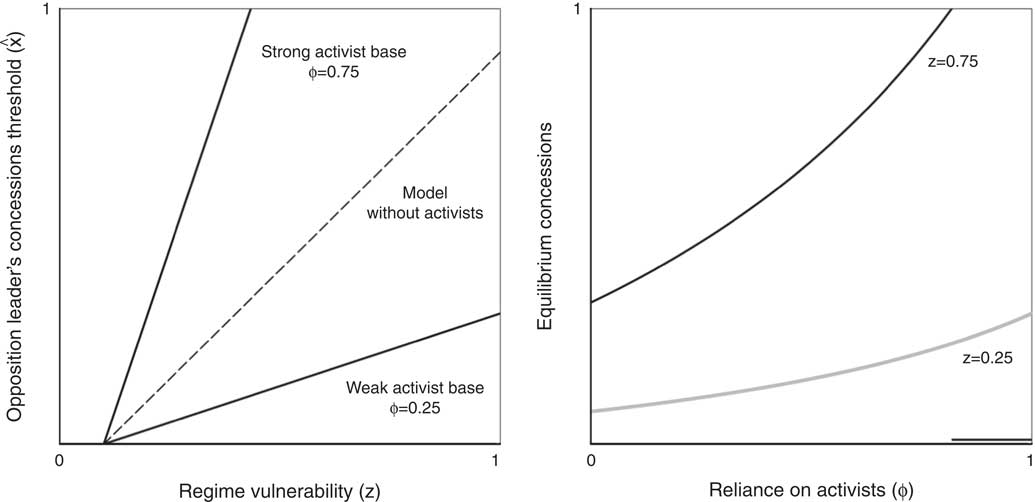
This influence of activists on elite negotiations is highlighted in the left panel of Figure 1. The figure compares the results from Lemma 3.1, for two different values of ϕ, against a model without activists (formal statement and proofs of this model are in the online appendix). The primary result shows that all parties require little or no concessions to co-operate when the regime is invulnerable to mobilization. However, as z increases, the party’s demands vary widely depending on the strength of the activist base. First, parties with a strong activist base require much more significant concessions to co-operate than their counterparts with a weak base. Secondly, the model without activists inflates the equilibrium demands of parties with a weak activist base. Even when the regime is very vulnerable to mobilization, opposition leaders with a weak base only demand (and receive) smaller levels of concessions from the incumbent. Thus ignoring activists over-emphasizes the role of regime vulnerability: concessions are instead significantly driven by party-level variables. Thirdly, parties with a strong activist base are better able to capitalize on regime vulnerabilities. Parties with high accountability to activists command more significant concessions and, for high levels of z, are ultimately unable to be co-opted. Thus by ignoring activists, a model fails to predict co-optation failures, which do occur in some cases.
The effect of activist base strength on patterns of co-optation Note: the left panel displays the optimal concessions demanded by the opposition leader in the baseline model for various levels of regime vulnerability and activist base strength. The presence of activists in the model drives different demands when compared to a model without activists. The right panel displays the equilibrium concessions accepted by the opposition leader. For very high values of ϕ and high regime vulnerability (z), the opposition leader rejects concessions from the incumbent and mobilizes.

Assuming that co-optation can be successful, this result has the important implication that parties with activists are better able to secure rents from the regime. Elites often create or maintain parties largely to secure patronage resources and political positions from the regime.Footnote 37 These ‘briefcase’ parties are often weakly institutionalized, and serve as vehicles for elite rent seeking. Thus the model uncovers an irony in this political strategy: parties that are formed to seek state resources for elites or local notables are least capable of commanding these rents in equilibrium. Those that have invested in party building or inherit organizational structures that have historically attracted activists are most likely to extract significant concessions from the regime. Not all parties are capable of building a strong activist base, but those that are find themselves in a better position to secure concessions via both co-optation and mobilization.
While parties with a strong base are able to command more significant concessions from the incumbent, the activist base can sometimes be strong enough to undermine co-optation altogether. As shown in the right panel of Figure 1, co-optation can always be sustained when the regime is only weakly vulnerable to opposition mobilization, such as when z=0.25. However, when the regime is vulnerable, then
 $\hat{x}\,\gt\, 1$
for large values of activist base strength. This causes a co-optation failure, since the incumbent cannot offer enough concessions for the opposition to accept the offer. This shows that political opportunity alone does not undermine co-optation. Instead, external opportunities must be combined with the right internal dynamics for an opposition leader to reject co-optation offers. Under this scenario, conflict is more efficient than negotiated concessions to an opposition leader, even high-profile political posts or large-scale rents. A strong activist base proves too effective at defeating the incumbent and too volatile when co-operating with the incumbent, which could ultimately undermine the leader’s position within her own party. Thus, given the central importance of leadership survival, conflict may be preferable to negotiated agreements for leaders with strong grassroots.
Lastly, the calculus of the two actors is not solely driven by opposition-level factors. State features can facilitate co-optation even when party-level variables are not conducive to co-operation. Both sides are more likely to strike a deal as the costs associated with conflict increase, c I and c L . The incumbent faces economic costs during conflict and must use resources to address threats from the opposition. Additionally, repression transfers power to the security apparatus and may promote military intervention.Footnote 38 Increases in these costs make the incumbent more likely to rely on co-optive solutions to mass threats. The opposition leader, who faces the logistical costs of mobilizing supporters in less-than-democratic regimes, will also be more willing to co-operate as mobilization costs increase. This generates collusion between the opposition leader and the incumbent, who prefers to deal with civilian rivals rather than allies in the military and security sector.
Endogenous regime vulnerability
The results from the model partially rely on the assumption that the incumbent’s vulnerability to opposition mobilization remains unchanged following co-optation. However, co-optation gives opposition leaders a respite from repression and may serve to transfer significant resources to the opposition. This weakens the incumbent, who must expend these resources on the opposition instead of shoring up support from ruling elites, leaders of the military or members of the ruling party. Indeed, opposition leaders in countries such as Kenya, Senegal and Ukraine have been able to parlay temporary co-optation into eventual victories over the incumbent.Footnote 39
Thus it is possible that the regime’s vulnerability (z) following periods of co-optation is actually greater than the value of z at time t. Depending on how much z increases at time t+1, relaxing the assumption of constant regime vulnerability can undermine the equilibrium point at which the opposition leader refuses to co-operate with the incumbent. Formally, the strategy profile m=1 is less likely to survive a one-shot deviation strategy when the regime becomes more vulnerable following co-optation. Thus some opposition parties have an incentive to temporarily co-operate, which weakens the incumbent, and then mobilize later. Thus the equilibrium point at which the opposition leader rejects all offers and mobilizes is less easily sustained. Overall, this change tempers the negative effect of activist base strength on the likelihood of co-optation and makes parties demand less in order to co-operate. This result seems consistent with the previously mentioned cases, where parties that rely on long-term mobilization strategies may choose to be temporarily co-opted. This enables parties to save resources and momentarily shield their base from repression in order to ‘fight another day’ when the incumbent is more vulnerable.
EXTENDED MODEL: DIVIDED LEADERSHIP
Elements of the Model
The previous model assumes that activists leave the party when their leader is co-opted. However, in some cases, activists may remove the leader, as happened in the Democratic Republic of the Congo and Togo. For activists to remove a co-opted leader, the party must first have a divided leadership, with at least one viable alternative leadership candidate. Secondly, the rival candidate must co-operate with activists in order to become leader. This requires the alternative leader to not only mount a challenge against the current leader; he or she must also keep the party mobilized if the leadership challenge is successful. Thus a leadership rival becomes fully accountable to the activist base after receiving their support in a leadership contest.
To capture this dynamic, I adapt the baseline model to include a rival for party leadership as a strategic actor. The rival leader (R; pronoun ‘he’) can mount a leadership challenge when the party leader is co-opted by the incumbent, with h t =1 denoting a leadership challenge at time t. Activists can only push back against co-optation when the rival leader chooses to challenge the current leader. His attempts are more likely to be successful when supported by a strong activist base. This assumption should hold regardless of whether a party is weakly institutionalized or has a formal means, such as a party convention or congress, of electing leadership positions. The model’s main assumption is that if the rival leader collaborates with and employs activists to remove the leader, he must avoid co-optation in all future periods. Thus in each period, the following sequence occurs:
1. The incumbent chooses some level of concessions, x t , to offer to the opposition leader.
2. The opposition leader can choose to reject the offer and mobilize against the government (m t =1) or accept the concessions and agree to be co-opted by joining the government (m t =0).
3. If the party mobilizes, the opposition forces some concessions from the incumbent, equal to z. The party leader survives into the next period with probability ϕ and the party succumbs to repression with probability 1−ϕ. If the party collapses, the leader leaves the game permanently.
4. If the opposition leader accepts x t and is co-opted, the rival leader can choose to mount a leadership challenge (h t =1) or support the current leader (h t =0).
5. If h t =1, then the party leader survives into the next period with probability 1−ϕ and the activist base successfully removes the leader with probability ϕ. If the leader is removed, she leaves the game permanently and the rival leader mobilizes in all future periods. If h t =0, the party leader survives into the next period.
The pay-offs for the incumbent and opposition leader remain the same. The rival leader does not receive a pay-off for any period in which he is not party leader. However, when he mounts a challenge, he must pay a cost for inciting conflict within the party, q∈[0,1], regardless of whether the challenge is successful. In some parties, factional conflicts boil over into intraparty violence, which increases the rival’s costs of mounting a challenge. Therefore the rival prefers to remain a loyal member of the party rather than mounting a costly, unsuccessful bid for party leadership. Yet if successful, he receives the expected benefit of mobilizing against the regime in all future periods given some cost, c R ∈[0,1]. This pay-off largely depends on the strength of the activist base, since the rival leader may receive few long-term benefits if the base is likely to erode from repression.
Attention is again restricted to stationary strategies. The incumbent and opposition leader’s strategies remain the same as in the baseline model. The actions of the rival leader consist of a decision to challenge the current leader, h. This decision is conditioned on the strength of the activist base (ϕ), which determines whether a leadership challenge is likely to be successful and whether the activist base can endure conflicts with the regime in subsequent periods. Thus h is a function, h:[0,1]→{0,1}. Hence, a stationary subgame-perfect equilibrium is a strategy combination {x, m, h}.
Analysis
First, consider the rival leader’s decision to co-operate with the leader or mount a leadership challenge. The rival prefers to remain loyal if his leadership challenge is unlikely to be successful. Therefore, a leadership challenge is the rival’s best response only when the activist base is sufficiently strong. Thus for any level of activist base strength ϕ, the rival leader mounts a challenge if ϕ≥ϕ*, where
 $$\phi ^{{\rm {\asterisk}}} ={q \over {\delta (q{\plus}z{\minus}c_{R} )}}.$$
In some cases, however, the value of ϕ required to sustain a leadership challenge exceeds 1. Internal competition will not occur, even for parties with a very strong activist base, when the costs of mounting a leadership challenge (q) are high. Specifically, when
 $q\gt {{\delta (z{\minus}c_{R} )} \over {1{\minus}\delta }}$
, then ϕ*>1 and the opposition leader will co-operate with the current leader.
Next, consider the opposition leader’s decision to accept offers from the incumbent if there is no leadership challenge. When a weak activist base eliminates the threat of competition over leadership, co-optation is less costly for the current leader. Since the activist base poses no threat to the leader without co-operation from the rival, there are no internal costs to co-operating with the regime. If co-opted, the opposition leader simply forgoes the potential gains from conflict, which are still dependent on the probability that the activist base can endure repression. Hence, the opposition leader will accept the incumbent’s offer of x and agree to be co-opted if
 $x\geq \tilde{x}$
, where
 $$\tilde{x}={{(z{\minus}c_{L} )(1{\minus}\delta )} \over {1{\minus}\delta \phi }}.$$
Assuming that z>c
L
, then the level of concessions demanded by the opposition leader is greater than zero and, as long as ϕ is sufficiently small, the opposition leader will accept any offer greater than or equal to
 $$\tilde{x}$$
.Footnote
40
Importantly, this value of
 $\tilde{x}$
is smaller than the amount of concessions required to co-operate in the baseline model defined in Lemma 3.1. Hence, as long as its leader is not highly reliant on activists, a party with a divided leadership is easier to co-opt since it requires fewer concessions from the incumbent.
In this case, the incumbent’s best response is to always offer
 $\tilde{x}$
as long as
 $\tilde{x}\in [0,1]$
. Given the lower costs of co-optation, the incumbent faces even stronger incentives to make acceptable offers to control the opposition. Therefore, I can characterize one equilibrium of the extended model in which co-optation occurs without a leadership challenge:
Proposition 4.1: Suppose that ϕ<ϕ*. Then there is an equilibrium of the game, where
 $\tilde{x}$
is given by (4.2): the incumbent offers
 $x=\tilde{x}$
as long as
 $\tilde{x}\in [0,1]$
; the opposition leader is co-opted, choosing m=0; and the rival leader does not mount a leadership challenge, h=0.
Now consider the case where the leadership rival has an incentive to mount a challenge, such as when ϕ≥ϕ*. There is an additional co-optation equilibrium in which the leader is co-opted and a leadership challenge occurs. When a party’s activist base is strong, a leadership challenge is more likely to be successful and the party is better able to endure conflict with the regime. In this case, the opposition leader faces much steeper costs for co-operating with the incumbent. The rival leader may spoil any benefits from a deal with the incumbent, and thus undermine the leader’s long-term survival. Therefore, the leader will require a higher offer of x from the regime in order to be co-opted:
 $$\tilde{x}={{(z{\minus}c_{L} )(1{\minus}\delta {\plus}\delta \phi )} \over {(1{\minus}\delta \phi )(1{\minus}\phi )}}.$$
Additionally, unlike the previously discussed equilibrium, the incumbent does not always prefer to make a successful offer of
 $\tilde{x}$
to the opposition leader. For very high values of ϕ, the costs of co-optation are so prohibitive that the incumbent allows the opposition to mobilize. When the offer required to co-opt the opposition leader,
 $\tilde{x}$
, exceeds the incumbent’s threshold, then the incumbent chooses some
 $x\,\lt\, \tilde{x}$
, which is rejected by the opposition leader and leads to conflict. Thus the incumbent will only make a successful offer when
 $\tilde{x}$
is sufficiently small:
 $$\tilde{x}\leq {{(z{\plus}c_{I} )(1{\minus}\delta )} \over {(1{\minus}\delta \phi )(1{\minus}\phi )}}.$$
This result suggests that the incumbent will allow conflict to occur when facing an opposition party with a base that is capable of successfully enduring conflicts with the regime. This seems counterintuitive, but the incumbent can prefer conflict in the current period under the existing leadership instead of giving wide-ranging concessions to an opposition leader whose party is extremely likely to be highjacked by a rival leader who will mobilize in all future periods. Conflict can ultimately be less costly for the incumbent than trying to buy off an opposition leader facing an internal coup from an agent of the activist base.
Thus it is more difficult to sustain co-optation when the activist base is very strong. However, an equilibrium still exists where co-optation occurs with a subsequent leadership challenge.
Proposition 2.2: Suppose that ϕ≥ϕ*. Then there is an equilibrium of the game, where
 $\tilde{x}$
is given by (4.3): the incumbent offers
 $x=\tilde{x}$
as long as
 $\tilde{x}\in [0,1]$
and inequality 4.4 holds; the opposition leader is co-opted, choosing m=0; and the rival leader mounts a leadership challenge, h=1.
Discussion
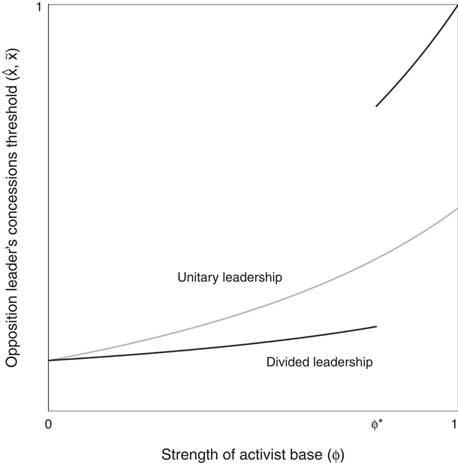
This extended model shows that the influence of the activist base on elite negotiations depends, in part, on the party’s leadership structure. In the baseline model, co-optation always led to the exit of activists since the party had unitary leadership with no internal rivals to support. However, when activists have an alternative option for party leader who represents their interests, they should instead remain loyal to the party and focus on internal channels to remove a leader who collaborates with the regime. The only obstacle is that these agents of the activist base do not always have an incentive to mount a campaign to replace the current leader. Thus, as shown in Figure 2, leaders of parties with a divided leadership structure are responsive to activists under a narrower set of conditions than those of parties with unified leadership, as represented in the baseline model.
The intervening role of leadership structure on the relationship between activist base strength and cooptation Note: the black curve shows the level of concessions,
 $$\tilde{x}$$
, required to co-opt a leader with an internal rival (extended model) for different values of activist base strength. The gray curve shows the same threshold from the baseline model (
 $\hat{x}$
), in which the party has unitary leadership.

When a party has a weak or even moderately strong activist base, it is too risky for a rival leader to mount a leadership challenge. A limited activist base, even if able to successfully replace the leader, is less able to endure repression during a conflict with the regime. Therefore, the internal rival remains loyal to the party leader and does not mount a challenge. Under these conditions, as shown in Figure 2, an opposition leader requires fewer concessions to co-operate than a leader of a party with unitary leadership. Also, increases in the strength of the activist base have very little influence on the concessions demanded by the opposition leader below the threshold ϕ*. Importantly, the incumbent is always willing to meet the opposition leader’s demands, since the costs of co-optation are minimal when the rival does not pose a threat to the leader.
However, when the activist base is extremely strong and the rival will mount a challenge if the leader is co-opted for values of ϕ≥ϕ*, the concessions required by the leader are much higher. While not shown in the figure, these increased demands are so large in some cases that the incumbent refuses to make an offer. Thus the interaction between activist base strength and the party’s leadership structure plays a key role in whether a deal can be struck between the opposition leader and the incumbent. For high levels of activism, the rival leader serves as a ‘spoiler’ to negotiations with the incumbent. This is consistent with findings from the civil conflict literature, which has found that divided groups are more likely to engage in conflict with the state.Footnote 41 However, I show that this relationship does not always hold since internal divisions may facilitate collusion with the state when the activist base is weaker. Thus divided parties are more likely to strike deals, receive fewer concessions and remain co-operative, as long as the activist base is weak. Therefore I show that the role of the activist base depends on its strength as well as on the nature of the party’s leadership.
In addition to these implications for authoritarian control, this model shows that parties with a divided leadership and a weak activist base are the least effective at forcing concessions from the regime when co-opted. These leaders cannot credibly demand significant concessions from the incumbent, since they face fewer repercussions for acquiescing to the regime. Thus for many levels of activist base strength, parties with a unitary leadership structure are more capable of commanding significant returns from a deal with the incumbent. However, parties with both elite competition and a strong activist base have the greatest potential to secure extensive rents. Since rival elites can exact severe political costs in response to co-optation, the opposition leader can demand large-scale returns as compensation for the risks posed by internal challengers.
CONCLUSION
This article examines the key question of why some opposition parties are co-opted while others are not, which has implications for the study of authoritarian persistence. The model shows that internal opposition dynamics are an important influence on the level of concessions a party demands, and whether an opposition leader can be successfully co-opted by the regime. A strong activist base may ultimately undermine co-optation and, subsequently, weaken authoritarian control by increasing the party’s ability to endure repression and by promoting internal pushback to co-operative strategies. Yet the role of activists is influenced by the party’s leadership structure. Activists in parties with a divided leadership exert less influence, since leadership rivals can only challenge the party leader for colluding with the regime when the activist base is extremely strong.
This analysis shows that internal party dynamics provide an important constraint on incumbents’ ability to control opposition parties. While parties are frequently co-opted, accountability to activists leads to greater concessions from the regime and, if sufficiently strong, a breakdown in co-optation that may produce democratic change. More generally, it shows that opposition leaders actually benefit from responsiveness to activists. While many opposition parties are personalist vehicles with no significant grassroots structure, those with a strong activist base are most likely to command offers of state resources. Activists thus play an important role in increasing their party’s effectiveness when mobilizing, as well as increasing their leader’s ability to extract concessions from the incumbent. The only caveat is that a strong activist base can make leaders pursue political change through conflict rather than agreeing to large-scale concessions from the incumbent. Thus activists can push parties into costly confrontations with the regime when negotiations would produce similarly beneficial outcomes for the leader.
While this model predicts which parties are most likely to be co-opted, it assumes that the actions of the incumbent and the opposition leader are not influenced by the actions taken by other opposition parties. In some cases, the incumbent must prioritize which parties to co-opt, given limited resources. Additionally, opposition leaders may attract co-optation offers when they are likely to coordinate with other opposition parties.Footnote 42 Thus patterns of co-optation may be a product of both intra- and inter-party dynamics.
Looking beyond the issue of co-optation, opposition parties have an influence on a variety of outcomes in non-democratic regimes. Thus the idea that opposition parties vary in their organizational and leadership structures should influence how we understand authoritarian rule. The literature on authoritarian institutions needs a greater understanding of opposition parties as political institutions, which have often been neglected in both theoretical and empirical studies despite their role in authoritarian persistence and governance. Therefore, future work should continue to examine how opposition parties respond to the various internal and external challenges they face in authoritarian settings.