INTRODUCTION
Serious conservation concerns arise as sea turtles are driven to dangerously low levels due to fishery bycatch and destruction of rookeries (NRC, 1990; Spotila et al., Reference Spotila, Reina, Steyermark, Plotkin and Paladino2000). The decline of sea turtles is a global problem, and solutions require knowledge of the turtles’ life histories. Satellite tracking is one of the methods to collect life-history data and many studies have examined migration of sea turtles (e.g. Sakamoto et al., Reference Sakamoto, Bando, Arai and Baba1997; Hatase et al., Reference Hatase, Takai, Matsuzawa, Sakamoto, Omuta, Goto, Arai and Fujiwara2002b; McClellan & Read, Reference McClellan and Read2007; Whiting et al., Reference Whiting, Murray, Macrae, Thorn, Chongkin and Koch2008). For example, Kobayashi et al. (Reference Kobayashi, Polovina, Parker, Kamezaki, Cheng, Uchida, Dutton and Balazs2008) demonstrated that the pelagic habitats of loggerhead turtles were characterized by the seasonal, annual, and spatial patterns of sea-surface temperature and chlorophyll-a concentration by using satellite tracking with the Argos system. Reviewing the studies using satellite tracking of sea turtles, there were, however, geographical biases in data due to the high cost of this method (Godley et al., Reference Godley, Blumenthal, Broderick, Coyne, Godfrey, Hawks and Witt2008). The study of distribution patterns of the epibionts on turtles provides an alternative method. For example, Koch & Willan (Reference Koch and Willan2007) reported the presence of the intertidal barnacle (Amphibalanus amphitrite) and the rock oyster (Booneostrea cucullina) on flatback sea turtle (Natator depressus), and explained the habitat utilization of sea turtles according to distribution of their epibionts. Hayashi & Tsuji (Reference Hayashi and Tsuji2008) showed the aggregated distribution of the turtle barnacles on the green sea turtles (Chelonia mydas) despite the turtle body size, indicating that variation in the density of the attached barnacles might result from differences in their migratory history.
The present study reports the turtle barnacle Cylindrolepas sinica Ren, Reference Ren1980 on loggerhead turtle in Japanese waters, which are a new record for Japan and a new host record for C. sinica. The relationship between the epibiont barnacle species and the turtle's behaviour will be discussed.
MATERIALS AND METHODS
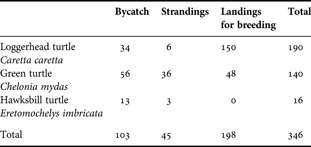
Three species of sea turtles (loggerhead turtles, Caretta caretta; green turtles, Chelonia mydas and hawksbill turtles, Eretomochelys imbricata) were investigated for epibionts in Japanese waters including bycatches, strandings and landings for breeding (Table 1). Removed barnacles from various parts of the turtle's body were fixed in a 99% ethanol solution.
Individual numbers of the examined sea turtles.

On 18 August 2008, a male loggerhead turtle, Caretta caretta (Linnaeus, 1758), was caught by set net at Yomitan village, Okinawa, Japan. This turtle was measured (minimum carapace length, 83.0 cm; standard carapace width, 65.3 cm) and tagged (Sea Turtle Association of Japan (STAJ) titanium tags, No. 37012 on the left flipper and No. 37013 on the right flipper), epibionts were collected, and the animal was released.
RESULTS
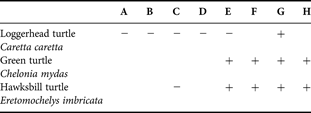
In Japanese waters, the barnacle Cylindrolepas sinica was found in multiple localities and was common on green turtles and hawksbill turtles, but rare on loggerhead turtles (Table 2). On 18 August 2008, a loggerhead turtle was found at Yomitan village, Okinawa with many barnacles attached including 15 individuals of C. sinica embedded in marginal scutes near the tail (Figure 1A), 2 individuals of Chelonibia testudinaria (Linnaeus, 1758), 216 individuals of Platylepas hexastylos (Fabricius, 1798), and 8 individuals of Stephanolepas muricata Fischer, 1886. Among 190 loggerhead turtles examined, 34 individuals of loggerhead sea turtles were captured in nearshore waters and only one turtle had C. sinica attached. This is a first record of C. sinica on a loggerhead turtle. This particular turtle was captured in the same set net three times (18, 21 and 23 August 2008) during the week it was tagged, and was recaptured at the same site in winter on 9 December 2008 (Toya fishermen and STAJ, personal communication).
(A) Cylindrolepas sinica Ren, Reference Ren1980 embedded in a marginal scute near the tail of the loggerhead turtle (Caretta caretta) captured at Yomitan village, Okinawa, Japan, 18 August 2008. A box in the inset drawing indicates the approximate region in which the photograph was taken, and shading on the drawing indicates regions where C. sinica was embedded; (B). Cylindrolepas sinica Ren, Reference Ren1980 detached from the Japanese loggerhead turtle (Caretta caretta) shown in Figure 1a, in upper view (upper left), basal view (upper right), upper oblique view (lower left), and lateral view (lower right) RUMF-ZC-02001).

Occurrences of Cylindrolepas sinica in Japanese waters. Upper case letters indicate localities.

+, occurred; −, not found; no symbol, could not be investigated. (A) Otsuchi, Iwate (39′21′N 141′56′E.); (B) Fukui, Fukui (36′0′8N 136′04′E); (C) Tateyama, Chiba (34′58′N 139′46′E); (D) Omaezaki, Shizuoka (34′38′N 135′21′E); (E) Yakushima Island, Kagoshima (30′24′N 130′26′E.); (F) Hahajima Island, Ogasawara, Tokyo (26′38′N 142′09′E); (G) Okinawajima Island, Okinawa (Ginoza, 26′28′N 127′57′E; Yomitan, 26′23′N, 127′43′E); (H) Ishigakijima Island, Okinawa (24′27′N 124′13′E).
Specimens of C. sinica examined have been deposited in Fujukan, the Museum of the University of Ryukyus, under accession numbers RUMF-ZC-02000–2007. They had a carino-rostral diameter range of 2.5–5.2 mm. One individual (No. RUMF-ZC-02000) was incubating eggs. The dimensions of the specimen in Figure 1B are: carino-rostral length, 4.2 mm; carino-rostral diameter of the opercular orifice, 3.0 mm; lateral length, 3.9 mm; carino-rostral diameter of the basis, 2.9 mm; and depth, 2.3 mm.
DISCUSSION
There was only one report of Cylindrolepas sinica attached to green turtles collected on 8 May and 2 June 1975 in the South China Sea (Ren, Reference Ren1980). In constrast, green turtles and hawksbill turtles in Japan are commonly found with C. sinica attached (Table 2). The distribution of turtle barnacles depends on the hosts’ migrations. Green turtles and hawksbill turtles forage on seagrass and sea sponges, respectively, in the neritic zone (Mortimer, Reference Mortimer and Bjorndal1995), while Japanese loggerhead turtles migrate widely over the Pacific Ocean during their life cycle (Bowen et al., Reference Bowen, Abreu-Grobois, Balazs, Kamezaki, Limpus and Ferl1995; Hatase et al., Reference Hatase, Kinoshita, Bando, Kamezaki, Sato, Matsuzawa, Goto, Omuta, Nakashima, Takeshita and Sakamoto2002a). Satellite tracking revealed that adult Japanese loggerhead turtles leave the coast after breeding and utilize pelagic waters for feeding and wintering (Sakamoto et al., Reference Sakamoto, Bando, Arai and Baba1997; Hatase et al., Reference Hatase, Takai, Matsuzawa, Sakamoto, Omuta, Goto, Arai and Fujiwara2002b). In Australia, loggerhead turtles are known to remain inshore (Limpus & Limpus, Reference Limpus, Limpus, Bolten and Witherington2007) and hibernate to inshore environments on the east coast of the USA (Carr et al., Reference Carr, Ogren and McVea1980) in the winter season. Around Okinawa Island, Japan, adult male loggerhead turtles are found almost exclusively from January to May (Hirate, Reference Hirate2002), but the single male on which C. sinica occurred was captured by the same set net in both summer (August) and winter (December). In contrast to most adult loggerhead turtles, this single male was recaptured in the neritic zone after the breeding season, like green and hawksbill turtles, and similarly harboured C. sinica. The occurrence of the epibiont C. sinica in this loggerhead turtle appears to corroborate the recapture result, indicating that this male was resident in the inshore waters around Okinawa.
Satellite tracking and bio-logging science can reveal the migratory routes of sea turtles accurately. However, the transmitters often lose the function after their battery is used up, and the data loggers will be cut off and retrieved from sea turtles by the auto-disconnector system. Those studies used high cost materials to ask the question about sea turtles: ‘Where are you going, next?’ In contrast, looking at the epibiont species on the turtle can answer the question: ‘Where did you come from?’ Epibionts can be often studied on turtles collected from bycatches, strandings and landings for breeding as these studies give an indication of their foraging grounds. Sample sizes of turtles collected from bycatches, strandings and landings for breeding were much higher than those used in tracking or flipper tag returns. However, tracing the geographical routes of turtles by looking at the epibiont diversity cannot be as precise as the methods in flipper tag returns or satellite tracking, and the epibiont method can only identify the habitat types of the turtles.
To reveal a more complete picture of sea turtle's movement, basic information on the epibiont barnacles should be analysed together with the data collected from the tracked turtles, attempting to advance the sea turtle science to a new level and showing how the turtles spend their time in the ocean. Much of previous epibiont studies only examined the sea turtle carapace (e.g. Caine, Reference Caine1986; Matsuura & Nakamura, Reference Matsuura and Nakamura1993; Frick et al., Reference Frick, Williams and Robinson1998) without looking at the epibiont on the plastron and flippers. Future studies should also examine the epibionts on different parts of the turtles, to give more complete diversity studies of turtle epibionts.
ACKNOWLEDGEMENTS
I thank Yuzo Ota and Taro Matsuo for useful information; fishermen of the ports of Toya, Kanna, and Hahajima for capturing living sea turtles; Kouichi Hirate, Hidetoshi Ota, Kazuki Tsuji, Katsufumi Sato, Tomoko Narazaki, Kunihiro Watanabe, Osamu Abe, Junichi Okuyama, Akio Yamamoto, Naoko Takashima, Kunio Komesu, and Muneyuki Kayo for assistance or for providing equipment or material. This study was supported by the Sea Turtle Association of Japan (STAJ), Ever Lasting Nature of Asia, Yakushima Umigame-kan. Thanks also to the Nippon-Koei Co., Ltd. Okinawa office for help with the fieldwork. Dr Benny K.K. Chan and two anonymous referees helped to improve an earlier version of the manuscript.