1. Introduction
Comparative constructions express comparison of one object, property, or event with another (Campbell & Wales Reference Campbell and Wales1969). We use the term comparative only for comparisons of inequality, as in 1 (see Stassen Reference Stassen1984, Beck Reference Beck, Claudia, von Heusinger and Portner2012), and the term equative for comparisons of equality, as in 2 (Haspelmath & Buchholz Reference Haspelmath, Buchholz, van der Auwera, Dónall and Baoill1998, Henkelmann Reference Henkelmann2006, Rett Reference Rett2013). When we compare such constructions in three Germanic languages, English and Dutch appear similar in their choice of comparative particles, while German deviates. The cognates than and dan are used in English and Dutch, respectively, while in German als is used in this context, as can be seen in 1. The cognates of the German particle als, that is, Dutch als and English as, are used in equatives, while German uses wie here. This is illustrated in 2.
-
(1)

-
(2)
Dutch thus seems to behave on a par with English, with respect to both comparatives and equatives, while German shows a different pattern. However, Dutch als, which is used in equatives, happens to occur in comparatives as well. While the use of dan in these comparatives is still dominant in present-day Dutch, there is a clear tendency in spoken Dutch to use als in constructions such as 1, as illustrated in 3b. This tendency would give Dutch a place in between English and German, as in the well-known sandwich metaphor (van Haeringen Reference van Haeringen1956). That is to say, apart from constructions such as 1b, one also finds constructions such as 3b in Dutch. Thus, Dutch seems to be moving away from the English-like pattern shown in 1a to the German-like one in 1c. Strikingly, however, in German another ongoing change has been observed (Small Reference Small1923, Lerch Reference Lerch1942, Jäger Reference Jäger2010): Present-day spoken German also exhibits the variant in 3c, in which the comparative particle als has been replaced by the particle wie ‘how’—the particle used in equatives in German (see 2c above).
-
(3)
Hence, one witnesses an ongoing process both in German and Dutch, in which the equative particle (wie in German and als in Dutch) also occurs in comparatives. In this sandwich metaphor, Dutch seems to appear between English and German, with English being the most conservative and German the least conservative (Small Reference Small1923). Early New High German moved from the use of the comparative particle dann/denn to als, and now present-day German seems to be moving from the use of als to wie. Dutch also started to move from dan to als in the second half of the 16th century, but this change has not been completed (yet) or it has not been successful, perhaps due to the influence of prescriptive grammar prohibiting the use of als in comparatives (see Hubers & de Hoop Reference Hubers and de Hoop2013). English appears to be the most conservative of the three languages in that it has retained the use of than in comparatives up to the present day.
The aim of the present study is to explain the (ongoing) changes in comparative particle use in Dutch and German. Section 2 describes the changes attested in Dutch and German. The question is what type of factors have triggered these changes. We argue against the explanation that Hubers & de Hoop (Reference Hubers and de Hoop2013) propose for the alternation in Dutch. Section 3 presents our alternative explanation in terms of a conflict between two competing principles, Economy and Iconicity, which can account for both the Dutch and the German data. Section 4 concludes the paper.
2. The German(ic) Cycle in Dutch and German
As pointed out in section 1 above, an alternation happens to exist in Dutch between the use of the comparative particle dan, a cognate of English than, and the comparative particle als, a cognate of German als. Two examples taken from the Spoken Dutch Corpus (see Hubers & de Hoop Reference Hubers and de Hoop2013:92, 95) illustrate this:Footnote 1
-
(4)
Note that dan and als in 4 can be classified as complementizers (that is, subordinate conjunctions), whereas in 1–3 above they can be considered prepositions (Jacobsson Reference Jacobsson1977, Hoeksema Reference Hoeksema1983, Napoli Reference Napoli1983, Hendriks Reference Hendriks1995, Hubers & de Hoop Reference Hubers and de Hoop2013). Following Jacobsson Reference Jacobsson1977 and Stassen Reference Stassen1984, we use the cover term comparative particle for both instances.
Stassen (Reference Stassen1984) distinguishes six types of comparatives on the basis of a sample of 110 languages, chosen from genetically diverse language families. The sixth type that he distinguishes contains a comparative particle and is therefore called particle comparative. Both Dutch and English belong to Stassen's sample and are characterized as having particle comparatives. Because many of Stassen's languages of this type are European, he considers particle comparatives to be an areal phenomenon (Stassen Reference Stassen1984:158; this is confirmed by Heine Reference Heine and Pütz1994). Clearly, German also fits the characterization of having particle comparatives.
Stassen notes that comparative particles vary in their etymological origin, which renders the set of particle comparatives a heterogeneous set in his view. As for Dutch dan, Stassen suggests that it might be derived from a temporal adverb meaning ‘then’, ‘thereafter’ (as he mentions is also the case for Toba Batak asa). A suggestion he puts forward for English is that than may have a negative element incorporated into the comparative particle, which he claims also to be the case for Hungarian mintsem. Note that Postma (Reference Postma2006) hypothesizes that dan in Middle Dutch originated from a merge of the complementizer dat with a negative clitic en as well. However, Laker (Reference Laker2008) rejects the idea that English than has derived from a comparative particle containing a negative element, because in Old English the same form þonne was used as a temporal adverb and as a comparative particle. According to Laker, the distinction between then as a temporal adverb and than as a comparative particle was a later development which probably took place in the 17th century (Laker Reference Laker2008:13).
Laker points to the fact that Old High German danne was also used both as a temporal adverb and a comparative particle, while Dutch dan is ambiguous between a temporal adverb and a comparative particle to the present day. Laker leaves open the possibility that while Old English þonne did not originally contain a negative particle ne, it may be true that Middle English speakers started to reanalyze the second syllable as the negative particle ne. Such a scenario could hold for Dutch as well (see Postma Reference Postma2006), but as argued by Hubers & de Hoop (Reference Hubers and de Hoop2013), this would still not explain the tendency to replace dan by als in Dutch (contra Postma Reference Postma2006). For now, we assume that the comparative particle dan in Dutch, and its cognates than in English and dann/denn in German, all derive from a temporal adverb meaning ‘then’, ‘thereafter’, as indeed was proposed by Stassen (Reference Stassen1984) for Dutch.
The history of the German language allows one to observe a phenomenon that Jäger (Reference Jäger2010) refers to as the “comparative cycle”. In the words of van Gelderen (Reference van Gelderen2009a:2), a linguistic cycle “is a name for changes where a phrase or word gradually disappears and is replaced by a new linguistic item.” In the stages of Old and Middle High German (750–1350 AD), als or some related form was used in equatives, as in 5a taken from Lerch Reference Lerch1942:345, and denn/dann in comparatives, as in 5b taken from Jäger Reference Jäger2010:471.
-
(5)
In 5a, alsô is used as an equative particle, while danne in 5b is used as a comparative particle (Jäger Reference Jäger2010). Note that one can still find archaic remainders of this old comparative particle in modern German, as in besser denn je ‘better than ever’.
In the following stage of German, the Early New High German stage (1350–1650 AD), the equative particle als also became the particle for the comparative, causing denn/dann to vanish from the system. Instead of two particles, one for each construction, German now had one particle used in both constructions. In 6, als is used as a comparative particle where in earlier stages of German, denn/dann would have been used (Lerch Reference Lerch1942:353).
-
(6)
Next, the particle als was replaced by wie ‘how’ in equative constructions, as illustrated in 7 (Jäger Reference Jäger2010:473).
-
(7)
‘That is why they, too, think and speak of the Lord's Supper as ignominiously and blasphemously as Muslims.’
Hence, after a stage in which German had only one particle—als ‘as’—for both, comparatives and equatives, wie ‘how’ was recruited to replace als in equatives, and the language had two separate particles again.
These two particles are still considered standard in German, but it has been observed that the equative particle wie ‘how’ can nowadays also be used instead of als in comparatives. This is illustrated in 8 (Lerch Reference Lerch1942:365).
-
(8)
Thus, first als replaced denn in comparatives; then wie was recruited to replace als in equatives; nowadays wie is reported to occur in comparatives, which is, however, strongly disapproved of by German language purists (Jäger Reference Jäger2010). Lerch (Reference Lerch1942) and Jäger (Reference Jäger2010) also note the use of what seems a combination of both particles als and wie in comparatives. An example is given in 9 (Lerch Reference Lerch1942:347).
-
(9)
However, Jäger (Reference Jacobsson2013) convincingly argues that als wie in German has not developed as a combination of the “old” comparative particle als and the new one wie. Rather, als wie can be seen as a grammaticalized combination of adjacent als ‘so’ and the current equative particle wie. Just like wie itself, the combination als wie was already present in comparisons of equality (equatives and similatives) before it became used as a particle in comparatives. Jäger (Reference Jacobsson2013:264) presents the following example from 1698, in which als wie is used in a similative construction:
-
(10)
Jäger (Reference Jacobsson2013) argues that the grammaticalized combination of als and wie is thus similar to Dutch zoals ‘like’, which has also developed from a combination of zo ‘so’ and als ‘as’, and which forms the basis of the current equative particle soos in Afrikaans, as shown in 11b below. In addition, she notes that a combination of comparative particles has never been identified in diachronic data. When, for example, denn was being replaced by als, no combination such as ∗denn als was observed.
Crucially, Jäger (Reference Jacobsson2013) also points out that als wie is not found in the border area between dialects that use als and dialects that use wie in comparatives. Thus, she convincingly shows, on the basis of both diachronic and areal data, that als wie is not a compromise between als and wie but an independent variant in its own right. Because the process of grammaticalization of als wie as a particle is independent of the comparative cycle as such, we ignore this variant in the rest of this paper.
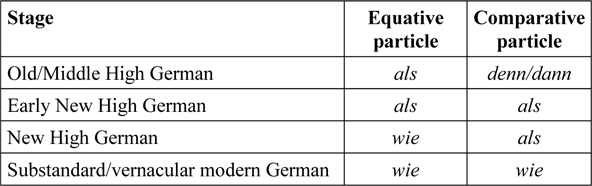
The changes in the comparatives and equatives in the history of German follow a certain pattern, in that the equative particle has repeatedly replaced the comparative particle. Jäger (Reference Jäger2010) refers to this as a “comparative cycle”. This comparative cycle is schematized in table 1.
The comparative cycle (compare Jäger Reference Jäger2010).

As already mentioned in the beginning of this section, Dutch has undergone a similar change, but only partially. The second half of the 16th century witnesses the rise of the comparative particle als in Dutch, but a countermovement emerged, led by Huydecoper (Reference Huydecoper, van Lelyveld and Hinlopen1730), who strongly opposed the use of als as a comparative marker (Stroop Reference Stroop, Hrnčířová, Krol, Mercks, Pekelder and Ultzen2011). The Woordenboek der Nederlandsche Taal (WNT, 1884) notes that als is the dominant variant in volksspraak ‘vernacular’, but argues that written language should not allow this use, because (see Hubers & de Hoop Reference Hubers and de Hoop2013:91):

The article on als in the WNT compares the development in Dutch to the development in German, in which dann/denn had already been replaced by als by that time, and ends with a passionate appeal not to let that happen in Dutch: “Laat ons toezien, dat bij ons niet hetzelfde geschiede” [Let us make sure that this won't happen in Dutch.]
The Dutch prescriptive rule introduced in the 17th century may have slowed down the process of replacing dan by als in Dutch comparatives. Nonetheless, even after centuries of schooling als is still frequently used, and almost all Dutch dialects predominantly use als in comparatives (Barbiers et al. Reference Barbiers, Bennis, De Vogelaer, Devos and van der Ham2005). As pointed out to us by one of the reviewers, Afrikaans shows a similar pattern to German and might be placed somewhere in between Dutch and German. Consider the following examples of a comparative and equative construction in Afrikaans (du Plessis Reference Plessis1977:2):
-
(11)
The comparative particle dan disappeared from Afrikaans (according to the reviewer around 1920) and was replaced by as. Subsequently, soos ‘so.as’ (comparable to German alswie as discussed above), replaced as in equatives.
In order to find out why and when people choose one comparative particle over the other, Hubers & de Hoop (Reference Hubers and de Hoop2013) examined the use of these particles in the Spoken Dutch Corpus. They found that the choice between als and dan strongly correlates with the level of education, such that highly educated people almost always use dan in comparatives while people with low levels of education use more als than dan. Prescriptive grammar rules prohibit the use of als in comparisons of inequality, which has given rise to a mechanism of avoidance of als in comparisons in general. This is referred to as hypercorrection. It happens in particular in equative constructions that express inequality, for example, en methaan is een 25 keer zo sterk broeikasgas dan CO2 ‘methane is 25 times as strong a greenhouse gas as CO2’ (NRC Handelsblad, cited in Hubers & de Hoop Reference Hubers and de Hoop2013:100).
This occurrence of hypercorrect dan in equatives reflects the strong influence of the prescriptive rule taught in schools against the use of als in comparatives. Hubers & de Hoop (Reference Hubers and de Hoop2013) argue that from a linguistic point of view, als would be a better candidate than dan in comparatives because als is used as a complementizer or a preposition inside and outside comparatives. In contrast, dan is not used as a complementizer or a preposition outside of comparatives. Instead, dan is used as a modal particle or a temporal adverb. Also, the use of dan as a modal particle or a temporal adverb is much more frequent than its use as a comparative particle. Because als is always used as a complementizer or a preposition, it would be favored in comparatives too, according to Hubers & de Hoop Reference Hubers and de Hoop2013.
However, Hubers & de Hoop's (Reference Hubers and de Hoop2013) analysis cannot be maintained in view of the process in present-day German by which the comparative particle als is being replaced by the equative particle wie. In order to test their hypothesis for German, we conducted a small corpus study using Twitter data.Footnote 2 As a data source, Twitter seems to be a good alternative to spoken language, because it contains contemporary written language that is rather similar to spontaneously spoken language. We collected 291 tweets containing the words als ‘as’ or wie ‘how’ and determined their word classes. It turned out that German als is only used as a preposition or a complementizer, just like Dutch als. Other constructions besides comparatives that use als as a preposition and a complementizer are presented in 12a and 12b, respectively.
-
(12)
By contrast, wie can not only function as a preposition and a complementizer, but also as an adverb, as, for example, in 13.
-
(13)
As a consequence, the hypothesis put forward by Hubers & de Hoop (Reference Hubers and de Hoop2013) for Dutch cannot explain the pattern in German. Whereas dan is not used as a preposition or complementizer outside of comparatives, its competitor als is. This would explain the use of als in comparatives, according to Hubers & de Hoop Reference Hubers and de Hoop2013. However, German als is always a preposition or a complementizer, just like its Dutch cognate als. There is no reason why it should get replaced by wie ‘how’, even more so because unlike als, wie ‘how’ is not only used as a preposition or complementizer outside of comparatives. The next section presents our alternative analysis of the comparative cycle attested in Dutch and German.
3. Economy versus Iconicity
This section argues that the comparative cycle witnessed in German and Dutch can be analyzed as the reflex of a principled conflict between two general constraints in language, Economy and Iconicity. Within Optimality Theory, Economy is a general markedness constraint (or rather, a family of constraints) that favors the least complex linguistic outputs. Iconicity is a family of constraints that require as many distinctions to be present in the linguistic output as there are in the input (see Hendriks et al. Reference Hendriks, de Hoop, Krämer, de Swart and Zwarts2010). Economy applies to the linguistic output only (in this case, the form that is used), whereas Iconicity applies to the relation between the linguistic input and the output (in this case, the relation between meaning and form). A general assumption is that Economy is a principle for the speaker's sake (ease of production), whereas Iconicity is a principle for the hearer's sake (ease of comprehension), and because they are necessarily conflicting, languages vary and change while trying to resolve this eternal battle.
For example, Malchukov (Reference Malchukov, Leonid, Malchukov and de Swart2006) proposes two general principles that determine the encoding of a transitivity parameter: An Iconicity constraint that requires a parameter to be marked on the argument to which it pertains, and an Economy constraint that penalizes marking on the primary argument. Malchukov (Reference Malchukov, Leonid, Malchukov and de Swart2006:347–348) explicitly argues that these competing motivations from functional typology can be viewed as two conflicting constraints within the framework of Optimality Theory. Whereas Economy can sometimes explain a certain pattern (for example, case ellipsis in Korean, as argued by Lee Reference Lee2010), in other cases Iconicity seems to play a major part (for example, in the choice of certain prepositions, as discussed in Hendriks et al. Reference Hendriks, de Hoop, Krämer, de Swart and Zwarts2010, chapter 8). Of course, instantiations of the general constraints Economy and Iconicity conflict with each other at different linguistic levels and in different contexts. It is clearly not the case that in one language Economy always outranks Iconicity while in another it is the other way around. Instead, the ranking will vary from construction to construction, and may change over time.
Another example of the interaction between Economy and Iconicity is presented by Hendriks et al. (Reference Hendriks, de Hoop, Krämer, de Swart and Zwarts2010), who argue that Iconicity requires the expression and the interpretation of negation, while Economy penalizes negation. These two core constraints are assumed to govern the expression of negation in natural language. As for negation, there is even a universal ranking between the two constraints: Iconicity always outranks Economy in that negation is always expressed. However, other constraints come into play to derive preverbal, postverbal, and discontinuous negation, thereby accounting for the Jespersen cycle, which is currently the most widely studied example of a linguistic cycle (see, for instance, various contributions to van Gelderen Reference van Gelderen2009b).
With respect to the comparative cycle, Jäger (Reference Jäger2010) appeals to the principle of Economy to explain the tendency to reduce the number of forms from two to one in comparatives and equatives. Because comparatives and equatives both involve comparisons, the use of one particle in the two constructions would satisfy Economy, whereas having two different particles would violate it. Jäger does not account for the other direction of change, however. When in Early New High German als was used in comparatives as well as equatives, thus satisfying Economy, wie ‘how’ got recruited as a new equative particle, thereby again violating Economy. In order to account for the whole comparative cycle, Iconicity has to be brought into play.
A first guess in relation to Iconicity could be that the comparative particle is used to express a comparison of inequality, while the equative particle is used to express a comparison of equality. If that were the case, having two different particles would be necessary in order to distinguish between the two types of comparison, equality and inequality. However, this is not the case in Dutch and German. The comparative particle in Dutch does not contribute to the meaning of inequality, as also pointed out by Hubers & de Hoop (Reference Hubers and de Hoop2013). The meaning of inequality lies in the comparative morpheme -er (Wellwood Reference Wellwood2015). That is, when the part of the sentence introduced by the comparative particle is omitted, the sentence is still interpreted as a comparison of inequality. This is illustrated for English, Dutch, and German in 14.
-
(14)
For equatives, there can be parameter markers (in the terminology of Haspelmath & Buchholz Reference Haspelmath, Buchholz, van der Auwera, Dónall and Baoill1998) such as English as, Dutch even, and German so in the equatives in 2 above, which seem to express a comparison of equality. Thurmair (Reference Thurmair2001) points out that the parameter markers used in equatives in German may vary (and the same holds for Dutch), and even that they are not necessarily present. This would mean that the equality meaning is not provided by the parameter marker, but rather by the equative particle als in Dutch and wie in German. Haspelmath & Buchholz (Reference Haspelmath, Buchholz, van der Auwera, Dónall and Baoill1998) provide numerous examples of equatives in languages that have an equative particle but no concomitant parameter marker, such as Turkish in 15a, Basque in 15b, and Italian in 15c.
-
(15)
Moreover, in so-called generic equatives such as in 16 there is no parameter marker present (Haspelmath & Buchholz Reference Haspelmath, Buchholz, van der Auwera, Dónall and Baoill1998, Henkelmann Reference Henkelmann2006). This means that in this construction, the equative meaning comes exclusively from the particle itself, that is, as in English, als in Dutch, and wie in German.
-
(16)
Clearly, if one leaves out the part of the sentence introduced by the equative particle in 16, the equative meaning disappears (unlike the comparative meaning in 14):
-
(17)
A final argument in favor of the idea that the meaning of comparison is situated in the equative particle itself rather than in the parameter marker comes from similative constructions, which can be seen as the verbal counterparts of adjectival equatives. In the similatives in 18, no parameter marker is present, and the similarity meaning thus comes from the similative particle itself, which often happens to be the same particle as the equative one (Haspelmath & Buchholz Reference Haspelmath, Buchholz, van der Auwera, Dónall and Baoill1998, Rett Reference Rett2013).
-
(18)
If indeed the presence of a parameter marker is not necessary to obtain an equative meaning in equatives, this meaning must come from the equative particle itself, at least in Dutch and German (see Umbach Reference Umbach2015). Hence, a crucial difference between the particles used in equatives and the ones in comparatives is that equative particles carry a meaning of comparison, while comparative particles do not. Since particles used in a comparative are merely present for grammatical reasons, they lose their semantics over time, which is a common feature of grammaticalization. Van Gelderen (Reference van Gelderen2009a) notes that sources for renewal in linguistic cycles are characterized by providing new semantic features for what was “grammaticalized away”. Whereas the equative particle als in Dutch still bears a comparison meaning, as in 16b and 18b, its German cognate als, which is nowadays used as a comparative particle and no longer as an equative particle, has lost this meaning. This can also be seen in 19.
-
(19)
We conclude from the difference between 19b and 19c that German als has lost its comparison meaning ‘like’ when it grammaticalized as a comparative particle, while Dutch so far has retained this meaning. That is why German als can no longer be used in equatives. It had to be replaced by a new element, wie ‘how’, that provided a new source for the comparison meaning, in accordance with the common pattern in a linguistic cycle (van Gelderen Reference van Gelderen2009a).
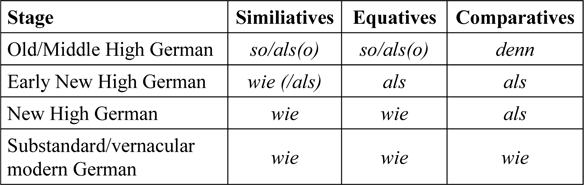
In German, wie was recruited to replace als in equatives because at that time wie was already used as a particle in similatives (Jäger Reference Jacobsson2013). Jäger (Reference Jacobsson2013:291) provides the following table that shows the spread of als and wie throughout constructions of comparison:
The comparative cycle in German.

The pattern of replacing denn by als and als by wie shown in table 2 goes hand in hand with a loss of the comparison meaning of the particles. The meaning of a similative construction crucially depends on the presence of a particle. The particles like in English, wie in German, and als in Dutch express the comparison meaning in similatives. In (nongeneric) equative constructions, this meaning is only partly expressed by the particle. In the sentences in 2 above, the standard markers as in English, als in Dutch, and wie in German are accompanied by the parameter markers as in English, even in Dutch, and so in German (Haspelmath & Buchholz Reference Haspelmath, Buchholz, van der Auwera, Dónall and Baoill1998:279). In other words, in (nongeneric) equatives, the comparison meaning is attributed to the combination of the two particles rather than to the equative particle alone. This indicates that the comparison meaning of equative particle has diminished compared to their similative counterparts. The next step in the process is that comparative particles have lost the comparison meaning entirely. The comparative morpheme itself is responsible for the comparison meaning, and not the particle. As illustrated in table 2 above, the replacement of als by wie follows a diachronic path from similatives to equatives to comparatives, which we propose goes hand in hand with a gradual loss of the comparison meaning.
Jäger's (Reference Jacobsson2013) analysis of the pattern differs crucially from ours. Jäger proposes a semantic typology of comparison constructions in which similatives are unmarked and unspecified for comparison meaning, whereas comparatives are the most marked, being specified for two features, that is, inequality and degree semantics. Equatives are in between comparatives and similatives in that they are specified for degree semantics, but not for inequality. By contrast, as we have argued above, in our semantic analysis we propose more or less the opposite pattern, in that comparative particles carry the least specified semantics, whereas similative particles carry the most specified semantics (and just as in Jäger Reference Jacobsson2013, equative particles are in between).
At this point, the particular instantiations of the principles of Iconicity as a faithfulness constraint and Economy as a markedness constraint in the conceptual domain of comparison can be defined as follows:
-
(20)
In comparatives, Iconicity is satisfied by the comparative morpheme -er independently of the presence of a comparative particle, but in equatives Iconicity is satisfied by the presence of a meaningful particle. We propose that the original German particle dann/denn had already lost its temporal meaning ‘then’ in comparatives when it got replaced by als in order to satisfy Economy. The latter particle in that stage still carried a comparison meaning due to its use as an equative (and similative) particle. Because of its use as a comparative particle, this comparison meaning faded away, not only in comparatives but eventually also in equatives. The principle of Iconicity then triggered the introduction of a new particle wie in equatives, in order to express comparison meaning.
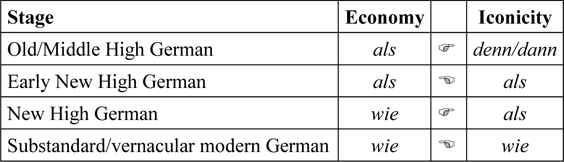
However, Economy has not completely been beaten yet, and nowadays the comparative particle als gets replaced by wie in German. We thus present the German(ic) comparative cycle in terms of this conflict between Economy and Iconicity. The pointing finger in table 3 points to the winning constraint in a certain stage.
The comparative cycle in terms of Economy and Iconicity.

Table 3 shows the alternation between having two particles and having one particle for equatives (in the left column) and comparatives (in the right). The pointing finger points to the winning constraint in a certain stage: When there are two particles, Iconicity wins; when there is only one, Economy wins. The competition between Economy and Iconicity sketched here might suggest the existence of comparative cycles in other languages as well. Indeed, Lerch (Reference Lerch1942) reports a comparative cyclic change in French. In Old French, the particle que was used in comparatives, whereas comme was used in equatives, as shown in 21.
-
(21)
In present-day French, the particle comme in equatives has been replaced by the comparative particle que. So, in French the same particle que is used in comparatives and equatives, as illustrated in 22 (Lerch Reference Lerch1942: 330–331).
-
(22)
It seems that in French, Economy has won the competition at the expense of Iconicity. Note, however, that in French it is actually the parameter marker aussi ‘also’ that carries the equative meaning and not the particle que. This is supported by the fact that in generic equatives as well as in similatives, when no parameter marker is present, the old equative particle comme ‘like’ is still used, as illustrated in 23a (Haspelmath & Buchholz Reference Haspelmath, Buchholz, van der Auwera, Dónall and Baoill1998:311) and 23b (Haspelmath & Buchholz Reference Haspelmath, Buchholz, van der Auwera, Dónall and Baoill1998:279).
-
(23)
So, in French Economy and Iconicity are both satisfied, but in a different way than in German and Dutch.
Another but similar type of change appears to have happened in Chinese, as reported by Sun (Reference Sun1996). In Old Chinese (500 BC–200 AD), the particle yu was used as comparative marker, as illustrated in 24 (Sun Reference Sun1996:38).
-
(24)
As can be seen in 24, yu in Old Chinese was not a meaningless comparative particle; it expressed the meaning of the comparative itself. The word bi was used as a verb, meaning ‘to compare’, as shown in 25 (Sun Reference Sun1996:38).
-
(25)
In Middle Chinese (201–1000 AD), the verb bi could be used as a similarity marker, meaning ‘like’. In other words, bi had grammaticalized from a verb to a preposition, as illustrated in 26 (Sun Reference Sun1996:39).
-
(26)
Modern Chinese uses the same word bi as a comparative marker. This is illustrated in 27 (Sun Reference Sun1996:38).
-
(27)
Thus, one can observe Chinese bi following a path from a verb meaning ‘compare’ to a preposition meaning ‘like’ to a comparative marker (Sun Reference Sun1996). This shows another type of comparative cycle in which a particle expressing similarity ends up as the marker of comparative meaning, suggesting that a competition between Iconicity and Economy in comparison constructions might be a more general phenomenon that is not limited to Germanic languages.
Returning to the sandwich metaphor introduced in the beginning of this article, one may wonder why English has not shown a cyclic change similar to the ones observed in German and Dutch in the use of its comparative and equative particles. English appears to have retained its distribution of comparative and equative particles throughout the years, thereby apparently satisfying Iconicity but violating Economy. Small (Reference Small1923:43) notes that in English, too, from the early middle period down to modern Scottish dialects, the particle as (or als) sometimes replaces than in comparatives. However, apparently, “[i]t has … never secured a hold on the idiom, although it occurs in ME. and in dialects, and even today is often used by careless speakers after the comparative” (Small Reference Small1923:43). The fact that Small (Reference Small1923) refers to speakers who often use as instead of than in comparatives as being “careless” suggests that in English, as in Dutch, prescriptivism may have successfully inhibited the process of replacing than by as in comparatives. The fact that as is used in English dialects is reminiscent of the Dutch situation, in which the majority of dialects use als in comparatives (Barbiers et al. Reference Barbiers, Bennis, De Vogelaer, Devos and van der Ham2005). Apart from the prescriptive pressure that may have blocked the comparative cycle in English, the principle of Economy might be less strong than in German and Dutch. Alternatively, it might be satisfied in a different way, or English might have found another type of compromise between Economy and Iconicity. Note that in English, the particle like is also used in generic equatives and similatives but not in equatives.
4. Conclusion
We have argued that the alternation between particles in German and Dutch comparatives and equatives reflects a cyclic change (van Gelderen Reference van Gelderen2009a, Jäger Reference Jäger2010) caused by a conflict between the principles of Economy and Iconicity. Economy requires a reduction of two particles of comparison to one, whereas Iconicity favors the use of an equative particle that expresses the meaning of comparison. The comparative particles als in German and dan in Dutch have grammaticalized into meaningless particles that do not carry such a comparison meaning. German als once had this comparison meaning but lost it due to its use as a comparative particle. Then the element wie entered the equative construction to satisfy Iconicity. In present-day spoken Dutch and German, Economy is gaining ground again with the equative particle als in Dutch and wie in German being used in comparatives. The never ending conflict between Economy and Iconicity thus results in an ongoing comparative cycle in German and Dutch.