Introduction
Human beings and dogs have lived closely for millennia (Zhang et al., Reference Zhang, Khederzadeh and Li2020) and the proximity and significance of their relationships evolve constantly (Cabral and Savalli, Reference Cabral and Savalli2020). Dogs help in many activities besides companionship, such as hunting, herding, guarding property, military services, law enforcement, therapeutic activities, among others (WSPA, 2011; Hart and Yamamoto, Reference Hart, Yamamoto and Serpell2016). However, despite this close relationship, the population of unowned dogs is growing on the streets around the world, especially in developing countries and in conflict zones where people have left their homes (FAO, 2014).
The number of free-roaming dogs (unrestricted owned and unrestricted unowned dogs) worldwide is estimated to be 525 million, which corresponds to approximately 75% of the world dog population (WSPA, 2011; Hughes and Macdonald, Reference Hughes and Macdonald2013). This large population of stray dogs needs to be managed to prevent transmission of many zoonotic diseases, as well as dog bites and transmission of diseases to other animals and people (FAO, 2014), in order to improve animal and human health and welfare. A control measure usually implemented to minimize the problems caused by stray dogs is sheltering, a common initiative in various countries worldwide, where these dogs can be euthanized, adopted, or permanently housed (Smith et al., Reference Smith, Hartmann, Munteanu, Dalla Villa, Quinnell and Collins2019). Governments, private enterprises, or non-governmental organizations generally administer these shelters. Nevertheless, in many countries, euthanasia is not allowed, causing shelters to be overcrowded (Smith et al., Reference Smith, Hartmann, Munteanu, Dalla Villa, Quinnell and Collins2019), which increases disease transmission among animals besides other health and well-being issues (Pesavento and Murphy, Reference Pesavento and Murphy2014).
Indeed, in animal shelters, the control of infectious diseases is a major challenge that requires a multidisciplinary approach, starting with diagnosis of the disease situation and the burden it causes (Belay et al., Reference Belay, Kile, Hall, Barton-Behravesh, Parsons, Salyer and Walke2017). In this context, leptospirosis, a zoonotic disease caused by Leptospira spp., has been an important concern, as it affects a variety of animals, including dogs, and it is an important zoonosis (Adler, Reference Adler2015). Annually, 1.03 million people are infected, and 58,900 die from leptospirosis worldwide (Costa et al., Reference Costa, Hagan, Calcagno, Kane, Torgerson, Martinez-Silveira, Stein, Abela-Ridder and Ko2015), and dogs are suggested as an important source of transmission to human beings (Polachini and Fujimori, Reference Polachini and Fujimori2015; Samir et al., Reference Samir, Soliman, El-Hariri, Abdel-Moein and Hatem2015; Kurilung et al., Reference Kurilung, Keeratipusana, Suriyaphol, Hampson and Prapasarakul2019). In addition, a greater concern to public health is the dogs that can have no clinical signs of the disease despite continued shedding of the bacteria in their urine (Miotto et al., Reference Miotto, Guilloux, Tozzi, Moreno, Da Hora, Dias, Heinemann, Moreno, de Souza Filho, Lilenbaum and Hagiwara2018). The growing global number of stray and sheltered dogs calls for attention about the epidemiological situation of zoonotic diseases, such as leptospirosis, in these populations, which is crucial for the establishment of measures to mitigate the risk of infection for caretakers, future adopters, and even other animals.
Therefore, focusing on contribution to the control and knowledge about leptospirosis among stray and sheltered dogs, the aim of this study was to conduct a systematic review on the prevalence (seroprevalence or prevalence of infection) of canine leptospirosis in these populations worldwide. A critical review of the quality of the published papers on the subject was also conducted, with special regard to the methodology used by the selected studies.
Materials and methods
The Preferred Reporting Items for Systematic Reviews and Meta-Analyses (PRISMA) guidelines were adopted in this review (Annex 1) (http://www.prisma-statement.org/PRISMAStatement/).
Search strategy
The search was conducted on 16 September 2019. Original studies on the prevalence of leptospirosis in stray and sheltered dogs were searched in six databases (Web of Science, PubMed, SciELO, Cochrane, Scopus, and CABI), without restriction on the year or location where the studies were performed. The search was performed based on the following terms for problem, intervention, comparison, and outcome (PICO) analysis: population (canin* or dog*), intervention (shelter*, kennel* or ‘stray dogs’), comparison (prevalenc*), and outcome (leptospir*). Detailed information on the search terms is provided in Annex 2. The selected keywords were investigated within all the sections from the papers (title, abstract, and full text) in all databases. Screening for articles was also conducted on the reference list of the reviews recovered in the primary search. After searching the databases, the articles were imported to EndNote X7.8 (Thomson Reuters, USA), and duplicates were removed.
Selection strategy and inclusion/exclusion criteria
In the first stage of selection, all articles were screened by title by two independent reviewers (A. C. T. R. B. C. and R. A. B. C.) according to the selection criteria. In the second stage, the selected papers were analyzed based on the abstract (A. C. T. R. B. C. and R. A. B. C.), whereas in the third stage, the full texts were analyzed (A. C. T. R. B. C. and R. A. B. C.). In all stages, when the two reviewers disagreed, a third one (E. M. S. D.) was responsible for the final decision.
The following aspects were considered for the article inclusion: (i) articles on prevalence, (ii) in stray and/or sheltered dogs, and (iii) approach to leptospirosis. Articles focusing on: (i) leptospirosis in other species, (ii) genetics, immunology, microbiology, molecular biology, diagnostic tests, therapeutics, and vaccination, and (iii) in languages other than English, Spanish, or Portuguese, were excluded. In addition, files that were not original research articles (thesis, abstract, book chapters, and reviews) were not selected, as well as systematic review papers. Due to the low quality identified in the recovered articles, all cross-sectional papers were selected by full-text and further analyzed for potential limitations and biases. The full inclusion and exclusion criteria are described in Annex 3.
Quality assessment and data extraction
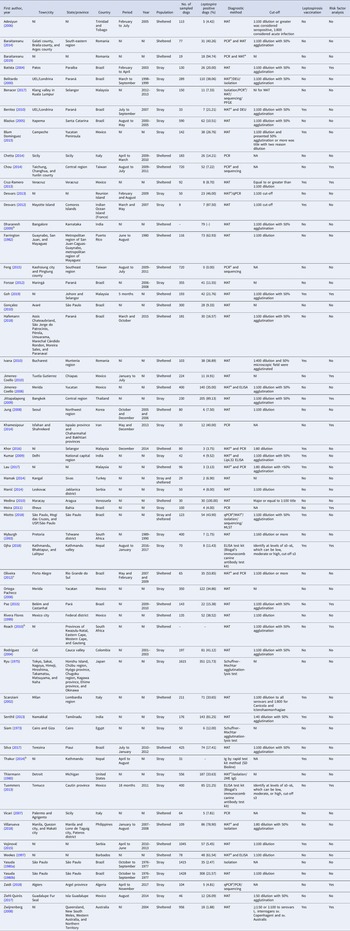
Two reviewers (A. C. T. R. B. C. and C. R. P.) were responsible for the quality evaluation of the articles selected by the full text. This evaluation followed the National Heart, Lung, and Blood Institute checklist using the Quality Assessment Tool for Observational Cohort and Cross-Sectional Studies (Gagnier et al., Reference Gagnier, Riley, Altman, Moher, Sox and Kienle2013). The data extracted from all selected articles were as follows: first author, publication year, the location where the study was carried out (city/town, county, state, and country, when informed), year in which sampling was performed, type of population (stray or/and sheltered dogs), number of sampled and leptospirosis-positive animals (only for stray or sheltered dogs), leptospirosis diagnostic technique employed, and the cut-off used (when applicable) (Table 1), leptospirosis vaccination status (when available), serovars identified in the serological tests (when available) (Annex 4), and the risk factors related to leptospirosis (when available).
Detailed information of the 60 cross-sectional studies selected by this systematic review on canine leptospirosis in stray or sheltered dogs, published between 1973 and 2019

UEL, Universidade Estadual de Londrina (State University of Londrina); USP, Universidade de São Paulo (University of São Paulo); MAT, microscopic agglutination test; PCR, polymerase chain reaction; PFGE, pulse field gel electrophoresis; DUE, direct urine examination in a dark field; ELISA, enzyme-linked immunosorbent assay; LipL32 ELISA, enzyme-linked immunosorbent enzyme linked immunosorbent assay using the LipL32 protein as antigen; qPCR, quantitative polymerase chain reaction; MLST, multilocus sequence typing; 2ME IgG, 2-mercaptoethanol resistant antibody IgG; Sv, serovar; NI, not informed; NA, not applicable.
a Test used to determine the frequency of positive animals.
b Does not separate sampled or positive results for stray or sheltered dogs from other dogs sampled.
c Considered only positive for MAT.
Evaluation of potential limitations and bias of the articles included
Based on the guidelines for strengthening the reporting of observational studies in epidemiology (Vandenbroucke et al., Reference Vandenbroucke, von Elm, Altman, Gøtzsche, Mulrow, Pocock, Poole, Schlesselman and Egger2007) and on representative sample requirements for a cross-sectional study design defined by Thrusfield (Reference Thrusfield2007), 10 criteria were used to assess potential limitations and bias in the articles selected by full-text, according to their presence or absence: A – basic epidemiological requirements: (1) clearly stated objective; (2) clear definition of location where the study (town or state or country) was carried out; (3) clear definition of the period when the study was carried out; (4) clear definition of the studied population (stray or sheltered dogs); (5) clear case definition (leptospirosis-positive); B – sampling requirements: (6) a referenced or 50% prevalence was used; (7) a level of confidence was adopted; (8) the size of sampled dog population was estimated or an infinite population was considered; (9) a statistic error was adopted; and (10) the sampling performed was randomized or all animals in the population were sampled (census). For each of the quality criteria adopted, a value of 1 was assigned when it was present and 0 when it was absent. At the end of the quality analysis, each study received a score according to the sum of the individual scores obtained in each criterion evaluated, which ranged from 0 to 10. The updated available impact factors of the journals where the selected papers were published were also extracted from the Journal Citation Reports (JCR) database 2019 (https://clarivate.com/webofsciencegroup/solutions/journal-citation-reports/) to evaluate their quality.
Statistical analysis
Descriptive analysis was performed on the data extracted from the selected articles. Categorical variables were analyzed by calculating proportions, while numeric variables were analyzed by calculating the mean, standard deviation, median, and interquartile range, when appropriate. The sampled dogs and dogs found positive were separated by population (stray and sheltered), and a weighted average was calculated according to the sample size for all selected articles.
Results
Main characteristics of studies included in this systematic review
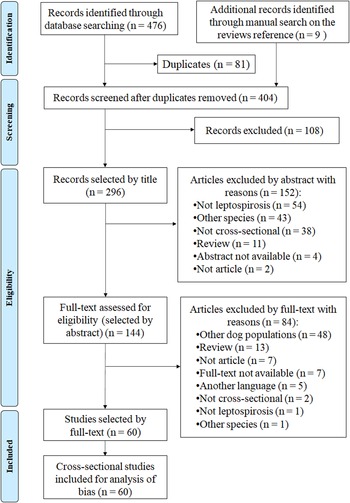
The database search recovered 476 articles, and an additional nine documents were identified by the active search. After the removal of duplicates (n = 81), the predefined criteria for selection were applied to 404 articles published between 1973 and 2019. The title selection excluded 108 articles. Of the remaining 296 articles, 144 were selected by abstract, and 152 were excluded. The full-text evaluation selected 60 studies that used a cross-sectional study design that met all the selection criteria for analysis of limitations and bias, whereas 84 were excluded (Fig. 1).
PRISMA flow diagram of selected studies.

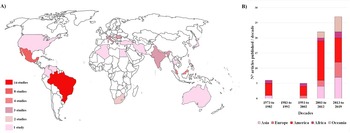
The geographical and temporal distributions of the articles selected in this study are shown in Fig. 2. The majority of the selected studies were conducted in Brazil [23.4% (14/60)], followed by Mexico [13.4% (8/60)], Malaysia [6.7% (4/60)], India [5.0% (3/60)], Italy [5.0% (3/60)], and Romania [5.0% (3/60)]. Nepal, Serbia, South Africa, and Taiwan were represented by two (3.4%) of the selected articles. The countries with only one study (1.7%) were Algeria, Australia, Barbados, Colombia, Egypt, Indian Ocean Island (Mayotte Island, France), Iran, Japan, Korea, the Philippines, Puerto Rico, Reunion Island, Thailand, Trinidad and Tobago, Turkey, the United States, and Venezuela (Fig. 2A).
Geographical and temporal distribution of the selected articles. (A) Distribution of the selected articles according to the country where the study was performed. (B) Distribution of the selected articles according to the decade of publication and to the continent where the study was performed.

The distribution of the year when the papers were published showed that 45.0% (27/60) were published between 2013 and 2019, 36.7% (22/60) between 2003 and 2012, 10.0% (6/60) between 1973 and 1982, 8.4% (5/60) between 1993 and 2002, and none of the selected articles was published between 1983 and 1992 (Fig. 2B). The main characteristics of the studies included in this systematic review are listed in Table 1.
Assessment of potential limitations and bias in the selected articles
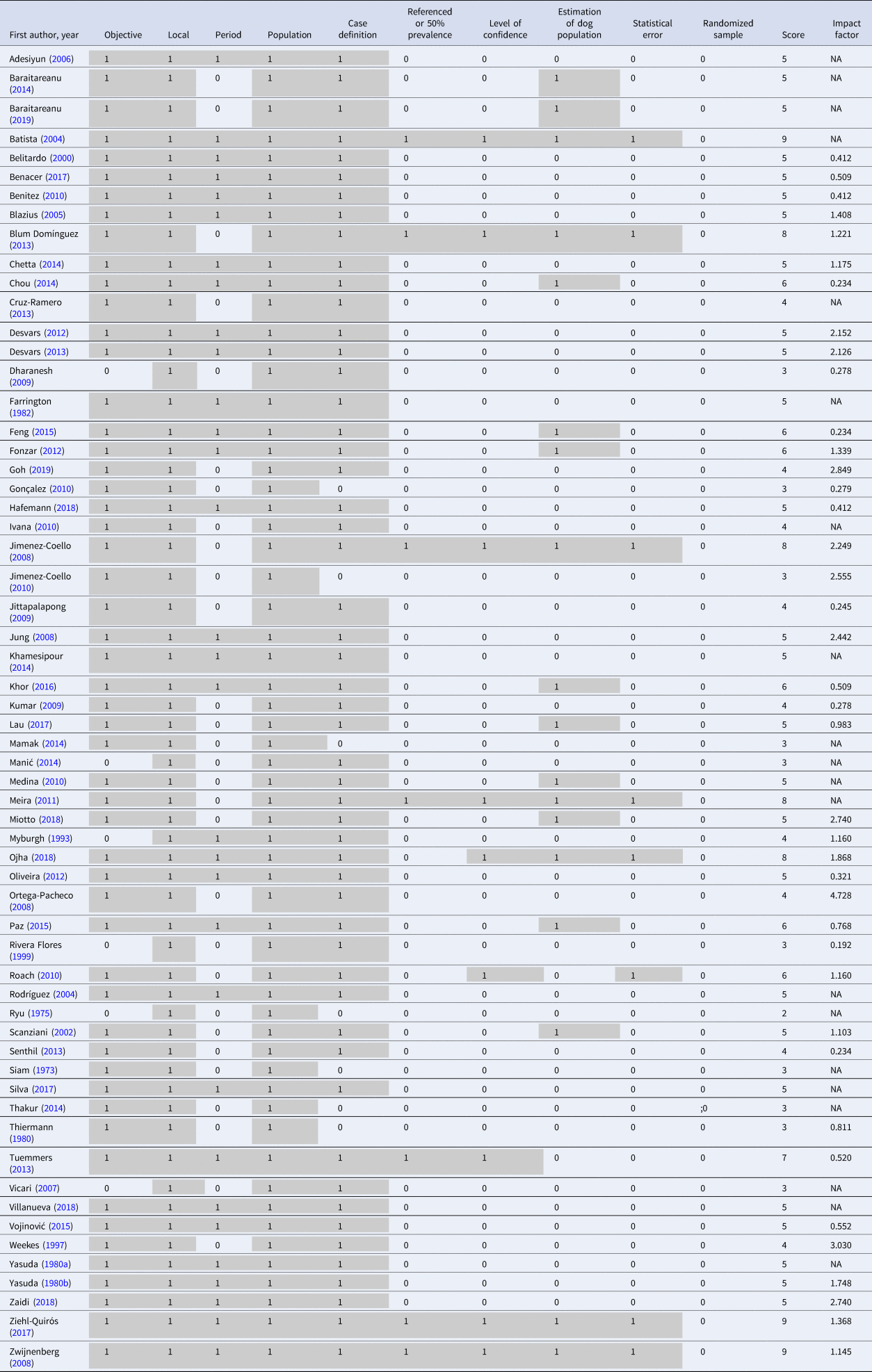
The analysis of the methodological quality of the articles showed that 43.4% (26/60) exhibited five of the 10 quality criteria analyzed, 16.7% (10/60) three, 15.0% (9/60) four, 10.0% (6/60) six, 6.7% (4/60) eight, and only 5.0% (3/60) showed nine of the 10 criteria analyzed. The remaining papers showed two [1.7% (1/60)] and seven [1.7% (1/60)] of the 10 criteria assessed (Table 2). The final score of articles by methodological quality varied between 2 and 9, with a mean and median of 5, standard deviation of 1.7 and interquartile range of 1.
Evaluation of potential limitations and bias in the methodology of the 60 papers selected by this systematic review

Objective: A clearly stated objective; local: clear definition of location where the study (city, state, or country) was carried out; period: clear definition of period (years) when the study was conducted; population: clear definition of the studied population (stray or sheltered dogs); case definition: clear case definition (leptospirosis positive); referenced or 50% prevalence: a reference or 50% prevalence was used; level of confidence: the confidence level was adopted; estimation of dog population: the size of the sampled dog population was estimated, or an infinite population was considered; statistical error: A statistical error was adopted; randomized sample: the sampling was randomized, and all animals in the population were sampled (census); score: the sum of all the information shown for each article; impact factor: impact factor of the journal by the Journal Citation Reports, 2019; NA: value of impact factor not present.
A value of 1 was assigned when the characteristic assessed was present (gray cells) and 0 when it was absent (white cells).
All articles described the location where the study was conducted (city, town, municipality, county, state, province, or country); however, six of them (10%) reported only the country. Similarly, all articles specified the study population. For the other criteria, 10.0% (6/60) of the articles did not provide a clear objective, 51.7% (31/60) described the period when the research was conducted and 11.7% (7/60) did not exhibit a clear case definition (Table 2).
For the evaluation of parameters regarding the sampling adopted, only 10.0% (6/60) of articles exhibited four of the five criteria assessed (reference or 50% prevalence, estimated dog population, level of confidence, and statistical error). Only one article (Tuemmers et al., Reference Tuemmers, Lüders, Rojas, Serr, Espinoza and Castillo2013) (1.7%) used 50% prevalence, a level of confidence, and a formula to estimate the sample size to determine the prevalence for an infinite population; however, there was no error in the calculation of the sample size. None of the 60 selected articles specified the methodology used to randomize sample collection, nor in the eight articles that used the word ‘random’.
Twenty (33.4%) of the papers were published in journals without an impact factor, and among all the journals that had an impact factor, the average impact factor was 1.262, with a maximum impact factor of 4.728 and a minimum of 0.234.
Epidemiological situation of leptospirosis among stray and sheltered dogs
The range of the sample size of the analyzed cross-sectional studies varied from 8 to 1615 stray or sheltered dogs (mean 282.7, standard deviation 364.8, median, 135; interquartile range, 273) (Table 3). The number of Leptospira spp. positive dogs per study, among the selected dogs, varied from 0 to 351 (mean of 52.2, standard deviation of 70.5, median of 30, and interquartile range of 55), with a relative frequency of positives varying from 0.00 to 100.00% of the total dogs (mean, 27.6%; standard deviation, 26.5%; median, 20%; interquartile range, 30.7%) (Table 3). In three articles (Dharanesh et al., Reference Dharanesh, Suryanarayan, Veeregowda, Rathnamma, Gajendragad, Prabhudas and Yathiraj2009; Roach et al., Reference Roach, van Vuuren and Picard2010; Thakur, Reference Thakur2014), it was not possible to separate the sampled population, the number of positive animals, or both forms of information, considering the population of dogs of interest (stray or sheltered dogs), from the total number of animals surveyed; therefore, these studies were excluded from the analyses. Similarly, only microscopic agglutination test (MAT)-positive animals were considered in one study (Oliveira et al., Reference Oliveira, Messick, Biondo, dos Santos, Stedile, Dalmolin, Guimaraes, Mohamed, Riediger and Gonzalez2012), because it was not possible to differentiate whether positive animals by polymerase chain reaction (PCR) from blood were also PCR-positive from urine and MAT. The distribution of sampled and test-positive dogs according to the population (stray or sheltered) is shown in Table 3.
Frequency of leptospirosis positive dogs weighted by the number of animals sampled for stray, sheltered and, total dog population obtained from the 60 papers selected in this systematic review

Wt (%), weight; Freq. (%), frequency of positive dogs according to dogs sampled by study; Wt freq. (%), weighted frequency – weight multiplied by frequency of positive dogs; NT, not tested.
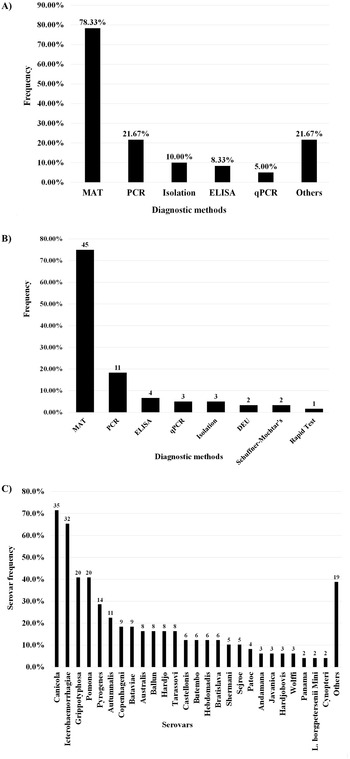
Among all the selected papers, the most common laboratory test used was MAT [78.4% (47/60)]. The second most frequent was standard PCR [21.7% (13/60)], followed by isolation and culture [10.0% (6/60)], different types of enzyme-linked immunosorbent assays (ELISAs) [8.4% (5/60)], and quantitative PCR (qPCR) [5.0% (3/60)]. Other tests [2-mercaptoethanol resistant antibody immunoglobulin G (IgG), multilocus sequence typing, sequencing, pulse-field gel electrophoresis, Schuffner–Mochtar agglutination-lysis test, urine examination by dark-field microscopy, and rapid test method] were used in 21.7% (13/60) of the studies (Fig. 3A). Among the diagnostic tests used to determine the frequency (prevalence and seroprevalence) of leptospirosis in stray or sheltered dogs, the most frequently performed tests were MAT [75.0% (45/60)], followed by PCR [18.4% (11/60)], ELISA [6.7% (4/60)], qPCR and isolation and culture [5.0% (3/60) each], direct urine examination in a dark field (DEU), and Schuffner–Mochtar agglutination test (Schuffner–Mochtar) [3.4% (2/60) each] (Fig. 3B). Among the articles that performed MAT or Schuffner–Mochtar agglutination-lysis tests (precursor of MAT), only 16.33% (8/49) stated information about the strains used for MAT (Thiermann, Reference Thiermann1980; Rodríguez et al., Reference Rodríguez, Ferro, Varona and Santafé2004; Adesiyun et al., Reference Adesiyun, Hull-Jackson, Mootoo, Halsall, Bennett, Clarke, Whittington and Seepersadsingh2006; Jung et al., Reference Jung, Song, Choi, Lee, Ha, Yoon, Kweon and Park2008; Roach et al., Reference Roach, van Vuuren and Picard2010; Cruz-Ramero et al., Reference Cruz-Romero, Romero-Salas, Aguirre, Aguilar-Domínguez and Bautista-Piña2013; Benacer et al., Reference Benacer, Thong, Ooi, Souris, Lewis, Ahmed and Mohd Zain2017; Villanueva et al., Reference Villanueva, Baterna, Cavinta, Yanagihara, Gloriani and Yoshida2018). Among the articles that exhibited at least one positive animal on MAT or Schuffner–Mochtar agglutination-lysis test, 16.33% (8/49) showed their results as serogroups (Ryu, Reference Ryu1975; Farrington and Sulzer, Reference Farrington and Sulzer1982; Weeks et al., Reference Weekes, Everard and Levett1997; Ivana et al., Reference Ivana, Bogdan, Ipate, Andreescu, Chiurciu, Chiurciu, Caplan, Bărăităreanu, Țogoe and Popescu2010; Desvars et al., Reference Desvars, Naze, Vourc'h, Cardinale, Picardeau, Michault and Bourhy2012, Desvars et al., Reference Desvars, Naze, Benneveau, Cardinale and Michault2013; Benacer et al., Reference Benacer, Thong, Ooi, Souris, Lewis, Ahmed and Mohd Zain2017; Miotto et al., Reference Miotto, Guilloux, Tozzi, Moreno, Da Hora, Dias, Heinemann, Moreno, de Souza Filho, Lilenbaum and Hagiwara2018). The serogroup Canicola was found as a serogroup result in all eight articles, followed by the serogroups Icterohaemorrhagiae [75.0% (6/8)], Pyrogenes [50.0% (4/8)], Grippotyphosa [37.5% (3/8)], Autumnalis and Pomona [25.0% (2/8)]. All the serogroup results were counted herein with the serovars, to facilitate summarization of results. The most common serovar found was Canicola [71.4% (35/49)], followed by Icterohaemorrhagiae [65.3% (32/49)], Grippotyphosa [40.8% (20/49)], Pomona [40.8% (20/49)], Pyrogenes [28.6% (14/49)], Autumnalis [22.4% (11/49)], and others [38.8% (19/49)] (Fig. 3C). Among these studies, 65.3% (32/49) exhibited serovar frequency, whereas 34.7% (17/49) determined the most probable serovar. The tested and positive serovars for all articles are shown in Annex 4. Also, among the articles that used MAT, 66.7% (30/45) followed the cutoff point recommended by the World Organisation for Animal Health (OIE) (positive: title ≥ 100) (OIE and World Organization for Animal Health, 2021).
Frequency of the methods used and serogroups and serovars observed among the selected articles. (A) Frequency of laboratorial methods used among the 60 articles selected by this systematic review. The group others included: 2-mercaptoethanol resistant antibody IgG (n = 1), DUE in a dark field (n = 2), multilocus sequence typing (n = 1), sequencing (n = 5), pulsed field gel electrophoresis (n = 1), Schuffner–Mochtar agglutination-lysis test (n = 2), and Ig by rapid test kit method (SD Bioline) (n = 1). The ELISA tests used were: ELISA (n = 1), LipL32 ELISA (n = 1), ELISA test Kit (Biogal's immunocomb canine antibody test kit) (n = 2), and indirect ELISA (n = 1). (B) Frequency of methods used to determine leptospirosis prevalence or seroprevalence among the 60 articles selected by this systematic review. DEU is direct urine examination in a dark field. Schuffner–Mochtar is Schuffner–Mochtar agglutination-lysis test. The ELISA tests used were: indirect ELISA (n = 1), LipL32 ELISA (n = 1), and ELISA test kit (Biogal's immunocomb canine antibody test kit) (n = 2). (C) Frequency of serogroups and serovars identified by articles that performed MAT or Schuffner–Mochtar agglutination-lysis test. Others serogroups and serovars were: Ranarum, Sarmin, Louisiana, Manhao, Javanica, Manilae, Semaranga, Losbanos, Poi, Mankarso, Medanesis, Robinsoni, Arborea, Zanoni, Fort Bragg, Sentot, Whiteombi, Lai, and Fort Bragg (one of each). MAT, microscopic agglutination test; PCR, polymerase chain reaction; qPCR, quantitative polymerase chain reaction; ELISA, enzyme-linked immunosorbent assay.

The vaccination status against leptospirosis among the sampled dogs was informed by 26.7% (16/60) of the studies (Table 1), of which only six reported the serovars composing the vaccine and the serovars diagnosed in the sheltered and stray dogs. Among these six studies, one article (Goh et al., Reference Goh, Ismail, Lau, Megat Abdul Rani, Mohd Mohidin, Daud, Bahaman, Khairani-Bejo, Radzi and Khor2019) did not separate the serovar frequency between stray and sheltered dogs from the other sampled animals and thereby was excluded from this analysis. The interval between vaccination and sampling among these articles varied from 10 days to approximately 1 year. The details of the interval from vaccination and sampling, the comparison between the serovars exhibited by seropositive dogs and those used in the composition of the vaccines are shown in Table 4.
Comparison between dogs seropositive for Leptospira spp. serovars, observed by MAT or Schuffner–Mochtar agglutination-lysis tests, and the composition of vaccines used for dogs, among the selected articles that informed the vaccination status of sampled animals

Cani, Canicola; Icte, Icterohaemorrhagiae; Grip, Grippodyphosa; Aust, Australis; Pomo, Pomona; Pyro, Pyrogenes; Cast, Castellonis; Autu, Autumnailis; Brat, Bratislava; Bata, Bataviae; Hard, Hardjo; Tara, Tarassovi; Sejr, Sejroe; Sher, Shermani; Java, Javanica; Wolf, Wolffi; Pos, positive; Neg, negative; NT, not tested.
The common serovars used in the vaccine and tested by serological tests are highlighted in gray shading.
Analysis of risk factors related to the occurrence of leptospirosis was carried out by only 23.4% (14/60) of the selected articles (Table 1). Of these, 57.1% (8/14) did not identify any significant factor associated with leptospirosis. Among the studies that observed variables significantly associated with canine leptospirosis, the main risk factors observed were age: older than 4 years (Chou et al., Reference Chou, Yeh, Lu, Shih, Chang, Chien, Liu, Wu, Tsai, Huang and Liao2014) and younger than 1 year (Zaidi et al., Reference Zaidi, Bouam, Bessas, Hezil, Ghaoui, Ait-Oudhia, Drancourt and Bitam2018), seasonality (Chou et al., Reference Chou, Yeh, Lu, Shih, Chang, Chien, Liu, Wu, Tsai, Huang and Liao2014), stray as opposed to a pet dog living in a household (Roach et al., Reference Roach, van Vuuren and Picard2010; Khamesipour et al., Reference Khamesipour, Doosti, Emadi and Awosile2014; Paz et al., Reference Paz, Rocha, Lima, Jorge, Pantoja, Moraes and Langoni2015), and dogs that lived in urban areas, sharing a common area with human beings and exhibiting a history of contact with rats (Goh et al., Reference Goh, Ismail, Lau, Megat Abdul Rani, Mohd Mohidin, Daud, Bahaman, Khairani-Bejo, Radzi and Khor2019). Detailed information on the risk factor analysis performed in these studies is shown in Table 5.
Significant risk factors for canine leptospirosis observed in articles that performed this analysis and were selected by this systematic review

OR, odds ratio; 95% CI, 95% confidence interval CCZ, Centro de Controle de Zoonoses (Zoonosis Control Center); NI, not Informed.
a Do not present a base category.
b Adjusted odds ratio.
Discussion
Comprehension of the epidemiological situation of a disease agent in stray and sheltered dogs is fundamental to implement efficient control and prevention measures (FAO, 2014), following a One Health strategy to deal with an associated zoonosis (Mbilo et al., Reference Mbilo, Coetzer, Bonfoh, Angot, Bebay, Cassamá, De Benedictis, Ebou, Gnanvi, Kallo, Lokossou, Manjuba, Mokondjimobe, Mouillé, Mounkaila, Ndour, Nel, Olugasa, Pato, Pyana, Rerambyath, Roamba, Sadeuh-Mba, Suluku, Suu-Ire, Tejiokem, Tetchi, Tiembre, Traoré, Voupawoe and Zinsstag2020), by understanding the disease behavior in animals, its transmission through the contaminated environment, and the risk to human beings. Therefore, the initial focus of the present systematic review was to establish the prevalence, seroprevalence, and risk factors of canine leptospirosis in stray and sheltered dogs. However, due to methodological problems found in the systematic review of the papers that addressed the subject, the real situation of this important zoonosis remains to be determined in these animal subpopulations. Additionally, the results obtained in this systematic review point to the main failures performed in the selected cross-sectional studies that impaired their external validity regarding the representativeness of the sampling, which can be used as a learning experience for the design of future studies in this field. Nevertheless, it is important to mention that the determination of the prevalence of canine leptospirosis was not the main objective of many of the studies evaluated, and, in their original contexts, they might be adequate, which certainly contributed to the low representativeness of the sampling performed. Some of the articles, although cross-sectional studies, were focused on assessing diagnostic tests or isolating and characterizing Leptospira spp. strains circulating among stray and sheltered dogs. Notwithstanding, despite the low representativeness of the sampled populations, some conclusions could be drawn from the selected studies, such as the presence of canine leptospirosis among stray and sheltered dogs worldwide and the most frequent serovars observed.
In this review, stray and sheltered dogs were chosen as subjects because of the risk that they offer to public and animal health regarding the transmission of disease agents, while considering these two different environments, streets, and shelters (agglomeration, daily contact with caretakers, and potential adopters). Nevertheless, the majority of the recovered articles did not perform sampling in a manner that significantly represented stray or sheltered dog populations, by not following basic epidemiological criteria to perform sampling (Thrusfield, Reference Thrusfield2007; Vandenbroucke et al., Reference Vandenbroucke, von Elm, Altman, Gøtzsche, Mulrow, Pocock, Poole, Schlesselman and Egger2007) (Table 2). The underrepresentation of sampling compromised the validity of the data generated (Patino and Ferreira, Reference Patino and Ferreira2018) and prevented a meta-analysis to recalculate the prevalence of leptospirosis in these dog subpopulations. The correct method for estimating the prevalence of a disease is to conduct a representative sampling of the target population (Sedgwick, Reference Sedgwick2014), which can be performed considering the population (1) as infinite, (2) as finite, or (3) performing a census (Thrusfield, Reference Thrusfield2007; Bloch and Coutinho, Reference Bloch, Coutinho and Medronho2009). The criteria used to evaluate the methodology of the recovered articles were those recommended for high-quality cross-sectional studies (Vandenbroucke et al., Reference Vandenbroucke, von Elm, Altman, Gøtzsche, Mulrow, Pocock, Poole, Schlesselman and Egger2007), allowing inferences from the data produced and epidemiological knowledge about a disease. For studies involving stray dogs, the absence of a representative sampling procedure may be partly justified by the difficulty in estimating this population in most locations, or it may also be due to the difficulty in finding these animals that have no restrictions on movement. Nonetheless, several recovered papers also failed to describe basic aspects of scientific and epidemiological studies, beyond non-representative samplings, such as not stating a clear objective or the locations and relevant dates for the study. Such low-quality methodology among the selected articles could explain the low impact of the journals in which these studies were published (Table 2). However, it is also important to consider that many journals consider papers carried out locally, as presenting only regional impact, which reinforces the publication in local journals that have a relatively low impact. Exceptions to the low impact factors were observed in 10 articles published in journals with impact factors greater than 2.
The majority of articles selected was published in the last 16 years and were from developing countries, such as Brazil, Mexico, and Malaysia (Fig. 2), probably due to the increase in stray dog populations in these countries (Jackman and Rowan, Reference Jackman and Rowan2007) and the importance of dogs in the maintenance of leptospirosis (Macpherson et al., Reference Macpherson, Meslin and Wandeler2000). Brazil was the country where most of the recovered studies were conducted, presumably because of the high number of dogs (52.2 million) in the country, which is the second-highest number of domestic dogs worldwide (IBGE, 2013). The country with the second-highest number of recovered studies was Mexico, which may be associated with the elevated stray dog population found in that country, estimated at 16.1 million animals (Cortez-Aguirre et al., Reference Cortez-Aguirre, Jiménez-Coello, Gutiérrez-Blanco and Ortega-Pacheco2018).
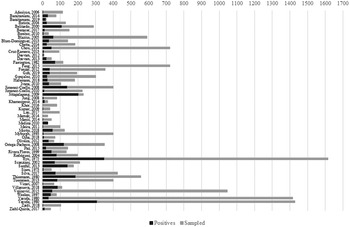
Despite the inferences about the target population being compromised, as stated before, the presence of canine leptospirosis among the stray and sheltered dogs was observed in the majority of the selected studies (Fig. 4 and Table 3), indicating the health risks associated with these animal populations; especially considering the dogs sheltered due to overpopulation, population densities in shelters, close contact with caretakers, and the risks for potential adopters. However, although present worldwide, the frequency of canine leptospirosis among these studies could not be compared directly, because, in addition to non-representative sampling, the studies were also very heterogeneous and used different diagnostic methods and cut-off points (Table 1). In fact, among those studies that used MAT as a diagnostic test, 15 (33.4%) performed the test using a different cut-off point from that recommended by the OIE (OIE and World Organization for Animal Health, 2021). Similarly, the grouping and discussion of the risk factors found in the recovered articles that were associated with canine leptospirosis among stray and sheltered dogs were hampered due to the questionable and varied analysis performed among the studies (Table 5). In general, the risk factors more associated with canine leptospirosis were age and type of population (stray or owned dogs), probably because life on the street exposes the animal to contact with more pathogens, and living without welfare and sanitary care (e.g. starvation, malnutrition, dehydration, vaccination, medication, and deworming) (Jackman and Rowan, Reference Jackman and Rowan2007).
Numbers of sampled and positive unowned (stray or/and sheltered) dogs per study selected by this systematic review.

Another important piece of information that could be extracted from the selected articles was the most common Leptospira serovars observed among seropositive dogs. The Canicola serovar/serogroup was the most frequent, indicating that transmission among dogs was common, probably because dogs are a reservoir of this serogroup/serovar that do not show clinical signs of leptospirosis when infected (Adler and de la Peña Moctezuma, Reference Adler and de la Peña Moctezuma2010). Indeed, no signs of acute leptospirosis were reported in most of the selected papers. The most common serovars, following Canicola, were Icterohaemorrhagiae, Grippotyphosa, and Pomona, which were already described as a concern for dogs worldwide (Ellis, Reference Ellis and Adler2015). Moreover, the findings showed that the serovars Canicola, Icterohaemorrhagiae, Grippotyphosa, and Pomona were present worldwide (Annex 4) and should be considered for the definition of disease control, as well as in the formulation of vaccines used for dogs; similarly, this has also been considered for domestic dogs in the United States since 2001 as well as in Europe (Schuller et al., Reference Schuller, Francey, Hartmann, Hugonnard, Kohn, Nally and Sykes2015). Curiously, the vaccination stray of the dogs sampled was shown only by five studies (Table 4), suggesting that vaccines are not a common preventive practice for street and sheltered dogs worldwide, and, of all the vaccines used, only two had a combination of the serovars Canicola, Icterohaemorrhagiae, Grippotyphosa, and Pomona. This observation suggests that the basic composition of leptospirosis vaccines for stray and sheltered dogs should be reviewed according to serovars observed in dog populations (Ellis, Reference Ellis2010), after careful verification of the circulating serovars through isolation. In addition, the serovars observed in dogs (Fig. 3) also call for attention to the importance of these four Leptospira spp. serovars in the epidemiology of leptospirosis in stray and sheltered dogs. However, comparison of the frequency of each serovar from every study analyzed in this review was not possible because of the variability in the methodology used, especially the different cut-offs shown in the articles and the heterogeneity in the presentation of results (serovar frequency versus most probable serovar).
The most common diagnostic test used to identify canine leptospirosis among the selected studies was MAT, probably because it is considered a gold standard method for serological diagnosis of Leptospira spp. and can indicate the most probable serovar that the dog had contact with (OIE and World Organization for Animal Health, 2021). Additionally, MAT is also suitable to identify serogroups because, usually, only some serovars from the serogroup are present in the serology battery. Therefore, depending on the antigens used, MAT will inform more certainly about the serogroups (OIE and World Organization for Animal Health, 2021). The serogroups, serovars, and strains used for MAT varied considerably among the selected articles, which is an expected result considering the worldwide distribution of the recovered articles. According to the Manual of Diagnostic Test and Vaccines for Terrestrial Animals, the antigens used for MAT to improve sensitivity should represent the exiting serogroups and strains in the study region, additionally to those known to be maintained elsewhere by the host species of interest (OIE and World Organization for Animal Health, 2021). PCR was the most frequently used method for the determination of leptospire prevalence through direct identification of the pathogen, being a molecular technique well-established for this purpose (Mérien et al., Reference Mérien, Amouriaux, Perolat, Baranton and Saint Girons1992). Although culture and isolation is considered the most specific when performed by trained staff, for direct identification of the agent (OIE and World Organization for Animal Health, 2021), in this review, it was the third most used method in the recovered articles, probably due to its peculiarities. Leptospira spp. are difficult to grow under laboratory conditions, requiring specific media, temperature, and long growth time (Mohammed et al., Reference Mohammed, Nozha, Hakim and Abdelaziz2011; Adler, Reference Adler2015).
The main limitation of this study was the impossibility of grouping the data, which prevented a meta-analysis and led to a descriptive analysis of most of the information available in the studies selected for review. The search performed for this review did not extrapolate to gray literature and databases less known to the scientific community, which could have prevented the inclusion of some articles in this review.
Conclusion
In conclusion, our results showed that leptospirosis is present worldwide among stray and sheltered dogs, constituting an important threat to human and animal health. However, the low-methodological quality of the recovered cross-sectional studies precluded the conduction of a meta-analysis and pointed to the urgent need to conduct well-designed studies to quantify and understand the epidemiological situation of the disease in these subpopulations of dogs.
Supplementary material
The supplementary material for this article can be found at https://doi.org/10.1017/S1466252321000190.
Acknowledgments
The authors acknowledge the Programa de Comutação Bibliográfica – Comut (Bibliographic Switching Program) from Universidade Federal de Lavras and Jordana Almeida Santana for their help in recovering some of the full-text articles. A. C. T. R. B. C., R. A. B. C., and C. R. P. are indebted to Coordenação de Aperfeiçoamento de Pessoal de Nível Superior (Capes) for their fellowships. A. P. L. and M. B. H. acknowledge the Conselho Nacional de Desenvolvimento Científico e Tecnológico (CNPq) for their fellowships. The EMSD lab was supported by Fundação de Amparo à Pesquisa de Minas Gerais (Fapemig), CNPq, and Capes.