




No CrossRef data available.
VICTIMS OF THE VICTIMS: Human trophies worn by sacrificed soldiers from the Feathered Serpent Pyramid, Teotihuacan
Published online by Cambridge University Press: 01 January 2004
Abstract
The large series of sacrificial victims excavated from the Feathered Serpent Pyramid (ca. a.d. 200) includes 72 males identified as soldiers. Although most of these wore pendants of imitation human maxillae, four soldiers each had between seven and eleven real human maxillae. Dental dimensions indicate that most, and perhaps all, of these trophies were from males. Dental attrition levels suggest a broader and flatter age profile for the pendants than for the soldiers, with a significantly higher mean age. The oxygen-isotope ratios in the dental phosphate of the pendant teeth, which indicate the geographic origins of those individuals, point to their derivation from three different regions, one of them probably in or near the Basin of Mexico itself. Apparently the soldiers had fought in more than one campaign, and the early interactions of Teotihuacan with more distant societies had sometimes involved an element of violence.
Information
- Type
- Research Article
- Information
- Copyright
- © 2004 Cambridge University Press
The ancient metropolis of Teotihuacan, the remains of which lie in the Basin of Mexico about 45 km northeast of Mexico City, rose around 150 b.c. and grew to become the center of one of the earliest state-level societies in the Americas (Millon 1981, 1992). Teotihuacan drew inhabitants from many different regions (Gómez 1998; Rattray 1987, 1993; Spence 1992) and exerted a strong influence over much of the Mesoamerican world until about a.d. 650, when it fell in a conflagration. The nature of its power is, however, still poorly understood. Scholars have long debated whether it was based on economic, military, or ideological dominance (Cowgill 1997; Demarest and Foias 1993; Hassig 1992; Millon 1992).
One of the many archaeological discoveries at the site, and perhaps the most significant and useful for addressing the issue of Teotihuacan's power, is the mass sacrifice of more than 200 individuals at the Feathered Serpent Pyramid (also known as the Temple of Quetzalcoatl). The victims were buried in a series of highly structured and symmetrically placed graves, beneath and just outside the pyramid, the whole probably patterned on the basis of calendrical and cosmological principles (Cabrera and Cabrera 1991, 1993). Details of the burials are available in Cabrera et al. (1991), Cabrera and Serrano (1999), and Sugiyama (1989, 1991, 1995). The rich iconography of the pyramid suggests strong ideological significance, but interpretations of its meaning vary. These include representations of the myth of creation (Coe 1981), the myth of the origin of time (López Austin et al. 1991), calendric succession (Coggins 1983; Drucker 1974; López Austin et al. 1991), rulership (Grove 1987; Taube 1992), and an expression of “cosmic values” (Pasztory 1988). A number of researchers have also suggested that the iconography represents war and the military (Carlson 1991; Sugiyama 1989, 1995; Taube 1992).
Several linear graves (Graves 4–6, 190, and 204), each containing 18 males identified as soldiers, have been excavated just outside the north, south, and east faces of the pyramid and inside its south edge (Figure 1). The symmetry of these and other graves suggests that analogous graves containing the same number of soldiers would be found on the other interior faces of the pyramid. The skeletons in the soldiers' graves had been placed facing outward from the pyramid with their arms behind their backs and crossed at their wrists, suggesting that they were bound at the time of death (Cabrera et al. 1991:79, 89). The artifacts that identify them as soldiers include many obsidian projectile points, “necklaces” of both imitation and real human maxillae and mandibles, shell beads in the form of human teeth, and slate disks behind their lower backs like those seen in Teotihuacan and later Postclassic-period representations of military figures (Cabrera et al. 1991:78; Sugiyama 1989:98, 1991:319). Furthermore, their elaborate and rich regalia, incorporating quantities of marine shell, indicates that they were an elite corps of professional or semiprofessional soldiers rather than some sort of peasant levy (Cowgill 1997:145).

Plan of soldiers' graves, Feathered Serpent Pyramid.
The ethnic identity of the soldiers is not entirely clear. Although some investigators believe that they were probably Teotihuacan soldiers selected for sacrifice (e.g., Cowgill 1997:145), others raise the possibility that they were foreign war captives from Oaxaca, the Maya region, or the Gulf Coast (Serrano et al. 1993:274–275; Sugiyama 1995:222–226). The analysis of oxygen-isotope ratios (see below) indicates that they were certainly not captives taken from Oaxacan, Maya, or Gulf Coast military forces, although some soldiers may originally have been recruited from those regions. Their isotopic bone signatures indicate that they had spent considerable time in the region of the Basin of Mexico before their deaths (White, Spence, Longstaffe, Stuart-Williams, and Law 2002). It remains possible that they were taken from some closer neighboring region (e.g., Tlaxcala or southern Hidalgo) where oxygen-isotope ratios overlap more with those of the Basin of Mexico. However, the numerous projectile points associated with the soldiers (see Sugiyama 1995:139–142, Figure 96) are products of the obsidian workshops of Teotihuacan, to judge by their materials, forms, and working. In the absence of any convincing evidence to the contrary, we view the soldiers as members of a Teotihuacan, not foreign, military force.
The role of the military in the emergence of the city and the maintenance of its political structure is not yet well understood. War among the polities in the Basin of Mexico may have played a role in the rise of Teotihuacan between about 200 and 150 b.c. (Sanders et al. 1979), and military force may have been involved in its subsequent rapid growth during the Patlachique phase between 150 b.c. and a.d. 0 (Cowgill 1992). The Feathered Serpent Pyramid is perhaps the most dramatic expression of military symbolism, but, notably, it was not constructed until about a.d. 200 (Cowgill 1997). The organization of the military and its membership are thus important considerations for understanding the political structure of the state. Was the army composed of Teotihuacan “citizens” alone, or did it include mercenaries or rely on tribute service? Was it centralized or composed of legions from various areas? Were soldiers stationed in foreign lands to maintain state control?
The analysis of oxygen-isotope ratios is an important technique for investigating questions of this sort (Stuart-Williams et al. 1996). The oxygen-isotope composition of bones and teeth is derived ultimately from the isotopic content of the local water consumed by a region's inhabitants. Isotopic ratios in the water in turn depend on a variety of geographic and climatic factors, including temperature, humidity, and latitude. Different regions are thus likely to have distinguishable isotopic “signatures,” which are then expressed in the bones and teeth of the people living in them. Furthermore, the isotopic composition of each tooth is fixed when that tooth develops and remains unchanged subsequently because dental tissue does not remodel. However, bone constantly remodels through an individual's lifetime, so the isotopic composition of the bone will be continually equilibrating to the individual's most recent environment. It is thus possible to detect movement over the course of an individual's lifetime and to identify the region(s) where that individual spent his or her early years and also the region where he or she passed the final years of life.
Previous analyses of oxygen-isotope ratios in skeletal and dental phosphate from a sample of the soldiers sacrificed at the Feathered Serpent Pyramid indicated that some soldiers probably spent most of their lives at Teotihuacan, but more had come from foreign locations to reside in Teotihuacan for some years before their deaths (White, Spence, Longstaffe, Stuart-Williams, and Law 2002). As many as four foreign lands of origin were indicated, and those who had relocated to Teotihuacan had done so at a fairly early age, probably in adolescence. These data raise the possibility that the military membership contained a strong mercenary or tribute-service component. Alternatively, immigration into Teotihuacan at this time may have been at a high level, and military recruitment may have followed the principle of citizenship—that is, all residents of the state were eligible regardless of their origin (Hassig 1992:49–50). However, the fact that foreign-born soldiers make up about two-thirds of those we tested from this elite corps suggests that some additional factor was involved. Perhaps military service offered a “fast track” to elevated status for newcomers, attracting them in disproportionate numbers. Or perhaps the Teotihuacan state deliberately sought out and recruited elite foreigners (often youthful ones) in their homelands as a way of solidifying support—or, at least, defusing hostility—in those regions. The variable isotopic composition of each of the soldiers' graves suggests that foreign-born recruits were then mixed with individuals from other regions, including native Teotihuacanos. They did not form ethnically distinct troops.
This raises the further question of the nature of the unit represented by each of the soldiers' graves. Morphological data and oxygen-isotope ratios indicate no simple mode of recruitment to these units. Individuals from one or more foreign regions, as well as from Teotihuacan itself, are represented in each of Graves 4–6 (White, Spence, Longstaffe, Stuart-Williams, and Law 2002), and nonmetric trait data suggest that, in some cases, related individuals occur in the same grave. For example, soldiers 190M, 190P, 204L, and 204Ñ all have rare supernumerary teeth, single-rooted teeth with oval crowns located immediately adjacent to the maxillary midline. Also, soldiers 5C, 5D, 5G, and 5H have retained deciduous teeth, although this feature does not appear in any of the other soldiers (Spence 1996a, 1997). While it is possible that the assignment of individuals to a particular grave was done randomly by those overseeing the sacrifice, rather than based on membership in a particular military unit, this seems unlikely. Saburo Sugiyama (1995:115) has suggested that military units in the Teotihuacan army were structured numerically on the basis of cosmological principles and that the uniform numbers in the graves reflect this. While the varying dental oxygen-isotope values in each grave indicate the disparate origins of the soldiers, their skeletal values show somewhat more intra-grave homogeneity. In terms of their more recent antemortem residence, then, the soldiers of each grave unit were more uniform than their dental values would suggest (White, Spence, Longstaffe, Stuart-Williams, and Law 2002). Also, those few individuals with real human maxilla pendants, the subjects of this article, are not evenly distributed among the graves (Figure 1). A more regular distribution would be expected if they had simply been assigned to graves without reference to their actual affiliations.
THE PENDANTS
Distributions
All of the 72 soldiers excavated to date wore complex collars formed of rows of numerous marine shell elements. Hanging from these collars were replicas of human maxillae, usually seven to nine for each soldier (Pasztory 1993:269, Catalogue No. 172; Sugiyama 1995:176–183). The replicas were formed on a base of perishable material, perhaps stucco and/or wood, that represented the bony parts of the maxilla. Set into these bases were marine-shell imitations of the teeth. When made realistically enough to be identifiable, these are always maxillary teeth. The perishable bases were often painted.
However, in a few cases the pendants were real rather that imitation human maxillae. Individuals Ñ of Grave 4, H of Grave 5, and A and F of Grave 190 all wore collars with a total of 36 real maxillae (including, in the case of 190F, three real human mandibles; Figure 1). In addition, individuals A and O of Grave 4 had real maxillae of canids, possibly coyotes, while individual H of Grave 6 wore pendants with shell imitations of canid teeth (Figure 1). Our primary concern here is with the human pendants associated with soldiers 4Ñ, 5H, 190A, and 190F.
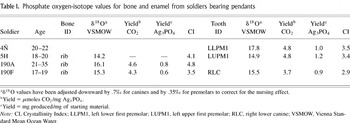
Individual 4Ñ was a young male, 20–22 years old at death (Serrano et al. 1991:Table 3). He was located third from the east end of the row of 18 soldiers in Grave 4, which extends east–west on the south interior of the pyramid (Figure 1). Eleven human maxillae were hanging from his collar. None of the other Grave 4 individuals wore human maxillae, but 4O (the adjacent individual to the west) and 4A (the seventh individual from the east end of the grave, and the fourth beyond 4Ñ) both had canid maxillae pendants (Figure 1; Sugiyama 1995:180). Oxygen-isotope analysis of teeth (Table 1; White, Spence, Longstaffe, Stuart-Williams, and Law 2002) indicates that soldier 4Ñ spent his earliest years in a foreign land. Adjacent soldier 4O (25–29 years old), with canid maxillae, seems to have passed his first years in the same region (White, Spence, Longstaffe, Stuart-Williams, and Law 2002). In contrast, 4A (35–39 years old) has dental and bone values that indicate continued residence in the Teotihuacan area throughout his life (White, Spence, Longstaffe, Stuart-Williams, and Law 2002).
Phosphate oxygen-isotope values for bone and enamel from soldiers bearing pendants

Graves 5 and 6 are oriented north–south on the eastern exterior of the pyramid, separated from each other by only a narrow trench that follows the extended east–west center line of the structure (Cabrera and Cabrera 1991:Figure 4). Each grave holds nine soldiers; thus, the two together hold the normal complement of 18 soldiers seen in the other excavated soldiers' graves (Graves 4, 190, and 204). Individual 5H, with eight human maxilla pendants, is the second individual from the north end of Grave 5, the more northerly of the two graves (Figure 1; Cabrera and Cabrera 1991:Figures 8, 12–13; Cabrera 1993:100). He was only 18–20 years old at the time of his death (Serrano et al. 1991:Table 3). Although his considerable degree of cranial modification and his unusually small and gracile skeleton seem to set him apart physically from the other soldiers (Cabrera et al. 1991:80, 89), his dental and skeletal oxygen-isotope values indicate lifelong residence in the Teotihuacan area (Table 1; White, Spence, Longstaffe, Stuart-Williams, and Law 2002).
Although none of the other Grave 5 and 6 soldiers wear real human or canid maxillae, soldier 6H has shell copies of canid teeth in his pendants. His location, second from the south end of Grave 6, is the mirror image of that of 5H (Figure 1). We have no samples for oxygen-isotope analysis from 6H and so can say nothing of his origins or movements during life. He was 30–34 years old at death (Serrano et al. 1991:Table 3).
In Grave 190, on the south exterior of the pyramid, soldier 190A has ten human maxilla pendants, while 190F has seven maxilla and three mandible pendants. Individual 190A was 21–35 years old at death, but 190F was only 17–19 years old (Serrano et al. 1991:Table 3). Their placement in the grave is symmetrical, with 190A seventh from its east end and 190F seventh from the west; the two are separated by four individuals in the center (Figure 1). The only oxygen-isotope value for 190A is for a rib and is just beyond the upper end of the Teotihuacan range of 14–16 parts per thousand (Table 1; White, Spence, Longstaffe, Stuart-Williams, and Law 2002). It may indicate incomplete isotopic equilibration to Teotihuacan values after movement to the city from a foreign locale, or it may be simply a Teotihuacan value from the extreme of the city's range. Soldier 190F has skeletal and dental oxygen-isotopic values indicating residence in the Teotihuacan area throughout his relatively brief life (Table 1).
In terms of their wider distribution among the graves, these individuals are not placed in any clear pattern. The 18 soldiers of Grave 204, on the north exterior, have only shell replicas of human maxillae. However, the corresponding grave on the south exterior, Grave 190, includes two individuals with real human maxillae. Grave 4 has only one person with real human maxillae but two others with canid maxillae, while Graves 5 and 6 include only one soldier with real human maxillae and one with shell replicas of canid maxillae.
Within most of the graves there is a certain degree of symmetry. Individual 5H is balanced spatially by 6H, and 190A and 190F are symmetrically placed. However, the locations of 4Ñ, 4O, and 4A show no obvious pattern other than the adjacent locations of 4Ñ and 4O. Also, none of those with real maxillae, human or canid, stand out from the rest of the soldiers in terms of regalia, positioning, or treatment (Sugiyama 1995:180). Although variations do occur in the distribution of particular items among individuals in each grave, no one person seems to have been exceptional, and all were of the same general social category (Sugiyama 1989:93, 98, 1991:307–308, 312, 320).
Two possible explanations can be suggested for the real human maxilla pendants. They may be either relics or trophies (Spence 1996a). If relics, two further possibilities occur. They could be relics of either kin-group ancestors or comrades fallen in battle. The former seems improbable, given that the oxygen-isotope values indicate that each grave includes soldiers from a variety of geographic—and thus presumably social—origins (White, Spence, Longstaffe, Stuart-Williams, and Law 2002). They are unlikely to have formed a kin group with a commonly recognized set of ancestors. It also seems unlikely that the pendants were taken from fellow soldiers killed in warfare. Dental attrition (see later) shows a broader, and generally older, age range than for the soldiers.
Most probably then, the pendants are trophies taken from victims of the soldiers (Sugiyama 1989:98). Our initial assumption was that they had been taken from enemies vanquished by the soldiers who were wearing them—that is, they represented individual combat records. However, this begs the question of the imitation maxilla pendants worn by the vast majority of the soldiers. Why did so few soldiers sport the real thing? It seems somewhat unlikely that these four individuals had been able to accumulate such impressive records while the others had no presentable conquests. Soldier 5H, besides being the smallest of all the soldiers, was, at 18–20 years old, one of the youngest in Graves 5 and 6. Soldier 190F at 17–19 years old was among the youngest in Grave 190, although 190A was somewhere between 21 and 35 years old. Soldier 4Ñ was among the three youngest in Grave 4 (Serrano et al. 1991:Table 3). It seems more probable that these four had been selected to bear the records of their units' victories—that is, the real maxillae represent “kills” accumulated by all of the soldiers in that grave. This honor may also have placed the bearers in a noncombatant role, thus serving to keep the more vulnerable (smaller and younger) members of the unit out of harm's way. The later Aztec were equally solicitous of the safety of the younger and more inexperienced members of their armies (Hassig 1988:36, 56–57). The fact that the four trophy bearers were nevertheless included in the sacrifice suggests that those responsible for the selection of the victims were somewhat removed from these military units and either did not share their concern for the younger members or had overriding concerns of their own.
Manufacture
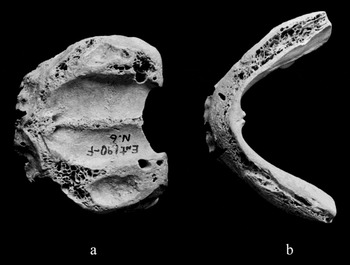
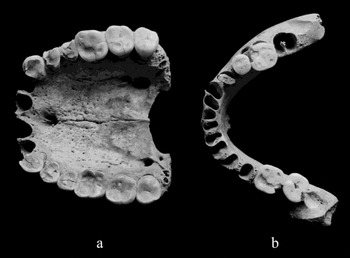
The maxillae had initially been separated from the rest of the face by cutting along two major planes (Figures 2a, 3a). A posterior cut passed vertically (in the coronal plane) along the posterior edges of the maxillary tuberosities or a few millimeters into the pyramidal processes. The area was then ground smooth. The second major plane of separation passed horizontally through the lower face, along the superior edge of the alveolus and just a few millimeters above the nasal floor. Again, the area was then ground to produce a relatively smooth surface.

(a) Superior view, maxilla pendant 190F 6; (b) inferior view, mandible pendant 190F 8.

(a) Inferior view, maxilla pendant 190F 6; (b) superior view, mandible pendant 190F 8.
Two-thirds of the maxillae were then further altered to facilitate their suspension. Two methods were employed with about equal frequency. In one, a hole was drilled diagonally down from the exposed floor of the maxillary sinus, to exit on the internal side of the alveolus at or just below the level of the palate and in the vicinity of the second or third molar-root apices. In some cases, the drilling started in the palate and proceeded upward to the sinus floor. The roots of the molars were occasionally cut in this process. In most cases these holes were drilled bilaterally. The alternative method was simply to enlarge the greater palatine canal to accommodate a cord. Where there was no working of either kind, we presume that suspension was accomplished through the unaltered greater palatine canals.
The three mandible pendants of soldier 190F were worked in such a way that their form generally matched that of the maxilla pendants, although of course without the bony base provided by the palate (Figures 2b, 3b). They appear to have been deliberately fashioned to imitate the maxilla pendants—and, perhaps, to be mistaken for them (Sugiyama 1995:182, Footnote 48; Luis Alfonso González, personal communication 1996). The entire inferior border of the corpus has been cut off from just below the level of the mental spines. The lower part of the remaining corpus was then beveled on the exterior, completely removing the mental eminence. The ascending rami were removed by cutting through the corpus just posterior to the area of the third molars. The cut areas were then ground smooth. Also, in two of the three mandibles the superior surface of the corpus at about the area of the third molar (just anterior to the cut) was ground to produce a slight hollow. This was apparently done to facilitate suspension. A wear facet from a cord can be seen by the hollow in one mandible.
It is not clear why mandibular copies of the maxilla pendants were worn by soldier 190F. Their alteration, especially with the addition of pigment and a false base, would have made them virtually indistinguishable from the maxillae to the unpracticed eye. Their occlusal fit indicates that Pendant 10 (Mandible Pendant 3) and Maxilla Pendant 2 of soldier 190F were from the same individual. Pendant 9 (Mandible Pendant 2) may go with Maxilla Pendant 7, but the fit is not as convincing. Mandible Pendant 1 (Pendant 8) does not seem to fit any of the maxilla pendants of 190F, but postmortem tooth loss and deterioration do not permit any conclusive statement. The match between Pendants 2 and 10 is intriguing but difficult to explain. Perhaps the soldiers of Grave 190 were inflating their record of battlefield success? More likely, though, the purpose was to maintain symmetry with soldier 190A, who had ten maxilla pendants.
Neither the mandibles nor the maxillae bear the scraping and cutting that would be expected with defleshing. This suggests either that the soft tissue had already naturally decayed from the crania and mandibles by the time that they were modified to produce the pendants or that it was removed by some process other than manual defleshing. The alveolus of Maxilla Pendant 190F 2 had been ground after the postmortem loss of the left third molar, suggesting some time for postmortem tooth loss before modification. Also, deliberately applied pigment occurs in the sockets of incisors that had been lost postmortem from Pendants 190F 3 and 6. The enamel of the crowns of some teeth in Pendants 190F 2 and 3 had been broken off and lost postmortem, but pigment was visible on the exposed dentin, again indicating that the pendants were fashioned from crania that had been fleshless for some time.
Sugiyama (1995:179) has suggested that the imitation pendants—those with shell copies of human teeth—may have been manufactured specifically for the sacrificial ceremony. However, this does not appear to have been the case with the real maxilla pendants. There had been a good deal more tooth loss after their manufacture but before their interment with the soldiers; most of the empty tooth sockets did not have pigment in them. In one case, a lost tooth in one of 5H's pendants had been replaced with one made of marine shell, painted red (Cabrera and Serrano 1999:11). The pendants may thus have been curated for some time as part of the ceremonial regalia of the military units.
The cutting, drilling, and grinding described earlier were the processes used to free and shape the pendants. The distribution of these technological traits shows no obvious patterning among the burials. Pendants with drilled suspension holes occur with all four of the soldiers, as do those with artificially enlarged greater palatine canals and those with no special alteration at all for suspension. Each soldier thus presents a mix of these technological attributes.
After they were fashioned, pigment was applied to at least some of the pendants. In most cases only traces survive, and several pendants do not show even this much. No evidence of pigment occurs on the 5H pendants, and only one of the 190A pendants has a few spots of black on the external surface of the alveolus.
The 4Ñ and 190F pendants show considerable evidence of pigment, though sometimes only as traces. The archaeological evidence indicates that the pendants were worn suspended from the shell collars, around the chests of the soldiers, with the palate and dental arcade facing outward (Cabrera 1993:100; Cabrera and Serrano 1999:374; Cabrera et al. 1991:Figures 12–13). The evidence of coloring is most intense on the palate and internal surface of the alveolus, but it also often occurs on the external alveolus.
Of the 4Ñ pendants, two have traces of red, two are painted green, and four are black. All seven of the 190F maxilla pendants have green palates and internal alveoli, and two of the three mandibular pendants have green pigment on the upper interior surface of the corpus. Pendants 190F 2, 5, 6, and 7 also have traces of stucco on the alveolus, while 3–8 have traces of black pigment, usually on the external alveolus. Pendant 190F 3 has a dark red pigment around the anterior teeth and in some of the empty sockets, but red is not visible on any of 190F's other pendants.
Some patterns seem to differentiate the pendants of the various soldiers, although, because of the condition of much of the material, these are not as clear as could be desired. The 4Ñ palatal areas are red, green, or black. The 190F palates, and at least two of the mandibles, are all green, but black is common on the exterior and some stucco appears. The apparent absence of pigment on 5H's pendants may be real, because the state of preservation in this area of the excavations was better than in the areas of Graves 4 and 190. However, the imitation maxillae worn by the other Grave 5 soldiers were painted green (Cabrera and Serrano 1999:369–375).
If these patterns can be trusted, the pendants of each soldier displayed somewhat different colors, although in the case of 4Ñ's pendants (and in contrast to those of 190F), the colors within the collar were not all uniform. It is possible that these are the unit's colors, but the appearance of green in the imitation maxillae of Grave 5 as well as in the trophies of 4Ñ and 190F makes this somewhat questionable.
Only one other maxilla pendant has been found in Teotihuacan. This single specimen was recovered from a mixed secondary context during an excavation of the Proyecto de Investigación Arqueológica en la Pirámide de la Luna (directed by Rubén Cabrera and Saburo Sugiyama) in structure 44:N4E1, the small central platform in the plaza of the Moon Pyramid. It displays the same alterations as the Feathered Serpent Pyramid specimens, and the palate shows traces of red pigment (Spence 2001). Unfortunately, the secondary context severely limits the information that can be drawn from it.
Biological Characteristics
With only these radically altered elements, the age and sex of the individuals from whom the pendants were derived are difficult to establish. However, two techniques can be applied. Dental attrition can be used as a measure of age (Brothwell 1981:71–72; Buikstra and Ubelaker 1994:49, 52–53), and dental dimensions have been shown to reflect sex in some cases (Hillson 1996:81–82). For both techniques a standard is needed for comparison. The baselines used here are the dental dimensions and attrition levels of the sacrificial victims of the Feathered Serpent Pyramid; these include both males and females of a variety of ages (Serrano et al. 1991). Also, they apparently derive from a number of sources (White, Spence, Longstaffe, Stuart-Williams, and Law 2002) and so provide models whose origins, although still Mesoamerican, are nevertheless biologically and culturally diverse enough to serve as appropriate comparators for the pendants.
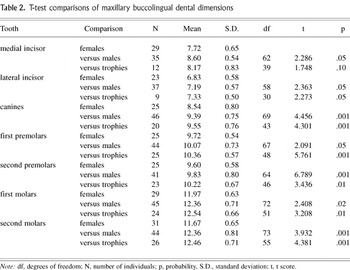
The buccolingual crown diameters were measured for each maxillary tooth category except third molars, both in the sacrificial victims and in the pendants. Mesiodistal dimensions were not used because of the greater difficulty of obtaining an accurate measurement and because of the distorting effect of contact facets. Where present, the left side tooth was used; otherwise, the right was measured. The identified male burials (Graves 4–6, 14, and 190) and female burials (Graves 2, 10, 11, 16, and 17; Cabrera and Serrano 1999:Figure 5) provided a sample of securely sexed maxillary dental measurements to compare with those of the pendants. The female means were tested against the male means and against the trophy means, using the t-test to determine significance (Table 2). In all tooth categories except the medial incisors, the mean dimensions for the pendant teeth are significantly above those for the identified females. For the medial incisors, the pendant mean is higher than the female mean, but the level of significance is only .10. The great majority, if not all, of the pendants had apparently been taken from males.
T-test comparisons of maxillary buccolingual dental dimensions

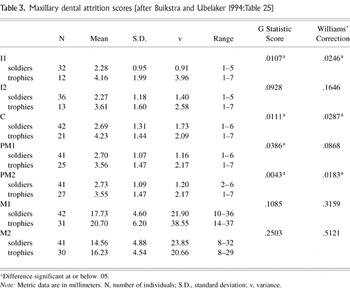
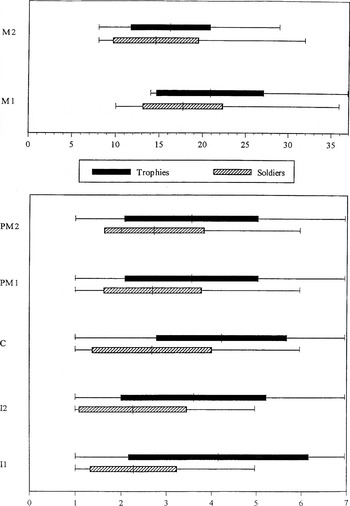
The age spans for the pendants were compared with those of the soldiers (Graves 4–6 and 190) through attrition values, following the system adopted from B. H. Smith (1984) and E. C. Scott (1979) by Jane Buikstra and Douglas Ubelaker (1994:Figure 25). The data are presented in Table 3 (see also Figure 4). Note that the attrition of the incisors, canines, and premolars is measured on a 1–8 scale, while the scale for molars is 0–40 (the higher values representing greater attrition and thus presumably greater age).
Maxillary dental attrition scores (after Buikstra and Ubelaker 1994:Table 25)


Dental attrition of soldiers and trophies; x-axes are attrition values (from Buikstra and Ubelaker 1994:Figure 25).
The attrition values for the pendants generally cover a broader range than those for the soldiers and are spread somewhat more evenly across that range. The mean attrition values for the soldiers are lower in all tooth categories. The soldiers' values also have a smaller standard deviation and variance in all categories except the second molars. The differences were tested for each category using the G statistic. To reduce the possibility of a Type I error and better approximate a chi-squared distribution, the Williams' correction was applied (Sokal and Rohlf 1995:698). The G statistic scores indicate that the soldiers' and trophies' attrition values have significantly different distributions for the medial incisors, canines, and first and second premolars (Table 3). However, the more rigorous Williams' correction raises the score for the first premolars above the level of significance (≤5%). The difference in the second molars may be less pronounced because, as the latest of these teeth to erupt, they have less time to register wear. In any case, these data indicate that the trophies include a broader age range than the soldiers, with less of a concentration in the younger age categories.
Some remarkably young people are represented among the trophies. Very few concrete, developmentally based age indicators are visible in the pendants. One such case is Pendant 190A Number B-1, in which the apex of the second molar root is still open. This corresponds to developmental stage 10 in Bonnie Trodden's system, and in her sample of Canadian Indians this stage is reached at 14 ± 1.65 years of age (Trodden 1982:Table XII). Pendant 190F 5, with the lowest attrition scores for all tooth categories among both soldiers and trophies, is likely to have come from an even younger individual. In contrast, Pendant 190F 3, in the collar of the same soldier, has the highest attrition scores and is probably from the oldest individual in the series.
The unfortunate individuals who provided the pendants thus seem to have been predominantly, perhaps exclusively, male and to have included a wide age range. However, their identities remain to be established. Dental-modification data for the soldiers have been used to suggest that some of them may have been foreigners—or, at least, foreign-born (Serrano et al. 1993, 1997; Serrano and Martínez 1989). Oxygen-isotope data from dental samples offer some support for that suggestion (White, Spence, Longstaffe, Stuart-Williams, and Law 2002). Unfortunately, many of the pendants lack the anterior teeth, where such modification generally appears; these single-rooted teeth were more susceptible to loss with the curation and manipulation of the pendants. Nevertheless, of the twelve pendants that were complete enough for observation, dental modification could be observed in five. All the anterior teeth had been lost or damaged in another sixteen pendants, while eight others showed no modification but were missing one or more anterior tooth categories.
Of the five pendants with modification, three are too incomplete to identify the full pattern. The canines of 190F 2 have B1 modification (Romero 1986:Figure 1), while the medial incisors are unaltered and the lateral incisors have been lost. The 4Ñ 1 pendant has type D9 modification of the medial incisors; the lateral incisors and canines are not observable. Pendant 4Ñ 2 has B2 modification of the medial incisors and no change to the canines, but the lateral incisors are unobservable.
Two 5H pendants present a full pattern. Pendant 5H 2 has type B5 alteration of the medial incisors and type C1 of the lateral incisors and canines. Pendant 5H 3 has A4 modification of all the incisors but no change to the canines.
Of the types of modification represented in the pendants, only C1 and D9 have not been previously reported from Teotihuacan and so might offer clues to the areas of origin of those individuals (Cid and Torres Sanders 1999; Romero 1986; Serrano and Martínez 1989; Serrano et al. 1993, 1997). However, type C1 has a long history and wide distribution in Mesoamerica, while D9 has so far only been identified in Postclassic Cholula (Romero 1986:Table 5). The dental modification, then, does not point to any particular place of origin for the pendants. The analysis of oxygen-isotope ratios offers a more productive approach (White, Spence, Longstaffe, Stuart-Williams, and Law 2002).
OXYGEN-ISOTOPE ANALYSIS
Theoretical Background
The interpretation of oxygen-isotope ratios derived from human remains is based on the facts that (1) environmental variables create regional differences in the oxygen-isotope ratios of water; and (2) the isotopic signature of water is passed on to those who drink it. This method is therefore a means of determining relative geographic identity. An analogous method based on the proportions of strontium isotopes, which are incorporated primarily through the consumption of foods, has also been successful in determining geographic origins in Mesoamerican samples but has not yet been applied to the Feathered Serpent material (Price et al. 2000).
Oxygen-isotope ratios (δ18O) are measured relative to the VSMOW (Vienna Standard Mean Ocean Water) standard and are expressed in parts per thousand (‰) using the standard notation:

The oxygen-isotope composition of local meteoric water is affected by climatic and physiographic variables such as temperature, humidity, distance from the ocean, and latitude (Ayliffe and Chivas 1990; Yurtsever and Gat 1981). The oxygen-isotope composition of animal body water equilibrates to that of the environmental water when body temperature is normal and constant. In turn, the oxygen-isotope composition of skeletal phosphate equilibrates with that of body water. Although most consumed water is imbibed, other sources can also include food (Longinelli and Peretti Paladino 1980; Luz et al. 1984). Imported foods could have different oxygen-isotope signatures that would be passed on to their consumers. In ancient populations, however, access to imported foods would probably have been restricted to high-status individuals, and even among these they would have formed a relatively minor part of the diet. Therefore, this source of error is unlikely to affect the data in this study.
The oxygen-isotope composition of body water is determined not only by water consumption, but also by metabolic rate and the expulsion of physiologically produced substances such as breath (water vapor), sweat, urine, and feces (Bryant and Froelich 1995; Kohn 1996; Kohn et al. 1996). We assume no significant differences in the effects of these variables among the individuals in our sample. Early research indicated that the degree of intrapopulational variability in oxygen-isotope ratios of skeletal phosphate was extremely low (1‰; Longinelli 1984). Previously analyzed archaeological samples of skeletal phosphate from Mesoamerica have resulted in a slightly larger range of approximately 2‰ for control groups representing different time periods and social statuses (White, Spence, and Longstaffe 2000; White, Spence, Longstaffe, and Law 2000; White, Spence, Longstaffe, Stuart-Williams, and Law 2002).
Tooth enamel, the tissue analyzed in this study, acquires its δ18O values from body water during the mineralization of the tooth crown (Luz et al. 1984). Because enamel does not remodel, a permanent isotopic record of tooth formation is created. This makes teeth a particularly sensitive means of reconstructing environmental changes during their period of growth and development. For example, variability among the teeth of an individual has been used to reconstruct the weaning process in humans (White, Longstaffe, and Law 2004; White, Williams, and Longstaffe 2002; White, Spence, Longstaffe, and Law 2000; Wright and Schwarcz 1998), and in nonhuman mammals variations in δ18O values within teeth have been used to reconstruct seasonality (Cerling and Sharp 1996; Fricke and O'Neil 1996; Koch et al. 1989; Stuart-Williams and Schwarcz 1997).
Analytical Procedure
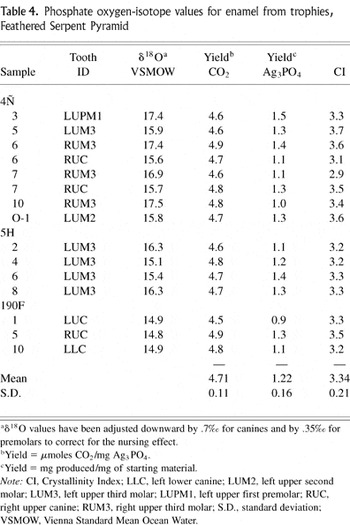
To remove calcium and organic material, approximately 30–35 mg of enamel from the entire length of the crown were dissolved and processed using lead phosphate and lead sulphate after the method of Stuart-Williams and Schwarcz (1995). The enamel was therefore homogenous, and any intra-tooth variation in δ18O due to seasonality or geographic relocations would be obscured. F. Henry Firsching's (1961) method was used to prepare silver phosphate (Ag3PO4). The yield of Ag3PO4 using this process has ranged from .5 to 1.5 mg produced/mg starting material in past studies (White, Longstaffe, and Law 2001; White, Spence, Longstaffe, and Law 2000; White, Spence, Longstaffe, Stuart-Williams, and Law 2002), with poorly preserved bones at the low end of this range and enamel yields commonly at the high end. Because bone is non-stoichiometric, the absolute yield of Ag3PO4 is unknown. Oxygen was extracted from the Ag3PO4 by reacting the samples with bromine pentafluoride (BrF5) at 600°C for ≥16 hours and then converted to CO2 over red-hot graphite using a procedure modified from Clayton and Mayeda (1963) and Crowson et al. (1991). Oxygen was released from the Ag3PO4 in an average amount equal to the theoretical yield for Ag3PO4 (4.7 μmoles CO2/mg Ag3PO4; Table 4). The oxygen-isotope measurements were made using a dual-inlet, triple-collecting, gas-source, stable isotope ratio Micromass 602C mass spectrometer.
Phosphate oxygen-isotope values for enamel from trophies, Feathered Serpent Pyramid

Because enamel is highly crystallized during its formation, it is quite resistant to postmortem alteration (Bryant et al. 1996; Quade et al. 1992; Reinhard et al. 1996). Nevertheless, there is a chance that phosphate in the mineral (bioapatite) structure of the enamel may have dissolved and been recrystallized or substituted in part by carbonate (Bryant et al. 1994; Elliot 1997; McArthur and Herczeg 1990; Shemesh et al. 1988). The Crystallinity Index (CI) is used to detect recrystallization and is calculated from carbonate and phosphate absorbances produced using Fourier transform infra-red (FTIR) spectrometry (Shemesh 1990) using the formula

where A represents absorbances at 565 cm−1 (v4PO4), 605 cm−1 (v4PO4), and ∼595 cm−1, which is the valley between these two peaks. A Nicolet 205 FTIR machine and data-processing software were used to obtain the CI data.
RESULTS AND DISCUSSION
Sample Description
The selection of teeth for both the soldiers and the trophies was limited by preservation. The teeth used in this analysis were all permanent. They include canines and premolars, which form between six months and six years of age and two and six years of age, respectively, and second and third molars, which form between three and seven years of age and nine and fifteen years of age, respectively (Massler et al. 1941; Ubelaker 1978). Although there is little doubt that variability in timing of weaning and weaning foods would have existed within and between Mesoamerican cultures, an elevation of δ18O values resulting from the consumption of mother's milk has been found consistently where the question has been examined (White, Longstaffe, and Law 2004; White, Williams, and Longstaffe 2002). To avoid misinterpreting the residence of nursing children and to be consistent with the way breastfeeding was factored into the interpretation of the larger body of data on the soldiers in the Feathered Serpent Pyramid sacrifice, the δ18O values of canines were adjusted downward by .7‰, and those of premolars by .35‰, to correct for this probable nursing effect (White, Spence, Longstaffe, and Law 2000; White, Spence, Longstaffe, Stuart-Williams, and Law 2002). The δ18O values of second and third molars reflect the residence location of middle and late childhood. Bone samples would probably have provided values for a somewhat later point in the lives of those from whom the pendants were derived. However, the bony parts of most of the pendants were either intact or had been carefully restored. Because our current technology would have resulted in an unacceptable amount of destruction, we chose not to sample them.
Postmortem Alteration
No evidence for postmortem alteration was found either in previous analyses of skeletal phosphate from Teotihuacan (Stuart-Williams et al. 1996) or in the sample of teeth analyzed from all other locations of the Feathered Serpent Pyramid (White, Spence, Longstaffe, Stuart-Williams, and Law 2002). The average CI for the enamel samples analyzed here is 3.3 ± .21 (Table 4), the same as it is for the entire enamel sample from the Feathered Serpent Pyramid (3.3 ± .26; White, Spence, Longstaffe, Stuart-Williams, and Law 2002). Also, there is no correlation between CI values and δ18O values (Pearson's r = .010, n = 15) for the trophy pendants, suggesting that the original biogenic δ18O values have not been modified by recrystallization. Similarly, there is no correlation between δ18O values and phosphate yield (Ag3PO4; Pearson's r = −.24, n = 15).
The Soldiers and Their Trophies
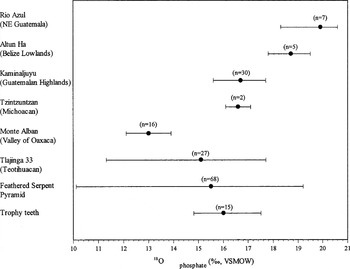
We broadly define a range of 14–16‰ for the Teotihuacan environment based on our analyses of oxygen-isotope values from Tlajinga 33:S3W1 (White, Spence, Stuart-Williams, and Schwarcz 1998; White, Spence, Longstaffe, Stuart-Williams, and Law 2002). The δ18O value (15‰) of a modern sample of tooth enamel from Mexico City (Levinson et al. 1987) also falls within this range. The δ18O values of individuals thought to have been long-term inhabitants of sites in other Mesoamerican environments also show a natural range of about 2‰ and are generally distinct from Teotihuacan values (White, Longstaffe, and Law 2001; White, Spence, and Longstaffe 2000; White, Spence, Longstaffe, and Law 2000; White, Spence, Stuart-Williams, and Schwarcz 1998; White, Spence, Longstaffe, Stuart-Williams, and Law 2002; Figure 5). However, the 14–16‰ range defined for Teotihuacan, and more generally for the Basin of Mexico, may overlap to a considerable degree with the ranges of neighboring regions that share similar geographic and climatic conditions—for example, southern Hidalgo, Tlaxcala, and perhaps parts of Puebla and the Valley of Toluca. At the time of the Feathered Serpent Pyramid sacrifice, some of these areas may have been outside the political borders of the Teotihuacan state. The proportions of the distinctive Sierra de las Navajas obsidian in various contexts in Teotihuacan, for example, indicate that the Teotihuacan state extended its dominion over the source area in southern Hidalgo in the Miccaotli phase, ca. a.d. 150–200, not long before the sacrifice (Spence 1996b:34–35).

Distribution of δ18O values in bioapatite phosphate from teeth and bone samples of the Feathered Serpent sacrifices and trophies compared with those from elsewhere in Teotihuacan and a variety of other Mesoamerican sites (bars represent ranges). See White, Spence, Longstaffe, Stuart-Williams, and Law (2002) for Feathered Serpent Pyramid values. See White, Longstaffe, and Law (2001), White, Spence, and Longstaffe (2000), White, Spence, Longstaffe, and Law (2000), and White, Spence, Stuart-Williams, and Schwarcz (1998) for those of other sites.
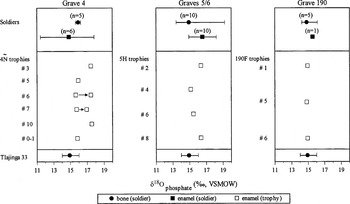
The δ18O values of the bone samples from soldiers 5H, 190A, and 190F are within or very near the Teotihuacan range, suggesting residence in the Teotihuacan area for some time before their selection for sacrifice (Table 1). We have no bone sample for soldier 4Ñ. The dental samples, which indicate geographic location at an earlier point in the lifespan (usually infancy or early childhood), suggest that soldiers 5H and 190F were born in or near Teotihuacan. In contrast, soldier 4Ñ came from a different region (Table 1). His enamel δ18O value of 17.8‰ falls at the high end of the range for samples we have analyzed from Kaminaljuyu (White, Spence, Longstaffe, and Law 2000) and at the low end of a sample from Altun Ha (White, Longstaffe, and Law 2001; Figure 5). However, it is likely that there are other regions, as yet untested, with a similar range of δ18O values.
Among the pendants of soldier 4Ñ there are two individuals (Trophies 6 and 7) who appear to have relocated during their lifetime (Table 4). Both of these victims have δ18O values for their canines that are consistent with an early childhood in the Basin of Mexico or perhaps some nearby region, but their third molar δ18O values indicate a move to the area from which soldier 4Ñ originated. Only one tooth was analyzed from each of those other pendants of soldier 4Ñ's collar that were included in the oxygen-isotope analysis. Of these, two (3 and 10) come from the same area as soldier 4Ñ, and two (5 and O-1) have δ18O values that lie in the higher part of the range for Teotihuacan, similar to the canine δ18O values for Trophies 6 and 7.
The three canine δ18O values for 190F's trophies show a very tight cluster at the center of the Teotihuacan range (Table 4). They differ from the dental and bone values of soldier 190F by only a small amount (Table 1), suggesting that the youthful soldier (and his unit) did active service in or near his own natal region, the Basin of Mexico. Nevertheless, some caution is required here, given the shift in δ18O values between the canines and the third molars of Trophies 4Ñ 6 and 7. It is possible that third molar or bone samples from 190F's trophies would reveal a similar shift in residence.
The trophies worn by a particular soldier were probably not from his victims alone but represented the conquests of his military unit as a whole. In that case, it would be more appropriate to compare the oxygen-isotope values of the trophies with those of all the soldiers in that grave (Figure 6). The bone δ18O values for the soldiers in Graves 5 and 6, who will be treated here as a unit, indicate that most of them had been living in the Teotihuacan area when they were selected for sacrifice, although a few individuals have non-Teotihuacan values (White, Spence, Longstaffe, Stuart-Williams, and Law 2002). The dental δ18O values, by comparison, vary widely, with most of them higher than the Teotihuacan range. The δ18O values for the trophies worn by soldier 5H (but presumably reflecting the military service of his whole unit) fall into two sets, one commensurate with the Teotihuacan area but the other higher (16.3‰), matching the values for teeth from two of the other soldiers of Graves 5 and 6 and falling in the range of samples from other regions—for example, highland Guatemala (Kaminaljuyu) and Michoacan (Tzintzuntzan; Figure 5). The 4Ñ trophies include two with probable residence in or near the Basin of Mexico but four others with δ18O values in the 16.9–17.5‰ range. The bone δ18O values of the Grave 4 soldiers are largely in the Teotihuacan range (Figure 6). Their dental δ18O values, however, vary considerably. One soldier has an δ18O value compatible with Teotihuacan, two are much lower, and three, including 4Ñ, have values of 16.8–17.8‰, suggesting their birth in the same region as most of their victims. These values are compatible with Kaminaljuyu, Tzintzuntzan, and perhaps other areas (Figure 5). However, they are unlikely to be from the same area as those 5H trophies that have δ18O values of 16.3‰.

Distribution of δ18O values for bone and tooth phosphate from the soldiers and trophies. Data for soldiers are from White, Spence, Longstaffe, Stuart-Williams, and Law (2002).
It is unfortunate that we have no samples from the trophies of soldier 190A. However, the three δ18O values from 190F's pendants are all in the center of the Teotihuacan range. The bone δ18O values for the Grave 190 soldiers also match the Teotihuacan values, as does the one value for enamel, which is from soldier 190F (Table 1).
CONCLUSIONS
Oxygen-isotope results for tooth enamel from the trophy jaws worn by some of the soldiers sacrificed at the Feathered Serpent Pyramid have provided insights into the military behavior of Teotihuacan. Recruitment of foreign-born individuals and a strong multiethnic membership for the military have been established previously using oxygen-isotope ratios (White, Spence, Longstaffe, Stuart-Williams, and Law 2002). The ratios of some of the trophy teeth allow a further investigation into the issue of military deployment ordered by the ancient state. The δ18O values of the trophy teeth indicate that these soldiers not only took part in foreign campaigns in relatively distant lands but also served in or near the Basin of Mexico, perhaps even taking the lives of some fellow Teotihuacanos. In some cases, they appear also to have slain individuals from their own homelands.
Of particular interest are two trophy victims (6 and 7 of 4Ñ) who probably spent their early childhood in or near the Basin of Mexico and then moved to the same foreign location, where they both became victims of 4Ñ's military unit. Because these were the only two dentitions from which more than one tooth was sampled, it is quite likely that more trophy victims would show similar geographic displacement during their lifetimes.
The variability in δ18O values of both the sacrificed soldiers and their victims indicates not only the multiethnic nature of membership in the Teotihuacan military but also the use of force in more than one foreign region. Some of the victims represented by the trophies were from the vicinity of the Basin of Mexico, perhaps from Teotihuacan itself, but the range of values suggests two other regions of origin, as well. One of these, with δ18O values around 16.9–17.5‰, would have been at some considerable distance from the city. The trophies of 4Ñ and 5H also suggest active service for each unit in two different areas, one local and one “abroad,” indicating that military units often served in more than one campaign.
It is unfortunate that we cannot precisely specify the regions reflected in the various δ18O values of the trophies. In particular, it would be important to determine whether the values commensurate with those of the Teotihuacan area actually indicate the use of state military force internally or instead are evidence of early Teotihuacan campaigns in neighboring regions as it extended its control beyond the Basin of Mexico. At the moment, we cannot resolve this question with the oxygen-isotope data. Perhaps the addition of other techniques, such as strontium stable-isotope analysis (Price et al. 2000), will allow us to triangulate chemically areas of origin.
Most of the archaeological evidence for sustained interaction between Teotihuacan and other Mesoamerican regions does not show up until a century or more after the construction of the Feathered Serpent Pyramid. The geographic identities of both soldiers and victims not only provide direct evidence that such interaction was already well established by a.d. 200; it also suggest that on some occasions, violence was involved.
RESUMEN
El gran número de víctimas del sacrificio asociado con la construcción de la pirámide de la Serpiente Emplumada en los años 200 d.C. incluye al menos 72 individuos identificados como soldados. La mayor parte de los soldados llevó pendientes fabricados con materiales como yeso y concha en la forma de maxilares superiores humanos pero cuatro soldados llevaron maxilares humanos auténticos. Los maxilares humanos fueron cortados, alisados, pintados y modificados para facilitar su suspensión. Las dimensiones dentales de estos trofeos, en comparación con las dimensiones de la serie más grande de sacrificados, indican que la mayoría de, y quizás todos, los trofeos son de varones. El desgaste de sus dientes presenta un rango más amplio, con una media más alta, que el de los soldados, e indica que los individuos de los trofeos tuvieron una distribución más regular de edades, con más personas de edades mayores. Las proporciones de los isótopos estables del oxígeno en el fosfato de los dientes de los trofeos demuestran que procedieron de tres regiones geográficas distintas, incluyendo dentro o cerca del valle de México. Concluimos que los soldados participaron en más que una campaña y que las relaciones tempranas entre Teotihuacan y las sociedades foráneas a veces involucraron conflictos militares.
ACKNOWLEDGMENTS
We are grateful to the Consejo de Arqueología of the Instituto Nacional de Antropología e Historia of Mexico and to its presidents (Joaquín García-Bárcena, Linda Manzanilla, and Lorena Mirambell) for permission to export to Canada and analyze the various samples discussed in this article. Rubén Cabrera, George Cowgill, and Saburo Sugiyama have generously helped us with many aspects of the project. Andrés del Ángel, Alfonso Gallardo, Luis Alfonso González, Martha Pimienta, Carlos Serrano, Enrique Serrano, and Miguel Trinidad have been of assistance with skeletal and dental analyses. We also thank Jennifer Blitz, Rubén Cabrera, Linda Manzanilla, Patricia Plunket, Evelyn Rattray, Carlos Serrano, Rebecca Storey, Gabriela Uruñuela, and Mark Winter for providing additional samples from Mexican archaeological sites. Statistical analyses of dental attrition were performed by Dori Rainey and of dental measurements by Adam Jackson. Figure 1 is by Spence and Chris Dodd; Figures 2 and 3 are by Saburo Sugiyama; and Figures 4, 5, and 6 are by Adam Jackson. We thank Fernando Larrea for his assistance with the Spanish abstract. White is also grateful to the Social Sciences and Humanities Research Council of Canada and the Bioanthropology Foundation for financial support, and Longstaffe thanks the Natural Sciences and Engineering Research Council of Canada for its support. Rebecca Storey, Lori Wright, and one anonymous reviewer provided helpful comments that substantially improved and clarified the article.
References
REFERENCES
Ayliffe, Linda K., and
Allen R. Chivas
1990
Oxygen Isotope Composition of the Bone Phosphate of Australian
Kangaroos: Potential as a Palaeoenvironmental Recorder.
Geochimica et Cosmochimica Acta
54:2603–2609.Google Scholar
Brothwell, Don R.
1981
Digging Up Bones.
3rd ed.
British Museum,
London.
Bryant, J. Daniel, and
Philip N. Froelich
1995
A Model of Oxygen Isotope Fractionation in Body Water of Large
Mammals.
Geochimica et Cosmochimica Acta
59:4523–4537.Google Scholar
Bryant, J. Daniel,
Boaz Luz, and
Philip N. Froelich
1994
Oxygen Isotope Composition of Fossil Horse Phosphate as a Record of
Continental Palaeoclimate.
Palaeogeography, Palaeoclimatology, Palaeoecology
107:303–316.Google Scholar
Bryant, J. Daniel,
Paul L. Koch,
Philip N. Froelich,
William J. Showers, and
Bernard J. Genna
1996
Biologic and Climatic Signals in the Oxygen Isotope Composition of
Eocene-Oligocene Equid Enamel Phosphate.
Palaeogeography, Palaeoclimatology, Palaeoecology
126:75–89.Google Scholar
Buikstra, Jane, and
Douglas Ubelaker
1994
Standards for Data Collection from Human Skeletal Remains.
Arkansas Archeological Survey Research Series No.44.
Arkansas Archeological Survey,
Fayetteville.
Cabrera, Rubén
1993
Human Sacrifice at the Temple of the Feathered Serpent: Recent
Discoveries at Teotihuacan. In
Teotihuacan: Art from the City of the Gods, edited by
Kathleen Berrin and
Esther Pasztory, pp.
100–107.
Thames-Hudson,
New York.
Cabrera, Rubén, and
Oralia Cabrera
1991
El Proyecto Templo de Quetzalcoatl: Plantemientos generales y
resultados preliminares.
Arqueología
6:19–31.Google Scholar
Cabrera, Rubén, and
Oralia Cabrera
1993
El significado calendárico de los entierros del Templo de
Quetzalcoatl. In
II Coloquio Pedro Bosch-Gimpera, edited by
María Teresa Cabrero, pp.
277–297.
Universidad Nacional Autónoma de México,
Mexico City.
Cabrera, Rubén, and
Carlos Serrano
1999
Los entierros de la Pirámide del Sol y del Templo de
Quetzalcóatl, Teotihuacan. In
Prácticas funerarias en la Ciudad de los Dioses: Los
enterramientos humanos de la antigua Teotihuacan, edited by
Linda Manzanilla and
Carlos Serrano, pp.
345–397.
Universidad Nacional Autónoma de México,
Mexico City.
Cabrera, Rubén,
Saburo Sugiyama, and
George L. Cowgill
1991
The Templo de Quetzalcoatl Project at Teotihuacan: A Preliminary
Report.
Ancient Mesoamerica
2:77–92.Google Scholar
Carlson, John B.
1991
Venus-Regulated Warfare and Ritual Sacrifice in Mesoamerica:
Teotihuacan and the Cacaxtla “Star Wars” Connection.
Center for Archaeoastronomy Technical Publication 7,
College Park, MD.
Cerling, Thure E., and
Zachary D. Sharp
1996
Stable Carbon and Oxygen Isotope Analysis of Fossil Tooth Enamel
Using Laser Ablation.
Palaeogeography, Palaeoclimatology, Palaeoecology
126:173–186.Google Scholar
Cid, José Rodolfo, and
Liliana Torres Sanders
1999
Patrones de mutilación dental en el sector oeste de
Teotihuacan.
Estudios de antropología biológica
IX:281–294.Google Scholar
Clayton, Robert N., and
Toshiko K. Mayeda
1963
The Use of Bromine Pentafluoride in the Extraction of Oxygen from
Oxides and Silicate for Isotopic Analysis.
Geochimica et Cosmochimica Acta
27:43–52.Google Scholar
Coe, Michael
1981
Religion and the Rise of Mesoamerican States. In
The Transition to Statehood in the New World, edited by
Grant Jones and
Robert Kautz, pp.
157–171.
Cambridge University Press,
Cambridge, MA.
Coggins, Clemency
1983
An Instrument of Expansion: Monte Alban, Teotihuacan, and Tikal. In
Highland–Lowland Interaction in Mesoamerica:
Interdisciplinary Approaches, edited by
Arthur Miller, pp.
49–68.
Dumbarton Oaks,
Washington, DC.
Cowgill, George L.
1992
Toward a Political History of Teotihuacan. In
Ideology and PreColumbian Civilizations, edited by
Arthur A. Demarest and
Geoffrey W. Conrad, pp.
87–114.
School of American Research Press,
Santa Fe, NM.
Cowgill, George L.
1997
State and Society at Teotihuacan, Mexico.
Annual Review of Anthropology
26:129–161.Google Scholar
Crowson, R.A,
William J. Showers,
E.K. Wright, and
Thomas C. Hoering
1991
Preparation of Phosphate Samples for Oxygen Isotope Analysis.
Analytical Chemistry
63:2397–2400.Google Scholar
Demarest, Arthur, and
A. Foias
1993
Mesoamerican Horizons and the Cultural Transformation of Maya
Civilization. In
Latin American Horizons, edited by
Don S. Rice, pp.
147–191.
Dumbarton Oaks,
Washington, DC.
Drucker, R. David
1974
Renovating a Reconstruction: The Ciudadela at Teotihuacan, Mexico:
Construction Sequence, Layout and Possible Uses of this Structure.
Unpublished Ph.D. dissertation,
Department of Anthropology, University of Rochester,
Rochester, NY.
Elliot, J.C.
1997
Structure, Crystal Chemistry and Density of Enamel Apatites. In
Dental Enamel, edited by
D.J. Chadwick and
G. Cardew, pp.
54–80.
John Wiley & Sons,
New York.
Firsching, F. Henry
1961
Precipitation of Silver Phosphate from Homogeneous Solution.
Analytical Chemistry
33:873–887.Google Scholar
Fricke, Henry C., and
James R. O'Neil
1996
Inter- and Intra-tooth Variation in the Oxygen Isotope Composition
of Mammalian Tooth Enamel Phosphate: Implications for
Palaeoclimatological and Palaeobiological Research.
Palaeogeography, Palaeoclimatology, Palaeoecology
126:91–99.Google Scholar
Gómez, Sergio
1998
Nuevos datos sobre la relación de Teotihuacan y el
occidente de México. In
Antropología e historia del occidente de México: XXIV
Mesa redonda de la Sociedad Mexicana de Antropología, pp.
1461–1493.
Sociedad Mexicana de Antropología,
Mexico City.
Grove, David C.
1987
Torches, “Knuckle Dusters” and the Legitimization of
Formative Period Leadership.
Mexicon
9:60–65.Google Scholar
Hassig, Ross
1988
Aztec Warfare: Imperial Expansion and Political Control.
University of Oklahoma Press,
Norman.
Hassig, Ross
1992
War and Society in Ancient Mesoamerica.
University of California Press,
Berkeley.
Hillson, Simon
1996
Dental Anthropology.
Cambridge University Press,
Cambridge.
Koch, Paul L.,
D.C. Fisher, and
D. Dettman
1989
Oxygen Isotope Variation in the Tusks of Extinct Proboscideans: A
Measure of Season of Death and Seasonality.
Geology
17:515–519.Google Scholar
Kohn, Matthew J.
1996
Predicting Animal δ18O: Accounting for Diet and
Physiological Adaptation.
Geochimica et Cosmochimica Acta
60:4811–4829.Google Scholar
Kohn, Matthew J.,
Margaret J. Schoeninger, and
John W. Valley
1996
Herbivore Tooth Oxygen Isotope Compositions: Effects of Diet and
Physiology.
Geochimica et Cosmochimica Acta
60:3889–3896.Google Scholar
Levinson, Alfred A.,
Boaz Luz, and
Yehoshua Kolodny
1987
Variations in Oxygen Isotopic Compositions of Human Teeth and
Urinary Stones.
Applied Geochemistry
2:367–371.Google Scholar
Longinelli, Antonio
1984
Oxygen Isotopes in Mammal Bone Phosphate: A New Tool for
Paleohydrological and Paleoclimatological Research?
Geochimica et Cosmochimica Acta
48:385–390.Google Scholar
Longinelli, Antonio, and
A. Peretti Paladino
1980
Oxygen Isotope Composition of Water from Mammal Blood: First
Results.
Mass Spectrometry in Biomedical, Medical and Environmental Research
1:135–139.Google Scholar
López Austin, Alfredo,
Leonardo López Luján, and
Saburo Sugiyama
1991
The Temple of Quetzalcoatl at Teotihuacan: Its Possible Ideological
Significance.
Ancient Mesoamerica
2:93–105.Google Scholar
Luz, Boaz,
Yehoshua Kolodny, and
Michal Horowitz
1984
Fractionation of Oxygen Isotopes between Mammalian Bone-Phosphate
and Environmental Drinking Water.
Geochimica et Cosmochimica Acta
48:1689–1693.Google Scholar
Massler, Maury,
Isaac Schour, and
H.G. Poncher
1941
Developmental Pattern of the Child as Reflected in the
Calcification Pattern of Teeth.
American Journal of Diseases of Children
62:33–67.Google Scholar
McArthur, J.M., and
A. Herczeg
1990
Diagenetic Stability of the Isotopic Composition of
Phosphate-Oxygen: Paleoenvironmental Implications.
Phosphorite Research and Development, Geological Society Special
Publication No. 52, pp.
119–124.
London.
Millon, René
1981
Teotihuacan: City, State and Civilization. In
Supplement to the Handbook of Middle American Indians, Vol. 1,
Archaeology, edited by
Jeremy A. Sabloff, pp.
198–243.
University of Texas Press,
Austin.
Millon, René
1992
Teotihuacan Studies: From 1950 to 1990 and Beyond. In
Art, Ideology, and the City of Teotihuacan, edited by
Janet C. Berlo, pp.
339–429.
Dumbarton Oaks,
Washington, DC.
Pasztory, Esther
1988
A Reinterpretation of Teotihuacan and Its Mural Painting
Tradition. In
Feathered Serpents and Flowering Trees: Reconstructing the Murals
of Teotihuacan, edited by
Kathleen Berrin, pp.
45–77.
Fine Arts Museum of San Francisco and University of Washington
Press,
Seattle.
Pasztory, Esther
1993
An Image Is Worth a Thousand Words: Teotihuacan and the Meanings
of Style in Classic Mesoamerica. In
Latin American Horizons, edited by
Don S. Rice, pp.
113–145.
Dumbarton Oaks,
Washington, DC.
Price, T. Douglas,
Linda Manzanilla, and
William D. Middleton
2000
Immigration and the Ancient City of Teotihuacan in Mexico: A Study
Using Strontium Isotope Ratios in Human Bone and Teeth.
Journal of Archaeological Science
27:903–913.Google Scholar
Quade, Jay,
Thure E. Cerling,
John C. Barry,
Michele E. Morgan,
David R. Pilbeam,
Allan R. Chivas,
Julia A. Lee-Thorp, and
Nikolaas J. van der Merwe
1992
A 16-Ma Record of Paleodiet Using Carbon and Oxygen Isotopes in
Fossil Teeth from Pakistan.
Chemical Geology
94:183–192.Google Scholar
Rattray, Evelyn
1987
Los barrios foráneos de Teotihuacan. In
Teotihuacan: Nuevos datos, nuevas síntesis, nuevos
problemas, edited by
Emily McClung de Tapia and
Evelyn C. Rattray, pp.
243–273.
Universidad Nacional Autónoma de México,
Mexico City.
Rattray, Evelyn
1993
The Oaxaca Barrio at Teotihuacan.
Monografías Mesoamericanas No. 1.
Universidad de las Américas-Puebla,
Cholula.
Reinhard, Ella,
Trinidad de Torres, and
James R. O'Neil
1996
18O/16O Ratios of Cave Bear Tooth Enamel:
A Record of Climate Variability during the Pleistocene.
Palaeogeography, Palaeoclimatology, Palaeoecology
126:45–59.Google Scholar
Romero, Javier
1986
Catálogo de la colección de dientes mutilados
prehispánicos, IV parte.
Instituto Nacional de Antropología e Historia,
Mexico City.
Sanders, William T.,
Jeffrey Parsons, and
Robert Santley
1979
The Basin of Mexico.
Academic Press,
New York.
Scott, E.C.
1979
Dental Wear Scoring Technique.
American Journal of Physical Anthropology
51:213–218.Google Scholar
Serrano, Carlos, and
Enrique Martínez
1989
Nuevos patrones de mutilación dentaria en Teotihuacan.
Estudios de antropología biológica
IV:585–598.Google Scholar
Serrano, Carlos,
Martha Pimienta, and
Alfonso Gallardo
1991
Los entierros del Templo de Quetzalcoatl. Patrón de
distribución por edad y sexo.
Arqueología
6:53–67.Google Scholar
Serrano, Carlos,
Martha Pimienta, and
Alfonso Gallardo
1993
Mutilación dentaria y filiación étnica en los
entierros del Templo de Quetzalcoatl, Teotihuacan. In
II Coloquio Pedro Bosch-Gimpera, edited by
María Teresa Cabrero, pp.
263–276.
Universidad Nacional Autónoma de México,
Mexico.
Serrano, Carlos,
Martha Pimienta, and
Alfonso Gallardo
1997
Mutilaciones e incrustaciones dentarias en un entierro colectivo
del Templo de Quetzalcóatl, Teotihuacan.
Estudios de antropología biológica
VI:295–308.Google Scholar
Shemesh, Aldo
1990
Crystallinity and Diagenesis of Sedimentary Apatites.
Geochimica et Cosmochimica Acta
54:2433–2438.Google Scholar
Shemesh, Aldo,
Yehoshua Kolodny, and
Boaz Luz
1988
Isotope Geochemistry of Oxygen and Carbon in Phosphate and
Carbonate of Phosphorite Francolite.
Geochimica et Cosmochimica Acta
52:2565–2572.Google Scholar
Smith, B.H.
1984
Patterns of Molar Wear in Hunter–Gatherers and
Agriculturalists.
American Journal of Physical Anthropology
63:39–56.Google Scholar
Sokal, Robert, and
F.J. Rohlf
1995
Biometry: The Principles and Practice of Statistics in Biological
Research.
3rd ed.
W.H. Freeman,
New York.
Spence, Michael W.
1992
Tlailotlacan, a Zapotec Enclave in Teotihuacan. In
Art, Ideology, and the City of Teotihuacan, edited by
Janet C. Berlo, pp.
59–88.
Dumbarton Oaks,
Washington, DC.
Spence, Michael W.
1996a
A Preliminary Report on the Nonmetric Traits of the Temple of
Quetzalcoatl Skeletons.
Unpublished manuscript on file,
Department of Anthropology, University of Western Ontario.
Spence, Michael W.
1996b
Commodity or Gift? Teotihuacan Obsidian in the Maya Region.
Latin American Antiquity
7:21–39.Google Scholar
Spence, Michael W.
1997
Further Morphological Analyses of the Quetzalcoatl Series.
Unpublished manuscript on file,
Department of Anthropology, University of Western Ontario.
Spence, Michael W.
2001
Los restos humanos de la segunda temporada de excavaciones en la
Pirámide de la Luna.
Report to Instituto Nacional de Antropología e Historia,
Mexico City.
Stuart-Williams, Hilary LeQ., and
Henry P. Schwarcz
1995
Oxygen Isotope Analysis of Silver Orthophosphate Using a Reaction
with Bromine.
Geochimica et Cosmochimica Acta
58:3837–3841.Google Scholar
Stuart-Williams, Hilary LeQ., and
Henry P. Schwarcz
1997
Oxygen Isotope Determination of Climatic Variation Using Phosphate
from Beaver Bone, Tooth Enamel and Dentine.
Geochimica et Cosmochimica Acta
61:2539–2550.Google Scholar
Stuart-Williams, Hilary LeQ.,
Henry P. Schwarcz,
Christine D. White, and
Michael W. Spence
1996
The Isotopic Composition and Diagenesis of Human Bone from
Teotihuacán and Oaxaca, Mexico.
Palaeogeography, Palaeoclimatology, Palaeoecology
126:1–14.Google Scholar
Sugiyama, Saburo
1989
Burials Dedicated to the Old Temple of Quetzalcoatl at Teotihuacan,
Mexico.
American Antiquity
54:85–106.Google Scholar
Sugiyama, Saburo
1991
Descubrimientos de entierros y ofrendas dedicados al Templo Viejo
de Quetzalcoatl. In
Teotihuacan 1980–1982: Nuevas interpretaciones, edited by
Rubén Cabrera,
Ignacio Rodríguez, and
Noel Morelos, pp.
275–326.
Instituto Nacional de Antropología e Historia,
Mexico City.
Sugiyama, Saburo
1995
Mass Human Sacrifice and Symbolism of the Feathered Serpent Pyramid
in Teotihuacan, Mexico.
Unpublished Ph.D. dissertation,
Department of Anthropology, Arizona State University,
Tempe.
Taube, Karl A.
1992
The Temple of Quetzalcoatl and the Cult of Sacred War at
Teotihuacan.
RES: Anthropology and Aesthetics
21:53–87.Google Scholar
Trodden, Bonnie
1982
A Radiographic Study of the Calcification and Eruption of the
Permanent Teeth in Inuit and Indian Children.
Archaeological Survey of Canada Paper 112.
Hull,
Quebec.
Ubelaker, Douglas H.
1978
Human Skeletal Remains: Excavation, Analysis and Interpretation.
Aldine,
Chicago.
White, Christine D.,
Fred J. Longstaffe, and
Kimberley R. Law
2001
Revisiting the Teotihuacan Connection at Altun Ha: Oxygen-isotope
Analysis of Tomb F-8/1.
Ancient Mesoamerica
12:65–72.Google Scholar
White, Christine D.,
Fred J. Longstaffe, and
Kimberley R. Law
2004
Exploring the Effects of Environment, Physiology and Diet on Oxygen
Isotope Ratios in Ancient Nubian Bones and Teeth.
Journal of Archaeological Science
31:223–250.Google Scholar
White, Christine D.,
Michael W. Spence, and
Fred J. Longstaffe
2000
The Identification of Foreigners in Mortuary Contexts Using
Oxygen-Isotope Ratios: Some Mesoamerican Examples.
Paper presented at the 69th Annual Meeting of the American
Association of Physical Anthropologists,
San Antonio
White, Christine D.,
Michael W. Spence,
Fred J. Longstaffe, and
Kimberley R. Law
2000
Testing the Nature of Teotihuacán Imperialism at
Kaminaljuyú Using Phosphate Oxygen-isotope Ratios.
Journal of Anthropological Research
56:535–558.Google Scholar
White, Christine D.,
Michael W. Spence,
Fred J. Longstaffe,
Hilary Stuart-Williams, and
Kimberley R. Law
2002
Geographical Identities of the Sacrificial Victims from the
Feathered Serpent Pyramid, Teotihuacan: Implications for the Nature of
State Power.
Latin American Antiquity
13:217–236.Google Scholar
White, Christine D.,
Michael W. Spence,
Hilary Le-Q. Stuart-Williams, and
Henry P. Schwarcz
1998
Oxygen Isotopes and the Identification of Geographical Origins: The
Valley of Oaxaca versus the Valley of Mexico.
Journal of Archaeological Science
25:643–655.Google Scholar
White, Christine D.,
Jocelyn Williams, and
Fred J. Longstaffe
2002
Oxygen Isotopic Composition of Bone Phosphate: An Additional Tool
to Investigate Weaning in the Maya Postclassic.
Paper presented at the 30th Annual Meeting of the Canadian
Association for Physical Anthropology,
Ottawa.
Wright, Lori E., and
Henry P. Schwarcz
1998
Stable Carbon and Oxygen Isotopes in Human Tooth Enamel:
Identifying Breastfeeding and Weaning in Prehistory.
American Journal of Physical Anthropology
106:1–18.Google Scholar
Yurtsever, Yuecel, and
Joel R. Gat
1981
Atmospheric Waters. In
Stable Isotope Hydrology: Deuterium and Oxygen-18 in the Water
Cycle,
Technical Report Series, No. 210, edited by
Joel R. Gat and
Roberto Gonfiantini, pp.
103–142.
International Atomic Energy Agency,
Vienna.
Phosphate oxygen-isotope values for bone and enamel from soldiers bearing pendants
(a) Superior view, maxilla pendant 190F 6; (b) inferior view, mandible pendant 190F 8.
(a) Inferior view, maxilla pendant 190F 6; (b) superior view, mandible pendant 190F 8.
T-test comparisons of maxillary buccolingual dental dimensions
Maxillary dental attrition scores (after Buikstra and Ubelaker 1994:Table 25)
Dental attrition of soldiers and trophies; x-axes are attrition values (from Buikstra and Ubelaker 1994:Figure 25).
Phosphate oxygen-isotope values for enamel from trophies, Feathered Serpent Pyramid
Distribution of δ18O values in bioapatite phosphate from teeth and bone samples of the Feathered Serpent sacrifices and trophies compared with those from elsewhere in Teotihuacan and a variety of other Mesoamerican sites (bars represent ranges). See White, Spence, Longstaffe, Stuart-Williams, and Law (2002) for Feathered Serpent Pyramid values. See White, Longstaffe, and Law (2001), White, Spence, and Longstaffe (2000), White, Spence, Longstaffe, and Law (2000), and White, Spence, Stuart-Williams, and Schwarcz (1998) for those of other sites.
Distribution of δ18O values for bone and tooth phosphate from the soldiers and trophies. Data for soldiers are from White, Spence, Longstaffe, Stuart-Williams, and Law (2002).
 You have
Access
- 41
- Cited by