Introduction
Mucormycosis is an opportunistic life-threatening infection, caused by fungi class zygomycetes. Based on the anatomical site of involvement and clinical presentation, mucormycosis is divided into rhino-orbito-cerebral, pulmonary, cutaneous, gastrointestinal, renal and disseminated forms.Reference Roden, Zaoutis, Buchanan, Knudsen, Sarkisova and Schaufele1 The most common form of mucormycosis is rhino-orbito-cerebral.
The prevalence of mucormycosis significantly increased in the coronavirus disease 2019 (Covid-19) era; the highest prevalence of mucormycosis before the Covid-19 pandemic outbreak was reported from India, with 0.14 cases per 1000 diabetic patients.Reference Chander, Kaur, Singla, Punia, Singhal and Attri2 Recently, a study performed by Hussain et al. reported that the prevalence of Covid-19-associated mucormycosis was 7 cases per 1000 patients, which is 50 times higher than the highest reported prevalence before the Covid-19 pandemic outbreak.Reference Hussain, Riad, Singh, Klugarová, Antony and Banna3
Multiple theories were supposed to explain the pathogenesis of mucormycosis in the Covid-19 era; severe acute respiratory syndrome coronavirus-2 (SARS-CoV-2) infection induces lymphocytopenia, decreased CD4+ and CD8+ cells and cytokine storm.Reference Liu, Li, Liu, Liang, Wang and Wang4 Endothelial damage and endothelialitis happen in severe Covid-19. Glucose-regulated protein (GRP 78) and the mucorales adhesin spore coat protein homologs (CotH) are endothelial receptors that facilitate the endothelial adhesion of fungus to the endothelial cells. Acidosis and hyperglycaemia induce the expression of these two receptors.Reference Ackermann, Verleden, Kuehnel, Haverich, Welte and Laenger5 On the other hand, prolonged hospitalisation, use of broad-spectrum antibiotics, oxygen therapy and mechanical ventilation during the course of Covid-19 predisposes patients to fungal infections like mucormycosis.Reference Rawson, Moore, Zhu, Ranganathan, Skolimowska and Gilchrist6
The presence of diabetes mellitus makes patients susceptible to mucormycosis; the innate immune system is impaired in hyperglycaemic states, resulting in decreased migration, chemotaxis and phagocytosis of neutrophils, which are the primary responses in fungus inoculation.Reference Petrikkos, Skiada, Lortholary, Roilides, Walsh and Kontoyiannis7 Besides, the hyperglycaemic state leads to overexpression of glucose-regulated protein 78 and CotH3 receptors and impairment of oxidative and non-oxidative pathways.Reference Petrikkos, Skiada, Lortholary, Roilides, Walsh and Kontoyiannis7 Diabetic ketoacidosis can exacerbate the condition by inhibition of iron sequestration proteins and increasing the free iron that promotes fungal growth.Reference Gebremariam, Lin, Liu, Kontoyiannis, French and Edwards8 However, Covid-19 infection can induce hyperglycaemia by direct impairment of the insulin-secreting cells in the pancreas.Reference Wu, Lidsky, Xiao, Lee, Cheng and Nakayama9 Corticosteroid use for the treatment of Covid-19 can induce hyperglycaemia too.Reference Moorthy, Gaikwad, Krishna, Hegde, Tripathi and Kale10
The reported prevalence of diabetes mellitus in the patients with rhino-orbito-cerebral mucormycosis was varied in the literature, with numbers between 51 to 88 per cent,Reference Jeong, Keighley, Wolfe, Lee, Slavin and Kong11,Reference Nithyanandam, Jacob, Battu, Thomas, Correa and D'Souza12 and to the best of our knowledge, no study reported the prevalence of diabetes mellitus and other underlying conditions in patients with Covid-19-associated rhino-orbito-cerebral mucormycosis. Therefore, this study aimed to evaluate the pooled prevalence of diabetes mellitus in patients with Covid-19-associated rhino-orbito-cerebral mucormycosis. The secondary goal of the current study was to evaluate the prevalence of the other underlying conditions such as hypertension, cardiovascular disorders, chronic renal disease and corticosteroid use in patients with Covid-19-associated rhino-orbito-cerebral mucormycosis. Awareness of the prevalence of the risk factors and underlying conditions can improve the clinical suspicion and lead to early diagnosis and prompt treatment of Covid-19-associated rhino-orbito-cerebral mucormycosis, improving outcomes for this life-threatening infection.
Materials and methods
Inclusion and exclusion criteria
The studies included in this systematic review were peer-reviewed cross-sectional studies that reported rhino-orbito-cerebral mucormycosis that developed in Covid-19 positive patients of any age. Only patients with a proven diagnosis of Covid-19 before or at the time of development of mucormycosis were added. There was no language restriction. The exclusion criteria were: case series, case reports, reviews, non-peer reviewed and pre-print articles. In the studies that reported the patients with aspergillosis or candidiasis besides the mucormycosis, only the data of cases with mucormycosis were extracted if it was possible. Otherwise, the studies that reported the cumulative data were excluded. The studies that discussed mucormycosis of other sites of the body (other than the rhino-orbito-cerebral cases) were excluded when the extraction of the data of the rhino-orbito-cerebral patients was not possible. The primary objective of the current study was to estimate the pooled prevalence of diabetes mellitus; therefore studies that did not report the number of patients with Covid-19-associated rhino-orbito-cerebral mucormycosis who were suffering from diabetes mellitus were excluded.
Search strategy and data source
The literature search was conducted in several databases including PubMed (Medline), Scopus, Web of Science, Embase and Google Scholar from 1 December 2019 to 31 August 2021. A hand search of the references of the included studies was additionally performed. The search strategy was implemented using the following medical subject heading terms and free-text terms: ‘mucormycosis’ OR ‘Mucorales’ OR ‘zygomycosis’ OR ‘Rhizopus’ OR ‘phycomycosis’ OR ‘black fungus’ AND ‘Covid-19’ OR ‘SARS-CoV-2’ OR ‘coronavirus’ OR ‘2019-nCoV’.
Data collection and extraction
Two authors (MMS and HZ) reviewed the titles and abstracts of the obtained articles independently. The discrepancies were resolved by the final decision of the third author (MM). The same two authors evaluated the full texts of the retrieved articles by eligibility criteria. The eligible articles’ data were extracted independently by two researchers (MMS and HZ). The following data were extracted: first author, year of publication, country, number of participants, mean age, sex, orbital or cerebral involvement, number of patients with each co-morbidity, history of steroid use, and mortality.
Risk of bias assessment
The quality of the included studies was evaluated by OM using the Newcastle–Ottawa Scale adapted for cross-sectional studies.Reference Stang13 The Newcastle–Ottawa Scale was used to evaluate the observational studies in the three fields of selection, comparability and outcome assessment. It includes 7 questions with a maximum score of 10. Higher scores indicate a higher quality of study.
Statistical analysis
The number of patients with orbital or cerebral involvement, co-morbidities, steroid use and all-cause mortality was used for meta-analysis. All statistical analysis was performed by Stata statistical analysis software (version 14.0; Stata Corp LP, College Station, USA). The effect size was estimated using pooled prevalence with its 95 per cent confidence interval (CI). The heterogeneity was calculated using the inconsistency (I2) test and categorised based on a study performed by Higgins et al. to low, moderate and high correspondence to I2 values of 25 per cent, 50 per cent and 75 per cent, respectively.Reference Higgins14 The significance level was set as a p-value less than 0.05. The random-effect model was used for effect size calculation.
Results
Literature search and baseline characteristics
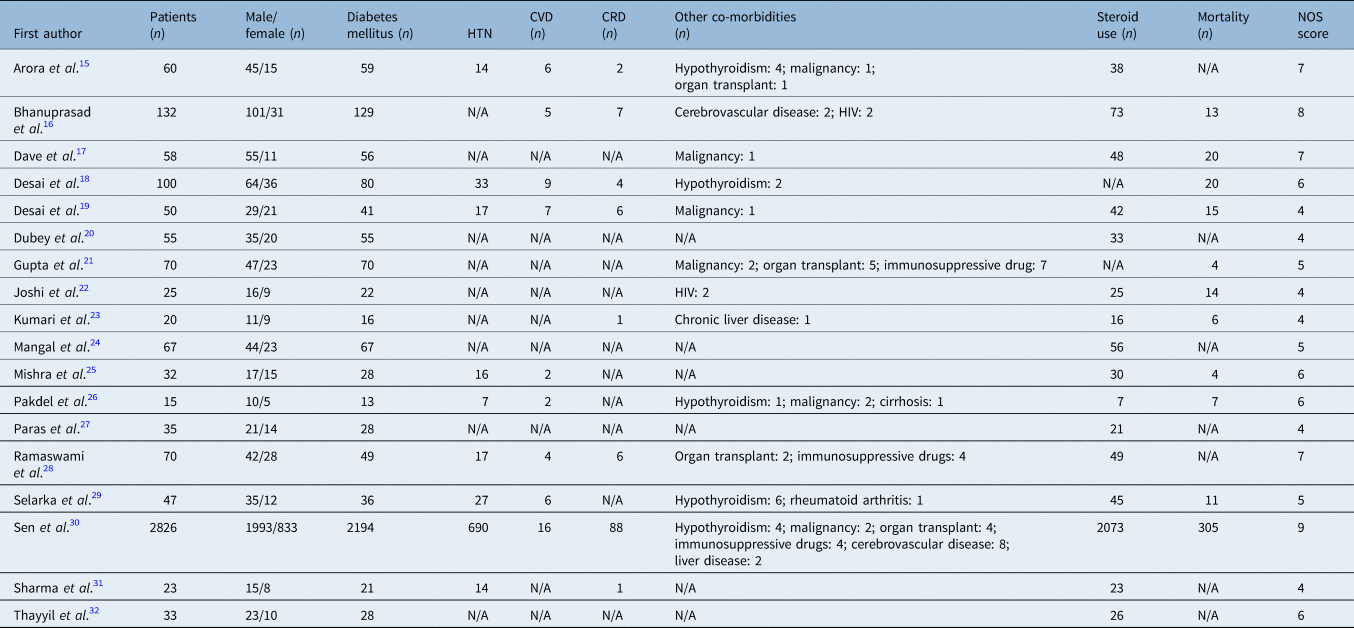
At the initial stage, we found 1136 articles; among them, 519 articles were duplicated and removed. The titles and abstracts of the 617 remaining articles were evaluated for eligibility criteria, and among them, 183 articles were selected for full-text evaluation. Finally, 18 articles were included in the study (Figure 1 and Table 1).
Preferred Reporting Items for Systematic Reviews and Meta-Analyses flow-chart of evaluated studies.

Characteristics of included studies

HTN = hypertension; CVD = cardiovascular disease; CRD = chronic renal disease NOS = Newcastle–Ottawa Scale; HIV = human immunodeficiency virus; N/A = not available
A total of 3718 patients were included in this study. Among these 3718 patients, 2592 patients were male, and 1126 patients were female. The mean age ranged from 44.5 to 58.3 years. Among 18 studies, 17 studies with 3703 patients were reported from India, and 1 study with 15 patients was from Iran.
Risk of bias assessment
The risk of bias assessment was performed for all 18 studies, and the results are reported in Table 1 and supplementary Table 1 (see Table 1 in the supplementary material, available on The Journal of Laryngology & Otology website). The median quality score was 5.5 (range: 4 to 9).
Pooled prevalence of orbital and cerebral involvement
Fifteen studies were eligible for the analysis of the pooled prevalence of orbital involvement among Covid-19-associated rhino-orbito-cerebral mucormycosis patients. The pooled prevalence of orbital involvement was 61 per cent (95 per cent CI, 53 to 69 per cent). The model demonstrated high heterogeneity (I2 = 90.7 per cent, p < 0.01; Figure 2a).
Forest plot of pooled prevalence of (a) orbital involvement and (b) cerebral involvement patients with Covid-19-associated rhino-orbito-cerebral mucormycosis. ES = effect size; CI = confidence interval

Cerebral involvement was reported in 15 studies. The pooled prevalence of cerebral involvement in Covid-19-associated rhino-orbito-cerebral mucormycosis patients was 13 per cent (95 per cent CI, 9 to 17 per cent). The model demonstrated high heterogeneity (I2 = 98.2 per cent, p < 0.01; Figure 2b).
Pooled prevalence of diabetes mellitus
Eighteen studies with 3718 patients were eligible for the analysis of the prevalence of diabetes mellitus in the patients with Covid-19-associated rhino-orbito-cerebral mucormycosis, which was 89 per cent (95 per cent CI, 85 to 93 per cent). The model demonstrated high heterogeneity (I2 = 97.9 per cent, p < 0.01; Figure 3a).
Forest plot of pooled prevalence of (a) diabetes mellitus and (b) new-onset diabetes mellitus in the patients with Covid-19-associated rhino-orbito-cerebral mucormycosis. ES = effect size; CI = confidence interval

New-onset diabetes mellitus was reported in 6 studies composed of 442 patients. The pooled prevalence of new-onset diabetes mellitus in patients with Covid-19-associated rhino-orbito-cerebral mucormycosis was 32 per cent (95 per cent CI, 14 to 50 per cent; I2 = 97.5 per cent; p < 0.01; Figure 3b).
Pooled prevalence of other underlying conditions
Nine studies were eligible for the analysis of the pooled prevalence of hypertension in patients with Covid-19-associated rhino-orbito-cerebral mucormycosis, which was 37 per cent (95 per cent CI, 29 to 45 per cent) with high heterogeneity (I2 = 83.4 per cent; p < 0.01; Figure 4a).
Forest plot of pooled prevalence of (a) hypertension, (b) cardiovascular disorders and (c) renal disease in patients with Covid-19-associated rhino-orbito-cerebral mucormycosis. ES = effect size; CI = confidence interval

Nine studies with 3332 patients were eligible for evaluation of the pooled prevalence of cardiovascular disorder in Covid-19-associated rhino-orbito-cerebral mucormycosis patients, which was 6 per cent (95 per cent CI, 3 to 9 per cent) with high heterogeneity (I2 = 76.6 per cent; p < 0.01; Figure 4b).
Eight studies with 3281 patients were eligible for the analysis of the pooled prevalence of chronic renal disease in patients with Covid-19-associated rhino-orbito-cerebral mucormycosis, which was 4 per cent (95 per cent CI, 3 to 5 per cent) with low heterogeneity (I2 = 9.7 per cent; p = 0.35; Figure 4c).
Sixteen studies with 3548 patients were eligible for analysis of the pooled prevalence of steroid use during Covid-19, which was 79 per cent (95 per cent CI, 72 to 85 per cent). The model demonstrated high heterogeneity (I2 = 98.7 per cent; p < 0.01; Figure 5).
Forest plot of pooled prevalence of steroid use in the patients with Covid-19-associated rhino-orbito-cerebral mucormycosis. ES = effect size; CI = confidence interval

Pooled prevalence of all-cause mortality
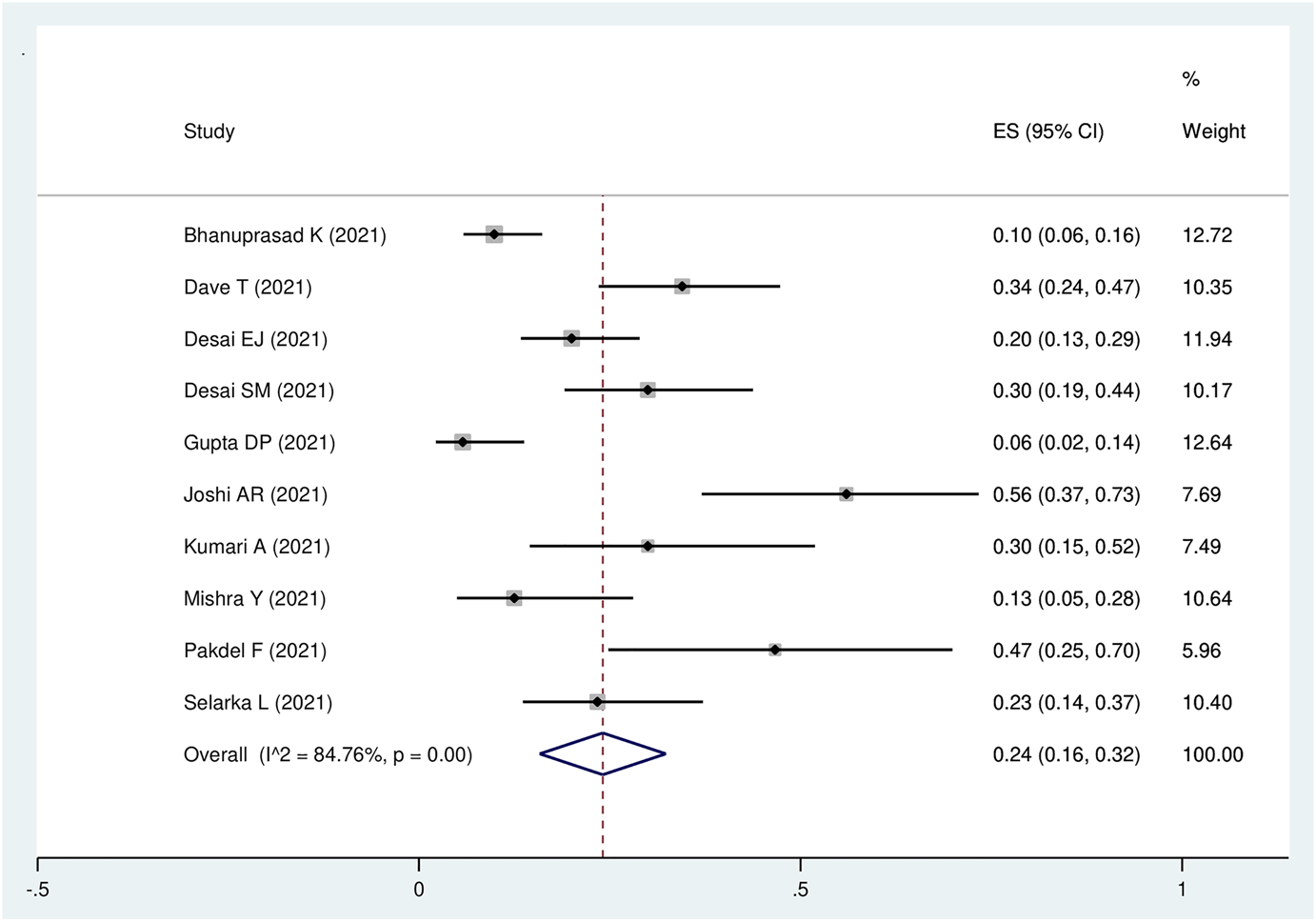
All-cause mortality was reported in 10 studies with 549 participants. The pooled prevalence of mortality was 24 per cent (95 per cent CI, 16 to 32 per cent; I2 = 84.8 per cent; p < 0.01; Figure 6).
Forest plot of pooled prevalence of all-cause mortality in the patients with Covid-19-associated rhino-orbito-cerebral mucormycosis. ES = effect size; CI = confidence interval

Discussion
This study was a comprehensive systematic review, composed of cross-sectional studies with a large number of participants which explored the pooled prevalence of underlying disorders in patients with Covid-19-associated rhino-orbito-cerebral mucormycosis. In the current study, the focus is on rhino-orbito-cerebral Covid-19-associated mucormycosis. The incidence of orbital involvement in cases with rhino-orbito-cerebral mucormycosis was reported to be 76 to 80 per cent in previous studies.Reference Pai, Sansi, Kharche, Bandili and Pai33 In the current study, the prevalence of orbital involvement was 61 per cent. The frequency of cerebral involvement in Covid-19-associated rhino-orbito-cerebral mucormycosis was reported to be 22 per cent.Reference Chouhan, Solanki and Shakrawal34,Reference Pradhan, Shaikh, Mishra, Preetam, Parida and Sarkar35 The pooled prevalence of intracranial involvement was 13 per cent in the current study.
Mucormycosis is an opportunistic fungal infection with a prevalence of 0.14 per 1000 in diabetic patients, as reported from studies in India, which is 80 times more than the prevalence of mucormycosis in developed countries.Reference Chander, Kaur, Singla, Punia, Singhal and Attri2 This can explain why the majority of patients (3703 out of 3718 cases) were reported from India in the current study. The pooled prevalence of Covid-19-associated mucormycosis is 2.7 to 7 per 1000 cases, which is higher than the highest prevalence of Covid-19-associated mucormycosis reported before.Reference Hussain, Riad, Singh, Klugarová, Antony and Banna3,Reference Patel, Agarwal, Rudramurthy, Shevkani, Xess and Sharma36 Covid-19-associated mucormycosis is predominantly seen in males (56.3 to 80 per cent), which is compatible with the frequency of males in Covid-19-associated rhino-orbito-cerebral mucormycosis patients in the current study (2592 patients of 3718 cases).Reference Singh, Singh, Joshi and Misra37–Reference Hussain, Baxi, Riad, Klugarová, Pokorná and Slezáková39
Uncontrolled diabetes mellitus with or without diabetic ketoacidosis is a predisposing condition for mucormycosis.Reference Petrikkos, Skiada, Lortholary, Roilides, Walsh and Kontoyiannis7 Innate immunity is altered in diabetes mellitus because of dysfunction of the polymorphonuclear cells.Reference Alba-Loureiro, Munhoz, Martins, Cerchiaro, Scavone and Curi40 Adaptive immunity and synthesis of some kinds of cytokines are compromised in diabetes mellitus too.Reference Morales-Franco, Nava-Villalba, Medina-Guerrero, Sánchez-Nuño, Davila-Villa and Anaya-Ambriz41 Decreased innate and adaptive immunity responses play a key role in mucormycosis involvement.Reference Ghuman and Voelz42 Additionally, during diabetic ketoacidosis, free unbounded serum iron increases. Iron overload is another predisposing factor for mucormycosis infection.Reference Narayanan, Chua and Baddley43
The prevalence of diabetes mellitus in the patients with rhino-orbito-cerebral mucormycosis without Covid-19 varies in different studies: in a study performed in India by Nithyanandam et al., uncontrolled diabetes mellitus was present in 30 of 34 patients with rhino-orbito-cerebral mucormycosis (88 per cent).Reference Nithyanandam, Jacob, Battu, Thomas, Correa and D'Souza12 Another study performed in the USA reported that 34 of 41 patients with rhino-orbito-cerebral mucormycosis (83 per cent) were diabetic.Reference Reed, Bryant, Ibrahim, Edwards, Filler and Goldberg44 Jeong et al. performed a systematic review and meta-analysis on the epidemiology of mucormycosis and reported that rhino-orbito-cerebral mucormycosis is more commonly observed in patients with diabetes mellitus (173 cases out of 340 patients; 51 per cent).Reference Jeong, Keighley, Wolfe, Lee, Slavin and Kong11 In a meta-analysis performed by Vaughan et al., 112 out of 175 patients with rhino-orbito-cerebral mucormycosis were diabetic (64 per cent).Reference Vaughan, Bartolo, Vallabh and Leong45 Neither of these two meta-analyses reported the pooled prevalence of diabetes mellitus in patients with rhino-orbito-cerebral mucormycosis. Within the Covid-19 era, a systematic review and meta-analysis was performed by Hussain et al. on Covid-19-associated mucormycosis of all anatomical sites of the body; it reported a pooled prevalence of diabetes mellitus of 74.5 per cent.Reference Hussain, Riad, Singh, Klugarová, Antony and Banna3 The pooled prevalence of diabetes mellitus in Covid-19-associated rhino-orbito-cerebral mucormycosis has not been reported before, to the best of our knowledge. In the current study, the pooled prevalence of diabetes mellitus in patients with Covid-19-associated rhino-orbito-cerebral mucormycosis was 89 per cent. Rhino-orbito-cerebral mucormycosis is more prevalent in patients with diabetes mellitus compared with the other forms of mucormycosis.Reference Roden, Zaoutis, Buchanan, Knudsen, Sarkisova and Schaufele1 Corzo-León et al. reported the prevalence of diabetes mellitus in different forms of mucormycosis; they reported diabetes mellitus in 72 per cent of the patients with mucormycosis and 88 per cent of the cases with rhino-orbito-cerebral mucormycosis.Reference Corzo-León, Chora-Hernández, Rodríguez-Zulueta and Walsh46 This can explain the higher prevalence of diabetes mellitus in the current study, compared with the study performed by Hussain et al. Reference Hussain, Riad, Singh, Klugarová, Antony and Banna3
SARS-CoV-2 infection can increase the risk of new-onset diabetes mellitus. The proposed mechanism is the binding of the virus to the angiotensin-converting enzyme-2 receptors in the pancreas, which causes overexpression of angiotensin II, which can impede insulin secretion. On the other hand, SARS-CoV-2 can be inserted into beta-cells of the pancreas and causes impairment of cells that secrete insulin.Reference Wu, Lidsky, Xiao, Lee, Cheng and Nakayama9,Reference Shrestha, Budhathoki, Raut, Adhikari, Ghimire and Thapaliya47 The administration of corticosteroids for the treatment of Covid-19 can cause drug-induced hyperglycaemia. The pooled prevalence of new-onset diabetes mellitus was 32 per cent of the patients with Covid-19-associated rhino-orbito-cerebral mucormycosis in the current study. In a study performed in India, new-onset diabetes mellitus was reported in 110 out of 300 patients with Covid-19-associated rhino-orbito-cerebral mucormycosis (37 per cent),Reference Goddanti, Reddy, Kumar, Rajesh and Reddy48 which is compatible with the results of our study.
The pooled prevalence of hypertension in patients with Covid-19-associated rhino-orbito-cerebral mucormycosis was 37 per cent in the current study. Hypertension was reported in 23 to 75 per cent of patients with Covid-19-associated mucormycosis in the literature.Reference Hussain, Baxi, Riad, Klugarová, Pokorná and Slezáková39,Reference Gupta and Ahuja49–Reference Pippal, Kumar and Ukawat54 Cardiovascular disease was present in 6 of 72 patients with Covid-19-associated mucormycosis (8 per cent) in a study performed by Pal et al.Reference Pal, Singh, Bhadada, Banerjee, Bhogal and Hage53 The pooled prevalence of cardiovascular disorder in the current study was 6 per cent. Recently, chronic renal disease was considered a predisposing factor for rhino-orbito-cerebral mucormycosis.Reference Prakash, Ghosh, Rudramurthy, Singh, Xess and Savio55 The frequency of chronic renal disease in Covid-19-associated mucormycosis patients was reported to be 1 to 11 per cent in the literature.Reference Hussain, Baxi, Riad, Klugarová, Pokorná and Slezáková39,Reference Dilek, Ozaras, Ozkaya, Sunbul, Sen and Leblebicioglu51,Reference Pal, Singh, Bhadada, Banerjee, Bhogal and Hage53,Reference Pippal, Kumar and Ukawat54 The pooled prevalence of chronic renal disease in Covid-19-associated rhino-orbito-cerebral mucormycosis patients was 4 per cent in the current study. Although the presence of underlying conditions like hypertension, cardiovascular disorders and chronic renal failure is accompanied by a higher risk of mortality in patients with Covid-19,Reference Tian, Jiang, Yao, Nicholson, Li and Sigurslid56,Reference Ssentongo, Ssentongo, Heilbrunn, Ba and Chinchilli57 a study performed by Riad et al. could not find a significant risk of increased mortality in patients with Covid-19-associated mucormycosis.Reference Riad, Shabaan, Issa, Ibrahim, Amer and Mansy50
Based on a trial performed by the Recovery Collaborative Group, corticosteroids are recommended in patients with Covid-19 who require mechanical ventilation or supplemental oxygen in order to decrease the mortality rate.58 Although steroids have no benefit in patients without respiratory support, it is widely used in these patients. Long-term, high-dose steroid therapy is a risk factor for rhino-orbito-cerebral mucormycosis.Reference Prakash, Ghosh, Rudramurthy, Singh, Xess and Savio55 Corticosteroids can impair the function of polymorphonuclear cells and macrophages, can exacerbate hyperglycaemia in patients with diabetes mellitus and induce hyperglycaemia in predisposed patients.Reference Lionakis and Kontoyiannis59 However, the role of short-course corticosteroid therapy in the pathogenesis of rhino-orbito-cerebral mucormycosis is controversial. The history of corticosteroid use was reported in 84 to 90.5 per cent of the patients with Covid-19-associated mucormycosis.Reference Singh, Singh, Joshi and Misra37,Reference Dilek, Ozaras, Ozkaya, Sunbul, Sen and Leblebicioglu51,Reference Vare, Yellambkar, Farheen, Nandedkar, Bhombe and Shah60 Hussain et al., in a systematic review and meta-analysis, reported that the pooled prevalence of steroid use in patients with Covid-19-associated mucormycosis was 94 per cent.Reference Hussain, Riad, Singh, Klugarová, Antony and Banna3 The pooled prevalence of corticosteroid use in patients with Covid-19-associated rhino-orbito-cerebral mucormycosis was 79 per cent in the current study.
The all-cause mortality rate was between 30 to 38 per cent in patients with Covid-19-associated mucormycosis in previous systematic reviews.Reference Hussain, Riad, Singh, Klugarová, Antony and Banna3,Reference Hussain, Baxi, Riad, Klugarová, Pokorná and Slezáková39,Reference Pal, Singh, Bhadada, Banerjee, Bhogal and Hage53 The mortality rate is dependent on the anatomical location of the involvement. In rhino-orbito-cerebral mucormycosis patients, the mortality rate is dependent on the extension of infection: it is higher in cerebral involvement (56 per cent), 20 per cent in rhino-orbital forms and nearly zero in rhinosinusal infection.Reference Lanternier, Dannaoui, Morizot, Elie, Garcia-Hermoso and Huerre61 In the current study, the pooled prevalence of all-cause mortality in patients with Covid-19-associated rhino-orbito-cerebral mucormycosis was 24 per cent.
The current study is a comprehensive systematic review with a large number of participants, which included cross-sectional studies with a special focus on Covid-19-associated rhino-orbito-cerebral mucormycosis. However, this study has some limitations: 17 out of 18 included studies were from India, which decreases the generalisability of the results, and interpretation of the results should be performed with caution. On the other hand, the data of co-morbidities was not reported in all studies, especially for malignancies and organ transplantation which are well-known risk factors for mucormycosis.Reference Skiada, Pavleas and Drogari-Apiranthitou62
Conclusion
In conclusion, the results of the current meta-analysis reported diabetes mellitus as the most frequent underlying disorder in patients with Covid-19-associated rhino-orbito-cerebral mucormycosis with a prevalence of 89 per cent. The second most prevalent underlying condition was steroid use. The prevalence of other co-morbidities such as hypertension, cardiovascular disorders and chronic renal disease was reported, which can increase the awareness and clinical suspicion in the presence of underlying conditions to accelerate the diagnosis of Covid-19-associated rhino-orbito-cerebral mucormycosis. The appropriate control of hyperglycaemia and judicious use of steroids in the treatment of Covid-19 is recommended.
Competing interests
None declared
Supplementary material
The supplementary material for this article can be found at https://doi.org/10.1017/S0022215122001074