

The editor has invited me to respond to Jonathan Smith's Research Note, “Shun 舜 and the Interpretation of Early Orthographical Variation.” The Research Note was in part a response to my article on the same topic that appeared in Early China in 2017.Footnote 1 I am grateful for Smith's engagement, and for the opportunity to continue the discussion. (I will assume hereafter that the reader is familiar with both my 2017 article and Jonathan Smith's Research Note.)
The Research Note makes the following claims. 1. Yun 允 was not the original phonetic speller of the name Shun, but was added during the Warring States period to an existing graph. 2. The graph lin 粦 (㷠) was the original “core constituent” of the graph shun 舜. 3. The OC phonological relationship between the name Shun and words spelled with the graph lin 粦 (㷠), notably lin 鱗 “scales,” lin 燐 “will-o’-the-wisp,” and 獜 “pangolin,” was such that they could have shared the same phonetic spelling. 4. The relationship between the OC initials of the words lin “will-o’-the-wisp” and Shun should be accounted for in the same way as the relationships which Smith asserts hold between liang 兩 “pair” and shang 商 “come between, split, etc.” (sic); between le 樂 “joy” and shuo 鑠 “melt”; and between lu 𧆨 (sic) “crucible” and hu 虎 “tiger.” 5. A graph in the Yin Ji li 尹姞鬲, thought by Chinese paleographers to be 粦, was in origin a pictogram for lin 鱗 “scales,” representing a lin 獜 “scaly pangolin.”
I will address each of these claims. All can be shown to be incorrect, or else are incompletely supported conjectures. Nevertheless, Smith's acute observation that graphs which write the name Shun resemble a graph known from the Western Zhou Yin Ji li inscriptions (his forms J and K) is of great significance. The conclusions he draws from this observation are not compelling, but if the observation is instead considered within the framework I presented in my original article, several longstanding problems are readily solved. This supports my original argument and also provides another excellent example of how a sophisticated phonological approach can resolve questions that have found no easy solutions using conventional paleographic techniques.
Claim 1. Yun 允 was not the original phonetic speller of the name Shun
The starting point for my article was the well-known presence in the ca. 300 b.c.e. Guodian manuscript “Qiong da yi shi 窮達以時” of a writing for the name Shun 舜 with 允 as a component. Smith agrees with the majority of Chinese scholars, and with me, that this component is present in the graph. He also agrees, though with some equivocation, that 允 “is arguably an acceptable speller for the name Shun.” Smith states that “the Guodian speller 允 is an innovation,” and the result of “Warring States-era regional innovation,” rather than a “window on an earlier form.” He may be correct. It may be the case that there were writings for the name Shun prior to the date of the Guodian manuscripts without the speller 允. However, since there are no attestations of the name Shun in excavated texts earlier than the Warring States period, there is no direct way of telling whether they were written with 允 or not.
I argued that Guodian form A, with a clear 允 (for forms A, B, C etc., see the images in Smith's Research Note) was more conservative than Guodian form B, which has an alternate top element replacing the loop at the top of 允. The 允 in form A appears to be motivated by its role as a phonetic speller; the alternate element in form B has no obviously motivated function. Smith does not propose one. An evolution from motivated to unmotivated seems, in general, more likely than the reverse. That is what is usually referred to as ebian 訛變 “erroneous change” in Chinese paleography. In my 2017 article I was also proposing the term “attraction” to cover certain kinds of graphic change in the direction from motivated to unmotivated.
Smith proposes graphic change in the opposite direction, from B to A. This is possible. In fact, none of the other claims I made would be affected if this were so: they depend only on the fact that 允 is present as a regular phonetic speller in a writing for Shun, and not on the details of how it got there. Smith and I both agree that the brush-written manuscript orthographies of the Eastern States during the Warring States period were characterized by relatively rapid and unrestrained innovation: quite conceivably, a phonologically motivated 允 was added, or substituted for a visually similar component whose original motivation—semantic or phonological—had become opaque. Nevertheless, the evidence that Smith offers in favor of the reality of this idea, as opposed to its theoretical possibility, has a number of shortcomings.
His argument runs something like this. When considering the evolutionary history of graph forms, we should not build arguments solely on exceptional, less commonly attested forms. Instead we should give particular weight to “the entire range of orthographical variation.” Applied to the problem of Shun, this means that, against the testimony of two instances of Guodian form A with 允, we have to set not just Guodian form B, but all of the guwen 古文 forms from the transmitted sources illustrated in Smith's Research Note. I understand him to be saying that, since none of these contain the element 允, what he calls the “common ancestor” of all known forms is unlikely to have had it.
As a phylogenetic argument this is not compelling, even if we accept the biological analogy. A numerical preponderance of forms with a particular trait is only a strong indication that the trait is ancestral if the forms are well distributed across phyla. If they are all descendants of one another, on the same branch, then a single form from a different, distant branch carries more weight against their testimony.
The guwen forms from received sources that Smith cites (his D–G) are all from the same branch. These sources were all compiled centuries after the graph forms had become obsolete for normal purposes. As is well known, a small number of exemplars of important texts in guwen orthography, most notably texts included in today's Shang shu 尚書, attracted attention during the Han period. These texts and their orthography were prized and carefully curated. They provided the sources for the guwen forms in the Shuo wen jie zi 說文解字 dictionary, and for those which were set in stone in the Three Script Stone Classics (san ti shi jing 三體石經) made during the Zhengshi 正始 reign period (240–248 c.e.), fragments of which survive today. In turn, the Shuo wen and the Three Script stone inscriptions were among the sources for the orthography of the reconstituted gu wen Shang shu editions that circulated during the early medieval period, including the so-called “pseudo-Kong Anguo (wei Kong 偽孔)” version, which, transcribed into regular orthography, has served as the standard version of the Shang shu since the Tang dynasty. A combination of all three of these provided many of the exemplars collected in the Song Dynasty gu wen dictionaries: the Han jian 汗簡 and its phonologically ordered rearrangement, the Gu wen si sheng yun 古文四聲韻. The forms in the Kangxi zidian 康熙字典 are, in turn, gu wen forms from earlier sources in regularized orthography.Footnote 2
Thus, rather than representing a broad range of Warring States-period orthographic variation, the transmitted gu wen forms are all from a single chain of later reproductions of a small number of exemplars encountered during the Han. By that time the structure of the graph and the motivation for its components were already opaque.
This is not to say that the evidence of transmitted gu wen forms is not valuable. It is valuable, but primarily as a means of seeing gu wen through the eyes of Han Dynasty and later observers, for understanding the range of exemplars they had available to them, and for undoing the confusions their imperfect state of knowledge introduced. The writing for shun 瞬 “blink” with the anomalous phonetic speller 寅, which I discussed towards the end of my article, is a good example of the latter. One of the gu wen writings for Shun from the Kangxi dictionary that Smith cites, 𡳉, is also a truly remarkable survivor, preserving the “inverted foot” component. I had not noticed it in preparing my article. However, the nature of the transmitted gu wen sources is such that they are unlikely to be a good counterweight to evidence that comes directly from early manuscripts.
Smith appeals to this transmitted gu wen evidence to make two claims, namely, that the 允 phonetic speller was not “original” (i.e. was not present in writings for Shun before the Warring States period), and that the component that resembles 炎 was “original.” Though I have conceded the possibility that 允 as a phonetic speller for Shun may have been a Warring States period innovation, the transmitted gu wen sources are not sufficient to demonstrate this: they simply reflect the survival into the Han period of at least one exemplar of a guwen text containing a form like Guodian form B. It is worth reiterating that the evidence for 允 as a phonetic speller for Shun is not confined to the two instances of Guodian form A. The Shan hai jing accounts of 帝俊, the writing of shun 瞬 “blink” as 䀵 in a version of the Gongyang zhuan that Lu Deming saw, and Zheng Xuan's equations of 舜 with 允 all support the idea that 允 as a phonetic speller for Shun had a currency beyond the Chu region ca. 300 b.c.e. The many examples of Shun spelled with 允 that are found in the Shanghai Museum and Tsinghua bamboo-slip collections indicate that, for that date and time, form A was the more usual writing. Certainly, the “Qiong da yi shi” is far from being an isolated witness, and forms spelled with 允 are more numerous, more diverse, and earlier than the transmitted gu wen forms without an obvious允.
Claim 2. The graph lin 粦 (㷠) was the original “core constituent” of the graph shun 舜.
Smith applies the same phylogenetic reasoning to the element that resembles 炎, common to all of the received gu wen exemplars, to Guodian forms A and B, and to the Shuo wen xiao zhuan 小篆 form (his form C). He claims that the 炎-like component is original, in the sense of being present in the common ancestor of all writings for Shun. This is important for his subsequent identification of the graph 舜 with the graph 粦 (㷠). Here he is on stronger ground, although I think that 粦 (㷠) and the words spelled with it (“scales,” “pangolin” etc.) are a distraction.
The best way of stating his observation is simply to note that all the Warring States and later writings for Shun (his A–F) share the 炎-like element, and then directly to compare this appearance with the Western Zhou graphs (his J and K), which also share the “feet” 舛 with the xiao zhuan forms (C and H). The similarity is undeniable.
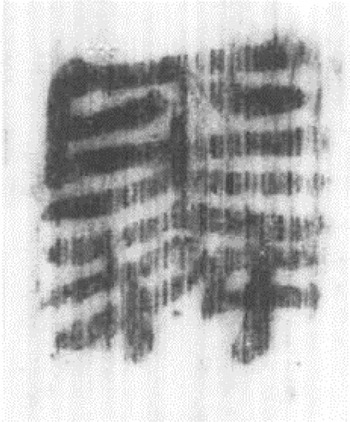
Comparisons are strongest when made with excavated sources, rather than relying on transmitted gu wen exemplars. The xiao zhuan form for Shun that appears in the Cangjie pian 倉頡篇 in the Peking University collection (my Figure 1) provides an especially good match for the Western Zhou forms (my Figure 2). Smith's form H (a Han seal) is also a good match.
Xiao zhuan form for Shun 舜, Peking University Cangjie pian, strip 65.Footnote 3

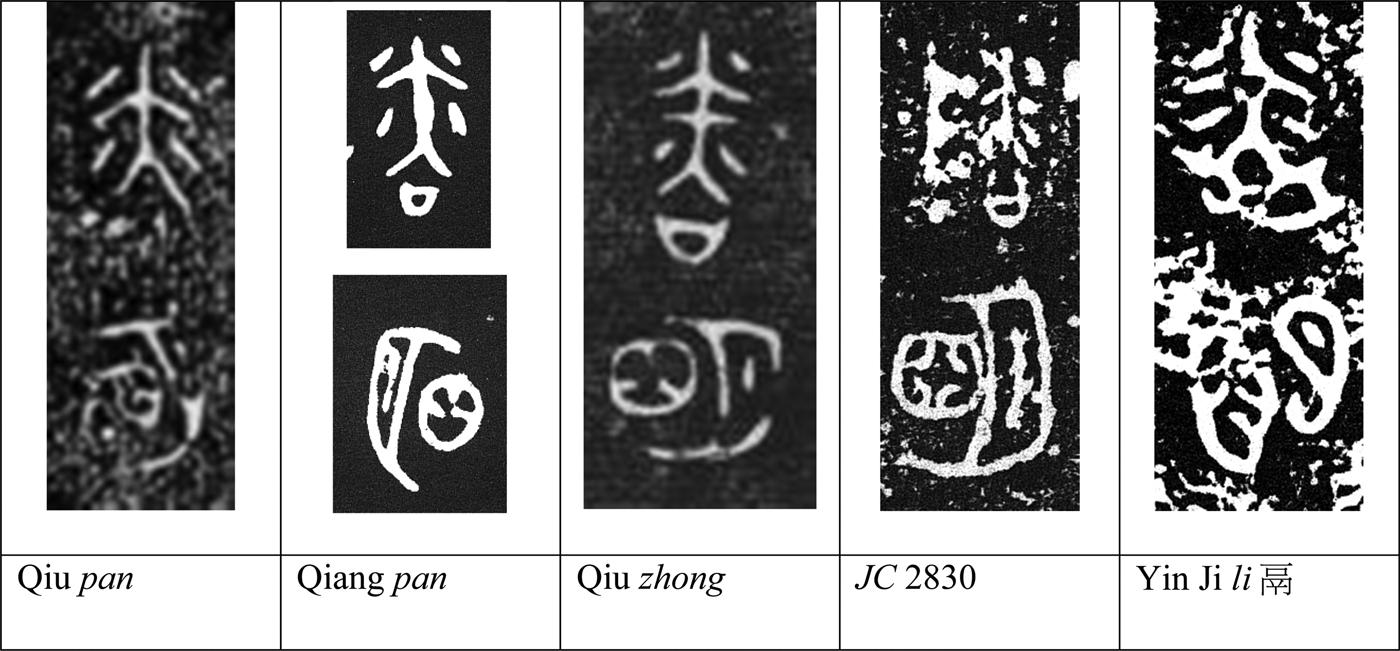
Instances of the phrase 粦(?)明 in Western Zhou bronze inscriptions.Footnote 12

From here it is obviously tempting to proceed to an identification with 粦 (㷠). Chinese paleographers since Chen Mengjia have wondered whether forms J and K were 粦. However, any equation between 舜 and 粦 has to pass the phonological test, and it fails (claims 3 and 4, below). The explanation that I will offer for the visual similarity between the xiao zhuan writings for Shun, and Western Zhou graphs J and K, makes more sense of the evidence than implicating lin 燐 “marsh gas,” lin 鱗 “scales,” and lin 獜 “pangolin.”
Claim 3. The phonological relationship between the name Shun and words spelled with the graph lin 粦 (“marsh gas” etc.) was such that Shun too could have shared the same phonetic spelling with these words.
We want to avoid arguing about personal subjective acceptability judgments of OC phonic spellings. Instead, we need to adopt a system of phonological reconstruction, and a theory of what constituted a regular spelling, and apply them to particular cases. For my part, I adopted a system that is essentially that of Baxter and Sagart, as well as a theory of regular spelling that is also (I believe) largely implied by their work. Both the system of reconstruction and the theory of regular spelling were conceived without consideration of the particular case of Shun 舜. However, having adopted them, I could state without equivocation that the name Shun 舜 can be reconstructed in such a way that a spelling with 允 is regular.
Perhaps the most important reason why I am unpersuaded by the claims in Smith's research note is that he does not adopt either a system of reconstruction or a theory of spelling. He refers to elements of Baxter and Sagart's reconstruction for some purposes, and Schuessler's (similar but distinct) reconstruction for others, without fully endorsing either, and elsewhere makes arguments on the basis of MC forms alone. The main item under discussion, the name Shun, is not reconstructed at all, and the reader is left to piece together a reconstruction from Baxter and Sagart's *r̥- and Schuessler's *-wins. Presumably something like *r̥wins is intended, but in whose system? How would yun 允 “indeed, truly” appear in that system, and would it be a regular spelling?
And what about that medial *-w-? In the system of Baxter and Sagart, there is no freely distributed OC medial *-w-: by the “rounded vowel hypothesis,” the vowel in Shun (and yun 允 and all of the other words that I reconstructed in my 2017 article) has to be a rounded vowel (i.e. *u) to account for the fact that all of these words are he kou 合口 in Middle Chinese.Footnote 4 This is how we could tell that the spelling of shun 瞬 “blink” with 寅 was likely a graphic error. Similarly, all the words known to be spelled with 粦 are, I believe, kai kou 開口, and not he kou. Certainly all the ones mentioned by Smith (“marsh gas,” “scale,” “pangolin”) are. Does this mean that he rejects the rounded vowel hypothesis? Does it mean that his OC medial *-w- is ignored by spelling rules? It might be, and that might be fine, but without an explicit framework it is impossible to pursue the question. Within the framework of Baxter and Sagart, 粦 would not be a regular spelling for Shun because of the vowel difference, at the very least.
Claim 4. The OC initials of lin “marsh gas” and Shun are related in the same way as those of the three pairs liang 两 “pair” and shang 商 “come between, split, etc.” (sic); le 樂 “joy” and shuo 鑠 “melt”; and lu 𧆨“crucible” (爐 ? “furnace”) and hu 虎 “tiger.”
Smith's choice of initial *r̥- for Shun is also problematic, and the discussion supporting it altogether too hasty. He offers three pairs illustrating what he asserts are xiesheng relationships parallel to the one he seeks between Shun and lin. The relationship between le 樂 “joy” and shuo 鑠 “melt” is indeed parallel to the one he seeks to find between Shun and lin. Baxter and Sagart reconstruct a *r̥- for shuo “melt.” This offers some support, but it should at least be mentioned that Baxter and Sagart consider this a “Western dialectal” development as a way of accounting for what would otherwise be irregular spellings.Footnote 5
The pairing of liang 兩 with shang 商 is puzzling. Smith appears to be hinting that the two words are etymologically related, and that 兩 is a component in the graph 商. Neither is a mainstream view. The graph 兩 is usually understood to be a pictogram for liang 輛 “couple [of horses]; (counter for chariots),” showing a pair of yokes and shaft.Footnote 6 Smith glosses shang 商 as “come between, split” but I can find no examples with that meaning. If this is intended as an etymology for shang 商 in the sense “merchant” or “to appraise,” in the hope it can be linked semantically with liang “pair,” it strikes me as exceedingly forced. Furthermore, shang 商 is usually reconstructed in such a way as to account for its robust connections to words spelled with 尚 (notably 賞 “to esteem; appraise; reward,” already in inscriptions prior to 1000 b.c.e).Footnote 7 Words spelled with 尚 often have alveolar stop initials (*t-, *th-, *d-). This is typically understood to entail an OC onset for shang 商 something like *st-. How Smith's proposed reconstruction with *r̥- fits with this is not at all clear.
The last of the three supposed parallels, between lu 爐 “furnace” and hu 虎 “tiger,” hinges on 虎 (虍) being the phonetic speller in lu “furnace.” The frequent appearance of the “tiger head” element (虍) in the writings for a large number of words that have no semantic connection with tigers is somewhat puzzling, and I do not believe it has been satisfactorily explained by anyone. We have yan 甗 “steamer,” chu 處 “to dwell,” fu 膚 “skin,” qian 虔 “kill,” and lü 慮 “think, consider.” Warring States manuscripts often write jia 甲 “armor” with a compound graph that includes 虍.Footnote 8 The idea that 虍is a phonetic speller in lu “furnace” feels like cherry-picking, since it leaves all of these other words and writings unaccounted for. The one thing that all of these words have in common is a shared OC vowel *a, with a variety of onsets and codas. In the absence of any better explanation, I tentatively suggest that what we call the “tiger head,” when it occurs in words that have nothing to do with tigers, is an exceptional speller indicating that the main vowel is *a.
Claim 5. A graph in the Yin Ji 尹姞 bronze inscriptions, thought by Chinese paleographers to be 粦, was in origin a pictogram for lin 鱗 “scales,” representing a lin 獜 “scaly pangolin.”
Smith concurs with the consensus position of Chinese paleographers that a mid Western Zhou-period graph found on the Yin Ji li 尹姞鬲 (his J and K) is to be identified as 粦. The problem with the identification has always been that it is not clear what word is being written by the graph in these inscriptions. In particular, no word that could be spelled phonetically with 粦 has been firmly identified for this context, leaving the identification as 粦 uncorroborated.Footnote 9
Smith's suggestion that the phrase in which they occur, sheng lin ming 聖粦明, might mean “the sagacity of the sage Shun” may be confidently ruled out. The collocation with ming 明 “bright; clear-minded, enlightened” and the context make it likely that the semantics are something like “wise” or “clear-minded.” The same collocation with ming 明, evidently in the same sense, recurs in other inscriptions, including the Qiang pan 牆盤,Footnote 10 and the Qiu (a.k.a. Lai) pan 逑(逨)盤 and Qiu zhong 鐘.Footnote 11

The probability that this is a metaphorical use of the name Shun appears to be very small.
The graph on the Qiang and Qiu pan, and JC 2830, all have the element 口 instead of 舛. JC 2830 additionally has 阜. All three share the element that Smith interprets as a pictogram for lin “scales” and a depiction of a pangolin. Subjectively speaking, I see no resemblance to a pangolin or any other kind of scaled creature.
However, I strongly endorse Smith's observation that this graph is a very good visual and structural match for early forms for 舜. This allows us to identify the word being written in these inscriptions as:
濬 ~ 浚 xùn < swinH < *sluns “deep, profound; to make deep”Footnote 13
The second writing that we see in received texts, 浚, has 夋 (允) as its phonetic speller. Semantically xun 濬 ~浚 “profound” makes perfect sense of the bronze inscriptions’ collocation with 明: “profound [in thought] and enlightened.” The word is, of course, common in the sense “to deepen, dredge [a water channel], dig [a well etc.].” For its metaphorical use as a positive appraisal of someone's mental abilities, there are three good examples in the Shang shu and Odes.
濬哲維商。Footnote 14
Profound and wise were the Shang.
This line from the Odes presents no difficulties. The early commentators state clearly that it refers to the “deep wisdom (shen zhi 深知)” of the Shang progenitors.
濬哲文明。Footnote 15
He [Shun] was profound, wise, culivated, and enlightened.
Again, this passage from the “Canon of Shun” presents no uncertainties.
日宣三德,夙夜浚明有家。Footnote 16
Daily proclaim three [of the aforementioned] virtues, and from morning till night, deepen and enlighten [the thoughts of] the possessors of households.
This passage from the “Counsels of Gao Yao” has been causing difficulties since at least the time of the pseudo-Kong commentary, which glosses 浚 as xu 須, making no sense at all. Duan Yucai proposed a confusion between words spelled with 夋 and words spelled with 矣, specifically si 俟 “wait,” in order to explain the gloss as xu 須 “wait.”Footnote 17 Note that this is exactly the same graphic confusion that I drew attention to in my 2017 discussion of shun 瞬 “blink.” In fact, the text as received is correct: the word is xun “deep(en)” spelled with 夋. The author of the pseudo-Kong commentary thought he saw si 俟 “wait” spelled with 矣, and so mechanically glossed it as xu 須 “wait,” presumably without having any understanding of what the passage meant.
To summarize: Jonathan Smith's observation that the writings for the name of the Sage Emperor Shun share components with graphs in several very well-known Western Zhou bronze inscriptions (his J and K, my Figure 2) is correct, and very consequential in that it allows a series of long-standing problems to be solved. However, there is (as far as I can see) no connection with words spelled with lin 粦, neither “scales” nor “pangolin.” In fact, his observation has the most explanatory potential when placed within the framework that I presented in my 2017 article. In particular, it allows us to identify the word written with the Western Zhou graphs as xun 濬 ~ 浚 “deep(en),” thereby resolving a problem first articulated by Chen Mengjia as long ago as 1956.