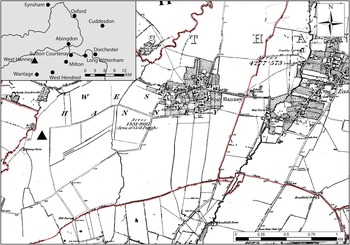
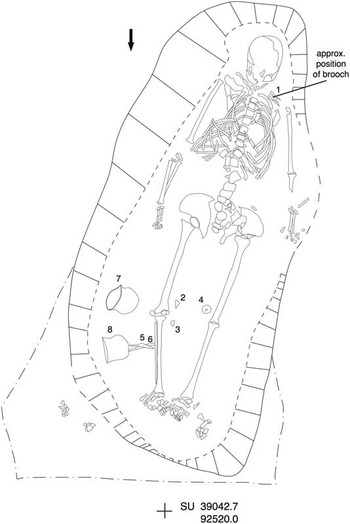
On 20 September 2009, an Anglo-Saxon garnet-inlaid composite disc brooch was discovered during a metal-detecting rally in a ploughed field on Kimmeridge Clay in West Hanney, Oxfordshire, approximately 5km north of Wantage (fig 1; ngr su 39042 92510).Footnote 1 The finder also observed what he believed to be human bone and notified the relevant authorities. Over the following week, a team of local archaeologists excavated a shallow, heavily truncated grave, in some places only c 100mm deep, containing the relatively complete inhumation of a woman estimated to be in her mid-twenties (see Appendix 2). An area of c 3sq m was excavated around the grave but no other features were visible within this area. The body lay in an extended supine position, lying approximately south–north, with the head to the south (fig 2). The skeleton had suffered some plough damage to the left side of the upper body and skull. The damage had also affected the brooch, which had been resting on the left shoulder – presumably the side on which it had been worn. A number of other grave goods were also recovered and are discussed below. The grave fill was dark brownish-grey silty-clay with frequent angular and sub-angular flint and stones and was similar in appearance and texture to the ploughsoil.
Site location; parish boundaries are shown in red. Map: © Crown copyright / database right 2014

Grave plan. Numbered artefacts are discussed in detail in Appendix 1

The Burial Assemblage
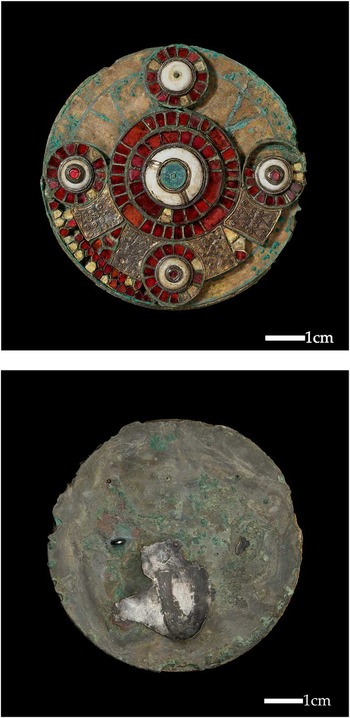
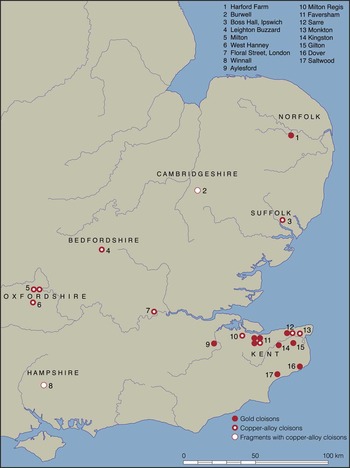
The garnet-inlaid cloisonné composite disc brooch (fig 3) is an exceptional find and forms the most recent and most westerly addition to the small corpus of this opulent and distinctive type of female dress ornament.Footnote 2 Composite discs were an elaboration of the simpler jewelled disc brooches worn relatively widely in Kent, in emulation of Frankish fashion. Only nineteen other complete or largely complete examples of composite disc brooches are known, thirteen of which were found in Kent (fig 4).Footnote 3 Of the remainder, one was found in London, one in Bedfordshire, and two in East Anglia. The remaining two were uncovered in the 1830s from two graves in a poorly recorded cemetery at Milton, North Field, Oxfordshire (formerly Berkshire), just south of Abingdon.Footnote 4 These provide by far the closest parallels for the Hanney brooch; the date and stylistic relationship of all three brooches are discussed in detail below.
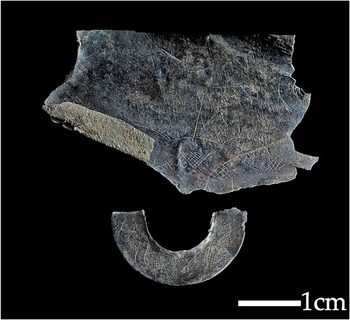
The composite disc brooch fromWestHanney: (a) front; (b) back; (c) fragments of engraved silver backing sheet. Photographs: I Cartwright, Institute of Archaeology,University of Oxford


Distribution map of composite disc brooches

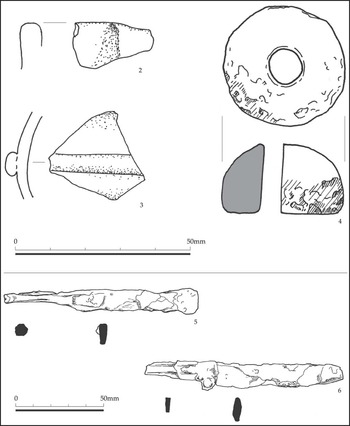
The rest of the grave assemblage from West Hanney fits within a relatively well-attested tradition of seventh-century female furnished burials.Footnote 5 The finds (fig 5 and Appendix 1), though few in number, are for the most part characteristic of such burials. Two fragments of glass, apparently from the same vessel, were found close together between the knees and may have been carried in a leather or cloth bag, although no organic remains were discernible. Meaney has suggested that pieces of vessel glass were often collected because of their attractive appearance, or for use in healing rituals.Footnote 6 Williams has argued more recently that such fragmentary objects, and indeed bag collections generally (which are mostly found with women and often in burials of seventh-century date), should be seen as having served a mnemonic or commemorative function, their importance deriving from their association with a particular individual or ancestor;Footnote 7 the two interpretations are, of course, not mutually exclusive. It is sometimes assumed that such glass fragments are Roman, although a number of burials have been shown to contain fragments of Anglo-Saxon glass. At the cemetery at Street House, Loftus (north-east Yorkshire), for example, three graves contained fragments of vessel glass dating to the period ad 550–700.Footnote 8 LA-ICPMS analysis of the fragments from the Hanney burial has demonstrated that these are natron glasses characteristic of Freestone et al’s Period II (ad 550–700).Footnote 9 Although the fragments are too small to allow the form of the vessel to be identified with any certainty, the date, convex shape and trail suggest that they derive from a globular bowl of a kind mostly found, and probably made, in Kent.Footnote 10 The only other globular bowls with trail decoration known from the Upper Thames Valley were found in the nineteenth century at Cuddesdon, to the east of Oxford, where two dark blue examples were recovered.Footnote 11
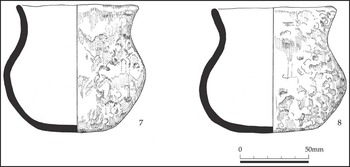
Grave goods: (1) see fig 3; (2) and (3) glass; (4) spindle whorl; (5) spatulate tool; (6) knife; (7) and (8) cups (opposite); (9) awl (not illustrated). See Appendix 1 for full descriptions. Drawings: M Wachnik; reproduced by permission of Oxfordshire Museums Service

(continued)

A chalk spindle whorl was found between the knees and may therefore also have been part of the putative bag collection. Spindle whorls, which are fairly common finds in settlements, were also occasionally deposited in graves: in Geake’s corpus of Conversion-period burials, forty-three contained spindle whorls.Footnote 12 Of these, chalk was the most commonly used material and nearly half were, like the Hanney example, plano-convex, a form that became ‘firmly established’ in the seventh century.Footnote 13 Whorls are, furthermore, strongly gendered grave goods, overwhelmingly associated with females, whose association with textile production is given particular emphasis in Old English texts.Footnote 14
Iron knives are the single most common find in both male and female burials of this period. The knife from the Hanney burial appears to conform most closely to Evison’s Type 3 (knives with an angled back and curved cutting edge).Footnote 15 At the Dover Buckland cemetery, most Type 3 knives derived from burials dating to phases 4–6 (around ad 625–700).Footnote 16 The West Hanney knife, which was found next to the lower right leg, lay beneath a spatulate tool of similar size, a pairing paralleled in a number of other seventh-century burials. Geake includes forty-eight spatulate tools in her study, only one of which appears likely to pre-date the seventh century.Footnote 17 Their function is unclear, although they are sometimes described as ‘steels’.Footnote 18 There is evidence from several burials to suggest that they were occasionally carried together with a knife in a bag or pouch.
The two small, near-identical, ceramic vessels also found next to the lower right leg (one of which was originally placed partly on top of the knife and spatulate tool) are perhaps best described as cups. While pottery was a fairly common grave good, to find two vessels in a grave of this period is extremely unusual; only three examples appear in Geake’s corpus.Footnote 19 Her distribution map of handmade pottery in Conversion-period graves shows a concentration in east Kent, possibly lending weight to the impression of a link between burial practices in the Upper Thames Valley and Kent.Footnote 20 Of the more than seventy-four pots from burials recorded by her, most were, like the Hanney vessels, small and undecorated. By the seventh century, furthermore, the majority of pottery fabrics in the Upper Thames Valley were also chaff-tempered; by the end of that century, the region appears to have been virtually aceramic.Footnote 21 The Hanney cups thus make a valuable addition to the tiny corpus of complete pottery vessels from the Upper Thames Valley known to date to the seventh century. The soil from inside the vessels was dry-sieved, but no trace of the original contents was recovered. In this respect, too, they mirrored the pots in Geake’s corpus, none of which produced evidence of any contents.Footnote 22
The Date Of The Brooch And Of The Burial
The brooch is the only object from the grave that can be closely dated. The most comprehensive study of composite disc brooches remains that published by Avent, who dated their manufacture to ad 610–50, based largely on associated grave goods, coin dating and typology.Footnote 23 As first recognised by Avent and later confirmed by Pinder, composite disc brooches that, like the Hanney and Milton brooches, have cloisons made of copper alloy rather than gold, were made late in the series.Footnote 24 Both Avent and Hawkes dated the Milton brooches to around the middle of the seventh century.Footnote 25 The use of copper alloy cloisons in the Hanney brooch and its close stylistic similarities to the Milton brooches, discussed in detail below, point to a comparable date of manufacture.
It is notable that several of the later forms of composite disc brooch display evidence of wear and repair, and thus appear to have been in circulation for some years prior to burial. The most striking example of this is the brooch from Harford Farm, Norfolk, which displays two large repairs and a runic inscription that reads: ‘Luda repaired [this] brooch’.Footnote 26 The brooch from the Boss Hall cemetery near Ipswich, Suffolk, had also been repaired, and must have been around fifty years old when buried.Footnote 27 Both thus appear to have been buried towards the end of the seventh century. The question of whether the Hanney brooch was old when buried is difficult to answer from its appearance alone because of its damaged state, although one of its largest slab-cut garnets appears to have cracked in antiquity. Furthermore, the filigree work on two of the surviving gold panels is beaded, whereas that on the other two is plain, much less carefully executed and non-matching, suggesting that the ‘plain’ mounts may represent repairs or replacements. XRF analysis has indeed demonstrated that the gold composition of the two beaded-wire mounts is identical, whereas that of the plain-wire panels is different both from the beaded panels and from each other, and has a higher silver content. This strongly suggests that the brooch saw at least one, and perhaps two, episodes of repair.
For these reasons, and because the Hanney burial is the first excavated under modern conditions to contain both a composite disc brooch and extensively preserved skeletal material, the possibility of undertaking radiocarbon dating was investigated. It was recognised that this would not enable the date of the brooch’s manufacture to be more precisely calculated than the broad mid-seventh-century date already derived from numismatic and typological evidence.Footnote 28 Nevertheless, it was decided that the possibility that the brooch was old when buried – like the Harford Farm and Boss Hall brooches – should be investigated. For this reason, three samples for AMS radiocarbon dating were taken from a third molar, rib and femur to achieve maximum precision. The combined date of 622–65 cal AD at 95.5 per cent probability and 644–59 cal AD at 68.2 per cent probability (OxA-30141, OxA-30142, OxA-30143) indicates that the brooch is unlikely to have been more than a decade or two old when buried.
The Hanney Brooch: Evidence Of An Upper Thames Workshop?
The Hanney composite brooch belongs to Avent’s Class 4, a group that also includes the two brooches from Milton, North Field (which Avent recognised as being particularly closely linked), and one from Faversham, Kent, sometimes referred to as the ‘Kennard’ brooch. The group is characterised by the use of simple garnet cloisonné, with two interlocking rows of ‘honeycomb’ pentagonal garnets forming the outer border.Footnote 29 The overall layout of the Hanney brooch is very similar to that of the Milton brooches, particularly Avent’s corpus no. 182. The rings of sub-rectangular garnets around the subsidiary bosses that interrupt the cloisonné border around the rim of the brooch is, however, a feature shared by most of the copper alloy composite brooches. That said, one of the Milton brooches – Avent’s corpus no. 183 – does not possess such rings.
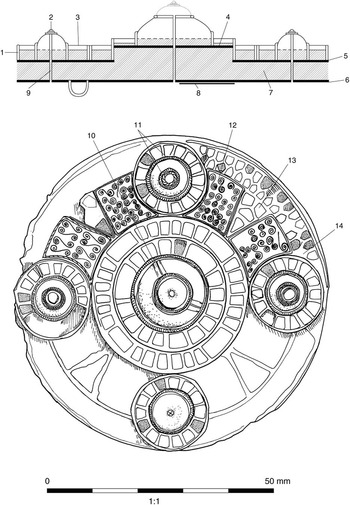
The proportions of the cloisonné designs and the overall dimensions of all three brooches are closely similar, but there are certain differences in design. Perhaps the most striking of these is the slightly raised central ‘tier’ found on the Hanney brooch (fig 6). Although the Hanney brooch shares the same symmetrical, cruciform layout as the Milton brooches, four small triangular cloisonné fields originally separated the gold filigree panels instead of four rectangular cloisonné arms projecting from the central circular field.Footnote 30 The simple scrolled wire decoration on the gold panels of the Hanney brooch is crude in comparison to the elegant Style II filigree serpents seen on the Milton brooches. Instead of ‘honeycomb’ garnets around the central setting, as on the Milton brooches, the Hanney brooch makes use of rectangular garnets, including several large slab-cut pieces. It should be recognised, however, that even the two Milton brooches, despite their obvious connection, differ from one another in a number of ways.Footnote 31
Composite disc brooch with diagram showing internal construction based on x-ray computed tomography: (1) circular strips of copper alloy soldered to the middle and upper plates; (2) cabochon garnet; (3) slab-cut garnets; (4) upper plate; (5) middle plate; (6) lower plate; (7) white paste; (8) silver sheet; (9) rivet; (10) crown arch; (11) filigree gold collars; (12) gold mount; (13) triangular field of garnets; (14) crimped copper strip. Drawing: M Wachnik; reproduced by permission of Oxfordshire Museums Service

Although Avent argued for a Kentish origin for the Milton brooches, based on their similarity to the Faversham brooch,Footnote 32 Hawkes took the view that the Milton brooches could equally have been made in the Upper Thames region and that the evidence ‘strongly suggests that the manufacture of these later bronze composite brooches was not confined to Kentish workshops’.Footnote 33 The discovery of a third closely similar brooch within 10km of Milton significantly strengthens the case for a local manufacture for all three brooches.
In order to shed further light on the question of the relationship of the three brooches and the likelihood of local production, technological and compositional analysis of the Hanney and one of the Milton brooches was undertaken at the Cranfield Forensic Institute. This took the form of microscopy and CT scans to reveal the construction of the brooches and XRF and XRD analysis of the materials used in their manufacture.Footnote 34 The results will be published in full elsewhere, but it is already clear that the Hanney brooch and that found at Milton, North Field, in 1832 – now in the Ashmolean Museum (Avent’s corpus no. 182) – differ in a number of ways. The rivets securing the five circular bosses on the Hanney brooch were, for example, made of copper alloy tubes, while those on the Milton brooch were of iron. A crimped strip that formed part of the outer row of cell-work on the Hanney brooch appears to be, very unusually, of pure copper, whereas they are all of copper alloy on the Milton brooch. There are also important similarities: the general techniques for working the metals involved seems very similar, the bottom plates of both brooches were of copper alloy covered on the back with silver sheet, and the white paste filler used is common to both. Perhaps most strikingly, the CT scan revealed that the proportions of the copper alloy plates used to form the middle layer of the Hanney brooch and the top layer of Avent’s corpus no. 182 are effectively identical, suggesting that the same template was used for both. It is too soon to evaluate the significance of these similarities and differences, but it is clear that there was more than one way to make a composite disc brooch, and even two visually similar brooches could contain subtle constructional differences. How such differences should be interpreted will be the subject of a separate study, but they do not make a local manufacture for the three brooches inherently less likely.
The Hanney Burial In Context
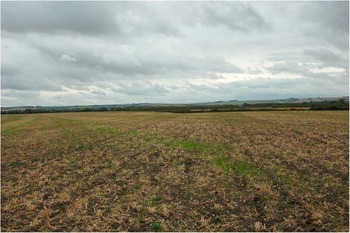
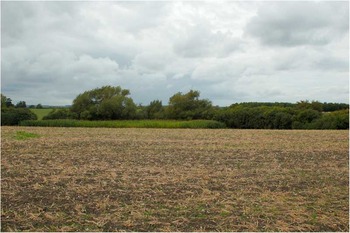
The burial occupied a prominent position on one of the highest points in the parish of West Hanney, with the ancient routeway known as the Ridgeway clearly visible to the south and with commanding views over the Ock valley to the north (fig 7). The burial lay approximately 2.5km west of the Roman road from Wantage to Marcham, stretches of which are still visible as a low linear earthwork, running parallel to, and just west of, the A338.Footnote 35 Less than 100m to the west of the burial runs the Childrey Brook, which formed part of the northern limits of an estate at East Hanney granted in 956 by King Eadwig to his adoptivus parens (fig 8); it also forms part of the parish boundary of West Hanney.Footnote 36 It is not too far-fetched to suggest that it already formed a significant boundary in the seventh century. No early Anglo-Saxon cemetery has been identified within a 5km radius, with the nearest known cemetery lying at West Hendred.Footnote 37
Looking south from the site of the burial towards the Ridgeway. Photograph: J Brasnett; reproduced by permission of Oxfordshire Museums Service

Looking west from the site of the burial towards the Childrey Brook (marked by the line of trees) and beyond towards the Vale of the White Horse. Photograph: J Brasnett; reproduced by permission of Oxfordshire Museums Service

The location of the burial therefore raises the question of whether it was originally a visible landmark. A geophysical survey, 60m by 60m and centred on the burial, was carried out to establish whether any evidence of a ploughed-out barrow and / or of further burials could be identified. No trace of either a ring ditch or further grave cuts was found, although linear ditches, possibly field boundaries, were identified. The lack of evidence for a barrow is not conclusive, however; the grave cut was severely truncated and a shallow ditched feature could have been ploughed away completely. A controlled metal-detector survey revealed a small number of both ferrous and non-ferrous signals that were not investigated further. Given the intensity of metal detecting in the field in question, however, and the good working relations between local metal-detecting groups and the local Portable Antiquities Scheme Finds Liaison Officer, finds of this period are likely to have been reported had the burial lain within a larger cemetery containing furnished burials.Footnote 38 The balance of probability, therefore, is that this find represents an isolated burial.
Recent refinements in the dating of Anglo-Saxon burials have demonstrated that, after a sharp and widespread decline in the furnished burial rite after the ad 570s (excepting, of course, a handful of lavish early seventh-century male princely burials), there was an ‘upsurge’ in well-furnished female burials, beginning in the second quarter of the seventh century. These burials were accompanied by a range of new artefact types that made use of precious and exotic materials. The number of male weapon burials remained small, however, and females tended to dominate the burial record until the demise of the furnished burial rite sometime towards the end of the seventh century.Footnote 39
The West Hanney burial thus belongs to a well-attested tradition of well-furnished seventh-century female inhumations, a few of which, such as those found at the Eton Rowing Course (Bucks) and in the reused Bronze Age barrow on Swallowcliffe Down (Wilts), were isolated.Footnote 40 Female burials like the one at West Hanney – which overlooked a long-distance routeway, lay close to a territorial boundary and contained an opulent brooch and probably a bag collection – are perhaps best understood within the context of a newly prominent hereditary aristocracy establishing its position within recently formed and rapidly expanding kingdoms.Footnote 41 For such a group, the furnished burial of women still offered the possibility of competitive display, notwithstanding the concealment of elements of the grave assemblage in containers. That said, these burials appear to have been less obviously concerned with the ‘conspicuous consumption of wealth’ than the male princely burials that preceded them in the early seventh century, such as those at Sutton Hoo (Suffolk).Footnote 42
As has recently been argued, this marked phenomenon may be related to increasing constraints on the circulation of weaponry leading to the decline of weapon burials, a possibility suggested by certain clauses in seventh-century law codes and maybe even by the Staffordshire Hoard.Footnote 43 Hines has suggested, furthermore, that the identity of the women accorded furnished burial in the seventh century may not have been ‘subject to the same direct public and political interests’ as that of the males previously buried with weapons: ‘put in positive terms, we can postulate that the female identity in question – relative wealth and eminence in the community, and a special domestic role – was both assigned and valued on a more local basis, rooted in the household and the family’.Footnote 44
Yet, furnished female burials like the one at West Hanney – regardless of whether they included objects with overtly Christian symbolism (and it is a moot point whether the brooch, with its cruciform motif, was intended to be understood as a Christian object, although it seems likely) – can be understood within the context of another remarkable phenomenon: the marked prominence of women in the Church from the middle decades of the seventh century onwards.Footnote 45 This same period saw the accumulation of considerable landed wealth in the hands of women.Footnote 46 Indeed, it appears increasingly likely that the ‘abbess generation’ of the 660s onwards (of which St Hilda was the most prominent member) emerged out of an earlier, widespread and undocumented change in the role of women evidenced in this ‘upsurge’ of well-furnished female burials that began in the 630s. This corresponds broadly to the period when the daughters of Anglo-Saxon noble families began to be sent to Frankish double monasteries, which were headed by abbesses and have been described by LeJan as ‘major players in the complex mechanisms by which land-ownership circulated’.Footnote 47 Some died there; a few famously rose to become heads of these establishments themselves. Still others returned to England, no doubt bringing with them new ideas about women as the managers of landed estates.
That women were now critical, in at least some cases, in assuring the continuity and securing the property of high-ranking Anglo-Saxon families may have contributed to their new prominence, along with their ‘tendency to outlive men’, another means by which they could acquire land.Footnote 48 Female members of land-owning families might thus not merely represent a valuable form of symbolic capital,Footnote 49 but also the family’s interest in newly gained estates. The burial of a female family member near a major boundary, accompanied by a range of richly symbolic ‘material metaphors’, would surely have had a significance that went well beyond the purely local and domestic.Footnote 50
The obvious similarity of the Hanney brooch to those from Milton appears designed to emphasise links with a leading family in the Abingdon area, a region that was able, from an early period, to procure precious metals, luxury imports and coinage, and that displayed high-status occupation over several centuries.Footnote 51 Furthermore, it is possible that the inclusion of the glass vessel fragments, with their associations with feasting and drinking, was intended to underscore this link, given the proximity of the Milton burials to the great hall complex at Sutton Courtenay / Drayton, a possible Anglo-Saxon ‘royal vill’.Footnote 52 The occasion on which these objects were deposited with the woman at West Hanney may also have evoked important communal memories regarding their production and giving as gifts.Footnote 53 Indeed, the site at Sutton Courtenay / Drayton yielded, in addition to high-status seventh-century metalwork, extremely rare (though undated) evidence of goldworking in the form of droplets of gold solder and fragments of cut gold sheet.Footnote 54 While this must inevitably remain conjectural, the site at Sutton Courtenay / Drayton is as good a candidate as any for the location of an Upper Thames Valley workshop capable of producing de luxe items such as the Milton and Hanney composite brooches.
While there can be no single answer to the question ‘who were the women to whom a richly furnished burial rite was accorded in the seventh century?’,Footnote 55 the West Hanney burial and others like it seem to express a complex interplay between the new political importance of land and inheritance on the one hand, and the prominent role of women in the initial stages of the Conversion, as set out so clearly by Bede, on the other. The extensive corpus of seventh-century female furnished burials – whose chronological development has now been defined in greater detail than ever before – thus retains considerable potential to enhance our understanding of gender and power in Conversion-period England.
Appendix 1: Grave Goods
Esther Cameron, FSA
1 Composite disc brooch: see figs 3 and 6Footnote 56
The brooch’s circular outline is slightly damaged as if by a blow to the edge, and a circumferential metal collar, most probably of copper alloy, gilt, is missing. There is further damage to the front: three of the four outer segments of the design, and its entire border, comprising copper alloy cells, garnets and gold, had been dislodged. On the back, silver sheet and a pin had become detached. Some of these elements were recovered from the soil.
The brooch has a layered structure: there is a lower plate of copper alloy, the outside coated with silver sheet, a middle plate with a large central hole, on which the majority of the cloisonné is set, and a small upper plate supporting the central tier. The spaces between the plates are filled with a white paste composed of calcium carbonate. Five rivets connect the upper and lower parts of the brooch, each headed with a boss of white aragonite, a mineral consisting of calcium carbonate (occurring, for example, in shell but also as a deposit in hot springs). The cell or cloison structure is formed from circular strips of copper alloy soldered to the supporting plates, and radial sub-divisions set into paste. The cells are filled with white paste topped with gold foil and garnets. The patterns on the foils are of two types: the majority is ‘standard’ grid with a line count of four lines per mm, a type that is not common among composite brooches but occurs frequently in the Sutton Hoo jewellery; a few, mainly those beneath the largest garnets, are ‘boxed’ grids with a line count of 3.2 lines per mm, a type occurring regularly in Anglo-Saxon garnet jewellery but not among composite brooches or the Sutton Hoo assemblage.Footnote 57 The garnets surmounting these cells, although well polished and flat, have irregular ‘nibbled’ edges, suggesting they were shaped in a workshop without specialist gem-cutting equipment or skills.Footnote 58
The front is divided into three concentric circles. The first, the innermost, has a central white boss (see below) encircled by two rings of trapeze-shaped garnets and gold foil in copper alloy cloisons. These slab-cut garnets are of two sizes, the larger ones being 2.5 times the width of the smaller ones, including one that appears to have an old break. In the second concentric circle there are four gold mounts, originally eight in total, wire-bordered and decorated with S-scroll motifs. Two of the mounts have thirteen to fourteen motifs each in beaded wire, while the other two have eight to ten each in plain slightly coarser wire, and the scroll-work appears less accomplished; it is possible that these represent replacements. In its complete state, the mounts would have depicted the four arms of a Maltese cross; the triangular spaces between the arms in-filled with garnets; the centre of each arm punctuated with a white boss encircled by trapeze-shaped garnets. The third, outermost circle is a double border of small pentagonal garnets separated by a crimped strip made (unusually) of pure copper.
The central boss consists of filigree gold collars at the base and crown, presumably surmounted by a smaller boss with a single cabochon garnet and filigree collar (missing). Two gold strips or ‘crown arches’ descend from the crown to the base. A third, and possibly a fourth, arch are presumed to be missing. There are four outer bosses, probably identical to each other (the stone and setting is missing from one of the bosses) comprising filigree gold collars at the base and crown with a single cabochon garnet set in the top.
On the back of the brooch, five small holes in the lower plate mark the exits of tubular rivets, the ends burred over. A small U-shaped loop, its ends fixed to the inner face of the lower plate, is a ‘safety loop’ for attaching a chain.Footnote 59 Fragments of silver sheet, some detached from the back of the brooch, are engraved with a simple interlace design against a partial background of cross-hatched lines, of similar design to that on the front of a seventh-century buckle from Eccles, Kent.Footnote 60 The layout suggests an interlace border, with further decoration around the base of the pin head and possibly the catch-plate. The back of the ‘Kennard’ brooch from King’s Field, Faversham (Kent), is engraved with cross-hatched triangles,Footnote 61 and there are similar motifs on the back of the Monkton brooch.Footnote 62 Pin fragments, including a drum-shaped pin head and a U-shaped deposit, possibly of solder, on the silver backing sheet, suggest that the fastening of the Hanney brooch was of Avent’s Type 5.Footnote 63 Diameter 70mm.
2 and 3 Glass: see fig 5 (2) and (3)
Two fragments of blue-green glass from the rim and body of a vessel: the rim, a simple upright edge; the convex body sherd with a trail across it. Rim thickness 5.5mm; body thickness 3mm; trail thickness 4mm.
4 Spindle whorl: see fig 5 (4)
Spindle whorl of chalk and clay, plano-convex: surface rough and eroded, of an ochreous grey colour. Diameter 34mm; height 18mm; diameter of hole 10mm.
5 Spatulate tool: see fig 5(5)
Iron, parallel-sided with a blunt, rounded end; straight tang possibly with a twist, no evidence of an organic handle. On the underside, a trace of mineralised skin or leather: probably from a sheath for the knife that was found beneath. Length 111mm; width 13mm.
6 Knife: see fig 5 (6)
Iron, with the trace of a horn handle; widest at the shoulder; back slopes gently towards an angled tip; cutting edge straight with a slight upward curve at the tip. On the underside, a trace of mineralised textile: Z-spun yarn, 0.3mm in diameter, the weave unclear. Length 113mm; width 14mm.
7 and 8 Cups: see fig 5(7) and (8)
Two near-identical ceramic cups: globular body with slightly flattened base, tall and flared neck, the rim a simple convex edge. Fabric mottled, black and orange/brown with carbonised organic temper. Surface roughened inside and out, with voids where the temper has been burnt away and lumps of adhering soil and laboratory consolidant. Height 92mm; diameter 106mm.
9 Awl or point (not illustrated)
Iron, part of a tapered rod, circular in cross-section, with associated iron fragments which, were they to join, would suggest a total length of approximately 50mm. Found during conservation of the cups, although the exact relationship of the ironwork and the pottery was not recorded. Extant length 23mm; width 5mm.
Appendix 2: Human Remains
Andreas Düring, Nicholas Marquez-Grant, Sophie Beckett and Paula Levick
The following skeletal report comprises the initial study by Paula Levick and a more in-depth analysis conducted in 2014 at Cranfield University, including CT scans. The study seeks in particular to establish the biological profile (sex, age at death) of the individual and to shed light on the lifestyle or living conditions as evidenced by the pathological conditions in the skeleton. We would like to thank Dr Sophie Beckett and Jessica Bolton for the CT scanning of the skeletal remains at Cranfield University. Sincere thanks go to Almudena García-Rubio, Kayleigh Cooper and Oznur Gulhan of Cranfield University as well as Janamarie Truesdell and Michael Gantley of the University of Oxford for their help and comments during the recording of the skeletal remains. An article on the osteological analysis discussing the CT scans in detail and including more comparative research is in preparation.
Methods
The osteological analysis was conducted according to the standards published by Brickley and McKinleyFootnote 64 and Mays.Footnote 65 Morphological observations were made to estimate sex and age at death as described in Brickley and McKinley. The metric analysis is based on Buikstra and UbelakerFootnote 66 as well as on Brothwell, Bass and Martin.Footnote 67 Stature was estimated based on the formulas developed by Bach, Trotter and Trotter and Gleser.Footnote 68
To assess the social status of one isolated individual based on a skeletal analysis is impossible. Palaeopathological methods and the newly developed methods on activity-related osseous changes require larger skeletal populations.Footnote 69 This report will, however, try to link its results with the archaeological context by addressing the individual’s living conditions. This is only possible because of an interesting offset between the results of some of the age estimation methods we applied. In this report we lay a different stress on some of the methods in light of the archaeological context, and draw comparisons with general frequencies of pathological conditions in the early medieval period as well as with a site of the same period that is known to have experienced challenging living conditions – the cemetery of Bärenthal in south-west Germany.
Preservation
Although most of the bones were fragmented and some of the bone surfaces eroded, especially the long bone diaphyses, the skeleton was relatively well preserved (skeletal completeness over 75 per cent, bone condition good but with high fragmentation). Only the facial skeleton and the anterior (ventral) aspect of the pelvic bone were missing almost entirely. The missing pubic symphyses complicate the age estimation. All the skeletal elements probably belong to a single individual and there were no repeated bone counts. Eleven animal bones, belonging to various species, were mixed with the human remains: the one tooth and one cranial and nine long bone fragments were found in different areas within the burial and this, combined with their fragmentary state and their size, indicate that they do not represent deliberate deposits.
The location of the brooch in the grave can be established on the basis of the green staining of the upper left thoracic area of the skeleton. The left part of the mandible, the left scapula, the left clavicle and six upper left ribs have been stained dark grey to green.
Sex
The sex of the individual could be estimated on the basis of standard morphological observations and metric data. The majority of the morphognostic sex markers were graded as feminine, especially the pelvis with its wide greater sciatic notch and the extremely gracile mandible (mental eminence, minimal gonion flaring). Of all the observable cranial features, only the strongly pronounced posterior zygomatic arch resembles male standards. The individual’s long bones are gracile and short, with lengths that fall on the female peak in comparison with other early medieval populations: eg maximum length of the left femur (Fe 1): 419mm, early medieval population of Bärenthal, Germany: Ø males: 467.7mm (s=18.8mm), Ø females: 424.6mm (s=28.9mm) / maximum length of the right fibula (Fi 1): 331mm, Bärenthal: Ø males: 377.3mm (s=29.4mm), Ø females: 332.5mm (s=17.5mm) / maximum length of the right radius (Ra 1): 221mm, Bärenthal: Ø males: 256.3mm (s=11.3mm), Ø females: 230.8mm (s=11.8mm).Footnote 70 The measurements of the epicondylar breadth of both humeri, the vertical head diameter (43mm) and bicondylar width of the right femur (69.8mm) and the height of both glenoid cavities (33.0 left and 34.5 right) help clarify the sex determination further as they score low indeterminate and female values according to the standard.Footnote 71
Age
The age at death of the individual was much harder to estimate as the pubic symphyses and the sternal rib ends were not recovered and, furthermore, the skull of the individual was very fragmented. Some of the methods also yielded different estimates. The age estimate therefore depends on how the methods should be weighed against each other and on contextual information.
The first age estimate is based on the postcranium. Because all the epiphyses (with the exception of the sternal ends of the clavicles, see below) are fully fused and the auricular surface does not retain any youthful signs and shows an overall coarse and granular surface with some striations and a beginning breakdown of the rims, an absolute age of twenty-five to thirty-five years seems realistic.Footnote 72
The second of the contradictory age estimates is based on observations of the individual’s dentition. The teeth of the individual are not abraded to any great extent (polished occlusal surfaces of the molars with tiny dentine spots on the tip of the mesiobuccal cusps of the first left lower molar and two dentine spots at the first upper right molar), which hints towards an absolute age of less than twenty-five years,Footnote 73 or twelve to twenty years of age,Footnote 74 depending on the grading system applied.Footnote 75 As both grading systems are based on Anglo-Saxon populations, tooth abrasion should reflect the relationship of the individual buried at West Hanney to the population standard of that time quite well.
The epiphyseal fusion of the sternal ends of the clavicles are generally seen as a good age marker above the age of eighteen as they do not represent a degenerative factor.Footnote 76 A thorough review of the existing literature has, however, revealed that there is a wide range of possible ages for partly fused sternal ends of clavicles. According to Bass, the fusion should mostly have stopped before the age of twenty-five.Footnote 77 The general literature, however, states that fusion progresses between twenty-three and thirty years of age.Footnote 78 A recent paper examined fusion stages of the sternal ends of clavicles and reviewed earlier research. The preserved sternal ends of the clavicles score stage 3 (active fusion) in the five-phase system and stages 2–3 in the three-phase system, which corresponds to a minimum age of nineteen and a maximum age of thirty years, with an average in the mid- to late twenties.Footnote 79 An age estimate of less than twenty-five years is therefore unsupported.
Cranial suture closure (only included because of the contradictory age estimates) yields a rough range of twenty to forty in this case as the S1 part of the sagittal suture had already started to fuse before death.Footnote 80
The buried individual did not show degenerative joint disease in the spine and extremities (with the exception of two small-scale osteophytic reactions at the medial aspect of the femoral heads). Together with the minimal abrasion of the teeth, this points towards an individual with a higher chronological age who had fewer abrasive elements in the diet than the average and was exposed to low levels of physical stress to the spine and the extremities. The evidence taken together therefore points to an age range of twenty-five to thirty as a narrow estimate and twenty to thirty-five as a wider estimate. This female therefore died a few years before, or in accordance with, the onset of the general mortality peak of early medieval populations at ages thirty to forty.Footnote 81
Stature
Different methods can be applied to estimate the stature of an individual. Siegmund presents an overview of the most common methods.Footnote 82 Trotter’s estimation formulas yielded good results in comparison with other archaeological data.Footnote 83 According to Trotter’s formula for white females and the length of the femur, the stature of the individual was 157.6±3.72cm. Bach’s chart for female femora lengths suggests a stature of around 1.61m to 1.62m.Footnote 84
Pathological conditions
Dental health
The dental health of the individual was relatively good and no enamel defects could be observed. Even those teeth scanned with CT displayed no irregularities on the outer surface of the enamel. In an overview study of health and disease in Britain, 18.8 per cent (640 of 3,407, crude prevalence rate) of Anglo-Saxons were diagnosed with enamel hypoplasia.Footnote 85 Overall, 384 of 5,167 (7.4 per cent) of teeth were affected, though some Anglo-Saxon sites yielded prevalence rates of over 60 per cent. In the early medieval low status site of Bärenthal, Germany, 88.9 per cent of all adult females were diagnosed with enamel hypoplasia.Footnote 86
Dental abrasion has already been discussed and corresponds with the lowest stages (6–12), suggesting an age of less than twenty to twenty-five.Footnote 87 This means that the cusps of the teeth showed polish, but only the first and second molars had developed small dots of dentine on the larger cusps. It is likely that the individual consumed food containing fewer abrasive elements than the average Anglo-Saxon. A caries lesion on the occlusal surface of the left upper first molar was identified by Paula Levick in the initial study but could not be verified as it was destroyed during the radiocarbon sampling. The other teeth showed no signs of caries and ante-mortem tooth loss could not be diagnosed. No signs of apical activities or active or healed periodontitis could be observed in the mandible and the still present parts of the maxilla, although the alveolar rims of 25, 26 and 27 show some slight pitting. Almost all teeth had light to medium calculus formation (tartar) on the lingual and labial surfaces.Footnote 88 According to Roberts and Cox, 4.2 per cent of 38,911 Anglo-Saxon teeth showed signs of caries; dental calculus was observed in 39.2 per cent of 3,567 teeth and 27.0 per cent of individuals suffered from periodontal disease.Footnote 89 At Bärenthal, 37.8 per cent of all teeth were affected with caries or had been lost ante-mortem, and every young adult female suffered from periodontal disease, while 85.7 per cent of young adult females had developed at least one caries lesion and six out of seven had lost at least one tooth ante-mortem. Young adult females had also built up dental calculus of the medium and strong stages.Footnote 90
Pathological conditions of the postcranium
The individual did not show any signs of trauma or cribra orbitalia. In the postcranial skeleton, Schmorl’s nodes (ie herniations of the intervertebral discs into the upper and lower surfaces of vertebral bodies) could be identified in the lumbar vertebra 2, 3 and 4 and the thoracic vertebra 8 and 10. These probably activity-related lesions are common in young adults and produce no symptoms.Footnote 91 Of all the observable articular surfaces only the rib heads of both twelfth ribs had slightly pitted surfaces and the lower medial aspect of the rims of the femoral heads showed slight osteophytic reactions. According to Waldron these lesions can be diagnosed as a mild form of osteoarthritis.Footnote 92
Only very few pathological changes could be observed and the individual showed very few minor degenerative changes. Many more pathological lesions due to physical stress or a high daily workload would not be uncommon for this age group in the Anglo-Saxon period. Joint disease is observed in 8.8 per cent of the overall population (628 of 7,122, crude prevalence rate) and usually more males than females are affected.Footnote 93 Of the individuals aged twenty to twenty-nine studied at the Alamannic cemetery of Munzingen, 10.18 per cent showed degenerative changes.Footnote 94 In other early medieval populations much higher prevalence rates have been observed in the age category of twenty to forty: 68.4 per cent of the adult individuals at Bärenthal, Germany, had developed spondylarthropathies and 73.7 per cent of the adult population showed osteoarthritic reactions of the extremities. The female part of the population had much higher prevalence rates than the males, with 87.5 per cent of cases of joint disease in the adult age group.Footnote 95 More positively diagnosed females than males – alongside a high rate of cases of individuals aged lower than thirty – could also be observed in the early medieval village of Berslingen.Footnote 96 Arguments based on the absence of evidence are always problematic. The analysis, however, suggests that this individual’s living conditions were slightly better than for the average woman of her time.
The only other pathological change is a 1.5 x 2cm large spot of grey woven-bone formation on the anterior surface of the diaphysis of the left femur. Periostitis symptoms can have a wide range of different causes, including stress, infection and metabolic/systemic disorders. Because a similar lesion on the right side could not be observed, the causes might be more localised and less systemic.Footnote 97
The absence of pathological lesions in the skeleton is not a guarantee that the individual did not suffer from diseases that do not affect the bones.Footnote 98
Activity-related osseous changes
Activity-related osseous changes are difficult to study without a large reference population and the following observations must therefore be treated with care.Footnote 99 The muscle attachments of the upper extremities were excluded from the study as the surface of the radii and ulnae was eroded. The diaphyses of the humeri show little relief but are not completely smooth. They can be graded maximally to stage 1 of expression based on the Coimbra Method.Footnote 100 The femora and tibiae belong to expression stage 1 in both zones. The linea aspera is very smooth and ‘gracile’. The muscles of the lower extremities of this individual were probably not continuously stressed more than the average. The two mild changes in the hip joint mentioned above should not, however, be forgotten.
Growth disruptions
The proximal epiphyses, metaphyses and proximal parts of the shafts of both tibiae, and the distal epiphysis, metaphysis and shaft of the right tibia were scanned at Cranfield University. The proximal tibiae showed no Harris Line formations;Footnote 101 the right distal tibia, however, had a minimum of three slight Harris lines that do not intersect the complete spongy material but become oblique towards the anterior aspect of the shaft. Two more probable Harris lines can be seen, but they are only present as very slightly transverse oriented spongy bone. The growth arrests might have been caused by multiple periods of (minor) physical stress of infections during the individual’s childhood and adolescence. The Harris lines might, however, already have been partly remodelled due to the individual’s age.
Summary
Sex: female
Age: (20–) 25–30 (–35)
Stature: 157.6±3.72cm
Pathological conditions: dental caries, dental calculus, Schmorl’s nodes in the lower thoracic and the lumbar vertebra, very early stage osteoarthritis (twelfth ribs, femoral heads), active periostits on the anterior surface of the diaphysis of the left femur, three to five slight or partly remodelled Harris lines in the right distal tibia.
The individual displays fewer degenerative pathologies, relatively gracile muscle attachments and below average dental abrasion for a young adult female in the early medieval period. The age of the individual was difficult to estimate because of a small offset between the observable age markers (ie between the auricular surface method and tooth abrasion stages). The results are generally consistent with the archaeological context indicating a high-status individual. Skeletal data on individuals of low status tend to show more nutritional and stress-related osseous changes and pathologies.Footnote 102 The osteoarchaeological analysis can, however, only identify a general trend and does not resolve the question of this one individual’s living conditions. The Harris lines in the lower tibia together with the absence of enamel defects suggest that even individuals of apparently high status could not escape mild physical stresses such as infectious diseases or nutritional deficiencies.
Acknowledgements
Our sincere thanks go to the owners of Manor Farm, Lyford – Jim, Alan and David Cottrell – and to the finder of the brooch, Chris Bayston, for their unfailing assistance and co-operation; to Peter Welch and Alan Armstrong for on-site assistance; to Paula Levick and Juan Moreno for assistance with the excavation and survey work; to Paul Booth, FSA, and Oxford Archaeology for the loan of excavation equipment; to Christopher Ramsey, Tom Higham and Rick Schulting for advice and assistance relating to the radiocarbon dating of the burial; to Sophie Beckett and Keith Rogers of Cranfield University for generously and meticulously undertaking the CT scans and XRD analysis of the Hanney and Milton brooches; to Mark Norman and Eleanor Standley of the Ashmolean Museum, Oxford, for kindly making the Milton brooches available for study; and to David Moon of Oxfordshire Museums Service for providing illustrations and facilitating access and study of the objects. Helena Hamerow would also like to thank the following for their invaluable insights and advice on an early version of the text: John Blair, FSA, George Speake, FSA, and Barbara Yorke, FSA. Figures 1 and 4 were prepared by Abi Tompkins and Alison Wilkins.