Cardiovascular diseases (CVDs) are the leading cause of deaths associated with chronic diseases [45 percent of all deaths related to non-communicable diseases (NCD)]. According to the World Health Organization's (WHO) report in 2015, over three quarters of NCD deaths occurred in low- and middle-income countries (1). It has been estimated that nine million people annually die due to hypertension as the main risk factor of CVDs (2). The prevalence of hypertension has been estimated to be around 26.21 percent in adults aged 18 years and over in Iran (Reference Aghaei Meybodi, Khashayar and Rezai Homami3).
The risk factors of chronic diseases are mostly preventable (Reference Divajeva, Marsh and Logstrup4). However, in many low- and middle-income countries, there is a wide gap between evidence-based recommendations and current practice. According to the WHO, “treatment of major CVD risk factors remains suboptimal and only a minority of patients who are treated reach their target levels for Blood Pressure (BP)…” (5). Self-care as a necessity can control and prevent complications in hypertensive individuals (Reference Heron and Smyth6). Adherence to diet and lifestyle modifications as well as antihypertensive drugs are pivotal in achieving optimal BP control. It has been shown that self-care could improve the quality of life, promote patient satisfaction, and decrease the need for primary care and outpatient and emergency visits (Reference Kho, Henderson, Dressler and Kripalani7)
Due to the rise in the ageing and chronically ill patients' population, more hospital care expenses are expected. Thus, health services cannot meet the ever-increasing demands of health care (8) and there is an ever-growing need to organize healthcare delivery services in living and work places (9).
Mobile health (mhealth) is an appropriate communication channel between patients and healthcare providers and can deliver services outside the facilities. mhealth applications can save cost and time (Reference Russo, McCool and Davies10). They are also a key to outcome amelioration and lifestyle modification. Since hypertensive patients' adherence to self-care is relatively low (Reference Padfield11), using educational self-care applications might increase participation in self-care behaviors as well as shifting towards community-based telehealth services. Nonetheless, a systematic review showed that most mhealth studies were conducted in developed countries (Reference Alessa, Abdi, Hawley and de Witte12).
Since the establishment of health houses in rural areas of Iran, more than 85 percent of the population in rural and deprived regions have gained access to free primary healthcare services. Since the family physician reform in Fars province in 2011, rural and urban residents have been provided with health and medical services. These services are paid through the governmental budget and patients pay only about 10 percent of the cost. Clinics affiliated to Shiraz University of Medical Sciences (SUMS) are the largest in south of Iran and people from other southern cities come to Shiraz clinics as referral centers. Therefore, they cover patients from all socioeconomic levels. However, the mhealth approach to managing hypertension has not been adopted in Iran as a developing country. Thus, the current study aims to evaluate the effect and acceptance of an educational self-care application as a community-based intervention on self-care adherence behaviors in Imam Reza heart clinic affiliated to SUMS.
Method
Study design
This matched controlled study intended to compare an intervention and a control group regarding the impact of using an educational self-care application for eight weeks on hypertensive patients' self-care based on the Hill-Bone hypertension self-care questionnaire (Reference Kim, Hill, Bone and Levine13).
Application development
An educational self-care application was developed according to the software development life cycle, including planning and analysis, design, implementation, and evaluation phases. The educational content of the application was determined according to the Joint National Committee on Prevention, Detection, Evaluation, and Treatment of High BP (JNC7) suggestions, which included complying with antihypertensive medications, controlling weight, following a low-salt diet, limiting alcohol consumption, engaging in regular physical activity, and quitting smoking (Reference Chobanian, Bakris and Black14). The content was prepared under the supervision of a cardiologist and dietitian and was classified with tables and images based on hypertension clinical practice guidelines (15;Reference Mancia, Fagard, Narkiewicz, Redon and Zanchetti16). The contents available at the American Heart Association and Chronic Disease Control websites were used, as well. The content validity of the self-care program was confirmed by a cardiologist, a nutritionist, and an education expert. In addition to the educational content, drug reminders, patients-healthcare provider communication, and charting patients' weight and BP as well as alarming high BPs, were among the capabilities of the application.
Patient selection
The research proposal was approved by the ethics review board of the Vice-chancellor for Research Affairs of SUMS (IR.sums.REC.1395.207). At first, in each clinic, a nurse measured the patients' BP by an automated sphygmomanometer two times after five minutes of sitting with legs uncrossed, back against chair, and cuff at heart level. Accordingly, the eligible patients were identified. They were explained about the objectives of the research and were ensured about the confidentiality of their information. Written informed consent forms were also completed by all patients who were willing to cooperate. Then, having agreed to participate, patients in both control and intervention groups answered the Hill-Bone questionnaire for the first time. Both groups were informed that they were required to respond the questionnaire two months later. Afterwards, the application was installed for the patients in the intervention group and they were taught how to use it. At the same time, their ability to correctly read their own BP on the monitor and save it on the application according to the instructions was checked.
Participants
The study participants were all outpatients referred to Imam Reza heart clinic as the intervention site and Al-Zahra heart clinic as the control site both affiliated to SUMS. Considering the power of 80 percent to determine a minimum difference of five scores (a mean of 45 ± 10 in the intervention group and 40 ± 10 in the control group), a 120-subject sample size was estimated for the study (n = 60 in each group). Based on the Hill-Bone hypertension self-care questionnaire, the mean difference was calculated using the two-tailed test at the significance level of 5 percent. Convenience sampling, a nonprobability method was conducted for the recruitment of the participants during their visits in the clinics. It should be noted that the two groups were matched with respect to age, gender, and education level.
Inclusion and exclusion criteria
The inclusion criteria were confirmed hypertension diagnosis by a physician, age above 18 years, positive history of hypertension for at least six months, having an android-operating mobile phone, willingness to participate, and continuous presence in the survey. The exclusion criterion was inability to use smart mobile phones.
Intervention
The patients in the intervention group were asked to use the application for eight weeks. They were also asked to measure and save their BP in the application every two weeks in order to ascertain their continuous presence in the study. By saving the BP in the application, an automatic message containing the patients' BPs was sent to the nurse supporting the intervention. The patients in the intervention group who did not send their BPs more than once were excluded from the study. The nurse remotely monitored their BPs and provided consultation where needed. For instance, when a very high BP (systolic BP⩾170, less than the hypertensive crisis) was sent to the nurse, she as well as the application provided the patients with feedback, provided some advice about medications, and asked them to visit their physician if necessary. The control group participants received the routine care and underwent no interventions.
To evaluate the patients' self-care behaviors before and after the intervention, the Hill-Bone questionnaire developed by Kim et al. in 2000 was applied. The reliability of the questionnaire was found to be 0.71 in a Persian study (Reference Esmaili Zabihi, Ashktorab, Banaderakhshan and Zaeri17). This instrument contained 14 questions in three subscales of adherence to diet (reducing sodium intake), medication intake, and appointment keeping (see supplementary). Each question was answered based on a five-point Likert scale range from “always” (1) to “never” (5). The patients completed the questionnaire once at the beginning of the study when they agreed to participate and once when they attended their appointments two months later. To make all patients complete the questionnaire, a telephone call was made with the patients who did not need to visit their physician at the clinic at the end of the study.
Acceptance of the application
The intervention group's acceptance was evaluated at the end of the study period. This satisfaction survey was conducted when the Hill-Bone questionnaire was completed for the second time. The participants in the intervention group rated their agreement with five statements on a five-point Likert scale range from “strongly agree” (5) to “strongly disagree” (1). After all, the data were analyzed using descriptive and inferential statistics in SPSS 18 software.
Results
Patients' survey on self-care
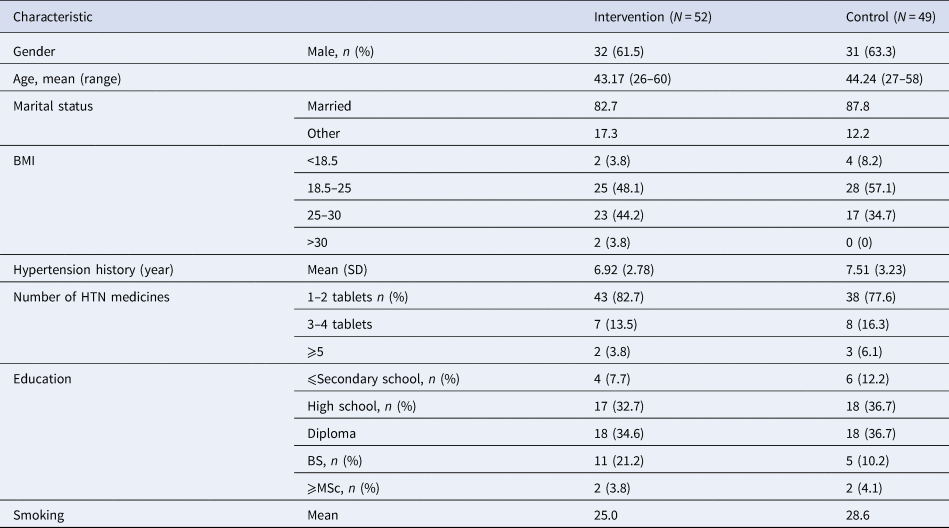
In total, 52 patients in the intervention group (response rate: 85.2 percent) and 49 patients in the control group (response rate: 80.3 percent) completed the study. Demographic characteristics of the participants in the two groups have been presented in Table 1.
Demographic Characteristics of the Participants

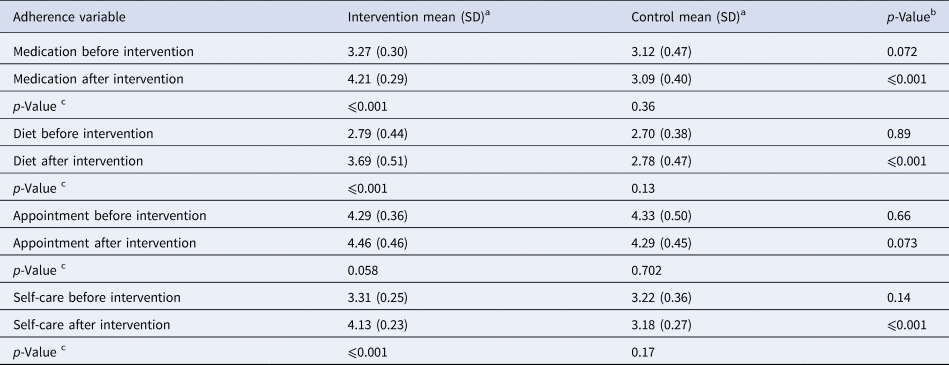
As shown in Table 2, there was no significant difference between the intervention and control groups regarding self-care subscales before the intervention. However, the results of the independent sample t-test showed a significant difference between the two groups with respect to self-care behaviors after the intervention (4.13 ± 0.23 versus 3.18 ± 0.27, p < .001). The results also indicated a significant difference between the two groups concerning “medication adherence” and “proper diet adherence” after the intervention. However, no significant difference was observed between the two groups regarding “appointment keeping” (p = .073).

The results of the paired t-test for comparing the means before and after the intervention have also been presented in Table 2. Accordingly, there was a significant difference in the intervention group's total self-care before and after the intervention (p < .001), but this was not the case in the control group (p = .17). The results also showed significant differences in the intervention group's mean scores of “medication adherence” and “proper diet adherence” before and after the intervention (p < .001). However, no significant difference was observed in the intervention group's mean scores of “appointment keeping” before and after the intervention (p = .058).
Patients' survey of satisfaction
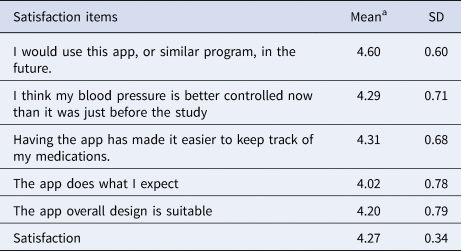
The results revealed the patients' high satisfaction with the application (4.27 ± 0.34 out of 5.0). The mean scores of the five individual questions have been presented in Table 3.

Discussion
The study findings showed the positive impact of the educational application on self-care behavior adherence in the intervention group compared to the control group. The intervention group patients were also satisfied with the provided community-based telehealth services through mhealth for managing hypertension. Based on the results, medication reminder through the mobile application was associated with the patients' adherence to their medications in the intervention group. Evidence (Reference Park, Kim and Kim18–Reference Daniali, Eslami, Maracy, Shahabi and Mostafavi-Darani20) has also approved medication reminder, self-care education, sending SMS, web-based interventions, and reminder cards as effective approaches for reducing BP, improving self-care behaviors, and taking medications regularly. Indeed, studies have shown that hypertension training, wireless self-monitoring programs, or other telemedicine interventions, when provided without reminder, had no effects on medication adherence (Reference Izquierdo, Lagua and Meyer21). Therefore, to be effective in medication adherence as an important aspect of managing hypertension, community-based telehealth services through mhealth should be empowered by drug reminder.
Improved self-reported diet and exercise was shown in the study by Izquierdo on the influence of telemedicine intervention on body mass index (BMI) (Reference Izquierdo, Lagua and Meyer21). Additionally, wireless self-monitoring program was revealed to enhance patient engagement by reducing cigarette smoking and improving BP control (Reference Kim and Wineinger22). Another study also showed the positive impact of hypertension training and sustained follow-up on exercising and hypertension management improvement. However, it exerted no effects on proper diet adherence (Reference Chiu and Wong23). Hypertension training either in face-to-face form or through mhealth applications seems to be associated with improved diet and exercise. Thus, providing training through mhealth tools might be influential since it provides educational content at any given time.
The application used in the present study was accepted by the patients. Still et al. investigated older adults' perceived the use of technology for hypertension self-management. They found out that although patients used smart phones for several activities, they expressed concerns about not being informed or trained sufficiently to apply such technologies for managing their hypertension (Reference Still, Jones, Moss, Variath and Wright24). Patients in Patel's study showed a high level of satisfaction with the medication reminder application (Reference Patel, Jacobus-Kantor and Marshall25). In the current study, the application was supported by a nurse, which could have contributed to the elimination of the patients' concerns by encouraging them to use the application. In addition, the nurse receiving the patients' BPs called them for consultation in case of very high-BP levels. The control group, however, did not have any communication channels between their two visits as usual. In Iran, patients with hypertension are not followed by healthcare providers between two visits, and this gap can be covered by such applications. Measuring and saving BP regularly and being aware of its changing trend could also contribute to motivating and reinforcing patients to adhere to self-care behaviors in order to control their BP. It has been confirmed in the study by Obara et al. that declared home BP monitoring could reinforce patients and improve their self-care behaviors (Reference Obara, Ohkubo and Asayama26). Moreover, patient-healthcare provider communication as well as feeling that healthcare providers were in touch whenever needed would motivate patients to participate more in the self-care program. These are what probably caused the patients to be satisfied with the healthcare facility.
In today's world that healthcare has become an industry, it is important to have a competitive edge. Mhealth has the potential to be integrated in all aspects of healthcare workflow and care delivery. It can increase patients' satisfaction and their desire to use the facilities again. On the other hand, inappropriate admission in the Emergency Department (ED) is a challenge (Reference Davido, Nicoulet, Levy and Lang27), which can be affected by managing chronic diseases through mhealth. Thus, the effect of using mhealth supported by healthcare providers on ED appropriate admission or appropriate use of health services as a whole can be addressed in future studies.
The findings of the present study have to be considered in the light of some limitations. First, convenience sampling might have caused a non-representative sample. Indeed, the participants were matched regarding gender, age, and education, but no clinical characteristics were taken into account. Second, the study timeframe was relatively short due to time constraints of the MSc thesis and in this short time, 15 percent of the intervention group participants did not complete the study, highlighting the issue of attrition commonly observed in mhealth interventions (Reference Wangberg and Bergmo28). In addition to these issues, patients' preparedness should be considered in future studies. Third, the self-report survey could have affected the quality of the data, and there was no chance to verify whether their answers were correct. Moreover, the effect of other forms of media or literature on self-care cannot be ignored. However, this limitation was somehow eliminated through considering a control group. Overall, a robust study design should be considered in future studies.
Conclusion
Community-based telehealth services through mhealth had the potential to improve self-care behaviors in hypertensive patients and seemed to be accepted by the patients. Yet, drug reminders should be reinforced by an appropriate communication channel for the patients who are not completely ready for mhealth interventions. Overall, mhealth applications could be applied by nurses for delivering primary care as well as by physicians, particularly general practitioners and cardiologists, for monitoring patients more efficiently.
Supplementary material
The supplementary material for this article can be found at https://doi.org/10.1017/S0266462319000655
Acknowledgment
This paper was extracted from Sahar Zare’s M.Sc. thesis in Health Information Management. The thesis was financially supported by the Vice-chancellor for Research Affairs of Shiraz University of Medical Sciences (grant No. 11990). The authors declare that there is no conflict of interests. The authors wish to thank all participants as well as Mr. H. Argasi at the Research Consultation Center (RCC) and Ms. A. Keivanshekouh at the Research Improvement Center of Shiraz University of Medical Sciences for their invaluable assistance in editing this manuscript.