INTRODUCTION
Located in north-west Spain, Galicia's coastline stretches over 1200 km which favours the development of the fishing and shell-fishing industry, one of the major economic activities in the region. The marine life on the coast of Galicia is undergoing dramatic changes related to the increasing number of exotic species establishing in the area as a consequence of a series of anthropogenic and climatic factors (Bañón et al., Reference Bañon, Villegas-Ríos, Serrano, Mucientes and Aronte2010; Bañón, Reference Bañón2012).
The Japanese skeleton shrimp, Caprella mutica, Schurin, 1935, is a caprellid amphipod first described in 1935 from specimens captured along the Siberian shores of the Sea of Japan. This species was originally distributed over the coastal waters of the sub-boreal regions in north-east Asia. In the last forty years, this species has spread all around the world. It was first observed outside its original distribution area in the 1970s in the Pacific (Carlton, Reference Carlton1979; Marelli, Reference Marelli1981) and then on the east coast of North America (MIT, Sea Grant, 2003). Since then, it has rapidly spread through the Atlantic Ocean all over the temperate region of the northern hemisphere, reaching The Netherlands in 1994 (Cook et al., Reference Cook, Jahnke, Kerchof, Minchn, Faasse, Boos and Ashton2007a). In 2002, it was also found in the southern hemisphere, near New Zealand (Willis et al., Reference Willis, Woods and Ashton2009).
In European waters, the current distribution covers the entire North Sea, extending from the coasts of Norway southwards until its limit in the port of Le Havre, in the north of France (Schückel et al., Reference Schückel, Schückel, Beck and Liebezeit2010).
Caprella mutica has a high reproductive capability, reaching sexual maturity at a body length of 11 mm for males and 7 mm for females (Willis et al., Reference Willis, Cook, Lozano-Fernandez and Takeuchi2004). Depending on the temperature, this may occur within two months (Boos, Reference Boos2009). Brood sizes vary depending on the female's body length but in most cases, they can produce 2 broods about 20 days apart (Cook et al., Reference Cook, Willis and Lozano-Fernandez2007b; Jensen, Reference Jensen2010).
This high reproductive capability, combined with a wide tolerance to salinity and temperature and a great adaptability to food, allows the species to colonize new places efficiently.
In October 2012, C. mutica was seen for the first time in Illa de Arousa (Galicia, north-west Spain), established around bateas, floating structures intended for shellfish farming. This was the first record of this species in the Iberian Peninsula, establishing a new southernmost limit of distribution in the European Atlantic waters and confirming the continuity of the colonization southwards.
MATERIALS AND METHODS
During one of the programmes that the Grupo de Estudo do Medio Mariño (GEMM) has been carrying out annually for the last 10 years in an attempt to catalogue the marine fauna of Ría de Arousa (north-west Spain), the SCUBA divers found several aggregations of C. mutica on different man-made structures. Surveys designed for collecting presence/absence data were conducted between the months of September 2012 and August 2013.
Based on specialized literature (Faasse, Reference Faasse2005; Boos, Reference Boos2009; Jensen, Reference Jensen2010), the individuals were positively identified after examining them with a binocular microscope, as well as after analysing the highly detailed images taken during the dives.
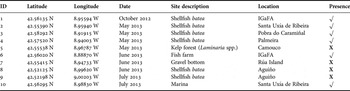
Following the first findings, 10 dives focusing on assessment of the species presence in other localities along Ría de Arousa were organized. Out of these 10 dives, six (60%) succeeded in locating numerous aggregations of C. mutica on different aquaculture structures, confirming the establishment of this species in Galician waters (Table 1).
Data from the surveys indicating presence/absence of Caprella mutica.

√, present; X, absent.
RESULTS
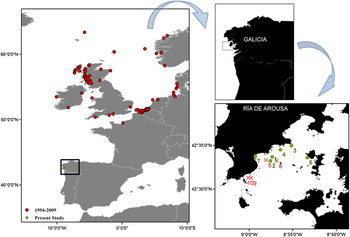
The presence of C. mutica has been confirmed in six different sites within the Ría de Arousa (Figure 1; Table 1). The first aggregations of C. mutica were found in October 2012 in a shellfish batea from the Instituto Galego de Formación en Acuicultura (IGaFA), located in Illa de Arousa (ID 1). Afterwards, the species was also found within a floating fish farm also belonging to IGaFA (ID 6). During these explorations to assess the degree of the invasion, C. mutica was subsequently found in shellfish bateas in Santa Uxía de Ribeira, Pobra do Caramiñal and Palmeira, all located on the north shore of Ría de Arousa (IDs 2, 3 and 4, respectively). Recently it has also been detected in the marina of Santa Uxía de Ribeira (ID 10). The depth-range for the specimens was between 2 and 15 m in all cases.
Updated distribution range of Caprella mutica in European waters according to data from Cook et al. (Reference Cook, Jahnke, Kerchof, Minchn, Faasse, Boos and Ashton2007a) and the new Galician records.

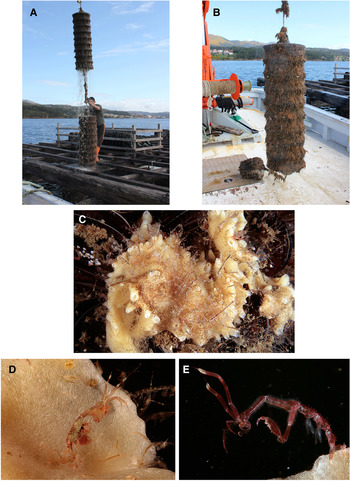
Details of one of the artificial substrata used in aquaculture where aggregations of C. mutica were found, as well as images of several specimens, are shown in Figure 2.
(A, B) artificial substrate used in aquaculture with presence of Caprella mutica aggregations; (C–E) in situ morphology of C. mutica, showing some details of fouling associated species (C) and detailed images of both male (D) and female (E).

The artificial substrata available for the species vary considerably from one place to another and include mussel rafts, fish farm nets, mooring ropes, buoys and mollusc trays.
There has not been an in-depth analysis of density so far, but some variations have been observed between localities. The highest density was found in the bateas from Palmeira, with an estimated average of 300 ind/m2. All age-classes (estimated from the size) were present in every single location, with mature females carrying brood masses.
DISCUSSION
The presence of C. mutica in Galician waters is not unexpected. The analysis of the species' distribution patterns over the years has led a number of authors to think about the possibility that C. mutica could reach the coast of Spain. There are indications that this might have been happening for several years now (Cook et al., Reference Cook, Jahnke, Kerchof, Minchn, Faasse, Boos and Ashton2007a). Some personal communications suggest in the Cook et al. (Reference Cook, Jahnke, Kerchof, Minchn, Faasse, Boos and Ashton2007a) paper that the species could have reached this area prior to 2012, but this has not yet been confirmed.
Based on current knowledge about the species biology, some studies foresee an area between 25° and 70° N where C. mutica could establish itself successfully due to yearly temperature variations being similar to those of the original location of the species where ranges from –1.8 to 25 °C (Ashton et al., Reference Ashton, Willis, Cook and Burrows2007a, Reference Ashton, Willis, Burrows and Cookb; Boos, Reference Boos2009). The Atlantic Iberian coast was also pointed out as within the potential distribution range for C. mutica with temperatures ranging from a minimum of 12.5°C in winter to a maximum of 18°C in summer (Nogueira et al., Reference Nogueira, Pérez and Ríos1996; Alvarez et al., Reference Alvarez, deCastro and Gomez-Gesteira2005). However, it is not expected to colonize certain areas such as the Mediterranean or the Baltic Seas due to its high and low levels of salinity, respectively (Cook et al., Reference Cook, Jahnke, Kerchof, Minchn, Faasse, Boos and Ashton2007a).
The vector used by C. mutica to colonize new areas is not well understood, although it is suspected that it is more likely to be via commercial and recreational shipping, rather than by the stock movement of cultured species (Cook et al., Reference Cook, Jahnke, Kerchof, Minchn, Faasse, Boos and Ashton2007a; Boos, Reference Boos2009). It has also been suggested that both, artificial buoyant (buoys, ropes and garbage) and natural materials (seaweed) may facilitate the dispersal of the species (Thiel et al., Reference Thiel, Guerra-García, Lancellotti and Vásquez2003).
In order to make accurate and useful predictions to manage and control non-native species, it is crucial to understand the nature of successful invaders, as well as the invasion process and the impact of these non-native species in the local ecosystem (Boos, Reference Boos2009). Although significant progress has been made towards the understanding of the biology of C. mutica, there are still many questions that need to be fully clarified.
From a socio-economic point of view, one of the most important issues is the potential impact of this species on native ecosystems and marine aquaculture, limiting the growth of the mussel Mytilus spp. on spat collectors (Turcotte, Reference Turcotte2010; Daneliya & Laakkonen Reference Daneliya and Laakkonen2012). The reduced size of these mussels when coexisting with C. mutica could be explained by interspecific competition for common food (phytoplankton), in which caprellids benefit from their positioning over mussels; or by the trampling done by caprellids, which would cause the mussels to close, hence interrupting their feeding (Turcotte, Reference Turcotte2010). The fact that each structure is an ideal niche for the establishment of new colonies may have dramatic consequences in a region with 3337 mussel bateas and a production of Mytilus galloprovincialis of over 200,000 tonnes yearly.
The appearance of this species in Ría de Arousa strongly suggests that it may already be present in other Galician localities, since the environmental conditions are similar as are the type of structures on which they were found. In any case, the fact that C. mutica was not present in previous surveys suggests that colonization of the species may be relatively recent.
Assessing the extent of the invasion will require large sampling efforts and the collaboration of the different sectors involved, as well as the scientific community and the regional administration. This is instrumental to assess the extent of the invasion and its impacts, as well as to minimize its possible influence on both natural and human made ecosystems.
ACKNOWLEDGEMENTS
We gratefully acknowledge the assistance of the members of Grupo do Estudo do Medio Mariño (GEMM) in conducting sampling dives. We thank Pablo Martín-Sosa for his help in revising this paper. Thanks are also due to IGaFA institute for allowing us to access their facilities to take samples.