British explorers in late Ottoman Palestine believed they had sorted out the “Bedouin race.” In racializing the Bedouin, they were guided by three ethnographic axioms. The first is the primacy of racial classification—a new scientific dogma sparked by the need to manage differences overseas. The origins of racial classification in modern European thought can be traced back to the debate between monogenists and polygenists in the early decades of the 18th century. These two groups sought to map the origins of human race(s) by charting differences in external appearance among present and past populations. While monogenism espoused a single origin of humanity as envisioned in the Biblical narrative, polygenism maintained that human races originated in separate racial lineages with varying qualities, and hence represented a hierarchy. Polygenism rested on the assumption that external appearance—including physical, biological, social, linguistic, and cultural traits—corresponded to distinct racial strata. Ultimately, it was the seemingly secular polygenists who began advocating the existence of racial supremacy among human races. Polygenism proved especially appealing to Europeans in the age of overseas adventure, trade, exploration, and discovery. In the course of 19th-century European colonial expansion, which involved the accumulation of new ethnographic, anthropological, linguistic, and biological knowledge, polygenism prevailed, becoming the intellectual hallmark of European racial thinking.Footnote 1
In Palestine, this novel way of imagining human relations was undertaken by a new breed of British explorers whose interest in the Bedouin went far beyond the romantic legacy of the 18th century. These explorers were writing at the peak of scientific racism in England, British nationalism, and imperial expansion. Working under the auspices of the Palestine Exploration Fund Society, they embarked on imperial careers that reflected the strong nexus of knowledge and power underpinning British policy in Palestine. Their legacy culminated in a new racial taxonomy that, by simply sorting out the physical and social peculiarities of the local population, insisted on viewing its demographic strata as belonging to different races. As a result, three “Arab races” were sorted out: the Bedouin, the fellaheen, and the townspeople. Only the Bedouin, however, were labeled “true Arabs.”
The second axiom is the dialectical relationship between race and nomadism. In a remarkably deterministic view, British ethnographers in Palestine singled out the Bedouin as a pure race because they are Bedouin: thanks to a unique value system and mode of life, the Bedouin managed to survive the vicissitudes of time, preserve their racial purity, and survive as the “original Arab race.” The Bedouin are also mobile, evasive, and fugitive people whose inherent character is averse to modern civilization. They live deeper in the desert, on the fringe of the country, where the tempo of life never changes, as a homogenous, archaic, and primordial people in a pristine state free of foreign influence. They maintain a strict system of intermarriage, and a deep-rooted tradition of blood relation and noble descent. They descend from the cradle of the Arab race, the Arabian Peninsula, and speak pure Arabic. In short, this view maintained that if there existed an Arab race, then, inherently, it must be Bedouin-nomadic.
The third axiom is the inherent opposition between nomadism and autochthony. Locking their tribal subjects into a state of perpetual mobility, British ethnographers viewed the Bedouin as a race of stateless, unsettled, and rootless nomads. As the descendants of the original Arab tribes who invaded Palestine in the 7th century, they represent a foreign race that, immune to racial assimilation, remade the country in its own image as a barren land. They are a race of conquerors responsible for the destruction of what was once the fertile granary of Roman Palestine. They are lawless intruders, enemies of the state, and barbarians at the gate. They are anathema to history, progress, and state-building. They live on primitive modes of production devoid of labor, property, and land cultivation. The Bedouin, in this view, stand at the opposite end of European conceptions of belonging, autochthony, and nationhood.
As we shall see, it was the well-established link between race and nomadism, embodied in the identification of Arabness with tribalism and conquest, that ultimately enabled British ethnographers to reinforce the image of the Arabs as a foreign race in Palestine. The Bedouin are not inherently nomadic, but treating them as such enabled the British to view tribal formations as the antipode of rootedness, belonging, and, most importantly, state and nation building. This view explains the shift in British ethnographic discourse from the model of the Bedouin to that of the fellah as the locus of national revival in Palestine, a shift mediated by the interplay in this discourse between the spatial (territoriality) and the temporal (autochthony).Footnote 2 This shift marked a total reversal of early British ethnography in Palestine, where the Bedouin had been portrayed as a pure racial archetype and ideal national prototype.
In its British version, racializing nomadism, or nomadizing Arabs, meant that Palestine, where the Bedouin and nomadic population constituted a tiny minority of the population, was not “purely Arab,” as one official document put it,Footnote 3 and hence belonged not to the Arabs, but rather to the Jews, as the Balfour Declaration would have it. During the Mandate period, this view would culminate in one of the most enduring and widespread myths about the Bedouin of Palestine in British ethnographic discourse, namely, the clearly ideological construct that they were the “original Arabs.”
Historians of the British Empire tend to agree that racial thinking emerged in British literature and the British popular imagination in the late 18th century.Footnote 4 These historians have explored myriad aspects of race in British colonial discourse, ranging from gender and sexuality to class and nationality.Footnote 5 Their scholarship, however, tends to focus on manifestations of racial thinking in this discourse, paying little attention to its colonial origins.Footnote 6 Yet there is sufficient textual evidence to suggest that British racial thinking was born in the encounter with natives, namely, through the uneasy marriage between race and ethnography. A notable case is British India. Historians of the British Raj have recently examined the rise of scientific racism in colonial India, and how modern theories of racial hierarchy guided 19th-century British encounters with Indian society.Footnote 7 As I show, Ottoman Palestine was yet another stage for this kind of exchange. By the close of the 19th century, men such as Richard Burton and Charles Tyrwhitt Drake had already turned Ottoman Syria into a laboratory for experimentation in scientific racism. It was left to their successors at the P.E.F. Society to implement their doctrine on the population of Palestine, a process that culminated in a new taxonomy of racial classification. By showing that the Bedouin served as a passive agent of a new “scientific” revolution, I aim to shed light on the colonial roots of British racial discourse.
The British did not invent racial classification ex nihilo. French travelers in Egypt and Syria during the 19th century, notably C.F. Volney, tended to classify the native population along purely racial lines.Footnote 8 Race thinking was also part of Ottoman ethnographic discourse, which crystallized in the wake of the Young Turk Revolution. In fact, one defining feature of the 1908 revolution was the secularization of Ottoman identity through the substitution of religion with race, hence Turkification and Turanianism.Footnote 9 Yet in the late Ottoman period, Arabs and Jews in Palestine were rarely identified in racial or ethnic terms. Instead, local identities were largely based on the millet system, by which Ottoman officials classified their subjects into broader religious categories that were rather flexible and loose, and relatively free of racial overtones. Only with the British did the doctrine of racial classification in Palestine reign supreme. In a notable departure from the ethnographic tradition of their Ottoman forebears, British explorers in Ottoman Palestine tended to divide their subjects along strictly demarcated ethnic lines.
THE DISCOVERY OF THE “BEDOUIN RACE”
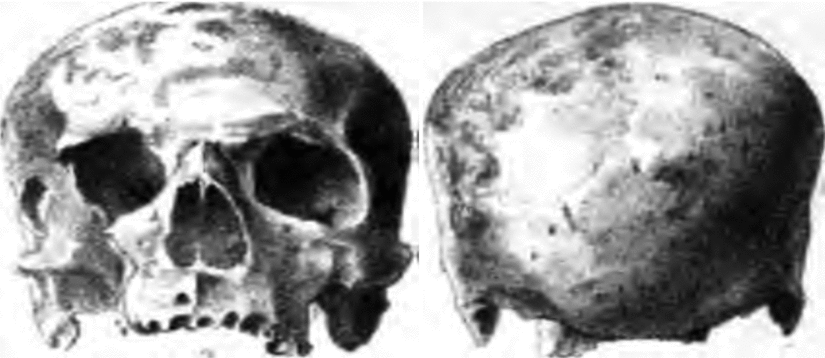
In 1869, after a long journey that took him from West Africa to the Americas, Richard Burton landed in Syria to assume his new post as British consul in Damascus, which he would hold until 1871. Taking on an official position did not end his passion for exploration in a country that he still considered terra incognita, as he recalled upon his return to London in 1872.Footnote 10 Sponsored by the newly founded Palestine Exploration Fund, Burton documented in detail his explorations in Syria and Palestine in his largely overlooked collection Unexplored Syria, written jointly with his fellow traveler Charles Tyrwhitt Drake.Footnote 11 Burton and Drake presented part of their findings in Palestine in a separate paper at the meeting of the Anthropological Institute on 20 November 1871.Footnote 12 The paper, entitled “The Anthropological Collection from the Holy Land,” examines an exhaustive list of skeletons, fossils, skulls, bones, and other human remains gathered by the two explorers during their expedition in the country. They sorted out, compared, and classified these specimens into distinct racial types, origins, and survival capacities. In one instance, they asked members of the institute to determine whether the extreme length of a given skull typified a race or an individual character. Matching the skull to its corresponding racial type, the members labeled it as “Syrian” (Figure 1). In another instance, they classified a large jaw as corresponding to racial characters of “the Badawi Arabs.”Footnote 13
A “Syrian” skull gathered by Richard Burton and Charles Drake in Syria. From Richard Burton and Charles Drake, Unexplored Syria (London: Tinsley Brothers, 1872).

Unexplored Syria marks Burton's interest in phrenology as the locus of ethnographic classification. It was the culmination of two decades of radicalization in his racial thinking following the scientific revolution wrought by the publication of Charles Darwin's Origins of Species in 1859, described by Burton as “the best and wisest book of this, or perhaps, of any age.”Footnote 14 Taken by the spread of scientific racism, Burton sought to build his theories into an institution. In 1863, he collaborated with James Hunt to found the Anthropological Society of London as a breakaway from the London Ethnological Society. The Anthropological Society distinguished itself from its predecessor by advocating the doctrine of polygenesis as the basis of racial classification, abandoning the philological approach to ethnographic research, and denying the influence of climate on physical appearances. Emerging as the hallmark of scientific racism in Britain, the new society embraced a strict biological approach to ethnographic classification, one involving the application of phrenological and craniological anatomy of the human body, such as skull size, body shape, skin texture, and color.Footnote 15 Within a few years of its inception, the Anthropological Society sponsored numerous publications that advocated the doctrine of racial hierarchy, propagated the superiority of European races, and championed British imperial paternalism over the “lower races” of Asia and Africa.Footnote 16 Burton, who served as the first vice president of the new society and chaired its inaugural meeting in London, embodied the scientific dogmatism that characterized its doctrine. Nowhere is this dogmatism more manifest that in his phrenological description of the “Bedouin race”: “The bones vary from the very massive to the remarkably thin, and the first points which struck me were the shortness of the lower bi-temporal diameter, the long square face, and the flatness or compression of the parietes, which every traveler remarks in the Badwain, the flower of the Semitic race.”Footnote 17
Burton was far ahead of his Victorian contemporaries, and his racial legacy reshaped the ethnographic thinking of his time. To him, anthropology was no longer concerned with human societies, but with human races. His travel literature was equally racialized. Whereas for European travelers in the early 19th century exploration was primarily associated with the discovery of hitherto uncharted lands, Burton linked exploration to the discovery, if not invention, of human races. His passion for race knew no limits, and it characterized both his research and his personal life. Burton was so enchanted with the “Arab race” that he ordered a tomb for himself in the shape of a Bedouin tent, and even suspected that he had Arab blood in his veins. An obituary reprinted by his wife, Isabel Burton, suggested that there might have been “a tinge of Arab, or, perhaps, of gypsy blood in Burton's race.”Footnote 18 Writing within the fast-growing tradition of raciology, and at a time when Englishness itself was being restructured into new racial taxonomies, Burton sought to create the Bedouin in his own image: an ideal archetype of racial purity.
To be sure, Burton did share with his British peers, notably his fellow traveler in Palestine Edward Palmer, the view of the Bedouin as a noble savage, even, as he put it, “a nuisance to be abated by civilization.” Yet he diverged from this view by maintaining that the Bedouin could be managed, if not used for genetic replication: “The race has high and noble qualities which, as the old phrase is, the world would not willingly see die; and perhaps the pure blood of the wilderness may be infused to good purpose into burgher-men, as into their horses.”Footnote 19 Burton's views also diverged from those of his peers around the notion of the racial superiority of the Bedouin, which he linked to the capacity for survival characteristic of life in the desert. In his early travelogue Personal Narrative (1855), he even anticipates Darwin by viewing Bedouin society as one in which only the fittest could survive and flourish. “In the first place, it is a kind of ‘societe leonine’ in which the fiercest, the strongest, and the craftiest obtains complete mastery over his fellows.”Footnote 20 For Burton the ethnologist, it is this racial quality that ultimately enabled the Bedouin to survive as the pure Arab race.
Burton's interest in the Arabs began early in his career. As a young student at Oxford, in the early 1840s, he called on England to study the Arabs in order to cultivate “means of dispelling her ignorance concerning the Eastern races with whom she is constantly in contact.”Footnote 21 In 1842, he withdrew from Oxford and sailed to India, where he served as a cadet in the East India Company.Footnote 22 There he composed a military manual that was adopted by the British army in India, and subsequently published in 1853.Footnote 23 In return for his services, the British Royal Geographical Society and the East India Company funded his early travels in the Arab provinces of the Ottoman empire. Arabia presented the young Burton with a mirror image of his native England, where “there has been such a mixture of blood and breed that now an almost infinite variety of features and complexions, shapes and forms, has been grafted upon the original stock which each region grew.”Footnote 24
Burton divided the Arabs into three racial stocks—Caucasian, sub-Caucasian, and pure Arabian—a classification “which agrees with observations of modern physiologists.” He viewed the Arabs as a mixture of disparate races, and their racial disparity to be attested by the Bedouin, who demonstrate “a strong evidence in favor of a variety in the Arabian family.” His view rests on the easy assumption that the Bedouin serve as a model of racial purity because they live in a state of being where physical and social differences are absolute. Three observations appear to have guided this conclusion. First, unlike the settled population, the Bedouin exhibit unchangeable, homogenous expressions: “There is not much difference in this point between men of the same tribes, who have similar pursuits which engender similar passions.” Whereas “expression is the grand diversifier of appearance among civilized people,” Burton asserted, “in the desert it knows few varieties.” Second, the Bedouin inhabit the desert, “and they who know how immutable is race in the desert, will scarcely doubt that the Bedouin preserves in purity the blood transmitted to him by his ancestors.” Third, tribal society is adverse to interracial marriage, and hence condemned to absolute racial purity: “Such is the Badawi, and such he has been preserved by systematic intermarriage.”Footnote 25 It should come as no surprise, then, that the later Burton would view the racial disparity between the Bedouin and the settled fellahin as unbridgeable.Footnote 26
Like many of his contemporaries, Burton offered his service to the empire. He advised the British Foreign Office on how to effectively subdue the unruly Bedouin should England annex the Arabian Peninsula to its imperial domains:
By a proper use of the blood feud; by vigorously supporting the weaker against the stronger classes; by regularly defeating every Badawi who earns a name for himself; and, above all, by the exercise of unsparing, unflinching justice, the few thousands of half-naked bandits, who now make the land a fighting field, would soon sink into utter insignificance.Footnote 27
In anticipation of the “martial race” doctrine, Burton deemed tribal qualities especially manageable and useful in wartime, for “should we find it necessary to raise regiments of these men, nothing would be easier.” He advised his fellow Englishmen to “pay them regularly, arm them well, work them hard, and treat them with evenhanded justice—there is nothing else to do.” He even took pains to enumerate those tribal qualities he deemed vital to the British takeover of Palestine.Footnote 28 His ethnographic corpus is replete with suggestions that the British must manage the Arabs in the same way they had been managing Indians in the Sind, where “military government is the only form of legislature precisely adapted to these countries.” He also suggested implementing in Ottoman Palestine “the Roman system of garrisoning the forts and outposts to the east and south of Syria.”Footnote 29
In his observations on the Ottoman Empire, Burton developed his racial doctrine into a full-fledged divide-and-conquer scheme. He viewed the Turks as “a nation more hated and suspected that any Europeans, without our prestige,”Footnote 30 and attributed the near decline in Ottoman rule in the Hejaz to Turkish bureaucracy and centralization, and to the effect of “the Tanzimat, the silliest copy of Europe's folly.”Footnote 31 Styling himself as a keen observer of the natives, Burton exaggerated the enmity between the Arabs and the Turks, while reassuring his fellow Englishmen that the Arabs regarded both the Turks and the Egyptians as a more serious threat to their national interests than the British.Footnote 32 In the same breath, the British observer praised how the Arab spirit of independence and rebelliousness upset Ottoman authorities, and constantly urged the Arabs to revolt against their Turkish rulers. He championed Arab independence from the Turks, the annexation of Syria to Egypt, and, ultimately, British rule over Egypt, “the most tempting prize which the East holds out to the ambition of Europe.”Footnote 33
Burton left his imprint on fellow British explorers and ethnographers at the time.Footnote 34 His racial legacy, while largely devoted to the Bedouin of Arabia, would color British policies and attitudes toward the Bedouin of Palestine. His ethnographic legacy in Palestine proved remarkably timely. By the time of his death in 1890, England had already occupied Egypt and further extended its influence in the Levant, where the Ottoman Empire desperately struggled to come to terms with growing ethnic and national sentiments in its Arab provinces. By the close of the century, England had been battling imperialist rivals such as France and Tsarist Russia to gain a permanent toehold in the Levant. British officials began to recognize the political importance of Palestine, its strategic location as a major juncture between competing empires, and the benefits of integrating it into the global market.Footnote 35 This period was also a time of growing religious and ethnic activity in Palestine. England's interest in the Bible was revived by its explorers in the Holy Land, British missionaries joined American missions in Jerusalem, and the idea of Jewish return to Palestine began to gain currency in Britain, where imperial policy joined forces with Christian evangelism in championing England's paternalistic claims to protect religious minorities abroad.Footnote 36 British fascination with the “Arab race” lost none of its force in this period. On the contrary, the British realized that in order to hasten the end of the Ottoman Empire, England had to ally itself with, mobilize, and, most importantly, gain knowledge of the native Arab population by studying its racial and ethnic composition.
EXPLORING THE ARABS: BRITISH ETHNOGRAPHIC LEGACY IN PALESTINE
In 1865, nearly two years after the establishment of the Anthropological Society, the Society of Palestine Exploration Fund was founded in London with the aim of carrying out surveys on the topography, ethnography, and anthropology of Ottoman Palestine. At its first official meeting, held at the Jerusalem Chamber of Westminster Abbey, William Thompson, the Archbishop of York, summed up the scholarly objectives outlined in the new society's original prospectus as an attempt “to apply the rules of science . . . to an investigation into the facts concerning the Holy Land.” One of these objectives also involved “bringing to light the remains of so many races and generations which must lie concealed under the accumulation of rubbish and ruins on which those villages stand.”Footnote 37
Yet, as we shall see, this seemingly uncompromising scientific vision of the new society was challenged by two factors: first, the inherent tension between the Biblical source and the findings of modern science, which was often resolved in favor of the Biblical interpretation; second, the uneasy ties between the P.E.F. Society and the British imperial enterprise in Palestine. This imperial link became all the more apparent as the new society, in part due to its complex relationship with the Corps of Royal Engineers, rapidly abandoned its original objectives and embarked on military intelligence gathering and conducting reports on how to effectively manage the local population. This strong nexus between knowledge and empire was also largely embodied in the imperial careers of prominent P.E.F. personages, such as Edward Palmer, Charles Warren, Horatio Kitchener, Charles Wilson, T.E. Lawrence, and C.R. Conder.
British explorers who visited Palestine on behalf of the P.E.F. Society fell under the same racialist outlook that had attracted Richard Burton and Charles Drake. Nowhere was the influence of these two men more manifest than in the writing and activity of Colonel Claude Reignier Conder, the British explorer whose legacy would color the ethnographic debate in Palestine for decades to come. Conder completed his education at University College London, followed by a degree from the Royal Military Academy at Woolwich and a commission in the Royal Engineers in 1870. Two years later, he was selected by the Royal Engineers to undertake a grand survey in Western Palestine, where he joined Drake and his team in mapping the topography of the land, exploring its archaeological sites, and studying the ethnography of its population. By 1875 he had completed the greater part of his survey before he fell ill and was taken back to London.Footnote 38 The expedition resulted in a landmark topographical survey of Western Palestine, from the Litany River in the north to Beersheba in the south, and the 1881 publication of the monumental Survey of Western Palestine, which included a “Great Map of Western Palestine,” printed in twenty-six sheets, on a scale of one inch to a mile.Footnote 39 The project sparked flames of anticipation in England. As a review dated July 1878 put it: “For the first time then, and as a reward of these efforts, Palestine is brought home to England.” Conder was celebrated in London as the man who “placed Palestine vividly before the reader.”Footnote 40
One year later, in 1882, Conder returned to Palestine to supervise a new grand survey in the eastern part of the country (today's Jordan), before the project was temporally halted within a year by the Turkish authorities.Footnote 41 The results of this expedition appeared in his second landmark survey, The Survey of Eastern Palestine, published in 1889.Footnote 42 Both expeditions were carried out under the auspices of the P.E.F. Society, and in the words of David M. Jacobson, Honorary Secretary of the fund, “this substantial legacy provided the foundations for the survey work done during the period of the British Mandate.”Footnote 43
Like Burton, Conder found in Palestine the kind of intellectual freedom cherished by European explorers and travelers abroad. For the most part, the country remained largely a terra incognita to him, and “it was possible to visit villages where the face of a Frank had never been seen.” Palestine also presented Conder with “a chance of studying the archaic manners of the peasantry and the natural condition of the nomadic Arab.” The two groups, by virtue of being largely untouched by foreign influence, presented him with a carte blanche to conduct his ethnographic research: “I have attempted to give some idea of the country as it was in the last years of its truly Oriental condition, with a peasantry as yet hardly quite tamed by the Turk, and regions as yet hardly traversed by the European explorer.”Footnote 44
Conder's ethnographic corpus includes two volumes on Palestine, Tent Work in Palestine (1878) and Palestine (1889).Footnote 45 Palestine, fashioned after Unexplored Syria, attests to his intellectual devotion to Burton and Drake. It is a classic example of the tendency, established by Burton, to group ethnography and raciology into a single taxonomy, and to read ethnography through the lens of race by fitting physical and social differences into distinct racial categories. Tent Work follows the same methodological pattern. The book, which summarizes Conder's first ethnographic survey in the country, tends to fuse race with ethnography by viewing Arab Palestine as a mishmash of pure and mixed races.
Initially, Conder divided the “present races of Palestine” into three original stocks: Semitic, Turanian, and Aryan. Like Burton, he employed phrenology as a key criterion for matching each of these stocks with its respective race within the population: “If the peasants are to be asked to have their heads measured, we must know something of their genealogies also. If skulls are to be collected, we must find out what skulls they are.” Linking race to genealogy, Conder, who appears to have examined the skulls gathered and brought in to London by Burton and Drake, further remarked: “I have known the skulls of peasants recently murdered to be sent home as types of the ancient population of the country.”Footnote 46
Cultural traits provided Conder with another key criterion for racial classification. Thus, for example, he contended that the Semitic origin of the Arabs and the Jews is attested by their common distaste for the arts: “The distinction is, however, one of race, for the Arab hates carved images as much as did the Jew, while the Turanian Canaanites were fond of such arts.”Footnote 47 This is followed by a warning: “In considering the character and manners of the natives of Palestine, there is one circumstance which must always be kept in sight—we are dealing with a Semite, not with an Aryan, people, and they must be judged from a Semitic point of view.” This “Semitic point of view” entailed “the faults and virtues of the Semitic race [which] are so distinct and peculiar, that is not easy for a European to judge of them fairly.” In other words, the Semitic race is not merely the sum of its physical and phrenological traits, but also the product of cultural and social peculiarities that include “ideas of right and wrong, of the beautiful and the praiseworthy, of religion and morality”—in short, ideas that had ultimately rendered the Semites “essentially different from us.”Footnote 48
After establishing its Semitic origin, Conder divided the local Arab population of Palestine into three distinct races: the Bedouin, the fellahin, and the townspeople. The racial distinction between the Bedouin and the fellahin was translated by Conder into one of national difference: “the peasantry must not be confused with the Badwain or nomadic tribes, living in the uncultivated districts; for the two nations are quite separate branches of the Semitic people, and they themselves acknowledge the distinction.”Footnote 49 To the British observer, the racial disparity between the Bedouin and the fellahin was largely an outcome of their common aversion to “interracial” marriages: “The Badawi speaks with the greatest contempt of the Fellah, and rarely, if ever, do intermarriages occur, as both sides would consider themselves degraded by the alliance.” Racializing Bedouin “contempt” for the fellahin is a governing theme in Conder's writings, where the presumed, if not projected, traditional enmity among the local population is almost habitually reconstructed into well-defined racial strata. Ultimately, and upon consulting a host of Biblical passages, Conder asserted “the time-honored conflict between the two races” as a matter of well-established historical fact.
Conder had little to say about the townspeople Arabs. Instead, he referred the reader to the work of his fellow British orientalist Edward Lane, whose “wonderful account on the life of townsmen of Egypt would apply almost equally well to the middle classes in Damascus and Jerusalem.” The reason for Conder's omission of this “third race” from his ethnographic narrative, we are told, is to draw more attention to the life and manners of the Bedouin and the fellahin, who are “far more valuable in illustration of the Bible narrative than are those of the townsmen.” Unlike the townspeople, the other two races are more ancient, archaic, and pristine. They serve not only as human relics of a sacred history, but also as agents of historical return to a lost biblical time. For Conder, the Bedouin are most interesting to the study of early Jewish history because “if among the peasantry we find a vivid picture of the life and customs of the later period, it is from the Bedawin that we learn most that can throw light on the Patriarchal times, and the life of Abraham and his immediate descendants.”
Not that the Christian explorer viewed the fellahin to be of less biblical value than the Bedouin. On the contrary, “it appears in short that in the Fellaheen, as descendants of the old inhabitants of Palestine, we find a people whose habits and customs are well worthy of study, because we should naturally expect them to throw much light on the Bible narrative.” The fellaheen, in fact, represented a race many centuries more ancient than the Bedouin, whom Conder viewed as “a horde of recent invaders.” This last observation is attested by a host of linguistic and cultural differences, which “confirm the views already expressed as to the antiquity of the Fellah race, contrasted with the more modern settlers who have encroached on their territory.”Footnote 50 One could hardly overlook the irony of dubbing the nomadic Bedouin “modern settlers.”
Conders constantly contrasts the perception of the Bedouin as a foreign race with the autochthony of the fellahin, and by introducing the conquest paradigm, he rendered absolute the disparity between the two “races.” This presumed disparity perhaps explains his main conclusion that the present fellahin of Palestine are none other than the descendants of the ancient Canaanites. “When compared to the earlier inhabitants of the land, from the days of Samuel downwards, the parallel is so remarkable that it seems justifiable to dub the fellahin the ‘modern Canaanites.’” As the descendants of the old inhabitants of Palestine, and hence the true sons of the land, the fellahin are labeled “Syrians, for want of a better title.” For Conder, the fellahin constituted along with the Arabs (Bedouin) and the Jews the fabric of the Semitic race in Palestine, joined by an admixture of foreign races, such as the Germans, the Turks, and the mongrel Levantines. The fellahin, therefore, represent a single nation by virtue of their “character, language and religion, which are the three fundamental questions regarding any nation.”Footnote 51
By arguing for the Canaanite origin of the fellahin, Conder was echoing a narrative that came to predominance during his lifetime, and would color the ethnographic debate on the Arabs of Palestine for decades to come. This debate was sparked by the French ethnographer Charles Clermont-Ganneau following his archaeological expedition to Palestine, which he undertook on behalf of the British government in 1874.Footnote 52 The next year, Ganneau presented his findings in a lengthy paper on the “Arabs of Palestine,” in which he declared the fellahin of modern Palestine to be the direct descendants of the ancient Canaanites: “I, therefore, arrived at the conclusion that the fellaheen of Palestine, taken as a whole, are the modern representatives of those old tribes which the Israelites found settled in the country, such as the Canaanites.”Footnote 53
What preoccupied Ganneau was not the question of whether the fellahin and the Bedouin belonged to the same racial stock, but the identity of the peasants whom the Arab conquerors had found in the country, and who became the fellahin of our time. “These peasants were neither Jews nor Greeks,” Ganneau contended. They were not Greeks because they still retained a host of observable Semitic traces. They certainly were not Jews because the Jewish race was “forever lost in Palestine,” where successive persecutions of Jews by Christian emperors “left no one stone upon another of either political or ethnic Judaism; they made it a tabula rasa, and cast the debris to the four winds of heaven.” Finally, the fellahin were most certainly not Arabs. They were Arabs only in the sense that they spoke Arabic, rendering “Arab” a rather “vague and deceptive term which is applied to so many distinct races and the heterogeneous remains of so many peoples.”Footnote 54
With Genneau, the Bedouin were no longer seen as an archaic race towering over a linear hierarchy of Arab races, but as a foreign race whose presence in Palestine represented a sad chapter of racial assimilation in the unfolding history of conquests. “Since the predominance of Islam,” he wrote, “the whole system of Semitic nationalities has followed the irresistible tendency to unity resulting from the pressure of linguistic conformity and political necessity.” As a result, racial divisions in Palestine “have poured their waters into this Arab lake, and have converted it into an ocean, in which every confluent loses its name.”
Yet Genneau warns that, when related to the Arab conquest of Palestine, racial domination should not be mistaken for racial superiority. For unlike the Christian crusaders, the Arabs were merely a conquering, and by no means civilizing, force. To the Christian ethnographer, civilization remained elusive to the Arabs because “a civilization, be it remembered, cannot be produced spontaneously, or improvised, any more than can a patrimony; it is the hereditary accumulation of living forces—a treasure formed by the hoarding of ages”—in a word, Christian.Footnote 55
For Ganneau, the civilizational chasm separating the two conquering races was best reflected in Arab attitudes to cultivation, a new taxonomy that enabled the French ethnographer to draw a sharp line between nomadism and civilization. Unlike the Christian conquerors, Ganneau reminds us, the Muslim conquerors, “as regards agriculture, knew no soil but the sand of the desert, and no tools but the point of the lance.” It was thus the fellahin, not the Bedouin, who incarnated the true biblical spirit by preserving the “Mosaic legislation [which] was founded on agriculture.”
Clearly Ganneau had little sympathy for Arab civilization, which he viewed as “a mere deception [that] no more exists than in the horrors of Arab conquest.” If anything, Arab civilization was “but the last gleam of Greek and Roman civilization gradually dying out in the powerless but respectful hands of Islam.” The “horrors of Arab conquest” only amplified his lamentation over the fall of Christian rule in Palestine, whose sole remnants were now reflected in the “anthropological trace of its passage, and the yellow hair and blue eyes which sometimes even at the present day the astonished traveler may see beneath a Bedouin kufiya or a fellah turban.”Footnote 56
For the French ethnographer, race alone could explain the present ethnographic reality of Palestine. That Arab rule had a more lasting impact on the local population than Christian rule is attributed to the racial affinity between the Arab conquerors and the conquered natives (the fellahin), both of whom were Semites. As a result, “the whole population accepted by a large majority, not only the language of their conquerors, which was somewhat akin to their Semitic dialect, but also their religion, in which they saw a slight but attractive resemblance to their own vague Christianity.”
What is perhaps unique about Ganneau's ethnographic narrative is his classification of the Bedouin and the town Arabs into a common racial origin. This classification leaves Palestine with two major racial stocks, thereby pitting the “indigenous” fellahin against their new masters. Drawing on a host of customary and linguistic peculiarities among the fellahin, Ganneau distinguished the “Arabized race” of the sedentary population from that of the “nomad hordes who came from Arabia with the Caliph Omar, and who are for the most part settled in the town.”Footnote 57 Ganneau thus followed Burton and Conder in exaggerating the racial disparity between the Bedouin and the fellahin by drawing on the same conquest paradigm. Yet it was the conquered fellahin, not the conquering Bedouin, who now embodied, by virtue of settlement and cultivation, the prototype of national revival in Palestine.
This period was thus marked by a growing disenchantment with the Bedouin as a model of autochthony in Palestine. Edward Palmer, Ganneau's peer at the P.E.F. Society and one of Conder's associates in the survey of western Palestine, began to entertain the hypothesis that the Bedouin of Palestine were not indigenous to the country, but descendants of its 7th-century Arab conquerors. Palmer, who had collaborated with Drake and his P.E.F. team in producing the first comprehensive map of the Negev region, argued that “Sinai was peopled formerly by other than a pure Arab race, and the present Bedouin came over with the (Arab) Conquest.”Footnote 58 For the British explorer, the Bedouin represented a “pure race” precisely because they are a conquering race in whose blood “there are still traces of a primeval race of inhabitants.”Footnote 59 Despite his evident hostility towards the Bedouin, Palmer could hardly hide his obsession with the kind of racial purity that they typified. In an 1871 book on Jerusalem, which he co-authored with Walter Besant for the popular market, he lamented the fact that a great many European Christians who had settled in Palestine during the Crusades intermarried with native Christians and other Semitic races had produced a race of semi-Asiatics called pullani (derived from the Arabic fulānī, meaning anybody). These pullanis, Palmer asserted, “seem to have united the vices of their descent, and to have inherited none of the virtues.”
In Palmer's writing we also find precursors of a declensionist discourse that increasingly viewed biblical Palestine as a fertile granary turned into ruins by the Arab conquests. As he wrote in his well-known Desert of Exodus (1871), “At the time of the Exodus it must have borne a similar relation to the then fertile region of the Negev which that now barren tract at the present day bears to Palestine.”Footnote 60 Palmer, who edited with Walter Besant thousands of Arabic place names for the P.E.F. survey of Palestine, noticed with disapproval how “villages [were] deserted in consequence of the encroachment of the Arabs into the country of the fellahin.”Footnote 61 Palmer viewed the Bedouin not only as the lowest race in Palestine, but also as an inherently destructive race untouched by civilization. “Wherever he goes, he brings with him ruin, violence and neglect.” Drawing a familiar comparison between the Bedouin and the Native Americans, he wrote, echoing Burton: “The sympathy already wasted on the Red man of North America warns me that . . . the ‘noble savage’ is a simple and unmitigated nuisance. To the Bedawi this applies even more forcibly.”Footnote 62 The Bedouin, in short, were at the other end of modern civilization.
The Bedouin also presented Palmer with the antitype of autochthony, belonging, and national affiliation. To him, the Bedouin lacked not only the European characteristics essential for modern nationhood, but even the noble qualities bestowed on them by earlier British explorers. Palmer clearly distinguished himself from his contemporaries, notably Burton, with whom he had close personal and intellectual ties, by protesting their romantic views on the racial quality of the Bedouin, especially when contrasted with that of the Europeans. “Although romance and war are intimately associated with our ideas of Arab character,” he wrote, “we shall look in vain among the inhabitants of the desert for any such annals as the chivalry of Europe has produced.”Footnote 63
Palmer's observations on the Bedouin were largely drawn from his expedition in the Negev desert, which he undertook as part of the P.E.F. survey of Sinai in 1869. This was followed by his famous explorations in the el-Tih desert, which, in company with Drake, he completed on foot and without escort, while making acquaintances with the local tribes, to whom he became known as ʿAbd Allah Effendi. This journey, Palmer observed, only sharpened his sense of disillusion with the Bedouin as a model of national revival in Palestine. For the most part, “they have no history, because they have no nationality. Their country, their mode of life, produce a kind of clanship among the members of individual tribes, and perhaps of sympathy with the rest of the race, but here these ties end.” For Palmer, the Bedouin lacked a national character because their loyalty is to the tribe, not to the nation. In his words, if the “Arab of the desert submits himself to no one, and owns no earthly lord or master but his own sovereign will,” the Bedouin “have not even a social, much less a political, organization.”Footnote 64
In 1871, the same year his Desert of Exodus was published, Palmer became Lord Almoner's Professor of Arabic at Cambridge University, where his writing about the Arabs assumed an air of academic authority. His ethnographic legacy on Syria and Palestine loomed large over the P.E.F. Society.Footnote 65 It helped resituate the fellah, not the Bedouin, as the locus of national recovery in Palestine, first by reinforcing the dual racial paradigm created by his predecessors, and second by implicating it with a declensionist narrative on the Arabs as an inherently destructive race.Footnote 66 Ironically, Palmer's view of the Bedouin did not prevent him from returning to Sinai in 1881 on behalf of the British government, where, by his account, he managed to mobilize the Arab tribes against the ʿUrabi revolt in Egypt, before he was led into an ambush and murdered with his companions on their way to Gaza in August 1882.Footnote 67
The image of the Bedouin that emerged from Palmer's writings was a total reversal of early British ethnography in Palestine, which portrayed the Bedouin as the aristocracy of the East, a pure racial prototype, and a model for national revival. His Bedouin were a horde of stateless, unsettled, and rootless nomads, foreign invaders, illegal intruders, a war-machine, and barbarians at the gate. Ironically, the perception of the Bedouin as stateless, unruly, and lawless did not prevent the British administrator from recruiting local tribesmen to assist the military in maintaining law and order in Sinai and southern Palestine. Eventually, the double image of the Bedouin as both lawless and law keepers masked a profound failure on the British ethnographer's part: his inability to reconcile his assimilating doctrine with his depiction of the Bedouin as a primitive, archaic, and static race. Palmer also failed to realize that the rationality of assimilation, predicated on the desire to integrate the natives into the superior culture of their colonial masters, stood in sharp contrast with perceptions of the native Bedouin as an inferior and unsophisticated race. This failure led him to conclude that tribal assimilation, as a colonial doctrine, was an inherent impossibility. The solution was to simply classify the Bedouin as a martial race, fit for warfare, rather than nation and state building, a policy that he seemingly adopted from the martial races doctrine implemented throughout the British Raj.
Conder, who had collaborated with Palmer in the survey of western Palestine, joined the burgeoning declensionist discourse on the Bedouin in a special paper published in the PEF Quarterly, tellingly entitled “The Fertility of Ancient Palestine.”Footnote 68 Drawing equally on Biblical sources and the findings of his survey, Conder argued that deforestation, desertification, and the decay of cultivation should not be attributed to climatic causes as much as to the destructive quality of the Arab race in Palestine. “The curse of the country is bad government and oppression,” he protested. “Justice and security of person and property once established, Palestine would become once more a land of corn, vines, and olives, rivaling in fertility and in wealth its ancient condition.” His conclusion about the fertility of ancient Palestine was “deduced from careful study of such notices as remain to us in the Bible and in the later Jewish writings.”Footnote 69 Conder believed, following Burton and Palmer, that the task of restoring Palestine to its biblical condition should rest upon England's shoulders. A pervasive sense of civilizing mission permeates his frequent allusions to the fertility of the country under the Romans and the Christians, from whom England was already claiming a natural and legitimate descent.
What is novel about this discourse is the interplay between the spatial (territoriality) and the temporal (autochthony) in the reinstitution of the fellah as the model of national revival in Palestine. Conder's narrative on the fellahin of Palestine, as an 1878 review of Tent Work put it, established the notion that “the fellahin of today are the actual descendants and the real representatives of the ancient inhabitants of the land.” This fact, the reviewer asserted, is evident in their character, language, and religion, “the three fundamental characteristics of nationality from which their origin may be rightly conjectured.”Footnote 70
Conder thus inherited the double tendency embedded in the genesis of the P.E.F. Society: the subjugation of modern science to the Biblical text, and of knowledge to the service of the empire. These two tendencies are closely intertwined. Thus, for example, his explorations in the ancient Biblical sites of Palestine serve as a reminder to his English peers of why the country should be reclaimed by the British. “That the Christians are bent on the reconquest of the land, which—as every ruin in Palestine witnesses—was once under their rule, is devoutly believed by the Fellaheen and the Arabs.”Footnote 71 That Conder rendered the local population a mere witness to his cyclical, if not deterministic, view of history clearly testifies to the tendency among imperial agents to project their wishes onto their subjects. Forcibly woven into the imperial realities of Palestine, his evangelical vision leaves nothing for the native population but silent consent. In his approach to Biblical narratives, Conder also embodied what Eric Auerbach refers to as the “claim of absolute authority” and the tendency “to overcome reality” in Western interpretations of the Bible.Footnote 72 Rather than the present condition of the country, Conder constantly reminds his readers that the distant memory of the Crusades should serve as a model for effective governance of Palestine should it fall under British rule. “We have historical evidence of the possibility of Western rule becoming consolidated and prosperous and the history of the Crusading kingdom is remarkably suggestive of the true principles on which such government should be framed.”Footnote 73 One detects a curious parallel here with Burton's proposal to restore “the Roman system of garrisoning the forts and outposts to the east and south of Syria.” For Conder, however, the restoration of Palestine to its ancient condition rested on virtues which the Bedouin were inherently lacking, namely, land settlement and cultivation.
Conder also inherited the strong nexus of race and ethnography underpinning British colonial discourse. He found in the history of the Crusades a rare example of how race could function in the process of empire building. He attributed the fall of the Frankish Kingdom in Palestine to the lack of racial purity among the later generations of the original Latin conquerors. In the early period of the Crusades, we are told, “the forces of the [Christian] conquerors were constantly recruited with fresh blood from the West.” Up to the 13th century, and for more than 150 years, the Arabs of Syria and Palestine were content to be ruled by a master Latin race whose racial unity also testified to its supremacy. This period came to an unhappy end as the Frankish kingdom fast receded into a process of racial assimilation. For unlike the eagerness with which the first conquerors had colonized the country, the subsequent intermarriages with the local races—Armenians, Greeks, and Syrians—reproduced in the Latin race the vices and weaknesses of each of those races, which ultimately endangered its vigor, energy, and capacity for survival. This interracial phase led to an unfortunate sequence of events which, according to Conder, culminated in the fall of the Frankish Empire and the reconquest of the country by the Arabs. Eventually, the Franks were defeated precisely because they lacked the kind of racial purity enjoyed by the new conquerors, “the free Arabs who had never been conquered.”Footnote 74
Like Burton and Palmer before him, Conder put his expertise in the service of the empire. His imperial scheme for Syria and Palestine was outlined in a lecture delivered for the Palestine Exploration Fund in 1892, and reprinted in the sixth edition of Tent Work (1895).Footnote 75 The lecture, aptly entitled “The Future of Palestine,” reads more like an imperialistic manifesto than ethnographic research. It addresses, with an air of urgency, questions of a political nature, notably “the colonization of Palestine, and the acceleration of Jewish return to it.”Footnote 76 Most importantly, it attempts to account for the emergence of Palestine on the British imperial stage as a strategic juncture in the Levant. With Conder, Palestine is no longer merely seen as the locus of biblical revival, but also as a country with “immense military value to England.” For example, he was quick to realize the centrality of Palestine to British imperial interests following the acquisition of Cyprus in 1878, which enabled England to secure a military base for future operations on the Levantine coast, and in the event of any struggle on the Indian borders.
Conder proves most valuable to empire-building efforts is in his area of expertise, namely, race. In 1882, he joined the British expedition to Egypt as a general officer in the intelligence department, where he collaborated with Palmer in his efforts to mobilize the Bedouin tribes against the ʿUrabi revolution. He would make his name in happier times as a leading expert on Palestine, where his ethnographic surveys on the local population, along with his topographical mappings of the country, would offer a recipe for effective British administration. As early as his 1892 lecture to the PEF Society, he had already been presenting himself as an astute observer of the racial dynamics in the country. Like Burton, he advised his government to follow the example of India, where “we have a living witness to the fact, that to some Western nations, and to England pre-eminently, is given the capability of governing the Oriental races with benefit to both the ruler and the subject.”Footnote 77
Echoing his British predecessors, Conder tended to exaggerate the enmity between the Arabs and the Turks. In his repeated claims to speak on behalf of the local population, a paternalistic terminology creeps in. Thus, for example, he informed his fellow Englishmen that “the native population lay the blame of their misery on the shoulders of their rulers, and are too anxious to pass into other hands.” Conder, who spent the bulk of his survey in Palestine among the peasant population, further asserted that “there is a very general belief that the land is destined to become once more the property of the Christians, and the Fellahin often inquire of visitors when this time is to come.” For Conder, that the fellahin “declare a preference of an English occupation of the country” is not a matter of dispute. Rather, it “shows clearly the high esteem in which our Englishmen stand, and reflects the highest credit on our Consuls, and on others, who, by their probity and energy, have created this high public opinion of a nation which is represented by so few individuals.” In a revealing statement that meshes his strategic vision with a grandiose rhetoric of civilizing mission, he reassured his audience that “the happiest future which could befall Palestine seems to me to be its occupation by some strong European power, which might recognize the value of [its] natural resources.” He concluded by advising “to deck the figure of Oriental despotism with the garb of Western constitutional government, to impose the ideas, the laws, the customs and the government of European Christianity on people to whom the motives and methods of such a condition of society were naturally repugnant.”Footnote 78 Conder had a canny talent for imperial governance. His corpus is permeated by the tendency to weave his racial dogma into the fabric of empire. In both his lectures and his articles, he underscored the benefits of Arab unity against the Turks, which perhaps explains why his interracial divisions of the Arab population rapidly recede into the broader division of Semites versus Turanians. Oftentimes, the racial disparity of the Arabs gets lost in an imperialist propaganda that swirls around his hostility to the Turks on the one hand, and his blind devotion to the British Empire on the other. When contrasted with the Turks, the Arab race emerges superior. “The history of the Turks has been that of an uncivilized, a cruel, and a rapacious race, whose transitory conquests were due to the decay of a superior civilization whose literature, religion, and law have all been stolen from the conquered Arabs.” In contrast, “the history of the Arab race has been that of a progressive and intelligent people of peculiar genius, whose civilization is founded on the most ancient civilization of Asia.”Footnote 79
To the British ethnographer, race explains everything. It is rather unfair, he grumbled, that “more than half of the Asiatic dominions of the Sultan are inhabited by a race not of common stock with the Turks.” In an implicit reference to Sultan Abdul Hamid II, he claimed that the idea that Islam can serve as a unifying bond of the scattered races of the Ottoman Empire is nothing short of a myth. After all, “can the Turkish Sultan claim to be the representative of the Arabic Prophet?” The answer, in his view, is definitely in the negative, because it is only in the British Empire that the connecting bond could be found and used to knit the disparate Arab races into a single nation. That Conder praised “the great Wahabi revival” is only a reminder that British fascination with the Arab race never lost its glamour. Despite the irreversible line of racial discontinuity that he drew among the Arab population, Conder made sure to outline his ultimate goal within the higher scheme of the British empire: these disparate Arab races, scattered throughout Syria and Palestine, awaited to be unified into a single nation, both by a great nation (the British) and against a common enemy (the Turks).Footnote 80
Race was at the root of Conder's vision for the future of Palestine. The only conceivable policy for the British in the country, he concluded in his P.E.F. lecture, is to forge alliances along existing racial lines, and to utilize the innate qualities of each race in a way that helps realize its best potential. “Among the sturdy peasantry and the warlike nomads of Palestine and the desert, she [England] might find allies of extreme values,” he affirmed, drawing on a common binary. Finally, the audience was given, with an air of obligation that both echoed Rudyard Kipling and anticipated T.E. Lawrence, a picture of what rests on England's shoulders in the Near East: because “the nationalities once conquered by the Turks are recovering their freedom and the right of self-government,” England should lead “the emancipation of the Semitic nationalities” by helping “the Arab and the Syrian alike to shake the hated yoke of their Turanian masters.”Footnote 81
In his racial views of the Arabs, Conder inherited the tension between knowledge and power underpinning British colonial discourse, which had characterized the imperial legacy of his predecessors. From his post in the Colonial Office, he, too, struggled to reconcile the twin doctrine of racial demarcation and imperial integration. On the one hand, the Arabs represented a race that was pure and singular, primordial and unchangeable. On the other, they were to be ruled by a superior power bent on managing, if not civilizing, the backward races under its dominion. Like Burton and Palmer before him, Conder seemed barely troubled by the internal contradiction in his scheme to manage what he himself deemed an inherently unruly race.
CONCLUSION
With Conder we conclude two decades of British ethnographic writing on the Arabs. For the British ethnographer, late Ottoman Palestine provided a fertile ground for racial thinking and imagination. In both discourse and praxis, race and empire went hand in hand, recasting British perceptions of the Arabs into new ethnographic configurations. In the second part of the 19th century, men such as Conder, Burton, and Drake turned Ottoman Palestine into a laboratory for their experiments in scientific racism. Theories of racial purity and hybridity shaped, and were shaped by, the uneasy encounters between these explorers and the native Arab population. This culminated in a new taxonomy of racial classification, mediated by the growing tendency to translate spatial categories into fixed racial hierarchies. For members of the P.E.F. Society, the Bedouin served merely as a passive agent of this “scientific revolution.” In this reconfiguration of human reality, nomadism marked no longer simply a demographic or socioeconomic category, but a form of metanarrative that generated a ready set of racial, ethnographic, and anthropological assumptions on the Arabs.
By the early 20th century, it had become customary among British ethnographers to speak of the Bedouin as the “original Arabs.” To their British observers, the Bedouin continued to perform not only as the pure Arab race, but as a racial archetype on which Arabness itself was measured and codified. In this view, Bedouin, fellahin, and townspeople represented discrete racial elements with separate and disconnected national trajectories. This classification ultimately enabled British ethnographers to sort out the Bedouin, indeed the Arabs, as a destructive race in Palestine.
In the postwar period, this racial taxonomy would lose none of its force. For the most part, it facilitated British attempts to redraw the administration division of Mandate Palestine along newly demarcated racial boundaries, to explain away the prospect of Arab nationhood (as opposed to Jewish nationhood), and, ultimately, to justify the allocation of the country to the Jews. Hence the Balfour Declaration, which promised to establish in Palestine a national home for the Jewish people, made perfect sense to many British officials.
The perception of the Bedouin as the “original Arabs” would continue to dominate ethnographic discourse in Palestine into the Mandate period. Ironically, it was around this perception that the ethnographic views of Arab nationalists, Zionist pioneers, and British administrators would ultimately converge: the Arabs because they sought to integrate the Bedouin into the fabric of the Arab nation; the Zionists because it suited their settler colonial scheme to identity the Arabs with nomadism and conquest; and the British because it fit well into their divide-and-conquer policy.Footnote 82 Even Arab nationalists beyond Palestine seemingly embraced the narrative of the racial purity of the Bedouin. One need not go beyond the writings of Arab historians from that period to grasp the irony.Footnote 83 In fact, if we were to believe the firsthand testimonies provided by desert administrators in tribal Palestine, the Bedouin themselves would concede to this romanticized image, yet not in the racial sense, and that is precisely what British ethnographers in Palestine had done–– racialize Arabness. Indeed, if a book on the invention of the Arab race in Palestine is ever to be written, it must begin with this early period.