F. J. Gracia, F. Gutiérrez & M. Gutiérrez comment: In a recent paper, Rubio & Simón (Reference Rubio and Simón2007) propose that the origin of the Jiloca Depression (Iberian Range, NE Spain) is primarily due to extensional neotectonics and estimate a Plio-Quaternary vertical offset of 350–400 m on the basin-bounding master fault. However, these authors omit crucial evidence presented in previous papers that contradict their model and derive interpretations from ambiguous or erroneous data. This discussion presents the main objections to their model and supports the mixed erosional (karstic) and tectonic origin proposed in previous research articles.
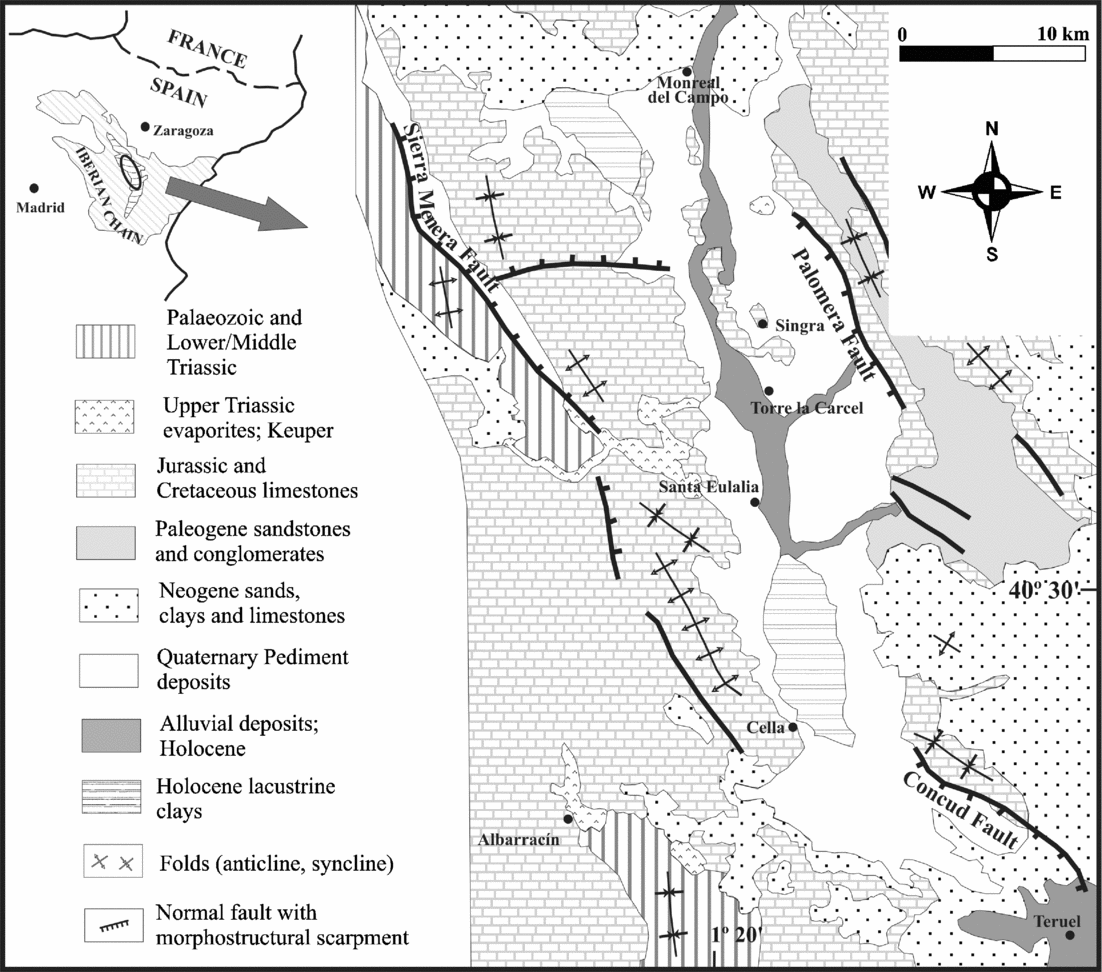
The Jiloca Depression is located in the central sector of the Iberian Chain (NE Spain). This intraplate orogen resulted from the tectonic inversion of Mesozoic sedimentary basins in Palaeogene and early Neogene times. Neogene and Plio-Quaternary grabens superimposed on the previous compressional structures record two main phases of postorogenic rifting (Capote et al. Reference Capote, Muñoz, Simón, Liesa, Arlegui, Gibbons and Moreno2002, Gutiérrez et al. Reference Gutiérrez, Gutiérrez, Gracia, Lucha and Guerrero2007). The Jiloca Depression has been traditionally interpreted as a Plio-Quaternary graben developed during the second extensional phase (e.g. Moissenet, Reference Moissenet1985; Simón, Reference Simón1989). This NNW–SSE-striking topographic basin, 70 km long and around 10 km in width, is controlled on its eastern margin by three major NW–SE-trending normal faults with a right-stepping en echelon arrangement: the Calamocha, Palomera and Concud faults (Fig. 1). The central sector of the depression, from Monreal del Campo to Cella, is mostly developed on Jurassic carbonate bedrock and has behaved as an endorheic area until its recent artificial drainage (Gracia, Gutiérrez & Gutiérrez, Reference Gracia, Gutiérrez and Gutiérrez2003; Rubio & Simón, Reference Rubio and Simón2007). In this portion of the basin, the eastern margin is dominated by the steep Palomera Fault mountain front, with a local relief of more than 400 m. The bedrock of the upthrown block consists of carbonate Jurassic rocks uncorformably overlain by Palaeogene formations made up of variegated detrital sediments and limestones. Locally, the folded Mesozoic and Palaeogene formations are overlain by subhorizontal or tilted Mio-Pliocene shales and limestones of the adjacent Teruel graben (see fig. 6 of Rubio & Simón, Reference Rubio and Simón2007, and fig. 1 of Gracia, Gutiérrez & Gutiérrez, Reference Gracia, Gutiérrez and Gutiérrez2003). In this central sector, the western margin of the basin displays a stepped sequence of erosional surfaces cut across Jurassic carbonate rocks (see figs 3 and 7 of Gracia, Gutiérrez & Gutiérrez, Reference Gracia, Gutiérrez and Gutiérrez2003). The relatively flat bottom is occupied by alluvial fans, mantled and rock-cut pediments, artificially drained palustrine depressions (Mierla and Cañizar swamps), and inliers of Jurassic rocks that form hills several tens of metres high above the basin floor.
Figure 1Geological map of the Jiloca Depression.
Recently, A. L. Cortés (unpub. Ph.D. thesis, Univ. Zaragoza, 1999) and Cortés & Casas (Reference Cortés and Casas2000) proposed that the formation of the Jiloca Basin is primarily related to erosional processes accompanied by the development of nested planation surfaces (pediplains). Subsequently, Gracia, Gutiérrez & Gutiérrez (Reference Gracia, Gutiérrez and Gutiérrez2003) interpreted the Jiloca Depression as a karst polje with a stepped sequence of corrosion surfaces developed within an active half-graben. The latter authors attribute most of the topographic relief of the depression to corrosional lowering, rather than to tectonic subsidence. Karst poljes are large enclosed depressions developed on soluble rocks that commonly show a structurally-controlled elongated geometry. These landforms are characterized by flat and alluviated bottoms locally interrupted by limestone hills (hums) and steep margins that may show stepped sequences of corrosion surfaces. Poljes have a typical karstic drainage with swallow holes or ponors that may function as springs (estavelles) during periods of high water table. In some cases, poljes are bounded by active faults and have a sedimentary fill up to 2.5 km thick indicating that they correspond to poljes and actively subsiding basins at the same time (Mijatovic, Reference Mijatovic and Mijatovic1984; Gams, Reference Gams2005). Ford & Williams (Reference Ford and Williams2007), well acquainted with the Jiloca area from their field visits, present the Jiloca Depression as an example of a polje developed within an active half-graben.
Rubio & Simón (Reference Rubio and Simón2007) raise objections to the genetic models presented by A. L. Cortés (unpub. Ph.D. thesis, Univ. Zaragoza, 1999), Cortés & Casas (Reference Cortés and Casas2000) and Gracia, Gutiérrez & Gutiérrez (Reference Gracia, Gutiérrez and Gutiérrez2003), and propose, following the old model, that the origin of the Jiloca Depression is primarily due to tectonic subsidence. These authors infer a Plio-Quaternary vertical offset of 350–400 m on the Palomera Fault. However, Rubio & Simón (Reference Rubio and Simón2007) omit crucial evidence presented in the previous papers that contradict their model and derive interpretations from ambiguous or erroneous data.
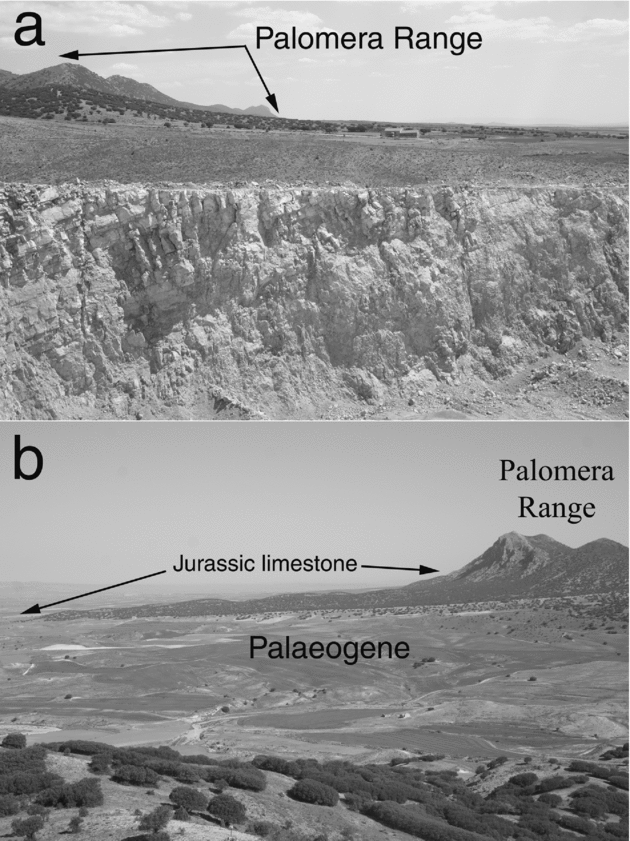
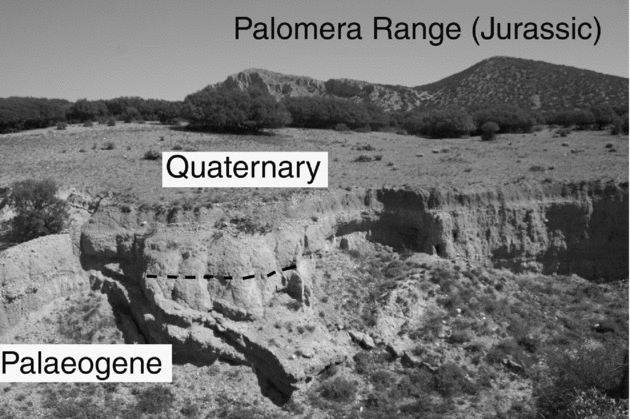
The main argument used by Rubio & Simón (Reference Rubio and Simón2007) to support their tectonic model is the thickness they have inferred for the basin fill. These authors, based on descriptions of selected boreholes, most of them destructive, differentiate two main lithological units and produce isopach maps with isolines interrupted in the medial–distal sector of the Palomera piedmont (see figs 6 and 7 of Rubio & Simón, Reference Rubio and Simón2007). According to them, the lower unit (Unit 1), up to 71 m thick, could have a Late Miocene–Early Pliocene age. A Late Pliocene–Quaternary age is ascribed to the upper unit (Unit 2 + Unit 3), up to 75 m in thickness. Surprisingly, Rubio & Simón (Reference Rubio and Simón2007) omit the presence of rock-cut pediments developed on outcrops of Jurassic rocks at the foot of the Palomera mountain front (Ramírez, Olivé & Moissenet, Reference Ramírez, Olivé and Moissenet1981; Cortés & Casas, Reference Cortés and Casas2000; Gutiérrez et al. Reference Gutiérrez, Gutiérrez, Gracia, Lucha and Guerrero2007; Fig. 2); that is, no or very thin sedimentary fill on the downthrown block next to the Palomera Fault. A significant tectonic subsidence in an endorheic basin with 350–400 m of Plio-Quaternary vertical throw on the Palomera Fault would have produced a fault-angle depression with a thick sedimentary sequence next to this structure, rather than the erosional features indicated above. Moreover, there are large outcrops of Triassic and Jurassic rocks along the geometrical axis of the basin between Torre la Carcel and Monreal del Campo, some of them protruding more than 90 m above the bottom of the depression (see fig. 1 of Gracia, Gutiérrez & Gutiérrez, Reference Gracia, Gutiérrez and Gutiérrez2003). Additionally, the age and limits attributed to the stratigraphical units differentiated by Rubio & Simón (Reference Rubio and Simón2007), solely based on lithological and colour descriptions, are highly doubtful. In this sector of the Iberian Range similar facies reoccur through time and their lateral and vertical changes may be complex. Very likely, a significant part of the sediments analysed by Rubio & Simón (Reference Rubio and Simón2007) correspond to the folded Palaeogene formations that crop out in the depression and on its eastern margin. Obviously, these sediments have a higher preservation potential in the downthrown block and cannot be considered as part of the Jiloca Depression fill. In fact, at the foot of the Palomera mountain front we have examined outcrops of folded detrital sediments, mapped as Palaeogene units by Ramírez, Olivé & Moissenet (Reference Ramírez, Olivé and Moissenet1981), overlain by Quaternary deposits a few metres thick (Fig. 3). On the other hand, regardless of the actual thickness and age of the basin fill, the proposed detrital infill nearly 100 m thick would not contradict the mixed polje–graben model proposed by Gracia, Gutiérrez & Gutiérrez (Reference Gracia, Gutiérrez and Gutiérrez2003). As has been indicated above, poljes and tectonically active sedimentary basins are fully compatible.
Figure 2.Extensive outcrops of Jurassic limestone largely truncated by rock-cut pediments at the foot of the Palomera mountain front (no or insignificant sedimentary fill). (a) Northern sector of the range front, NE of Villafranca del Campo. Limestone quarry in the foreground; the scarp in the quarry is about 7 m high. (b) Southern sector of the mountain front piedmont, view looking north. The Jurassic rocks in the downthrown block are unconformably overlain by folded Palaeogene detrital and limestone sediments.
Figure 3.Folded Palaeogene detrital sediments unconformably overlain by Quaternary deposits (valley fill) at the foot of the Palomera mountain front. The Palaeogene sediments, with a strike of N42E and dipping 22° S, are strongly oblique to the NW–SE-trending Palomera mountain front.
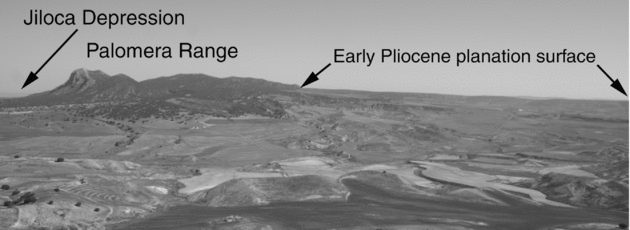
Rubio & Simón (Reference Rubio and Simón2007) indicate that ‘precise knowledge of the displacement on the Sierra Palomera normal fault is not possible, as no Neogene or Quaternary stratigraphic marker can be recognized in both walls’. None the less, these authors, based on a morphostructural reconstruction, estimate a Plio-Quaternary vertical offset of 350–400 m on the Palomera Fault. According to their interpretation, the Palomera Range forms part of a backtilted block on which a planation surface, developed across this range, connects with the Lower Pliocene limestones of the adjacent Teruel Neogene graben. However, such early Pliocene planation surface is inset more than 100 m into the Palomera Range (Fig. 4), and consequently the morphostructural reconstruction used by Rubio & Simón (Reference Rubio and Simón2007) is not valid (see for example fig. 4 in Moissenet, Reference Moissenet1984). On the other hand, estimating a vertical offset for a normal fault based on the tilting of the upthown block is highly ambiguous, since the result depends largely on the position of the rotation axis, unknown in our case. The smaller the distance between the fault and the rotation axis, the lower the vertical throw. Concerning the Concud Fault, the authors refer to several papers coauthored by Simón in which, based on an obsolete morphostratigraphical sequence of three terrace levels, the authors estimate a vertical offset of 40 to 60 m for a 169–116 ka terrace of the Alfambra River, solely dated on the footwall (Simón & Soriano, Reference Simón, Soriano, Aleixane and Pérezdr González1993; Arlegui et al. Reference Arlegui, Simón, Lisle and Orife2006; Simón et al. Reference Simón, Lafuente, Arlegui, Liesa and Soriano2005). Detailed geomorphological mapping carried out by Gutiérrez (Reference Gutiérrez and Meléndez1998) reveals the presence of nine terrace levels above the floodplain of the Alfambra River upstream of the Concud Fault. Moreover, recent OSL (Optically Stimulated Luminescence) and 230U–234Th datings indicate that the deposits used systematically by Simón and his collaborators to calculate the vertical offset on the Concud Fault do not correlate: c. 71 ka in the downthrown block and c. 213–250 ka in the upthrown block (Gutiérrez, Gutiérrez & Gracia, Reference Gutiérrez, Gutiérrez, Gracia, Desir, Gutiérrez and Gutiérrez2005; Gutiérrez et al. Reference Gutiérrez, Gutiérrez, Gracia, Lucha and Guerrero2007).
Figure 4.Tilted Early Pliocene planation surface inset more than 100 m with respect to the Palomera Range.
Gracia, Gutiérrez & Gutiérrez (Reference Gracia, Gutiérrez and Gutiérrez2003) mapped a sequence of eight stepped levels of corrosion surfaces at the western margin, slightly inclined towards the Jiloca Depression. These corrosion surfaces record a progressive entrenchment of the bottom of the basin interrupted by periods of planation controlled by the position of the water table. In contrast to the arguments presented by Rubio & Simón (Reference Rubio and Simón2007), this morphogenetic sequence clearly indicates that corrosional lowering has played an instrumental role on the development of the Jiloca Depression. An internally drained basin affected by tectonic subsidence, as proposed by Rubio & Simón (Reference Rubio and Simón2007), would be domi-nated by aggradation rather than by erosional lowering and planation. The slope of the corrosion surfaces towards the basin may be partially explained by neotectonics. Based on previous works (e.g. Peña et al. Reference Peña Monné, Gutiérrez Elorza, Ibáñez Marcellán, Lozano Tena, Rodríguez Vidal, Sánchez Fabre, Simón Gómez, Soriano Jiménez and Yetano Ruiz1984; Gutiérrez & Gracia, Reference Gutiérrez and Gracia1997), a Pliocene age was ascribed to the extensive planation surfaces into which the polje corrosion surfaces are inset (Gracia, Gutiérrez & Gutiérrez, Reference Gracia, Gutiérrez and Gutiérrez2003). However, we admit that they could have an older Miocene age as suggested by A. L. Cortés (unpub. Ph.D. thesis, Univ. Zaragoza, 1999, p. 163).
Rubio & Simón (Reference Rubio and Simón2007) argue against the polje–graben model indicating that water can hardly dissolve a carbonate bedrock overlain by a calcareous alluvium. They also suggest that collapse structures and exokarstic features should be more abundant. These arguments reveal a lack of knowledge about the literature on karst poljes and the geomorphology of the study area. The bottom of most karst poljes in the world is covered by calcareous alluvial deposits with a wide thickness range. On the other hand, a large number of karstic features have been identified along the corrosion surfaces and the bottom of the depression. These include more than 80 sinkholes, some of them of collapse type, clay-filled dissolutional conduits and cutters, collapse structures, abundant exhumed covered-karst karren, swallow holes and springs, and up to three subsidiary poljes around 1 km long located on the margins of the Jiloca Depression (Gracia, Gutiérrez & Gutiérrez, Reference Gracia, Gutiérrez and Gutiérrez2003). In the bottom of the depression these features have been largely obliterated by agriculture. However, their previous existence is corroborated by accounts provided by local people and local names. For example, Campo de la Sima, located in the Mierla area, means ‘field of the sinkhole’.
According to Rubio & Simón (Reference Rubio and Simón2007), characteristics of the Jiloca Depression that contrasts with the geomorphology of the surrounding region are the scarce incision and the lack of fluvial terraces. However, this is far from being unusual since there are other scarcely dissected depressions in the area, like the Gallocanta, Orihuela and Rodenas depressions, that have been interpreted as karst poljes (Gracia, Gutiérrez & Gutiérrez, Reference Gracia, Gutiérrez and Gutiérrez2002; Gutiérrez, Gutiérrez & Gracia, Reference Gutiérrez, Gutiérrez, Gracia, Desir, Gutiérrez and Gutiérrez2005). All of these depressions display conspicuously flat floors and stepped corrosion surfaces in their margins cut across folded carbonate bedrock as in the Jiloca Depression.
In our opinion, the mixed karstic and tectonic model proposed by Gracia, Gutiérrez & Gutiérrez (Reference Gracia, Gutiérrez and Gutiérrez2003) is the one that provides the most satisfactory explanation for the origin of the central sector of the Jiloca Depression. Conversely, the interpretation presented by Rubio & Simón (Reference Rubio and Simón2007), based on partial and ambiguous data, is not consistent with some of the main features of the basin.
José C. Rubio & José L. Simón reply: F. J. Gracia, F. Gutiérrez and M. Gutiérrez are prestigious geomorphologists who have been working for decades in the central Iberian Chain, making highly valuable contributions to the regional knowledge of landscape evolution. We can understand that they defend their own points of view about the origin of the Jiloca Depression. However, we do not believe that their arguments pose serious objections to our model of an essentially tectonic graben, neither do they prove ambiguity or errors of data supporting our interpretations.
We appreciate the comments by Gracia, Gutiérrez & Gutiérrez, which include some new data and very expressive photographs, specifically about erosion surfaces and sedimentary filling of the Jiloca basin. We admit that certain aspects can still be considered as a matter of debate, but not all these controversial points have the same relevance for the central discussion. We first deal with issues considered as accessory, then we will pay attention to the essential problem: the relative role of (i) displacement at the eastern faults, and (ii) erosional lowering by suballuvial corrosion in the development of the Jiloca Depression.
1. Non-essential issues
1.a. Is the Jiloca depression a polje?
We respect the opinion of the authors, who consider the Jiloca depression as a polje. Many poljes were originated within tectonic grabens, some of them show thick sedimentary fill, and these features are not contradictory with the occurrence of karstic corrosion. So we have no objection to that geomorphological assignation.
1.b. Quaternary offset at the Concud Fault and the age of the involved Pleistocene deposits
Post-Early Pliocene throws of about 250 m and 160–180 m are clearly documented for the Concud and the Calamocha faults, respectively, from dated palustrine sediments (Rubio & Simón, Reference Rubio and Simón2007). These are the essential data for us, since they strongly suggest a displacement similar to or even larger than that for the central master fault of the graben (Palomera Fault).
In the case of the Concud Fault, decametric-scale offsets recorded in Pleistocene sediments are also undeniable (Simón et al. Reference Simón, Lafuente, Arlegui, Liesa and Soriano2005; Gutiérrez, Gutiérrez & Gracia, Reference Gutiérrez, Gutiérrez, Gracia, Desir, Gutiérrez and Gutiérrez2005). Although the precise dating of some Pleistocene levels is not crucial for our discussion, we should explain that the calcareous tuffa deposits, tentatively correlated by Simón et al. (Reference Simón, Lafuente, Arlegui, Liesa and Soriano2005) and Arlegui et al. (Reference Arlegui, Simón, Lisle and Orife2006) and used to calculate the post-Middle Pleistocene offset, have not exactly the ages proposed by Gracia, Gutiérrez and Gutiérrez: they are 116–169 ka in the footwall (Arlegui et al. Reference Arlegui, Simón, Lisle and Orife2006), and older than 71 ka in the hangingwall (Gutiérrez, Gutiérrez & Gracia, Reference Gutiérrez, Gutiérrez, Gracia, Desir, Gutiérrez and Gutiérrez2005).
Besides, we cannot understand why the currently used morphostratigraphical sequence in the Alfambra valley is considered in the comment as ‘obsolete’, since no other one has been effectively diffused to the scientific community. As far as we know, the ‘detailed geomorphological mapping’ supporting the alternative model of nine terrace levels cited by Gracia, Gutiérrez and Gutiérrez is still unpublished. The cited article (Gutiérrez, Reference Gutiérrez and Meléndez1998) does not contain any map!
1.c. Presence of rock-cut pediments close to the Sierra Palomera mountain front
The comment includes photographs of non-covered pediments near the foot of Sierra Palomera (Figs 2, 3). Curiously, both photographs represent areas close to the northern and southern tips of the fault trace. Therefore, they do not refute the possibility of significantly thick sediments being accumulated at the central segment of the fault, where alluvial fan sedimentation (even active at present) does exist. Neither of those data refute the recent tectonic activity of the Palomera Fault. Deposition and preservation of sediments on the downthrown block depend upon several factors, such as the character (external or internal) of the drainage system, erosion rate at the footwall, existence of effective transport channels, or relative height to the regional base level. As an example, less than 50% of the total length of the neighbouring Teruel half-graben, with post-Early Pliocene displacement attaining 300–400 m, shows Late Pliocene–Pleistocene alluvial deposits at its eastern, active boundary. When compared with the Teruel basin, it is evident that the Jiloca basin has a more extensive and conspicuous Plio-Pleistocene alluvial infill.
The comment tries to discredit both our interpretations about the nature of this infill and our source data. We should remind that the latter are official compilations of borehole information made by public institutions (Instituto Geológico y Minero de España, unpub. report, 1985; EPTISA, unpub. report, 1992). Gracia, Gutiérrez and Gutiérrez neither adduce new subsoil information, nor seem to know in depth the database that we used. We cannot therefore understand upon what base they state that ‘very likely, a significant part of the sediments . . . correspond to folded Palaeogene formations’. At least three details make very unreliable such an hypothesis: (i) cementation of gravel and sand is described in borehole logs as low to medium, which does not correspond to the Palaeogene coarse clastic deposits outcropping near Sierra Palomera; (ii) folded Palaeogene sediments paraconformably overlie Upper Jurassic units in synclinal areas, whereas clastic sediments filling the Jiloca basin overlie homogeneous, nearly horizontal marls which, in turn, are strongly unconformable over Triassic and Lower Jurassic rocks at anticlinal cores; (iii) the facies distribution suggests a concentric sedimentary pattern consistent with the actual Jiloca basin and its source areas (Rubio & Simón, Reference Rubio and Simón2007, fig. 7b). Moreover, the aforementioned marls underlying the clastic filling, sampled at a new borehole drilled by the Geological Survey of the Diputación Provincial de Teruel near Torrelacárcel, contain small, delicate shells of fresh-water gastropods, ostracods and coal fragments that clearly point to a Late Neogene age.





 You have
Access
F. J. Gracia, F. Gutiérrez & M. Gutiérrez comment: In a recent paper, Rubio & Simón (Reference Rubio and Simón2007) propose that the origin of the Jiloca Depression (Iberian Range, NE Spain) is primarily due to extensional neotectonics and estimate a Plio-Quaternary vertical offset of 350–400 m on the basin-bounding master fault. However, these authors omit crucial evidence presented in previous papers that contradict their model and derive interpretations from ambiguous or erroneous data. This discussion presents the main objections to their model and supports the mixed erosional (karstic) and tectonic origin proposed in previous research articles.
The Jiloca Depression is located in the central sector of the Iberian Chain (NE Spain). This intraplate orogen resulted from the tectonic inversion of Mesozoic sedimentary basins in Palaeogene and early Neogene times. Neogene and Plio-Quaternary grabens superimposed on the previous compressional structures record two main phases of postorogenic rifting (Capote et al. Reference Capote, Muñoz, Simón, Liesa, Arlegui, Gibbons and Moreno2002, Gutiérrez et al. Reference Gutiérrez, Gutiérrez, Gracia, Lucha and Guerrero2007). The Jiloca Depression has been traditionally interpreted as a Plio-Quaternary graben developed during the second extensional phase (e.g. Moissenet, Reference Moissenet1985; Simón, Reference Simón1989). This NNW–SSE-striking topographic basin, 70 km long and around 10 km in width, is controlled on its eastern margin by three major NW–SE-trending normal faults with a right-stepping en echelon arrangement: the Calamocha, Palomera and Concud faults (Fig. 1). The central sector of the depression, from Monreal del Campo to Cella, is mostly developed on Jurassic carbonate bedrock and has behaved as an endorheic area until its recent artificial drainage (Gracia, Gutiérrez & Gutiérrez, Reference Gracia, Gutiérrez and Gutiérrez2003; Rubio & Simón, Reference Rubio and Simón2007). In this portion of the basin, the eastern margin is dominated by the steep Palomera Fault mountain front, with a local relief of more than 400 m. The bedrock of the upthrown block consists of carbonate Jurassic rocks uncorformably overlain by Palaeogene formations made up of variegated detrital sediments and limestones. Locally, the folded Mesozoic and Palaeogene formations are overlain by subhorizontal or tilted Mio-Pliocene shales and limestones of the adjacent Teruel graben (see fig. 6 of Rubio & Simón, Reference Rubio and Simón2007, and fig. 1 of Gracia, Gutiérrez & Gutiérrez, Reference Gracia, Gutiérrez and Gutiérrez2003). In this central sector, the western margin of the basin displays a stepped sequence of erosional surfaces cut across Jurassic carbonate rocks (see figs 3 and 7 of Gracia, Gutiérrez & Gutiérrez, Reference Gracia, Gutiérrez and Gutiérrez2003). The relatively flat bottom is occupied by alluvial fans, mantled and rock-cut pediments, artificially drained palustrine depressions (Mierla and Cañizar swamps), and inliers of Jurassic rocks that form hills several tens of metres high above the basin floor.
Geological map of the Jiloca Depression.
Recently, A. L. Cortés (unpub. Ph.D. thesis, Univ. Zaragoza, 1999) and Cortés & Casas (Reference Cortés and Casas2000) proposed that the formation of the Jiloca Basin is primarily related to erosional processes accompanied by the development of nested planation surfaces (pediplains). Subsequently, Gracia, Gutiérrez & Gutiérrez (Reference Gracia, Gutiérrez and Gutiérrez2003) interpreted the Jiloca Depression as a karst polje with a stepped sequence of corrosion surfaces developed within an active half-graben. The latter authors attribute most of the topographic relief of the depression to corrosional lowering, rather than to tectonic subsidence. Karst poljes are large enclosed depressions developed on soluble rocks that commonly show a structurally-controlled elongated geometry. These landforms are characterized by flat and alluviated bottoms locally interrupted by limestone hills (hums) and steep margins that may show stepped sequences of corrosion surfaces. Poljes have a typical karstic drainage with swallow holes or ponors that may function as springs (estavelles) during periods of high water table. In some cases, poljes are bounded by active faults and have a sedimentary fill up to 2.5 km thick indicating that they correspond to poljes and actively subsiding basins at the same time (Mijatovic, Reference Mijatovic and Mijatovic1984; Gams, Reference Gams2005). Ford & Williams (Reference Ford and Williams2007), well acquainted with the Jiloca area from their field visits, present the Jiloca Depression as an example of a polje developed within an active half-graben.
Rubio & Simón (Reference Rubio and Simón2007) raise objections to the genetic models presented by A. L. Cortés (unpub. Ph.D. thesis, Univ. Zaragoza, 1999), Cortés & Casas (Reference Cortés and Casas2000) and Gracia, Gutiérrez & Gutiérrez (Reference Gracia, Gutiérrez and Gutiérrez2003), and propose, following the old model, that the origin of the Jiloca Depression is primarily due to tectonic subsidence. These authors infer a Plio-Quaternary vertical offset of 350–400 m on the Palomera Fault. However, Rubio & Simón (Reference Rubio and Simón2007) omit crucial evidence presented in the previous papers that contradict their model and derive interpretations from ambiguous or erroneous data.
The main argument used by Rubio & Simón (Reference Rubio and Simón2007) to support their tectonic model is the thickness they have inferred for the basin fill. These authors, based on descriptions of selected boreholes, most of them destructive, differentiate two main lithological units and produce isopach maps with isolines interrupted in the medial–distal sector of the Palomera piedmont (see figs 6 and 7 of Rubio & Simón, Reference Rubio and Simón2007). According to them, the lower unit (Unit 1), up to 71 m thick, could have a Late Miocene–Early Pliocene age. A Late Pliocene–Quaternary age is ascribed to the upper unit (Unit 2 + Unit 3), up to 75 m in thickness. Surprisingly, Rubio & Simón (Reference Rubio and Simón2007) omit the presence of rock-cut pediments developed on outcrops of Jurassic rocks at the foot of the Palomera mountain front (Ramírez, Olivé & Moissenet, Reference Ramírez, Olivé and Moissenet1981; Cortés & Casas, Reference Cortés and Casas2000; Gutiérrez et al. Reference Gutiérrez, Gutiérrez, Gracia, Lucha and Guerrero2007; Fig. 2); that is, no or very thin sedimentary fill on the downthrown block next to the Palomera Fault. A significant tectonic subsidence in an endorheic basin with 350–400 m of Plio-Quaternary vertical throw on the Palomera Fault would have produced a fault-angle depression with a thick sedimentary sequence next to this structure, rather than the erosional features indicated above. Moreover, there are large outcrops of Triassic and Jurassic rocks along the geometrical axis of the basin between Torre la Carcel and Monreal del Campo, some of them protruding more than 90 m above the bottom of the depression (see fig. 1 of Gracia, Gutiérrez & Gutiérrez, Reference Gracia, Gutiérrez and Gutiérrez2003). Additionally, the age and limits attributed to the stratigraphical units differentiated by Rubio & Simón (Reference Rubio and Simón2007), solely based on lithological and colour descriptions, are highly doubtful. In this sector of the Iberian Range similar facies reoccur through time and their lateral and vertical changes may be complex. Very likely, a significant part of the sediments analysed by Rubio & Simón (Reference Rubio and Simón2007) correspond to the folded Palaeogene formations that crop out in the depression and on its eastern margin. Obviously, these sediments have a higher preservation potential in the downthrown block and cannot be considered as part of the Jiloca Depression fill. In fact, at the foot of the Palomera mountain front we have examined outcrops of folded detrital sediments, mapped as Palaeogene units by Ramírez, Olivé & Moissenet (Reference Ramírez, Olivé and Moissenet1981), overlain by Quaternary deposits a few metres thick (Fig. 3). On the other hand, regardless of the actual thickness and age of the basin fill, the proposed detrital infill nearly 100 m thick would not contradict the mixed polje–graben model proposed by Gracia, Gutiérrez & Gutiérrez (Reference Gracia, Gutiérrez and Gutiérrez2003). As has been indicated above, poljes and tectonically active sedimentary basins are fully compatible.
Extensive outcrops of Jurassic limestone largely truncated by rock-cut pediments at the foot of the Palomera mountain front (no or insignificant sedimentary fill). (a) Northern sector of the range front, NE of Villafranca del Campo. Limestone quarry in the foreground; the scarp in the quarry is about 7 m high. (b) Southern sector of the mountain front piedmont, view looking north. The Jurassic rocks in the downthrown block are unconformably overlain by folded Palaeogene detrital and limestone sediments.
Folded Palaeogene detrital sediments unconformably overlain by Quaternary deposits (valley fill) at the foot of the Palomera mountain front. The Palaeogene sediments, with a strike of N42E and dipping 22° S, are strongly oblique to the NW–SE-trending Palomera mountain front.
Rubio & Simón (Reference Rubio and Simón2007) indicate that ‘precise knowledge of the displacement on the Sierra Palomera normal fault is not possible, as no Neogene or Quaternary stratigraphic marker can be recognized in both walls’. None the less, these authors, based on a morphostructural reconstruction, estimate a Plio-Quaternary vertical offset of 350–400 m on the Palomera Fault. According to their interpretation, the Palomera Range forms part of a backtilted block on which a planation surface, developed across this range, connects with the Lower Pliocene limestones of the adjacent Teruel Neogene graben. However, such early Pliocene planation surface is inset more than 100 m into the Palomera Range (Fig. 4), and consequently the morphostructural reconstruction used by Rubio & Simón (Reference Rubio and Simón2007) is not valid (see for example fig. 4 in Moissenet, Reference Moissenet1984). On the other hand, estimating a vertical offset for a normal fault based on the tilting of the upthown block is highly ambiguous, since the result depends largely on the position of the rotation axis, unknown in our case. The smaller the distance between the fault and the rotation axis, the lower the vertical throw. Concerning the Concud Fault, the authors refer to several papers coauthored by Simón in which, based on an obsolete morphostratigraphical sequence of three terrace levels, the authors estimate a vertical offset of 40 to 60 m for a 169–116 ka terrace of the Alfambra River, solely dated on the footwall (Simón & Soriano, Reference Simón, Soriano, Aleixane and Pérezdr González1993; Arlegui et al. Reference Arlegui, Simón, Lisle and Orife2006; Simón et al. Reference Simón, Lafuente, Arlegui, Liesa and Soriano2005). Detailed geomorphological mapping carried out by Gutiérrez (Reference Gutiérrez and Meléndez1998) reveals the presence of nine terrace levels above the floodplain of the Alfambra River upstream of the Concud Fault. Moreover, recent OSL (Optically Stimulated Luminescence) and 230U–234Th datings indicate that the deposits used systematically by Simón and his collaborators to calculate the vertical offset on the Concud Fault do not correlate: c. 71 ka in the downthrown block and c. 213–250 ka in the upthrown block (Gutiérrez, Gutiérrez & Gracia, Reference Gutiérrez, Gutiérrez, Gracia, Desir, Gutiérrez and Gutiérrez2005; Gutiérrez et al. Reference Gutiérrez, Gutiérrez, Gracia, Lucha and Guerrero2007).
Tilted Early Pliocene planation surface inset more than 100 m with respect to the Palomera Range.
Gracia, Gutiérrez & Gutiérrez (Reference Gracia, Gutiérrez and Gutiérrez2003) mapped a sequence of eight stepped levels of corrosion surfaces at the western margin, slightly inclined towards the Jiloca Depression. These corrosion surfaces record a progressive entrenchment of the bottom of the basin interrupted by periods of planation controlled by the position of the water table. In contrast to the arguments presented by Rubio & Simón (Reference Rubio and Simón2007), this morphogenetic sequence clearly indicates that corrosional lowering has played an instrumental role on the development of the Jiloca Depression. An internally drained basin affected by tectonic subsidence, as proposed by Rubio & Simón (Reference Rubio and Simón2007), would be domi-nated by aggradation rather than by erosional lowering and planation. The slope of the corrosion surfaces towards the basin may be partially explained by neotectonics. Based on previous works (e.g. Peña et al. Reference Peña Monné, Gutiérrez Elorza, Ibáñez Marcellán, Lozano Tena, Rodríguez Vidal, Sánchez Fabre, Simón Gómez, Soriano Jiménez and Yetano Ruiz1984; Gutiérrez & Gracia, Reference Gutiérrez and Gracia1997), a Pliocene age was ascribed to the extensive planation surfaces into which the polje corrosion surfaces are inset (Gracia, Gutiérrez & Gutiérrez, Reference Gracia, Gutiérrez and Gutiérrez2003). However, we admit that they could have an older Miocene age as suggested by A. L. Cortés (unpub. Ph.D. thesis, Univ. Zaragoza, 1999, p. 163).
Rubio & Simón (Reference Rubio and Simón2007) argue against the polje–graben model indicating that water can hardly dissolve a carbonate bedrock overlain by a calcareous alluvium. They also suggest that collapse structures and exokarstic features should be more abundant. These arguments reveal a lack of knowledge about the literature on karst poljes and the geomorphology of the study area. The bottom of most karst poljes in the world is covered by calcareous alluvial deposits with a wide thickness range. On the other hand, a large number of karstic features have been identified along the corrosion surfaces and the bottom of the depression. These include more than 80 sinkholes, some of them of collapse type, clay-filled dissolutional conduits and cutters, collapse structures, abundant exhumed covered-karst karren, swallow holes and springs, and up to three subsidiary poljes around 1 km long located on the margins of the Jiloca Depression (Gracia, Gutiérrez & Gutiérrez, Reference Gracia, Gutiérrez and Gutiérrez2003). In the bottom of the depression these features have been largely obliterated by agriculture. However, their previous existence is corroborated by accounts provided by local people and local names. For example, Campo de la Sima, located in the Mierla area, means ‘field of the sinkhole’.
According to Rubio & Simón (Reference Rubio and Simón2007), characteristics of the Jiloca Depression that contrasts with the geomorphology of the surrounding region are the scarce incision and the lack of fluvial terraces. However, this is far from being unusual since there are other scarcely dissected depressions in the area, like the Gallocanta, Orihuela and Rodenas depressions, that have been interpreted as karst poljes (Gracia, Gutiérrez & Gutiérrez, Reference Gracia, Gutiérrez and Gutiérrez2002; Gutiérrez, Gutiérrez & Gracia, Reference Gutiérrez, Gutiérrez, Gracia, Desir, Gutiérrez and Gutiérrez2005). All of these depressions display conspicuously flat floors and stepped corrosion surfaces in their margins cut across folded carbonate bedrock as in the Jiloca Depression.
In our opinion, the mixed karstic and tectonic model proposed by Gracia, Gutiérrez & Gutiérrez (Reference Gracia, Gutiérrez and Gutiérrez2003) is the one that provides the most satisfactory explanation for the origin of the central sector of the Jiloca Depression. Conversely, the interpretation presented by Rubio & Simón (Reference Rubio and Simón2007), based on partial and ambiguous data, is not consistent with some of the main features of the basin.
José C. Rubio & José L. Simón reply: F. J. Gracia, F. Gutiérrez and M. Gutiérrez are prestigious geomorphologists who have been working for decades in the central Iberian Chain, making highly valuable contributions to the regional knowledge of landscape evolution. We can understand that they defend their own points of view about the origin of the Jiloca Depression. However, we do not believe that their arguments pose serious objections to our model of an essentially tectonic graben, neither do they prove ambiguity or errors of data supporting our interpretations.
We appreciate the comments by Gracia, Gutiérrez & Gutiérrez, which include some new data and very expressive photographs, specifically about erosion surfaces and sedimentary filling of the Jiloca basin. We admit that certain aspects can still be considered as a matter of debate, but not all these controversial points have the same relevance for the central discussion. We first deal with issues considered as accessory, then we will pay attention to the essential problem: the relative role of (i) displacement at the eastern faults, and (ii) erosional lowering by suballuvial corrosion in the development of the Jiloca Depression.
1. Non-essential issues
1.a. Is the Jiloca depression a polje?
We respect the opinion of the authors, who consider the Jiloca depression as a polje. Many poljes were originated within tectonic grabens, some of them show thick sedimentary fill, and these features are not contradictory with the occurrence of karstic corrosion. So we have no objection to that geomorphological assignation.
1.b. Quaternary offset at the Concud Fault and the age of the involved Pleistocene deposits
Post-Early Pliocene throws of about 250 m and 160–180 m are clearly documented for the Concud and the Calamocha faults, respectively, from dated palustrine sediments (Rubio & Simón, Reference Rubio and Simón2007). These are the essential data for us, since they strongly suggest a displacement similar to or even larger than that for the central master fault of the graben (Palomera Fault).
In the case of the Concud Fault, decametric-scale offsets recorded in Pleistocene sediments are also undeniable (Simón et al. Reference Simón, Lafuente, Arlegui, Liesa and Soriano2005; Gutiérrez, Gutiérrez & Gracia, Reference Gutiérrez, Gutiérrez, Gracia, Desir, Gutiérrez and Gutiérrez2005). Although the precise dating of some Pleistocene levels is not crucial for our discussion, we should explain that the calcareous tuffa deposits, tentatively correlated by Simón et al. (Reference Simón, Lafuente, Arlegui, Liesa and Soriano2005) and Arlegui et al. (Reference Arlegui, Simón, Lisle and Orife2006) and used to calculate the post-Middle Pleistocene offset, have not exactly the ages proposed by Gracia, Gutiérrez and Gutiérrez: they are 116–169 ka in the footwall (Arlegui et al. Reference Arlegui, Simón, Lisle and Orife2006), and older than 71 ka in the hangingwall (Gutiérrez, Gutiérrez & Gracia, Reference Gutiérrez, Gutiérrez, Gracia, Desir, Gutiérrez and Gutiérrez2005).
Besides, we cannot understand why the currently used morphostratigraphical sequence in the Alfambra valley is considered in the comment as ‘obsolete’, since no other one has been effectively diffused to the scientific community. As far as we know, the ‘detailed geomorphological mapping’ supporting the alternative model of nine terrace levels cited by Gracia, Gutiérrez and Gutiérrez is still unpublished. The cited article (Gutiérrez, Reference Gutiérrez and Meléndez1998) does not contain any map!
1.c. Presence of rock-cut pediments close to the Sierra Palomera mountain front
The comment includes photographs of non-covered pediments near the foot of Sierra Palomera (Figs 2, 3). Curiously, both photographs represent areas close to the northern and southern tips of the fault trace. Therefore, they do not refute the possibility of significantly thick sediments being accumulated at the central segment of the fault, where alluvial fan sedimentation (even active at present) does exist. Neither of those data refute the recent tectonic activity of the Palomera Fault. Deposition and preservation of sediments on the downthrown block depend upon several factors, such as the character (external or internal) of the drainage system, erosion rate at the footwall, existence of effective transport channels, or relative height to the regional base level. As an example, less than 50% of the total length of the neighbouring Teruel half-graben, with post-Early Pliocene displacement attaining 300–400 m, shows Late Pliocene–Pleistocene alluvial deposits at its eastern, active boundary. When compared with the Teruel basin, it is evident that the Jiloca basin has a more extensive and conspicuous Plio-Pleistocene alluvial infill.
The comment tries to discredit both our interpretations about the nature of this infill and our source data. We should remind that the latter are official compilations of borehole information made by public institutions (Instituto Geológico y Minero de España, unpub. report, 1985; EPTISA, unpub. report, 1992). Gracia, Gutiérrez and Gutiérrez neither adduce new subsoil information, nor seem to know in depth the database that we used. We cannot therefore understand upon what base they state that ‘very likely, a significant part of the sediments . . . correspond to folded Palaeogene formations’. At least three details make very unreliable such an hypothesis: (i) cementation of gravel and sand is described in borehole logs as low to medium, which does not correspond to the Palaeogene coarse clastic deposits outcropping near Sierra Palomera; (ii) folded Palaeogene sediments paraconformably overlie Upper Jurassic units in synclinal areas, whereas clastic sediments filling the Jiloca basin overlie homogeneous, nearly horizontal marls which, in turn, are strongly unconformable over Triassic and Lower Jurassic rocks at anticlinal cores; (iii) the facies distribution suggests a concentric sedimentary pattern consistent with the actual Jiloca basin and its source areas (Rubio & Simón, Reference Rubio and Simón2007, fig. 7b). Moreover, the aforementioned marls underlying the clastic filling, sampled at a new borehole drilled by the Geological Survey of the Diputación Provincial de Teruel near Torrelacárcel, contain small, delicate shells of fresh-water gastropods, ostracods and coal fragments that clearly point to a Late Neogene age.
2. Essential issues
2.a. Total Neogene–Quaternary offset at the Palomera Fault
We have admitted in our paper that, in the absence of dated stratigraphical markers, the total offset at the extensional Palomera Fault remains unknown. However, this uncertainty does not invalidate our morphostructural reconstruction of the Sierra Palomera tilted block based on height differences of the fundamental erosion surface and its correlative Late Neogene sediments. It is true that this surface is inset into the summit of the Palomera range (1529 m.a.s.l.), but such relationship was already taken into account. According to our estimate, the entrenchment does not exceed 50 m, since the tilted reference surface attains 1480 m at the Tertiary conglomerates of Cerros de Cabrosa and Cerro de las Carboneras, near the Palomera summit; then it slopes downward up to 1060 m at the Pliocene mesas some 3 km SE of Alfambra. The resulting height difference (420 m), diminished by the original, pre-tilt gentle slope of the erosive surface, provides a reasonable approach to the tectonic uplift of the Palomera range relative to the bottom of the Teruel graben.
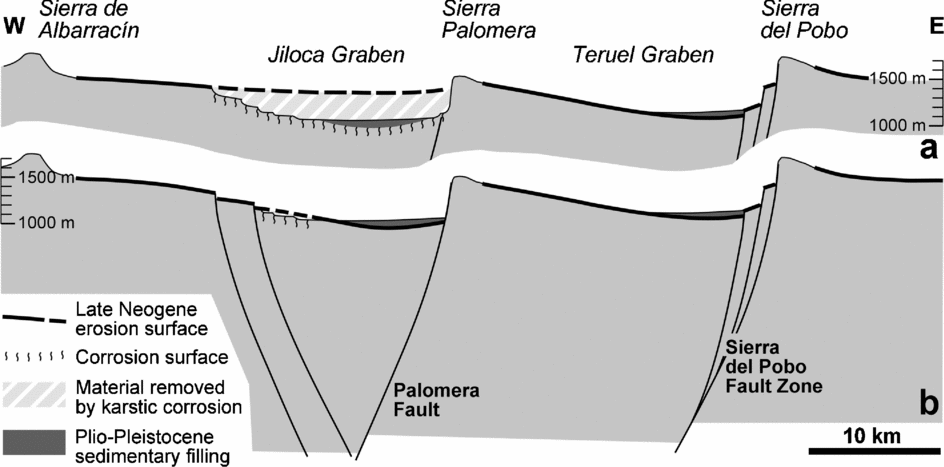
This relative uplift does not necessarily represent the offset at the Palomera Fault. As a first hypothesis, it could be due only to displacement at the Sierra del Pobo fault zone (eastern boundary of the Teruel graben), assuming a neutral point of vertical motion (fulcrum: Leeder & Gawthorpe, Reference Leeder, Gawthorpe, Coward, Dewey and Hancock1987) at 1480 m, and a single roll-over fold developed by falling from a regional level at the same height (Fig. 5a). However, according to classic maps of Late Neogene erosion surfaces, a second roll-over structure (together with a few minor antithetic faults) would explain the progressive eastwards decrease in height between the calcareous ‘paramo’ of Sierra de Albarracín (1400–1500 m) and the Jiloca Depression (<1100 m) (Fig. 5b); it would involve a throw of about 300–400 m for the Palomera Fault. This second hypothesis fits better the overall structure of the graben, whose northern and southern segments are controlled by faults with well-documented Plio-Pleistocene throws of >160–180 m and 250 m (Calamocha and Concud faults, respectively; Rubio & Simón, Reference Rubio and Simón2007).
Sketches summarizing the main differences between the opposing models proposed for the Jiloca Depression. (a) Model by Gracia, Gutiérrez & Gutiérrez (Reference Gracia, Gutiérrez and Gutiérrez2003): erosional lowering by suballuvial karstic corrosion within a shallow initial graben. (b) Model by Rubio & Simón (Reference Rubio and Simón2007): tectonic subsidence in an asymmetric graben with minor karstic corrosion at its western margin. Vertical scale ×7.
2.b. To what extent could karst corrosion deepen the Jiloca Depression?
In order to support their hypothesis of an essential role of erosional deepening, Gracia, Gutiérrez & Gutiérrez maximize the meaning of some evidences of karstic solution that we do not consider sufficiently strong. We discuss separately three pieces of evidence:
(a) Corrosion surfaces. Some nearly plane, relatively low surfaces at the western margin of the Jiloca Depression (Ojos Negros–Monreal del Campo area) show clear dissolution features such as karren or clay-filled conduits. They could effectively represent ancient polje bottoms, at heights up to about 150 m above the present-day bottom. Other higher remnants have slopes that do not fit the topography of corrosion surfaces (Rubio, Simón & Soriano, Reference Rubio, Simón and Soriano2007). The appeal to neotectonics for explaining these ‘anomalous’ slopes (Gracia, Gutiérrez & Gutiérrez, Reference Gracia, Gutiérrez and Gutiérrez2003) has merely the appearance of an ad hoc hypothesis. These surfaces can be better interpreted as pediments; we should remind that indeed they were previously identified as Late Miocene to Early Pliocene (Gutiérrez & Gracia, Reference Gutiérrez and Gracia1997) or Late Oligocene to Early Miocene (Casas & Cortés, Reference Casas and Cortés2002) pediplains. In consequence, evidence of erosional lowering due to karstic corrosion is very limited: no more than 150 m at the western edge of the Jiloca Depression, compatible with asymmetric entrenchment into a gentle roll-over fold associated to the Palomera Fault (Fig. 5b).
(b) Sinkholes. Gracia, Gutiérrez & Gutiérrez cite the existence of more than 80 sinkholes, but they do not provide any map. Maybe they compute every sinkhole appearing on the planation surfaces surrounding the Jiloca Depression. It is known that the Neogene erosion surfaces show numerous, sometimes spectacular, sinkholes all over the chain (Peña et al. Reference Peña Monné, Gutiérrez Elorza, Ibáñez Marcellán, Lozano Tena, Rodríguez Vidal, Sánchez Fabre, Simón Gómez, Soriano Jiménez and Yetano Ruiz1984), but this does not prove that those surfaces are polje bottoms. The hypothetic occurrence of alluvial sinkholes within the sedimentary bottom of the depression would effectively give the measure of suballuvial karstic activity. However, in this sense, the authors only adduce very weak arguments in the form of accounts of local people or a vague toponym.
(c) Swallow holes. Gracia, Gutiérrez & Gutiérrez (Reference Gracia, Gutiérrez and Gutiérrez2003) had mapped two ‘ponors’ within the Mierla plain, west of Monreal del Campo. However, a field survey in search of evidence for such swallow holes has provided negative results (Rubio, Simón & Soriano, Reference Rubio, Simón and Soriano2007): one of them is a karstic spring (Ojo de Mierla), whose topographic position and hydrogeological conditions do not allow consideration of hypothetical operation as an estavelle; the other one is an artificial pool built to intercept and store runoff at the middle part of the Mierla pediment (Balsa de los Ramblares). The ‘Mierla plain’, as can be seen on any topographic map, shows a quite homogeneous eastwards slope (about 1.5%); therefore, to designate the ‘Mierla swamp’ as an ‘artificially drained palustrine depression’ is untrue. Confusing references to this type of environment already appeared in the original work by the authors, where the ‘Cañizar swampy area’ was erroneously illustrated with a photograph of the ‘Ojos de Monreal’ spring, located some 30 km to the north (Gracia, Gutiérrez & Gutiérrez, Reference Gracia, Gutiérrez and Gutiérrez2003, fig. 5).
Finally, we should remember that a sedimentary infill nearly 100 m thick poses serious difficulties to the hypothesis of a topographic deepening of 300 m developed during 3–4 Ma through suballuvial corrosion. Under dissolution at the highest feasible rates (in the most favourable surface conditions), such deepening would require between 7 and 25 Ma. In contact with saturated or nearly saturated groundwater, such as currently flows through both Jurassic and Neogene–Quaternary rocks (Rubio, Simón & Soriano, Reference Rubio and Simón2007), the dissolution rate would become negligible, and the proposed deepening absolutely unreliable.