Introduction
Negative mood states consist of symptoms of depression and anxiety, and a third group of symptoms related to stress, tension and irritability. Depression and anxiety have long been observed to be experienced together: the symptoms are correlated in healthy people (Clark & Watson, Reference Clark and Watson1991), and depressive and anxiety disorders are co-morbid in at least half of patients who have either diagnosis (Brown et al. Reference Brown, Campbell, Lehman, Grisham and Mancill2001; Lamers et al. Reference Lamers, Burstein, He, Avenevoli, Angst and Merikangas2012). Analysis of the psychological factors that underpin negative mood states has confirmed the existence of a third factor. It was described by Clark & Watson (Reference Clark and Watson1991) as ‘negative affect’, which they showed was present in high levels in people with depression and anxiety. Lovibond & Lovibond (Reference Lovibond and Lovibond1995a ) also found evidence for the existence of a third factor, which they included in their Depression Anxiety Stress Scales (DASS). They identified a cluster of items that were highly correlated with depression and anxiety but that could not discriminate between them. This third ‘stress–tension’ factor included items related to difficulty relaxing, nervous tension and irritability.
The stress–tension factor has been found to be independent of the depression and anxiety factors, supported by studies in clinical and non-clinical populations (Antony et al. Reference Antony, Bieling, Cox, Enns and Swinson1998; Crawford & Henry, Reference Crawford and Henry2003; Henry & Crawford, Reference Henry and Crawford2005; Szabo, Reference Szabó2010; Osman et al. Reference Osman, Wong, Bagge, Freedenthal, Gutierrez and Lozano2012; Sinclair et al. Reference Sinclair, Siefert, Slavin-Mulford, Stein, Renna and Blais2012). In developing the DASS stress–tension subscale, Lovibond & Lovibond (Reference Lovibond and Lovibond1995a ) only included items that did not load on the depression and anxiety subscales, and argued that the correlation between the three factors was consistent with their having a common underlying aetiology rather than mapping overlapping constructs, or there being causal relationships between them. In a longitudinal study of the DASS factors they found that each factor had temporal stability, with the stress–tension factor being no more predictive of later depression and anxiety symptoms than depression was of anxiety, and anxiety was of depression (Lovibond, Reference Lovibond1998).
In the present study our aim was to use a recently introduced regression-based methodology – ’Inference on Causation through Examination of FAmiliaL CONfounding’ (ICE FALCON) (Hopper et al. Reference Hopper, Bui, Erbas, Matheson, Gurrin, Burgess, Lowe, Jenkins, Abramson, Walters, Giles and Dharmage2012; Stone et al. Reference Stone, Dite, Giles, Cawson, English and Hopper2012; Bui et al. Reference Bui, Bjornerem, Ghasem-Zadeh, Dite, Hopper and Seeman2013; López-Solà et al. Reference López-Solà, Fontenelle, Bui, Hopper, Pantelis, Yücel, Menchón, Alonso and Harrison2015) – to determine if there was evidence consistent with there being one or more ‘causal’ relationships between the DASS factors. The term ‘causal’ in this approach is used in the sense that if the predictor variable for a person was to be varied experimentally, then the value of the outcome variable in that person would be expected to change. We were particularly interested in understanding how the third stress–tension factor related to the depression and anxiety factors: whether it had causal influences on depression and anxiety, or as Lovibond & Lovibond (Reference Lovibond and Lovibond1995a ) suggested, arose alongside depression and anxiety from the same underlying variable, without exerting any causal influence on them.
Method
Participants
Twins were recruited from the Australian Twin Registry (ATR), a national volunteer resource of twin pairs (Hopper et al. Reference Hopper, Foley, White and Pollaers2013). A total of 1550 monozygotic (MZ) twin pairs were emailed by the ATR on our behalf (as part of a larger study; López-Solà et al. Reference López-Solà, Fontenelle, Alonso, Cuadras, Foley, Pantelis, Pujol, Yücel, Cardoner, Soriano-Mas, Menchón and Harrison2014, Reference López-Solà, Fontenelle, Bui, Hopper, Pantelis, Yücel, Menchón, Alonso and Harrison2015). Twins were selected according to age (18–45 years) and recorded zygosity. Twin pairs were randomly selected to receive the study email each week over a 4-month period. At 2 weeks after receiving the initial invitation, non-responding twins were followed-up with a reminder email, followed by a further telephone reminder 2 weeks later. A second telephone follow-up was performed for all remaining non-responders. This data collection phase ran for approximately 1 year between June 2011 and May 2012. The final sample consisted of 503 MZ twin pairs. The mean age of the twins was 34.5 (s.d. = 7.8) years, and 59% were female.
DASS
The twins completed an online version of the 21-item DASS, which provides an assessment of negative mood states (Lovibond & Lovibond, Reference Lovibond and Lovibond1995b ). In the course of the empirically guided development of the DASS it was determined that negative mood states could be described by three correlated but distinct factors: depressive symptoms, anxiety symptoms, and stress–tension symptoms. The depression subscale is characterized principally by a loss of self-esteem and incentive, and is associated with a sense of pessimism about achieving life goals. The anxiety subscale emphasizes the links between enduring anxiety and the acute fear response. It gives weight to somatic and subjective symptoms, including situational anxiety. The stress–tension subscale measures a state of persistent arousal and tension, with the tendency for becoming upset or frustrated (Lovibond & Lovibond, Reference Lovibond and Lovibond1995a ).
Causal inference analysis
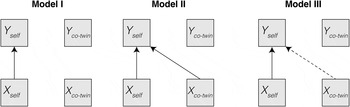
We used the recently developed ICE FALCON twin-regression methodology to test for the presence of causal influences between factors (Hopper et al. Reference Hopper, Bui, Erbas, Matheson, Gurrin, Burgess, Lowe, Jenkins, Abramson, Walters, Giles and Dharmage2012; Stone et al. Reference Stone, Dite, Giles, Cawson, English and Hopper2012; Bui et al. Reference Bui, Bjornerem, Ghasem-Zadeh, Dite, Hopper and Seeman2013). The underlying statistical model tests for a direct causal relationship between a predictor and an outcome via examination of familial confounding. If the predictor is familial – that is, it is correlated in twin pairs – and there is an association between the outcome of a twin with the predictor of the co-twin that reduces after adjusting for the predictor of the index twin, then this is consistent with the existence of a causal relationship between the predictor and the outcome (see Fig. 1 and the online Supplementary material). The reduction in cross-trait cross-pair association must be more than could be attributed to chance. If the associations between the outcome of a twin and the predictor of the co-twin are no different before and after adjusting for the predictor of that twin, then there is no evidence for the existence of a direct causal relationship between the predictor and the outcome. Whether or not the cross-trait cross-pair association remains significant after adjusting for the predictor of the index twin can also be informative.
Inference about Causation from Examination of FAmiliaL CONfounding (ICE FALCON) methodology. Model I examines the within-twin cross-trait relationship (regressing outcome Y self on predictor X self ); model II the cross-trait cross-pair relationship (regressing Y self on X co-twin ); and model III adjusts the cross-trait cross-pair relationship for the within-twin cross-trait relationship (regressing Y self on X self and X co-twin ). When the cross-trait cross-pair association in model III (represented by the dashed line) is not significant, and significantly less than the association in model II, this is consistent with X having a causal influence on Y. See the online Supplementary material for further details.

We regressed one of the DASS subscales (the outcome) for a twin against another of the subscales (the predictor) for both that twin and their co-twin. We fitted a series of models using the following predictors: model I using the predictor of that twin only; model II using the predictor of the co-twin only; and model III using the predictors of both that twin and the co-twin. We performed the analysis for each of the DASS subscales against the other two subscales using a statistical approach that takes into account the fact that the outcomes of both twins in a pair can be correlated. Sex was included as a covariate. A one-sided statistical significance of the change in regression coefficients was calculated using non-parametric bootstrap methods. This involved randomly sampling twin pairs with replacement to obtain the same sample size as the original dataset, and then fitting the models to this new dataset to get a new set of estimated parameters. The process was repeated 1000 times to estimate the sampling distribution of the parameter estimates, from which a standard error was estimated by computing the standard deviation. Further detail on the ICE FALCON methodology is provided in the online Supplementary material.
Results
There was a cross-pair correlation for total DASS scores of 0.39 [95% confidence interval (CI) 0.32–0.47]: in females it was 0.40 (95% CI 0.30–0.49) and in males 0.29 (95% CI 0.16–0.41). Within-twin and cross-pair correlations, both within- and between-subscales, are presented in Table 1.
Within-twin and cross-pair correlations for the DASS subscales

Data are given as correlation (95% confidence interval).
DASS, Depression Anxiety Stress Scales.
a Within-twin cross-subscale correlations.
b Cross-pair correlations (the cross-pair within-subscale correlations are in the diagonal cells).
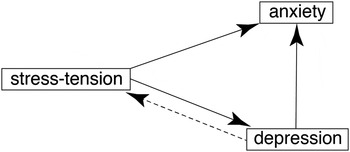
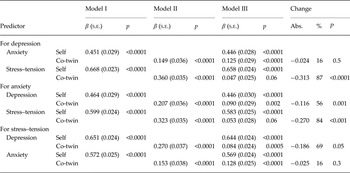
The results of the ICE FALCON analysis provided evidence consistent with the existence of causal relationships between the DASS factors (Table 2; Fig. 2). For both depression and anxiety scores, these outcomes for a twin were associated with the stress–tension factor of the co-twin, but after adjusting for the stress–tension score of that twin, the cross-trait cross-pair associations were significantly reduced (by 87% for depression, p < 0.0001, and by 84% for anxiety, p < 0.001), and were no longer significant (p = 0.06 for each; Table 2). This is consistent with the stress–tension factor having causal influences on both the depression and anxiety factors. Similarly, the data were consistent with the depression factor having a causal influence on the anxiety factor: adjusting for a twin's depression score reduced the cross-trait cross-pair association with the co-twin's depression score by 56% (p = 0.001). There was marginally significant evidence consistent with the depression factor having a reciprocal effect on the stress–tension factor (coefficient reduction of 69%, p = 0.05). There was no evidence that the anxiety factor had a causal influence on either the depression or stress–tension factors.
Graphical representation of the causal relationships between the factors predicted by the modelling. A bold line represents a causal influence of one factor on another, in the direction indicated by the arrow. The dashed line represents a potential causal relationship.

Causal inference modelling, with each DASS factor as the outcome variable and the other two factors as predictors, separately a

DASS, Depression Anxiety Stress Scales; β, standardized regression coefficient; s.e., standard error; p, significance of estimate; Abs., absolute change in β; %, percentage change in β; P, one-tailed significance of change.
a Relationship between the outcome for a twin and, for model I, the predictor of that twin (‘self’); for model II, the predictor of the co-twin; and for model III, both the predictor of that twin and the predictor of the co-twin.
Discussion
The twin regression modelling has illuminated a potential role for stress–tension in the structure of negative mood states, providing evidence consistent with it having causal influences on the depression and anxiety factors. The depression factor in turn might have a causal influence on the anxiety factor: the latter would thus be influenced by stress–tension directly, and also indirectly via depression.
These findings are in contrast to the interpretation made by Lovibond (Reference Lovibond1998) from his longitudinal study of 882 participants who repeated the DASS between 3 and 8 years after first completion. Lovibond (Reference Lovibond1998) reported ‘temporal stability’ of the three DASS subscales: at follow-up, each subscale was best predicted by its baseline measure. The stress–tension factor was no better than the anxiety factor at predicting later depression, and nor was it better than the depression factor at predicting later anxiety. Lovibond (Reference Lovibond1998) claimed that this showed that stress–tension was independent of the other two subscales, and did not simply represent a factor that was common to them. While the study reported moderate correlations between baseline stress–tension and later depression and anxiety symptoms (0.27 for both), the design could not determine the nature of the influences between the subscales. The modelling approach employed here takes advantage of a feature of the MZ twin pairs: they not only had high cross-trait correlations within twin, but also high cross-trait cross-pair correlations [the latter were of a similar scale to those reported by Lovibond's (Reference Lovibond1998) longitudinal study]. This feature allowed the use of a novel regression methodology to reveal evidence consistent with causal influences between the factors: principally, the causal influence of stress–tension.
The role of stress–tension in determining a person's susceptibility to negative mood states suggests that strategies that reduce stress and tension – that specifically target a person's sense of being wound up, of over-reacting to situations, of intolerance – could have particular benefits for well-being, and potentially reduce the risk of developing mood and anxiety disorders. To free oneself of mental stress and tension is to aim for a state that the ancient Greeks described as ataraxia, or freedom from disturbance of mind (Sharples, Reference Sharples1996). In those suffering from mood and anxiety disorders, alleviating stress–tension symptoms might be effective in reducing symptom burden. The recent emergence of mindfulness-based therapies for the disorders can be thought of as one such approach (Hofmann et al. Reference Hofmann, Sawyer, Witt and Oh2010).
The causal influence that depressive symptoms might have on anxiety symptoms is of additional interest. The onset of anxiety disorders is usually observed in late childhood, preceding the typically post-pubertal onset of depression (Kovacs et al. Reference Kovacs, Gatsonis, Paulauskas and Richards1989). The results of the present study, however, suggest that in adults a reduction in levels of depressive symptoms might lead to a reduction in anxiety symptoms, with no evidence that the converse occurs. The study also suggests that reducing depressive symptoms might have some influence on symptoms of stress–tension. This provides a rationale for preferentially targeting interventions at depressive, rather than anxiety, symptoms when they co-occur. The fact that commonly used ‘antidepressant’ medications are effective for both depression and anxiety disorders, but that benzodiazepine medications are only effective for anxiety (Schatzberg & Cole, Reference Schatzberg and Cole1978; Nutt, Reference Nutt1997), might be a reflection of the unidirectional causal relationship between the factors, consistent with our modelling.
A recent classic twin study used multivariate modelling to examine the structure of the DASS (Burton et al. Reference Burton, Williams, Richard Clark, Harris, Schofield and Gatt2015), concluding that genetic and environmental factors exerted their influence on the DASS subscales via a common factor. Our causal modelling approach challenges the assumptions of such multivariate models. The multivariate classic twin model assumes that the only causes of cross-trait cross-pair correlations are unmeasured familial factors that predispose to multiple traits. It assumes that there are no direct causal relationships between traits. The ICE FALCON model tests for evidence consistent with causal relationships between traits; i.e. in our case, causal influences between the DASS subscales.
We found evidence that once the possibility of causal effects between the DASS factors were taken into account, the residual familial effects between some of the factors were reduced to at best marginally significant levels. Specifically, when the correlations between the predictor and outcome variables of the index twin were added to the models (in model III), the correlations between the predictor of the co-twin and the outcome of the index twin were reduced for the influences of stress–tension on depression (p = 0.06) and anxiety (p = 0.06; Table 2). This suggests that for these relationships, the familial correlations were driven largely by the measured causal influences, and not through other unmeasured familial factors shared by the twins, such as genes or factors related to shared family environment. The ICE FALCON modelling shows that the assumptions of multivariate twin models might not hold for our twin data, and therefore not apply in general.
There are limitations to the study that warrant consideration. The study was cross-sectional, with assessments completed as part of an online survey. We did not collect data on past or current mental illnesses, and measured the factors that comprise negative mood states dimensionally using the DASS. There is some justification for this approach: there is no disjunction between clinical and non-clinical populations with respect to depressive and anxiety symptoms, with good evidence that clinical disorders represent one extreme in a continuous symptom distribution (Widiger & Samuel, Reference Widiger and Samuel2005). Nonetheless, the conclusions that can be drawn in terms of what the results mean for understanding co-morbidity between clinical mood and anxiety disorders, and interventions to prevent or treat them, are tempered by this approach. It is also possible that the results of our modelling were affected by differential participation. We received complete twin-pair data from 32% of the pairs who were invited to participate in the study. While it might be that the participating and non-participating pairs differed, with the former being more similar in their response than the latter, this would not necessarily mean that they differed in terms of the underlying aetiology, and nor would it probably influence the direction of the causal influences.
To conclude, the use of our novel twin modelling approach has illuminated a distinct aetiological structure for negative mood states that has plausibility. In particular, the stress–tension factor appears to have a critical role, and interventions that specifically target the factor might prove to be effective in reducing depressive and anxiety symptoms, and hence the incidence of clinical disorders.
Supplementary material
The supplementary material for this article can be found at http://dx.doi.org/10.1017/S0033291716001884
Acknowledgements
The study was funded by an Early Career Researcher Grant to B.J.H. from The University of Melbourne. C.G.D. is supported by a National Health and Medical Research Council of Australia (NHMRC) Clinical Career Development Fellowship. C.L.-S. is supported by the Spanish Ministry of Education, Culture and Sport. J.L.H. is supported by a NHMRC Senior Principal Research Fellowship, and as a Distinguished Visiting Professor at Seoul National University, Korea. C.P. is supported by a NHMRC Senior Principal Research Fellowship, and a Brain and Behavior Research Foundation (NARSAD) Distinguished Investigator Award. B.J.H. is supported by an NHMRC Clinical Career Development Fellowship. This research was facilitated through access to the ATR, a national resource supported by an Enabling Grant from the NHMRC.
Declaration of Interest
C.P. has participated on advisory boards for Janssen-Cilag and Lundbeck, and has received honoraria for talks presented at educational meetings organized by Astra-Zeneca, Janssen-Cilag and Lundbeck. None of the other authors has interests to declare.