1. Introduction
The standard model of particle physics is, arguably, the most successful fundamental model in the history of physics. It is theoretically capable of handling all the strong, electromagnetic, and weak interactions of quarks, leptons, gluons, W and Z bosons, and photons. Yet, it is conspicuously absent from many recent philosophical accounts of quantum field theory (QFT).Footnote 1 In these accounts the prevailing contention is that relativistic QFT does not support, and is not even compatible with, particle ontology. One way to understand the gap between physical accounts and philosophical reconstructions is to focus on the strategy choices facing philosophers. I will schematize this in terms of two interrelated sets of choices, one philosophical and the other physical.
The philosophical choice concerns theories about scientific theories. The familiar distinction between syntactic accounts, based on axiomatic formulations, and semantic accounts, based on the interpretation of a formalism through models, draws attention away from a shared presupposition. A necessary condition, presupposed by both methods is that the mathematical formulation of a theory should have a basic consistency independent of any physical interpretation. This is a requirement proper to an interpretative reconstruction of theories. In the normal practice of physics very few functioning theories meet this requirement.
There are two major traditions in quantum field theory. The mainstream tradition, which I will call Lagrangian quantum field theory (LQFT), but which most physicists simply call quantum field theory, is based on Lagrangians constructed by a variety of methods. Historically, the development began by quantizing classical, or pseudoclassical, Lagrangians. This was soon supplemented by the method of functional integration associated with Feynman diagrams, and other methods of quantization. The resulting quantum formulations were often modified to accommodate experimental results, expanded to include theoretical assumptions, and revised to yield desirable consequences. This is the general approach that led to the standard model of particle physics. Neither LQFT, nor the standard model, has a mathematical formalism that is consistent independent of the intended interpretations. For the present discussion I will grant that the standard model does not fit, and probably cannot be revised to fit, the basic norms of the semantic conception of theories. From this perspective LQFT and the standard model are not theories, but ugly collections of rules.
The opposing tradition is labeled ‘algebraic’, ‘axiomatic’, or ‘local’ quantum field theory. On the assumption that the algebraic formulation is more general and that with plausible assumptions it can accommodate axiomatic quantum field theory (Haag Reference Haag1992, Section 3) we will take algebraic quantum field theory (AQFT) as the alternative. AQFT pays a high price for mathematical rigor. It treats single particle states, interactions by perturbation theory and collisions by S-matrix theory. It does not include the particle interactions basic to the standard model.Footnote 2
This division puts the basic choices facing concerned philosophers into stark relief. They can stick to a priori conceptions of what a scientific theory should be and judge the acceptability of QFT formulations by these norms. AQFT passes; the standard model does not. Alternatively, they can accept LQFT and the standard model on the grounds of their established success and then revise philosophical conceptions of scientific theories and the modes of interpreting them. This alternative encounters a methodological problem. The physicists who developed the standard model have paid very little attention to AQFT and, for the most part, have either ignored or explicitly rejected philosophical accounts of theory interpretation. As a result the second alternative has not been made philosophically intelligible. This is the task of the present paper. For this reason we will focus on interpretative perspectives and refer to other sources for technical details.
2. The AQFT Perspective
The two approaches to QFT involve different interpretative perspectives, one explicit and one implicit. My goal is to make the interpretative perspective implicit in functioning LQFT philosophically intelligible. Here we will simply indicate the aspects of the AQFT interpretation that challenge LQFT. More familiar philosophical perspectives will be introduced later.
Both approaches begin by quantizing classical fields functionally represented by classical oscillators. AQFT now relies on Weyl canonical commutation relations. This exponentiates the
 $\hat{p}$
and
 $\hat{q}$
of the Heisenberg commutators, on the grounds that both cannot be jointly defined over all of Hilbert space. Since the Stone–von Neumann theorem does not apply to an infinite dimensional Hilbert space there is a problem of relating inequivalent representations.Footnote 3 Quantization of classical oscillators with positive frequencies leads to commutation (or anticommutation) relations for creation,
 $a^{\dagger }( k) $
, and annihilation
 $a( k) $
operators. Repeated use of these operators leads from the vacuum, the lowest energy state of the system, to an n-particle state in Fock space and a number operator,
 $N=\int \, d^{3}a^{\dagger }( k) a( k) $
. This is one component of the theoretical term ‘particle’ (or
 $particle_{t}$
) as it functions in QFT.
The group-theory component, stemming from Wigner, asks what kind of entity corresponds to an irreducible representation of the Poincaré group. It is an object characterized by mass, spin, parity, and various charges. A one-particle state in the corresponding Fock space is produced by a creation operator operating on the vacuum,
 $a^{\dagger }( k) =\,\vert k\rangle $
.
 $Particles_{t}$
are generated by repeated operation on the vacuum. The theory does not provide localization for
 $particles_{t}$
.
A more promising approach towards a clarification of the theoretical concept, ‘particle’ is to see where this fits into a network of basic concepts. A basic assumption of current AQFT is that local observables carry all the relevant physical information. There are, accordingly, two foundational presuppositions: Minkowski space-time as a classical manifold (
 $\mathstrut{\cal M} $
) with the familiar metric, g, and observables defined as functions of space-time. For a bounded space-time region,
 $\mathstrut{\cal O} $
one can construct an algebra of observables:
 $\mathstrut{\cal O} \rightarrow \mathstrut{\cal A} ( \mathstrut{\cal O} ) $
. This is a W*-algebra closed with respect to weak limits and closed under the adjoint operation. This has the property of isotony,
 $\mathstrut{\cal O} _{1}\subset \mathstrut{\cal O} _{2}\Rightarrow \mathstrut{\cal A} ( \mathstrut{\cal O} _{1}) \subset \mathstrut{\cal A} ( \mathstrut{\cal O} _{2}) $
, leading to a net of algebras. Since different theories select different observables, an indefinitely large number of algebras is possible. The quasilocal algebra is the smallest C*-algebra containing all the local algebras. Two qualifications should be noted. At this general level one needs only space-time localization of observables, not particular values. Also, Einstein causality enters through the assumption that operator representing observables of space-like separated regions commute.
In the earlier development of QFT by Dirac and Schwinger, and in many contemporary developments, fields are assigned point values and a foundational role. AQFT treats observables, rather than fields, as basic. The classical analysis of field measurements by Bohr and Rosenfeld showed that field measurements only yield values spread out over the volume of a classical test particle. This is compatible with the independently developed emphasis on operator-valued distributions, rather than field point values. Symbolically, if f is a smooth test function, then
 $\phi ( f) =\int \,\phi ( x) f( x) d^{4}x$
. States can be defined as positive, normalized linear functionals on the algebra of observables. The Gelfand-Naimark-Segal construction leads from a *-algebra,
 $\mathstrut{\cal A} $
, and algebraic states to a Hilbert space,
 $\mathstrut{\cal H} $
, and a representation of
 $\mathstrut{\cal A} $
by linear operators acting in
 $\mathstrut{\cal H} $
. I will only consider one aspect of this, how particle localization figures in this theoretical framework.
Relativistic particle mechanics does not support the nonrelativistic position operator,
 $\langle x\rangle =\int \,\overline{\psi }\,\hat{x}\,\psi \, d^{3}x$
. The equivalent relativistic position operator is not covariant and does not produce a position average. The effective position operator resulting from the Newton-Wigner, or Foldy-Wouthuysen, reduction of the Dirac wave function is a nonrelativistic operator that smears position over a volume about the size of the particle's Compton wavelength. The primacy accorded observables suggests localizing a particle by localizing its observables. Naively, a particle in a state is localized in a region, O if all of its observables,
 $\hat{\mathstrut{\cal F} }$
have values,
 $\langle \psi \vert \hat{\mathstrut{\cal F} }\vert \psi \rangle =0$
for any region spacelike separated from
 $\mathstrut{\cal O} $
. This, however, leads to incompatible eigenvalues assignments. One way around this is to specify differences relative to the vacuum. In Knight localization a system specified by a state, ψ, is localized in a region,
 $\mathstrut{\cal O} $
, iff
 $\langle \psi \vert \hat{\mathstrut{\cal F} }\vert \psi \rangle -\langle \Omega \vert \hat{\mathstrut{\cal F} }\vert \Omega \rangle =0$
for any system observable localized in a region spacelike separated from
 $\mathstrut{\cal O} $
. According to the Reeh-Schlieder theorem, our first no-go theorem, the set of vectors,
 $\mathstrut{\cal F} \,\vert \,\Omega \rangle $
obtained by applying the operator,
 $\hat{\mathstrut{\cal F} }$
to the vacuum state is dense in the Hilbert space of state vectors. It follows that relatively localized states span the Hilbert space, blurring any notion of sharp localization.Footnote 4
Secondly, there is the issue of the interactions specified by local gauge invariance. According to Haag's theorem (Haag Reference Haag1992, 55–57; Earman and Fraser Reference Earman and Fraser2006) the canonical quantization process that leads to free fields cannot yield any unitarily equivalent interacting fields. The objects on which local gauge symmetry acts cannot be accommodated by the algebra of observables. So AQFT proponents tend to interpret away the distinctive physical significance the standard model accords local gauges.Footnote 5
For the final no-go theorem we rely on the Halvorson-Clifton (Reference Halvorson and Clifton2002) version of the strengthened Hegerfeld-Malament theorem. The presentation of a strict localization system for particles coupled to a lower bound on system energy leads to superluminal spreading of wave functions, which is incompatible with relativity. This presents a choice. If the assumptions of the theorem hold, then our world cannot be correctly described by a particle theory. If it can be so described, then at least one of the assumptions must be wrong. They develop the first choice and argue that recourse to fuzzy localization is of no avail. I believe one should also consider the physical significance of these assumptions. The postulate that a particle is sharply localized in a volume Δ at time t would require something like an infinite potential well. Then the offensive conclusion that at times later than t the wave packet would have infinite tails would depend on how the potential is lowered. Also, localization in Δ cannot be considered equivalent to measurability in Δ until some method of measurement is specified.
3. The LQFT Perspective
Basic texts on LQFT and the standard model do not treat the algebra of observables, the Stone–von Neumann theorem, inequivalent representations, Haag's theorem, the Reeh-Schlieder theorem, or theoretical problems of particle localization (except for condensed matter physics). One may handle this by repeating the opposed jokes about sloppy mathematics and physical contributions less than any preassigned epsilon. Or one may try to understand why these are not seen as pertinent issues. The latter alternative requires a radically different interpretative perspective, which I will attempt to indicate.
As Weinberg (Reference Weinberg, Hoddeson, Brown, Riordan and Dresden1997) noted, the development of the standard model induced a revised understanding of how quantum field theory functions. The standard model emerged from a collective effort and merged components with their own proper constraints and modes of interpretation. I will list some features of the standard model that grate against philosophical conceptions of theories as based on a mathematical foundation with a consistency independent of the interpretation accorded it. The principal ingredients were the following: quantum physics; special relativity; group theory, especially Lie groups and Lie algebras (but not *-algebras); extension of symmetry principles to internal symmetries; the extension of gauge invariance from global to local gauges; the renormalization group, and spontaneous symmetry breaking. The constraints included considerations of analyticity, unitarity, covariance, and fitting Feynman diagrams. There was a sustained collective effort to fuse these into a viable synthesis. The standard model is a collection of disjoint parts weakly unified by a particle ontology. Mathematical propriety was relegated to a mopping up operation.
Neither LQFT nor the standard model has a basic mathematical consistency independent of a physical interpretation. The struggle was to achieve a basic consistency of the standard model as a functioning physical theory, not as an abstract mathematical formalism. This struggle focused on removing, or at least taming, the major sources of inconsistency. The electroweak component of the standard model had two basic sources of inconsistency. The first, already familiar from QED, involved a reliance on series expansions that have divergent terms and may not converge even when the divergences are covered over. This was originally handled by regularization and renormalization and eventually by the renormalization group. Because of anomalies related to chiral symmetry breaking, the electroweak component in not renormalizable when treated in isolation. It is renormalizable in an overall model including quarks. (See Kaku Reference Kaku1993, 414–429.) The second source of inconsistency involved the introduction of intermediate vector bosons. Introducing massive bosons violated covariance requirements; while massless bosons did not accord with short-range forces. The accepted solution involved introducing massless bosons and then invoking the Higgs mechanism to supply the needed mass.
Strong interactions presented different consistency problems. Because of the strength of the strong coupling constant one could not rely on series expansions. This was resolved through the discovery of quark confinement and asymptotic freedom. A reliance on the flavor quantum number as the basis for exchange forces led to inconsistencies with the Pauli exclusion principle. This was resolved by the introduction of a new color quantum number. The net result of these resolutions was a contextual consistency of the standard model as a theory of local gauge interactions. The contextual aspect is clearest when the standard model is regarded as an effective theory valid only within a limited energy range.
LQFT and the standard model rely on interpretation through a detailed correspondence with experimental results as reported. Two aspects of this should be noted. The first is an implicit reliance on language as an essential part of the process of interpreting the theory. Participants in the ongoing dialog rarely analyze the language used. A philosophical critic should consider the necessary conditions for unambiguous communication of physical information. The second is the changed relation between experimentation and theory consequent upon the emergence of the standard model, something emphasized by Pickering (Reference Pickering1984). Prior to the development of the standard model experimenters discovered new particles (
 $\tau ,\,\theta ,\, q_{\mathrm{strange}\,},\, q_{\mathrm{bottom}\,},\, J/ \phi $
), which theoreticians then attempted to explain. In the later, and now dominant stage, theoreticians predicted particles (
 $\Omega ^{-},\, W^{\pm },\, Z,\, q_{\mathrm{charmed}\,},\, q_{\mathrm{top}\,}$
) and guided experimenters on the paths to observe the predicted particles.
In this context, the no-go theorems previously cited seem irrelevant. They rely on presuppositions that are incompatible with the presuppositions implicit in the standard model. Haag's theorem shows that if one begins with free particle states and then introduces an interaction representation, then one cannot get nontrivial interactions. Here Einstein supplies a helpful guide. Lorentz addressed the experimental challenges to electrodynamics by beginning with the standard theory and adding corrections of order
 $( v/ c) $
(stellar aberration, the Hoek-Fizeau experiment), and of order
 $( v/ c) ^{2}$
(the Michelson-Morley experiment). Einstein postulated the invariance of the speed of light and the covariance of the laws of physics to deduce Lorentz's equations and modify the interpretation of time. The standard model implicitly postulates sharply localized interactions. Revolutionary postulates should be evaluated through their consequences, not their antecedents.
The Reeh-Schlieder theorem is also irrelevant. The use of this theorem to refute locality hinges on the status of the vacuum as a cyclic vector. Here ‘vacuum’ does not refer to some objective nothingness. It is the lowest invariant state of the Hamiltonian. As Halvorson and Muger Reference Halvorson and Muger2006 has shown, a necessary condition for the applicability of this theorem is the translation invariance of the vacuum state. This applies to the vacuum state proper to free particles. The standard model relies on an effective vacuum state that is not translation-invariant. The clearest illustration of this difference comes from a consideration of the significance of spontaneous symmetry breaking (Kaku Reference Kaku1993, Chapter 10). The cosmological assumption is that the universe began as a pure quantum state and quickly evolved through a sequence of spontaneous symmetry breakings: of the gravitational force; the strong force, and the weak force. If the Lagrangian is characterized by symmetry groups corresponding to n generators and, because of symmetry breaking, the vacuum is characterized by symmetry groups corresponding to m generators, then the number of massless bosons generated corresponds to the number of broken generators, n−m. The introduction of a local gauge transformation leads to the Higgs mechanism, that swallows these massless bosons and yields massive bosons. The effective vacuum, the lowest energy state, is not invariant under the translations proper to the Lagrangian.
The interactions postulated by local gauge theory are sharply localized. The nature of this localization can be illustrated by the simplest application. Consider the local phase transformation,

This is local in the sense that the value of
 $\theta ( \mathbf{x}) $
can be different for different positions. To relate this to nonrelativistic quantum mechanics as well as electrodynamics, use the Schrödinger wave equation,

If in (2) we substitute
 $\psi ( \mathbf{x},t\,) ^{\prime }$
, then we get

This definitely does not have the same form as (2). However, we may supplement (1) with the local electromagnetic gauge transformation,

For a particle of charge, q, the conjugate momentum is
 $\mathbf{p}\rightarrow \mathbf{p}-q\mathbf{A}( \mathbf{x}) $
. The standard quantization procedure is to replace
 $\mathbf{p}$
by
 $-\imath \nabla $
. So,

D is the covariant derivative. When this is substituted for the ordinary derivative and the two sets of phase changes are introduced, then the transformed Schrödinger equation has the same form as the untransformed equation. The covariant derivative used in the standard model can be written in symbolic form as:

where
 $L_{k}$
are the generators of the gauge group, the
 $A^{k}_{\mu }$
are the gauge fields, and g is the matching coupling constant. These couplings are simply postulated and then the coupling constants are adjusted to fit the empirical data.
The use of the same spatial point,
 $( \mathbf{x}) ,$
for both the wave equation and the electromagnetic potential provides a sharp localization for the interaction. The assumption is that this sharp localization obtains as a matter of fact. However, the localization is not related to the framework of observables that plays a basic role in the application of the no-go theorems. Since the localization is not specified relative to an observer's system, there is no foundation for addressing the covariant properties of the (non)specification.
Does acceptance of the local gauge principle support an argument from localized interactions to localized beables? Any attempt to answer this leads to contrasting philosophical perspectives. Foundational approaches to theories, i.e., accepting an abstract mathematical formulation as the foundation for an interpretation, treat the interpretation of a theory as a relation between the theory and the reality it is a theory of. The previously dominant ontological approaches asked the forbidden question: What must (or might for antirealists) the world be like if quantum mechanics is true of it? This was forbidden by Bohr's strictures on meaningful language. In the interpretation just considered language plays no role, but beables do. In the epistemological orientation characterizing AQFT the algebra of observables contains the physical content. This has not been extended to include local gauge theory.
In the practice of particle physics the crucial correspondence is between theoretical predictions and experimental results as reported, i.e., reportables rather than beables. This requires a mode of interpretation that takes language seriously. This will be given a detailed development elsewhere (MacKinnon, Reference MacKinnonforthcoming). Here I will simply provide an illustration. In high-energy physics both experimenters and theoreticians rely on inferential systems in which ‘particle’ plays a supporting role. After Gell-Mann predicted the existence of the
 $\Omega ^{-}$
particle, he discussed experimental tests with Nicholas Samios, who directed high energy particle physics experiments at Brookhaven National Laboratory. Samios had access to an eighty inch bubble chamber and could produce a stream of high energy
 $K^{-}$
mesons. Gell-Mann wrote on a paper napkin the processes that should be consequent on the production of an
 $\Omega ^{-}$
:

The experimental design required a network of inferences in which ‘particle’ plays a foundational role. Surprisingly, the concept ‘particle’ in this experimental context is unproblematic. It is the classical concept of a small object with a precise location. This is not an ontological claim that this is what the
 $\Omega ^{-}$
or
 $e^{+}$
really is. It is Bohr's complementarity principle specifying the experimental contexts in which the use of the classical concept is appropriate. Thus the concept ‘
 $particle_{c}$
’ entails ‘traveling in a precise trajectory’, ‘colliding with other particles’, etc. This plays a role in tracking the
 $e^{+}$
and
 $e^{-}$
tracks back to their sources. It played a crucial role in identifying the
 $\Omega ^{-}$
. If a
 $\Xi ^{-}$
had been produced there would be a straight-line trajectory between its production point (the origin of the
 $K^{+}$
track) and the vertex of the
 $p\pi ^{-}$
tracks. If an
 $\Omega ^{-}$
is produced there is a slight displacement due to the intermediate steps indicated above (see Samios Reference Samios, Hoddeson, Brown, Riordan and Dresden1997, 533). The analysts, including Staten Island housewives, had to keep examining successive frames until the deviation was found. The tiny displacement that supplied the basis for inferring
 $\Omega ^{-}$
production and decay was finally detected on the frame numbered
 $97,025$
. An interpretation must take into account the differing roles that ‘particle’ plays in experimental and theoretical contexts.
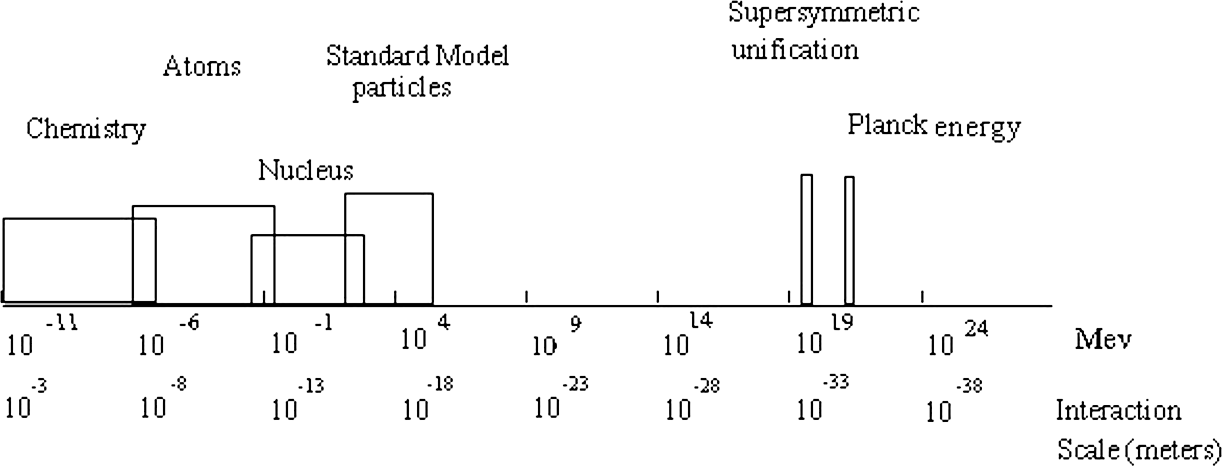
The standard model systematizes particle interactions. Intrinsic to the theory are three families of leptons and quarks, the photon, three intermediate vector bosons, and eight gluons. Other particles, especially Higgs particles, axions, and magnetic monopoles, are assumptions or tentative consequences of the model. The final difficulty concerns the status of these particles when the standard model is interpreted as a low energy approximation to a not-yet-developed deeper theory (see Figure 1). This should not be seen as a project of theory replacement. At issue here is the status of effective theories and their commitments. The general principle is that a theory can be regarded as an effective theory up to a proper high-energy cutoff. Above that level new physics is needed. The new physics supplements, but does not replace, the old physics. Quarks and leptons should remain as permanent commitments of physics. This, however, is a relative ontology, not a depiction of the basic furniture of the universe. I believe that attempts to construct an ontology by searching for the basic constituents of reality represent a classical imposition. Accepting quantum mechanics as the basic science of reality entails accepting superposition, interference, and entanglement as features of reality at the most basic level now available. In my opinion only the Consistent Histories interpretation of quantum mechanics accommodates these features in an acceptable way. A defense of this will be given elsewhere.
Interaction energies.