Somehow, Shen Fu-hsiung lost. The charismatic four-term incumbent had been expected to win re-election easily, since he was very popular in his Taipei City district. He was the top-ranked candidate from his party in his district in every poll published in the two months prior to the election, and, as a senior figure within the President's faction of the party and one of the most sought-after guests on political talk shows, had the kind of name recognition that most politicians can only dream of. Yet he lost, coming in 12th in a ten-seat district. Shen was not the only surprising loser in the 2004 Taiwanese legislative elections, nor was this phenomenon unique to 2004. On the day after an election, one always finds a story about a politician like Shen, whose defeat came completely without warning.
Shen was a victim of strategic voting gone awry. In particular, his case is an example of a kind of strategic voting absent in single member districts: strategic defection from strong candidates. In this paper, I will explore strategic defections from strong candidates in the 2004 Taiwanese Legislative Yuan elections. I provide evidence that strategic voting did actually occur and shifted significant numbers of votes from stronger to weaker candidates. I will further argue that strategic voting was responsible for several coordination errors, as strategic voters overcompensated by shifting too much support to marginal candidates, particularly in larger districts. Finally, I will explore the role of personal votes in moderating the wild swings that strategic votes can produce. While the existing literature assumes that large personal votes tend to exacerbate coordination problems, I argue that large personal votes mitigate coordination problems by providing a foundation of stable votes for each candidate and tempering the potentially wild and devastating swings away from strong candidates.
The rest of the paper will be organized as follows. First, I will review the literature on strategic voting in single non-transferable vote (SNTV) electoral systems. Second, I will present some background to the 2004 legislative elections in Taiwan. Third, I will present evidence that strategic voting, specifically strategic defection from strong candidates, occurred. Fourth, I will discuss the effects of personal votes on strategic voting. The fifth section concludes.
Strategic voting in SNTV
In a limited vote electoral system, in a district with m seats, a voter casts between one and m – 1 votes, and the m candidates with the most votes win seats. The single non-transferable vote (SNTV) is a form of the limited vote in which each voter can only cast one vote. While the arguments developed in this paper are framed in the context of an SNTV system, they should apply to all limited vote systems.
Cox, building on earlier work by Reed,Footnote 1 proves that, in perfect equilibrium, there should be either m or m + 1 candidates splitting all the votes evenly. All votes expended on the m + 2th candidate and weaker candidates are wasted votes. Equally important, all votes that the first m–1 candidates receive in excess of the mth candidate's total are also wasted. All rational voters whose first preferences would lead them to waste their votes either on leading or trailing candidates should strategically shift their support to a preferred marginal candidate until all m or m + 1 candidates have exactly the same number of votes.Footnote 2
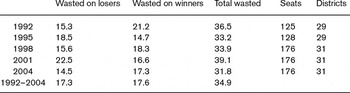
Of course, actual elections never achieve perfect equilibrium. In Taiwan, the number of wasted votes is actually quite high. In the five legislative elections since 1992, about 35% of all votes have been wasted (Table 1). About half of these have been wasted on weaker candidates, and half have been wasted on stronger candidates. To put it another way, about one out of every six votes is wasted on a candidate who has already won. Why don't these voters strategically shift their support to other candidates who really need the extra votes?
Percentage of votes wasted in legislative yuan elections, 1992–2004

As we shall see, strategic voting is not that easy. In fact, this paper will argue that strategic voting has often led to results that were nearly as far or even farther from the equilibrium as sincere voting would have produced. Moreover, strategically defecting from strong candidates entails a risk. If the voter's favorite candidate ends up losing, his or her aggregate utility will be lowered, not raised, by strategic voting. The results presented in this paper demonstrate that this type of disaster is not merely a hypothetical possibility; it happens quite often.
Cox lays out four conditions for strategic voting. First, voters must have strict preference orderings over the candidates. For example, if a voter prefers candidate A and is indifferent to candidates B and C, there is no reason to desert A to ensure that B triumphs over C. Second, there must be a chance that strategic voting could affect the electoral outcome. For example, if it is clear that candidates A, B, and C are far ahead of the field in a three-seat district and that no one else has a reasonable chance of catching them, then voting strategically for candidate D will not change the outcome. In this case, there is no incentive to vote strategically. Third, voters must be short-term rational; they must care about affecting the outcome of the election rather than sending a message or helping a candidate perform better than expected. Fourth and most important, voters must have information about who is leading and who is trailing. That is, they must be able to identify which candidates are ranked 1 through m–1, which are at m and m + 1, and which are at m + 2 and lower. Generally, this type of information is disseminated through survey results. Cox points out that beliefs may be self-fulfilling: when voters believe that a candidate is out of the running, they will strategically switch their allegiance to other candidates and that candidate will, in fact, be out of the running. This insight that what matters is not how good the information actually is but how good the voters believe it to be turns out to be crucially important. In fact, the information is often shaky. The polls rarely indicate a clear rank ordering in any kind of statistically significant way, especially in large districts. In addition, the polls may not be updated to reflect how other strategic voters will act. However, if the voters do not perceive these deficiencies, they may act as if the data were perfect.Footnote 3
There is some evidence from Japan that voters in SNTV elections do vote strategically. Most basically, Reed has shown that Japanese elections do generally seem to conform to the m + 1 rule.Footnote 4 Hsieh and Niemi have shown that this result generally holds in Taiwan as well, though the trend is far stronger in large districts than in small districts.Footnote 5 Cox and Niou show that, over time, there have been fewer wasted votes on strong Liberal Democrat Party (LDP) candidates.Footnote 6 Moreover, Cox shows that fewer votes are wasted on strong candidates when the gap between m and m + 1 is close. Presumably, voters cast their votes strategically to obtain the greatest effect, elites expend more effort trying to convince voters to vote strategically in close races, or some combination thereof. More generally, if voters sometimes act strategically and sometimes do not, we should see a difference in the ratio of the support of the second loser to that of the first loser. If voters strategically desert all candidates ranked m + 2 and lower, then the ratio should be near zero. If they do not vote strategically, the ratio should be near one. In fact, Cox finds that there is a clear bimodal pattern to this ratio, indicating that voters do sometimes strategically desert weak candidates.Footnote 7 Other results from Japan highlight the importance of information. Reed posits that voters should have better expectations about the outcomes when candidates have run in previous elections. He finds that candidates who previously finished as the top loser tend to increase their support if they run again. In contrast, candidates who finished in the m + 2 and lower positions tend to lose support in subsequent elections. Reed argues that voters are able to identify second and lower runners-up as trailing candidates, and their supporters strategically desert them.Footnote 8 Cox and Shugart assume that voters will have more information about the race when most of the candidates are incumbents and find that the bimodality pattern of the second runner-up to first runner-up is markedly stronger when at least half the candidates are incumbents.Footnote 9
Taken as a whole, this literature provides evidence that Japanese voters sometimes vote strategically, that they shift their support from both strong and weak candidates to marginal candidates, and that information plays a critical role in how much strategic voting might occur. However, this evidence is far from conclusive for several reasons. First, it is based almost entirely on the experience of one country, Japan. In fact, since no other parties besides the LDP regularly nominated more than one candidate in a district, evidence for theories about strategic voting comes almost exclusively from a single party, the LDP. Second, it is fairly indirect. Generally, this evidence compares aggregate outcomes with a theoretical equilibrium and presents patterns that are consistent with theoretical expectations rather than providing more direct evidence that voters do, in fact, vote strategically. For example, we cannot be sure if a high second to first ratio in a given district is the result of strategic voting or simply reflects the distribution of voters’ sincere preferences. Even Cox admits that his evidence ‘is merely suggestive of the existence of strategic voting and needs to be bolstered in any given case with further evidence (e.g., from surveys)’.Footnote 10 Third, the information about who is leading and who is trailing is fairly crude. Strong candidates in a previous election may not be strong or even viable candidates in the current election. Fourth, since almost all districts in Japan have three, four, or five seats, this literature has difficulty analyzing the effect of district size on strategic voting.
In this paper, I address some of these deficiencies. Empirically, I use evidence from the 2004 Taiwanese legislative elections, in which four different parties nominated multiple candidates. Rather than comparing aggregate outcomes to a theoretical equilibrium, I look at whether individual candidates fared as well as they were predicted to by pre-election surveys. Moreover, survey results provide much clearer expectations of the electoral outcomes than simply looking at the previous election. Finally, districts magnitudes in Taiwan range much more widely than in Japan, and this variation allows a clearer picture of the effects of district magnitude.
Background of the 2004 Taiwanese legislative elections
In 2004, Taiwan employed a mixed electoral system. Of the 225 seats, 176 were elected from nominal constituencies using SNTV, while the other 49 were elected from party lists. In this paper, we will focus only on the SNTV portion of the elections. The 176 seats were divided among 31 different constituencies, ranging in size from one seat to 13 seats.
In March 2000, Taiwan witnessed its first rotation of political power when Chen Shui-bian of the Democratic Progressive Party (DPP) won the presidency. Since then, Taiwanese politics have become increasingly polarized, with politicians and voters forming two large camps. The ruling camp, commonly called the Green camp, includes the DPP and its much smaller ally, the Taiwan Solidarity Union (TSU). The other camp, known as the Blue Camp, is composed of the long-ruling Kuomintang (KMT) and two splinter parties, the People First Party (PFP) and the New Party (NP). Following Chen's re-election in early 2004 by a razor-thin margin of 0.22% and the Blues’ refusal to accept the legitimacy of the result, the enmity between the two groups reached fever-pitch in the run up to the December 2004 legislative elections.
In the previous election in 2001, the Blues had won a slim majority, with 115 of the 225 seats. Of these, the KMT won 68; the PFP, 46; and the NP, 1. Meanwhile, the Greens won 100 seats, with the DPP taking 87 and the TSU 13. The other ten seats went to independent candidates. In the 2004 elections, the Greens were widely expected to expand their representation in the legislature and possibly win an outright majority. Combined with their control of the presidency, this would have given them the power to implement a wide array of programs unpalatable to the Blues.
While much of the political conflict was framed as a struggle between the two camps, it is important to remember that the parties maintained distinct identities. Within the Green camp, the TSU took a much more idealistic and radical line toward questions of national identity than the DPP. The DPP, in contrast, portrayed itself as a responsible and pragmatic party capable of governing. It is noteworthy that the cabinet did not include TSU members; the DPP governed alone, not in coalition. The divisions between the KMT and PFP were perhaps even deeper.Footnote 11 The PFP was founded in 2000 after James Soong's failed presidential bid. Soong ran against the official KMT candidate, and both KMT and PFP supporters continued to blame the other side for splitting the vote and allowing Chen to win. While the joint KMT–PFP presidential ticket in 2004 seemed to heal many of the wounds between the two parties, divisions re-emerged in the protests in the aftermath of the controversial election. PFP politicians were much more prominent in the protests, and they were much more strident in their condemnations of President Chen. In fact, some KMT politicians feared that the PFP's militant tactics were driving moderate voters, presumably the KMT's market, into the arms of the DPP. We should also note that, with only a few exceptions, the DPP and KMT vote-rationing schemes (see below) did not include TSU and PFP candidates. Generally speaking, each party ran its own campaign.
With political power hanging in the balance, voters had a strong incentive to try to maximize the number of seats won by their party. In previous legislative elections, the Blue majority had never been under serious threat. This possibly changed voters’ priorities. Whereas in previous elections, it may have been more important to elect a specific candidate with a strong personal appeal, in this election it was important to elect as many party nominees as possible, regardless of their personal qualities. In other words, voters had good reason to vote strategically within parties to maximize the number of seats their side would win. There is good reason to believe that, in this election, voters placed more emphasis than normal on party labels and less on other possible dimensions, such as personal connections, local ties, or constituency service.
Using survey data to detect strategic voting
As noted above, one of Cox's conditions for strategic voting is that the candidates must have a clear preference among the marginal candidates. With the high degree of polarization and control of the legislature at stake, it is reasonable to assume that a very high percentage of voters preferred all the candidates from their own party to all other candidates. As long as one of their preferred party's candidates could be identified as marginal and that party ran multiple candidates, some voters had an incentive to vote strategically. This leads us to define the unit of analysis somewhat differently than previous studies have. In most of the Japanese literature, the basic unit of analysis is the electoral district, and studies examine whether there were excess votes for strong candidates, the ratio of the second loser to the first loser, whether the number of incumbents affects the outcome, etc. In this paper, since strategic voting is assumed to occur overwhelmingly within parties, the units of analysis will be party-nominated candidates and party-districts, the ith party in the jth district. In addition, the cases will be limited to those with more than one candidate from the party.
The most important condition for strategic voting is that voters have clear expectations about who is leading and who is trailing. In 2004, the Taiwanese media published multiple polls in almost every district. In 2001 and 1998, the media had presented the odd poll in a few urban districts, but 2004 was qualitatively different in the number of different organizations presenting polls, the total number of polls that they presented, and the nearly universal coverage of all districts. I have collected data from 102 polls published by the three most respected media polling organizations, including the United Daily News (UDN), a newspaper, and TVBS and ERA, cable television stations. With only a few exceptions, each organization published at least one survey in all the districts in which one or more parties ran multiple candidates.Footnote 12
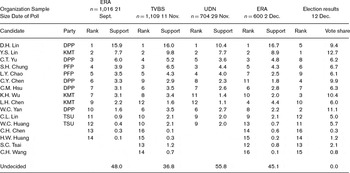
Table 2 shows the surveys published by the three organizations for Kaohsiung County. A quick glance reveals several reasons to object to any use of the data. The last poll has a sample size of only 600. The percentage of respondents who are undecided varies quite a bit among the various polls. Most importantly, the margins separating the various candidates are very small and are rarely statistically significant. For example, by any normal statistical standard, there is no difference among any of the candidates ranked fourth or lower in any of the polls. These features are not limited to Kaohsiung County; the same problems occur in most of the polls. Clearly, these data are not ideal.
Poll and election results for Kaohsiung County

Notes: Kaohsiung County elected nine seats.
Question wording: (TVBS) ‘If the election were tomorrow, which one of the following candidates would you be most likely to vote for?’
On the other hand, it would be a mistake to conclude that these polls do not convey real information. Some features are strikingly consistent across the polls. D.H. Lin is always ranked first by a large margin. Y.S. Lin is always second, again by a fairly comfortable margin. Even among the candidates in the scrum between third and 12th place, the results are fairly consistent. A candidate's rank usually does not change more than one or two places from poll to poll. This consistency is all the more striking considering the polls vary across time and across organizations. In fact, the difference in undecided responses provides assurance that these are useful data: in spite of the differing survey methodologies that produce such different non-response rates, the rankings are very similar. We are getting a pretty good picture of the population's preferences.
Moreover, it is worth reiterating that the actual quality of the information may be less important than how reliable people believe it is. While a statistician would be loathe to conclude that C.M. Hsu, who finished seventh, sixth, seventh, and sixth in the four polls, is safely among the top nine candidates, many ordinary voters may not be so discriminating. Polling organizations certainly do not emphasize the uncertainty of their results. To the contrary, they highlight their expertise and sophistication. We should also remember that survey results are often the only objective evidence that voters have of how the race is shaping up. In a pre-election environment filled with rumor and innuendo, polls are hard evidence. In short, the polls conveyed valuable information to voters about the state of the race.
The most striking feature in Table 2 is that the strong DPP candidates in the polls did poorly in the election, while the weak DPP candidates did very well. D.H. Lin was first in every poll, but she fell to third out of the five DPP nominees in the election. C.T. Yu, who was the second strongest DPP candidate in each poll, won the fewest votes of the five and very nearly lost his re-election bid. Meanwhile, the three weaker DPP nominees surged ahead of Yu and easily won seats in the legislature. The DPP was lucky in that it had enough aggregate support for all five to win, but if one of its candidates had lost, the unlucky person would have been Yu, one of its more popular candidates.
To determine whether this instance of weak candidates doing well and strong candidates doing poorly is part of a wider pattern, we need to define some variables. A candidate's electoral support is her share of the votes. For example, D.H. Lin's electoral support is 9.4% (51,083 of 545,184 valid votes). I define each candidate's poll support as the average of her support among those expressing opinions in the last poll published by each of the three survey organizations. D.H. Lin's poll support is ([(16.0/.632) + (10.4/.442) + (16.7/.549)]/3) = 26.4. A candidate's excess margin is defined as the candidate's poll support minus the poll support of her party's weakest nominee.Footnote 13 In Kaohsiung County, the DPP's weakest candidate was C.Y. Chen, who had a poll support value of only 4.4. Thus, D.H. Lin's excess margin is 22.0. The number of nominees is the number of candidates nominated by a party in a particular district. For D.H. Lin, this number is five, since the DPP nominated five candidates in Kaohsiung County.
A very crude way to see that strong candidates did not dominate the elections is to look at whether the strong candidates in the polls won their elections more often than the weakest candidates. In fact, they did not. There were 53 instances in which a party nominated two or more candidates in a district. Forty-one of the 53 top-ranked candidates won seats, while 40 of the 53 candidates with the lowest poll support won seats. In other words, an extremely popular candidate was just as likely to lose as a relatively unpopular one from the same party.
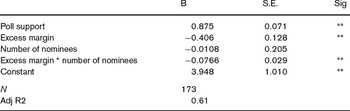
D.H. Lin did not lose her race, but she did come closer to losing than expected. This was a fairly general pattern. The regression model in Table 3 uses poll results to predict election support among the 173 candidates from parties with multiple nominees. The coefficient for poll support (0.875) is only slightly less than one, meaning that a point in the polls is worth nearly a point in the electoral results. However, this is only true for the weakest candidates. Strong candidates have large excess margins, and the coefficient for this variable is negative (–0.406). Put simply, strong candidates have to ‘give back’ about 40% of their excess margin. For D.H. Lin, this represents a loss of 9.0% in electoral support. Moreover, the penalty for a large excess margin increases as the number of nominees increases. The coefficient for an interactive term for number of nominees times excess margin is also negative (−0.0766). This can be substantial; for D.H. Lin, it is a penalty of another 8.4%. In fact, this model predicts that D.H. Lin's electoral support should be 9.6%, almost exactly the 9.4% that she actually won. In short, this model portrays a pattern in which strong candidates consistently underperform expectations in the election. The obvious explanation for this pattern is that strategic voters deserted strong candidates in favor of more marginal candidates.
Using poll results to predict electoral results

Notes: *significant at p < 0.05; **significant at p < 0.01. The dependent variable is Electoral Support. The cases are candidates.
This regression model focuses attention on district magnitude. Strategic voting is more prevalent in larger districts with more nominees from each party. It is well understood that it is increasingly difficult to turn enough votes for k seats into k seats as k increases.Footnote 14 Parties might nominate too many candidates, not enough candidates, or, most importantly for our purposes, fail to equalize votes among candidates.Footnote 15 Equalizing votes among a larger number of candidates is inherently harder. While plenty of voters in large districts seem willing to take on this task, they face a daunting challenge. With no central coordinating mechanism to ensure that every candidate gets just the right number of votes, the risk of error is high. For strong candidates in large districts, there is a very real danger that too many of their supporters will judge them to be safe and strategically vote for a more needy candidate. More nominees means more needy candidates clamoring for strong candidates’ excess votes. Sometimes this leads to disaster.
There are two obvious objections to this argument, one methodological and one theoretical. Methodologically, it is possible that a simple regression to the mean is driving the results. That is, strategic voting is not causing strong candidates in the polls to become weak candidates in the elections. Rather, this is a statistical blip in which some candidates randomly get ‘good’ samples and appear to be strong. However, the chances that they will get such a deviant sample twice in a row is low, so their support in the next sample, the election, is lower. This could account for strong candidates appearing to lose support and weak candidates appearing to gain support between the poll and the election.
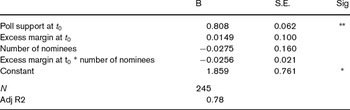
If, in fact, a regression to the mean were driving this result, it should be evident not only between the polls and the elections, but also between earlier and later polls. Both TVBS and ERA conducted multiple waves of surveys in several districts. I test for a regression to the mean by using the results of the earlier surveys to predict a candidate's poll support in later surveys done by the same polling organization, using exactly the same regression model as in Table 3.Footnote 16Table 4 provides no support for this hypothesis. The coefficients for excess margin and the interaction of excess margin and number of nominees are no longer significant. The only significant coefficient is poll support. In other words, the best prediction is that support in the later poll will be basically the same as poll support in the earlier poll. The strong remain strong, and the weak remain weak.
Using earlier poll results to predict later poll results

Notes: *significant at p < 0.05; **significant at p < 0.01. The dependent variable is poll support at t 1. The cases are candidates.
Correlations between poll ranks and electoral ranks
Notes: * significant at p < 0.05; ** significant at p < 0.01. The cases are candidates.
Theoretically, one might object that party strategy, not strategic voting, is responsible for these patterns. Starting from a few isolated cases in 1995, it has become increasingly popular for parties to provide a vote-rationing scheme to their supporters to equalize the number of votes that each party nominee gets. For example, in Kaohsiung County, the KMT attempted to ration votes among its three candidates, telling supporters born in January through April to vote for Chen; May through August, for Lin; and September through December, for Wu. The DPP had a similar scheme. Supporters were instructed to vote for one of the five candidates according to the last digit of their ID number. If all voters were to follow these schemes, all party nominees would get the same number of votes. Naturally, the candidates hurt the most by these schemes are the strongest candidates.
These vote-rationing schemes are different from strategic voting in an important sense. The point of strategic voting is to divert support away from candidates who do not need it, either because they are clearly leading or clearly trailing, to marginal candidates. Vote-rationing schemes make no distinction among the various candidates. Rather than a strategic judgment about which candidates need support, they allocate votes randomly, trusting in the law of large numbers to produce an equitable result. While a voter following the vote-rationing scheme may not vote for his or her favorite candidate, he or she is as likely to vote for the strongest candidate as for the marginal candidate.
There is some survey evidence that large numbers of voters were willing to ration their votes. Twelve days before the election, the head of the KMT's Organization Department cited internal polls showing that about 40% of KMT supporters were willing to ration their votes.Footnote 17 A week later, the KMT Secretary General said KMT internal polls showed that, nationwide, about 30% of KMT supporters were willing to ration their votes, but this figure reached into the low 40s in some of the more urban districts, including those in Taipei City and County.Footnote 18 However, a UDN poll conducted the day after the election casts a different light. Overall, 14% of all voters said that they had rationed their votes (pei piao). However, only 4% said they had voted according to a party scheme; the other 10% said they had rationed their votes according to their own judgments. In the Blue camp, 4% of KMT and PFP supporters voted according party instructions, while another 8% rationed votes by their own judgments. Vote rationing was higher in the Green camp, with 6% and 17% voting by party schemes or personal judgments, respectively.Footnote 19 Of course, voting according to one's own personal judgment is precisely what we have defined as strategic voting. According to this survey, strategic voting was much more common than voting according to a party scheme. It was twice as common among Blue voters and three times as common among Green voters.
Post-election survey results aside, we can also find evidence of strategic voting by comparing the pre-election polls with election outcomes. We might think of a candidate's support in the polls as comprised of two components: a personal vote and a party vote. That is, some proportion of the supporters is expressing support for the individual candidate, and they will not switch to another candidate simply because of a party appeal. The other supporters are primarily party supporters. They care more about the party than any individual in it, and will vote to maximize the party's fortunes. The former group is not willing to shift its support to another candidate; the latter group is. Assuming the leaders in the polls are the ones who have the most personal votes, all the party votes could be redistributed without affecting the rank-ordering of the candidates. If the party supporters all vote according to the party's vote-rationing scheme, each candidate should receive the same number of votes from them. However, the rank order will remain the same, since the strongest candidates still have more personal votes. In other words, vote rationing should reduce the gaps between candidates, but it should not completely eliminate them. It is only if the strongest candidates’ supporters are overwhelmingly composed of party voters and the weakest candidates’ supporters are overwhelmingly composed of personal voters that a vote-rationing scheme could reverse the rank ordering. While possible, this is highly unlikely.
On the other hand, if voters vote strategically, rather than according to a party scheme, it is quite plausible that the rank ordering will change. Rather than giving each of the party nominees her ‘fair share’ of votes, strategic voters shift all of their votes from the strongest candidate to weaker candidates. If large numbers of voters make the same calculations about which candidates are the strongest and weakest, they can easily turn marginal candidates into runaway winners and strong candidates into losers.
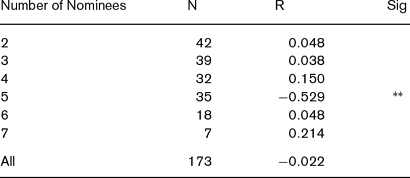
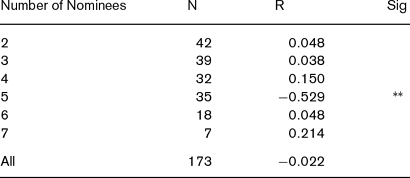
In fact, there are dramatic changes in the rank orderings of candidates. If the rank ordering did not change, we would expect the correlation between the poll ranks and electoral ranks to be one. In fact, the correlation is not statistically different from zero (r = −0.022; p = 0.775).Footnote 20 In other words, the electoral ranks change so much that the two variables are statistically completely unrelated to each other. Moreover, this pattern holds for each number of nominees except five. When there were five nominees, the correlation was negative, precisely the opposite of what one would expect if party vote-rationing strategies were driving these results. Vote rationing may have had some effect, but its impact was minor compared to that of strategic voting.
Coordination mistakes, district size, and the personal vote
We have seen that strategic voting can hurt strong candidates, even causing them to lose, while making marginal candidates into runaway winners. In a sense, it is surprising that strategic voting does not produce even more disasters. Imagine two otherwise identical cases, one in which all voters vote strategically and the other in which none does. If no one votes strategically, the electoral outcome is identical to the poll outcome. A large number of votes are wasted on the strongest candidate, while the weakest candidate lags far behind and probably loses. If everyone votes strategically, the strongest candidate receives zero votes and loses, while the weakest candidate receives all of his sincere supporters plus all of the strongest candidate's strategic supporters. The purely strategic outcome is even more lopsided and skewed than the purely sincere one.
In reality, while the strong candidates may plummet in support and even lose, they are never reduced to zero votes. In part, this may be because people have different information and not everyone recognizes them as having more than enough support to win. More importantly, not everyone votes strategically. As mentioned above, voters can be divided into personal and party voters or, equivalently for our purposes, sincere and strategic voters. Strategic voting works best when the proportion of strategic voters is not too high and not too low. If there are too few strategic voters, they cannot make a difference to the outcome. If there are too many, they can produce wild swings and perverse outcomes, as in the preceding example. Another way of saying this is that personal votes provide stability in SNTV elections.
It is possible that there might be too many personal votes, but this seems highly unlikely. Taiwanese society is simply not that thoroughly organized. For example, Hawang's study of constituency service finds that in the early 1990s, the average legislator only had about four legislative aides working in the district on constituency service.Footnote 21 In contrast, the average Japanese Diet member has roughly 30 paid secretaries and up to a thousand unpaid workers organizing his or her support group (koenkai).Footnote 22 The real danger is that there are not enough personal votes to ensure that strategic votes do not produce unexpected outcomes. This leads to a clear prediction: a higher percentage of personal votes should lead to a more even distribution of votes among a party's candidates.
Note that this is exactly the opposite of the common assumption. For example, Swindle assumes that if party is the only thing that matters, ‘voters have no reason to prefer one co-partisan to another, so there is no reason to believe that one candidate will outpoll another.’Footnote 23 He concludes that large standard deviations among a party's nominees’ vote totals should result when the candidates have effectively differentiated themselves from their co-partisans. In other words, Swindle argues that large personal votes should lead to a less even distribution of votes among a party's candidates. In his classic study of the LDP, Thayer follows the same reasoning in examining Tanaka Kakui's 1963 victory. Tanaka garnered nearly three times the votes of the other LDP candidates, and one of them lost. Thayer explains that this unfortunate outcome was due to Tanaka's extreme popularity and organizational muscle.Footnote 24 In other words, Tanaka's personal vote was responsible for the uneven distribution of votes. Similarly, Baerwald explains the gaps between the first two and the third LDP candidates in Gumma Third District in 1983 in terms of personal votes. For reasons of prestige, the first two candidates, former Prime Minister Fukuda Takeo and current Prime Minister Nakasone Yasuhiro, fought hard to win the highest vote total, leaving the third LDP candidate far behind.Footnote 25
Testing my prediction requires measurements of how evenly votes are distributed and how strong candidates’ personal votes are in a given district. I measure the distribution of votes by taking the standard deviation of the vote totals of all a party's candidates in a district. To assure that a few extremely lopsided cases do not skew the data, I take the natural log of the standard deviation. This produces the dependent variable, vote distribution. Measuring personal votes is much more inexact.
A candidate's personal vote may be divided into two groups: one which is geographically concentrated and another which is dispersed evenly over the entire district. For example, a candidate who does a lot of constituency service and brings home a lot of pork may have a large personal vote concentrated in her hometown. At the same time, that candidate may also have a personal following that is scattered all over the district because of her strong support for Taiwan independence. While the diffuse personal vote is undoubtedly important, it is impossible to determine from electoral returns if a diffuse vote is a personal vote or a party vote. Because of this, I will focus on the other component, the geographically concentrated personal vote. Strategic voters and voters who vote for the party, randomly picking one of its nominees, should act the same way everywhere in the district and produce a perfectly diffuse vote. Any geographic patterns must be due to personal factors.Footnote 26 Elsewhere, I have developed a measure of geographic vote concentration, and I use this measure here as a proxy for a candidate's personal vote.Footnote 27 We take the average of the concentration measure for all the party nominees in a district.
Finally, since we know that coordination is increasingly difficult as the number of candidates from the same party increases, I control for the number of nominees in each party.
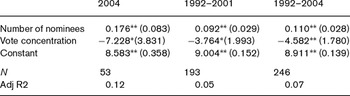
A simple regression model (Table 6) shows that, after controlling for difficulty of the task, parties did a better job of equalizing the vote among their various candidates when the candidates had more geographically concentrated votes. That is, fewer mistakes were made when candidates had stronger personal votes. The relationship is strong enough to reach statistical significance even though concentration is an imperfect measure of personal votes and there were only 53 cases in which a party nominated two or more candidates in a district in 2004.
OLS model of equalization of the vote

Notes: *significant at p < 0.10; **significant at p < 0.05. Unstandardized coefficients are shown. Standard errors are in parentheses. The dependent variable is the natural log of the standard deviation of the vote totals of all of a party's nominees in a district. The cases are party*district.
This paper argues that strategic voting was probably heavier than usual in 2004 because of the unprecedented number of polls and because control of the government hung in the balance. If this argument is correct, we would expect the relationship between personal vote and vote equalization to be weaker in previous elections. Running the same model on the four elections from 1992 to 2001, we find that the coefficients of the two independent variables are, indeed, only about half of the size as those in the 2004 model. Equalizing the vote among party nominees in larger districts was more difficult in 2004 than in the past. One might have expected that a larger amount of strategic voting would help parties smooth out the differences among candidates, but instead it seems to have exacerbated those differences, perhaps because too many votes were transferred from strong to weak candidates. Moreover, geographic concentration was more important in 2004 than in past elections in minimizing these coordination errors. With the heavier strategic voting, the stability provided by a strong personal vote became even more critical in avoiding wild swings to weaker candidates.
Discussion
This paper presents evidence that a substantial number of voters strategically deserted their most preferred candidate in favor of more marginal candidates in the 2004 Taiwanese legislative election. Moreover, there was so much strategic voting that the top candidates in the pre-election surveys were often reduced to marginal or even losing positions in the electoral outcomes. That is, there was often an excess of strategic voting. Rather than simply reducing the surplus votes garnered by the strongest candidates from excessive to merely enough for a moderate but comfortable victory, the large number of strategic voters all acting with the same basic information often turned the election into a very nervous affair for the front-runner, while producing the excessive surpluses for erstwhile marginal candidates. The greater incidence of strategic voting did not equalize the vote more in 2004 than in the past; instead it produced even more lopsided outcomes than in the past, especially in larger districts. Too much information, it seems, can be a bad thing.
Surprisingly, the key to equalizing the vote among a party's nominees is a strong personal vote, not a large number of voters willing to act strategically. Strong personal votes provide a stable distribution of support among the various candidates. Quite a bit of the literature on Japanese politics discusses how legislators’ need to construct a strong personal vote affects the system.Footnote 28 The finding in this paper goes a step beyond that. Rather than simply being an important variable that affects how the system operates, strong personal votes may be necessary for the stable operation of any SNTV electoral system. It is not that the system would just operate differently if the pork, factions, personal support organizations, corruption, and strong tendencies toward localism were removed, it might not operate at all, collapsing under the pressure of wild electoral swings and large differences in vote shares and seat shares. It is possible that parties could devise strategies to deal with this, such as the Taiwanese parties’ vote-rationing schemes. However, as long as a substantial number of voters think that they can defect from those schemes and produce a better outcome, wild swings are inevitable. Strong personal votes provide the glue that holds the system together.
The findings in this paper also focus our attention on the travails of the strong candidates. Being popular is something of a curse. Popular candidates do well in the polls, and when they are identified as having more than enough support, their voters are prone to desert them in droves. Even though they have strong popular support, their re-election bids are anything but assured. Not uncommonly, the most popular legislators are replaced by less popular candidates from their party. This type of pathological outcome is a serious problem. When voters fail to elect their most preferred candidate, they have erred. When they do so repeatedly and systematically, the system is flawed. SNTV is fundamentally flawed in the sense that it produces a systematic bias against the most popular candidates. In Japan, several factors combined to mitigate this bias. Districts were smaller, so that there were rarely more than three candidates from the same party running in the same district. Control of the government was never so obviously at stake as in the 2004 Taiwan election, so voters had less incentive to vote strategically. Japanese candidates probably have stronger personal votes than Taiwanese candidates do. While many Taiwanese candidates have support organizations (houyuanhui), these are not as large or institutionalized as the Japanese koenkai.Footnote 29 Combined with more conservative nomination strategies commonly employedFootnote 30 and the generally high re-election rates,Footnote 31 the strongest candidates probably do not lose very often in Japan. In Taiwan, however, this bias against the strongest candidates is on full display.
Finally, this paper demonstrates how difficult successful strategic voting is in SNTV. Voters may think that their information is better than it really is. They may not understand the limitations of survey data, but, more importantly, they may not understand that other voters are looking at the same survey data and making the same calculations. Like generals who ‘strategically’ plan for the previous war because they fail to anticipate that their counterparts might also develop new strategies, voters vote strategically based on the ranking of candidates published in surveys rather than on the rankings produced after all the other voters have viewed the same surveys and changed their vote decisions. The problem is that there are no minute-by-minute polls to show how other voters are updating. With perfect information, these problems might be solved, but in the real world, strategic voters make mistakes and the strongest candidates lose.