Introduction
Demoralization refers to a state of lowered morale and poor coping associated with severe life-limiting medical conditions, characterized by feelings of hopelessness, despair, and meaninglessness (Kissane et al., Reference Kissane, Clarke and Street2001; Grassi and Nanni, Reference Grassi and Nanni2016). It is particularly prevalent in populations with advanced disease and chronic illnesses, where control over disease is limited and cure is uncertain, and contributes to depression, poor coping, and a desire for hastened death (Kissane et al., Reference Kissane, Clarke and Street2001, Reference Kissane, Wein and Love2004; Sansone and Sansone, Reference Sansone and Sansone2010; Robinson et al., Reference Robinson, Kissane and Brooker2016). It is measurable using the Demoralization Scale (DS), developed by Kissane et al. (Reference Kissane, Wein and Love2004), which was recently refined and revalidated by Robinson et al. (Reference Robinson, Kissane and Brooker2016) as the DS-II. High DS-II scores are positively correlated with depression, physical symptoms, and desire to die, and it is a useful tool for clinicians to recognize and address signs associated with these disorders (Kissane et al., Reference Kissane, Wein and Love2004; Robinson et al., Reference Robinson, Kissane and Brooker2015, Reference Robinson, Kissane and Brooker2016, Reference Robinson, Kissane and Brooker2017).
To date, the measurement of demoralization has not taken place in a rural setting. In Australia, this population is at an increased risk of chronic, life-limiting maladies, such as heart disease, diabetes, and vascular disease, as well as depression and anxiety (Clarke, Reference Clarke2007; AIHW, 2015). A lack of available health professionals and services in rural areas also adds to the psychosocial burden of these chronic diseases (Phillips, Reference Phillips2009; Kirby et al., Reference Kirby, Barlow and Saurman2016). These communities also have a greater proportion of vulnerable populations who typically have poorer health outcomes, such as Aboriginal and Torres Strait Islander peoples and people from low socio-economic households (Phillips, Reference Phillips2009; Kirby et al., Reference Kirby, Barlow and Saurman2016). However, rural communities may also foster protective factors against demoralization such as resilience, stoicism, and strong local support networks (Phillips, Reference Phillips2009; Kirby et al., Reference Kirby, Barlow and Saurman2016). In either case, rural communities may have unique qualities that influence a patient's ability to cope with advanced illness and any associated feelings of helplessness and demoralization.
This study, therefore, aimed to examine demoralization in a rural cohort with chronic disease in Lithgow, a rural town in New South Wales, Australia, and assess associated factors that may be unique to this rural context.
Methods
Design
A single interviewer-administered scales assessing demoralization, mood, and symptom burden to a cross-sectional convenience sample of patients who consented to participate.
Population
Lithgow is a town in the Central Tablelands of New South Wales, 140 km west of Sydney, with a population of 21,565 (ABS, 2016). 22% of the population is greater than 65 years old, compared with the national average of 15.8%. The most common ancestry in Lithgow is Australian or Angloceltic. Only 5.1% of households speaking a language other than English at home (ABS, 2016). 5.7% of the population are Aboriginal or Torres Strait Islander (ABS, 2016).
The major source of employment in Lithgow is in coal mining and aged care residential services, with a 7.7% unemployment rate, higher than the national average of 6.9%. 31% have a weekly income of less than $650, compared with the national average of 20%. 17.8% of people in Lithgow report year 10 as their highest level of educational attainment, compared with 10.8% nationally. Most people in Lithgow travel using a car (69%), more than the national average of 61.5%.
Recruitment
The study was approved by the Nepean Blue Mountain Local Health District ethics committee and the University of Notre Dame ethics committee. Participants were recruited from the ambulatory care clinic and general medical wards of Lithgow hospital by convenience sampling between May and August 2018. Recruitment also took place at an adjacent nursing home and retirement village. Participants were eligible for the study if they were greater than 18 years old; could comprehend spoken English and provide written informed consent (thereby excluding those with a cognitive impairment or diagnosis of dementia); resided within a rural or remote location according to the Australian Standard Geographical Classification of Remoteness Area (ASGC-RA, 2006) classification system (RA4 or RA5) at the time of recruitment; were well enough to participate; and had one or more chronic disease(s) determined by the Australian Institute of Health and Welfare to be responsible for a significantly increased burden of disease (cancer, pulmonary disease, liver disease, diabetes, osteoarthritis, rheumatoid arthritis, chronic kidney disease, cardiovascular disease, or depression).
Measures
The Demoralization Scale-II (DS-II) was used to measure demoralization. The DS-II comprises 16 items rated on a three-point Likert scale with two subscales: meaning and purpose, and distress and coping ability. Higher overall scores indicate higher levels of demoralization. The DS-II has demonstrated good internal reliability (α = 0.89) and test–retest reliability in previous studies (Robinson et al., Reference Robinson, Kissane and Brooker2016). Scores ≥11 are considered clinically significant (Robinson et al., Reference Robinson, Kissane and Brooker2016).
The Memorial Symptom Assessment Scale (MSAS) (Chang et al., 2004) was used to measure symptom burden and health-related quality of life. The MSAS has demonstrated good reliability (α = 0.82) and has been extensively validated in palliative care studies. The MSAS comprises a total score and three subscale scores: global distress, physical symptomatology, and psychological distress.
The Patient Health Questionnaire-9 (PHQ-9) (Kroenke et al., Reference Kroenke, Spitzer and Williams2001) is a self-reported measure of depressive symptoms, comprising nine items representing the criteria for a major depressive episode (MDE), with scores greater than 15 indicative of MDE (Kroenke et al., Reference Kroenke, Spitzer and Williams2001). The PHQ-9 has demonstrated good internal reliability (α = 0.89) and construct validity with other health-related measures (Kroenke et al., Reference Kroenke, Spitzer and Williams2001).
The Charlson Comorbidity Index (CCI) was used to qualify the participant's chronic disease status (Charlson et al., Reference Charlson, Pompei and Ales1987). The index is divided into four categories based on the risk of dying associated with the conditions in each category. Categories are unequally weighted, with Category 1, 2, and 3 conditions counting for 1, 2, and 3 points, respectively, and the most severe Category 4 condition (metastatic solid tumor, AIDS) counting for 6 points. Every decade over 40 also counts for 1 point. The total overall point score reflects severity of comorbidity and one-year mortality. Illness-related information was also obtained from the participant's medical record with their consent to identify relevant comorbid conditions.
Participants were also asked about demographic factors such as age, gender, ethnicity, marital status, education level, religious status, and travel burden (distance traveled from the place of residence to specialist medical care, if any).
Statistical analysis
Descriptive statistics were used to characterize the study sample. A DS-II score of ≥11 was used to identify clinically significant demoralization, in alignment with contemporary literature (Robinson et al., Reference Robinson, Kissane and Brooker2016). The association between independent factors and the prevalence of demoralization was examined using Fisher's exact test. Spearman's rho was used to evaluate the independent associations between the significant independent variables and demoralization. All analyses utilized SPSS software (IBM Corp, 2017).
Results
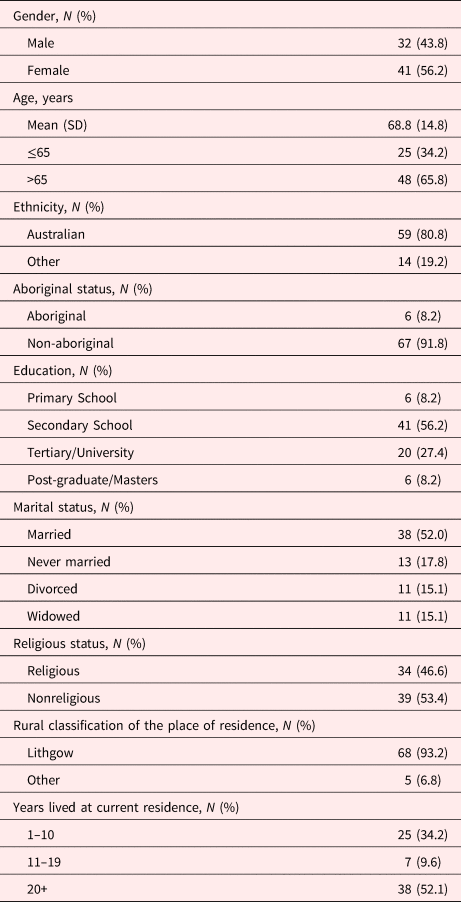
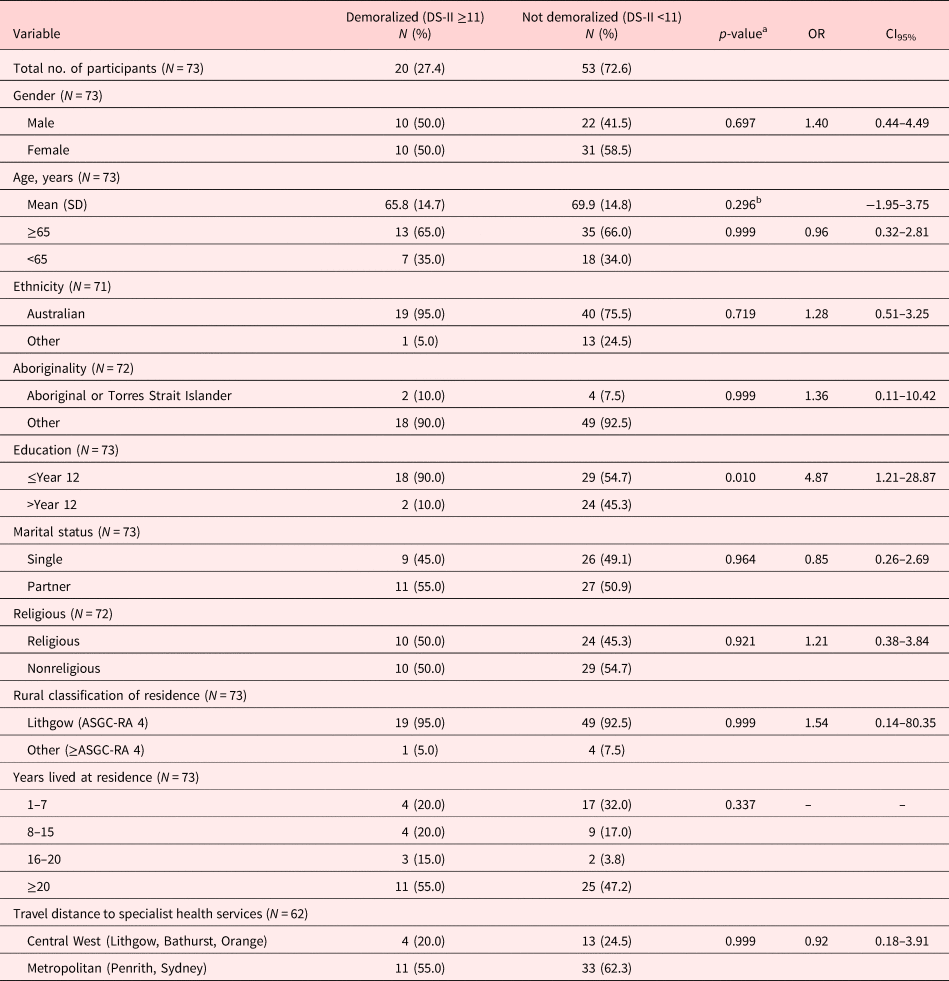
During the sampling period (May–August 2018), 80 patients were identified as appropriate for the study and invited to provide informed consent. A total of 75 participants completed the survey (response rate of 94%). Two participants were excluded from analysis, as they did not reside within a rural or remote area according to the current ASGC-RA criteria (≥4). Of the five participants who declined to complete the study, three were due to lack of interest and two felt unwell, leaving 73 questionnaires to be considered for analysis. A summary of the demographic data is presented in Table 1. Tables 2–4 summarize the associations found between demoralization scores and socio-demographic, physical, and psychological factors, respectively.
Summary characteristics of participants (N = 73)

Prevalence of demoralization
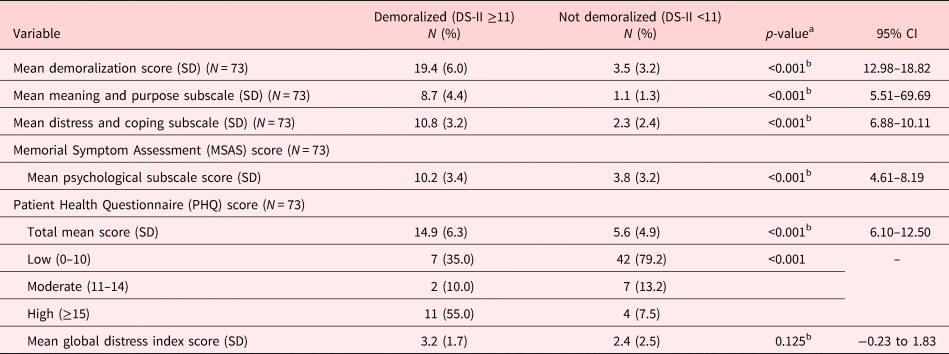
The mean DS score was 7.8 (SD 26.4), and the median was 6 (IQR = 10). Overall, 20 participants (27.4%) were clinically demoralized, having a DS-II score ≥11. Of these, the average demoralization score was 19.4 (SD 6.0), compared to a mean score of 3.5 (SD 3.2) in those with nonclinical demoralization scores (p < 0.001). Both groups scored higher on the distress and coping subscale, with an average of 10.8 (SD 3.2) in the clinically demoralized versus 2.3 (SD 2.4) in the nonclinical group than on the meaning and purpose subscale, with scores averaging 8.7 (SD 4.4) versus 1.1 (SD 1.3), respectively. There was a significant difference in the mean scores of both subscales between the two groups (p < 0.001).
Demoralization and demographic factors
No significant statistical differences were observed between patients with and without demoralization with respect to the site, gender, ethnicity, aboriginal status, marital status, religious status, duration of time spent living in a rural area, or travel time taken to see a specialist (Table 2).
Demographic characteristics of participants with and without demoralization

a Fisher's exact test.
b Two-sample independent t.
However, there was a significant association between the DS-II score and education level (p = 0.024). Participants who finished school at a year 12 level or less were almost five times more likely to be demoralized (OR 4.87, 95% CI [1.21–28.87], p = 0.01) than those with tertiary or post-graduate qualifications.
Demoralization and physical factors
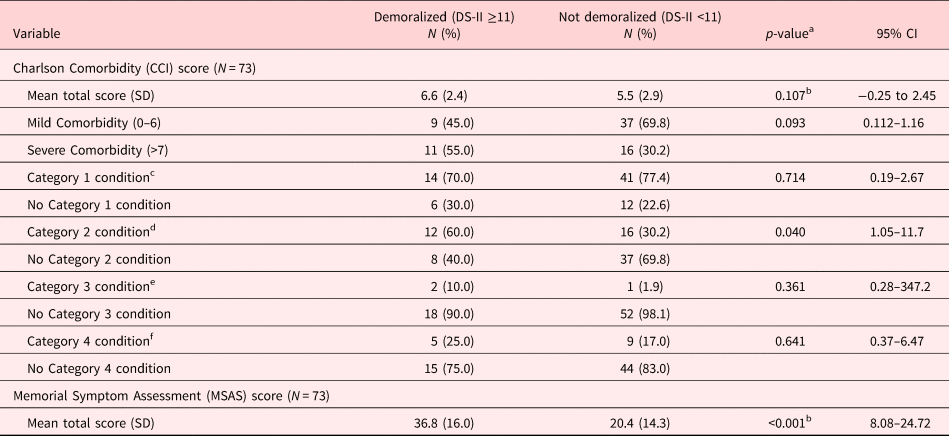
Demoralization was significantly associated with the overall Memorial Symptom Burden Score (p = <0.001) measuring illness morbidity (Table 3). Demoralization was not significantly associated with severity of comorbidity (CCI score) but was significantly associated with having a CCI Category 2 condition (p = 0.04).
Physical characteristics of participants with and without demoralization

a Fisher's exact test.
b Two-sample independent t.
c Category 1 conditions: Myocardial infarction, congestive heart failure, peripheral vascular disease, cerebrovascular disease, chronic pulmonary disease, connective tissue disease, peptic ulcer disease, mild liver disease, diabetes without end-organ damage.
d Category 2 conditions: Hemiplegia, moderate to severe renal disease, diabetes with end-organ damage, tumor without metastases, leukemia.
e Category 3 conditions: Moderate to severe liver disease.
f Category 4 conditions: Metastatic solid tumor, AIDS.
Demoralization and psychological factors
The average overall score on the PHQ-9 was 7.96 (SD = 6.75) (Table 4). Based on the PHQ-9 cutoff of 15 (Kroenke et al., Reference Kroenke, Spitzer and Williams2001), 15 participants (20.5%) met the criteria for a MDE. There was a significant association between demoralization and the PHQ score (p = <0.001), though there was no association with the PHQ-9 global distress subscale. Eleven participants (15.1%) were both demoralized and depressed, though nine participants (12.3%) were demoralized without meeting the criteria for depression.
Psychological characteristics of participants with and without demoralization

a Fisher's exact test.
b Two-sample independent t.
There was also a significant association between the MSAS psychological subscale score of psychological morbidity and DS-II scores (p < 0.001).
Independent factors associated with demoralization
Regression analysis using Spearman's coefficient identified several factors correlated with the DS-II score and the DS-II subscales. Education (r s = −0.259, p = 0.027) was negatively correlated with the DS-II score. A positive correlation was observed between the DS-II score and symptom burden (MSAS score) (r s = 0.545, p = <0.001), and depression (PHQ score) (r s = 0.682, p = <0.001). A significant percentage of the variance in DS-II scores can be attributed to the MSAS score (R 2 = 0.30) and the PHQ score (R 2 = 0.47), with lesser contributions from the level of education (R 2 = 0.07) and the CCI score (R 2 = 0.05). The CCI score was positively correlated with the DS-II meaning and purpose subscale score (r s = 0.296, p = 0.011), but not with the overall DS-II score or the distress and coping ability subscale score.
Discussion
This study expands existing literature utilizing the DS-II to identify demoralization in a population of people with advanced chronic illness, and identifies associated biological, psychological, and social factors.
This study found that prevalence of demoralization in this population was 27.4%, considerably higher than the 13%–18% prevalence estimated in a recent systematic review of demoralization studies (Robinson et al., Reference Robinson, Kissane and Brooker2015). Measurement factors may have contributed to this high rate, as the cutoff for demoralization was based on a DS-II score ≥11, whereas other studies have used higher cutoff scores (Robinson et al., Reference Robinson, Kissane and Brooker2015). This cutoff was chosen to be consistent with the paper by Robinson et al. (Reference Robinson, Kissane and Brooker2016), which set out the parameters of external validity for the DS-II, and to preserve the reliability of these results against existing literature. A small sample size with a large standard deviation (SD) of DS-II scores also prevented the use of other cutoff measurements based on SD. The large variability in DS-II scores reflects the range of disease characteristics within the participant cohort, which ranged from patients with severe or palliative chronic illness to patients with less severe, well-managed chronic disease. This is consistent with other studies assessing demoralization in nonpalliative, noncancer populations, where scores are more variable and cohorts more heterogenous (Clarke et al., Reference Clarke, McLeod and Smith2005; Julião et al., 2016).
Alternatively, the high demoralization scores may reflect high total symptom burden scores measured by the MSAS in both groups compared to other studies (Tranmer et al., Reference Tranmer, Heyland and Dudgeon2003; Robinson et al., Reference Robinson, Kissane and Brooker2015). Depression and distress scores were also high in this population, with total mean PHQ-9 scores relatively higher than existing literature utilizing the same measure in palliative and oncology populations (Robinson et al., Reference Robinson, Kissane and Brooker2016, Reference Robinson, Kissane and Brooker2017; Vehling et al., Reference Vehling, Kissane and Lo2017; Ko et al., Reference Ko, Lin and Pi2018). These results may reflect the higher levels of chronic illness and mental illness within rural Australian populations (Phillips, Reference Phillips2009; NRHA, 2010; Kirby et al., Reference Kirby, Barlow and Saurman2016).
A number of participants were demoralized without being depressed, and several participants met the criteria for depression without being greatly demoralized. These results are consistent with existing literature that suggests that though depression and demoralization can coexist, the two do not necessarily go together, and that demoralization is an independent measure of distress in its own right (Jacobsen, Maytal & Stern, Reference Jacobsen, Maytal and Stern2007; Kissane, Reference Kissane2014; Tang et al., Reference Tang, Wang and Chou2015; Tecuta et al., Reference Tecuta, Tomba, Grandi and Fava2015).
Demoralization was also significantly correlated with a low level of education in this cohort. Education is known to affect psychological well-being and quality of life, providing resources for coping with serious illness, but may also be a proxy for the influence of financial security, health literacy, or other socio-demographic factors influencing demoralization (Ko et al., Reference Ko, Lin and Pi2018). Future studies controlling for these variables may help to elucidate the exact effect of education on demoralization and would be especially relevant in a rural context, where levels of education are generally lower than the national average (ABS, 2016), and associated with these other social determinants of health.
No other socio-demographic factors were significantly associated with demoralization in this study, which is interesting, as being single, socially isolated, younger, unemployed, and female have been correlated with demoralization in systematic reviews (Robinson et al., Reference Robinson, Kissane and Brooker2015). One can hypothesize that rural communities have a protective influence through their interconnectedness, although a specific measure of such social support would be needed to confirm this. More sensitive measures of socio-demographic burdens, particularly travel burden, are also needed in future studies to evaluate the impact of these factors on demoralization, especially in a rural context.
Further qualification of symptom and illness characteristics in the MSAS and CCI would also be useful to identify which symptoms, and which of the CCI Category 2 conditions, had the greatest association with demoralization. In particular, pain presence and severity may have been highly relevant, considering the significant impact it has been found to have on demoralization scores in other noncancer cohorts (Kissane, Reference Kissane2014; Deshields et al., Reference Deshields, Penalba and Liu2017). However, the nonsignificant association between CCI measures and demoralization in this study is in line with the existing literature, where there is little association between demoralization and illness type and severity (Robinson et al., Reference Robinson, Kissane and Brooker2015, Reference Robinson, Kissane and Brooker2017).
Other limitations of the study include a small sample size, resulting in the inability to perform more detailed regression analysis of the data, as well as reliance on convenience sampling, which was also due to the small number of eligible participants. Saturation of recruitment was quickly reached, and without convenience sampling by a single investigator, participants might have been double counted. Future studies could address these shortcomings by including more healthcare sites across the region. This could also permit a wider geographical area to assess travel distance and place of residence as factors for evaluation, which was limited by ASGC-RA classifications.
Despite these shortcomings, this study provides evidence that the DS-II is a valid psychometric instrument in a rural population, with prevalence rates and associations with other psychometric tools congruent with other studies in the wider literature. This study demonstrates that demoralization is a relevant concept for people in rural populations, and future studies should continue to investigate the unique factors in this population that contribute to demoralization so as to alleviate this unique form of suffering in context.
Acknowledgments
The authors acknowledge the support of this project by residents, staff, and patients of Lithgow Hospital, Three Trees Aged Care nursing home, and Treeview Retirement Estates.