1. Introduction: the migration/welfare-state paradoxFootnote 1
The welfare state and migration are often seen as at odds, both in policy and research. ‘It's obvious that you can't have free immigration and a welfare state,’ Nobel Laureate Milton Friedman once said – a sentence since found in every textbook about migration and the welfare state.Footnote 2 Friedman argued that without barriers the welfare state becomes a refuge for the poor and destitute of the whole world, emptying the public purse and ending the welfare state (Razin et al., Reference Razin, Sadka and Suwankiri2011).
The welfare state is, according to this view, considered as a pull factor for migration, i.e. migrants move to countries with a generous welfare state. Borjas’ ‘welfare magnet theory’ (Reference Borjas1999) plays an important role in this economic frame. Whether the welfare state really acts as a magnet is still open to discussion, even after two decades of research. Some studies do show a link between the amount of benefit and the number of immigrants (Razin et al., Reference Razin, Sadka and Suwankiri2011; Giulietti and Wahba, Reference Giulietti and Wahba2012), but others show no difference (Nowotny, Reference Nowotny2011; De Giorgi and Pellizzari, Reference De Giorgi and Pellizzari2009; Barrett and Maître, 2011). Razin and Wahba (Reference Razin and Wahba2011) argue that it is crucial to distinguish by level of education: the welfare magnet applies only to lower-educated migrants, while higher-educated ones are in fact deterred by high social security contributions and taxes.
Migration, it is argued, also affects solidarity. When ‘strangers’ appear on the scene, trust and identification are reduced (Freeman, Reference Freeman1986; Miller, Reference Miller, Banting and Kymlicka2006; Goodhart, Reference Goodhart2013). The arrival of immigrants supposedly reduces support for the welfare state. To prevent this, academics sometimes argue for a ‘citizenship ladder’, with the rights of immigrants being (temporarily) restricted (e.g. Engelen, Reference Engelen2003). In addition, within this sociological frame, research increasingly focuses on the autochthonous populationFootnote 3 who favour excluding immigrants from the welfare state, behaviour referred to as ‘welfare chauvinism’ (e.g. Crepaz, Reference Crepaz2008; Van der Waal et al., Reference Van der Waal, van der, Koster and van Oorschot2013).
This financial and social friction between migration and the welfare state is sometimes referred to as the migration/welfare-state paradox (Bommes and Geddes, Reference Bommes and Geddes2000; Banting and Kymlicka, Reference Banting and Kymlicka2006; Brochmann and Hagelund, Reference Brochmann and Hagelund2012; Carmel et al., Reference Carmel, Cerami and Papadopoulos2012; Koning, Reference Koning2013). Recent years have seen an increasing number of studies on elements of the migration/welfare-state paradox, most of which zoom in on welfare state support and on what people – especially autochthones – think about the rights of immigrants within the welfare state (e.g. Taylor-Gooby, Reference Taylor-Gooby2005; Van Oorschot, Reference Van Oorschot2008; Mau and Burckhardt, Reference Mau and Burckhardt2009; Van der Waal et al., Reference Van der Waal, van der, Koster and van Oorschot2013; Larsen, Reference Larsen2011; Reeskens and van Oorschot, Reference Reeskens and van Oorschot2012;). Immigrants are the object of study but, with a few exceptions, do not themselves have a say (Dancygier and Saunders, Reference Dancygier and Saunders2006; Morissens and de Blander, Reference Morissens and de Blander2011).
This article presents qualitative research exploring the wishes and views of various groups of labour migrants in the Netherlands regarding the welfare state. The Netherlands experiences an increasing number of immigrants, particularly since the European principle of free movement of people came into being. As in many other European countries, more than 10 per cent (in fact 11.6 per cent) of the working population in 2013 was born outside the country (OECD, 2015). By far the majority of immigrants are lower-educated (Holtslag et al., Reference Holtslag, Kremer and Schrijvers2013). Therefore policy efforts are taken to attract knowledge workers (labour migrants who are invited by employers and earn wages above a certain threshold) from outside the EU. The Netherlands thus engages in the worldwide ‘battle for brains’. At the same time, the Dutch welfare state is still comparatively comprehensive and generous although, over the last decades, social security has become more selective, which also effects immigrants. The length of Unemployment Insurance for instance has been restricted and workfare policies have been introduced in Social Assistance (Kremer, Reference Kremer2013; Koning, Reference Koning2013). Like many other European countries, the Netherlands could thus be confronted with the social and financial friction of the migration/welfare-state paradox.
This study, however, shows that in contrast to economic and welfare state theories the lower-educated labour migrants questioned have little interest in the Dutch welfare state: they just wanted a good employment contract. By contrast, higher-educated Western European immigrants find a generous welfare state very attractive. If Borjas’ welfare magnet theory applies, then it may be more applicable to them. Moreover, the respondents argued that immigrants should not be able to immediately claim social security when entering the country. They believed that social citizenship must be ‘earned’, especially by working and paying taxes. This calls into question whether the pejorative term ‘welfare chauvinism’, which has become popular in welfare state research, is the appropriate term. If not only autochtones, but immigrants too, stress that rights should not be given immediately to those born outside a country, this may not simply be a matter of ‘chauvinism’. How immigrants can earn citizenship and the timeframe for doing so seems to be an important welfare state issue more generally. Finally, this explorative focus group study stressed the importance of the institutional logic in welfare state research, i.e. that attitudes are actually shaped by welfare states themselves but the welfare state tradition in countries of origin also needs to be taken into account.
2. Solidarity under pressure
This article, mostly concerned with the frame of the welfare state paradox which is sociological and moral in nature, concerns allocation of citizens’ social rights and obligations. According to T.H. Marshall (Reference Marshall1976, or. 1950) the social rights of citizenship allow people to participate in society. The ties that bind people should not be based on family or shared heritage but on individual rights. Citizenship rights are a strong uniting force that contributes to what he calls a common civilisation. Miller (Reference Miller, Banting and Kymlicka2006), however, stresses that a shared feeling of community within a nation state is not an effect of social rights but a necessary condition. People will feel more loyalty and sympathy when fellow citizens need support. Making available the entire range of rights to ‘strangers’ may undermine the solidarity necessary for the welfare state (see also Goodhart, Reference Goodhart2013).
These differing views on citizenship reflect opposing views on how welfare states should incorporate immigration. In her comprehensive study ‘Welfare States and Immigrant Rights’ (2012), Sainsbury follows a Marshallian interpretation of citizenship. She describes the extent of inclusion and exclusion of immigrants in various welfare states, with Scandinavian countries coming out best. For her, full inclusion of immigrants should underpin policy; inclusion is the benchmark by which all welfare states are tested. This emphasis on the importance of full equality between immigrants and autochthones is also found, for example, in Bolderson (Reference Bolderson2010), and Koning (Reference Koning2013).
In addition to this plea for inclusive citizenship, other scholars stress differentiated citizenship. Joppke (Reference Joppke1999) writes that, because social rights are expensive, they cannot apply to everyone. Citizenship rights cannot therefore simply be allocated, but must be earned. According to Engelen (Reference Engelen2003), maintaining solidarity in periods of migration requires that a (small) price be paid. He therefore advocates introducing a graduated system of citizenship in welfare states, in other words a citizenship ladder. Immigrants should only be able to call on the employee insurance that they have built up themselves. Only after some time – and if they have passed the citizenship examination – should they be able to claim tax-funded facilities. Phased-in citizenship is, according to Engelen, a way out of the migration/welfare-state paradox.
What do empirical studies on the foundation of solidarity show? American researchers in particular conclude that immigration is a danger for European welfare states. Alesina and Glaeser (Reference Alesina and Glaeser2004) show that the US has a much smaller welfare state than European countries because the majority of the population believes that redistribution benefits racial and ethnic minorities that have become poor ‘because of their own fault’. If Europe is becoming more heterogeneous, and if benefits cater to immigrants especially, this may mean the end of the welfare state (see also Freeman, Reference Freeman1986).
All existing European survey-studies, however, show that there is little empirical evidence for the statements that increasing numbers of immigrants and diversity directly leads to decreasing welfare state support (Taylor-Gooby, Reference Taylor-Gooby2005; Van Oorschot, Reference Van Oorschot2008; Van Oorschot and Uunk, Reference Van Oorschot and Uunk2007; Burgoon et al., Reference Burgoon, Koster and van Egmond2012; Mau and Burckhardt, Reference Mau and Burckhardt2009; Senik et al., Reference Senik, Stichnoth and van der Straeten2009; Crepaz, Reference Crepaz2008; De Beer and Koster, Reference De Beer and Koster2009; Finseraas, Reference Finseraas and Kvist2012; for an opposite view: Eger, Reference Eger2010; Larsen, Reference Larsen2011). It is argued that the welfare state itself is a buffer against its dismantling, even in times of immigration. People who grow up in the institutional setting of the welfare state are more prone to support it. Solidarity shapes the welfare state, but the welfare state itself also shapes solidarity (Crepaz, Reference Crepaz2008; Taylor-Gooby, Reference Taylor-Gooby2005; Mau and Burckhardt, Reference Mau and Burckhardt2009; Koning, Reference Koning2013; Van der Waal et al., Reference Van der Waal, van der, Koster and van Oorschot2013).
Although people may support the welfare state in times of immigration, do they also support the welfare state for immigrants? Surveys of the autochthonous population focus increasingly on what is labelled as ‘welfare chauvinism’: the welfare state has strong support, but only for oneself, not for those born elsewhere. In other words: immigrants should not participate in the welfare state on the same basis as autochthones (Van Oorschot, Reference Van Oorschot2008; Crepaz, Reference Crepaz2008; Van der Waal et al., Reference Van der Waal, van der, Koster and van Oorschot2013). Only a small number of people within Europe believe that immigrants should enjoy no rights at all, although it differs between countries. The more comprehensive the welfare state, the less welfare chauvinism there is. At the same time, the great majority of Europeans believe that rights for immigrants should be subject to conditions, such as reciprocity or citizenship. This is not only the case in less comprehensive welfare states such as Poland and the UK, but also in more comprehensive welfare states such as those in Denmark and The Netherlands (Reeskens and van Oorschot, Reference Reeskens and van Oorschot2012).
In explaining attitudes towards the welfare state and solidarity, two theoretical strands can be distinguished. The first of these stresses self-interest (Baldwin, Reference Baldwin1990): people that are against immigration, mostly lower-educated people, also benefit most from redistribution, and hence they continue to support the welfare state (De Beer and Koster, Reference De Beer and Koster2009). The second strand stresses the institutional logic: the welfare state itself creates the structure of solidarity (Esping-Andersen, Reference Esping-Andersen1990), and so, in other words, it is the institutional structures of different welfare states that frame people's perceptions of the poor, the unemployed and immigrants. People's attitudes are not exogenous, as in the theory of self-interest, but are shaped by the welfare states’ institutional set-up (Larsen, Reference Larsen2006).
In most existing welfare support research, it is mainly autochthones who answer survey-studiesFootnote 4 . But what do immigrants themselves think about the welfare state? Should different social rights apply for immigrants? And what should they be based on? In this article these two elements are examined: the question of whether the welfare state is supported, and secondly, what is a reasonable allocation of rights and duties given the notion of solidarity within the welfare state?
3. What immigrants say
With a few exceptions, very little is known about how immigrants themselves view the welfare state. The limited numbers of surveys published give two different answers to whether they and the autochthonous population think differently about the welfare state. Some studies reveal that, if one allows for income disparities, there are no attitudinal differences between autochthones and immigrants: both categories want more redistribution and higher social spending (Dancygier and Saunders, Reference Dancygier and Saunders2006; Morissens and de Blander, Reference Morissens and de Blander2011).
Other studies show that immigrants actually want greater inequality and less redistribution; they are in fact not very enamoured of the welfare state (Chiswick, Reference Chiswick1999; Bergh and Fink, Reference Bergh and Fink2009). There are also indications that they do not want to pay much in contributions because they think that they make little use of social security, or in other words there is less self-interest (Heitmueller, Reference Heitmueller2005; Claus and Claus, Reference Claus and Claus2010). This may relate to the fact that migrants suffer from the lack of portability of rights (Avato et al., Reference Avato, Koettl and Sabates-Wheeler2010). Yet, others refer to a ‘new transnational class’ which is supposedly uninterested in national, solidarity-based welfare states. They feel little solidarity with any nation or community whatsoever (Sklair, Reference Sklair2001).
The surveys have generally asked a limited number of questions. Support for the welfare state is often measured in terms of whether people want greater equality or inequality, more or less social spending, and bigger or smaller governments (for an exception: Reeskens and van Oorschot, Reference Reeskens and van Oorschot2012). The answers to these questions do not give very precise indications of what kind of welfare state immigrants actually want. It is also uncertain whether the questions are understood in the same way by people with different backgrounds, and what exactly the point of reference is of the interviewee: is it the country of origin or that of arrival? In addition, the limited number of immigrants surveyed means that the existing survey-studies do little to clarify differences between various groups of immigrants. Immigrants do not, after all, form a uniform group: they differ, at least, according to such things as duration of stay, educational level, and county of origin. Gender, age and migration status are also particularly important (Sainsbury, Reference Sainsbury2012)
Methods: focus group study with labour migrants
This paper reports on a qualitative study of various categories of labour migrants in the Netherlands. It applies the focus group method: group discussions with a limited number of participants, which helps us understand shared knowledge and experience, in this case of labour migrants. Group discussions make clear what topics they consider important, what they emphasise, and what arguments count for them. In group discussions, the moral limits of possible topics and ideas are set by the group. It is important to bear in mind that discussions reflect what is socially acceptable within the group context and that discussions, therefore, reflect ‘legitimate’ ideas and views.
A disadvantage of focus groups is that they are very labour intensive and that they are often unrepresentative because of their infrequency. Therefore, they are not a substitute for other methods, such as survey research, but they may serve as an effective follow-up by providing a deeper and more stratified understanding of survey answers. Focus groups can also precede surveys, for example to generate hypotheses (Stewart et al., Reference Stewart, Shamdasani and Rook2007, Taylor-Gooby and Martin, Reference Taylor-Gooby and Martin2010; Cyr, Reference Cyr2015) as the present study has done.
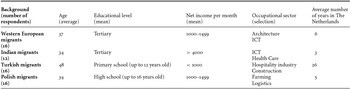
Focus groups were set up among the main categories of labour migrants in the Netherlands to explore their views of the welfare state. Our focus groups were made up exclusively of labour migrants, i.e. people who had come to the Netherlands for work purposes. As there is no such thing as a typical labour migrant, this study examined four different groups that varied in education levels and countries of origin: higher-educated Indian and Western European migrants and lower-educated Polish and Turkish migrants.
In the 2010s, most labour migrants in the Netherlands have come from Poland, with 15,000 new arrivals counted in official 2012 statistics. The true figures may be much higher because no registration is required. Polish migrants generally have primary or secondary education, and few of them are unemployed but their labour position is precarious, often involving temporary contracts or employment agency work. Western Europeans are another main migrant category; most of them are higher-educated and originate from Germany (9,000) and the UK (4,400), followed by France, Italy and Belgium. The largest group of non-European labour migrants come from Turkey (4,600), and Turkey also accounted for a large number of ‘guest workers’ in the past. Indian migrants, finally, form the biggest component of the ‘knowledge workers’ category – workers who have arrived in the Netherlands as a result of special migration rules, in place since 2004, to attract the highly skilled. Each year, around 2,000 Indian labour migrants arrive in the Netherlands, generally university graduates working in the ICT industry (Jennissen and Nicolaas, Reference Jennissen and Nicolaas2014: Ministerie van Veiligheid en Justitie, 2013).
Table 1 illustrates the labour migrants who were selected for this study.Footnote 5
Socio-economic characteristics of the respondents

These four groups were chosen for three reasons. Firstly, as just described, they represent the most important categories of labour migrants in the Netherlands. Secondly, it is important to distinguish between labour migrants’ educational attainments because the literature on support for the welfare state shows that the lower-educated, including labour migrants, are often more positive about the welfare state, particularly as regards social security, than the higher-educated. It is, after all, more important for them for reasons of self-interest: they are more often unemployed than the higher-educated (Svallfors, Reference Svallfors2006; Razin and Wahba, Reference Razin and Wahba2011). Thirdly, their country of origin is also important. The institutional logic stresses the importance of socialisation in a particular welfare context. In addition, both migration and social security rules for EU citizens differ so greatly from those for non-EU citizens that it is important to allow both types of immigrants to have their say, as labour migrants with more social security rights (Poles) may have different views about migrants’ social rights from those held by migrants from outside the EU (Turks). The EU's coordination arrangements give its citizens transportable rights to unemployment insurance and, in some cases, to welfare benefits. Labour migrants from non-EU countries do not have such rights (India) or, if a bilateral agreement has been concluded, they have rights to a much lesser degree (Turkey).
Ideally, the focus groups should have been composed of participants with higher- and lower-educated labour migrants from one single country. At the same time, the countries chosen should have reflected important sending countries in order to gain insight into a broader part of the migrant population. These two demands, however, turned out to be difficult to put in practice because lower-educated Indian migrants are a rarity in the Netherlands, just as are higher-educated Turkish and lower-educated Western Europeans. Our choice of categories, therefore, is a ‘second best’ one, making it more difficult to disentangle whether educational backgrounds or countries of origin matter most in explaining differences. This study, as most qualitative studies, aims rather to explore and understand values and behaviour. West European migrants, moreover, were interviewed together because this can facilitate a more general discussion on Western European welfare states. The other option would have been to focus, for example, on German labour migrants which would have led to a comparison of German-Dutch welfare states. This choice, however, also has an important side-effect as it may obscure potential differences between the welfare states in their home countries.
In total, sixty labour migrants were questioned. Seven group discussions took place with a total of 54 labour migrants. Two discussions took place with the Polish, Western European and Turkish migrants, each involving eight participants. In the case of the Indian migrants, in addition to one group discussion with six people, we held six individual interviews. Recruiting Indians was particularly difficult because they worked long hours and showed greater reluctance to being engaged in a research project. It was easier to find respondents for individual interviews.Footnote 6 Respondents were recruited through a data-base used by Bureau Veldkamp (a research institute specialised in interviewing migrants), employers, and the Rotterdam city council.Footnote 7
Discussions were about the pros and cons of the welfare state, rights and obligations, solidarity, and what they considered would be the ideal welfare state. The list of discussion points was drawn up after examining frequently used questionnaires on attitudes to the welfare state, such as the European Value Survey, interviews with immigrants, and interviews with key figures. The list comprised open questions to allow participants themselves to raise important topics and ideas (‘What would your ideal welfare state be like?’), and statements to make sure people would adopt a position and support it with arguments (‘You should only be entitled to social security if you are a Dutch citizen’). Vignettes, brief sketches of a hypothetical migrant,Footnote 8 were also used to make sure that people would not remain non-committal, and such specific situations also made the discussion more precise. The focus group discussions took 1.5 to 2 hours and were conducted in English for the Western European and Indian migrants and in Dutch for the Turkish and Polish migrants. The choice of the Dutch language excluded people that had newly arrived or felt insecure when speaking Dutch. To make up for this, translation services were available during the focus groups, which were occasionally used.
4. Welfare state support
How attractive is the welfare state for labour migrants? There turned out to be major differences between the participating groups based on education and country of origin. Contrary to the views outlined by scholars above, higher-educated Western European migrants were positive about the welfare state. ‘It is a great idea’, says a British migrant. An Italian woman even states very plainly that the Dutch welfare state was a reason to stay:
Yes, that [the welfare state, MK] is the reason for me staying. If I lose my job, no work, I know there is a system. In Italy I am not sure about that.
(WE/F/FGB2) Footnote 9
The higher-educated Western European labour migrants said that the welfare state increased their quality of life. They preferred to pay higher taxes if it improved quality of life. What they particularly value is the feeling of security that the welfare state gives them. Even if they need not make use of it personally, they find it reassuring that it exists. It provides a safety net against destitution, which has become especially important because of the insecurities that followed the financial crisis. In short, the welfare state gives them the ‘peace of mind’ (Stolk and Wouters, Reference Stolk and Wouters1982) and freedom to make choices and live the life they want.
There is a catching net. If you fall, the system somehow catches you. It gives me a sense of security.
(WE/M/FGB3)
The participating Western European migrants define their self-interest very broadly in terms of a general feeling of security. At the same time, they appear to have become accustomed to the welfare state. As their country of origin was also a welfare state, they have been socialised within a welfare state, and hence they are familiar with its logic and principles, know the rules, regulations and ideas that underlie it and count on it. Western European migrants hail from various welfare regimes, which are sometimes considered better than the Dutch one (as some German and French migrants stress) and sometimes worse (as some Italian and British migrants stress). All in all, however, labour migrants from Western European countries, where welfare states are more generous than those in Turkey, Poland and India, are more consensual about the attractiveness and importance of a comprehensive welfare state. This is indeed consistent with the institutional theory of the welfare state, whose premise is that welfare states shape people's attitudes (March and Olsen, Reference March and Olsen1989; Larsen, Reference Larsen2006). In this case, Western European labour migrants retain the views that were formed in their countries of origin.
Institutional theory also helps us understand that, unlike the Western Europeans, higher-educated Indian immigrants find the welfare state a totally new concept; social security is new to them. They repeatedly say: ‘We are brought up with the idea that nobody will care for us – we take care of ourselves – and of course of our family’. The Indians in the Netherlands say that they are initially not happy with the high taxes and mandatory pension contributions. This seems consistent with the idea that higher-educated migrants have little self-interest in the welfare state. The interviewed Indian migrants stress they would like a rather different welfare state, not a completely new one but a new version, ‘a welfare state 2.0’ as someone said. The provisions that they experience – especially healthcare and education – are often considered inadequate. Back in India, these well-off people can easily acquire these facilities on the market. Many interviewed Indians would prefer a watered-down Dutch model with fewer collective obligations, more freedom of choice, and a more limited version of the present one, in which people would have to work much harder. Many of the questioned Indians view the lack of ambition in the Netherlands as an objectionable downside of reduced inequality.
Whereas the higher-educated Western Europeans appreciate the peace of mind of the welfare state, the Indians say it provides too much peace of mind:
I understand the big picture but, at the individual level, they don't give you the ambition. . . .And it works in the sense that there is not much disparity, because there is not really rich or really poor. But people don't make much of an effort.
(I/M/FGF2)
People that are working are paying too much and some people have all the fun.
(I/M/I2)
However, after a while in the Netherlands, Indians say they come to appreciate the welfare state rather more. Some immigrants questioned explicitly said that their views had gradually changed. Yet, if they appreciate the welfare state they emphasise a different dimension from Western European immigrants, namely the redistributive side. They like the fact that in the Netherlands, unlike in India, there is less disparity between rich and poor. Although they themselves are often well off – most Indians in the Netherlands come from the wealthier middle class – this also increases their quality of life. An Indian migrant who came to the Netherlands more than three years ago says:
There is a rather broad band, which a huge majority of people fall in, in terms of life style, economic standard. I like that. Now I have noticed (how it is in the NL), there are a lot of differences in India. The economic disparity really hits you. . . . After living here, it does hit you; it is a good thing about here.
(I/M/FGF3)
Some of the Indian immigrants seem to become socialised within the Dutch welfare state, as it were. This raises important questions for the institutional approach towards solidarity and the social foundation of the welfare state: how influential does the institutional framework of the country of origin remain in shaping people's attitudes towards the welfare state and when does the welfare state of the country of arrival start to matter? The institutional approach has little to say about when in our lifetime views on the welfare state are actually formed, and whether and how they can change in a different context. A closer look at what could be labelled a ‘two-way institutional approach’, exploring welfare states of departure and of arrival together, may help to understand processes of socialisation within welfare states.
Moving from the higher-educated Indian migrants to the lower-educated Polish and Turkish migrants, during the discussions the latter two groups showed surprisingly little interest in the welfare state. They said they are not interested in receiving unemployment insurance or welfare but job security. The group discussions about the welfare state frequently and constantly concerned work and, much less, the arrangements of the welfare state, however much we tried to get back to the topic. What these immigrants want is a decent wage – the same as everyone else – and a decent employment contract, preferably full time and permanent. For the lower-educated immigrants, a permanent contract is worth far more than all the social security arrangements put together. A Polish migrant said:
The Dutch are good for me, in giving me benefits, but I'd rather have a permanent employment contract.
(P/M/FG/E6)
This is striking because, as has been stressed in most analyses of support for the welfare state, lower-educated people express greater support for it because they have more to gain (Svallfords, Reference Svallfors2006). This has been thought to be even more the case for immigrants, who are sometimes labelled as ‘welfare tourists’ (Borjas, Reference Borjas1999; Razin and Wahba, Reference Razin and Wahba2011). A possible explanation is that the labour market position of low-educated migrants in The Netherlands is extremely vulnerable. In the highly flexible Dutch labour market, the work of Polish migrants is often temporary. They are highly dependent on temporary employment agencies and on their employer, which is not only the case in the Netherlands but in various European countries (Holtslag et al., Reference Holtslag, Kremer and Schrijvers2013; Jennisen and Nicolaas, Reference Jennissen and Nicolaas2014). The interviewed Polish migrants felt particularly vulnerable because they do not fully understand the labour laws. Turkish labour migrants, in turn, feel threatened by the arrival of Eastern-European immigrants, who they say will work for even lower wages. Job security is more important to them than any welfare state schemes. Their experiences and views as migrants are thus very much coloured by their experiences of work (see also Jordan and Brown, Reference Jordan and Brown2007).
Another possible explanation for why lower-educated migrants think the best social security is job security is that they are less convinced that the welfare state is also there for them. Polish labour migrants do not believe that they can make use of the Dutch welfare state. A lack of information makes them insecure. How will they be treated? Some argue that hospitals and the municipality increasingly ask for their nationality. Others argue that they should be treated the same as the Dutch: ‘We are also Europeans’. Turkish labour migrants who have been in the Netherlands for a while point out how the welfare state has changed over time; it no longer gives them ‘peace of mind’. It used to be very easy to claim benefit, and the social services were generous, even if you wanted to undertake training. But the welfare state is now less accessible. This analysis indeed reflects changes in the Dutch welfare state, which has become increasingly selective and reciprocal for immigrants as well as the rest of the population (see Kremer, Reference Kremer2013; Koning, Reference Koning2013). A Turkish man who came to the Netherlands more than thirty years ago tells how the welfare state has changed and how this affects people's attitude towards work and benefits:
Everybody in the Netherlands used to think: OK, I'm not working but I can claim benefit. That's how they thought. But now I think: I need to go to work tomorrow, otherwise I won't be able to pay the mortgage this month. Then I wake up and I think: I need to work overtime, extra work. We used to think: oh, that's not necessary in the Netherlands, you'll get benefit. It didn't matter whether you worked. But now it's very different. And my kids don't think like that. One of them has become a policeman.
(T/M/FGC3)
Whereas the questioned higher-educated Western European and Indian migrants differ greatly from one another, the questioned Turkish and Polish migrants – in short, the lower-educated – show more similarities in their thinking about the welfare state. Although they support the fact it is there, its social security gives them, personally, too little security. In welfare state research and migration theories, lower-educated people would support or even feel attracted by social security because of their self-interest. But we found migrants’ perceived self-interest is not to be in favour of social security. ‘We came to the Netherlands to work’, they say. This is entirely in line with (comparative) studies which show that most migrants come to countries where there is work and not where benefits are high (Jennissen and Nicolaas, Reference Jennissen and Nicolaas2014; De Haas, Reference De Haas2010; Corrigan, Reference Corrigan2010). If the welfare state does have an appeal –‘à la Borjas’– then that is not for the lower-educated but rather for higher-educated Western European immigrants who want a welfare state that offers security.
5. From welfare state to contribution state: earned citizenship
Some of the autochthonous population believe that immigrants should have fewer rights than they have. This is referred to as ‘welfare chauvinism’. Some scholars consider that a certain level of exclusion is necessary to maintain both migration and the welfare state (Engelen, Reference Engelen2003; Miller, Reference Miller, Banting and Kymlicka2006; Goodhart, Reference Goodhart2013). Others specifically emphasise the importance of equal rights for immigrants (Sainsbury, Reference Sainsbury2012; Koning, Reference Koning2013). A study by Reeskens and van Oorschot (Reference Reeskens and van Oorschot2012) shows, for example, that only 3 per cent of Dutch people favour the total exclusion of immigrants (UK 9 per cent, Sweden 1 per cent, Denmark 2 per cent, Germany 7 per cent, France 5 per cent). These people believe that immigrants do not ‘deserve’ any rights. At the same time, the great majority of the Dutch (82 per cent) do believe that rights for immigrants should be subject to conditions. Many people (36 per cent) consider that social security should be based on the principle of reciprocity; people should only have social rights if they work and pay taxes. In the Netherlands, national citizenship (i.e. a passport) is also mentioned as a criterion for social rights by 44 per cent of Dutch people – the highest figure of all its EU neighbours. What rights do labour migrants themselves think they should have? And what obligations?
The European Social Survey includes the statement ‘migrants should be given the same rights as everyone else’. When used in the focus group discussion everyone immediately responded to this with ‘Of course, everybody is equal’. That is often people's first reaction. Some Polish immigrants, in particular, argue that they should have the same rights as they are also inhabitants of the EU. But once one respondent begins to express doubts, others follow. When questioned further, the great majority of the immigrants questioned say that people should not have the same rights when they have just arrived. But they all say that deciding where exactly to draw the line is difficult. A higher-educated Western European says:
I think it is a very fine line. Where do you draw the line? People come here and pay taxes; they are part of society and should also be able to get something back from the society when they need it. You don't want to encourage people to come here for social security.
(WE/M/FGB3)
Many immigrants say that they have come to the Netherlands to work but are afraid that others are attracted by the welfare state. That is why, according to one Polish labour migrant, you should not pay people benefit too quickly: ‘Then too many will come.’ Although there is little evidence in practice that Borjas’ magnet theory is correct, as already discussed, the idea does resonate among migrants themselves. An Indian migrant says about the comprehensive welfare state:
In my personal opinion it is what's attractive to come and live in the NL, but then there should definitely be some hard rules around it because you cannot just move in and then straight away in 3 months say, oh I need benefit . . . you should attract people to live in the Netherlands but not for the wrong reasons.
(I/M/FGF2)
Most labour migrants questioned think that you should first make a (financial) contribution before you can make use of the welfare state. It is only in education that access should definitely not be restricted: all children should go to school. Work, above all, is seen as a condition for receiving social security benefit or provisions, because then you have paid tax. You have to ‘earn’ social citizenship. This means that, for most migrants, simply living somewhere is not enough. As one person put it, supported by others: ‘Just living here is not enough, you must have contributed’. What matters is the contribution that people make to society. As a Turkish migrant says: ‘If you work, if you're good to the Netherlands, then you should have the same rights’.
There is no consensus or pattern among the interviewed immigrants as to how long you must have paid contributions before qualifying to receive benefit. In any case, most labour migrants consider the current number of months (six) worked in the Netherlands to quality for unemployment benefit to be much too short. A large number of immigrants refer to one or two years; others, specifically Turkish migrants, consider five years to be reasonable. Many of the higher-educated Western Europeans find that too long; for them, the period of exclusion would be too lengthy. In general, Western European migrants expressed most worries about the exclusion of migrants, which, again, may be a result of their socialisation in a Western European welfare state.
Most immigrants, across all categories, argued during the focus group discussions that at least after a number of years migrants should be fully included in the welfare state. Many find Dutch arrangements for the general old age pension to be objectionable. To qualify for a full pension, one has to have lived in the Netherlands for 50 years; the country of residence criterion applies. Most people find it unjust that, even though you have lived in the Netherlands for more than ten years, you still do not have the same rights. The suggestion that rights should only be proportional to a certain extent was strongly supported. If you have paid contributions for a number of years, you should then get everything. A higher-educated Western European migrant expresses what many others also emphasise:
You shouldn't get something the first day. You shouldn't be on a sliding scale. After three years you are entitled to (social security), then you have been here, paying taxes. I don't think you should get more if you have worked here for twelve years. That is ridiculous.
(WE/M/FGA7)
The immigrants therefore favour a citizenship ladder where paying contributions means going up a rung. But the ladder should not be too long. What many migrants therefore disagree with is that immigrants always remain immigrants in the Dutch social security system. Someone who comes to the Netherlands is an ‘eternal immigrant’.
The migrants that participated in the research do not differ much in this regard from surveyed autochthones (Reeskens and van Oorschot, Reference Reeskens and van Oorschot2012). The emphasis they place on the importance of contributions to building up social security rights is similar. There is an important difference, however. A significant proportion of the autochthonous population (44 per cent) believe that immigrants should only have social security rights if they adopt Dutch nationality. The participating migrants find that absolutely wrong: contributions are relevant but nationality is not. Importantly, in Dutch social security legislation, nationality explicitly and deliberately is not a condition for access and never was. In fact, EU agreements mean that citizenship-based social security is a thing of the past in all EU countries (Soysal, Reference Soysal2012).
A significant number of the migrants considered that paying contributions – in particular taxes – was, thus, an important aspect of citizenship. They see that, as a way of participating in the society in which they live, paying taxes makes you part of what you could call a welfare state community. A higher-educated Western European migrant says: ‘Paying taxes. . .is the first thing that you do to be a member of the community, you participate.’
An Indian migrant says:
I'm perfectly OK with that (paying for Dutch elderly etc.). Actually, we're contributing for that society. We would do that anywhere we live.
(I/M/FGF2)
None of the labour migrants in the focus groups fits into the picture of the ‘egocentric’ or ‘transnational capitalist class’ (Sklair, Reference Sklair2001) who wilfully evades the national welfare state. The higher-educated immigrants are mainly middle-class people who want to feel integrated ‘somewhere’. Contributing to the welfare state makes them feel more integrated, many immigrants say. In welfare state support theories deservingness criteria play an important role (Van Oorschot, Reference Van Oorschot2008). The questioned migrants stress that the welfare state should not be based on nationality or residence. Rights are deserved when people have contributed by working and paying into the welfare state. Citizenship rights should therefore be ‘earned’.
6. Conclusion: the migration/welfare-state paradox revisited
The migration/welfare-state paradox involves two intertwined issues. The welfare state is allegedly collapsing financially through its own success, because social security supposedly acts as a magnet for potential immigrants, particularly the lower-educated. The welfare state is also under pressure because of social frictions. The solidarity necessary for the welfare state can supposedly be undermined when ‘strangers’ appear on the scene.
Most research focuses on the attitudes of the autochthonous population towards migration and the welfare state. This exploratory study, where 60 labour migrants from various countries and with different levels of education discussed the welfare state in focus groups, shows that the ‘migration/welfare-state paradox’ is indeed an apparent contradiction. First because, among those studied, it is above all the higher-educated Western European migrants who value the welfare state most as they desire security and the ‘peace of mind’ that the welfare state can apparently give them. Compared to other groups of immigrants, they have become accustomed to it, having grown up with it. Lower-educated Turkish and Polish labour migrants interviewed do not feel very attracted to the welfare state as they have less confidence that it is also there for them. For lower-educated immigrants job security – a permanent contract, a decent wage – is therefore far more important than welfare arrangements. This not only means that Borjas’ theory of the ‘welfare magnet’ needs to be reconsidered but also that, for some categories of highly skilled immigrants, notably Western Europeans, a comprehensive, secure, welfare state may be an asset, among other factors, that attracts the highly skilled (see also Holtslag et al., Reference Holtslag, Kremer and Schrijvers2013).
Like surveys of the autochthonous population show (Reeskens and van Oorschot, Reference Reeskens and van Oorschot2012), most labour migrants questioned felt that immigrants should not have social security rights from day one. The welfare state should function as a contribution state: you should ‘earn’ your citizenship, specifically by working and paying taxes and contributions. How long you have lived in the Netherlands or your nationality should not count, but how long you have worked should. Rights should therefore be accrued over years (and not months) and should be proportional, although only until a certain point. The citizenship ladder should terminate at some point, because nobody wants to be an immigrant forever. These views are interesting because they are, albeit partly, consistent with analyses by Engelen (Reference Engelen2003), and are based not on a Marshallian equal rights perspective but on an equal contributions/equal rights perspective. Such an interpretation of citizenship also offers a way out of the migration/welfare-state paradox.
Migrants’ views also question the concept of ‘welfare chauvinism’, which has highly negative connotations: after all, chauvinism means exaggerated patriotism. When labour migrants themselves also argue that immigrants should not immediately receive rights, it could be argued that the term ‘welfare selectivism’ is thus a better concept to study attitudes of both autochonous people and immigrants. At the same time, surveys indicate that autochthonous people stress nationality as a condition for social rights and, in this case, the term ‘welfare nationalism’ might be more apt (Reeskens and van Oorschot, Reference Reeskens and van Oorschot2012). Further political-philosophical and sociological research is needed concerning what is a reasonable and balanced basis for citizenship, and how long it should take before rights are accrued. Being an ‘eternal immigrant’ is problematic in many perspectives.
Finally, this explorative, qualitative study of labour migrants’ attitudes reveals that perceived self-interest may be an important basis of solidarity and welfare state support. These perceptions are shaped by migrants’ position in the labour market, as Polish and Turkish labour migrants showed, and migrants’ expectations and views on the welfare state of their country of arrival as well as that of their country of origin. Indian migrants, for example, bring with them many ideas from their country of origin, and are therefore least in favour of a comprehensive welfare state, but their views change somewhat, although not entirely, after living in the Netherlands. A more two-sided, and dynamic approach to the institutional theory of the welfare state may render new insights.
The present paper covers an initial, exploratory study of labour migrants’ attitudes towards the welfare state. The focus group method shows that discussing what are sometimes sensitive political topics can lead to different and often more informative conclusions. Additional surveys, qualitative research and more comprehensive theories are needed regarding the views of immigrants on the welfare state, if only because, in most European countries, they make up a considerable part of the population.