Introduction
While labor has been weakened in the locations from which productive capital emigrated, new working classes have been created and strengthened in the favored new sites of investment.Footnote 2
The year 1978 was one of the turning points in contemporary history. In Britain, the “winter of discontent” brought thousands of workers onto the streets to protest against the Labour government. The rise of Margaret Thatcher in the UK and Ronald Reagan in the US signaled the rise of neoliberalism in world politics. The crisis of capitalist “social democracy” met a crisis of its “socialist” rivals. In China, Deng Xiaoping stepped up in 1978 amid the political turmoil that followed Mao's death and launched a “reform and opening” policy. While the developed West moved toward a “post-industrial society,” China embarked on an unprecedented project of industrialization. As noted in the epigraph, Beverly Silver predicted that a new working class would be “created and strengthened” in the new global production centers.Footnote 3 To what extent does China's experience over the past three decades support Silver's prophecy? This article addresses this question, taking as its case study the region of China that was the most important initial site of Deng Xiaoping's reforms and China's new industrialization: the Pearl River Delta (PRD) in south China's Guangdong province.
In the field of labor history, Marxian historian E.P. Thompson has inspired a long-lasting interest in the working class since the 1960s. In his seminal book, The Making of the English Working Class, first published in 1963, Thompson departed from orthodox working-class studies, which concentrated on trade unions and labor parties, and highlighted instead the role of workers’ culture, social life, and struggle experiences in the formation of a conscious class. He rejected class as a “structure” or “category” derived directly from the position in the mode of production and instead suggested that class was a “historical phenomenon” that was influenced by “traditions, value-systems, ideas, and institutional forms” and embodied in a real context of class struggles.Footnote 4 Thompson inspired a revitalization of interest in broader working-class history and culture across the Western world.Footnote 5 In Britain, the eminent Marxist historian Eric Hobsbawm (1984) borrowed from Thompson the methodology and, in fact, the name of Thompson's book, The Making of the English Working Class, to study the class formation of the English working class from 1870 to 1914.Footnote 6 However, Hobsbawm contested Thompson, contending that class formation was not complete by the 1830s, when Thompson's study ended. Contrarily, he argued that a “class-for-itself” did not exist in England until the end of the nineteenth century, after class organizations and communities had been well established among industrial proletarians following a second round of industrialization during the Victorian boom.
Following Hobsbawm, Ira KatznelsonFootnote 7 also criticized Thompson's approach as being a “weak but still teleological version” of the “class-in-itself/class-for-itself” model by only concentrating on England. He argued that England was an exceptional case where the working class was homogenous and the language of class was widely used, and that Thompson's approach could only be introduced to studies of other countries where the concept of “class” was unambiguously defined. To make historical comparative analysis possible, Katznelson then suggested a more concrete analysis of class formation with four levels that reinforce each other: class structure (the mode of production); the social organization of class (the ways of life in workplaces and communities); class disposition (the actions and beliefs of individuals in relation to others); and class action (collective action as an organized and self-conscious force).Footnote 8
In short, a “historical” approach was commonly adopted by theorists of class formation: Thompson highlighted the role of workers’ struggles; Hobsbawm brought in the role of trade unions as a form of class organization, while Katznelson went beyond to connect the dimensions of structures and agencies of working-class politics with his four-layer model. Inspired by this intellectual tradition, this article attempts to grasp the process of the new working-class formation under the ongoing industrialization in China by studying how the trade union has been contested by migrant workers in their strikes in the PRD during the past three decades.
I view the workers’ strikes and their relation to labor organization as the best point of departure to study the formation of workers’ subjectivity in China and its implications for labor as a social force. I chose the region of the PRD in the province of Guangdong to conduct my fieldwork because it is the first export-processing zone in the country and the area most prone to labor conflicts. As a pioneer of the reform, Guangdong is one of the “engines of growth for the rest of China”Footnote 9 and a “global factory.”Footnote 10 Guangdong's production is concentrated in the PRD, which has been described as an industrial “powerhouse.”Footnote 11 The cases I have chosen to present in this article are emblematic of workers’ struggles that have aroused public attention in the specific periods of analysis. The data presented have been drawn from documentary research as well as from interviews with workers and labor organizers.Footnote 12
The following section includes a review of the political economic history of China since 1978, with a focus on the PRD. This highlights the background of the strike case studies presented in the third section, which explores a number of important strikes in the PRD in different historical stages. The portrait of the strike cases will be followed by discussions of their characteristics and the historical changes in the connection between strike activities and trade unions. In the conclusion, I will reflect on the wider implications of my research for our analysis of the politics of class formation in China.
The History of Chinese Political Economy since 1978Footnote 13
Economic development and labor relations in the PRD have been shaped by the central state's policies, and the political atmosphere within the party-state, as well as by global economic conditions. This section will provide an historical review of the transformation of the political and economic context in China and its impact on labor relations in the PRD since 1978.
1979–1983: During this period, economic reform was carried out mainly in rural areas. The market-oriented, household-based production contract system was introduced to replace the communes and production brigades. From 1978 to 1984, the per-capita income in rural China grew at an average annual rate of fifteen percent in real terms.Footnote 14 Export-oriented urban economic reform was limited to four Special Economic Zones (SEZs). The PRD is the home to two of these four SEZs, namely Shenzhen and Zhuhai. The achievement of the Shenzhen SEZ was especially startling. From 1978 to 1983, the GDP of the city increased eleven-fold to 1.31 billion yuan.Footnote 15 In 1983 alone, more than 2,500 economic cooperation agreements were signed by the government with foreign partners.Footnote 16
1984–1988: Urban economic reform was not formally launched until 1984. Deng Xiaoping paid his first visit to the SEZs and highly praised the model of Shekou Industrial Zone (SIZ) in January 1984. Later that year, the open-door policy was expanded from the SEZs to fourteen coastal cities, including Guangzhou, the capital city of Guangdong province.Footnote 17 Agricultural productivity and rural income growth stagnated in the second half of the 1980s.Footnote 18 After the spring festival of 1987, the annual “tidal wave of migrant workers” (mingong chao) flooding into the train stations of coastal cities was captured by the media for the first time.Footnote 19
1989–1991: The student-led democracy movement shocked the country as an expression of social discontent in response to the reform.Footnote 20 Worker activists formed the Workers’ Autonomous Federation in Beijing and a number of other cities. After the suppression of the movement, China entered a period of “readjustment and restoration” (zhili zhengdun).Footnote 21 The economic reform and opening policy was in stagnation. After the democracy movement, some student activists tried to organize and establish independent trade unions outside of the All-China Federation of Trade Unions (ACFTU), the only legal trade union center in China, but they were all mercilessly suppressed.Footnote 22
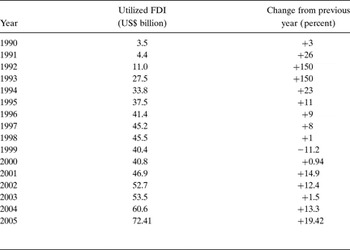
1992–1994: Deng Xiaoping again visited the southern SEZs in 1992 and called for the acceleration of the reform process. Deng pledged in Shenzhen that “reform and opening policies must be insisted on for one hundred years.” Afterwards, a series of new policies was put forward, as can be seen through the privatization of small-sized state-owned enterprises (SOEs), the institutionalization of the labor arbitration system in 1993, and the announcement of the Labor Law in 1994. Foreign Direct Investment (FDI) in China rose from 4.7 billion US dollars in 1991 to $11.3 billion in 1992 and $26 billion in 1993 (see Table 1). On the other hand, the hardship of rural lives in inland provinces forced more peasants to migrate across provincial borders to Guangdong looking for work. Official data estimated that the number of migrant workers in Guangdong in 1993 was around ten million.Footnote 23
Foreign Direct Investment in China, 1990–2004

Source: Ministry of Commerce.
1995–2000: The privatization of SOEs was launched in this period, producing millions of laid-off workers.Footnote 24 From 1996 to 2001, twenty-six million jobs were lost, equal to 40.5 percent of manufacturing jobs.Footnote 25 The laid-off workers joined the peasant migrants to compete for the job opportunities provided in the coastal cities. The high unemployment rate in these cities engendered a “tidal wave of return home” (huiliu chao) migration. The labor market suffered unprecedented dual constraints: Both the ability to absorb the rural and laid-off surplus laborers in the cities and the growth of rural income declined.Footnote 26 The growth rate of foreign direct investment (FDI) declined after 1994, and it even experienced an 11.2 percent reduction in 1999 due to the Asian financial crisis (Table 1).
2001–2008: Further changes in the labor market took place after China joined the WTO in 2001 and a series of socioeconomic reforms were introduced after 2003 under the Hu Jintao-Wen Jiabao regime. The growth rate of FDI inflow, which had been in decline since 1994, returned to double digits (see Table 1). Since 2003, China has surpassed the US to become the country with the greatest FDI inflow in the world. The period between 2002 and the global economic recession in 2008 was also marked by a rapid growth in exports. According to the World Bank, Chinese exports of goods and services as a percentage of GDP jumped from 25 percent in 2002 to 39 percent in 2006, 38 percent in 2007 and 35 percent in 2008.Footnote 27
At the beginning of 2004, the CCP Central Committee and the State Council issued a No. 1 Document entitled “Opinions on Policies for Facilitating Increases in Farmers’ Incomes.”Footnote 28 The problems of san nong (peasants, rural villages, and agriculture) were addressed in the party's No. 1 Document each year for seven consecutive years.Footnote 29 The policies highlighted the rights and interests of peasant workers. For example, in 2004, the No. 1 Document stated that “peasant-workers are an important component of production workers” and, hence, deserved the state's protection and basic civil rights.
The dramatic changes in both the urban economy (rapid growth driven by export-oriented manufacturing) and the rural economy (improvements in the socioeconomic conditions under the state's new policy direction) have given rise to a new phenomenon since 2003—a shortage of labor (mingong huang)—which is in stark contrast to the labor surplus (mingong chao) of the early 1990s. Surveys conducted by the Ministry of Labor and Social Security (MOLSS) revealed that 13 percent more migrant workers were employed in 2004 than in 2003,Footnote 30 but, at the same time, a shortage of at least a million workers in the PRD and 300,000 workers in Shenzhen were noted by an official source.Footnote 31
2008–2009: The global economic crisis in 2008 exerted a great influence on the Chinese economy. China's total exports in 2009 decreased by 16 percent to 1,201,610 million yuan, when compared to the 1,430,690 million yuan in 2008.Footnote 32 This means that the export-oriented industries in China were seriously affected. Twenty million migrant workers were reckoned to have been laid off.Footnote 33 Many of the laid-off migrant workers returned to their home villages and found temporary jobs in the towns and cities nearby.
2010–2012: The Chinese government has managed to keep the economy more or less immune from the world economic crisis. It set a target of 8 percent growth in the year 2009 while actual growth reached 8.7 percent.Footnote 34 In 2010, the growth rate returned to double digits and jumped to 10.3 percent.Footnote 35 Concomitant with the economic revival was the reemergence of labor shortages. A local newspaper, the Chengdu Commercial Daily, reported that a total of two million workers were needed in the PRD in early 2010, and some production lines were suspended due to the labor shortage.Footnote 36
A History of Migrant Workers’ Strikes in the PRD since 1978
Labor historians have pointed out that an economic boom can strengthen workers’ confidence and lead to proactive strikes (workers demanding better pay and working conditions), while the state and capital's strategies to lower labor costs during an economic downturn would trigger workers’ defensive struggles (workers trying to maintain their existing rights and interests).Footnote 37 This finding is supported by the history of workers’ strikes in the PRD since 1978. As reviewed in the previous section, there was no significant economic recession during the past three decades, but China's economy has experienced fluctuations in terms of its rate of economic growth. For example, during the economic slowdown in 2008 and 2009, workers’ resistance was defensive in nature.Footnote 38 My special interest, however, lies in workers’ proactive actions (usually in the form of strikes) during the economic boom. I will argue that through these collective actions, workers’ consciousness concerning class solidarity and class organizations (in the form of trade unions) has been strengthened.
1986: A Silent Strike
Documentary research and interviews with labor researchers show that strikes were not a common phenomenon during the 1980s in the PRD.Footnote 39 According to an estimation made by the Shenzhen Federation of Trade Unions (SFTU), there were nine small strikes in 1986 in Shenzhen, all of which lasted for only several hours. The China Youth News also reported in July 1988 that there were at least twenty-one strikes in Shenzhen SEZ during 1986 and 1987. The official newspaper claimed that both the number and scale of strikes had escalated since 1987.Footnote 40
One of the strike cases taking place in the Sanyo Semiconductor Factory in June 1986 was especially notable.Footnote 41 As noted by Asia Monitor Resource Centre, it was “a small-scale strike that shocked Shekou” because strikes were rare in SEZs at that time, and Sanyo was regarded as a model factory.Footnote 42 This wholly Japanese-owned enterprise was the biggest employer in Shekou, with over 2,000 workers.
The strike in June 1986 resulted from management not fulfilling the terms of employees’ contracts. The twenty-one workers who staged the strike had all been recruited by the management committee of Shekou Industrial Zone (SIZ) from their homes in northern Guangdong. Before they came to Shenzhen, they had been told that their salary would be increased after three months; after ten months, they still had not received a raise.
At midnight on June 11, 1986, the group gathered together to write a petition letter to the management. Two workers, Zheng and Chen, acted as coordinators. In the morning, the workers went to work like everyone else. But after one hour, they left the workshop collectively without informing anyone and returned to their dormitory.
Actually, the workers’ plan to strike had already been detected by the local trade union. Two officials from Shekou Industrial Zone Federation of Trade Unions (SIZFTU) came to their factory to investigate the case on June 10. Yet all of the workers refused to reveal anything. Meanwhile, at 4 p.m. on the same day, the company pinned up a notice to inform workers that their monthly salary would be increased by twenty yuan, backdated to April 1. Nonetheless, the workers did not give up their plan, and the strike took place the next day, despite the fact that a pay raise was their central demand.
In Sanyo factories, more than 50 percent of the workers were members of SIZFTU. Two trade union cadres, as well as the officials from the Party Committee and SIZ Labor Service Company (a government body to monitor employment issues in the zone), appeared in their dormitories immediately after the “wildcat” action took place.
When the trade union officials talked to the strikers in an effort to persuade them to return to work, the workers did not say a word. Their dialogue was recorded as follows:
“Why don't you go to work?”
Silence.
“It's no good to set up an issue. Our law will not allow it to happen anyway. Please go back to work, because the consequences may be serious if you don't. If there is any problem, you can raise it with the union. The union can approach the company and help to resolve …”
Silence.
“What you are doing is against Section 158 of the Penal Code. In the name of the union, we demand you go back to work immediately.”Footnote 43
The officials’ strategy turned from “soft” persuasion to “hard” threatening as time went on. The workers seemed to be frightened, especially by the references to laws,Footnote 44 about which they had no idea. They bowed down and returned to work one by one. However, one of their leaders, Zheng, suddenly shouted: “Hey! If anybody can beat me in arm-wrestling, they can go back to work.”Footnote 45 All of the twenty-one workers then went back to stay with Zheng. However, the workers finally returned to their work after striking for more than ten hours because the trade union, party, and administrative officials persistently followed and talked with them.
The day after the strike, the workers’ leaders, Chen and Zheng, were fired. They were sent back to their homes. According to a cadre of SIZFTU, “[They were] handed in to the local labor department, [which was] informed not to arrange jobs for these two persons again. [It is] a piece of mouse feces to stir up a bowl of soup.”Footnote 46
Labor Relations in the 1980s
Wildcat strikes were increasingly being staged by workers in the late 1980s after the opening up of the PRD. Still, they were very place-of-origin oriented and lacked any strategic planning. According to the union incident report, the ten-hour strike at Sanyo was the “worst strike” in the industrial zone between 1981 and 1986.Footnote 47 But even in the “worst” case, workers only took a passive measure to express their discontent toward “being cheated.” Unlike participants in a mature strike, they did not have any formal demands, did not negotiate with the management, trade union, and the Party Committee cadres but kept silent the whole day. The hometown connection (the bond of being from the same hometown in northern Guangdong) was the only crucial element being mobilized in organizing the strike. As a matter of fact, the organizers took no action to inform other workers from other counties and dormitories of the strike. Also, the official trade unions played a key role in constraining workers. The SOE model of labor control, in which the CCP committee and trade unions worked with management to constrain workers’ resistance, still prevailed in the industrial zone.
1994: Temporary Trade Union During Strike
In the 1980s, most of the migrant workers in the PRD were local migrants coming from other parts of the Guangdong province. However, workers crossing provincial boundaries outnumbered the local migrants by the early 1990s. After the Spring Festival of 1992, two million migrant workers from inland provinces flooded into Guangdong.Footnote 48 This was caused partly by the expansion of the “reform and opening” policy ordered by Deng Xiaoping and by the rapid inflow of FDI to the country as previously discussed.
During 1993 and 1994, the media in Hong Kong and China reported widely on labor issues including the long working hours, infringement of the minimum wage rates, physical abuse of workers, poor workplace safety, disastrous industrial accidents, and workers’ protests.Footnote 49 Li Boyong, the head of the central state MOLSS, expressed his concern:
This year's labor and employment conditions are very bad, and the labor conflict cases have a trend of rapid escalation; last year the number of strikes, work stoppages, filing of grievances with higher authorities [shangfang], petitions, marches and demonstrations was not lower than ten thousand, among which those at foreign-invested enterprises were most evident. At the same time, the problems of occupational diseases and industrial accidents were also very common, and need to be resolved as soon as possible …Footnote 50
Strike Tide in 1993–1994Footnote 51
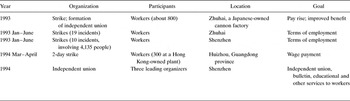
Leung reported “a momentous rise in the number of labor protests such as strikes, sit-ins, and street demonstrations waged by larger numbers of workers during the years 1992–1994.”Footnote 52 She documented a chronology of reported labor protests in China from 1984 to 1994.Footnote 53Table 2 captures the cases concerning foreign-invested enterprise (FIE) workers in the PRD during 1993–1994. In the words of Jiang,Footnote 54 there was an “unprecedented strike wave in FIEs concentrated in south China” in the early 1990s, while Taylor, et al. called it “the third wave of strikes” in the history of the People's Republic.Footnote 55
Reported Labor Protests of FIE Workers in the PRD from 1993 to 1994

Source: Leung, 1998: 331–35.
Although the wage levels in the Shenzhen and Zhuhai SEZs were among the highest in the country in the early 1990s,Footnote 56 workers suffered from a high inflation rate.Footnote 57 A series of strikes was staged by workers to demand reasonable wage adjustments. Among others, “during the seventy-five days from March 9 to May 23, twelve strikes took place in ten foreign-owned factories [in Zhuhai], directly participated in by 7,263 workers, with an accumulated stoppage of 18,147 working day shifts.”Footnote 58 The following case (Yongfeng), which took place during 1994 in Shenzhen, provides a glimpse into the general pattern of the strikes in this period.Footnote 59
Strike in Yongfeng
In March 1994, a strike happened in Yongfeng, a Taiwan-invested shoe factory in Bao'an, Shenzhen.Footnote 60 The factory had provided free meals and accommodation to its workers. One day, the workers surprisingly found that 150 yuan was being deducted from their salaries for meal and living fees. Thus, after deducting the 150 yuan, their salaries were lower than the legal minimum wage rate. Some workers lodged a complaint to the Shenzhen Municipal Labor and Social Security Bureau (LSSB). Workers’ discontent was intensified by an incident of a security guard beating a woman worker. On the evening of March 13, 1994, the day they received their salary, a strike exploded: “They created uproars, struck objects [to make noise] and expressed outrage.”Footnote 61 The strike was first initiated by male workers in the assembly workshop whose work was the most intensive, but lowest paid. The next morning, a notice was posted to call for a strike in the name of a “temporary trade union.” Over three thousand workers responded to the appeal.
The strike lasted for three days. The workers’ dormitory and the factory were next to each other but separated by a wall. During the daytime, the police were patrolling within the factory, while workers stayed quietly in the dormitory. They did not make their outcries heard until the evening. As soon as the night came, workers created an uproar, struck objects, and threw sundries down to the floor or towards the factory. According to a worker, as it was easier to be recognized and punished during day time, so they kept silent in the day but voiced their agitation at night when it was hard to recognize workers. Furthermore, the management or police dared not catch workers in the dormitory at night because the dormitory at night was the workers' world and catching them there might lead to violent conflict.Footnote 62
Workers were so worried about revenge that there were no representatives to negotiate with management during the dispute. An “agreement” was reached between the management and the officials from the LSSB without any involvement of, or consultation with, workers. The factory returned the 150 yuan to the workers, but the workers needed to sign new contracts with the factory formalizing the charging policy. In exchange, the “concession” from the management was to increase the overtime wage rate from one yuan per hour to 2.1 yuan, the minimum standard regulated by Shenzhen municipal government. That means the legal minimum wage would thus be nominally implemented in the factory. The LSSB also announced that the “temporary trade union” was an illegal organization. After this, some of the strike leaders quit their jobs in fear of punishment.
The Implications of the 1993 and 1994 Strikes
As can be seen in the case just described, workers’ consciousness made progress in terms of their demands, collective action, strike duration, and strategies when compared to the strike in 1986. As shown in the Yongfeng case, some of the strike leaders even attempted to organize an independent trade union. The traditional form of labor control, relying on the cooperation of the trade union, the party committee and the management, ceased to be effective. Both the trade union and Party Committee were absent from most of the FIE workplaces. Thus, the ACFTU lost its position in pacifying workers and mediating workplace conflicts in the private sector, although in some cases, the municipal or district trade unions still played a role in accommodating workers’ grievances.
As a response to this challenge, a new labor law was announced in 1992. In 1994 alone, 17,293 trade unions were set up in FIEs, nearly double the total figure of the previous ten years. But, as pointed out by many researchers,Footnote 63 most of them were organized and fully manipulated by management. The LSSB and the labor arbitration court then played a more important role in mediating between workers and management while the role of trade unions declined, especially after the labor law became effective in 1995.
Lin observed that after 1994 the number of strikes in the PRD had become more stable as the labor laws provided a basis for conciliation.Footnote 64 This was the central state's effort to absorb workers’ radical actions into administration-managed legal channels.
2004: Strike for a Trade Union
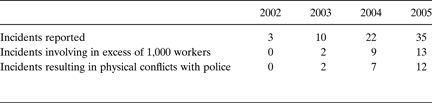
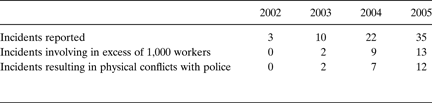
In addition to noting the widely reported phenomenon of a labor shortage arising shortly after China joined the WTO, labor NGOs and the media have also paid attention to the rising frequency and scale of wildcat strikes after 2004 (see Table 3). One of the most notable cases among workers’ strikes demanding a trade union took place in a Japanese electronics factory, Uniden,Footnote 65 in Shenzhen. The Japanese factory, which was set up in 1990, had sixteen thousand employees in 2004, of which one thousand were male-dominant managerial and R&D staff; the rest were young female production-line workers.
Workers’ Collective Action Reported in the PRD from 2002 to 2005Footnote 92
Source: Leung, 2005.
The strike took place in late 2004. The immediate cause of the strike was that the factory dismissed a worker who had served in the factory for nearly ten years without any severance pay. On a Friday morning in December 2004, a suggestion letter [changyi shu] was sent by the hidden strike organizers to the company-provided e-mail address of all administrative and technical employees.Footnote 66 The letter set out fifteen demands, which included realization of the promise to establish a trade unionFootnote 67 and a permanent contract for workers who had served for ten years and ended with, “Hope the above points are responded to by 16:00 of XX (day) XX (month) [the same day the letter was circulated]. Otherwise, we will take action as soon as possible.”
At 4 p.m., workers began to walk out from the production building. Employees working in the technical and administrative departments had not yet joined the strike. At 9 p.m., a pamphlet was circulated among rank-and-file workers. Its message was more or less the same as the e-mail message, but with an extra call for workers to elect representatives on a group basis in order to negotiate with the “Japanese.” “Now we need to negotiate with the legal representative [faren daibiao] from Japan, as we don't recognize any Chinese [official] mandated by the Japanese … We will hire a lawyer and interpreter to negotiate with them,” the paper read.
The next day was Saturday. After a morning meeting of all the production department heads, the factory announced to the production workers that the day was a factory holiday and work would resume on Monday morning. Staff in nonproduction departments still needed to report to work as usual at 8 a.m. However, unexpectedly for the management, the staff working in the technology building came out to join the strike from 11 a.m. onward. The pamphlet, which was circulated among production workers, now had also reached the technical staff. The spread of the strike forced management to announce at noon that the technology building would also be closed that afternoon.
Some technical staff members, who could be regarded as the organizers and core supporters of the strike, held a meeting and reached a consensus that all the demands of the production workers should be supported. Workers tried to call the media on Sunday and Monday, yet there was no response. Beginning at 6 a.m. on Monday, thousands of production workers first rallied on the drill ground of the factory and the pavement outside. By then, representatives had been elected. The workers were joined by the technical staff at 8 a.m. To draw public attention, six hundred to seven hundred women production workers walked toward the highway. They were stopped by the well-equipped police and security guards who had been standing by.
At 10 a.m., some of the elected worker representatives stood up on a stage to brief the assembled workers. Among others, the trade union was a key issue being addressed. One of the representatives recalled the speech of another representative:
The factory can dismiss workers casually, deduct and keep wages, set up unequal regulations, conduct body checks when [workers are] getting on and off work and even bring in the security guards to grab the women workers who were sacked but still working in the factory. Why? It is because workers are a weak community. Now we should protect our own rights. We should form our own trade union to protect our workers, and protect the legal rights and interests of us all.Footnote 68
Workers were encouraged by their representatives to speak on the stage. One of them suggested forming a trade union preparation committee. The idea was hailed by the assembled gathering. More than fifty workers, recommended by their workmates or made to stand by them, became committee members. Among them, Tom and Henry, who were both working in technical departments, showed themselves to be natural leaders.Footnote 69
After the end of the assembly, the preparation committee members contacted the SZFTU and asked if a spontaneously organized workers’ trade union was legal or not. The city trade union responded that it was legal and asked them to contact the town level trade union branch for help. The members then called the town union. The town union officials agreed to meet them at 2:30 p.m. A committee lunch meeting was held to elect twelve negotiators. These representatives indeed were also those elected by the workers before the morning rally. In the afternoon, the town trade union cadres came and met with the committee members in the factory. Before the arrival of the trade union officials, the government officials from the LSSB had already arrived at the factory to talk with the managers. When the twelve workers’ representatives went into the meeting room, twenty government officials and factory managers walked out to the drill ground where a group of workers had gathered. When officials from the district LSSB were about to address the workers, representatives outside the negotiation room informed the negotiators. Henry came out and told the workers, “Our negotiation is now under way, and we have not reached any agreement at this moment. Please act according to what we said this morning.” The labor bureau official continued his speech, although workers started to disperse.
The negotiation was going well, and several dozen points were agreed on, such as ending the practice of frisking women workers when they went outside the factory and providing food and accommodation allowances for those residing outside factory. The worker-elected representatives who had participated in the meeting tried to calm the workers who had still not dispersed and persuaded them to go back to work as soon as possible. Afterward, following the resumption of production, some unlawful policies—for example, overtime work that exceeded the legal standard—were abandoned by the factory, but the main part of the agreement was not implemented. One item in the deal stated, “The implementation of the above rules is to be monitored by the workers’ representatives.” However, the managers said that they did not recognize the representatives, as they did not have legal status. Another item stipulated that a trade union would be set up in July 2005 with the collaboration of management and the workers’ representatives. Yet, again, the managers ruled out a role for the workers. In addition, the factory used different excuses to force the resignation of some activists.
Tom, the worker leader who was financial manager of the information technology (IT) department, was one of those who were dismissed. Several days after Tom was dismissed, a factory-wide strike was staged to demand his reinstatement as well as a wage increase in accordance with the law. The strike lasted for four days and ended without any significant promise from management. According to workers, on the third day, the policeFootnote 70 began to harass family members of the organizers who lived in Shenzhen. It was a crucial factor that compelled the workers to eventually give up the strike.
After this strike, the factory announced that it would strictly abide by Chinese labor laws. An enterprise trade union was set up by the management under the guidance of the local trade union. A department-based union committee election was held, but the management tried to manipulate the election by asking the managers and supervisors to stand as candidates. Still, at least two rank-and-file workers outside the management list were elected in the production departments. The two, however, could not bear the pressure from management and soon resigned from their union posts. They had been constantly scrutinized for their relationship with the outgoing strike leaders.Footnote 71
The Characteristics of the Uniden Strike
A common distinguishing attribute of the Yongfeng strike in 1994 and Uniden in 2004, both in the Bao'an district, was that some workers aspired to organize a trade union to represent the interests of workers. In both cases, the legal minimum wage rate was implemented, at least superficially, after the strike, but the leaders of the strike were more or less forced to leave the factories. These two cases also occurred in the context of two waves of strikes in the PRD, one from 1993 to 1994 and the other from 2004 to 2007. Nevertheless, there were some differences in the processes and the results of the strikes.
First, in the Uniden case, a trade union was formed with the support of the higher-level trade union. When workers telephoned the city trade union branch, its response was unambiguous: It was legal to form a trade union. In 1994, however, the LSSB officers and the city or district trade union did not appear to support the establishment of a trade union in Yongfeng. In Uniden, representatives sought help from the high-level trade unions and formed a twelve-member negotiating team; in Yongfeng, workers did not declare their status as strikers or temporary trade union leaders, and because of that, no worker was involved in the negotiation.
Second, while workers in Yongfeng internalized their struggle within the dormitory, Uniden workers tried their best to externalize their campaign, using methods such as calling the media, attempting to block the highways to gain public attention, and writing blogs and a web forum to inform the outside world of their struggle.
The above two points are related to a third difference concerning the strike leadership. At Uniden, well-educated professionals joined in to lead the struggle, while the leadership of the Yongfeng strike solely relied on the production workers. Comparing Yongfeng with Uniden in 2004, the key distinctions are very apparent. The Uniden workers were more advanced in terms of their organizing capacity and strategy of struggle, as well as in terms of the duration and the scale of their strike.
2010: Strike and Trade Union Reform
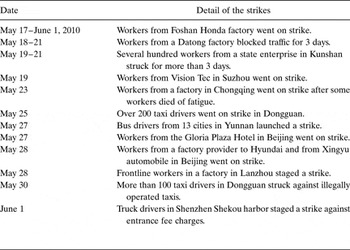
Uniden is one of the pioneer cases of worker strikes from 2004 to 2007.Footnote 72 As mentioned above, the impact of the global economic crisis and the state policies during 2008 had changed the nature of workers’ struggle from proactive to defensive. However, the situation has changed dramatically since 2010, as the Chinese economy started to recover. Table 4 indicates the strike cases that took place from May to June 2010 in China, as reported by Asian Weekly. All twelve of these strikes were said to be triggered by one of the most important strike cases since 1978, the workers’ strike at Honda Auto Parts Manufacturing Co., Ltd. in Foshan (hereafter, “Foshan Honda”).Footnote 73
Strikes in Different Industrial Sectors and Geographical Areas Within Two Weeks of the Honda Workers’ Strike Outbreak

Source: Asia Weekly 2010.
Beginning on May 17, 2010, the Foshan Honda strike attracted both nationwide and international attention. The factory is solely owned by Honda and was set up in 2007. The strike involved about 1,800 workers and lasted for 17 days. Workers listed 108 demands at the meeting convened by the management at the beginning of the strike, but two of them in particular were consistently retained: (1) a wage increase of 800 yuan for all workers and (2) a democratic election of new trade union leaders [minzhu gaixuan gonghui], as the existing trade unions barely represented their interests. The company was at first reluctant to hold any negotiations with workers. Instead, it resorted to intimidation, firing two activists (who, in fact, had already resigned before the strike), and pushing workers to sign a document stating that they would not lead, organize, or participate in any strikes.Footnote 74 Despite the company's threats, however, the strike continued. The company did come up with two proposals concerning a wage increase, but the workers turned them down since they were still far below their wage demand of 800 yuan.
Throughout the strike, the enterprise trade union was not on the workers’ side but instead backed the management. One worker noted,
The chairman of the trade union tried to talk workers into resuming their work. And he engaged in private conversations with the CEO of the company during his first meeting with workers’ representatives on May 24. He is deputy head of the Business Management Department [shiye guanli bu].Footnote 75
In his own blog, a worker representative of the strike wrote, “It is frustrating that many enterprise trade unions fail to represent workers; instead they are on the side of companies. The enterprises’ interest, rather than the workers’ [interest], is their top concern.”Footnote 76
The failure of the workplace trade union to provide representation was further manifested by the physical confrontation between a crowd of people who claimed to be “trade union members” and the strikers on May 31. That morning, many workers resumed work under strong pressure from management and the local government. However, about forty workers refused to work and gathered together on the factory grounds. At noon on that day, about 200 people were said to have been mobilized by both the Shishan town-level and Nanhai district-level trade unions to persuade the workers to go back to work.Footnote 77 But the workers refused, and some of those 200 people and strikers had physical confrontations. A few of the workers were hurt and sent to the hospital. Official sources did not declare where the 200 “trade unionists” had come from, but one source close to the ACFTU said that they had been mobilized by the local government. They wore yellow caps and carried a “trade union membership card” [gonghui huiyuan zheng], according to one of the strikers who witnessed the physical confrontations.
This incident served as a turning point, after which the company and trade unions came under even greater pressure. The factory-wide strike continued, and on June 1 hundreds of workers gathered near the factory gate. Zeng Qinghong, the CEO of Guangqi Honda Automobile (who is also a member of the National People's Congress), went to talk to the strikers, asked them to elect their own representatives, and promised to negotiate with them three days later. Workers told me that Zeng was invited by Foshan Honda to intervene as the strikers were very furious and refused to talk with the Japanese management. In the presence of Zeng, some strikers elected about sixteen representatives.Footnote 78 Later, at 5 p.m. the same day, the Nanhai District Federation of Trade Unions (NDFTU) and Shishan Town Federation of Trade Unions (STFTU) issued a letter of apology to all of Foshan Honda's workers, which, however, still hinted at the fault of workers who continued to insist on striking. It said,
Yesterday the trade unions took part in the conciliation between workers and management in Foshan Honda. Since some workers refused to perform their duties, the factory's production has been seriously affected. During our communication with about forty workers, verbal conflicts arose due to misunderstanding; some workers were emotionally unstable and have had a physical confrontation with trade union members … Having learnt about this incident, some workers think the trade unions are biased in favor of the company … We would like to express our apologies about a number of things that workers find hard to accept … The trade unions coming out to exhort those workers (who refuse to work) are in fact protecting the rights of the majority of workers; this is what trade unions should do.Footnote 79
Endeavoring to gain wider public support and calling for stronger solidarity among workers, workers’ representatives issued an open letter to all Foshan Honda workers and the public on June 3, reiterating their demands: (1) a wage increase of 800 yuan, (2) a seniority premium, (3) a better promotion system, and (4) democratic election of the enterprise trade union. This letter manifested the workers’ strong class consciousness. It declared,
We urge the company to start serious negotiations with us and to accede to our reasonable requests. It earns over 1000 million yuan every year and this is the fruit of our hard work … Foshan Honda workers should remain united and be aware of the divisive tactics of the management … our struggle is not only for the sake of the 1,800 workers in Foshan Honda; it is also for the wider interest of workers in our country. We want to be an exemplary case of workers safeguarding their rights.Footnote 80
The workers’ voice reflected in this statement serves as significant evidence of the growing level of class consciousness among migrant workers in China.Footnote 81 At the request of the worker representatives, Zeng held a pre-negotiation meeting with them in the afternoon of June 3. The same evening, the company initiated a democratic election in all departments, and altogether thirty representatives were elected. The same day, with outside help, workers’ representatives were able to get in touch with a prominent labor law professor—Chang Kai, at Renmin University, Beijing—who later agreed to be their advisor.
On June 4, the newly elected workers’ representatives, the representatives of the company, the town and district level government officers, the workers’ legal advisor, the chairman of the enterprise trade union, and Zeng attended the negotiations. In the end, the parties reached an agreement to raise workers’ wages from 1,544 yuan to 2,044 yuan—a 32.4 percent increase—and student interns’ wages from about 900 yuan to around 1,500 yuan (an increase of 70 percent).Footnote 82
After the strike, trade union elections, organized from the department level to the factory level, took place in CHAM from September to November 2010 with the Guangdong Provincial Federation of Trade Unions (GDFTU)'s active intervention. However, the GDFTU delegates ruled out the call of workers’ representatives to remove the existing trade union president, as they thought he should be given “a chance to correct himself” [gaizheng de jihui]. Moreover, by manipulating their candidacies and isolating active workers’ representatives who had close contact with external supporters such as prolabor scholars and labor activists during the strike, the GDFTU ensured that most union committee members elected were from the managerial or supervisory level. While the union chair remains unchanged, two deputy chairpersons were elected in February 2011. According to workers, one of them is a department head while the other is the vice-head. One of the strategies of higher-level trade unions to manipulate election results is to establish a preparation committee for the election that is under its own control. Candidates for the trade union committee members, including the union chair, were nominated by the preparation committee.Footnote 83
From February 25 to March 1, 2011, almost a year after the strike, a wage negotiation took place between the trade union and the factory's management. The plant union demanded a wage increase of 880 yuan for production line workers in 2011, a 46.1 percent increase, according to the managers. Rejecting the trade union's demand, management proposed a 27.7 percent increase of 531 yuan, saying that the union's demand was too aggressive. In the end, both parties agreed to a pay raise of 611 yuan.Footnote 84
Significance of the Honda Case
As can be seen, not only the coordination and persistence of the workers in this strike and the nature of their demands, but also the impact of the strike go well beyond previous instances of strike actions, including the Uniden case in 2004. Honda workers’ growing sense of solidarity and class consciousness forced the local party-state and factory management to take the issues of workplace representation and wage bargaining seriously and enabled them to achieve a higher wage level. A democratic election was organized during the strike for the workers to elect their own strike representatives. A trade union election and wage negotiations were held after the strike, although the process was not fully democratic. In Uniden and many other previous cases, the leaders of strikes were dismissed or forced to leave the factory after the strike; at Foshan Honda, however, we have not heard any reports that the factory dismissed strikers after the strike. All of these achievements have gone beyond the case of Uniden.
Moreover, the Honda strike has also exerted a greater impact on industrial relations in general. Since the Honda strike, in many of the strike cases in the PRD, reconstruction of the workplace trade union has become one of the important formal demands. Since that strike, the vice president of the GDFTU, Mr. Kong Xianghong, confirmed that the “democratization” of trade unions would be sped up so that members could elect their own president in the near future. He also announced that a pilot scheme of democratic election of workplace trade unions and relevant training would be carried out in ten factories, including the Honda factory in Foshan.Footnote 85 In 2012, the SFTU announced that they would initiate direct elections in 163 factories. According to the information from a local researcher,Footnote 86 the 163 factories are those with more than 1,000 workers each, and their union committee term would end in 2012.
It is too early to predict the outcome of the trade union direct election in the PRD. As a model case, Foshan Honda's election demonstrates that the party-state, along with the company's management, is still determined to manipulate the workplace trade union. However, comparatively speaking, workers’ strikes have exerted a great challenge to the party-state to take the problem of workplace representation more seriously than before.
Conclusion
The past three decades have given evidence of China's integration into a global capitalist economy. As the frontier of the transformation, the PRD experienced rapid and dramatic industrialization, which produced and reshaped the landscape of class conflict in the region. Inspired by the labor historians of neo-Marxist tradition, E.P. Thompson and Eric Hobsbawm, this paper has presented a number of important strikes of migrant workers in the area which have attracted public attention at different stages of the development of political economy in China. I have suggested that the trade union as a class organization has been a contested domain for migrant workers’ struggles in the PRD. Through their collective actions, workers’ class consciousness and strategies toward class organization have steadily advanced in the process of China's integration into the global economy. First of all, through the four most emblematic strikes in different stages, we have seen how worker discontent was constrained by the Chinese socialist tradition of trade unionism in the early stage of the economic reform. While 1989 to 1992 was a period of reform stagnation where no significant development was seen in the export-oriented economy, 1993 to 1994 was a turbulent time in which a tidal wave of strikes arose in the twin SEZs of Zhuhai and Shenzhen. More recent strike cases have been presented to show how they differed from those in the 1980s and how workers’ efforts to organize an independent trade union were thwarted. After 1995, while the labor law and labor arbitration mechanism provided workers with a channel to express their dissatisfaction at a time of high unemployment, the trade union lost its significance in workplace relations in the PRD's foreign-invested enterprises. However, after China was admitted to the WTO, the export-oriented economy was further expanded and more job opportunities became available. The labor shortage encouraged those with privileged job market positions to have the courage to rebel in the form of semiorganized strikes in the PRD since 2004. From 2004 to 2010, we also witnessed the rising awareness of the strikers regarding trade unions as a channel for articulating class interests. This observation supports Silver's thesisFootnote 87 that a new working class will be “created and strengthened in the favored new sites of investment,” although the state and capital's manipulation of class organization has slowed down the process of class formation in China.Footnote 88
In his four-layered framework to understand the process of class formation (class structure, social organization of class, class disposition, and class action), KatznelsonFootnote 89 defined “class action” as “classes that are organized and that act through movements and organizations to affect society and the position of class within it.” Seen through his framework, as class organization has been ineffective and freedom of association is still denied in contemporary China, workers’ collective actions that bypass the ACFTU are not class actions. However, within a capitalist class structure, workers in the PRD have shown some extent of class disposition or class-consciousness. This has been particularly demonstrated in the cases of Uniden and Foshan Honda, especially workers’ efforts to establish or democratize workplace trade unions. This is not to suggest that the class-consciousness of migrant workers has become mature. However, if we compare the case of the strike in the 1980s, in which only twenty-one workers stopped work and conducted their strike in silence, the historical progress by the time of the Honda strike is very apparent. In short, the implications of this research in the PRD on the politics of class formation in China are twofold. First, class organization might be better understood as a consequence of workers’ conscious class actions rather than its precondition, which Katznelson's model implies.Footnote 90 Second, even though class organization in China is highly manipulated by the party-state and capital, class consciousness is able to grow through workers’ collective struggles. Thus, the experiences of migrant workers’ struggles in the PRD call for new approaches and concepts to understand the dynamics of working-class formation in China. I have argued both here and elsewhere that the migrant workers’ struggle in China is “class struggle without class organization,” which is different from the class organization-centered approach to class action which Western theorists such as Katznelson have adopted based on Western historical patterns.Footnote 91 More research will be needed in other parts of China and the Global South to see if these suggestive conclusions can be extended beyond the PRD—and perhaps even beyond China.
Supplementary Materials
To view photos as supplementary materials, please access: http://dx.doi.org/10.1017/S0147547913000082