Introduction
General background
Adoption of integrated pest management (IPM) strategies for the farming community has been defined as a goal on national, regional, state and local levels. The endorsement of this goal has been in response to studies indicating that pesticide use could be reduced following implementation of IPM and that conventional chemical control strategies were responsible for widespread pest resistanceReference Zalom and Fry1. IPM is a flexible management philosophy that emphasizes the need for suppression rather than eradication of pest populationsReference Olkowski, Olkowski and Daar2, Reference Stern, Smith, van den Bosch and Hagen3. Specific components of a cranberry IPM program include scouting for pests, application of pesticides in accordance with pre-established economic thresholds, and use of biological controls and cultural practices that alter or manipulate the environment to be less favorable to pestsReference Zalom and Fry1, Reference Sandler and Sandler4.
Many growers report using IPM techniques as their primary program for controlling pest populationsReference Kovach and Tette5–Reference Hollingsworth and Coli7. Quantifying IPM success is challenging as many farmers choose to engage selectively in particular aspects of an IPM programReference Musser, Wetzstein, Reece, Varca, Edwards and Douce8–Reference Vandeman, Fernandez-Cornejo, Jans and Hwan Lin11. Measurements of IPM adoption have ranged from reliance on self-reporting by farmers, assessments based on individual IPM practices employed or the use of key practices, to evaluation of farmer knowledge and decision-making criteria with regards to pest management strategiesReference McDonald and Glynn12, Reference Nowak, Padgette, Hoban, Greene and Kramer-LeBlanc13.
Development of successful Extension and research IPM programs for any commodity relies on feedback from grower groups to document current practices and future needs. Even with their limitationsReference Hollingsworth and Coli7, Reference Dillman14–Reference Smith and Aerts16, surveys are legitimate methods for obtaining information about perceptions and adoption of IPM in agriculture. Previous researchers have identified factors affecting agricultural adoption of IPM to include variables operating on the individual or farm level such as age, farming experience, farmer education level, size of farm, farm income, as well as the cost and perceived benefits of IPMReference Barrientos and Anciso17–Reference Leslie and Cuperus19. For example, a study of apple growers noted a negative association between use of specific IPM practices and age of farmersReference McDonald and Glynn12. Another study focusing on IPM use by fruit and vegetable farmers in New Jersey concluded that education had a positive impact on IPM adoptionReference Hamilton, Robson, Ghidiu, Samulis and Prostko20. Furthermore, a national survey found that IPM users tended to have less farming experience than did non-usersReference Rajotte, Kazmierczak, Norton, Lambur and Allen21.
Previous surveys have documented relationships between perceptions, behavior and IPM use. When considering the role of economic and environmental factors, IPM users were much more likely to have positive beliefs about the impacts of IPM on profit and yield than non-IPM usersReference Musser, Wetzstein, Reece, Varca, Edwards and Douce8. Barrientos and AncisoReference Barrientos and Anciso17 found that the perceived economic risks associated with IPM adoption served as barriers to greater implementation by cucurbit growers in Texas. In a study of factors affecting IPM adoption by WearingReference Wearing22, the farmer's desire to conserve the natural enemies of pests was identified as an important environmental concern. In a survey distributed to all cranberry regions in North America, researchers found that growers were willing to adopt new and selective management practices provided they were both efficacious and environmentally friendlyReference Weber23.
In this study, a mail survey was distributed to Massachusetts (MA) cranberry growers during the summer of 1999 to identify significant factors influencing cranberry IPM adoption. The overall objective of the survey was to compare farmer perceptions regarding the economic and environmental consequences of IPM among those growers who identified themselves as frequent, occasional or non-IPM practitioners, as well as to compare the suite of practices used by those growers. Questions in the survey were designed to identify relationships between grower perceptions and behavior with regard to the use and adoption of IPM practices. In addition, obtaining grower opinions on the value of existing IPM educational materials and programs and the effectiveness of current IPM practices for cranberries was also an important objective. Finally, we also sought to examine the influence of demographic factors, such as age and education level, on grower beliefs and adoption of IPM.
IPM and cranberry agriculture in MA
The topic of IPM is especially salient to MA cranberry growers as cranberry farms along the east coast have been identified as having more significant pest problems than other cranberry growing regions in the US. The climate, geology and soils of southeastern MA have proven ideal for growing cranberries and support a wide range of organisms (both beneficial and not) that also live in the agroecosystem. The long growing season and high summer temperatures of the region are especially conducive to the outbreak of cranberry diseases such as fruit rotReference Mahr and Moffitt24. In addition, the development of pesticide resistance among key cranberry insect pests, such as Sparganothis fruitworm and cranberry weevil, has been an increasingly significant problem for MA growersReference Averill and Sylvia25, Reference Averill, Sylvia, Sylvia and Cannon26.
Cranberry agriculture in MA is different from that in other cranberry growing regions due to the large number of family farmers and growers with small acreage in the stateReference Ganim-Barnes27. On average, MA growers manage older, less productive bogs than growers in other states. Nevertheless, MA historically produced more cranberries than any other region until surpassed by Wisconsin (WI) in the mid 1990sReference Farrimond28. This was a result of substantial acreage expansion that occurred in WI during the 1980–1990s. Notably, much of the acreage was planted to high yielding varieties in large farm parcelsReference Roper29. In contrast, MA growers have been limited in their ability to expand acreage significantly due to the lack of available land, high land prices, and environmental regulatory restrictionsReference Simon30.
Despite changes in the proportion of fruit output from the various regions, the industry enjoyed a prosperous period up to the late 1990s. The high value of the crop permitted growers to include expensive pest management practices (such as the use of entomophagous nematodes) in their IPM programs. In the year following the distribution of this survey, the US cranberry industry experienced a sharp economic downturn as supplies greatly exceeded demand. Factors including increased importation of foreign cranberry products, increased production from the newly planted acres, and flat consumer sales contributed to the surplusReference Farrimond28.
Presently, small cranberry operations in MA are struggling to be economically viable. Many growers are considering selling or leasing their land or leaving cranberry production to pursue other full-time jobsReference Ganim-Barnes27. Others have chosen to cut back on management practices, including scouting and the use of expensive chemicals or practices to save money until prices recover. Readers should note that this paper reflects grower views about IPM just prior to the economic downturn. Further examination of the effects of market collapse on grower use of IPM practices would be a suitable follow-up study to this paper.
Materials and Methods
Survey development and distribution
The survey was developed and distributed during the summer of 1999. General methodology for writing the questionnaire, preparation of the cover letter, follow-up letters, and multiple mailings was patterned as per DillmanReference Dillman14. The mailing list was obtained from the University of Massachusetts Amherst Cranberry Station and supplemented by the 1999 Massachusetts Department of Agricultural Resources 1999 Wholesale Growers Directory to generate a more inclusive list of cranberry growers in the state.
The survey was sent to 452 growers, approximately 90% of the estimated grower population in MA (J. LaFleur, Cape Cod Cranberry Growers' Association, and A. Davis, National Agricultural Statistics Service, personal communication, 1999). Because the population was so small and the mailing list was not absolutely inclusive, random sampling was not employed. Instead, the survey was sent to all growers on the mailing list. A minimum sample size of 217 (a response rate of 48%) would be necessary to achieve ±5% sampling errorReference Salant and Dillman15 and produce a credible sample.
The final survey consisted of an eight-page monarch-size booklet with 27 questions inquiring about: (1) grower IPM use; (2) major factors affecting grower adoption; (3) satisfaction with educational materials and programs produced by the University of Massachusetts Amherst Cranberry Station; (4) opinions about the economic and environmental consequences of IPM; (5) perceptions about the effectiveness of IPM methods in controlling major cranberry pests; and (6) demographic issues. Many of the questions had multiple parts, yielding a total of 104 potential responses per survey.
Questions were constructed to allow responses in one of three formats: choose one response from a list of choices (demographic variables); choose one response from three levels of possible activity (never, sometimes, or frequently) or importance (not, somewhat, or very); and choose one response from six levels of agreement (strongly disagree, disagree, mildly disagree, mildly agree, agree, or strongly agree). Unless specifically mentioned, reported results in which it is stated that growers ‘agree’ or ‘disagree’ implies the combination of results from the three levels of agree or disagree responses, respectively.
Statistical analyses
All analyses were carried out using SAS version 9.1 for Windows31. Descriptive statistics, including counts and frequencies of various responses, and counts and frequencies of various responses as a function of the demographic variables, were computed using PROC FREQ. Six demographic variables were identified: IPM adoption, educational level, age, years of experience, farm size, and work status (full or part-time). Excluding these demographic variables, factor analysis was conducted to identify underlying patterns among a group of related variables.
Factor analysisReference Hinkle, Wiersma and Jurs32 was performed using PROC FACTOR. The ‘varimax’ orthogonal rotation method was used to ensure that the factors produced by this analysis would be uncorrelated with one another. Squared multiple correlations were used for prior communality estimates. Some of the assumptions of factor analysis may have been violated by our use of categorical, rather than continuous, data in the present study. Use of factor analysis on categorical variables is common in the behavioral sciences, and appears to provide valid results with these types of data33. This violation should not have any consequences on the validity of our conclusions about the existence and location of relationships and common variance among the variables analyzed.
Significant factors for each question were determined by keeping those factors whose loadings were greater than 0.30 in absolute values. Once these factors were determined, factor scores were created for each survey respondent. These factor scores were then used to develop multinomial regression models using PROC GENMOD. This allowed the investigators to determine the location of significant relationships between the continuous factor scores and the categorical (and often ordinal) responses to the questions regarding descriptive characteristics. Specifically, we determined which factors were significantly related to the six demographic variables listed above.
Results
Descriptive statistics
Of the 450 surveys that were mailed, 285 were returned, of which 243 were usable. The overall response rate was 54%, well above the expected return rate for most mail surveys of about 30%Reference Dillman14, Reference Salant and Dillman15. Presentation of the data categorizing the responses for the suite of management practices used for insects, weeds, diseases and general horticulture management are presented in Figures 1–4. Responses to questions describing growers' sentiments about IPM and its effectiveness in controlling major pests are presented in Figures 5 and 6. Responses to other questions are presented in the following discussion in text form only.
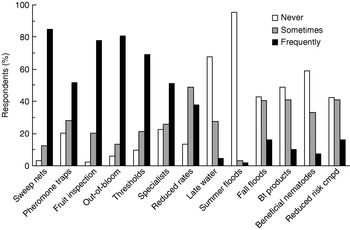
Percentage of respondents in 1999 MA grower survey who used various practices to monitor or manage cranberry insects. The various practices are: scouting using sweep nets; pheromone traps for determining peak flight; fruit inspection for cranberry fruitworm; determination of percent out-of-bloom for cranberry fruitworm; applying pesticides only after action thresholds were reached; applying pesticides based on advice of IPM specialists; using reduced rate applications; use of late water floods; use of short-term floods; use of Bt products; use of beneficial nematodes; and use of reduced-risk compounds.

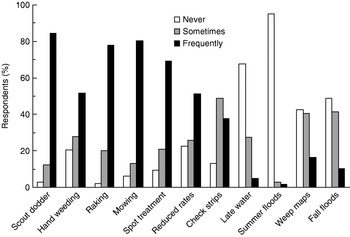
Percentage of respondents in 1999 MA grower survey who used various practices to monitor or manage cranberry weeds. The various practices are: scouting for dodder emergence; hand weeding; raking for dodder control; mowing broadleaf weeds; spot treatment with herbicides; reduced rate pesticide applications; using untreated check strips with a herbicide application; late water floods; short-term summer floods; weed mapping; and fall floods.

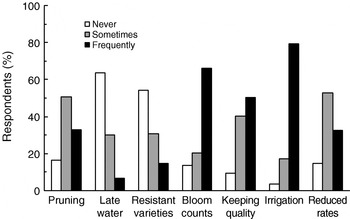
Percentage of respondents in 1999 MA grower survey who used various practices to monitor or manage cranberry diseases. The various practices are: pruning; late water floods; disease-resistant crop varieties at planting; using percent bloom counts to time fruit rot management; using keeping quality forecast; irrigation scheduling to minimize leaf wetness; and reduced-rate fungicide applications.

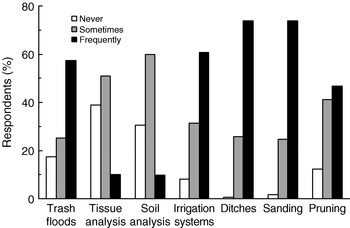
Percentage of respondents in 1999 MA grower survey who used various horticultural practices. The various practices are: post-harvest trash removal floods; leaf tissue analysis for nutrition management; soil analysis for nutrient and pH values; maximizing performance of irrigation systems; cleaning ditches; regular applications of sand; and regular pruning.

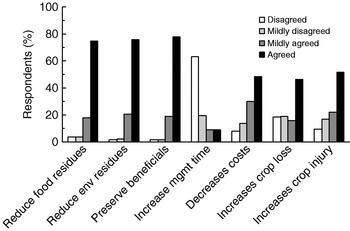
Percentage of respondents in 1999 MA grower survey who agreed or disagreed about the following statements: IPM reduces pesticide residues in food; IPM reduces pesticide residues in the environment; IPM helps preserve insects beneficial to the grower; use of IPM increases management time; use of IPM decreases the monetary costs of pest management; use of IPM increases the risk of crop loss; and use of IPM increases the risk of crop injury.

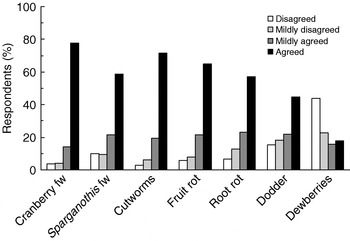
Percentage of respondents in 1999 MA grower survey who agreed or disagreed about the effectiveness of current IPM practices for: cranberry fruitworm, Sparganothis fruitworm; cutworms; fruit rot; Phytophthora root rot; dodder; and dewberries.

Demographic characteristics indicated that the majority of respondents were full-time growers (63%), older (33% aged 50–59 years and 27% aged 60 or over), educated (48% with college and 11% with graduate education) and experienced growers (34% with 11–20 years and 12% with 20 or more years of bog management experience). Forty-seven percent reported farming 10 acres or less, one-third farmed between 11 and 40 acres and 21% reported farming more than 41 acres.
According to the survey results, a significant percentage of respondents had a favorable perception of IPM, and were using numerous IPM practices in 1999. Approximately 80% of respondents claimed to practice IPM frequently (FreqP), about 16% claimed to practice IPM occasionally (OccP), less than 3% said they did not use IPM (NonP), and less than 1% of respondents answered that they were not sure or did not know.
Growers adopted IPM practices for a number of reasons, among them environmental and economic benefits, and the belief that IPM is effective. The most popular reasons cited for choosing to practice IPM included agreeing with the IPM philosophy (80%), environmental benefits (73%), satisfaction with its effectiveness (59%), the belief that IPM saves money (57%), and personal and public health benefits (54%). Although growers certainly have experienced pressure from neighbors and the public to reduce pesticide useReference Croston34, Reference Curtis35, this did not appear to be an important factor motivating them to use IPM, as only 6% cited public pressure as a reason for practicing IPM. These results suggested that IPM is not just being employed by a few environmentally concerned growers, but rather has been adopted as a mainstream approach to pest control and that multiple benefits are perceived as attributable to IPM.
When given the opportunity to state why they did not practice IPM, 46% of the small subset of growers (5% of respondents) indicated they were satisfied with the effectiveness of non-IPM methods and thought IPM was too expensive. One-third of NonP growers thought IPM was too time-consuming and too risky. Two or fewer growers indicated that they did not understand IPM, thought IPM was too difficult to practice, or thought IPM did not work.
A significant percentage of respondents from the entire survey pool (72%) agreed or strongly agreed that the provision of a government cost-share program, which could help to offset the costs of IPM adoption, would encourage them to adopt more IPM practices. The survey also revealed that a similar number of growers were aware of the potential implications of the Food Quality Protection Act (FQPA) on future pesticide use (restriction or loss), as this was cited as an important factor that might encourage many to adopt IPM practices they are not currently using.
Almost all respondents (92%) agreed that more IPM-related research and education programs and increased funding for IPM method development would encourage the adoption of underutilized IPM practices. Similarly, 88% of respondents agreed that the development of more on-farm demonstrations would encourage them to adopt IPM practices. On the other hand, the provision of crop insurance that would protect against loss due to IPM was not an issue that a majority of respondents demanded. Forty percent agreed or strongly agreed that the availability of crop insurance programs would encourage them to adopt IPM practices they were not currently using.
Over half (57%) agreed or strongly agreed that the creation of markets for IPM-grown cranberries would be an incentive for IPM adoption. However, less than 28% agreed or strongly agreed that public pressure would promote them to increase their use of IPM practices. This further confirmed grower claims that public pressure did not play a large role in their decision to adopt IPM in the first place. Perceptions about the risk of crop loss (77%) and vine injury (66%) as well as commodity price (53%) were the most important factors affecting pest management decision-making. In contrast, the cost of IPM consulting (42%), biological controls (28%), and reduced-risk pesticides (24%) were considered not to be important factors influencing pest management decisions.
The survey results also indicated that an overwhelming number of respondents (over 90%) seemed to be satisfied with Extension educational programs and materials provided by the University of Massachusetts Amherst Cranberry Station. Specifically, they agreed that these sources were helpful in providing information on how to use IPM techniques and in communicating the benefits of IPM. More than 95% of survey respondents claimed to rely significantly on Extension publications, personnel, and workshops as resources for information on IPM. The local grower association (88%) was also seen as an important resource, as were private consultants (69%). Respondents claimed to depend least upon trade magazines (49%) and pesticide company representatives (42%) for information on IPM.
When asked about factors influencing their decisions about when and if to carry out sprays for pest control, an overwhelming number of respondents (93%) claimed to be using economic thresholds as a primary basis for that decision, while only a very small percentage (2%) claimed to rely heavily on salesperson recommendations or the consideration of when other growers spray. Past experience with a pest (51%) and the first sign of a pest (57%) were cited as very important factors affecting the decision to spray, which suggested that many growers often do not use scouting and threshold recommendations at all times. Notable was the fact that 65% of respondents claimed to rely on a regular schedule as a somewhat or very important factor for determining the need for and timing of pesticide applications. Growers considered the advice of Extension personnel (55%) and private pest management consultants (45%) very important for determining the need to spray for pest management.
Practices involving monitoring of pests before they reach outbreak levels appear to have been carried out by a significant percentage of respondents for insect, weed, and disease management (Figs. 1–3). These include frequent use of scouting for insects with sweep nets (85%), scouting for dodder emergence (70%) and conducting bloom counts for fruit rot management (66%). Many also reported frequent use of strategies involving the judicious use of pesticides, such as application only after pests have reached economic thresholds (69%) and use of spot treatments for weed control (68%). Reduced rate pesticide applications were used frequently by approximately 35% of respondents for insect, disease and weed management. Methods generally perceived as more risky due to the increased likelihood of crop loss, vine injury or ineffectivenessReference Averill, Sylvia, Kusek and DeMoranville36–Reference Sandler and Mason39, such as late water and summer floods, and the use of Bacillus thuringiensis (Bt) products, respectively, were used frequently by very few growers (⩽10%).
One-half to three-quarters of respondents claimed to be using a number of different crop management practices aimed at preventing development of pest and disease outbreaks, such as sanding, cleaning ditches, and post-harvest floods to remove leaf debris (Fig. 4) on a frequent basis. However, few growers were employing soil or leaf tissue analysis frequently (⩽10%), although 60% and 51%, respectively, used these analyses sometimes.
Growers were asked about their perceptions regarding the consequences of using IPM. Most respondents attributed environmental benefits to IPM (75%), and also believed that it could save money (Fig. 5). Sentiment about economic benefits did not seem to be quite as strong. While over 78% of growers agreed that IPM helps to decrease costs of pest management, a large portion of all respondents (30%) agreed only mildly with this statement. A majority of growers (84%) did not feel that using IPM increased the time they devoted to managing their farms. However, many respondents felt IPM carried some risks. For example, many agreed or strongly agreed that IPM use can increase the risk of crop loss (46%) or vine injury (51%).
Many respondents agreed or strongly agreed that pest resistance is an increasing problem for cranberry growers in MA (81%) and many have experienced it first-hand on their own farm (40%). Notably, almost one-fifth of respondents were not sure about experiencing resistance on their own farm. Three-quarters of surveyed growers thought that pest pressures were worse in MA than in other regions of North America, but only 5% thought IPM adoption was more risky in MA than in other production areas. Ninety percent agreed that use of IPM can help resolve the problem of pest resistance (data not shown).
Growers who participated in the survey agreed or strongly agreed that many of the existing IPM options were relatively effective in controlling major insect pests, such as cranberry fruitworm and cutworms (Fig. 6). However, fewer agreed or strongly agreed that existing IPM options offered an effective control method for certain problems like dodder and dewberries (only 45% and 18%, respectively).
Survey results: factor analysis and GENMOD results
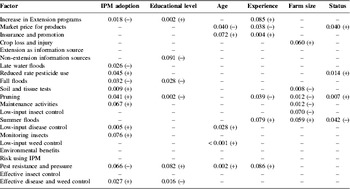
The 104 question/answer possibilities, based on the factor analysis (see the section ‘Statistical analyses’), were condensed to 22 factors (Table 1). Each factor represents an observed pattern of covariance (or correlation) within a group of questions, suggesting that some latent (unobservable) variable is present and influencing the responses to all of the questions represented by that factor. A descriptive identifier was assigned to each factor (column 1 of Table 1). Effort was taken to develop a short phrase that would concisely describe the questions that were grouped together by the factor analysis. For example, the label ‘Market price for products’ was created to define the factor that was comprised of questions relating to the importance of market prices for reduced risk compounds, market price of biological controls, cost of IPM consultants, and the current commodity price. The factor identifiers were designed to be descriptive enough so the reader could readily associate the significant factors from Table 1 with the descriptions of the results in the text. The P-values (indicating the location of significant relationships) and signs (indicating the direction of these relationships) associated with the estimates generated from the GENMOD procedure using the factors as predictors and the six demographic variables are presented in Table 1. Only P-values less than 0.10 are associated with a sign for the estimate.
P-valuesFootnote * and signFootnote 1 of estimates from GENMOD procedure for factors used as predictors and various demographic variables as the outcome.

1 IPM adoption: Negative sign indicates association with less frequent adopters, positive sign with more frequent adopters.
Education level: Negative sign indicates association with more educated growers, positive sign with less educated growers.
Age: Negative sign indicates association with older growers, positive sign with younger growers.
Experience: Negative sign indicates association with more experience, positive sign with less experience.
Farm size: Negative sign indicates association with larger farms, positive sign with smaller farms.
Status: Negative sign indicates association with part-time growers, positive sign with full-time growers.
* Only P-values <0.10 are listed and associated with a sign for the estimate.
The following discussion is principally organized, for each demographic variable (progressing from left to right), according to the list of factors as ordered in the first column of Table 1. To clarify the trend of the factor listed in the first column, descriptions of survey results and references to one or more specific questions from the survey may be included in the discussion. Specific data are given within the text to provide the reader with a sense of the trends, but the complete data set is not presented herein. The reader should note that Figures 1–6 represent responses from the group as a whole; the following discusses data trends after the respondents were grouped by demographic variables (e.g., IPM adoption, education level, experience, etc.) A copy of the full factor analyses can be requested from the corresponding author.
Eleven factors were associated with level of IPM adoption (Table 1). NonP overwhelmingly responded that an increase in Extension programs and materials as well as more on-farm demonstrations would encourage them to adopt IPM practices they are not currently using. More than 90% of FreqP and OccP felt that they would be more apt to adopt IPM practices if provided with more IPM-related research and education programs. Educational workshops and availability of informational materials are needed to encourage growers to accept and incorporate IPM practices into routine farm activities.
Late water floods can be used to lower pesticide inputs but the success of this practice is dependent on many variablesReference Averill, Sylvia, Kusek and DeMoranville36, Reference Vanden Heuvel and Botelho38. Due to this perceived risk, many FreqP and OccP never used late water floods (69% and 53%, respectively). Of all the respondents that never used late water floods, 83% were FreqP. Periodic use of the flooding practice was also slightly lower for FreqP than for OccP (26% and 38%, respectively). The use of another flooding practice (fall floods) was similar between FreqP and OccP; 45% and 41% never used fall floods and 38% and 40% occasionally used fall floods, respectively, for insect or weed management. FreqP were more apt to use fall floods rather than late water floods for pest control.
The IPM adoption self-report variable was also associated with grower use of disease monitoring and other important IPM practices for major cranberry disease problems (low-input disease control). OccP were less likely than FreqP to at least occasionally use resistant varieties (36% versus 48%) and more likely to never have used them (64% versus 52%). FreqP more routinely used bloom counts (70% versus 57%) and fruit quality forecasts (52% versus 43%) as part of their disease management program than OccP. Most growers incorporated proper irrigation scheduling into their disease management program (80%).
Grower use of insect monitoring practices considered important components of cranberry IPM programs was also found to be related to their classification as frequent, occasional, or non-IPM users. Frequent use of fruit inspection for cranberry fruitworm was often used by both groups, but was slightly higher for FreqP than OccP (81% versus 68%). Very few FreqP (3%) never used fruit inspection. FreqP were more apt to use pheromone traps (59% versus 24%), out-of-bloom counts (86% versus 61%), and to apply control strategies based on the advice of consultants as part of their routine management program (60% versus 19%) than OccP. Most growers routinely used sweep nets (85%) to monitor for insects. These practices are considered fundamental to basic insect pest management in cranberry.
Differences between the user groups were noted for several other perceptions and practices relating to cranberry pest management. Perceptions of pest resistance and pest pressure varied between FreqP and OccP. OccP were more apt to agree that pest pressures were more severe (86% versus 69%), and that IPM was more risky in MA compared to other growing regions (45% versus 20%) than FreqP, respectively. OccP were also less convinced that IPM could help reduce pest resistance issues than FreqP (31% versus 63%), respectively. FreqP were more apt to frequently use reduced rates of herbicides, insecticides, and fungicides (37%) than OccP (28%). Notably, 12% of FreqP and OccP growers always use the full label rates. FreqP were also more likely to use tissue (65% versus 53%) and soil (73% versus 63%) tests than OccP, at least occasionally. Notably, 42% of OccP and 31% of FreqP never use these crop management practices.
When asked to evaluate the effectiveness of available pest management options, FreqP were more likely to agree or strongly agree that IPM was effective for fruit rot management (70% versus 43%), Phytophthora root rot management (63% versus 35%), and dodder control (49% versus 25%) than OccP, respectively (effective disease and weed control). Two-thirds of respondents from each group of practitioners felt that current IPM options were not effective for dewberry control.
Education level was associated with four factors at the 0.05 alpha-level: increase in Extension programs, fall floods, pruning, and effective disease and weed control (Table 1). Growers with at least a high-school education (i.e., more educated) felt they would be inclined to adopt more IPM practices if additional educational materials (62%), research programs (66%) and increased funding for IPM method development (66%) were available. A very large proportion (>83%) of less educated (non-high school graduates) growers agreed or strongly agreed that they would be encouraged to adopt IPM practices through more Extension education and research efforts. Fall floods were not used frequently, but their use was twice as common with more educated growers (16%) than for non-high school graduates (7%). A large proportion of less educated growers (46%) tended to prune frequently to enhance canopy habitat, however, pruning was still used frequently by 39% of more educated growers. Educated growers were more inclined than less educated growers to agree or strongly agree that existing IPM options were effective for fruit rot (66% versus 53%), Phytophthora root rot (59% versus 33%) and dodder (45% versus 38%) management, respectively.
Grower age was also associated with four factors at the 5% level: market price, low-input disease and weed control, and pest resistance. Growers under 30 (more so than older growers) felt that the current commodity price was very important with regards to their decisions about pest management. Younger growers also felt the cost of biological control products, reduced risk products, and consulting fees were not important factors. Low-input disease management was used frequently by all age groups, but older growers (50+ years) were more likely than younger growers to respond that they never used options such as resistant varieties (64% versus 39%), bloom counts for fungicide timing (16% versus 10%) and fruit quality forecasts (11% versus 8%), respectively. In a similar fashion (although the percentages were lower), older growers were slightly more likely than younger growers to never use low-input weed options such as scouting for dodder (9% versus 2%) or spot-treatment control (6% versus 1%), respectively. Growers under the age of 30 were most apt to use raking for dodder control (57%) compared to older growers (27%). Growers over 30 were more inclined than younger growers to agree or strongly agree that pest pressure was more severe in MA than other growing areas. Growers over 40 strongly disagreed that IPM was riskier in MA than in other growing regions.
Growers with 10 or more years experience in cranberry farming were more inclined than less experienced growers (38% versus 22%) to view the cost of reduced risk compounds and biological control products as very important factors in their pest management decisions (market price factor). Though promotion and insurance issues tended to be less influential for experienced growers, almost half of all growers agreed or strongly agreed that insurance and promotion products would encourage them to adopt IPM practices. Less experienced growers were almost twice as likely to never prune (19%) as experienced growers (10%) (maintenance activities).
Growers with large farms (40+ acres) were twice as likely to frequently conduct soil and tissue tests than owners of smaller farms (16% versus 8%, respectively). Similarly, owners of smaller farms (<40 acres) were almost twice as likely to never conduct monitoring tests compared to larger farms (34% versus 19%, respectively). Small-farm managers were more than twice as likely to never prune (16% versus 6%) and less likely to frequently prune (36% versus 54%, respectively) than managers of large farms. Small farms were more than twice as likely to never receive routine maintenance activities (e.g., leaf removal floods, ditch cleaning, efficient irrigation schedules; 8% versus 2%) and less likely to frequently receive these activities than large farms (64% versus 79%, respectively).
Part-time growers were somewhat more likely to not consider market prices of products as important influences to their pest management decisions than full-time growers (27% versus 20%) and full-time growers were slightly more likely to have these factors frequently affect their IPM decisions than part-time growers (44% versus 37%). Full-time growers tended to use reduced rates of pesticides frequently compared to part-time growers (39% versus 27%). Full-time growers tend to prune frequently (45%) compared to part-time growers (31%).
Discussion
Primarily, the findings of the survey were related to the significant percentage of respondents who appeared to be using multiple IPM component practices, with practices involving monitoring and detection of pests along with judicious use of pesticides being most common. The use of alternative cultural and biological tools such as flooding management practices and biorational pesticides were reportedly used on a frequent basis by only a small number of respondents. In addition, although a very large percentage claimed to use economic thresholds for pest management decision-making, a significant percentage also claimed to rely on other factors such as past experience, first sign of a pest, or a regular schedule. This suggested that many may not be using monitoring and thresholds consistently.
The large percentage of respondents claiming to be frequent IPM users was surprising. As such, developing a profile of the typical IPM user was difficult, and a comparison of frequent, occasional and non-IPM user groups was challenging for some factors. However, limited generalizations can be made about the different groups. For example, the analyses did suggest that self-defined frequent IPM users were more likely to use more IPM component practices as a whole and had more positive perceptions about the efficacious, economic, and environmental implications of IPM adoption.
Frequent IPM users tended to be more likely to possess certain demographic characteristics. More specifically, the results suggested that full-time, highly experienced growers, in charge of larger operations, tended to use more IPM practices on a frequent basis than less experienced growers who worked part-time and managed smaller bogs. Although these findings conflict with previous researchReference Rajotte, Kazmierczak, Norton, Lambur and Allen21, Reference Anderson40 that has characterized growers with less farming experience as being more likely to adopt IPM or other alternative agricultural practices, other studies have demonstrated that larger farms tend to adopt IPM at a faster rate compared to smaller operationsReference Nowak, Padgette, Hoban, Greene and Kramer-LeBlanc13, Reference Barrientos and Anciso17, Reference Coli, Szala, Autio, Cooley, Hauschild, Prokopy, Autio and Bramlage41. The labor-intensive nature of many IPM practices may be serving as a significant constraint for further adoption by part-time growers. Likewise, some IPM practices may be more cost-effective or easier to implement for larger operations, which may have greater income and labor resources to draw upon than comparatively smaller operations. In addition, private consultants may be more apt to solicit large portions of consolidated acreage of a few growers rather than contract with many growers who own only a few acres each.
The finding that respondents with higher levels of education seemed to be using more IPM component practices, such as flooding practices and pruning, also corresponds to previous researchReference Ridgeley and Brush9, Reference Hamilton, Robson, Ghidiu, Samulis and Prostko20. This result was not unexpected since many IPM practices require a high degree of knowledge about insect biology or bog ecology.
IPM user groups could not be easily differentiated, however, based solely on their use of selected sources of information on IPM. This was because a large percentage of respondents claimed to rely on the same resources, namely Extension publications, staff and workshops, and also was likely related to the fact that only a small percentage of respondents claimed not to use IPM at all. The specialized nature of cranberry cultivation and its limited geographic scope most likely has served to limit the number and type of informational sources available to growers.
The strong positive perceptions that most respondents seemed to have about the environmental and economic effects of IPM were also notable. A large number of respondents agreed that IPM can reduce pesticide residues in food and the environment, and can help to preserve beneficial insects. Many also directly cited environmental benefits as an important factor influencing their use of IPM. Significantly, the survey found that a large percentage of respondents had experienced pest resistance firsthand and agreed that it was an increasing problem in MA. Self-defined frequent IPM users were more likely than occasional users to see IPM as a solution to the problem of pest resistance, which suggests that grower concerns about pest resistances may act as an incentive to adoption.
Economic benefits were also cited by many as an important factor influencing their use of IPM. The perception that IPM decreases management costs was held by many. However, respondents appeared to feel less strongly about the economic benefits than potential environmental ones. The perception that IPM can pose measurable economic risk also appeared to act as a barrier to IPM adoption. For example, concerns about the potential for vine injury and crop loss were cited among the most important factors affecting grower pest management decisions. Results implied that the costs of pest control products and services have not acted as significant barriers to adoption.
The high level of grower perception of the efficacy of most current IPM methods for controlling major cranberry pests was notable. Still, many respondents also cited the allocation of more funding resources to IPM method development as a primary factor that could promote them to adopt more IPM practices. This further supported the finding that existing IPM methods for a few pests were viewed as ineffective. Likewise, despite the seemingly overwhelming support for existing cranberry IPM educational materials and programs, the development of more IPM-related research and education programs was cited as a potential major adoption incentive, and growers seemed to have a preference for the on-farm demonstration format.
Another primary incentive to adoption revealed by the survey was the provision of more government cost-share programs. Growers seemed less enthused about other potential sources of economic aid such as crop insurance programs. Many also recognized the important role that future FQPA restrictions may play in the future availability of pest management tools.
IPM adoption continues to be in a fluid state for the cranberry industry. Readers should note that this survey was conducted just prior to a significant economic collapse of the cranberry industry. Growers who responded in this survey were receiving high cash returns for their fruit (often, twice the cost of production) and could afford to use very expensive management options. At the time of this writing, the profit margin for cranberry fruit has become smaller compared to the late 1990s. Future surveys of the cranberry industry could determine if the recent change in economics has influenced growers' perceptions and adoptions of IPM options.
Acknowledgements
The authors thank D. Lopez for assistance with survey development, statistical analysis and interpretation. M. Anderson, C. Armstrong, F. Caruso, G. Deziel, J. Mason, and M. Weldon and many cranberry growers provided valuable feedback on the survey content. A. and J. Myers, M. Myers, and A. Savage provided critical financial support to the senior author.