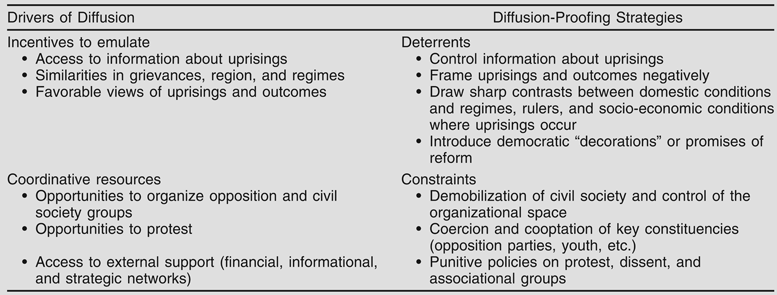
“Diffusion is the process whereby past events make future events more likely.”Footnote 1
“If you open the window for fresh air, you have to expect some flies to blow in.”Footnote 2
Do authoritarian leaders take measures to insulate their regimes from the possibility of the contagion effects associated with the cross-national diffusion of popular challenges to authoritarian rulers? This important question helps us re-think our understanding of both international diffusion and the strategic foundations of authoritarian politics—two issues that are rarely joined, but that have invited considerable scholarly attention in recent years.Footnote 3 In particular, many studies of cross-national diffusion—that is, the transfer among countries of an innovative idea, product, policy, institution, or repertoire of behavior—take as their central mission the identification of structural factors that drive the spread of change.Footnote 4 What is often missing in these studies, however, is not just an identification of the innovation that is producing change, but also such equally important issues as the role of agency in these processes and factors that deter diffusion, including the strategies deployed by defenders of the status quo.Footnote 5
At the same time, virtually all studies of authoritarian resilience focus on the strategies authoritarian rulers use to contain domestic threats.Footnote 6 Here, we encounter two problems. One is the failure to examine the management of international challenges. This is surprising, because most contemporary authoritarian regimes (unlike their predecessors during the Cold War) are deeply integrated into the international system, and international influences figure prominently in the cross-national spread of democratic change—a dynamic that obviously constitutes one of the biggest threats to the tenure of authoritarian rulers.Footnote 7
The other problem is that analyses of the strategic calculations of authoritarian leaders often emphasize the benefits associated with their actions, but fail to take into account their costs.Footnote 8 On the one hand, there is little doubt that the threats posed by such waves are real. Over the past twenty-five years, there have been in fact three such cross-national waves; that is, the popular challenges to communist party rule in the Soviet Union, Eastern Europe and China from 1989 to 1991, the color revolutions (1998–2005), and the Arab uprisings (2010–present). These waves, moreover, have managed to remove twenty-one authoritarian leaders from office, despite in many cases their long tenure, their considerable coercive powers, and their alliances with powerful international actors.Footnote 9 Thus, if authoritarian rulers are vigilant stewards of their powers, they can be expected to deploy strategies that seek to discourage their citizens from modeling their behavior on the rebellious precedents set by their counterparts elsewhere.
On the other hand, measures to contain diffusion entail some risks. Repression can lead to the growth of popular resentments, and, in the case of the regime's governing coalition, transform “obedient agents into political rivals.”Footnote 10 Moreover, one of the foundations of authoritarian resilience is the ability of the leader to make a credible claim that she is invincible.Footnote 11 Just as such an image deters ordinary citizens and opposition groups from taking the risks associated with mounting challenges to the leader, so it reduces the likelihood that allies of the regime will choose to defect and thereby risk at the least their rents and at the most their lives. However, by their very nature, measures that seek to contain the contagion effects associated with waves of popular uprisings in other authoritarian regimes send a clear signal to ordinary citizens, opposition groups, and regime allies that authoritarian leaders are worried about their hold on power. In contrast to those that respond to challenges arising solely in the domestic arena, such actions are closely tied in terms of timing and content to the proven ability of popular uprisings against authoritarian rulers to occur, succeed in their mission, and spread rapidly among states.
Our purpose is to use a controlled comparison in order to assess whether and under what conditions authoritarian leaders take preemptive action to deter their citizens from joining cross-national waves of popular mobilizations against authoritarian rulers.Footnote 12 In particular, we compare the responses of the Russian and Chinese leadership to two recent waves: the color revolutions in postcommunist Europe and Eurasia from 1998 to 2005 and the ongoing Arab uprisings. Russia and China were selected for this study because of their similarities, yet differences make for an illuminating comparison. On the one hand, both regimes are authoritarian; they have long histories of communist party rule and even longer experiences with authoritarian politics, and they have transitioned over the past several decades from international isolation and political-military competition with the West to greater integration with the global security and especially economic order. On the other hand, because these two regimes represent different types of authoritarian rule, their reactions to these waves should be different. While the Russian regime holds competitive national elections, albeit ones that favor the incumbent or his anointed successor, the Chinese regime does not. Russia, in short, represents a competitive and China a non-competitive variant on authoritarian politics.Footnote 13 This distinction suggests that Chinese leaders have more weapons at their disposal to contain diffusion than their Russian counterparts, and that, while leaders of both countries are vulnerable to popular uprisings for the simple reason that they are authoritarian, Russian leaders face an additional threat: the possibility of electoral challenges to their power.Footnote 14
A comparison of the color revolutions and the Arab uprisings helps us leverage these and other distinctions. While both waves focused on the removal of authoritarian rulers from power, they diverged from one another in several important respects. Most obviously, they took place in different parts of the world. Less obviously, while the color revolutions involved innovative approaches to challenging authoritarian rulers at the polls, the second wave involved a different repertoire: large-scale mobilizations in the streets. While the former approach was tailored to exploit the political opportunities provided by competitive authoritarianism, the second one reflected the fact that such opportunities were unavailable in the Middle East and North Africa (MENA)—either because the regime did not hold such elections (Libya) or because the outcome of national elections, despite ostensible competition, had become a foregone conclusion (Egypt). This left the opposition with only one option, especially after the 2010 Egyptian elections: large-scale popular protests, albeit in new forms that enabled the Egyptian model to succeed and to travel.Footnote 15 In this sense, while the color revolutions “specialized” in competitive authoritarian regimes, the MENA uprisings targeted non-competitive systems.
Diffusion-Proofing
We address two questions in our analysis. First, is there evidence that the leaders of Russia and China have taken preemptive measures to reduce the likelihood that these waves will engulf their countries as well? At issue, therefore, is whether authoritarian leaders perceive such external developments as threatening and whether to contain them by taking counter-measures, as they have been shown to do in response to domestic threats. It is here where we can introduce a useful concept that borrows from James Quinlivan's study of the actions that authoritarian leaders have taken—and, given recent trends, with evident success—to reduce the likelihood of one common, domestic threat to their power—that is, decisions by leaders of the military and security forces to launch coups d'état.Footnote 16 Can we argue, therefore, that authoritarian leaders do not just engage in “coup-proofing;” they also engage in “diffusion-proofing”?
The second question builds on the costs noted earlier regarding decisions to contain diffusion. Are Russian and Chinese leaders more likely to launch diffusion-proofing measures when the cross-national spread of popular uprisings poses, at least in theory, more contagious precedents?Footnote 17 Here, combining our earlier observations about limitations on authoritarian rulers with the literature on diffusion, we can argue that leaders of authoritarian regimes are more likely to introduce measures to preempt diffusion when sites are close to one another such as when neighboring countries have joined the wave, or when there are similarities among sites such as when their regime-type matches those that have participated in the wave.Footnote 18
This line of argument suggests that, if geography is a critical consideration, then both the Russian and the Chinese leadership would be more threatened by the color revolutions than by the MENA uprisings. Second, if regime “fit” matters, then the Russian leadership should be more threatened by the color revolutions than their Chinese counterparts. The Arab uprisings, however, present a less clear-cut expectation. Because they took place in non-competitive systems, they should be more threatening to the Chinese than the Russian leadership. However, because popular uprisings are the Achilles heel of all authoritarian regimes, the MENA protests should represent a dangerous precedent to the leaders of both of these countries.Footnote 19
How can we determine whether these regimes have engaged in diffusion-proofing? There is no simple answer to this question, because authoritarian leaders keep their motivations hidden, and at least some elements of a diffusion-proofing strategy are likely to overlap with the strategies leaders use to manage threats that arise solely from the domestic arena.Footnote 20 For example, whether we focus on diffusion-proofing or its domestic equivalent, “protest-proofing,” we would expect authoritarian leaders to deprive citizens and opposition groups of “coordinative resources” and to maintain control over the “organizational space.”Footnote 21
These considerations lead us to use three measures in this study to evaluate whether diffusion-proofing is taking place. One is to focus on changes in rhetoric, not just changes in policies. By tracking both, we emerge with a more well-rounded reading of the ensemble of strategies authoritarian leaders deploy while putting the concept of diffusion-proofing to a more stringent test. In addition, we will pay particular attention to timing and whether changes in rhetoric and actions occur in conjunction with waves of popular mobilizations against authoritarian rulers. Finally, we take a cue from the literature on diffusion, which argues in effect that the spread of change depends upon whether local actors, monitoring these events from the outside, have the incentives and the resources to emulate the precedents set by their counterparts who have joined the wave.Footnote 22 The job of authoritarian leaders, therefore, is to reduce, where possible, these incentives to emulate and the coordinative resources available to their citizens. This leads us to Table 1, where we compare the factors that drive diffusion with those that deter it.
Drivers and deterrents of diffusion
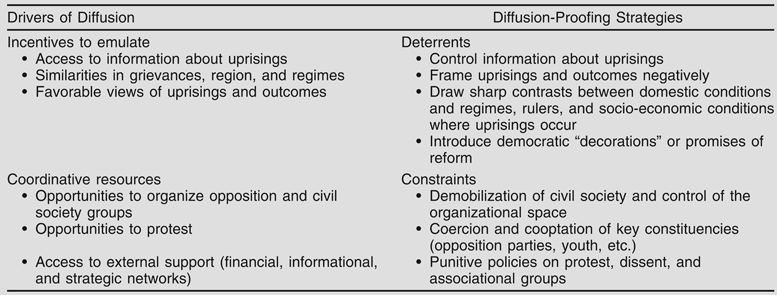
As the table indicates, protests are more likely to spread across state boundaries when citizens have an incentive to engage in similar behaviors (because they know about these events, see them as having positive effects, and see similarities between their situation and the situation in regimes that have hosted the waves) and when they have the resources to do so (because there are opportunities to organize and to protest, given a relatively open organizational space and external support for such activities). In contrast, protests are less likely to spread when regimes adopt diffusion-proofing strategies that deprive citizens of the incentives and resources—for example, by limiting information about the waves, portraying their effects in negative ways, drawing sharp contrasts between their regime and those that have hosted these waves, cracking down on external support of civil society, and using a mixture of coercion and cooptation in order to demobilize opposition groups, civil society organizations, and students.
In the analysis that follows, we use this table to compare the reactions of the Russian and Chinese leadership to the color revolutions and then to the Arab uprisings. Contrary to our expectations, we find strong evidence that the rulers of both regimes were threatened by both of these waves. Moreover, they responded by taking relatively similar and equally ambitious countermeasures to contain their local impact. Thus, irrespective of the wave's geography and the type of regime it targeted, it prompted the rulers of Russia and China to use rhetoric and policies to diffusion-proof their rule and their regimes.
The Color Revolutions
There is strong evidence that the success of the color revolutions in using elections to oust dictators across Eastern Europe and Eurasia prompted Russian and Chinese leaders to code these events as existential threats that required many of the countermeasures that we listed in table 1. Thus we can conclude that authoritarian leaders—or at least the leaders of these two countries and in this particular wave—went to considerable lengths to deny their citizens the incentives and the coordinative resources they needed to carry out their own color revolutions. While the similar responses of the two regimes introduce the possibility that the geography of the wave played an important role, since these electoral mobilizations took place on the borders of both of these states (though in many more cases for Russia), they call into question the impact of regime-type and its associated repertoires of protest. Because it lacks the competitive national elections of Russia, China is not a logical candidate for a color revolution. We can now elaborate on this conclusion by turning first to the issue of reducing the incentives to emulate popular uprisings.
Deterrents
While neither the Russian nor the Chinese leadership went to unusual lengths to censor information about the color revolutions, they did make extensive use of negative framing.Footnote 23 Just as this helped them distance their regimes from these events, so it allowed them to bolster the very arguments that these two regimes have repeatedly used to legitimate their rule—that is, their proven ability to protect the nation from foreign (especially Western) interference and to promote economic growth and political stability.Footnote 24 For example, in a September, 2005 meeting with Western academics and journalists, Vladimir Putin was asked about the wave of electoral turnovers that had taken place from 2003 to 2005 in Georgia, Ukraine, and Kyrgyzstan. Putin responded by, first, locating these three countries in the “former Soviet Union,” thereby reminding his audience of Russia's role as the regional hegemon, and, second, by characterizing these three neighbors of Russia as “banana republics.” This is an efficient term for his purposes, because, in drawing parallels with Central America during the Cold War, it highlights the small size of these countries and their vulnerability to Western domination (both in contrast to Russia), while linking these features in turn to political disorder and economic crises in the wake of these electoral transitions.Footnote 25 Not surprisingly, the Russian media subsequently picked up these themes by reporting, for example, that the color revolutions were not “real revolutions,” but rather power struggles orchestrated and financed by the West to weaken Russia and promote Western hegemony in Eastern Europe and Eurasia.Footnote 26
The Russian campaign against the color revolutions succeeded, at least until the outbreak of protests following the December 2011 parliamentary elections, largely because the themes that were developed resonated so well with popular memories of the 1990s when, not coincidentally in the minds of many Russians, the Yel'tsin regime forged a close alliance with the West, and the Russian experiment with democracy and capitalism led to economic and political implosion. It is telling that a nationwide survey found that only three percent of Russians think that life in Georgia and Kyrgyzstan has improved following the color revolutions, and only six percent report that they believe that life has improved following Ukraine's Orange Revolution.Footnote 27 It is further noteworthy, given the role of youth movements in toppling authoritarian rulers in Ukraine, but also in Serbia and Georgia, that the negative portrayals of the color revolutions have been particularly successful in influencing Russian youth. For example, a poll of 16- to 29-year-olds found that 72 percent opposed an Orange Revolution taking place in Russia.Footnote 28
China's state-run media and academic circles have also painted a dismal portrait of this wave of electoral turnovers. Similar to the Russian framing, the color revolutions have been largely reduced to events that were orchestrated by the United States, though there was some recognition, which also served the interests of the regime, of the role of high levels of poverty and economic crises in providing fertile ground for these uprisings. Like their Russian counterparts, moreover, the Chinese media have reported that the so-called “revolutionaries” have not delivered on their election promises—an argument that also serves the purpose of disparaging the value, more generally, of Western-style electoral competition. Rather than improving people's lives, the Chinese media report the color revolutions as instead ushering in an era of inflation, rampant corruption, and a dramatic decline in the quality of life.Footnote 29
A great deal of the blame for this sorry state of affairs in the Chinese media (and to a lesser extent the Russian) has been placed on the international NGO community, such as the U.S. based National Endowment for Democracy, the National Democratic Institute, the International Republican Institute, and the Open Society.Footnote 30 These organizations are characterized as claiming to be in the business of supporting human rights but in reality dedicating themselves to the instigation of public protest or, to use a phrase favored by the Chinese, “street politics” (jietou zhengzhi).Footnote 31 For instance, one editorial suggested that foreign NGOs are staffed by “regime change professionals” who “flaunt democracy and freedom and under the banner of humanitarianism, hold signs of assistance and poverty reduction, while their real intention is to export their ideology and values, to set off a ‘democratic wave’.”Footnote 32 Academic sources tell a similar story, insisting that international NGOs are Trojan horses in the West's multi-step plan of using elections to promote regime change and encourage street politics.Footnote 33
Constraints
The campaign by Chinese and Russian officials to reduce the incentives of their citizens to launch their own color revolutions has been joined with measures that also limit their ability to engage in such actions. Here, the primary emphasis has been on demobilizing key constituencies—that is, opposition groups, civil society associations, and youth, all of whom played a prominent role in mounting both the electoral challenges to authoritarian leaders in Europe and Eurasia and the protests that often followed these electoral confrontations. For both China and Russia, the weapon of choice used to reduce the influence of the first two actors has been repression, while in the case of youth, it has been cooptation, if at times outright courtship.
Since Vladimir Putin's rise to power in Russia in 2000, there have been concerted efforts to weaken opposition parties by harassing them, raiding their offices, disbanding their organizations, and impairing their ability to participate in elections and, if participating, to conduct credible campaigns. These kinds of actions seemed to have escalated in the aftermath of the color revolutions. For example, during the 2006–2007 campaign season opposition parties, ranging from Yabloko (“Apple”) to the Communists (KPRF) logged complaints against law enforcement agencies for obstructing their activities.Footnote 34 The Respublikanskaja partija (“Republican Party”), one of the oldest opposition parties in the country, was denied registration before the elections took place.Footnote 35 Maksim Reznik, the head of Yabloko in Saint Petersburg, was detained for two months after collecting information on voter fraud in connection with the 2007 parliamentary elections. Gary Kasparov, the leader of the opposition party Drugaja Rossija (“Other Russia”), was temporarily jailed for trying to organize a protest in Moscow. Thereafter, he was forced to drop his bid for the Russian presidency, because Russian law required candidates to rent a hall for a nominating convention, but Kasparov was prevented from doing so.Footnote 36 In the process of limiting threatening opposition groups, Kremlin elites have also promoted “virtual” opposition parties to create the image of a pluralist political landscape.Footnote 37 It is also a telling comment about the lack of a level playing field in elections that the national convention of the party of power, Edinaja Rossija (“United Russia”), that took place in October 2007 (in anticipation of the 2007 parliamentary elections, the first national elections to take place after the Orange Revolution), was disproportionately covered in the Russian media.Footnote 38
While the CCP does not have to contend with an organized opposition, it has taken strong measures to repress even modest forms of opposition to the regime. Thus even small groups such as the co-signers of the pro-democracy Charter 08 have become targets of state aggression in the wake of the color revolutions.Footnote 39
Constraining the drivers of diffusion has also meant the close management of popular protests by both the Russian and Chinese leadership. However, their approach to this issue has nonetheless been somewhat different—though in ways that are often surprising, given the differences, as discussed earlier, between competitive and non-competitive authoritarian regimes. During the early years under Putin, a priority was placed on preventing protests from taking place or limiting them to very small-scale actions that have been characterized by the Kremlin as “pocket protests.”Footnote 40 When demonstrations have managed to take place, moreover, the police have been given the go-ahead to carry out militant attacks on protesters.Footnote 41
In China, violent repression of protests certainly falls within the strategic arsenal of the regime. However, recent scholarship demonstrates that protests have been tolerated and even used to prolong authoritarian rule. As has been hypothesized, protests help particularly to identify local “troublemakers” (who can later be punished), provide some quality control with respect to service delivery by making local cadres more accountable, and deflect popular criticism away from the center.Footnote 42 Whether these functions are actually served, however, depends upon two factors: whether the CCP will be able to control their dynamics such that demonstrators continue to hold local government and party officials—and not Beijing—responsible for their problems, and whether protests remain contained within jurisdictional boundaries rather than spilling across them and laying the groundwork, as a result, for more ambitious political challenges.
The color revolutions were also followed by the introduction in both countries of new laws and institutions that serve the purpose of managing and monitoring associational life.Footnote 43 In a 2004 presidential address to the Federal Assembly, for example, Putin followed up the concerns expressed about Western involvement in the color revolutions by criticizing civil society groups for being financed from abroad and serving “dubious groups and commercial interests.”Footnote 44 Soon thereafter, these warnings were codified into law restricting civil society associations. Thus, following the Orange Revolution, the Russian parliament passed legislation increasing the restrictions on NGOS, including mandatory re-registration with special emphasis on those receiving Western funding. If NGOs successfully re-register with authorities, they are required to operate under much more stringent conditions, such as the newly-granted rights of government officials to sit in on internal meetings, request audits, monitor activities, and deport foreign staff.Footnote 45 This law or versions of it, moreover, seems to have served as a model for leaders in other authoritarian states, including not just China, but also Venezuela, Kazakhstan, Uzbekistan, Tajikistan, Belarus, Egypt, and Zimbabwe.Footnote 46
Finally, both regimes have made the courtship of youth a high priority. This strategy is driven in part by recognition of the prominent role of youth movements during the color revolutions, such as Otpor (“Resistance”) in Serbia, Kmara (“Enough”) in Georgia, and Pora (“It's Time”) in Ukraine.Footnote 47 Thus, building on the ideas behind the Young Pioneers during Soviet times, the Russian government has developed a large pro-Kremlin youth movement committed to promoting patriotism and defending the Russian nation, its core values, and policies. The youth movement is not only well-financed—sponsoring summer camps, providing members with mobile phones, and promising career advancement—but also reaches out to all ages. For instance, pro-Kremlin groups at the core of the movement, including Nashi (“Ours”), Otechestvo (“Fatherland”) and Molodaya Gvardiya (“Young Guards”) target secondary and college-age students; others, such as Mishki (“Teddy Bears”), organize patriotic activities for 7–15 year olds.Footnote 48 The activities of the pro-Kremlin youth often have an expansive interpretation of what falls within their patriotic purview. They have served as moles in opposition parties and harassed journalists critical of Putin. The Chelyabinsk headquarters of Molodaya Gvardiya even organized a series of training drills to thwart a potential color revolution from occurring. Under the codename Poligon (“Firing Range”), members rehearsed military drills, orchestrated a pro-government rally, repelled the attack of potential opposition activists, and then staged an impromptu takeover of a local TV station in order to prevent an “illegitimate seizure of power” by color revolutionaries.Footnote 49 Thus the seemingly shared goal among all youth associations is to defend the Kremlin from threats, especially those posed by the color revolutions.Footnote 50
Like Russia, the Chinese state has also courted younger generations, but in somewhat different ways. In the mid-1980s, university students represented less than one percent of all Party members. This problem, especially when joined with the central role of youth in the demonstrations in China in 1989 and in the color revolutions, led the Chinese Communist Party (CCP) to particularly focus on expanding youth membership.Footnote 51 Over the course of the 1990s, for example, students came to represent roughly ten percent of the Party. However, from 2002 to 2007 (years that spanned the color revolutions), college recruits increased by over 250 percent. Since that time, student membership in the Party has consistently outpaced other loyal constituencies, including workers, farmers, and army officers.Footnote 52
The Chinese regime has also used the National Postgraduate Entrance Examination (boshi yanjiusheng renxue kaoshi), the equivalent of the U.S. based GRE, to socialize students about the proper reading of the color revolutions. In 2005, the examination included a question on the 2004 election crisis that led to the Orange Revolution. Test-takers were asked to analyze the strategic position of Ukraine and evaluate how the election standoff would affect relations among Russia, the United States, and Europe.
While the inclusion of the question reveals the Chinese leadership's concern over the Orange Revolution, it also performs another function: sending a clear signal, reinforced by a compendium of model essays, of how students should interpret the protests. For example, one such “model essay” explains the events in the following way:
The essence of the Ukrainian election crisis is a conflict of interest between the U.S. and Russia. After the U.S. brought down the Soviet Union, on the surface the U.S. has had decent relations with Russia, but the U.S. has never put down its guard against Russia. The U.S. endeavored to win over other CIS countries and bring them into its own sphere of influence …. In this strategic context, Ukraine became the latest target of U.S. efforts of expansion …Footnote 53
The model essay concludes by suggesting that the United States is “immorally” intervening, in the name of democracy, with the underlying goal of using elections to promote disorder, marginalize Russia, and unleash a “domino effect” across the region.Footnote 54 Once again, the Chinese have crafted a self-serving message that performs two functions: warning students about the dangers posed by the color revolutions and drawing a linkage between electoral competition, on the one hand, and, on the other, political disorder and Western interference.
Explaining the Chinese Reaction
There seems to be strong evidence, therefore, that both the Russian and Chinese regimes saw the color revolutions as threatening developments that required elaborate preemptive measures. The question then becomes why did the Chinese, given the absence of a national electoral venue, worry so much about the possibility of contagion. One could account for the Chinese reaction by arguing, in line with some recent studies, that the durability of the dictatorship rests upon two pillars: a proactive leadership and the incentives that some ambitious members of the Party and some leaders of the security agencies have to exaggerate the potential for contagion and thereby improve their opportunities for upward mobility in the first case and expand their political influence and access to resources in the second.Footnote 55 While plausible, there are some other explanations that we can offer that are more rooted in the issue of diffusion. One is that the information deficits of authoritarian leaders make it rational for them to assume the worst and to act accordingly.Footnote 56 Because the color revolutions did produce in fact the “worst” outcome, which is the removal of authoritarian leaders from office, they would counsel authoritarian leaders to take preemptive measures.Footnote 57
In addition, for those color revolutions that took place in more repressive political contexts, the electoral mobilizations were followed by street-based protest. In this way, the color revolutions became relevant to all authoritarian leaders, whether they headed competitive or non-competitive systems. Moreover, the experiences of the 2005 Kyrgyz Revolution might have been particularly instructive for China. Here we refer not just to the facts that the two countries share a border and that their leaders knew one another through their participation in the Shanghai Cooperation Council, but also that Kyrgyzstan borders Xinjiang, a deeply-divided province that has experienced violent Uighur-Han riots over the past decade and has an active, if now repressed, separatist movement.Footnote 58 The uprisings in Kyrgyzstan also followed a pattern that would seem to have been particularly disturbing to the Chinese in view of their situation at home—that is, unrest that began outside of the capital in an area heavily populated by disgruntled minority communities that then spread quickly to the rest of the country and resulted in the president's decision to vacate office.Footnote 59
Finally, it is important to recognize the involvement of the West in general and the United States in particular in the diffusion of these electoral challenges to authoritarian rulers throughout postcommunist Europe and Eurasia. Western participation was no doubt very threatening to the Chinese (and to the Russians) because of what these interventions suggested about Western willingness to promote democratic change in authoritarian regimes. Just as disturbing was the fact that protests against authoritarian rulers managed to spread even to places such as Georgia and Kyrgyzstan where the West did not have—at least in the elections held in 2003 and 2005 respectively—a strong commitment to leadership change. Thus, for the Chinese as for the Russians, the color revolutions carried two equally disturbing messages: they could be attributed to the power of the United States or to the power of the diffusion dynamic itself.
The MENA Uprisings: Incentives to Emulate
The MENA uprisings also prompted the Chinese and the Russian leadership to take ambitious countermeasures to curtail the spread of change. Two key planks in this newer version of “containment policy” has been to expand state control over the information their citizens have been able to get about the MENA wave and to introduce more punitive laws governing the actions of the broadcast and print media.Footnote 60 Beginning with the color revolutions, the Chinese and the Russians began to share technologies with each other and with other authoritarian states such as Kazakhstan, Belarus, and Venezuela that block the free flow of information and enhance the ability of the regime to monitor the exchange of information. As one might expect, especially given the role of social media in the Arab uprisings, the second wave of anti-authoritarian protests has led to a further tightening of electronic information sources. China's extensive influence over of the Internet—including the army of state-sponsored bloggers and online police, monitoring mechanisms and technical filters, requirements for private companies to self-censor and filter search results, and bans on Facebook, YouTube and Twitter—translated into the blocking of “Egypt,” “jasmine,” and “freedom” from Google searches and popular microblogging sites (weibo) once protesters began to fill Egypt's Tahrir Square, as well as crippling several popular virtual private network services (VPNs) used to bypass the Great Firewall.Footnote 61 The state-run media justified these restrictions by warning that “some people with sinister ulterior motives both inside and outside China attempt to divert troubled water to China and ‘fan flames’ via the Internet in a hope also to … make China chaotic.”Footnote 62 In the process, the government has also stirred up nationalistic sentiments by calling on grassroots bloggers to defend China against hostile external forces.Footnote 63
Russian authorities have taken a more subtle approach to controlling information. Just as they have consolidated ownership and influence over mainstream broadcast and print media, with respect to the regulation of the Internet they have targeted sites, blogs, and even specific time periods such as electoral campaigns that are considered to represent significant threats. The fact that the Internet remains the least regulated source of information in Russia, at least up to the protests that broke out in December, 2011, seems to reflect three factors.Footnote 64 Because Russia is a competitive, not fully authoritarian regime, there are pockets of liberalization; a majority of Russians already rely on government-controlled or influenced news sources so there is no pressing need to overtly manipulate cyberspace; and there seems to be no consensus among the ruling elite on how best to control the Internet.Footnote 65 For instance, while still president, Medvedev argued that the state would not impose any top-down restrictions. By contrast, the FSB has advocated a Chinese model of banning independent Internet, telephone, and e-mail services because of their potential to encourage large-scale mobilizations.Footnote 66 There has also been some discussion of creating an army of patriotic, pro-Kremlin commentators modeled after China's “Fifty Cent Party” (wumao dang)—the term used for anonymous online commentators who were allegedly paid 50 cents by the government for each pro-regime posting.Footnote 67
Deterrents
Similar to their handling of the color revolutions, the Chinese and the Russian regimes have characterized the Arab uprisings in very negative ways. It has been argued that the protests in the MENA have been financed by Western countries interested in oil and NATO expansion; the demonstrations have been orchestrated and manipulated by Western regime-change professionals; and the outcome of these events will not be democracy, but rather social and economic instability throughout the region and in global markets.Footnote 68 Indeed, in reporting on the MENA wave, the Beijing Daily reminded citizens that “stability is a blessing and chaos a calamity,” while other newspapers ran photographs of Jon Huntsman, the U.S. ambassador, at one of the few Jasmine demonstrations in Beijing and suggested that the United States was coordinating the protests.Footnote 69 In Russia, leaders of Edinaja Rossija have also claimed that Russians are “too smart” to allow the West to engineer an Arab Spring, because it would negatively “affect common folk … trigger higher interest rates on loans, industrial deterioration, destabilization of the ruble exchange rate [and] curtailment of social programs.”Footnote 70
This recycling of their negative depictions of the color revolutions has been joined, however, with two new narratives that are intended to evoke sympathetic reactions from their citizenry. One is that the implosion of long-ruling authoritarian regimes will likely empower Islamic extremists. Here, Moscow (and to a lesser degree Beijing) has been particularly keen on emphasizing that the second wave will favor Islamic fanatics, destabilize Central Asia (and more importantly the North Caucasus), and generate tensions among Muslim populations.Footnote 71 It is interesting to note, however, that this anti-Islamic framing does not seem to resonate strongly with their publics. For example, a 2011 poll revealed that only 10 percent of Russians believe the MENA uprisings are “Islamic revolutions” that will bring fanatics to power, while 27 percent view the events as popular revolutions against corrupt despotic regimes.Footnote 72 More striking is that nearly 40 percent of Russians expect that positive changes will follow the MENA wave and consider “an Egypt Scenario” (as it was defined in February 2011) to be a possibility for Russia—an interpretation that contrasts sharply with popular sentiments about the color revolutions.Footnote 73
The other innovative framing introduced by the Arab Spring is the type of contrast that has been drawn between the Russian and Chinese regimes versus the toppled governments in the MENA. In China, regime elites downplay the idea of revolutionary contagion by emphasizing their ability to ensure stability and improve the quality of life for ordinary citizens. At a conference in Munich, China's Vice Foreign Minister remarked: “Some people suggested the Arab Spring will come to China, but that is [no] more than a fantasy because the policies and governance of the country have the overwhelming support of the people.”Footnote 74 While admiration of the Party's many contributions is hardly a new observation in the Chinese press or among senior Party leaders, the comparison drawn between China and the failures of autocracy in the MENA is. To channel this narrative effectively, the state-run media has been quick to remind citizens that China is not run by a family or single dictator and has “abolished the life-long tenure of leading officials … and [made] the change of leadership … a conventional practice.”Footnote 75 Therefore, unlike the deeply entrenched and corrupt autocrats of the Arab world, Chinese leaders change regularly and “have always complied with public will and are bent on tackling social problems … including unemployment, high house prices, a rise in food and other commodities prices and a gap between the rich and the poor.”Footnote 76 Thus their depiction of the MENA uprisings carries the underlying message that “China is definitely not the Middle East, and any vain scheme to deliver Middle East turmoil to China is doomed to fail.”Footnote 77
Constraints
These self-serving framings have been joined moreover with heightened sensitivity to popular protests, whether they are large or small or have real or imagined ties to the MENA uprisings. In late February 2011, for instance, after anonymous web postings called for Chinese citizens to “stroll” (sanbu) through central squares in thirteen cities and participate in a domestic “Jasmine Revolution,” the authorities responded with an unusual show of force.Footnote 78 Although turnout for these protests was low (estimated at less than 100, including the U.S. ambassador), uniformed and plain-clothed police officers constructed barriers around the protest sites, filmed and detained demonstrators and journalists, temporarily shut down public transportation to city centers, and placed well-known pro-democracy activists under house arrest.Footnote 79 Such a harsh response may be in part because protestors were openly critical of the central party-state; however, even when local government officials have been the targets, the Chinese authorities have responded swiftly and severely. For example, in June 2011 a security guard in Guangdong allegedly assaulted a pregnant street vendor while attempting to move her unlicensed cart. As rumor spread of the incident, migrant workers rioted for three days, burning police cars and ransacking local government offices. Anxious that the anti-government riots might spread, and perhaps that the incident would be associated with the Tunisian street vendor who inspired the Arab Spring, authorities declared martial law, called in the riot police, jailed demonstrators, and launched a top-down campaign to quiet anti-regime sentiments.Footnote 80
In the case of Russia, riot police continue to disband small “anti-authoritarian” protests and harass opposition organizers.Footnote 81 For example, with respect to the large-scale protests that broke following the 2011 parliamentary elections, in contrast to its counterpart in Bahrain, the Russian regime demonstrated, at least initially, remarkable tolerance. Moreover, the Kremlin decided to restore popular elections of Russian governors and to minimize the hurdles of party registration—though the latter action is less indicative of its support of competition than a calculation that easier registration encourages further fragmentation of an already divided opposition. These democratic “decorations,” however, have been followed by other actions that suggest that Russian leaders are concerned about popular protests at home and in the MENA. Once Putin was reelected in March 2012, the Kremlin has taken unprecedented steps to restore the image of his invincibility and to undermine the opposition. Thus, the Russian leadership immediately blamed the West for inciting unrest in their country and organized pro-regime demonstrations across the country as a counterbalance.Footnote 82 Here is it striking to observe a return to Soviet era tricks, such as orchestrating public demonstrations of popular support by requiring (and paying) state employees to rally around the Kremlin.Footnote 83 At the same time, the regime has passed a number of laws to minimize the possibility of future dissent. For example, fines increased 1,500 percent on protesters (up to RUB 1.5m, or $46,000); NGOs receiving funds from abroad must re-register as “foreign agents” or face penalties of up to one million rubles and four years in prison; democracy-promoting organizations that are funded by USAID have been forced to shut down or leave the country; the definition of both slander and libel has been broadened and the fines leveled for these transgressions have increased dramatically; and, in November 2012 the government's supervisory agency for communications (Roskomnadzor) was extended legal right to blacklist websites and require Internet providers to censor “harmful” content.Footnote 84 For these and other reasons, a recent report by Human Rights Watch has concluded that repression in Russia during 2012 reached a level not seen since the communist era.Footnote 85
Perhaps even more than was the case for the color revolutions, the MENA uprisings have led the Russian and the Chinese leaderships to launch elaborate campaigns to diffusion-proof their rule and their regimes. While such reactions were expected in the sense that the Chinese and Russian leaders, like all authoritarian rulers, fear popular unrest, especially when it is (as in the Arab cases) so unexpected and able to spread so quickly, it is nonetheless somewhat surprising that events so far away generated such strong responses. One reason for this might be the timing of the MENA wave; the Arab publics rose up on the eve of scheduled successions in both Russia and China. It is instructive to note here that succession is a nagging problem for virtually all authoritarian regimes, in part because it is strongly associated with divisions within the ruling circle and upsurges in popular unrest.Footnote 86
At the same time, we suggest that the color revolutions had primed the Russian and the Chinese leadership to react forcefully and quickly to the Arab uprisings, especially since the latter erupted in a region that had been long seen as the last bastion of authoritarian politics. Indeed, at least in the case of Russia, there was some concrete evidence that the leadership had good reason to fear the precedents set by this wave. In a poll taken shortly after the departure of Ben Ali in Tunisia and Mubarak in Egypt, there was a substantial increase in comparison with polls taken during the previous eight months in the percentage of respondents expressing a willingness, despite Putin's popularity, to participate in protests.Footnote 87 Of course, this is exactly what happened in December 2011.Footnote 88
Conclusions
Our purpose has been to assess whether and under what conditions authoritarian leaders take preemptive actions to insulate their regimes from the cross-national diffusion of popular mobilizations against other authoritarian rulers. We addressed this issue by comparing how the leaders of two variants of authoritarian politics—the competitive form in Russia and the non-competitive version of authoritarianism in China—have responded to two waves: the color revolutions, which targeted competitive authoritarian regimes, and the Arab uprisings, which took place in non-competitive authoritarian systems. As we discovered, the Russian and the Chinese leaderships seemed to code the precedents set by each of these waves as very dangerous to their future and the future of their regimes. As a result, they deployed an array of ambitious—and relatively similar—strategies at both the rhetorical and the policy levels to contain the reach of these waves. Irrespective of the wave's regional or regime theatre of operation, diffusion-proofing has been the norm for the leaders of both countries and with respect to both waves.
These findings have implications, first, for our understanding of the strategic foundations of authoritarian rule. While we concur with the claim that authoritarian leaders are vigilant and therefore deploy strategies that preempt and manage threats to their power, we introduce additional points to this discussion. One is that there are good reasons to bring comparative evidence to bear on this issue, especially when that evidence allows us to introduce variation in leaders, regimes, and likely perceptions of threat. The other is that the toolkit authoritarian leaders use to maintain their powers needs to be expanded to include measures, such as those we have detailed, that serve the purpose of containing international, as well as domestic threats.
Our study also contributes to the understanding of diffusion in important ways. This body of work has tended to focus on a single wave, the participants seeking change, and the sources and impact of mobilization. By contrast, our study compares multiple waves, the defenders of the status quo, the containment of diffusion, and the origins and consequences of demobilization. Our analysis, therefore, counsels students of diffusion to pay more attention to those who resist, as well as to those who adopt change, and to the role of agency as well as structural factors in influencing the course of diffusion.Footnote 89
These observations suggest in turn two additional points. One is that those who map diffusion dynamics have often been geographically too conservative, failing to take into consideration the measures that actors—even those located very far from the epicenter of the process—take to contain the reach of change.Footnote 90 Broadening the spatial arena of diffusion would seem to be particularly warranted when the guardians of the authoritarian status quo are very resourceful and the external threat involves a fundamental challenge to their political survival.
The other implication is confirmation from some unexpected sources—that is, the leaders of Russia and China—of how the scholarly community has understood diffusion processes. Authoritarian leaders seem to understand that “diffusion is no illusion,” and that it is a dynamic that requires both a supply side—for example, Western support for civil society and the establishment elsewhere of appealing and transferrable precedents—and a demand side—for instance, similarities between those countries that hosted the wave and other countries that could join it, along with the opportunities and incentives available to local actors to embrace those precedents.Footnote 91 Thus the Chinese and Russian response was precisely what students of diffusion would predict (were they to take a more agency-oriented approach): block external supply and suppress local demand.
Indeed, we can go one step further. Russian and Chinese leaders carried out these tasks by neutralizing the impact of precisely the two drivers of diffusion that have received the most attention in the literature. One is demonstration effects. The argument here is that innovations in one site are more likely to sponsor emulation elsewhere when three conditions are met: they have been introduced in contexts that appear to be similar to other settings, they are perceived to have been successful, and they rest on a repertoire that seems to be relatively easy to transfer. As a result, individuals watching these developments from the outside engage in a recalculation of their behavior such that the benefits of emulation rise, while the perceived costs of doing so decline. They have become, in short, more optimistic about change. The other and less-often recognized driver of diffusion is one that sees a more deliberate and orchestrated dynamic. Here, we refer to the role of transnational networks, or the formation of coalitions among domestic and international actors that play the role of designing and applying an innovation in one setting and then carrying it to others.
While analysts of diffusion disagree about which driver is more important, the Chinese and the Russian leadership appear to be agnostic. Rather than choosing between them, their rhetoric and their policies—as we saw in Table 1 and its application to our two waves—rested on the shared premise that both could play a role. In this sense, the Chinese and Russian leaders hedged their bets.