Cognates are words that share meaning across two languages, as well as overlap in word form (e.g., telefono is the Italian word for telephone), in contrast to noncognates, which share only meaning across languages (e.g., albero is the Italian word for tree). Due to this dual overlap in meaning and word form across languages, investigating cognate processing can provide valuable insights into lexical processing and organization in bilingual speakers. Thus, cognate processing has been a topic of much interest to researchers of bilingual language.
The majority of studies investigating distinctions between cognates and noncognates have found a processing advantage for cognate words over noncognate words across a wide range of language tasks, including picture naming (Costa, Caramazza, & Sebastian-Galles, Reference Costa, Caramazza and Sebastian-Galles2000), lexical decision (De Groot & Nas, Reference De Groot and Nas1991; Dijkstra, Grainger, & Van Heuven, Reference Dijkstra, Grainger and Van Heuven1999; Lemhöfer & Dijkstra, Reference Lemhöfer and Dijkstra2004), repetition priming (Cristoffanini, Kirsner, & Milech, Reference Cristoffanini, Kirsner and Milech1986; Lalor & Kirsner, Reference Lalor and Kirsner2000), translation (Sánchez-Casas, Davis, & Garcìa-Albea, Reference Sánchez-Casas, Davis and Garcìa-Albea1992), and word association (Van Hell & De Groot, 1998). An advantage for cognates has even been found in within-language tasks not explicitly requiring activation of the speaker's second language (L2; Van Hell & De Groot, Reference Van Hell and De Groot1998).
Bilinguals have also been found to respond differently to cognates and noncognates, depending upon the direction of language processing. Although Sánchez-Casas et al. (Reference Sánchez-Casas, Davis and Garcìa-Albea1992) found no significant difference between translating cognates from the native (first) language (L1) to the L2 (L1–L2) or in the reverse direction, translation of noncognates was significantly faster in the L2–L1 direction. In contrast, Kroll and Stewart (Reference Kroll and Stewart1994) found that word translation for both cognates and noncognates was faster in the L2–L1 direction than the opposing direction. Researchers have also found that the distinction between cognate and noncognate processing may be more pronounced in the speaker's L2 (Costa et al., Reference Costa, Caramazza and Sebastian-Galles2000) or the cognate advantage may even be language specific and restricted to the speaker's L2 (De Bleser et al., Reference De Bleser, Dupont, Postler, Bormans, Speelman and Mortelmans2003; De Groot, Borgwaldt, Bos, & Van den Eijnden, Reference De Groot, Borgwaldt, Bos and Van den Eijnden2002).
To compare within-language and between-language processing of cognates and noncognates, several researchers have utilized the repetition priming paradigm (Cristoffanini et al., Reference Cristoffanini, Kirsner and Milech1986; Lalor & Kirsner, Reference Lalor and Kirsner2000; Woutersen, de Bot, & Weltens, Reference Woutersen, de Bot and Weltens1995). This paradigm involves presentation of a target stimulus and after a delay of several minutes (in contrast to the short-interval delays in some other priming experiments) the same target stimulus is presented for the second time. Priming is said to occur where the second presentation of the target results in faster response times or improved accuracy relative to the first presentation. In a bilingual repetition priming experiment, the critical comparison is between words repeated in the same language (within-language repetitions) and words repeated in different languages (cross-language repetitions). This comparison has been used to infer the degree of interconnection between the two lexicons. Although some authors have suggested that repetition priming is episodic rather than lexical in nature (De Groot & Nas, Reference De Groot and Nas1991), other researchers maintain that repetition priming provides valid information about the structure of the bilingual lexicon (Lalor & Kirsner, Reference Lalor and Kirsner2000; Monsell, Matthews, & Miller, Reference Monsell, Matthews and Miller1992; Woutersen et al., Reference Woutersen, de Bot and Weltens1995).
Using the repetition priming method, Cristoffanini et al. (Reference Cristoffanini, Kirsner and Milech1986) found that for both identical and nonidentical but similar cognates, participants produced faster overall reaction times (RTs) than for noncognates. For cognates, there was no significant difference between RTs in the same language or different language repetitions. For noncognates, priming was only found when words were repeated in the same language. These findings, for both cognates and noncognates, were replicated by Lalor and Kirsner (Reference Lalor and Kirsner2000) in another study employing the repetition priming paradigm with native English speakers who were bilingual in Italian. Although researchers have suggested a variety of explanations for the cognate facilitation effect, the common assumption is that cognates either share a common or overlapping representation (Sánchez-Casas et al., Reference Sánchez-Casas, Davis and Garcìa-Albea1992; Van Hell & De Groot, 1998), or are in some way more closely linked than noncognate words, resulting in simultaneous activation of cognate partners (De Groot et al., Reference De Groot, Borgwaldt, Bos and Van den Eijnden2002; Lemhöfer & Dijkstra, Reference Lemhöfer and Dijkstra2004).
The studies reported above, which predominantly involved younger adult bilinguals, provide strong support for a cognate facilitation effect in younger bilingual adults. In contrast, very little research has investigated cognate processing in older bilinguals; the findings that do exist suggest that the cognate facilitation effect may not be as robust in this population. In a study investigating bilingual aphasia (Roberts & Deslauriers, Reference Roberts and Deslauriers1999), no differences were found in naming accuracy on the basis of cognate status in a group of older bilingual control subjects (mean age = 59 years). In fact, when the control participants named words correctly only in French (i.e., the participants' L1), responses were correct significantly more often for noncognates than cognates. If, as researchers propose, cognates share lexical representation (Sánchez-Casas et al., Reference Sánchez-Casas, Davis and Garcìa-Albea1992; Van Hell & De Groot, 1998) or are strongly linked and are activated together (De Groot et al., Reference De Groot, Borgwaldt, Bos and Van den Eijnden2002; Lemhöfer & Dijkstra, Reference Lemhöfer and Dijkstra2004), it is possible that older bilinguals may have difficulty selecting between two highly similar lexical competitors when trying to access a cognate word.
The notion that lexical selection may be more challenging for older adults, particularly when two competitors are similar in form, is supported by the findings from Logan and Balota's (Reference Logan and Balota2003) study investigating age-related changes in lexical retrieval in monolingual speakers. Word fragment targets were preceded by primes that were neutral, unrelated, or orthographically similar to the target word (i.e., they had the same initial letter as the target word and shared over 50% orthography). Results indicated that older adults were more likely than younger adults to incorrectly complete words fragments using the orthographically similar blocking prime. Logan and Balota (Reference Logan and Balota2003) proposed that the difference between the two age groups was indicative of the older participants' poorer ability to discriminate and select the appropriate response when another highly relevant competitor is also active.
Other studies in the monolingual aging literature have also found evidence of impaired inhibitory mechanisms in older adults performing sentence priming tasks (Charlot & Feyereisen, Reference Charlot and Feyereisen2004; Hartman, Reference Hartman1995; Hartman & Hasher, Reference Hartman and Hasher1991). These authors have suggested that older adults are less successful than younger adults at inhibiting irrelevant information (Charlot & Feyereisen, Reference Charlot and Feyereisen2004; Hartman & Hasher, Reference Hartman and Hasher1991), and that older adults are inefficient at resolving ambiguity when both target and nontarget information are potentially relevant (Hartman, Reference Hartman1995). Given the difficulties that monolingual older adults exhibit with lexical selection, it is possible that older adult bilinguals may also have difficulty selecting between two plausible alternatives, in this case cognate translations. Consequently, the cognate advantage demonstrated by younger bilinguals may not be shown by older bilingual adults.
This may particularly be the case in tasks that seem to increase the complexity of language processing for older bilinguals by switching between languages. Hernandez and Kohnert (Reference Hernandez and Kohnert1999) compared the performance of older and younger bilingual speakers on picture-naming tasks either blocked for language or alternating between two languages. They found that although the two age groups did not differ significantly in RTs and error rates in the blocked condition, older adults made significantly more errors and produced slower RTs, relative to the younger participants, in the mixed language conditions of the experiment. It is likely that these difficulties with language switching would also occur in a lexical decision task that is unblocked for language, the task employed in the present study.
In view of the paucity of data exploring cognate processing in older bilinguals, the present study aimed to investigate whether previous findings regarding cognate/noncognate processing distinctions extend to an older adult bilingual population. To investigate the degree of interconnection between the two lexicons depending upon cognate status, the repetition priming paradigm was employed, combined with a lexical decision task that was unblocked for language. In the first phase of the experiment, all stimuli were presented for the first time; in the second phase they were repeated in either the same language (within-language repetition) or different language (cross-language repetition). The critical comparison in this experiment was whether cognates or noncognates showed more facilitation upon repetition (relative to the original presentation) in either the same or different language. We initially used this paradigm with a group of young adult Italian-dominant speakers who were bilingual in English to test previous research findings.
It was anticipated that the younger bilinguals would produce faster RTs for cognates upon repetition, in either the same or different language, relative to novel presentation, and should show faster overall RTs in comparison to those for noncognate stimuli. Alternatively, noncognates would be expected to only show faster RTs when repeated in the same language. The expected cognate advantage could prove to be greater in the participants' L2 or even specific to their L2. It was also possible that repetition of stimuli in the L2–L1 direction would produce faster RTs than the reverse direction, although it was not as clear whether this result would extend to noncognates alone or to cognates and noncognates alike.
Although we expected to find a cognate advantage in the cohort of younger bilingual speakers, it was less certain that this would be the case for older adult bilinguals. The limited data regarding cognate processing in older bilinguals in addition to the difficulties demonstrated by older monolingual speakers, for lexical selection between similar competitors and inhibition of irrelevant information, suggest that the cognate advantage may not necessarily be demonstrated by an older bilingual cohort. In Experiment 1 we initially investigated cognate processing in a younger bilingual population using a repetition priming paradigm, to see if previous findings regarding cognate status would be replicated in a population of Italian/English speakers.
EXPERIMENT 1: YOUNGER ADULT BILINGUALS
Method
Participants. Twenty-one bilingual Italian/English speakers (11 female, 10 male) aged between 19 and 41 years (M = 33.5 years) were recruited for the study. Information was collected from participants, via interview, regarding their language background and usage. With the exception of one participant who was first exposed to Italian at 8 years of age, the remaining participants had all been exposed to or started communicating in Italian by 2 years of age. Mean age of exposure to English was 10.7 years (range = 2–32 years) with participants having spent 11 years on average in an English-speaking country. Participants had received 17.4 years of education on average (range = 10–25 years). They were asked to complete self-ratings of their spoken proficiency on a 7-point scale (1 = minimal proficiency, 7 = nativelike proficiency) for English (M = 5.67, range = 4.5–7) and Italian (M = 6.52, range = 4.5–7). With the exception of one participant, all participants were right-handed according to Bryden's (Reference Bryden1982) hand preference questionnaire and all had normal or corrected-to-normal vision.
Apparatus. Participants were tested using a Pentium 4 IBM-compatible laptop. Stimulus presentation and response recording were controlled using E-Prime software Version 1.1 (Schneider, Eschman, & Zuccolotto, Reference Schneider, Eschman and Zuccolotto2002). The computer recorded both response times and error data.
Stimuli. A set of Italian cognate stimuli was chosen, from the word set contained in the Lexvar psycholinguistic norms for Italian nouns (Barca, Burani, & Arduino, Reference Barca, Burani and Arduino2002), for which there were also normative data available for the corresponding English translation equivalents (UWA Psychology, n.d.). A cognate status questionnaire was used to confirm which of the selected stimuli could correctly be considered cognates. The procedure followed was similar to that in Kroll and Stewart (Reference Kroll and Stewart1994), in which native English speakers were used to determine the cognate status of words. In the present study, the Italian cognate stimuli were presented to 45 native English speakers (24 male, 21 female) in semantically categorized clusters (e.g., the 18 Italian animal words were listed under the heading “Animal”), and participants were asked to guess the meaning of the Italian words. Words for which the correct meaning was guessed by 70% or more of participants were considered to be cognates and were deemed suitable for inclusion in the experiment. Italian and English noncognate words were then selected, from the databases listed above, that fell within the same range of frequency and concreteness as the cognate words from each language. No significant difference was found (at an α level of .05) between the English cognates and noncognates or the Italian cognates and noncognates for concreteness and written frequency.
Eighty nonwords were created that were matched to the word stimuli in length. Half of the nonwords followed the orthographic and phonological rules of English; the other half conformed to Italian orthographic and phonological rules.
Design. A total of 115 word stimuli (60 cognates, 55 noncognates) and 80 nonwords were chosen for the experiment using the procedures described above. The word stimuli were divided across two lists. List 1 contained 30 cognates (15 Italian, 15 English) and 27 noncognates (13 Italian, 14 English), whereas List 2 included 30 cognates (15 Italian, 15 English) and 28 noncognates (14 Italian, 14 English). List 3 consisted of the translations of the words presented in List 2. Across the three lists, the Italian words did not differ significantly in concreteness, frequency, or number of phonemes and neither did the English words (p > .05).
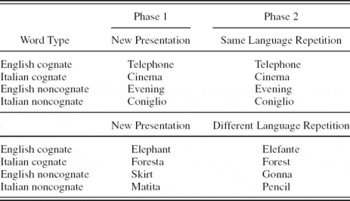
The experiment was divided into two phases with stimuli from Lists 1 and 2 presented in Phase 1. In Phase 2, words from List 1 were presented for a second time along with words from List 3 (consisting of the translations of the words in List 2, i.e., different language repetitions). Table 1 shows examples of the stimuli used in each phase. Words from Lists 1 and 2 were combined with nonwords for presentation in Phase 1 of the experiment. No more than three cognates or noncognates appeared consecutively, and no more than three English words or three Italian words appeared in a row. Once the experimental stimuli had been merged into a single list, they were divided into blocks of stimuli. A similar procedure was carried out for stimuli for Phase 2 of the experiment. Each phase of the experiment contained four blocks of stimuli presented in random order. Each block began with four start-up items followed by approximately 50 test stimuli.
Examples of stimuli used across phases and repetition type in Experiment 1 for younger adult bilinguals

The experiment had a 2 × 2 × 3 within-subjects factorial design. The factors were Language (Italian, English), Cognate Status (cognate, noncognate), and Repetition Condition (new presentation, same repetition, different repetition). The dependent variables were RT and number of errors.
Procedure. Participants were tested individually and were given both verbal and written instructions (on the computer screen) for the experiment. Before commencing testing, participants completed a short practice block of eight trials. During the experiment, optional breaks were available at the end of each block. A longer break of approximately 5 min separated Phase 1 from Phase 2.
Each trial began with the presentation of a fixation point for 1 s. Following this, a letter string appeared on screen for 1500 ms, during which participants were able to respond, followed by an intertrial interval of 1500 ms. Stimuli were presented centrally in black, lowercase, 22-point Arial font on a white screen. Participants were required to make a lexical decision on each target as quickly and accurately as possible. They were asked to press a green button if the letter string was a real Italian or English word, and to refrain from responding where the stimulus was not an Italian or English word and simply to wait for the next trial.
Results
Data from all 21 participants were included in the analyses. Exclusion of data from the participant with a later acquisition of Italian and the left-handed participant did not change the overall results; therefore, these participants were also included. Data were analyzed using a linear mixed model with subject as a random factor; the within-subjects fixed factors were language, cognate status, and repetition condition, and the dependent variable RT. To investigate the impact of the participants' potentially varying degrees of bilingualism, the continuous variable English exposure (number of years that the participant had spent in an English-speaking country) was included as a covariate in the model. English exposure was deemed to be a more naturalistic measure of bilingualism, in comparison to “fixed” variables such as age of exposure to a language or years of education in a language, which fail to take into account differences in a bilingual speaker's language usage patterns. Due to the low proportion of errors, no analyses were conducted on the error data. Unless otherwise indicated, an α level of .05 was adopted for all statistical tests.
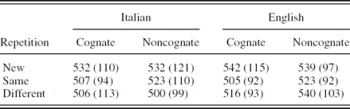
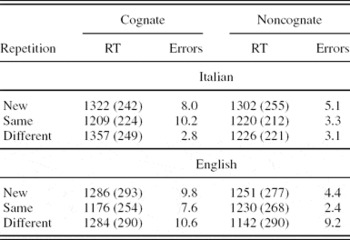
Only accurate responses to real-word trials were included in the RT analysis. RTs greater than 1000 ms and less than 100 ms were removed from the data set (4% of accurate responses). The latency data for each language is presented in Table 2. The analysis revealed significant main effects for language, F (1, 4591) = 290.96, p < .001, cognate status, F (1, 4591) = 9.76, p = .002), and repetition condition, F (2, 4591) = 9.487, p < .001. In addition, the analysis showed significant interaction effects of Cognate Status × Repetition Condition, F (2, 4591) = 7.89, p < .001, English Exposure × Repetition Condition, F (2, 4591) = 5.98, p = .003, Cognate Status × Language, F (2, 4591) = 13.68, p < .001, Language × English Exposure, F (1, 4592) = 521.80, p < .001, Cognate Status × Repetition Condition × English Exposure, F (2, 4591) = 10.39, p < .001, and Cognate Status × Language × English Exposure, F (1, 4591) = 15.83, p < .001.
Mean reaction time (ms) for each Language × Cognate Status × Repetition Condition in Experiment 1 for younger bilinguals
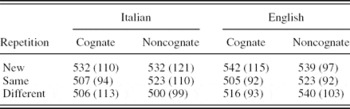
Note: Standard deviations are in parentheses.
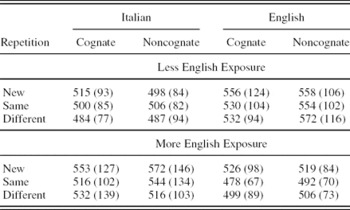
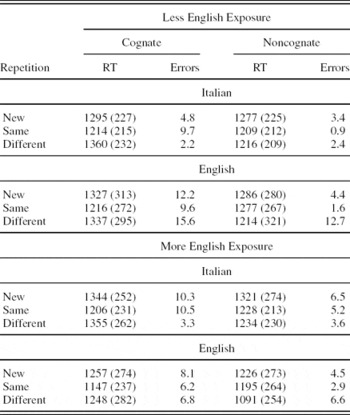
Because the variable English Exposure was found to interact with the other fixed factors, further statistical analyses were conducted to elucidate the nature of the relationship between English exposure and the other variables. A median split was used to divide the participant cohort into two groups: less English exposure (N = 11, M = 1.8 years, SD = 1.6) and more English exposure (N = 10, M = 21.15 years, SD = 13.68). Table 3 displays the latency data for each English exposure group. A second linear mixed model analysis (with RT as the dependent variable) was performed with subject as a random factor, English exposure as a between-subjects fixed factor and cognate status, language, and repetition condition as within-subjects fixed factors. This analysis again revealed main effects for repetition condition, F (2, 4591) = 30.20, p < .001, cognate status, F (1, 4591) = 9.23, p = .002, and language, F (1, 4591) = 5.40, p = .02, as well as a number of significant interaction effects: Cognate Status × Repetition Condition, F (2, 4591) = 3.77, p = .023, Language × Repetition Condition, F (1, 4591) = 226.13, p < .001, English Exposure × Repetition Condition, F (1, 4591) = 15.83, p < .001, English Exposure × Language, F (2, 4591) = 8.15, p < .001, and Cognate Status × Language × English Exposure, F (1, 4591) = 7.44, p = .006. The analysis also showed a marginal interaction of Cognate Status × Language × Repetition Condition, F (2, 4591) = 2.92, p = .054.
Mean reaction time (ms) for the less and more English exposure groups for each Language × Cognate Status × Repetition Condition in Experiment 1 for younger bilinguals

Note: Standard deviations are in parentheses.
Cognates versus noncognates across repetition conditions
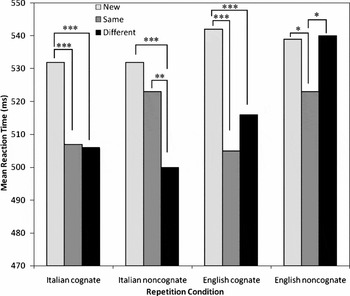
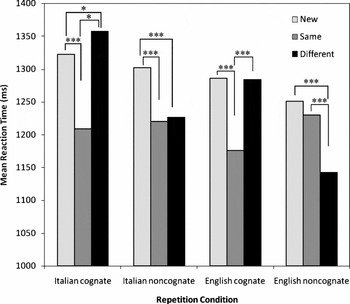
Planned contrasts were conducted on the Cognate Status × Language × Repetition Condition interaction and showed that for words that were repeated in the same language, participants produced significantly faster RTs for cognates than noncognates in both Italian (p < .05) and English (p < .05). For words repeated in the different language, only English cognates had significantly faster RTs than English noncognates (p = .004), whereas for words seen for the first time, there was no significant difference between any of the conditions. Finally, planned pairwise comparisons indicated that a language advantage occurred only for noncognate words with Italian noncognates being significantly faster than English noncognates (p < .001). Figure 1 displays the differences between RTs for cognates and noncognates from both languages across the various repetition conditions.
Reaction times for cognates and noncognates from each language across the different repetition conditions in Experiment 1 for younger bilinguals. *p < .05, **p < .01, ***p < .001.

Language dominance
Further contrasts were performed to investigate the Cognate Status × Language × English Exposure interaction. These contrasts demonstrated that participants with less English exposure showed an advantage for Italian words; with Italian cognates having faster RTs than English cognates (p < .001) and Italian noncognates having faster RTs than English noncognates (p < .001). Participants with more English exposure showed the opposite pattern with an RT advantage for English cognates over Italian cognates (p < .001) and English noncognates over Italian noncognates (p < .001). Participants with less English exposure showed a significant cognate advantage only in English (p = .001), whereas those with more English exposure showed a significant cognate advantage only in Italian (p < .001).
Discussion
Experiment 1 aimed to investigate differences between processing of cognates and noncognates and their interconnection across languages, using a repetition priming paradigm, with younger adult Italian/English bilinguals. Overall, the results of the present study lend further support to previous research that has found cognate facilitation across a wide range of tasks. The current study highlighted differences in the links between cognates and noncognates, within and between languages.
Cognate versus noncognate processing. When cognates and noncognates were repeated in the same language, a cognate advantage occurred in both Italian and English. This result supports the prior finding that, even for tasks requiring within-language processing, cognates are accessed faster than noncognates (Van Hell & De Groot, 1998) suggesting that their representation differs from noncognates in a manner that facilitates cognate access. As has been previously proposed (e.g., Sánchez-Casas et al., Reference Sánchez-Casas, Davis and Garcìa-Albea1992), because cognates share word form with their cross-language translation equivalents, it is possible that they are strongly linked together or have a shared representation in the lexicon. Furthermore, during acquisition of an L2, a learner may link L2 cognates directly and more strongly to their L1 counterparts, potentially more so than for noncognates due to the additional overlap in word form (Van Hell & De Groot, 1998). As other researchers have suggested (De Groot et al., Reference De Groot, Borgwaldt, Bos and Van den Eijnden2002; Lemhöfer & Dijkstra, Reference Lemhöfer and Dijkstra2004), this proposed strong linkage between cognates may mean that accessing a cognate also involves at least partially activating its other language counterpart, particularly if bilingual lexical access is nonselective of language. If cognates are always accessed simultaneously, they may be accessed more frequently than noncognates due to their bilingual activation. This may lead to a lower threshold for lexical access for cognates than for noncognate words, creating a form of cross-lingual frequency effect that facilitates cognate retrieval during within-language processing.
In contrast, when word repetition occurred in the different language, the cognate advantage was restricted to English. In other words, a cognate, that initially appeared in Italian and was then repeated in English, was recognized upon repetition more quickly than a noncognate, which was initially presented in Italian and repeated in English. However, this cognate advantage did not occur if the order of the language repetition was reversed, producing a language-specific cognate advantage similar to that found by De Groot et al. (Reference De Groot, Borgwaldt, Bos and Van den Eijnden2002).
Cross-language connections between cognates and noncognates. Exploring the possible nature of the lexical links between cognates and noncognates across the two languages can assist us in understanding how the language-specific cognate advantage occurs in this context. For the participants in the present experiment, Italian is likely to be their dominant language or L1 when we consider that they were native Italian speakers, and they showed an RT advantage for Italian noncognates over English noncognates. The faster RTs demonstrated for cognate words in both repetition conditions, in comparison to novel presentation, may be taken as evidence that cognate words have strong bidirectional lexical links because facilitation occurred regardless of whether the cognate was repeated in the same or different language. In contrast, noncognate words showed different RTs depending upon the language and type of repetition condition. For English noncognates, repetition in the same language produced faster RTs than repetition in the L1–L2 direction or upon first presentation. For Italian noncognates, however, repetition in the different language (i.e., in the L2–L1 direction) produced faster RTs than repetition within the same language. This finding supports the notion that lexical links between noncognates in the L2–L1 direction are stronger than links in the opposite direction, corroborating results from previous priming and word translation studies (Kroll & Stewart, Reference Kroll and Stewart1994; Sánchez-Casas et al., Reference Sánchez-Casas, Davis and Garcìa-Albea1992).
A possible explanation for the results in the present study is that the linkage between L2–L1 noncognates is equally as strong as the link between L2–L1 cognates, removing any advantage in accessing cognate words. Alternatively, noncognates are more weakly linked in the L1–L2 direction than in the opposite direction. Due to cognates sharing strong bidirectional links, while noncognates share strong links in only the L2–L1 direction, a discrepancy may arise between the strength of lexical links connecting cognates and those connecting noncognates in the L1–L2 direction, creating a language-specific cognate advantage.
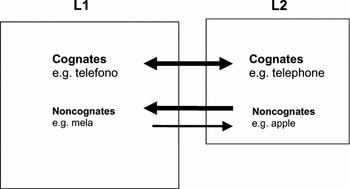
These findings from Experiment 1 further elucidate the nature of lexical links between a bilingual speaker's L1 and L2 when taking cognate status into consideration. Because all the stimuli in this task were translation equivalents that shared semantic overlap with their cross-linguistic counterparts, any differences between cognates and noncognates must be attributed to differences at the lexical level. Figure 2, therefore, models the lexical links between cognates and noncognates, allowing for the easier access to cognates in within-language tasks, the asymmetry of priming effects and the language-specific cognate advantage. This proposed model is compatible with the lexical level of the revised hierarchical model of bilingual lexical and conceptual organization proposed by Kroll and Stewart (Reference Kroll and Stewart1994) and further clarifies lexical links between entries based on cognate status.
The proposed model for lexical links between cognate and noncognate words in an Italian-dominant speaker.

One final point to clarify is that the present finding of facilitation for Italian noncognates initially presented in English (i.e., L2–L1) is in contrast to previous studies, which found no differences between RTs for noncognates presented for the first time and those repeated in a different language (Cristoffanini et al., Reference Cristoffanini, Kirsner and Milech1986; Lalor & Kirsner, Reference Lalor and Kirsner2000). How can these different results be reconciled according to the proposed lexical links presented in Figure 2? It is possible that the present model may need to be modified to explain the finding from the aforementioned studies. It may be that in those studies, the lexical links between noncognates were weak in both directions, possibly due to differences in speaker proficiency or language dominance, and therefore, repetition of noncognates in a different language (specifically in the L2–L1 direction) failed to produce significant priming in these studies (Cristoffanini et al., Reference Cristoffanini, Kirsner and Milech1986; Lalor & Kirsner, Reference Lalor and Kirsner2000).
Dynamic nature of language dominance. If we consider the influence of the factor English exposure, we can identify differences between participant results based on whether they had less or more exposure to their L2. The results from this experiment indicate that increased exposure to a language (conceivably equating to better proficiency in that language) can influence which language the cognate advantage occurs in. For Italian speakers with less English exposure (and possibly poorer proficiency in English than participants with more English exposure), RTs were faster for Italian words than English words and the cognate advantage was found only in English, which was the L2 for this group of participants. Alternatively, for speakers with more English exposure and an overall RT advantage for English words over Italian, the cognate advantage occurred in Italian. It is feasible that for this second group of participants, language dominance or proficiency had altered such that English was now their L1 and the cognate advantage had changed languages accordingly.
In Experiment 2 we investigated whether these cognate versus noncognate processing distinctions would alter with age, by testing a population of older bilingual speakers. Considering prior findings regarding language processing in older speakers, which have demonstrated problems with lexical selection between competing alternatives (Logan & Balota, Reference Logan and Balota2003), poorer inhibitory processes (Hartman & Hasher, Reference Hartman and Hasher1991) and poorer performance on tasks involving language switching (Hernandez & Kohnert, Reference Hernandez and Kohnert1999), it was anticipated that the cognate advantage demonstrated by younger adult bilingual speakers may not be found in an older adult bilingual population.
EXPERIMENT 2: OLDER ADULT BILINGUALS
Method
Participants. Twenty-one bilingual Italian/English speakers (13 female, 8 male) aged between 47 and 80 years (M = 62.3 years) were recruited for the second study. Information was once again collected from participants regarding their language background and usage. All participants were initially exposed to Italian by 2 years of age with the average age of exposure to English being 13.7 years (range = 2–32 years). Participants had spent between 6 and 63 years in an English-speaking country (M = 45.8 years) and had received 10.7 years of education on average (range = 2–20 years). Participants self-rated their spoken proficiency on a 7-point scale (1 = minimal proficiency, 7 = nativelike proficiency) in English (M = 6, range = 4–7) and Italian (M = 6.7, range = 5–7). Cognitive status was screened using the Mini-Mental State Examination (Folstein, Folstein, & McHugh, Reference Folstein, Folstein and McHugh1975) and all participants scored within the normal range. None of the participants reported any previous history of neurological disease, psychiatric illness, head trauma, dementia, brain tumour, cerebral abscess, speech and language disorder, learning disability, or alcoholism. All participants were right-handed and had normal hearing.
Apparatus. The same computer and software from Experiment 1 were used to present Experiment 2. In Experiment 2, however, the stimuli were presented auditorily to avoid any potential issues with poor literacy in either language. A native Italian speaker who was bilingual in English recorded all stimuli for the experiment using Acoustica software Version 2.25b (http://www.aconas.com/).
Stimuli. The stimuli used were the same as for Experiment 1; however, because they were presented auditorily in Experiment 2, an auditory cognate status questionnaire was used to examine whether the stimuli could be still be considered cognate or noncognate on the basis of phonological overlap rather than orthographic overlap as in Experiment 1. A bilingual Italian/English speaker read aloud the Italian translations of all the experimental stimuli to a group of 10 monolingual English speakers (7 females, 3 males), aged between 24 and 33 years (M = 28 years). Participants were asked to attempt to guess the English meaning of the word upon first hearing it. If unable to do so, they were given a categorically related semantic cue and asked to attempt to guess the word meaning again. For the stimuli designated as cognates in Experiment 1, participants had a mean accuracy of 77% for guessing the meaning upon first hearing the word and a mean overall accuracy, after being given a semantic cue, of 93%. Alternatively, for noncognate stimuli from Experiment 1, mean accuracy was 2% after first hearing the word and mean overall accuracy was 6%. The findings of the questionnaire suggest that the cognate stimuli from Experiment 1 had sufficient phonological overlap to also be considered auditory cognates, just as the noncognates were sufficiently different in phonological form to be regarded as noncognates in the auditory mode also.
Design. Although the same stimulus set was used as for Experiment 1, the experiment was divided into two subexperiments that could be administered over different sessions or days, if necessary, to avoid possible participant fatigue. In Experiment 2A, half of the stimuli from Lists 1 and 2 were used to create Phase 1. The corresponding stimuli from Lists 1 and 3 were then presented in Phase 2 of Experiment 2A. The remaining stimuli were used to construct Experiment 2B using the same procedure. Each phase in the subexperiments had half as many stimuli as the phases in the full experiment, which were presented across three blocks with approximately 30 stimuli per block.
Procedure. As in Experiment 1, each block was preceded by four start-up items. Before commencing testing, participants completed a practice block of 15 trials. Participants were tested individually and listened to all stimuli through headphones.
In the experiment, a fixation point appeared for 2 s at the beginning of each trial. Following this, participants were presented with an auditory stimulus, during which the screen remained blank. Participants were asked to respond to real Italian or English words with a button push as quickly and accurately as possible. Response times were recorded from the onset of the target to the button push in accordance with previous studies utilizing an auditory priming paradigm (Janse, Reference Janse2006; Misiurski, Blumstein, Rissman, & Berman, Reference Misiurski, Blumstein, Rissman and Berman2005; Moineau, Dronkers, & Bates, Reference Moineau, Dronkers and Bates2005; Myers & Blumstein, Reference Myers and Blumstein2005). No response was required for nonwords. The next trial was initiated by the button push or 3 s after the offset of the target.
Results
Data from all 21 participants were included in the analyses. Data were analyzed using a linear mixed model with the random factor subjects and the within-subjects fixed factors language (Italian, English), cognate status (cognate, noncognate), and repetition condition (new presentation, same repetition, different repetition). As for the results in Experiment 1, the continuous variable English Exposure (number of years that the participant had spent in an English-speaking country) was initially included as a covariate in the model to investigate the impact of the participants' possibly varying degrees of bilingualism. RT and percentage of errors were the dependent variables in separate analyses.
RT. Only accurate responses to real word trials were included in the analysis. RTs greater than 2500 ms and less than 200 ms were removed from the data set (2% of accurate responses). Latency and error data for each language is presented in Table 4. The latency analysis revealed significant main effects for language, F (1, 4417) = 20.68, p < .001, and repetition condition, F (2, 4417) = 3.04, p < .05, as well as interactions of Repetition Condition × English Exposure, F (2, 4417) = 4.52, p = .011, and Language × English Exposure, F (1, 4417) = 39.48, p < .001.
Mean reaction time (ms) and mean errors (%) for each Language × Cognate Status × Repetition Condition in Experiment 2 for older bilinguals

Note: RT, reaction time. Standard deviations are in parentheses.
Because the variable English exposure was once again found to interact with the other fixed factors, further statistical analyses were conducted to elucidate the nature of the relationship between English exposure and the other variables. A median split was used to divide the participant cohort into two groups: less English exposure (N = 9, M = 35 years, SD = 13.8) and more English exposure (N = 12, M = 54 years, SD = 3.84). Table 5 displays the latency and error data for each English exposure group. A second linear mixed model analysis of the RT data was performed with subject as a random factor, English exposure as a between-subjects fixed factor, and cognate status, language, and repetition condition as within-subjects fixed factors. This analysis revealed main effects for repetition condition, F (2, 4417) = 42.95, p < .001, cognate status, F (1, 4417) = 36.80, p < .001, and language, F (1, 4417) = 19.00, p < .001, as well as a number of significant interaction effects: Cognate Status × Repetition Condition, F (2, 4417) = 34.44, p < .001, Language × Repetition Condition, F (2, 4417) = 5.29, p < .01, English Exposure × Repetition Condition, F (2, 4417) = 3.17, p < .05, and English Exposure × Language, F (1, 4417) = 46.86, p < .001.
Mean reaction time (ms) and mean errors (%) for the less and more English exposure groups for each Language × Cognate Status × Repetition Condition in Experiment 2 for older bilinguals

Note: RT, reaction time. Standard deviations are in parentheses.
Contrasts were performed to further investigate the Cognate Status × Repetition Condition interaction and revealed that RTs for cognates were faster in the same repetition condition than either the different repetition condition (p < .001) or for new presentations (p < .001). Participants produced faster RTs for noncognates repeated in the different language than the same language (p < .01) and likewise noncognates repeated in the same language had faster RTs than noncognates that were first presented (p < .001). Participants showed an RT advantage for cognates over noncognates only when words were repeated in the same language (p < .05), whereas when words were repeated in the different language (p < .001) or when first presented (p < .01) participants produced faster RTs for noncognates than cognates.
Further contrasts were conducted to investigate the Language × Repetition Condition interaction. These contrasts indicated that for Italian words, participants produced faster RTs in the same repetition condition than either the different repetition condition (p < .001) or for new presentations (p < .001). For English words, RTs were faster in the same and different conditions than for novel presentation (both p < .001). Contrasts further showed that for words presented for the first time, a language advantage existed for English words over Italian words (p < .001). Similarly, when words were repeated in the different language, participants produced faster RTs for English words than Italian words (p < .001). Words that were presented first in Italian then English had faster RTs on their second presentation than words first presented in English and then repeated in Italian.
The role of the variable English exposure was also explored by performing contrasts to investigate the English Exposure × Repetition Condition interaction. Pairwise comparisons indicated that participants with less English exposure produced faster RTs in the same repetition condition than in either the different repetition condition (p < .001) or for new presentations (p < .001). Participants with more exposure to English produced faster RTs in the same condition than the different condition (p < .01), and likewise produced faster RTs for words repeated in the different language than when words were first presented (p < .001). Finally, the Language × English Exposure interaction was examined, with participants with more exposure to English showing an RT advantage for English words over Italian words (p < .001), whereas those from the Less English exposure group showed no significant difference between words from the two languages.
Cognate versus noncognate processing across repetition conditions. To make comparisons between the patterns of results obtained by the younger and older groups, further planned contrasts investigated RTs for cognates and noncognates from each language across each of the repetition conditions. It should be noted, however, that these analyses are based on a priori predictions and are not driven by statistically significant higher order interactions, and should therefore be interpreted with caution.
Planned comparisons indicated that when words were repeated in the same language, a cognate advantage existed only in English (p = .012). In contrast, when words were presented in the different language repetition condition, English noncognates had faster RTs than English cognates (p < .001), and similarly, Italian noncognates produced faster response times than Italian cognates (p < .001). This noncognate advantage also occurred when words were presented for the first time in English (p = .01). Figure 3 displays the differences between RTs for cognates and noncognates from both languages across the different repetition conditions.
Reaction times for cognates and noncognates from each language across the different repetition conditions in Experiment 2 for older bilinguals. *p < .05, ***p < .001.

Errors. A linear mixed model analysis with the random factor subject; the between-subjects fixed factor English exposure (created by median split), and the within-subject factors of cognate status, language, and repetition condition was conducted with number of errors as the dependent variable. The analysis showed main effects for cognate status, F (1, 4785) = 24.86, p < .001, and language, F (1, 4785) = 9.99, p = .002, as well as significant interaction effects of Cognate Status × Repetition Condition, F (2, 8785) = 4.143, p = .016, Language × Repetition Condition, F (2, 4785) = 11.00, p < .001, English Exposure × Repetition Condition, F (2, 4785) = 3.301, p < .05, and Language × English Exposure, F (1, 4785) = 17.19, p < .001.
Planned contrasts investigating the Cognate Status × Repetition Condition interaction indicated that error rates for noncognates were significantly lower than cognate error rates in the new presentation and same repetition conditions (both p < .001), negating a speed–accuracy trade-off. Further contrasts examining the Language × Repetition Condition interaction showed that error rates for Italian words were lower in the different repetition condition than the same repetition (p = .004) or new presentation (p < .003) conditions. For English words, error rates were significantly higher for words repeated in the different language than those repeated in the same language (p = .001) or seen for the first time (p < .05). Finally, planned contrasts revealed that participants with more English exposure were more accurate for words repeated in the different language than for new presentations of words (p < .05), and those with less English exposure were significantly more accurate for Italian than English words (p < .001).
Discussion
Experiment 2 investigated differences in cognate and noncognate processing in older bilinguals to examine whether any changes occur in cognate processing with age. Although there were some similarities between the two cohorts, the overall pattern of results found for Experiment 2 differed substantially to the findings for younger adult bilinguals.
Cognate versus noncognate processing
Similar to Experiment 1, when words were repeated in the same language in Experiment 2 a cognate advantage did occur; however, in contrast to Experiment 1, cognate facilitation was language specific and restricted to English. The finding of a cognate advantage in at least one language provides some evidence of a cross-lingual frequency effect for cognates. Because the cognate advantage occurs only in one language, however, it seems that in this population of bilinguals, cognates in both languages do not necessarily have a stronger representation or lower activation threshold than noncognates.
When words were repeated in the different language, the older bilingual participants produced a novel set of results. In contrast to previous findings regarding cognate processing (e.g., Cristoffanini et al., Reference Cristoffanini, Kirsner and Milech1986; Lalor & Kirsner, Reference Lalor and Kirsner2000; Lemhöfer & Dijkstra, Reference Lemhöfer and Dijkstra2004), faster RTs were produced for noncognates rather than cognates in both languages. This RT advantage for noncognate words also occurred for words that were seen for the first time. In addition, the lower error rates for noncognates than cognates upon first presentation, and similarly when repetition occurred in the same language, negates any possible speed–accuracy trade-off. The findings from Experiment 2 lend support to the prediction that lexical access in older bilinguals may be detrimentally affected by the form similarity of cognate translations. Mechanisms underlying the reversal of the cognate advantage will be discussed in more detail in the General Discussion Section.
Cross-language connections between cognates and noncognates. The results for English cognates indicated that repetition in the same language produced faster RTs than different language repetition or new presentation, wheres for Italian cognates, repetition in the different language produced RTs that were slower than both same language repetition and novel presentation. In contrast to the findings from the younger bilinguals, these results suggest that for this population of older bilinguals, a distinction exists between processing cognates in the same language and processing cognates in different languages.
If we examine participant responses to noncognates, we see that for English noncognates, the fastest RTs were produced when repetition occurred in the different language (i.e., L2–L1 direction for this group), suggesting that in the older cohort also a strong lexical link joins L2–L1 noncognate translation equivalents. Alternatively, RTs for Italian noncognates did not differ between the same repetition and different repetition conditions. This may be due to weaker lexical links in the L1–L2 direction providing no advantage over within-language priming.
Dynamic nature of language dominance. One of the differences between the older and younger groups appears to be overall language dominance. Even though participants from both age groups were native Italian speakers, the older group showed an overall RT advantage for English words suggesting that English has replaced Italian as their L1 or dominant language. When we turn to the influence of the factor English Exposure, it is apparent that participants with more exposure to English showed an RT advantage for English words over Italian words, whereas the less English exposure group showed no significant differences between the two languages. These findings support the notion that increased exposure to a language may alter language dominance. Unlike the younger bilingual cohort, the older bilinguals did not demonstrate a shift in the language of the cognate advantage with changing language dominance. Finally, when participant error rates were examined by English exposure, both groups showed lower error rates for noncognates either in one or both languages providing some evidence that the unusual finding of faster RTs for noncognates is not likely to be related to differences in language proficiency or dominance.
GENERAL DISCUSSION
The results from the younger bilinguals in Experiment 1 generally replicated previous studies that have identified a processing advantage for cognate words over noncognate words (e.g., Costa et al., Reference Costa, Caramazza and Sebastian-Galles2000; De Groot et al., Reference De Groot, Borgwaldt, Bos and Van den Eijnden2002; Lalor & Kirsner, Reference Lalor and Kirsner2000; Lemhöfer & Dijkstra, Reference Lemhöfer and Dijkstra2004; Van Hell & De Groot, 1998), and allowed further elucidation of the lexical links connecting cognate and noncognate translation equivalents. When we turn to the older bilingual speakers, a different pattern of results emerges that has not been previously reported. Despite producing faster RTs for noncognates when words were repeated in different languages, these same older participants showed a cognate advantage for within-language processing in the experiment. The maintenance of a cognate advantage during within-language processing suggests that the reversal of the cognate advantage during cross-language processing is not due to changes in the representation of cognates but rather due to the manner in which they are accessed. It seems that in these older bilinguals, for cross-language repetitions, the overlap in form between cognates no longer facilitates lexical access, but instead causes interference. This proposition is consistent with the finding that older speakers, compared to younger speakers, may have more difficulty with lexical selection, particularly between competitors that are similar in form (Logan & Balota, Reference Logan and Balota2003). It is pertinent that in the current study, response times by older bilinguals were slowest when Italian cognates were repeated in the different language, even slower than when Italian cognates were first presented. This result supports the findings of Hernandez and Kohnert (Reference Hernandez and Kohnert1999) that older bilingual speakers have greater difficulty than younger bilinguals under mixed language conditions, and further supports the notion that poorer inhibitory mechanisms may be slowing lexical access for cognates across languages. The bilingual interactive activation (BIA) model (Van Heuven, Dijkstra, & Grainger, Reference Van Heuven, Dijkstra and Grainger1998) refers to bilingual control mechanisms for lexical access, and is thus useful for interpreting the present findings.
The BIA model, which is an extension of the monolingual Interactive Activation model of visual word recognition (McClelland & Rumelhart, Reference McClelland and Rumelhart1981), has four levels of nodes: letter features, letters, words, and languages. The language nodes specify which language a word belongs to. According to the BIA model, both bottom-up and top-down processing mechanisms are involved in bilingual language processing. As a bilingual speaker sees a letter string, the bottom-up processing mechanisms trigger activation of several possible word targets, from both languages, which may correspond to the letter string presented. Inhibitory mechanisms are active both at the word and language level. Active words may inhibit other competitors within a language and the language nodes send top-down inhibition to word competitors from the other language. Eventually, the word that best matches the visual input will be selected.
Although the BIA model is based on visual word recognition, Léwy and Grosjean (cited in Schulpen, Dijkstra, Schriefers, & Hasper, Reference Schulpen, Dijkstra, Schriefers and Hasper2003) have proposed a compatible model of bilingual auditory word recognition: the bilingual interactive activation model of lexical access (BIMOLA). These authors propose that the levels of nodes in the BIMOLA consist of phonological features (overlapping between the two languages), phonemes, words, and language. As with the BIA, the BIMOLA has both bottom-up processing and top-down inhibitory mechanisms. The principles underlying these two models can be used to explain the findings of the present study.
First, we can consider the finding of faster RTs being produced in response to noncognate words over cognates when words were repeated in different languages. According to the BIMOLA, bottom-up processing mechanisms will lead to activation of several word competitors from both languages. For both cognates and noncognates, their phonological features will activate a number of possible targets from both languages. Second, the lexical links between cognates will lead to automatic activation of their partner, whereas for L2 noncognates, their translation equivalents will also be activated via the strong lexical link. At the same time, top-down inhibitory mechanisms from the language nodes will inhibit items from the nontarget language leading to eventual selection of the target word.
Given previous findings that older speakers may have more difficulty with lexical selection between close competitors (Logan & Balota, Reference Logan and Balota2003) or inhibition of irrelevant information (Hartman & Hasher, Reference Hartman and Hasher1991), it is feasible that in this older bilingual population top-down inhibitory mechanisms are less effective for cognates than they may be in younger speakers. Because cognates overlap closely in form, it may be harder to identify which language a cognate originates from, thus making it more difficult to suppress the competing nontarget cognate. Therefore, while bottom-up mechanisms are activating both cognate partners, the top-down inhibitory mechanisms are slower for cognate words, leading to delayed selection of the target cognate. For noncognates, in contrast, bottom-up activation will similarly activate several possible targets from both languages; however, because of the lack of similarity in word form, the language nodes are able to inhibit words from the nontarget language at an earlier stage of lexical access, leading to earlier selection of noncognate targets. The results from Experiment 2 suggest that for older bilinguals, inhibitory mechanisms for cognates are poorer, leading to difficulty with selecting between form-similar competing translation equivalents and ultimately leading to a reversal of the cognate advantage.
The BIA model and BIMOLA can also be used to explain why older bilinguals demonstrate cognate facilitation for same-language repetitions but no cognate advantage for cross-language repetitions. Italian/English cognates are similar in form (both orthographically and phonologically); however, they are rarely identical. In the same language condition of these experiments, the cognate is identical in both presentations, whereas in the different language condition, there are subtle differences in the form of the two items presented. In the same-language repetitions, the bottom-up processing mechanisms will be faster to correctly identify the target cognate because it is identical to a previously presented stimulus. Therefore, despite the poorer top-down inhibitory mechanisms, the target cognate is still selected more quickly. With the different-language repetitions, bottom-up processing of cognates will be slower than the same-language condition because the presented stimuli are not identical, and a bottom-up match will thus take longer. The combination of longer bottom-up processing and poorer top-down inhibition leads to a distinction between same-language and different-language cognate processing.
One aspect of the experiments that should be considered in discussing these results is the visual presentation of stimuli to the younger group in contrast to the auditory presentation of stimuli to the older bilinguals. Although it is possible that altering the modality of presentation may have influenced the findings of the present study, results from the auditory cognate status questionnaire indicated that the cognates and noncognates employed in the visual modality maintained the same cognate status in the auditory modality. Furthermore, Woutersen et al. (Reference Woutersen, de Bot and Weltens1995) conducted a study using a repetition priming paradigm that compared cognate/noncognate processing in the auditory and visual modalities. The authors found the same main effects regardless of modality, and asserted that results of bilingual repetition priming studies using either modality could be compared to each other. To confirm the findings of the present study, however, future research needs to investigate cognate processing in younger and older bilinguals using the same modality of stimulus presentation that would also allow direct comparisons.
A final point regarding the findings from this study is the importance of considering the participants' levels of proficiency. Although researchers may attempt to select a homogenous group of bilinguals (e.g., all native speakers of Italian with English as their L2), it is challenging to find a group of bilinguals with identical language backgrounds because of differences in factors such as current usage patterns, employment, education, place of habitation, and so forth. To this end, it is useful to include variables measuring participants' levels of bilingualism in analyzing results of the study. As the results of these experiments demonstrate, taking differences in language background into account can provide important new information on language processing in bilingual individuals. A further point to note is that the shifting language dominance demonstrated by the participants in this study also supports Heredia's (Reference Heredia1996) proposal to refer to languages on the basis of language dominance rather than chronological order in which the languages were learned. The present findings are consistent with Heredia's suggestion to use the “most dominant language” and “least dominant language” instead of L1 and L2 to refer to the languages of a bilingual speaker.
CONCLUSIONS
The goals of the present study were to investigate cognate/noncognate processing distinctions in younger bilinguals to see if previous findings would be replicated, and to examine the effects of cognate status on lexical organization and processing in older bilingual speakers. The younger bilingual cohort produced similar results to previous studies in the area, including within-language cognate facilitation and a language-specific cognate advantage when repetition occurred in different languages. Findings from the present study were used to clarify the nature of lexical links on the basis of cognate status. Results suggested that cognates share a strong bidirectional lexical link, whereas noncognate translation equivalents have a stronger link in the L2–L1 direction than the reverse direction. The older bilingual group produced a different pattern of results to those previously reported in the literature and those found in the young adults. Older bilinguals demonstrated a language-specific cognate advantage only for words repeated in the same language while showing faster RTs for noncognates when words were repeated in the different language. These results were interpreted in light of previous findings regarding difficulties with lexical selection and poorer inhibitory mechanisms with increasing age and with reference to the inhibitory mechanisms outlined in the BIA model. It was concluded that, in older bilinguals, the similarity of word form between cognates slows the process of lexical access rather than facilitating it as occurs in younger bilingual speakers. Future research in this area should aim to test these findings using the same modality of presentation for both age groups and should endeavor to take differences in language background into account.
ACKNOWLEDGMENTS
Portions of this paper were presented in November 2006 at the Aphasiology Symposium of Australia, Sydney. This work forms part of the doctoral dissertation by the first author.