Although this essay is about reading texts from the past, I begin with the present, with a US president who was elected despite widespread knowledge that he had infamously boasted about how he often starts kissing beautiful women without consent. “I don't even wait,” he crowed. “When you're a star they let you do it. You can do anything. Grab ’em by the pussy. You can do anything.”Footnote 1 The internet was soon flooded with angry feminist responses to his crass admission of sexual violence, retorts that appropriated his use of vulgar language with wit and resistance, the most prevalent being the meme “Pussy Grabs Back!” (see fig. 1). The Pussy Hat Project soon followed. As we know, the pussy hat phenomenon offended some who felt it was racist (not all vulvas are pink) and/or transphobic (not all women have pussies). Nevertheless, a sea of pink pussy hats, worn by persons of many embodiments and identity categories, would be seen in protest, worldwide, at the record-breaking post-inauguration Women's Marches across the globe. If “Grab ’em by the pussy” rightly offended, “Pussy Grabs Back!” gained traction.
“Pussy Grabs Back,” original image by Stella Marrs. Featured in Nicole Puglise, “‘Pussy Grabs Back’ Becomes Rallying Cry for Female Rage Against Trump.” The Guardian, October 10, 2016.

The purpose of beginning my essay this way is not to revisit the critique of the vagina as a metonym for woman. Rather, as a feminist teacher-scholar of Victorian literature, I want to consider how thinking about the present impacts our and our students’ thinking about the past, beginning with how the “grab ’em by the pussy” statement functions as a metonym not just for violating women but for an attack on all things that feminisms are concerned about. Feminisms, plural, because there are many different kinds of feminism; yet taken as a whole, what I mean by feminism is the theory and practice that seeks to make visible and understand the oppression of all who “travel under the sign women” in order to eliminate that oppression.Footnote 2 Further, because women's lived experience includes so many other axes of identity (race, ethnicity, class, religion, nationality, age, ability, sexuality, gender expression and identity, etc.), feminism is also the theory and practice that seeks to make visible and to understand all forms of oppression and their interrelationships in order to eliminate them. Since the 2017 US presidential inauguration, we have seen the president and his supporters attack many things that should be of concern to feminists: reproductive rights, federal LGBT protections, the environment, the poor, immigrants, and more, all of which disproportionately affect people of color. These multiaxial acts of violence have been perpetrated by the current president with the same disrespect for personhood and in the same cavalier, entitled tone as his crass boast. Many of us are outraged but not surprised at these acts of violence. This is why I say these many and various acts of violence find a metonym in the pussy-grabbing statement.
According to the Oxford English Dictionary, “to grab” is “to grasp or seize suddenly and eagerly: to appropriate to oneself in a rapacious or unscrupulous manner,” as in “I just grab ’em by the pussy.”Footnote 3 It means “to make a grab or snatch at,” as in Anthony Trollope's Mrs. Van Siever, who “stretched out her hand to grab at the ledger.”Footnote 4 To have “the grab on” means “to have great advantage of”; ironically, Grab was a nineteenth-century children's card game.Footnote 5 This president has repeatedly treated women, persons with disabilities, and others as a joke, as unimportant as a game. The OED tells us that “grab” also means “to collar, capture, or arrest,” like the many undocumented persons in the US who are now being rounded up, separated from their families, and returned to their countries of origin. For feminists, indeed for any one concerned with social justice, much is amiss at present, like the brakes of a car that “grab” and jerk. The situation grabs our attention.
Yet another Victorian slang usage of grab is “grab on”—“to get along, live”—as in London Labour and the London Poor’s street clown who takes a second job selling sweetmeats, and says, “Between the two I do manage to grab on somehow.”Footnote 6 How do we “grab on” through feminist theory and practice? How might we, as scholars and teachers, grab back?Footnote 7
In what follows, I engage debates among feminist, queer, and gender theorists, and between proponents of historical and presentist approaches, about methodology and motivation in feminist approaches to Victorian studies today. What is the future of Victorian feminist scholarship in an era of increasing precarity that also sees radical reinterpretations of sexuality, gender, and sex itself? How do the historically distant objects of our study grab our attention, how do they grab our students’ attention, and in grasping to understand the texts and lives of people in the past, especially with regard to the sex-gender system, how do we attend to them? Here I consider how we grab back and backward—how, as scholars and feminists, we attend to our relationship to the future, present, and past. By way of a case study, I'll refer to two poems and a diary entry by the coauthors who wrote under the pseudonym Michael Field: Katherine Harris Bradley (1846–1914), also known as Michael or Sim, and Edith Emma Cooper (1862–1913), also known as Henry, Field, and Pussie.
Given their historical dramas, poetry, and lifewriting, Michael Field produced much that has been usefully considered from feminist and queer perspectives. They created feisty, innovative renditions, in both poetry and drama, of a host of classical, religious, and historical personages including Sappho and Mary, Queen of Scots; they experimented widely with literary form; and they engaged in complex explorations of love, nature, art, and death. Their diaries and letters also are interesting from feminist and queer perspectives, for statements like “we have much to say that the world will not tolerate from a woman's lips” and “we are closer married.”Footnote 8 Michael Field is also remarkable for the sizable, detailed archive that their joint diary provides about their fellow Victorians, and for the thought they might provoke in us about our selves and our times. Here, I focus on two narrative poems that feature a change of gender. The first is Bradley's “Tiresias” published in 1889 in Long Ago, a collection that reenvisions and expands Sappho's fragments.Footnote 9 The other is Cooper's 1900 “Caenis Caeneus,” presented to her beloved that year in a birthday collection called Dedicated, and then published by Bradley after Cooper's death, in an expanded collection by the same name. Like much of Michael Field's work, both poems reimagine subjects from history—Michael Field's characteristic “grabbing back,” as it were.
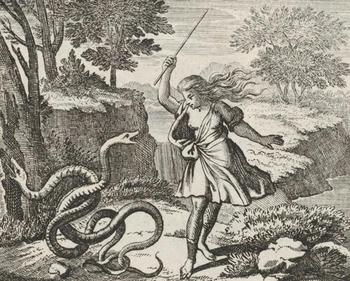
Michael Field's version of Tiresias narrates how Hera changed Tiresias into a woman after he killed the female in a pair of copulating snakes (see fig. 2). Tiresias enjoys being a woman, especially having “receptivity of soul,” and “the pleasure men must lack.”Footnote 10
Tiresias. Engraving, circa 1690. Johann Ulrich Krauss, Die Verwandlungen des Ovidii, plate 34.

After seven years, Hera returns him to his male form and asks, “In marriage who has more delight?” and then blinds him (line 33). According to Michael Field's rendition, Tiresias need not voice his reply, his answer is clear: Woman. The poem closes with the claim that Tiresias's subsequent gift of prophecy didn't really come from Zeus, but because
The later poem, “Caenis Caeneus,” begins with Caenis, a discontented maiden, begging Neptune to change her sex (see fig. 3). Neptune grants her prayer: “And she become a man in form and thought.”Footnote 11 As a man, Caeneus freely mountaineers and sails, soldiers and hunts while being impervious to wounds, and wins the praises of men and the attentions of women. Eventually however, centaurs beat him in battle by burying him in a pile of logs, where he begins to suffocate. Caeneus is then turned into a female bird and escapes, only to perish later that winter and live on unhappily in the underworld:
Poseidon and Caenis. Woodcut illustration, circa 1563. Virgil Solis, Ovid's Metamorphoses, book 12, 189–209.

The poem closes, “And there she sobs, ‘Ah, would I were a bird!’” (line 208). Notably, Bradley writes about Cooper's “Caenis Caeneus” in their joint diary soon after it was composed: “The poem is her Tiresias. I decide for the bliss of woman-hood, for her it is shadow-land. Surely some day she will be a man.”Footnote 12
How and to what purpose do we read, interpret, and teach texts like this, today? How might we consciously interrogate and perhaps reshape how we read authors who in some ways seem so Other to us yet, on the other hand, seem so similar as to suggest that in some sense we are still very Victorian? How do current trends and discussions in feminism, queer theory, trans studies, and new gender studies hinder and help us?
1. Thinking Gender, Thinking Sex: A Brief History of Feminist and Queer Literary Theory
Beginning in the mid-1970s, the earliest critics, theorists, and historians who were interested in gender, sex, and sexuality in the past focused on rediscovering “lost” authors and rereading their texts, on paying attention to literary characters who defied accepted gender norms in appearance and action, on identifying strategies that challenged patriarchal standards, including publishing norms, and on characters who die because dominant norms provide no possibility of a happier ending.Footnote 13 These scholars also conducted foundational work in highlighting subtle same-sex dynamics in texts that otherwise privileged heterosexuality, and they uncovered evidence of female couples, male couples, all-female coteries, and all-male erotic subcultures.Footnote 14 Such hitherto underdiscussed evidence of “Other Victorians” was also of interest to Steven Marcus and his influential study of pornography, prostitutes, and underground sexual clubs—a study that inspired Michel Foucault's work in The History of Sexuality on the nineteenth-century proliferation of discourses about sex, the productive and regulatory function of said discourses, the spiral of power-knowledge-resistance, and the emergence of new identities, including sexual identities. While some feminist and gay and lesbian literary critics of the time sought evidence of “feminists,” “lesbians,” and “gay men” in the past, and named them as such, many were attentive to the constructed nature of sexual categories and identities and preferred to label their subjects with terms like protofeminist, lesbian-like, and homoerotically inclined. Work of this period, notably by Lillian Faderman, among others, identified Michael Field and similar female couples as woman-identified romantic friends with values very much in keeping with second-wave feminism. Such scholarship featured a tension between gender essentialism on the one hand and devotion to constructionist ideas about their historically bound sexual identities on the other—namely, that the lack of historical evidence of genital sexual activity meant that what we would call sex either did not/could not have happened between romantic friends or would not have been recognized by the friends as having anything in common with heterosexual intercourse. Notably, such scholarship, in seeking feminist and lesbian foremothers, created an identificatory and teleological narrative that these “other” Victorians were really very much like us today, except they didn't know it.
Under these rubrics, Michael Field's life and work are of interest for their rhetoric of sameness, merging, and marriage, and their celebration of women's bodies, often conflated with nature. Their collaboration was interpreted as a relationship of shared subjectivity and what Faderman described as “absolute perfect equality.”Footnote 15 Reading “Tiresias” and “Caenis Caeneus” in this way would invite us to note how each poem represents marked, innate difference between the sexes: the beauty and erotic sensuality of the female body in each character's incarnation as woman, and Tiresias's stated preference for his lived experience as woman, especially regarding pleasure and insight. Caenis's preference for living as the male Caeneus as well as the diary statement that “surely, someday Edith will be a man” would be understood in context of the classical roots of the tale, in which Neptune rapes Caenis, who then wishes to become a man in order to cease feeling powerless. Of interest would be the poem's treatment of social constraints placed upon women, such as the extended metaphor starting at line 17 where the ocean itself is “impatient,” “urgent,” and “dejected,” yearning for alteration so it can do other things, flow into other tides, shores, and streams. At the end of the poem, Caenis mourns her loss of male freedom, opportunity, and privilege:
These lines would be interpreted for their congruence with many Michael Field statements, such as their request that Robert Browning keep secret their identity: “The report of lady authorship would dwarf and enfeeble our work at every turn. … We have much to say that the world will not tolerate from a woman's lips. We must be free as dramatists to work out in the open air of nature—exposed to her vicissitudes, witnessing her terrors: we cannot be stifled in drawing room conventionalities.”Footnote 16 Of course, many other feminist interpretations, especially historical and psychoanalytic, would be possible; but most readings would, in some sense or another, fundamentally revolve around the observation that Bradley, Cooper, and Caenis, just like the early feminist scholars writing about them, were invested in (a) women's distinctly feminine nature and (b) how often the world is all too disempowering for women.
By the late 1980s and early 90s, as many feminist theorists became less essentialist and were influenced by Judith Butler's theories of gender performativity, feminism also began to prioritize how the lived experience of gender intersects with other identity categories such as sexuality, race, and class. At the same time, queer theory's emergence led to pondering the extent of queer theory's overlap with feminism. In her influential 1984 essay “Thinking Sex: Notes for a Radical Theory of the Politics of Sexuality,” Gayle Rubin wrote, “Feminism is the theory of gender oppression and not necessarily the theory of sexual oppression. To assume automatically that this makes it the theory of sexual oppression is to fail to distinguish between gender, on the one hand, and erotic desire, on the other.”Footnote 17 In Epistemology of the Closet (1990), Eve Sedgwick produced “Axiomatic,” her introduction, with its influential statements:
A1. People are different from each other.
A2. The study of sexuality is not coextensive with the study of gender; correspondingly, antihomophobic enquiry is not coextensive with feminist inquiry. But we can't know in advance how they will be different.
A3. There can't be a priori decisions about how far it will make sense to conceptualize lesbian and gay identities together. Or separately.
A4. The immemorial, seemingly ritualized debates about nature vs. nurture take place against a very unstable background of tacit assumptions and fantasies about both nurture and nature.
A5. The historical search for The Great Paradigm Shift [when sexual behavior “became” sexual identity] may obscure the present conditions of sexual identity.
A6. The paths of allo-identification are strange and recalcitrant. So are the paths of auto-identification.Footnote 18
Queer theory came to define “queer” in a manner that resisted definition and included questioning its own terms as well as those associated with gender, sexuality, and identity. In Tendencies (1993), for instance, Sedgwick defines queer as: “an open mesh of possibilities, gaps, overlaps, dissonances and resonances, lapses and excesses of meaning when the constituent elements of anyone's gender, of anyone's sexuality aren't made (or can't be made) to signify monolithically.”Footnote 19 By 2004 Lee Edelman would write, “Queerness can never define an identity, it can only ever disturb one.”Footnote 20 Such insights invited scholars to no longer perceive male homosexuality and lesbianism as historically uniform and unchanging. Studies such as those anthologized in Richard Dellamora's Victorian Sexual Dissidence (1999) began to proliferate, contributing to a growing body of anti-heteronormative nineteenth-century inquiry and inviting scholars to examine how the Victorians imagined sex and gender difference in ways that both overlap and depart from our own conceptions of embodiment, identity, and desire.
Butler's notions of gender performativity, combined with archival evidence and queer critiques of identity itself, enable observations that Michael Field's claims to likeness, joint authorship, and shared subjectivity were always to a certain extent strategic performance and, by early critics, overemphasized and romanticized. Further, as I have previously argued, “For the coauthors, continuing attraction between the lovers—sexual, emotional and intellectual—is clearly predicated upon a strategic practice of a fluid and changing performance of sexuality and subjectivity.”Footnote 21 In this vein “Tiresias can be read,” as Yopie Prins does, as “an interchangeably doubled self: both masculine and feminine, self-divided yet coupled together. His … ability to cross between sexual identities and be receptive to the split” also suggests “erotic interchangeability,” which Prins locates throughout the poetic structure of many of Long Ago’s lyrics.Footnote 22 In fact, both “Tiresias” and “Caenis Caeneus” can be read as gender play that critiques precisely those power dynamics attributed to Michael Field by earlier scholars; such play explores the pleasures of power and desire, which in other writing Michael Field strategically performs along with lived sexual dissidence such as bisexual, intergenerational, nonmonogamous desire within a long-term same-sex relationship, cross-gender identification, and erotic role play.
More recently, theorizing queer temporality––a critique of how heteronormativity underpins traditional, linear conceptions of time and of futurity––has resulted in fierce debates, especially among Early Modernists. Queer temporality theorists critique traditional historical methods and instead advocate that scholars of the sex-gender system in the past should wield various methodologies that most historians and many literary critics would dismiss as presentist.Footnote 23 On the most radical end, Jonathan Goldberg and Madhavi Menon ask why historicism constructed the Early Modern period and homosexuality alike as alterity. They call the historicist project into question from a queer standpoint, particularly the mapping of sexual difference onto chronological difference; they theorize that history is insufficient to house the queer project, which they call “unhistoricism,” and they want to suspend ideologies of what we think we know and don't know about sex and history.Footnote 24 Meanwhile, Jack Halberstam's concept of “perverse presentism” is perhaps less radical than unhistoricism but nevertheless seeks “a methodology for the study of nineteenth-century and early twentieth-century same sex desire” and gender variance.Footnote 25 Halberstam distinguishes between presentism in which we find only that with which we already are familiar, and perverse presentism which “constructs a framework. … within which we can study cross-identifying women without reading them always as lesbians who lack a liberating and identitarian discourse.”Footnote 26 For Halbertstam, “[Perverse presentism] uses present-day insights to make sense of the complexities of other eras; we can see that multiple modes of variance exist in both contemporary society and nineteenth-century society.”Footnote 27 It denaturalizes the present and also applies “what we do not know about the present to what we cannot know about the past.”Footnote 28
Such insights would invite readers of Michael Field to understand the coauthors not as women or lesbians, or even as “trans” as the term is used today, but as belonging to a category of sexual and gender variation that exceeds our present concepts. Caenis's discontent and Cooper's statement that womanhood is “shadowland” would thus be read not just as critiquing women's gender roles but, perhaps, also as a critique of how women are expected to feel about, and/or orient themselves toward, their embodiment and desires. Cooper's statement that womanhood is “shadowland” might certainly be a critique of the nineteenth-century identity “woman”; nevertheless, that does not necessarily mean that Cooper would have preferred the twenty-first-century identity “lesbian,” “queer,” “trans,” “man,” etc. (although she might have).
While queer theorizing about temporality invites us to consider the potential utility of presentist methodological approaches to “Tiresias” and “Caenis Caeneus,” queer time is also relevant, I would argue, to thinking about meter. These two poems are not the most interesting specimens in this regard, although the third stanza of “Tiresias” does have some notable metrical features with the first line (line 21) deviating from the regular iambic tetrameter of the previous two stanzas.
Shifting to trochees at line 21, Tiresias's life as a woman drastically transforms as the meter performs metric difference—the extra stress in the last foot enacts disorientation. Then, the next line resumes regular iambic meter as Tiresias “Resumes his cruder part ’mong men.” A few lines later, elisions create a sole trimeter line among the tetrameters, enacting the play and pauses of seduction:
Although I think these are clever uses of meter, I wouldn't say there's anything particularly queer here. On the other hand, the metrical shifts and pauses and ambiguities in Bradley and Cooper's devotional poetry written decades later do provide another way to think about what Kate Thomas terms “Michael Field's queer temporalities,” by which she means Bradley and Cooper's intergenerational relationship, their obsession with historical figures, and the fact that they believed they have always been and always will be “out of time.” Michael Field's metrics, especially in their Catholic poems, offer another example of what Thomas, following Elizabeth Freeman, calls “that queer sense of being out of sync.”Footnote 29
Finally—as Joanne Meyerowitz, among others, explains—in the newest developments in gender theory, “the hierarchy to be critiqued is not male over female but one in which … feminine women and masculine men are accorded privileges denied to gender [nonconforming people]. This development in gender studies focuses on the [rigid limits] of ‘masculinity’ and ‘femininity’ more than on the subordination of women. This ‘New Gender Politics’ has complex relations to feminist and queer theory, but it is not identical to them.”Footnote 30 Such theorizing might lead readers to conclude that “Tiresias” and “Caenis Caeneus” merely reinforce gender binaries since the poems do not imagine a space between masculinity and femininity, man and woman. Yet, it might also lead one to ask if “Michael” and “Henry” critique and play with gender in a more fluid way elsewhere in their writing. Certainly, Bradley and Cooper's lived experience (and the persona “Michael Field” itself) suggests that the coauthors believed that masculinity and femininity could manifest within an individual in ways that were (and still are) considered nonnormative. Their life and work provides ample evidence that these coauthors saw much promise in being able to freely move among and between identity categories, especially existing categories regarding sex, desire, and gender.
2. The Time Has Come to Talk About Method
With so many critical modes grabbing our attention, what is the future of feminist and queer approaches to Victorian studies? What methods, what theories, what subjects? Are our answers different for writing and for teaching? For me, as I stated at the outset of this essay, these questions are situated in our political moment, and answers emerge in the context of who is doing the studying and for what purpose. Thus these are questions that involve considerations—perhaps ethical ones—of standpoint, motivation, and methodology. My aim here is not to close doors but to open them; my goal is to invite thoughtful reconsideration of methodologies and their clashing and mixing, rather than assess their pros and cons. So let's think about the dynamics between practitioners of feminist, gender, and sexuality studies (from multiple disciplines), a kind of gatekeeping that reminds me of the Charmed Circle of Sexual Value in Rubin's “Thinking Sex” (see fig. 4).
“The Charmed Circle,” from Gayle Rubin, “Thinking Sex: Notes for a Radical Theory of the Politics of Sexuality,” in Pleasure and Danger: Exploring Female Sexuality, ed. Carole S. Vance (New York: Routledge and Kegan Paul, 1984), 281.

Rubin opens her famous essay, “Thinking Sex,” with the dramatic statement, “The time has come to talk about sex.”Footnote 31 She asserts, “A radical theory of sex must identify, describe, explain, and denounce erotic injustice and sexual oppression. Such a theory needs refined conceptual tools. … It must build rich descriptions of sexuality as it exists in society and history.”Footnote 32 In describing the histories and characteristics of thinking about sex, Rubin deftly identifies what she calls a “hierarchy of sexual value” and illustrates, via her now famous “Charmed Circle,” how sexual practices have been and continue to be conceptualized in dynamic relation to one another. This section of my essay, indeed, my entire essay, is greatly influenced by Rubin's Charmed Circle and how we might draw useful analogies between thinking about sex and thinking about disciplinary methods for studying sex (and the sex-gender system).
Rubin shows how the circle's inside contains good, “normal,” and “natural” sexual practices (ideally heterosexual, marital, monogamous, reproductive and noncommercial, etc.) and the outer circle describes “bad, abnormal, and unnatural” practices. In her essay, she traces how authorities (legal, medical, and psychiatric) deem practices in “the outer limits” as defective and dangerous while rewarding “the inside circle” with respectability and support. Here, I am most interested in the dynamics that Rubin unpacks between the inner and outer circle of this value system: gays and lesbians identified with behaviors inside the charmed circle (married, monogamous, etc.) get at least somewhat legitimized; that legitimization, in turn, further demonizes those who practice what's on the outside (promiscuous and/or public sex, S/M, etc.).
In the hopes of elucidating how our reading methods and methodological gatekeeping may have the unintentional yet nonetheless negative effect of splintering scholars who might actually share feminist sensibilities and educational and political goals, let us consider the following diagram, what we might call a Charmed Circle of Reading Methodologies, first with “historical/traditional methods” as the charmed part (see fig. 5). This image is similar to Rubin's in that “authorities” (senior scholars; dissertation, hiring, and tenure and promotion committees; gatekeepers at the most longstanding and prestigious journals and presses; etc.) often deem practices in “the outer limits” as jargon-filled, nonsensical, lacking rigor, and faddish while rewarding those who employ more traditional and historical methods described in “the inside circle” with praise, respectability, and support. Scholars who employ a method or two from the “outer limits” can sometimes redeem their work by otherwise sticking to practices from within “the charmed circle,” but in the process those who employ methods completely outside of the charmed circle appear even less rigorous, less scholarly, less worthy.
Methodological Hierarchy: The Charmed Circle vs. the Outer Limits (Version 1).

However, this image differs from Rubin's charmed circle because, as current critical debates in the academy (in Early Modern studies, Victorian studies, or otherwise) demonstrate, we could just as easily posit its inverse: a second Charmed Circle of Reading Methodologies, with queer studies and antihistoricism as charmed (see fig. 6 for both, together). Examining both circles together reveals that power and judgment in academia, at least sometimes, differ from the one-way street of how power and judgment operate within the heteronormative sex-gender system. What I mean by this is the following: while, for a historically oriented feminist scholar, figure 5 (the left-hand circle of fig. 6) might describe what's inner and outer, acceptable and not, figure 5’s inverse (the right-hand circle of fig. 6) does wield power within other circles in academia. So the outer becomes the inner; academics in each circle make claims of methodological correctness; and each set of practitioners is seen by the other set as being judgmental and cliquish. Disdainful wedges grow between thinkers who otherwise may well share pedagogical and political goals––and who are likely equally critical of pussy-grabbing, both literally and metonymically construed.
Methodological Hierarchy: The Charmed Circle vs. The Outer Limits (Version 2).

The methodological practices depicted inside each slice of these diagrams are not meant to be a comprehensive list; there are bound to be many more methods, labels, etc. But by focusing, following Rubin, on the dynamics between the inner and the outer circles in both iterations, we can identify a problem that significantly complicates efforts to answer the question, “What is the future of feminist and queer Victorian studies?” We can observe in our institutions, in our curricula, at our conferences, in our peer review of scholarship, and in our coalitions with community activists a dynamic wherein, regardless of where you are situated within the charmed circle of methods, the practices in the inside tend to Other the practices on the outside. This dynamic has sometimes resulted in lively and productive debate and important transformations in the field, but it has also resulted in conflict that at times has gotten ugly and unproductive: feminism vs. transfeminism, identity politics vs. anti-identitarian politics, historicists vs. presentists, etc.
At this point in time, in the context of #MeToo and rising rates of LGBT hate crimes, amid political assaults on myriad civil rights, amid neoliberal assaults on higher education and the humanities, and when so many of us are barely grabbing on, let alone succeeding in grabbing back, what are the implications of humanities scholars clinging to methodological divides that are so rigid?Footnote 33 Do they serve us well? What would our methods look like if their boundaries were less binary—more porous, transactional, shifting? What if scholarship drawing upon charmed methods (whatever they happen to be) did not demonize the methods outside its own circle? What if we who study the sex-gender system refuse to participate in the methodological equivalent of shaming or murdering each theory and method as soon as a new one comes along? For me, these are ethical as well as practical questions. As scholars, do we attack or build coalition and community with one another?
3. Grabbing Backward, Moving Forward: Feminist Methodological Futures in Victorian Studies Today
As a scholar, it is difficult to contemplate, much less advocate, how to head usefully and ethically into the future when the present is in crisis. It is extremely difficult to figure out how to grab on, let alone grab back. As I have struggled with precisely these issues while writing this essay over the past months, I've found some useful direction––a starting point––in the work of historian Dipesh Chakrabarty. In addressing the particular threat of global climate crisis (not unrelated to the other crises I've alluded to here), he emphasizes that “the crisis of climate change calls on academics to rise above their disciplinary prejudices, for it is a crisis of many dimensions.”Footnote 34
As just one example of what rising above disciplinary prejudices might look like in the field of literary history and criticism, we might consider Heather Love's provocative statement in Feeling Backward (2009), wherein she notes that the turn to affective history urges us to “[stop] asking were there gay people in the past … and [focus on] questions such as why do we care so much if there were gay people in the past.”Footnote 35 Of course, scholars of Victorian literature and culture who are interested in sex, gender, and sexuality study the past for various reasons. Perhaps some of us, perhaps especially our students, seek ourselves in the past, or someone different from us, or a way of being that we yearn for but just can't put a finger on. Regardless of our motivation, Love advocates that we “make central the desires that propel such engagements, the affects that drive relationality even across time.”Footnote 36 Perhaps, for some students and scholars, it is a comfort just to realize that the figures we read and seek to know also engaged in such backward gazing, feeling, grasping, often strategically mixing objective and subjective methods, historicism and presentism, archaism and anachronism, often strategically and explicitly so.
Michael Field certainly put such complex affective, self-reflective, historical work to creative and inspiring ends. Even as Bradley and Cooper immersed themselves in rigorous historical study of their many subjects from multiple eras and locations, ultimately they produced renditions of Sappho, Mary Queen of Scots, and countless other figures that, by their own admission, “plead guilty to anachronism.”Footnote 37 In an 1882 letter to Cooper, for instance, Bradley writes, “The motto for the dramatist should be ‘Behold I make all things new.’”Footnote 38 And in the preface to their rendition of a feminist, homoerotically inclined Mary, Queen of Scots, in their 1890 drama, The Tragic Mary, Michael Field confess that they have been “seized by a passionate desire of access. … Of absolute knowledge we have nothing; her tragedy, clear cut in detail is vague in its determination. … It is therefore possible for a dramatist to transcribe his sense of the fact of her life, to justify the vision of her as it has come to himself.”Footnote 39 Two years later, in the preface to their collection of ekphrastic verse, Sight and Song, Michael Field would similarly proclaim that their creative and intellectual approach to rendering master works of art into contemporary poetry blended historical and what we might today call perversely presentist methods, objective and subjective viewpoints:
The effort to see things from their own centre, by suppressing the habitual centralisation of the visible in ourselves, is a process by which we eliminate our idiosyncrasies and obtain an impression clearer, less passive, more intimate.
When such effort has been made, honestly and with persistence, even then the inevitable force of individuality must still have play and a temperament mould the purified impression: —
“When your eyes have done their part,
Thought must length it in the heart.”Footnote 40
From Tiresias to Caenis/Caeneus, from Sappho to Mary, Queen of Scots, perhaps Michael Field's innovations with anachronism explain, at least in part, the considerable surge of critical interest in them by recent scholars of feminist and queer theories of many stripes. Bradley and Cooper's life and work can be understood as an example of how one might look backward in order to look forward––how to use one's encounters with the uncertainty and unknowability of the Other as a zone of possibility, critical intervention, imagination, and queer-feminist resistance. Michael Field's passion is palpable as they embrace those uncertainties, viewing themselves––like Tiresias and Caenis/Caeneus––as radical figures who venture into unknown territory. Furthermore, Bradley and Cooper's writing about their collaboration documents their efforts to negotiate both positive and negative responses from others—and their own sometimes significant personal differences—as they sought to find their way in the very uncertain terrain of a life and writing partnership for which they had few role models.
To my mind, we urgently need these and similar examples of living with uncertainty and unknowability. If we are to attend to contemporary reinterpretations (in and out of academia) of gender, sexuality, and sex, and if we are to attend to all the complexities of a feminism that can be the theory and practice that seeks to make visible and understand the oppression of all who travel under the sign “women” in order to eliminate that oppression, and if we are to attend to living, writing, and teaching in the urgent political context of literal and metonymic pussy-grabbing, then we must be open to the uncertainty that comes with loosening our disciplinary and identitarian prejudices, especially in relation to those with whom we share overarching political goals. We should strive to make our feminism more queer and our queer theory more feminist, and to move toward what Wendy Brown calls “feminism beyond sex and gender” even if we are not sure in advance what that might mean.Footnote 41 We must be willing to be inspired by notions of feminism and queerness that trouble those boundaries that establish given epistemologies and ontologies and that question the fixity of what is. This, I believe, is our best hope for a future of a feminist Victorian studies that will provide the intellectual, emotional, and coalitional tools for scholars and students to “grab on somehow” and, perhaps, to grab back. Such practices of thinking and relating will arm us with resources that may embolden and guide us for other kinds of resistance that may be needed toward other ends.
Dear readers, perhaps the more cynical among you may be thinking: she's grabbing at straws, implying that literary history and criticism can change our deeply troubled world. But let's recall the activist origins of feminism, the promise in Eve Sedgwick's concept of reparative reading, and the useful impulses of what José Esteban Muñoz called queer utopias. Let's also not forget that how we read and engage with the Other is a question about the possibility of ethics and humility in our work. We impact the present by engaging the Other through our methods, through respectful critique, and through generous and intersectional citation practices. Joanne Meyerowitz asserts that historical texts are particularly useful for engaging the Other because “they pry us out of the familiar and thereby position us … to anachronize the present. Just as we might provincialize the United States by making the center of our focus somewhere outside it, so we might anachronize the present by centering our attention on a moment in the past. The past can show us that our own ways of seeing the world are contingent, curious, and changeable.”Footnote 42
Chakrabarty's charge to approach and challenge the limits of our disciplines is, I think, especially applicable to what Rubin identified in “Thinking Sex” as the limits of feminism at the time of that essay's writing.Footnote 43 Here and now, in thinking about the future of feminist Victorian studies, I acknowledge the value of Rubin's observations about the limits of feminism, just as I acknowledge there are limits to strictly historicist approaches. Many rich insights have resulted in theories of sex that are not explicitly feminist, just as many rich insights have resulted in readings of texts from the past that diverge from historicism. Yet I would just as firmly insist that neither feminism nor historicism are “over,” nor should they be. In this particular crisis moment it is necessary to recognize the ethical pitfalls of “charmed circle” dynamics within our fields of study and devotedly work around the binary methodological logic that such charmed circles prescribe. We need not turn our backs on rigor or personally adopt methods we're not comfortable with but, rather, be less dismissive in our scholarly communities when presented with methodological difference. We could make efforts to proceed more dialectically, embracing permeability and mutability; we could strive to address the limits of our respective critical interventions into the sex-gender system by making our feminist theory and criticism more queer and our queer theory and criticism more feminist.
Such a methodological move is also a call to make our writing and teaching more intersectional. There's some contestation over the term nowadays—is its use too divorced from its Black Feminist origins?Footnote 44 Has it come to weakly mean “difference” as a way for universities to claim diversity work that's not really diverse?Footnote 45 Is, as Jasbir Puar asserts, “assemblage” a better term?Footnote 46 When I use the term “intersectionality,” I'm suggesting that our scholarship contain multiaxial awareness of identity-based oppression, that when we study and teach sexual desire, relational affiliation, gender presentation, and/or gender roles, we don't erase the experiences of Victorian persons of color, Victorians uprooted due to colonial enterprise, and disabled Victorians. As an example, for Michael Field studies this would mean, among other things, continued work on disability, interrogating how the circulation of wealth and aesthetic commodities operated in Bradley and Cooper's life and work, beginning with their family origins in manufacturing; and critiquing the morally questionable racial and imperialist politics apparent in Michael Field's life and texts alongside their more radical gender and sexual politics.
More broadly, however, I'd like to suggest a fivefold guide for feminist scholars who study the past:
1. Anachronize the present in order to find ways to change it;
2. remember that our current notions of gender and sexuality are not the only ways to construct these conceptual categories;
3. be aware of the affective dynamics and identity politics that drive our work;
4. proceed intersectionally; and
5. refrain from demonizing the scholarly methods of our colleagues that are not our own.
Contra a Charmed Circle with a firm boundary separating methods into binaries, in practice these five tenets could manifest in a manner that would encourage scholars to adopt attitudes akin to a permeable membrane or gradient between “opposing” ways of approaching literature, history, and the sex-gender system (see fig. 7). The gray areas between methodological stances generally viewed as mutually exclusive could be viewed as undefined zones of possibility and methodological becoming where ideas and practitioners could mix and respectfully, productively, clash. Instead of gatekeeping, we might consider how as-of-yet-undefined hybridity might be as promising for rigorous intellectual discovery and critical intervention as any more established and/or rigidly defined critical approach.
A Feminist Methodological Vision.

I would argue that these are good tenets for anyone who studies literature and culture but are particularly pressing for those who are scholars and teachers of nineteenth-century sexuality and gender precisely because so much of what developed in that era continues to have profound influence upon our own. After all, that was the era whose own “thinking gender” and “thinking sex” saw—amid the context of Victorian industrial capitalism, the rise of empire, and the changing role of the liberal individual—the slow rise of women's rights and the emergence of the terms heterosexuality and homosexuality. So, even while I have been advocating that we attend to our potential conceptual differences from the past, we—“other Victorians”—should nevertheless be able to learn from and be uniquely inspired by the desires and struggles of the unfamiliar yet familiar nineteenth-century subjects of our study.Footnote 47 Surely as we find ourselves “thinking gender” and “thinking sex” today amid our context of neoliberalism, rising white supremacy, global warming, and pussy-grabbing presidents, we may find, in scholarly community and coalition that bridges our varied identity politics and disciplinary and methodological stances, ideas about how to “grab on somehow”—and grab back. Let us do so intentionally and respectfully, with intellectual curiosity and humility, regardless of our standpoint, our motivation, and our reading methods.