Introduction
The ichnology of brackish-water environments has been extensively explored (e.g., Pemberton and Wightman, Reference Pemberton and Wightman1992; Gingras et al., Reference Gingras, Pemberton, Saunders and Clifton1999; Buatois et al., Reference Buatois, Gingras, MacEachern, Mángano, Zonneveld, Pemberton, Netto and Martin2005; MacEachern and Gingras, Reference MacEachern and Gingras2007). However, the ichnology of the fluvial-tidal transition has not received significant attention, although earlier studies were undertaken in the Ogeechee Estuary of Georgia (Dörjes and Howard, Reference Dörjes and Howard1975; Howard and Frey, Reference Howard and Frey1975; Howard et al., Reference Howard, Elders and Heinbokel1975) and there is a growing number of studies documenting examples in the fossil record (e.g., Buatois et al., Reference Buatois, Mangano and Maples1997, Reference Buatois, Mangano, Maples and Lanier1998; Mángano and Buatois, Reference Mángano and Buatois2004) and, more recently, in modern settings (e.g., Dashtgard et al., Reference Dashtgard, Venditti, Hill, Sisulak, Johnson and La Croix2012; Johnson and Dashtgard, Reference Johnson and Dashtgard2014). The complexity of marginal-marine environments is in part related to the numerous and variable parameters representing controlling factors on benthic communities (e.g., Pemberton and Wightman, Reference Pemberton and Wightman1992; MacEachern and Pemberton, Reference MacEachern and Pemberton1994; MacEachern and Gingras, Reference MacEachern and Gingras2007; Carmona et al., Reference Carmona, Buatois, Ponce and Mángano2009; Dashtgard, Reference Dashtgard2011). One of the most important factors is salinity fluctuations, which control ichnodiversity, intensity of bioturbation, and type and size of trace fossils (e.g., Pemberton and Wightman, Reference Pemberton and Wightman1992; MacEachern and Pemberton, Reference MacEachern and Pemberton1994; Buatois et al., Reference Buatois, Mangano and Maples1997; Mángano and Buatois, Reference Mángano and Buatois2004; MacEachern and Gingras, Reference MacEachern and Gingras2007; Carmona et al., Reference Carmona, Buatois, Ponce and Mángano2009). In particular, it has been shown that fluvial-tidal transitions contain freshwater to terrestrial ichnofaunas in tidal deposits formed between the maximum salinity limit and the maximum tidal limit (Buatois et al., Reference Buatois, Mangano and Maples1997, Reference Buatois, Mangano, Maples and Lanier1998). According to Dalrymple and Choi (Reference Dalrymple and Choi2007), the tidal-fluvial transition reflects a combination of processes (fluvial and tidal modulated), and environmental conditions (brackish-water and freshwater), that undoubtedly play a major role as controlling factors on ichnofaunal distribution. By detailed integration of ichnologic, sedimentologic, and paleontologic datasets, it is possible to differentiate the associated subenvironments to delineate complex facies mosaics.
In this paper, we analyze the ichnofauna from tide-influenced meander loop deposits and their overbank mudflats in the Maastrichtian “redbeds” of the Tremp Formation in South Central Pyrenees (Spain). This unit records progradation of meandering channel systems recently interpreted as located at or close to the fluvial-tidal transition of a delta (Díez-Canseco et al., Reference Díez-Canseco, Arz, Benito, Díaz-Molina and Arenillas2014). These deposits are composed mainly of hybrid rocks with siliciclastic and carbonate components (Nagtegaal et al., Reference Nagtegaal, Vanvliet and Brouwer1983; Díez-Canseco et al., Reference Díez-Canseco, Arz, Benito, Díaz-Molina and Arenillas2014). Ichnologic characterization of hybrid deposits is complicated since diagenetic processes may play an important role as is the case of pure carbonates (Fürsich, Reference Fürsich1972; Bromley and Ekdale, Reference Bromley and Ekdale1984; Buatois and Mángano, Reference Buatois and Mángano2011, p. 17). Therefore, a discussion of the taphonomic overprint on trace-fossil morphology is also presented.
The aims of this paper are to (1) document in detail the invertebrate trace-fossil content of the Maastrichtian Tremp Formation, (2) evaluate their main taphonomic controls, (3) characterize the ichnofauna of the different deposits of the coastal meandering environment, and (4) discuss the utility of trace fossils to refine the environmental characterization of the fluvial-tidal transition. Although only the invertebrate trace fossils are discussed in detail, other biogenic structures (e.g., vertebrate tracks and root trace fossils) are taken into account for the paleoenvironmental analysis.
Study area
The study area is located in the Tremp-Graus Basin (Fig. 1.1). This basin is a compartmentalized part of the foreland basin linked to the evolution of the South-Central Pyrenees (Puigdefàbregas et al., Reference Puigdefàbregas, Muñoz and Vergés1992). The Tremp-Graus Basin contains Upper Cretaceous to Cenozoic deposits showing a westward transition from continental to marine facies. The present study focuses on the lower part of the Tremp Formation defined by Mey et al. (Reference Mey, Nagtegaal, Roberti and Hartevelt1968). It is located in the northeast region of the basin, which records the marginal-marine environments of the foreland basin during the Maastrichtian (Baceta et al., Reference Baceta, Pujalte, Serra-Kiel, Robador and Orue-Etxebarria2004; Díez-Canseco et al., Reference Díez-Canseco, Arz, Benito, Díaz-Molina and Arenillas2014). The Maastrichtian Tremp Formation consists mainly of multicoloured and hybrid mudstone and sandstone known as the “Garumnian facies” or the “redbeds.” These deposits have traditionally been regarded as having been deposited in alluvial, fluvial and lacustrine settings (Rosell, Reference Rosell1965; Nagtegaal et al., Reference Nagtegaal, Vanvliet and Brouwer1983; Cuevas, Reference Cuevas1992; Rosell et al., Reference Rosell, Linares and Llompart2001; Riera et al., Reference Riera, Oms, Gaete and Galobart2009). Recently, tidal influence has been detected based on sedimentologic data, such as the presence of inclined heterolithic stratification (IHS, sensu Thomas et al., Reference Thomas, Smith, Wood, Visser, Calverley-Range and Koster1987), authigenic glauconite and the presence of non-reworked planktonic foraminifera most likely transported landwards by tidal currents (Díez-Canseco et al., Reference Díez-Canseco, Arz, Benito, Díaz-Molina and Arenillas2014). The Maastrichtian Tremp Formation is renown because of its remarkable record of dinosaur fossils, hosting some of the youngest dinosaur-rich sites in the world (López-Martínez, Reference López-Martínez2001; Riera et al., Reference Riera, Oms, Gaete and Galobart2009; Vila et al., Reference Vila, Galobart, Canudo, Le Loeuff, Dinarès-Turell, Riera, Oms, Tortosa and Gaete2012), as well as the youngest dinosaur tracksites in Europe (Vila et al., Reference Vila, Oms, Fondevilla, Gaete, Galobart, Riera and Canudo2013). The Maastrichtian “redbeds” of the Tremp Formation are underlain by lagoonal or estuarine deposits (Rosell, Reference Rosell1965; Nagtegaal et al., Reference Nagtegaal, Vanvliet and Brouwer1983; Cuevas, Reference Cuevas1992; Rosell et al., Reference Rosell, Linares and Llompart2001; Riera et al., Reference Riera, Oms, Gaete and Galobart2009) and overlain by upper Danian limestones interpreted as deposited in coastal lakes of variable salinity (López-Martínez et al., Reference López-Martínez, Arribas, Robador, Vicens and Ardèvol2006; Díez-Canseco et al., Reference Díez-Canseco, Arz, Benito, Díaz-Molina and Arenillas2014).
(1) Map of the Tremp-Graus Basin, South-Central Pyrenees, showing the Orcau study area. (2) Orcau field site with the location of the logged section along the Cantals and Carant gullies.

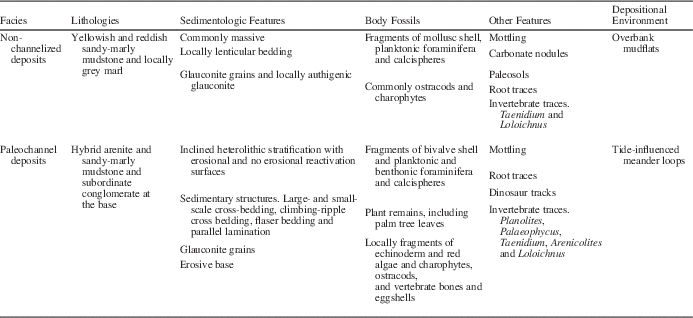
Ichnologic data were obtained from a 300 m thick section near the Orcau locality along the Cantals and Carant gullies (Fig. 1.2). Two main sedimentary facies are recognized in this section; paleochannel deposits and non-channelized sandy-marly mudstones. These facies have been recently analyzed by Díez-Canseco et al. (Reference Díez-Canseco, Arz, Benito, Díaz-Molina and Arenillas2014) and interpreted as deposited in tide-influenced meander loops and overbank mudflats, respectively (Table 1).
Sedimentologic and paleontologic features in the “redbed” facies (Maastrichtian Tremp Formation; modified from Díez-Canseco et al., Reference Díez-Canseco, Arz, Benito, Díaz-Molina and Arenillas2014).
Systematic paleontology
Five ichnogenera and six ichnospecies have been identified. Trace fossils are described and classified based on the concept of ichnotaxobases or morphological features that relate to major behavioral aspects and are used to differentiate ichnotaxa (Bromley, Reference Bromley1996, p. 165; Buatois and Mángano, Reference Buatois and Mángano2011, p. 27). The preservational nomenclature of Seilacher (Reference Seilacher1964) is followed. Ichnotaxa are listed alphabetically. Specimens are housed at the Departamento de Estratigrafía of the Universidad Complutense de Madrid, Spain (DEUC-IC).
Ichnogenus Arenicolites Salter, Reference Salter1857
Arenicolites isp.
Arenicolites isp. preserved as negative epirelief and full relief at the top of layers: (1) general view of the paired circular openings, field photo, scale bar represents 10 cm; (2) close-up of paired circular openings, field photo, scale bar represents 1 cm; (3) burrow wall and passive fill in thin-section; note the subtle lining and the massive and fine-grained fill (left) contrasting with the host rock (right), microscope photo, scale bar represents 500 μm; (4) cross-section view of a straight and cylindrical arm of the burrow, oriented perpendicular to the bedding plane, DEUC-IC 5, scale bar represents 1 cm.
Specimens
Approximately 145 specimens (60 pairs and 25 individual arms) studied in the field and 11 slabs with 25 specimens collected (DEUC-IC 5, 22, 24, 38, 26–31, 35, 36). Two specimens studied under petrographic microscope. 185 individual arms measured.
Description
Straight cylindrical burrows, unbranched and oriented perpendicular to inclined to the bedding plane, commonly seen as paired circular openings at the top of the layers. Lined wall and massive fill contrasting with the host rock. Diameter is 3.4–30 mm. Preserved as negative epirelief and exceptionally as full relief. Cross-section views are rarely observed and depth is difficult to measure. Maximum observed length is 70 mm.
Discussion
Where observed, cross-section views show partially preserved single arms of the trace. Although the full U-shaped morphology has not been observed in cross-section, the recurrent presence of paired openings suggests U or Y shape for the specimens. U-shaped burrows are placed in three ichnogenera Rhizocorallium Zenker, Reference Zenker1836, Diplocraterion Torell, Reference Torell1870, and Arenicolites, being Arenicolites the only one without spreite (Fürsich, Reference Fürsich1974). Y-shaped burrows are included in Psilonichnus Fürsich, Reference Fürsich1981, which is characterized by unlined burrows with typically lateral branches, changes in the diameter and with tendency to form singular or bifurcated culs-de-sac (Frey et al., Reference Frey, Curran and Pemberton1984a). None of these features were observed in these specimens. However, features related to the vertical architecture are not possible to evaluate since cross-section views are rarely observed. No identification at ichnospecies level was performed because of the lack of well-exposed cross-sectional views, as well as for the uncertainties regarding differentiation of Arenicolites ichnospecies (Mángano et al., Reference Mángano, Buatois, Maples and West2002).
Ethology and tracemaker
Arenicolites is a dwelling trace (domichnion) produced by suspension-feeding worms (Häntzschel, Reference Häntzschel1975) or by detritus and deposit-feeding worms, particularly polychaetes (e.g., Bromley, Reference Bromley1996). In modern environments, similar burrows are produced in coastal environments by deposit-feeding polychaetes of the families Spionida (e.g., Gingras et al., Reference Gingras, Pemberton, Saunders and Clifton1999) and Carpitellida (e.g., Dashtgard, Reference Dashtgard2011), as well as by suspension-feeding amphipod crustaceans and deposit-feeding sipunculids (e.g., Baucon and Felletti, Reference Baucon and Felletti2013).
Ichnogenus Loloichnus Bedatou, Melchor, Bellosi and Genise, Reference Bedatou, Melchor, Bellosi and Genise2008
Loloichnus isp.
Loloichnus isp. preserved as full relief: (1) general view of the cylindrical and gently sinuous burrow with knobby surface, field photo, scale bar represents 1 cm; (2) detail of the knobby surface texture on the burrow fill, DEUC-IC 16, scale bar represents 1 cm; (3) burrow wall and fill in thin-section; note the micritic wall (white arrow) and the semicircular sections in the inner wall of the transversal grooves (white dashed lines), microscope photo, scale bar represents 500 μm.
Specimens
Approximately 30 specimens studied in the field and four slabs with eight specimens collected (DEUC-IC 16, 27, 36, 38). One specimen studied under petrographic microscope. 28 specimens measured.
Description
Cylindrical, unbranched, straight to gently sinuous burrows, oriented perpendicular to inclined to the bedding plane. Lined burrow, with a micritic wall ~1 mm thick and with transversal grooves in the inner part of the wall. The burrow fill shows isolated protuberances as knobby texture if detached from the lining. Massive fill contrasting with the host. Diameter is 5–28 mm. Maximum observed length is 132.4 mm. Preserved in full relief.
Discussion
Loloichnus has been recently erected based on specimens from the Upper Jurassic-Upper Cretaceous deposits of Patagonia (Argentina). Loloichnus is mainly straight, vertical, cylindrical, thickly lined burrow of constant diameter and knobby surface that is mostly passively-filled (Bedatou et al., Reference Bedatou, Melchor, Bellosi and Genise2008). Only one ichnospecies is known, Loloichnus baqueorensis Bedatou, Melchor, Bellosi and Genise, Reference Bedatou, Melchor, Bellosi and Genise2008. It is commonly Y-branching, with a wall showing grooves and grouped or isolated protuberances in the inner part and with a passive fill where pellets and root trace fossils can be preserved (Bedatou et al., Reference Bedatou, Melchor, Bellosi and Genise2008). The specimens of Loloichnus isp. from Spain are unbranched, commonly sinuous shaped and potentially represent a different ichnospecies.
Because of the knobby marks of the walls, Loloichnus isp. can be confused with ichnospecies of Psilonichnus, Lunulichnus Zonneveld, Lavigne, Bartels and Gunnell, Reference Zonneveld, Lavigne, Bartels and Gunnell2006 or Camborygma Hasiotis and Mitchell, Reference Hasiotis and Mitchell1993 (Bedatou et al., Reference Bedatou, Melchor, Bellosi and Genise2008). However, Psilonichnus is unlined and predominantly J-, Y- and U-shaped (Frey et al., Reference Frey, Curran and Pemberton1984a) and Lunulichnus is unlined and with a distinctive lunate wall sculpting (Zonneveld et al., Reference Zonneveld, Lavigne, Bartels and Gunnell2006). On the other hand, Camborygma commonly displays multiple shafts, corridors and chambers (Hasiotis and Mitchell, Reference Hasiotis and Mitchell1993). In terms of general form, a related ichnogenera is Capayanichnus Melchor, Genise, Farina, Sánchez, Sarzetti, Visconti, Reference Melchor, Genise, Farina, Sánchez, Sarzetti and Visconti2010; however, Capayanichnus has an ornamented wall with parallel sets of ridges oblique to the burrow axis instead of knobby marks. In some of the Loloichnus isp. specimens described, the lining is not apparent. In South-Central Pyrenees similar trace fossils are observed in Maastrichtian fluvio-lacustrine facies where they have been assigned to the ichnospecies Spirographites ellipticus Astre, Reference Astre1937 (Mayoral and Calzada, Reference Mayoral and Calzada.1998). Spirographites ellipticus is a meniscate filled trace with a knobby ornamentation that resembles that of the analyzed specimens. However, meniscate backfill is absent in the analyzed specimens.
Ethology and tracemaker
Loloichnus is a dwelling trace (domichnion) produced by predaceous decapods, particularly crabs or crayfishes (Bedatou et al., Reference Bedatou, Melchor, Bellosi and Genise2008). These authors interpreted the only known ichnospecies as produced by crayfishes. Similar trace fossil morphologies have been compared with crayfish burrows based on neoichnological data (Hasiotis and Mitchell, Reference Hasiotis and Mitchell1993; Hasiotis et al., Reference Hasiotis, Mitchell and Dubiel1993). Crayfishes from the Northern Hemisphere are camboricids, whereas crayfishes from the Southern Hemisphere are parastacids (Crandall and Buhay, Reference Crandall and Buhay2008). Loloichnus is commonly associated with parastacids (Bedatou et al., Reference Bedatou, Melchor, Bellosi and Genise2008). However, the studied area during the Upper Cretaceous was located in the Northern Hemisphere (Scotese, 2001) and the Spanish Loloichnus may have been produced by camboricids.
Ichnogenus Palaeophycus Hall, Reference Hall1847
Palaeophycus isp.
Palaeophycus isp. preserved as full relief at the top of the layers: (1) general view of the cylindrical burrow oriented parallel to the bedding plane, field photo, scale bar represents 5 cm; (2) general view of various specimens oriented gently inclined to the bedding plane; note the circular section and the dust film wall, field photo, scale bar represents 5 cm.
Specimens
Approximately 30 specimens studied in the field and five slabs with 14 specimens collected (DEUC-IC 18, 20, 21, 23, 33, 34). 18 specimens measured.
Description
Unbranched, cylindrical, straight to gently sinuous burrows, oriented parallel to gently inclined to the bedding plane. Burrow lining consisting of a dust film. Massive fill similar to the host rock. Diameter is 3–17 mm. Maximum observed length is 142.3 mm. Preserved in full relief on the top of the layers. Overlapping among different individuals is rare.
Discussion
Palaeophycus can be confused with Planolites Nicholson, Reference Nicholson1873 being both simple horizontal to inclined, cylindrical burrows with full relief preservation. However, Planolites has unlined wall and active fill that commonly contrasts with the host substrate (Pemberton and Frey, Reference Pemberton and Frey1982). Additionally, Palaeophycus from the Tremp Formation occurs as isolated specimens, whereas Planolites tends to occur in profuse densities (see below).
Ethology and tracemaker
Palaeophycus is a dwelling structure (domichnion) produced by predaceous vermiform or suspension-feeding organisms (Pemberton and Frey, Reference Pemberton and Frey1982). Incipient Palaeophycus are known to be produced by predaceous polychaetes in marine environments (e.g., Gingras et al., Reference Gingras, Pemberton, Saunders and Clifton1999), but other makers may have been involved in continental settings, such as semiaquatic insects (orthopterans and hemipterans) or semiaquatic and non-aquatic beetles (Krapovickas et al., Reference Krapovickas, Mancuso, Arcucci and Caselli2010).
Ichnogenus Planolites Nicholson, Reference Nicholson1873
Planolites isp.
Planolites isp. preserved as full relief: (1, 2) cross-section view of several specimens tubular shaped and oriented parallel to inclined to the bedding plane; note the common overlapping, field photos, scale bar represents 1 cm; (3) burrows displaying circular and cylindrical sections and coarser sized fill contrasting with the finer host rock, field photo, scale bar represents 1 cm; (4) burrow wall and fill (dark patch) in thin-section; note the massive fill and the unlined nature of the wall (arrow), microscope photo, scale bar represents 1 mm; (5) close-up of the active fill showing glauconite grains (white arrows) and foraminifera (black arrows), microscope photo, scale bar represents 500 μm.
Specimens
Approximately 60 specimens studied in the field and three slabs with nine specimens collected (DEUC-IC 20, 23, 33). Two specimens studied under petrographic microscope. 104 specimens measured.
Description
Unbranched, cylindrical, straight to gently sinuous, unlined burrows, oriented parallel to gently inclined to the bedding plane. Massive fill contrasting with the host rock. Diameter is 3–18 mm. Maximum observed length is 134.4 mm. Preserved in full relief. Overlapping among different individuals is common.
Discussion
Planolites can be confused with Palaeophycus being both simple horizontal to inclined and cylindrical burrows with full relief preservation. However, Palaeophycus has lined wall and passive fill that commonly is similar to the host substrate (Pemberton and Frey, Reference Pemberton and Frey1982).
Ethology and tracemaker
Planolites is a feeding structure (fodinichnion) interpreted as produced by deposit-feeding vermiform organisms that actively fill their burrows (Pemberton and Frey, Reference Pemberton and Frey1982; Fillion and Pickerill, Reference Fillion and Pickerill1990; Uchman, Reference Uchman1995).
Ichnogenus Taenidium Heer, Reference Heer1876–18Reference Heer77
Discussion
Taenidium comprises unlined meniscate burrows. Taxonomy of meniscate trace fossils is based on their wall details and the presence or absence of branching (D’Alessandro and Bromley, Reference D’Alessandro and Bromley1987). Taenidium is distinguished from other meniscate ichnogenus, such as Beaconites Vialov, Reference Vialov1962, Scoyenia White, Reference White1929, and Anchorichnus Heinberg, Reference Heinberg1974 by the absence of wall, wall striations, and peripheral mantle, respectively (Keighley and Pickerill, Reference Keighley and Pickerill1994). Taenidium is straight, curved or sinuous, variably oriented, unlined, essentially cylindrical and with meniscate backfilled; secondary successive branching may occur, but true branching is absent (Keighley and Pickerill, Reference Keighley and Pickerill1994). The structure of the meniscate fill is used for Taenidium at ichnospecies level (D’Alessandro and Bromley, Reference D’Alessandro and Bromley1987; D’Alessandro et al., Reference D’Alessandro, Ekdale and Picard1987; Keighley and Pickerill, Reference Keighley and Pickerill1994; Bromley, Reference Bromley1996). Originally, three ichnospecies were regarded as valid by D’Alessandro and Bromley (Reference D’Alessandro and Bromley1987), all of them with the menisci distinctly packed and distinguished by the geometry of the menisci and the relative size and shape of the packets; T. serpentinum Heer, Reference Heer1876–18Reference Heer77, T. cameronensis (Brady, Reference Brady1947), and T. satanassi D’Alessandro and Bromley, Reference D’Alessandro and Bromley1987. Taenidium barretti (Bradshaw, Reference Bradshaw1981) was originally included in Beaconites and subsequently transferred to Taenidium based on the absence of lining (Keighley and Pickerill, Reference Keighley and Pickerill1994). However, there is still no consensus regarding the presence or absence of lining in Beaconites. For instance, Goldring and Pollard (Reference Goldring and Pollard1996) and Morrisey and Braddy (Reference Morrissey and Braddy2004) assigned unlined meniscate specimens to Beaconites. Despite the efforts of Smith et al. (Reference Smith, Hasiotis, Kraus and Woody2008), we agree with Buatois et al. (Reference Buatois, Uba, Mángano, Hulka and Heubeck2007) in that a comprehensive review of meniscate trace fossils is still necessary.
Taenidium barretti (Bradshaw, Reference Bradshaw1981)
Two different forms of Taenidium barretti have been recognized and named as type 1 and type 2.
TYPE 1
Taenidium isp. preserved as full relief: (1) straight to sinuous meniscate burrows of Taenidium barretti type 1. They are variably oriented with respect to the bedding plane; note the circular cross sections and the common overlapping of the specimens, DEUC-IC 10, scale bar represents 1 cm; (2) meniscate burrows of Taenidium barretti type 2 are oriented parallel to the bedding plane, reaching up to 70 cm long, arrows pointing the length of the specimen illustrated, field photo, scale bar represents 15 cm; (3) cross-section view of the meniscate fill of Taenidium barretti. Meniscate fills display similar (type 1) or contrasting (type 2) grain size with respect to the host rock, DEUC-IC 42, scale bar represents 1 cm; (4) Meniscate Taenidium bowni; note the menisci grouped in elliptical shaped packets, field photo, scale bar represents 1 cm.
Photomicrographs in transmitted light with line drawings of Taenidium barretti. Menisci are marked by coloured oxides (larger dashed lines) and by lined grains of quartz (circles); note the unlined wall (shorter dashed lines): (1) Meniscate fill in Taenidium barretti type 1, texturally similar to the host rock, longitudinal view, scale bar represents 1 mm; (2) Meniscate fill in Taenidium barretti type 2, contrasting with the host rock; note the subtle concentric fill when the trace fossil is observed in cross-section view, scale bar represents 1 mm.
Specimens
Approximately 160 specimens studied in the field and 12 slabs with 30 specimens collected (DEUC-IC 3, 10, 13, 20, 23, 24, 32, 34, 37, 40–42). Ten specimens studied under petrographic microscope. 150 specimens measured.
Description
Straight to gently sinuous, unbranched, unlined, meniscate filled burrows, with circular to ellipsoidal section and oriented variably to the bedding plane. The parallel to inclined part of the burrow can be joined to a short vertically oriented segment that ends at the top of the layer. Burrow fill similar in grain size and composition to the host rock, but with different colour. Meniscate fill is homogenous to gently heterogeneous. Where homogenous, menisci are demarcated by oxide precipitation, whereas where heterogeneous, menisci are subtly delineated by the orientation of quartz grains. Menisci are densely and commonly diffusely stacked and are not grouped in visible compartmentalized packets. Trace width is 3–19 mm. Maximum observed length is 126.8 mm. Preserved in full relief. Overlapping among different specimens is very common. Some specimens coalesce to form aggregates.
TYPE 2
Specimens
Approximately 70 specimens studied in the field and 11 slabs with 20 specimens collected (DEUC-IC 20, 25, 27–29, 31–34, 37, 42). Two specimens studied under petrographic microscope. 63 specimens measured.
Description
Straight to sinuous, unbranched, unlined, meniscate-filled burrows, with circular to ellipsoidal section and oriented parallel to the bedding plane. Burrow fill contrasting with the host rock, being commonly finer-grained and with more abundance of dark micrite-clay. Meniscate fill is commonly heterogeneous with menisci marked by selected and lined grains of quartz. Menisci are densely and commonly diffusely stacked and are not grouped in visible compartmentalized packets. Trace width is 4–18 mm. Maximum observed length is 664.5 mm. Preserved in full relief on the top of the layers. Overlapping among different specimens is rare.
Discussion
Taenidium barretti is the only ichnospecies with the menisci not grouped in compartmentalized packets. The menisci are thin segments, hemispherical or deeply arcuate and tightly stacked (Keighley and Pickerill, Reference Keighley and Pickerill1994). In the original definition of T. barretti, Bradshaw (Reference Bradshaw1981) noted that the horizontal sections are commonly joined by short vertical tunnels. Both types of burrows can be included within T. barretti, but they differ in their preservation and in two ichnotaxobases that must be taken into account (Bromley Reference Bromley1996; Buatois and Mángano, Reference Buatois and Mángano2011). First, the general form is notably different, being type 2 specimens more sinuous, longer and mainly oriented parallel to the bedding plane instead of variably oriented as in type 1. Second, although both types have meniscate fill, the fill in type 1 is similar to the host rock whereas it is different than the host rock in type 2.
Ethology and tracemaker
Taenidium barretti is a locomotion trace (repichnion) and/or a feeding structure (fodinichnion). Meniscate fill is an active backfill that results from mechanic manipulation or ingestion by the animal (e.g., Buatois and Mángano, Reference Buatois and Mángano2011). On one hand, meniscate fill is produced by an animal that passes material along the sides of its body and compact it behind them by forward motion but with few evidence of ingestion (Bradshaw, Reference Bradshaw1981) and commonly produced by locomotion of insects (Frey et al., Reference Frey, Pemberton and Fagerstrom1984b; O’Geen and Busacca, Reference O’Geen and Busacca2001; Gregory et al., Reference Gregory, Martin and Campbell2004). On the other hand, Taenidium barretti may involve ingestion and excretion of an animal that transports the sediment through the body as it has been associated with deposit or detritus feeding organisms, most likely worm-like organisms (Bown and Kraus, Reference Bown and Kraus1983; Squires and Advocate, Reference Squires and Advocate1984; D’Alessandro et al., Reference D’Alessandro, Ekdale and Picard1987; Sarkar and Chaudhuri, Reference Sarkar and Chaudhuri1992; Schlirf et al., Reference Schlirf, Uchman and Kümmel2001). The characteristics of the meniscate active fill in Taenidium barretti of the Tremp Formation suggest a feeding behaviour for the tracemaker. The active fill is usually finer-grained than the surrounding sediment (Figs. 6.3, 7.2) and mostly there is an accumulation of grains of quartz delineating the menisci (Fig. 7). The sorting of sedimentary grains by manipulation of an infaunal burrower is associated with a selective feeding strategy (Dafoe et al., Reference Dafoe, Gingras and Pemberton2008). Stanley and Fagerstrom (Reference Stanley and Fagerstrom1974) also interpreted the sorting of the menisci as produced by selective or non-selective deposit feeders that preferably pass sediment around or through their bodies, respectively but always with ingestion. Thereby, feeding behavior was interpreted for similar trace fossils in “redbeds” facies in South-Central Pyrenees based on the heterogeneous microstructure of the menisci (Rossi, Reference Rossi1997). This author suggested that the organisms feed the organic matter associated with Microcodium. Taenidium barretti is interpreted here as produced by a deposit feeder with the ability to ingest and to excrete material and compact it behind the body, being most likely a feeding structure (fodinichnion).
Taenidium bowni (Smith, Hasiotis, Kraus, and Woody, Reference Smith, Hasiotis, Kraus and Woody2008)
Specimens
Approximately 10 specimens studied in the field and two slabs with six specimens collected (DEUC-IC 3, 41). One specimen studied under petrographic microscope. 10 specimens measured.
Description
Straight to sinuous, unbranched, unlined, meniscate-filled burrows, with circular to ellipsoidal section and oriented variably to the bedding plane. Burrow fill similar to the host rock, but with different color. Meniscate fill is homogenous with menisci distinguished by the oxide precipitation through the discontinuities between them. Menisci are densely stacked and grouped in elliptical shaped packets. Trace width is 6–16 mm. Maximum observed length is 178 mm. Preserved in full relief. Overlapping among different specimens is very common.
Discussion
Taenidium bowni was originally included in a new separate ichnogenus as Naktodemasis bowni Smith, Hasiotis, Kraus, and Woody, Reference Smith, Hasiotis, Kraus and Woody2008. It is unlined and distinguished from other meniscate ichnotaxa only by the presence of the fill organized in nested series of ellipsoidal packets (Smith et al., Reference Smith, Hasiotis, Kraus and Woody2008). These structures were originally referred to as adhesive meniscate burrows in various papers (e.g., Hasiotis, Reference Hasiotis2004). Taenidium bowni differs from other ichnospecies of Taenidium in the style of the meniscate fill. The style of the meniscate fill is an ichnotaxobase used in Taenidium as ichnospecies rank (D’Alessandro and Bromley, Reference D’Alessandro and Bromley1987). Thus, Krapovickas et al. (Reference Krapovickas, Ciccioli, Mángano, Marsicano and Limarino2009) suggested that T. bowni should be included in Taenidium, a decision endorsed here. Therefore, Naktodemasis is regarded as a junior synonym of Taenidium.
Ethology and tracemaker
Taenidium bowni has been interpreted by Smith et al. (Reference Smith, Hasiotis, Kraus and Woody2008) as a locomotion (repichnion) structure constructed most likely by burrower bugs, cicada nymphs, and less likely by scarabaeid or carabid beetles, based on burrow morphology and comparison with similar structures produced in modern soils. In addition, neoichnological experiments show that this kind of burrow may be also produced by beetle larvae (Counts and Hasiotis, Reference Counts and Hasiotis2009).
Size of invertebrate burrows
Burrow width and length were measured. True burrow length is obscured by poor exposure of cross-section views (Arenicolites), or by variable orientations (Loloichnus, Planolites, or Taenidium). Thus, maximum observed length has been measured, but this has not been treated statistically. Measurements were taken from 61 selected field images by using the software JMicroVision v1.27. The statistical analysis (descriptive statistics and frequency analysis) was made with the software SPSS v15.
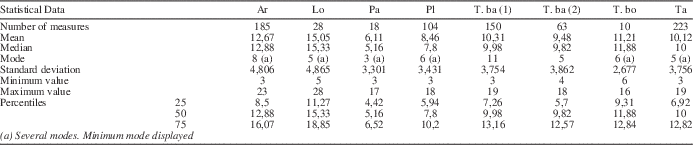
All of the invertebrate burrows are cylindrical to sub-cylindrical and the width rarely varies along individual specimens. Burrow width ranges from 3 to 28 mm. The statistical analysis illustrates that burrow width varies according with the ichnogenera (Fig. 8, Table 2). Three populations of trace fossils are suggested by differences in width size. Although the minimum and maximum values of burrow width overlap in the three populations (Fig. 8.1), the dispersion of the values varies. How data fall in a distribution can be observed by their relative standing that is well expressed by quartiles (Larsen and Marx, Reference Larsen and Marx1990, p. 115). The Interquartile Range (IQR, difference between the third and the first quartiles) indicates where the most representative data are distributed, as well as their dispersion (Fig. 8.2). The three populations identified are (1) small Palaeophycus and Planolites with minimum and maximum width values of 3 and 18 mm. The majority of width data are within a narrow range of values (Fig. 8.2), IQRPalaeophycus=4.4–6.5 and IQRPlanolites=5.9–10.2; (2) variable sized Taenidium with minimum and maximum width values of 3 and 19 mm. The width data have higher dispersion (Fig. 8.2), IQRTaenidium=6.9–12.8; and (Reference Astre3) large and variable sized Arenicolites and Loloichnus with minimum and maximum width values of 3 and 28 mm. The width data have the highest dispersion and so the burrows exhibit a broad range in sizes (Fig. 8.2), IQRArenicolites=8.5–16 and IQRLoloichnus=11.3–18.9. The implications of size analysis are addressed below.
Descriptive statistics for the measures of burrow width: (1) distribution of burrow widths grouped by ichnotaxa; note the burrow width ranging from 3 to 28 mm; (2) Interquartile Range (IQR) plotted for each ichnogenus and showing three populations of burrow widths based in the position and size of the IQR; note that “variable” is here synonymous of relative high dispersion of values. Mean is indicated with the black transversal line. Ichnogenera displayed are from the bottom to the top, Palaeophycus, Planolites, Taenidium, Arenicolites, and Loloichnus.
Statistical data for the measures of burrow width.
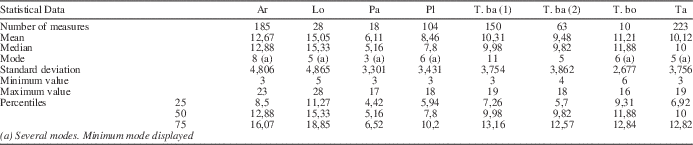
Ar, Arenicolites isp.; Lo, Loloichnus isp.; Pa=Palaeophycus isp.; Pa=Planolites isp.; T. ba (1)=Taenidium barretti type 1; T. ba (2)=Taenidium barretti type 2; T. bo=Taenidium bowni; Ta=Taenidium isp., units=mm.
Trace fossil distribution and additional biogenic structures
The ichnologic characteristics of the two main facies of the Maastrichtian “redbeds” of the Tremp Formation; the paleochannel deposits and the non-channelized sandy-marly mudstones (Table 1), as well as their changes through the stratigraphic section (Fig. 9), were studied.
Stratigraphic section of the Maastrichtian “redbeds” of the Tremp Formation at Orcau locality, showing the vertical distribution of biogenic structures and other features: (1) mottling; (2) carbonate nodules; (3) paleosols; (4) root traces; (5) vertebrate tracks; (6) invertebrate burrows (modified from Díez-Canseco et al., Reference Díez-Canseco, Arz, Benito, Díaz-Molina and Arenillas2014). Note invertebrate burrows are indicated in decreasing abundance from left to right.
Paleochannel deposits show mottling, root trace fossils, invertebrate burrows and vertebrate tracks (Fig. 9, Table 1). The invertebrate trace fossils present in paleochannel deposits are Planolites isp., Palaeophycus isp., Loloichnus isp., two types of Taenidium barretti, and Arenicolites isp. The distribution of these ichnotaxa within the paleochannel deposits is heterogeneous and is mainly controlled by the sedimentary processes taking place in meander loops, such as differences in flow velocity on the point bars. In addition to the invertebrate ichnofauna previously described, other biogenic structures such as root-related structures and vertebrate tracks, occur in this facies (Fig. 9). Root-related structures fulfil for the most part the criteria proposed by Gregory et al. (Reference Gregory, Martin and Campbell2004) to identify structures related to plant roots. They consist of single tubes, locally branching downwards, oriented perpendicular to the bedding plane, with millimetric width and depth that varies from a few millimeters to 1 m. Diameter is highly variable even within individual specimens. They are commonly surrounded by centimetric reddish alteration haloes. Root-like structures are here named traces since they show substrate changes recorded in haloes that would reflect behaviors such as respiration, ion exchange, water and nutrients flow, and/or interactions with other organisms (Gregory et al., Reference Gregory, Martin and Campbell2004). Root trace fossils can be profuse, particularly at the uppermost part of the deposits (Fig. 9). In addition to these paleosol features, vertebrate tracks are preserved as positive hyporeliefs at the base of paleochannel deposits. They have been recently interpreted as produced by hadrosaurian and sauropod dinosaurs (Vila et al., Reference Vila, Oms, Fondevilla, Gaete, Galobart, Riera and Canudo2013). Besides, mottling is common and occurs as centimetric yellow and red amoeboid patches with irregular distribution. Mottling is mainly produced by the intrusion in soupy substrate of benthic organisms (Bottjer and Droser, Reference Bottjer and Droser1991; Ekdale and Bromley, Reference Ekdale and Bromley1991; Taylor and Goldring, Reference Taylor and Goldring1993; Mángano and Buatois, Reference Mángano and Buatois2004; Buatois and Mángano, Reference Buatois and Mángano2011, p. 28) or/and by the remobilization of iron associated with pedogenic processes (Freytet et al., Reference Freytet1973; Alonso-Zarza, Reference Alonso-Zarza2003). In the paleochannel deposits, mottling is commonly observed together with abundant invertebrate trace fossils, suggesting that it is formed, at least partially, due to the activity of the invertebrate tracemakers. However, mottling is also common through the uppermost part of the deposits where root trace fossils can be also profuse. Here, mottling could be related with both pedogenic and/or biogenic processes.
The abundance of mottling, root trace fossils and vertebrate tracks, as well as the main invertebrate ichnotaxa, varies in the paleochannel deposits along the studied section (Fig. 9). Díez-Canseco et al. (Reference Díez-Canseco, Arz, Benito, Díaz-Molina and Arenillas2014) grouped the paleochannel deposits into three clusters based on their location along the stratigraphic section as first, second, and third cluster of paleochannel deposits (Fig. 9). In general, the three clusters contain the suite formed dominantly by Taenidium barretti, type 1, and locally by Taenidium barretti, type 2, Arenicolites isp. Palaeophycus isp. and Loloichnus isp. However, there are some differences among the ichnofaunal content of the three clusters. The first cluster is characterized by abundant mottling and a Planolites isp. suite in the lowermost part, the second cluster is typified by a remarkable abundance of Arenicolites isp., and the third cluster is characterized by abundant mottling and the recurrent presence of root and vertebrate trace fossils.
The non-channelized sandy-marly mudstone facies displays mottling, root trace fossils, paleosols, carbonate nodules and invertebrate burrows (Fig. 9, Table 1). Mottling and root trace fossils are similar to those described for the paleochannel deposits. Paleosols are characterized by a high concentration of carbonate, mottling, and widespread root trace fossils. Paleosols are up to 2 m thick and with a lateral continuity of hundreds of meters. Carbonate nodules are centimetric sized, irregular shaped and disperse in some reddish sandy-marly mudstone (Fig. 9). Carbonate nodules were most likely produced by pedogenic processes (Esteban and Klappa, Reference Esteban and Klappa1983; Alonso-Zarza, Reference Alonso-Zarza2003). Where burrowed, this facies is characterized by a suite of Taenidium barretti, type 1, Taenidium bowni and locally Loloichnus isp. Mottling and invertebrate burrows commonly occur together and also with root trace fossils in the third cluster of paleochannel deposits (Fig. 9).
Discussion
Taphonomic controls
The mode of preservation of trace fossils is controlled by intrinsic biological determinants, but also by extrinsic ones as the type or consistency of the substrate (Bromley, Reference Bromley1996), as well as other subsequent sedimentologic factors, such as diagenetic processes and penecontemporaneous erosion and agradation (Goldring et al., Reference Goldring, Pollard and Taylor1997). The morphological features resulting from external parameters must be taken into account during ichnotaxonomic determination (Goldring et al., Reference Goldring, Pollard and Taylor1997; Minter et al., Reference Minter, Braddy and Davis2007) to avoid oversplitting. Here, the relationship between some morphological features of the studied trace fossils and the extrinsic parameters are evaluated.
One of the principles of ichnology is that the same behaviour of an organism can produce various morphologies in different substrates (Bromley, Reference Bromley1996). A well-known example of trace fossil controlled by substrate consistency are the different morphologies of the chevron-shaped locomotion trace Protovirgularia, which is produced by bivalves with a bifurcated foot moving across the sediment (e.g., Maples and West, Reference Maples and West1990; Seilacher and Seilacher, Reference Seilacher and Seilacher1994; Mángano et al. Reference Mángano, Buatois, West and Maples1998; Gibert and Domènech, Reference Gibert and Domènech2008; Carmona et al., Reference Carmona, Mángano, Buatois and Ponce2010). The two morphologic types of Taenidium barretti in the Tremp Formation can be explained as well as controlled by the characteristics of the substrate. Substrate consistency and physical properties are mainly controlled by water content, compaction, and cementation (Ekdale, Reference Ekdale1985; Lewis and Ekdale, Reference Lewis and Ekdale1992) and these characteristics control burrowing styles. For example, as compacted sediment is stiffer, this results in a decreased burrowing rate and penetration depth (Ansell, Reference Ansell1962; Trueman, Reference Trueman1966). The same happens with cementation, which increases shear strength, making penetration difficult. The vertical profile through the substrate is zoned in terms of water content because the weight of overburden causes dewatering (Bromley, Reference Bromley1996). Consequently, a more compacted and/or cemented substrate has less water content and increased shear strength, offering additional resistance to burrowing (Mángano et al., Reference Mángano, Buatois, West and Maples1998). Less compacted or cemented substrates tend to favour the generation of variably oriented burrows, being the tracemakers able to change the direction of burrowing and to penetrate deeper (Fig. 6.1). Otherwise, the path followed by infaunal burrowers where the substrate is stiffer tends to be shallower and mainly oriented horizontal to the bedding plane since the underlying sediment is more compacted, dewatered or/and cemented (Fig. 6.2). Following this line of reasoning, the two types of Taenidium barretti do not represent differences in behaviors, but essentially reflect changes in the properties of the substrate.
On the other hand, diagenesis implies physicochemical processes of preservation and alteration that may enhance or diminish trace fossils (Goldring et al., Reference Goldring, Pollard and Taylor1997; Buatois and Mángano, Reference Buatois and Mángano2011). This is due, in part, to the different characteristics of the sediment within burrows and in the host rock. For instance, the content in organic matter may act as focus for mineral precipitations in burrow linings (Fürsich, Reference Fürsich1972) or linked to the organic detritus excreted by feeding organisms (McIlroy et al., Reference McIlroy, Worden and Needham2003; Needham et al., Reference Needham, Worden and Cuadros2006). In addition, the differences in porosity and permeability of the burrows play an important role during diagenesis (Pemberton and Gingras, Reference Pemberton and Gingras2005). Taenidium barretti shows Fe oxides precipitated along the discontinuities between the menisci (Fig. 7), most likely during diagenesis. These oxides enhance the meniscate fill, favouring menisci visibility (Fig. 7). Because the precipitation of oxides is controlled by the oxidation/reduction conditions, a change in these conditions would affect the mode of preservation of the burrows. Although Planolites (Fig. 5) may be regarded as a preservational variant of Taenidium barretti where the meniscate fill is not visible, subtle evidence of the meniscate fill, such as the array of the quartz grains or visible meniscate shaped discontinuities (Fig. 7), are not observed in the specimens assigned to Planolites. In addition, Planolites is consistently smaller than Taenidium (Fig. 8) in the studied collection, arguing against a taphonomic control.
The large variation in size of Loloichnus and Arenicolites is most likely due to intrinsic biologic determinants, but external parameters, such as erosion and lithification cannot be disregarded. The preservation potential of the thick-walled Loloichnus is higher than that of unlined burrows; even smaller burrows produced by juvenile crustaceans may be preserved. In addition, the depth of penetration of the burrowing crustaceans producing Loloichnus is larger than that of the other burrows described in this study (Fig. 3), increasing preservation potential as well. These features, intrinsic to the Loloichnus tracemaker, may have contributed to the large range of sizes recorded for Loloichnus (Fig. 8, Table 2). Arenicolites is similar in width to Loloichnus (Fig. 8, Table 2) but because of the type of preservation of the burrows as negative epirelief, the large variation in their size may reflect an overprint by erosion. Preservational style of the Tremp Arenicolites is remarkably similar to U-shaped burrows present in intertidal sediment covering beach rocks in the Bay of Fundy (Fig. 10.1). There, on the sedimentary surface, openings of U-shaped burrows are visible as paired large oval depressions preserved as negative epirelief (Fig. 10.2). In cross-sectional views, small U-shaped traces of incipient Arenicolites produced by the amphipod crustacean Corophium volutator (Pallas, Reference Pallas1766) are preserved as full relief (Fig. 10.3, 10.4). Corophium volutator has the ability to switch from suspension feeding to deposit feeding (Gerdol and Hughes, Reference Gerdol and Hughes1994), as well as to feed from detritus by scraping (Meadows and Reid, Reference Meadows and Reid1966). The larger size of Arenicolites preserved on bed tops may reflect currents during ebb-flood tides, washing up sediment previously manipulated and accumulated by the organisms. Thus, the contrast in size between the openings preserved as negative epirelief and the U-shaped burrows preserved as full relief (Fig. 10) may be a taphonomic feature controlled by sedimentary processes, such as erosion and partial lithification and not by differences in behavior. Thus, the high dispersion of Arenicolites width in the Tremp Formation can be of taphonomic origin. Differences in substrate conditions (e.g., water or organic matter content or consolidation) even in an isochronous surface result in variable resistance of the substrate to erosional processes.
Incipient Arenicolites produced by Corophium volutator (Pallas, Reference Pallas1766) in intertidal deposits of the Bay of Fundy: (1) paired large oval openings preserved as negative epirelief at the top of the layers; (2) close-up of paired openings; note the similitude with the trace fossil in Figure 4.2; (3) cross-section in the intertidal deposit, showing small U-shaped tubes preserved as full relief (black arrow); (4) detail of the tracemaker, the amphiphod Corophium volutator, scale bar represents 0.5 mm.
Ichnofacies model
The dominant elements of the Tremp Formation ichnofauna are meniscate backfilled trace fossils typical of the Scoyenia Ichnofacies, an archetypal ichnofacies first proposed by Seilacher (Reference Seilacher1967) and refined subsequently by Frey et al. (Reference Frey, Pemberton and Fagerstrom1984b) and Buatois and Mángano (Reference Buatois and Mángano1995, Reference Buatois and Mángano2002). The meniscate trace fossils of the Tremp Formation belong in Taenidium, mostly Taenidium barretti. Most of the characteristics associated with the Scoyenia Ichnofacies are present in the Tremp ichnofauna. For example, the abundance of meniscate burrows produced by mobile organisms, the mixture of invertebrate, vertebrate and plant trace fossils and the common occurrences of monospecific suites of meniscate ichnotaxa are all characteristics of this ichnofacies (Frey et al., Reference Frey, Pemberton and Fagerstrom1984b; Buatois and Mángano, Reference Buatois and Mángano2004). The Scoyenia Ichnofacies indicates that sediments were periodically exposed to air or periodically inundated (Frey et al., Reference Frey, Pemberton and Fagerstrom1984b; Frey and Pemberton, Reference Frey and Pemberton1984, Reference Frey and Pemberton1987). A low-energy setting is suggested by the abundance of horizontal trace fossils (Buatois and Mángano, Reference Buatois and Mángano2011), whereas the lack of ornamentation characterizes the soft substrate suite of the Scoyenia Ichnofacies (Buatois et al., Reference Buatois, Mángano and Aceñolaza1996; Savrda et al., Reference Savrda, Blanton-Hooks, Collier, Drake, Graves, Hall, Nelson, Slone, Williams and Wood2000; Buatois and Mángano, Reference Buatois and Mángano2002, Reference Buatois and Mángano2004). Dwelling structures, such as Skolithos Haldeman, Reference Haldeman1840 and Cylindricum Linck, Reference Linck1949, may occur, but tend to be subordinate in the Scoyenia Ichnofacies (e.g., Buatois and Mángano, Reference Buatois and Mángano1995). In the Tremp Formation, dwelling structures, such as Arenicolites and Loloichnus, are subordinate to the meniscate trace fossils, but they may be abundant in some paleochannel deposits characterized by higher-flow velocities. Finally, Planolites in the lower paleochannel of the first paleochannel cluster (Fig. 9) most likely illustrates a poorly developed aquatic suite that cannot be included within the Scoyenia Ichnofacies.
Implications for the characterization of tide-influenced meandering channels
Trace fossils of tide-influenced meandering channels have been described in delta plains (e.g., Rebata et al., Reference Rebata, Gingras, Räsänen and Barberi2006a; Hovikoski et al., Reference Hovikoski, Lemiski, Gingras, Pemberton and MacEachern2008a; Sisulak and Dashtgard, Reference Sisulak and Dashtgard2012) and inner zones of estuaries (e.g., Gingras et al., Reference Gingras, Pemberton, Saunders and Clifton1999, Reference Gingras, Räsänen and Ranzi2002; Pemberton et al., Reference Pemberton, Spila, Pulham, Saunders, MacEachern, Robbins and Sinclair2001; Mángano and Buatois, Reference Mángano and Buatois2004; Rebata et al., Reference Rebata, Räsänen, Gingras, Vieira, Barberi and Irion2006b; Hovikoski et al., Reference Hovikoski, Räsänen, Gingras, Ranzi and Melo2008b). In these marginal-marine environments, the ichnofauna is controlled by the stressful conditions affecting the benthic biota, such as salinity fluctuation, increased sediment discharge, and high clay content (e.g., Dörjes and Howard, Reference Dörjes and Howard1975; Pemberton and Wightman, Reference Pemberton and Wightman1992; MacEachern and Pemberton, Reference MacEachern and Pemberton1994; Buatois et al., Reference Buatois, Mangano and Maples1997; Mángano and Buatois, Reference Mángano and Buatois2004; MacEachern and Gingras, Reference MacEachern and Gingras2007; Carmona et al., Reference Carmona, Buatois, Ponce and Mángano2009; Dashtgard, Reference Dashtgard2011). For instance, tide-influenced deposits from brackish-water deltaic or estuarine systems show low-diversity marine trace-fossil assemblages (Pemberton and Wightman, Reference Pemberton and Wightman1992; Mángano and Buatois, Reference Mángano and Buatois2004), whereas the freshwater inner parts may display relatively high diversity of assemblages produced by a terrestrial to freshwater fauna (Buatois et al., Reference Buatois, Mangano and Maples1997). However, examples exhibiting a continuous ichnologic record from the open to the inner part of the estuarine/deltaic system are virtually inexistent.
The ichnofauna from the Tremp Formation does not display marked changes in ichnodiversity through the stratigraphic section, but it shows a subtle change in the trace-fossil assemblages from a poorly developed aquatic suite in the lower part of the first cluster of paleochannel deposits to a relatively well-developed Scoyenia Ichnofacies in the third one (Fig. 9). In addition, small variations in burrow sizes have been detected between the elements of these two assemblages (Fig. 8, Table 2). Therefore, the two trace-fossil assemblages may reflect differences in salinity during the development of the meander loops. The assemblage of the lower part of the first cluster could reflect higher stress conditions due to extreme salinity fluctuations, and brackish-water. This interpretation agrees with the presence in the first cluster of authigenic glauconite (Díez-Canseco et al., Reference Díez-Canseco, Arz, Benito, Díaz-Molina and Arenillas2014).
The Scoyenia Ichnofacies is typical of non-marine, inundated environments, such as lake margins and floodplains (Buatois and Mángano, Reference Buatois and Mángano2011, p. 75 and references therein). However, the Scoyenia Ichnofacies is also present in marginal-marine environments (Buatois et al., Reference Buatois, Mangano and Maples1997), particularly in the fluvial-tidal transition where the ichnofauna distribution is controlled by the limits of maximum salinity and tides. Between both limits, a freshwater tide-influenced area is formed, commonly tens of kilometres wide (e.g., Buatois et al., Reference Buatois, Mangano and Maples1997; Dalrymple and Choi, Reference Dalrymple and Choi2007; Shiers et al., Reference Shiers, Mountney, Hodgson and Cobain2014). The occurrence of elements of the Scoyenia Ichnofacies in the tidal-fluvial transition has been also reported by Netto and Rossetti (Reference Netto and Rossetti2003), Mángano and Buatois (Reference Mángano and Buatois2004), and Hovikoski et al. (Reference Hovikoski, Gingras, Räsänen, Rebata, Guerrero, Ranzi, Melo, Romero, del Prado and Jaimes2007, Reference Hovikoski, Räsänen, Gingras, Ranzi and Melo2008b). Netto and Rossetti (Reference Netto and Rossetti2003) attributed monospecific assemblages of Taenidium in this setting to inner mangrove areas. Thus, the upper part of the section of Tremp Formation was deposited most likely under freshwater conditions within the fluvial-tidal transition.
On the other hand, Arenicolites is more abundant in the lower part of the section, particularly in the second cluster of paleochannel deposits (Fig. 9). The higher abundance of Arenicolites may indicate areas occasionally subjected to higher-energy tidal currents and/or brackish-water conditions. Arenicolites in the Tremp Formation closely resembles the enlarged Arenicolites observed in the intertidal areas of Bay of Fundy, where it is produced by the crustacean Corophium volutator (Pallas, Reference Pallas1766) (Fig. 10). Corophium volutator inhabits mud flats, salt-marsh pools, and brackish-water ditches, and tolerates a wide range of salinities from seawater to almost freshwater (Kluijver and Ingalsuo, Reference Kluijver and Ingalsuo1999; Percy, Reference Percy1999). The differences in abundance of Arenicolites in the studied section can be explained as a result of salinity fluctuations, as well as by tidal fluctuations. Salinity fluctuations may control the distribution of the producer, whereas tidal fluctuations may act as a control factor for the erosion and enlargement of burrow entrances. The second cluster of paleochannel deposits most likely represents an intermediate situation within the fluvial-tidal transition characterized by the Scoyenia Ichnofacies and areas with high density of Arenicolites.
The ichnofaunal variation through the stratigraphic section agrees with the shallowing-upwards tendency detected in the Tremp Formation, based on the decrease in abundance of planktonic foraminifera transported by tidal currents (Díez-Canseco et al., Reference Díez-Canseco, Arz, Benito, Díaz-Molina and Arenillas2014). In the same vein, the ichnofaunal changes reflect the landward location of the younger meandering loop deposits since a decrease in salinity and a passage to freshwater conditions is inferred (Fig. 11). The higher abundance of root trace fossils, paleosols and vertebrate tracks in the third cluster of paleochannel deposits, together with the widespread Scoyenia Ichnofacies indicates formation under freshwater conditions in a landward location. The ichnofauna of the Tremp Formation records deposits within the fluvial-tidal transition of a delta (Díez-Canseco et al., Reference Díez-Canseco, Arz, Benito, Díaz-Molina and Arenillas2014), particularly located in the mixed-energy area and the fluvial-tidal channel (sensu Dalrymple and Choi, Reference Dalrymple and Choi2007) and controlled by the maximum salinity limit (Fig. 11).
Summary model of ichnofaunal distribution in the fluvial-tidal transition of the Tremp Formation. The mixed area and the fluvial-tidal channel are marked in terms of current dominance, whereas ichnology responds to salinity and is controlled by the salinity limit (modified from Buatois et al., Reference Buatois, Mangano and Maples1997; Dalrymple and Choi, Reference Dalrymple and Choi2007; Díez-Canseco et al., Reference Díez-Canseco, Arz, Benito, Díaz-Molina and Arenillas2014; and Shiers et al., Reference Shiers, Mountney, Hodgson and Cobain2014).
Conclusions
The ichnofauna of the tide-influenced meandering channels recorded in the Maastrichtian Tremp Formation consists of Taenidium barretti types 1 and 2, Loloichnus isp., Arenicolites isp., Planolites isp., Palaeophycus isp., and Taenidium bowni. The meniscate trace fossils are the most abundant elements of the ichnofauna. Taenidium barretti is interpreted as produced by a deposit feeder based in the structure of its meniscate backfill.
This ichnofauna reflects paleoenvironmental changes in the meandering channels along the stratigraphic section with a poorly developed aquatic suite in the lowest part of the stratigraphic section and the Scoyenia Ichnofacies in the remaining part. The two suites reflect specific characteristics associated with salinity conditions. The lowermost suite was likely formed seaward of the maximum salinity limit, under extreme brackish-water conditions, whereas the Scoyenia Ichnofacies records a freshwater assemblage that was formed landward of the maximum salinity limit. The presence of brackish-water and freshwater assemblages together within the stratigraphic succession of marginal-marine deposits has been rarely documented in the geological record. Continental ichnofacies occur not only in purely fluvial meandering deposits, but also in deposits of meandering channels emplaced at the fluvio-marine transition.
Acknowledgments
Financial support for this study was provided by the Ministerio de Ciencia e Innovación of Spain via project CGL2009–09000, and a FPI Predoctoral contract and two FPI mobility fellowships awarded to D. Díez-Canseco. We thank J. Cuevas for helping with the statistical analysis and for his assistance in field work, M. Gingras for providing information on the locations in the Bay of Fundy, B. Töró for his assistance in the Bay of Fundy and for providing the photographs of Corophium, and B. Pratt for providing valuable comments on thin sections. We also thank the staff of the Departamento de Estratigrafía of the Universidad Complutense de Madrid who did the thin sections, and B. Novakovski and B. Pratt from the Department of Geological Sciences of the University of Saskatchewan for technical assistance with thin sections and microphotographs. The authors are grateful to A. Martin and an anonymous referee who performed insightful reviews of the manuscript and the editors, S. Hageman and L. Tapanila, for their useful comments and their editing work.