INTRODUCTION
Dairy herd turnover is the result of a trade-off between heifer recruitment and cow culling, which are tightly interlinked (Cournut Reference Cournut2001). Herd-scale culling and replacement decisions are largely shaped by the farmer's forward objectives (Malher et al. Reference Malher, Beaudeau, Poupin, Falaise and Losdat1999), but they may also be governed and/or dictated by farm management system or reproduction performances. In France, as in most milk-producing countries, annual dairy cow culling rates range from 25 to 35% (Mourits et al. Reference Mourits, Van Der Fels-Klerx, Huirne and Huyben2000; Vasseur Reference Vasseur, Pellerin, Rushen, de Pasillé, Cue and Lefebvre2006; RECP 2010), making culling and replacement a critical factor on current cattle farms. Various study sources (CER-Poitou-Charentes 2005; Hénot Reference Hénot2006) cite the average cost (excluding labour) of breeding a replacement dairy heifer at somewhere between €1000 and €1300 in France, depending on the farm system employed. An economic simulation estimated this cost to be €1364 in The Netherlands (Nor et al. Reference Nor, Steenveld and Hogeveen2010). The economic significance of this farm factor therefore warrants special focus from cattle farmers and trade organizations looking to plan ahead on viable future dairy cows. However, the impact of heifer management conditions on the animal's future productivity is still widely underestimated or even completely disregarded, not just by dairy farmers themselves but also by agricultural technologists and/or monitoring organizations. Many reasons have been put forward to explain this shortfall (Mourits et al. Reference Mourits, Dijkhuizen, Hiurne and Galligan1997; Le Cozler et al. Reference Le Cozler, Peccatte, Porhiel, Brunschwig and Disenhaus2009), including no immediate profitability, direct animal management costs unknown as lost in the mass of results for milk activity, and farmers lacking motivation, hard data and/or technical skills on this farm activity.
Following the same logic as for lactating dairy cows, heifers should benefit from rigorous livestock management from birth through to the first calving in order to optimize culling and replacement. Monitoring replacement status involves animal growth and development-stage objectives that may or may not be dictated by the farm's livestock production strategy. These replacement decisions can have potentially significant technical and/or economic impacts. Hénot (Reference Hénot2006) reported that reducing calving age from >32 months to <27 months can cut livestock management costs (by c. €220 per market heifer), reduce the number of animals on the farm and improve milk production per day of life. However, a ‘late calving’ strategy (commonly 36 months at first calving) cannot be routinely ruled out, as it also offers a number of advantages depending on livestock management system, geographic location and other factors (Le Cozler et al. Reference Le Cozler, Peccatte and Delaby2010, Reference Le Cozler, Gallard, Dessauge, Peccatte, Trommenschlager and Delaby2011). Ultimately, though, whatever the strategy adopted, it will hinge on a core set of heifer breeding principles, such as aiming for strong weight gain rates from birth to a 6-month target of c. 200 kg. There are heifer growth monitoring tools available to help farmers achieve this goal, generally employing weight measurement (on a scale) or size gauging (tape weighing, height gauges). Farmers could be expected to devote as much effort to growth monitoring as milk yield and/or quality monitoring, yet this is surprisingly not the case. To illustrate, in the Mayenne département of France, 2800 farms track individual productive animals through the milk quality control testing scheme, whereas only 600 farms track animal growth, of which 400 count both dairy cattle and beef cattle (O. Recoursé, personal communication).
While research on dairy cow performances, herd systems and livestock management practices is flourishing, the few studies specifically addressing dairy heifer farm management are often outdated. However, a handful of descriptive studies recently conducted in Europe (The Netherlands – Mourits et al. Reference Mourits, Van Der Fels-Klerx, Huirne and Huyben2000; Sweden – Pettersson et al. Reference Pettersson, Svensson and Liberg2001) or North America (Canada – Vasseur Reference Vasseur, Pellerin, Rushen, de Pasillé, Cue and Lefebvre2006; USA – USDA 2008) give a general picture of the divergence and/or convergence of practices found across different countries or sub-regions. Little if any equivalent information is available in France. Even when animal growth monitoring is routine practice, there is little if any understanding of the diverse range of livestock management systems engaging the future dairy cow. The aim of the current paper is partially to fill this information gap. Working from an essentially technical standpoint, the paper describes the diversity of dairy heifer herd management systems employed in the low-lying plain zone of the ‘Pays de la Loire’ region of western France, a major dairy area in this country.
MATERIALS AND METHODS
Geographical locality
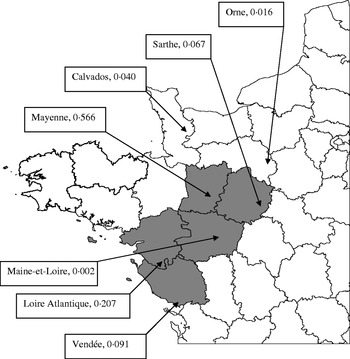
At the outset, the primary objective of the current study was to sketch out an initial description of the heifer rearing practices employed in the low-lying plains of western France using questionnaire-based surveys. For reasons of convenience and practical availability, the work focused on the second-largest region of France in terms of production volumes: the ‘Pays de la Loire’ (0·15 of National production, Fig. 1).
Answers collected per geographic origin from 449 surveyed here as proportion of the total sample population (in grey, the Pays de la Loire Region, Western of France).

Survey samples
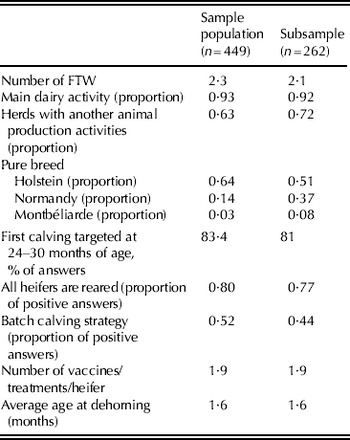
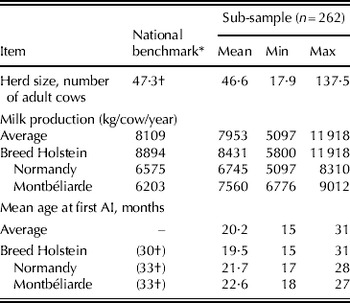
The survey collected essentially qualitative information, and was deliberately designed not to focus on any potential relationships to production levels and/or herd sizes. Furthermore, the survey did not integrate production criteria to prevent investigators from introducing sampling bias. The target focus was on farm diversity rather than all-round sample homogeneity or representativeness. However, at a later stage, i.e. after the survey collection process, a further analysis on a subsample of 262 of the total population of farms was performed, extracting data from the national farms database Système D'Information Génétique (SIG; i.e. the French information system for cattle breeding; Rehben et al. Reference Rehben, Balvay, Bereziat, Bertrand, Boulesteix, Champy, Dos, Fusai, Le Gal, Marguin and Poisnel2005) (Table 1). The qualitative characteristics of these herds were not different from the rest of the sample and thus, the qualitative analysis performed on this subsample was considered to be representative of the entire surveyed sample. The purpose of this procedure was to gauge their position against a handful of national benchmarks.
Cross-comparison on selected items between the subsample used for quantitative analysis and the total sample population

Procedures and survey
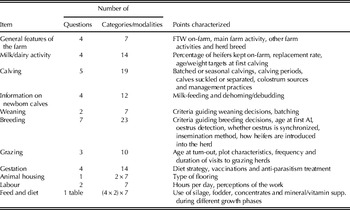
In practice, the vast majority of surveys were conducted by technicians working for French livestock engineering agencies (Organismes Conseil Elevage (OCEL)) tasked with monitoring milk production and technicians working for Bovins Croissance agencies tasked with tracking animal growth in the different administrative départements involved. In a conscious effort not to burden the technicians with an excessive survey workload, the questionnaire was designed to be quick and easy to complete (15–20 min per farm). The authors of the questionnaire thus took similar studies published abroad (Mourits et al. Reference Mourits, Van Der Fels-Klerx, Huirne and Huyben2000; Pettersson et al. Reference Pettersson, Svensson and Liberg2001) as their template. The questionnaire was then adapted, finalized and validated by field experts and survey-based research specialists. The core themes tackled in the questionnaire start with the main defining features of the farm and its local environmental position. Section 2 of the questionnaire turns towards questions on the farm's milk production activity, with the focus on the conditions and practices governing calving, weaning, reproduction, grazing, animal housing, work tasks and diet. In total, the questionnaire tackled nine core themes through 36 questions with several response formats (Table 2). This dataset was completed with a summary table collating the animal feed and diet management policies recorded at each heifer development stage.
Key point description of the questionnaire used (adapted from Mourits et al. Reference Mourits, Van Der Fels-Klerx, Huirne and Huyben2000)

All questions were deliberately closed-ended or semi-structured, to facilitate subsequent analysis of the information collected. The questionnaires were delivered to investigators together with a cover letter, plus oral explanations in some cases.
Analysis
Despite providing comprehensive written guidelines, occasionally consolidated with further oral explanations, there were still cases where no responses were recorded. Consequently, it was not always possible to run the analysis on the full set of questionnaires, particularly for the final section of the survey that dealt with animal housing and feed/diet strategies. Details are given in the text or, where appropriate, in the herd headcounts given in the tables and figures. The information collected was used to build an Excel spreadsheet database. Descriptive analysis of the spreadsheet was mainly performed in Excel, with R statistics software (Venables et al. Reference Venables and Smith2010) also used in some cases. In this later case, descriptive analyses were completed when necessary by additional analysis, using principal component methods and/or other factor analysis (not presented), which confirmed some of the relationships initially observed.
RESULTS
Geographic origin and main defining characteristics of the farms
In total, 449 farmers were interviewed by 107 technicians over the period from November 2009 to March 2010. The sample used represented 0·043 of dairy producers of this region. Only 0·056 of the total sample population was comprised of farms falling outside the administrative boundaries of the ‘Pays de la Loire’ region (i.e. in the Calvados and Orne départements; Fig. 1). The majority of the farmers interviewed were based in the Mayenne département (254 interviewees, i.e. 0·57 of the total sample population). The farms surveyed averaged 2·3 (±0·9) full-time workers (FTW), with some farms having less than one FTW, while others employed up to seven FTW. Milk production is the core activity in the vast majority (0·93) of the farm operations surveyed. However, almost two-thirds of farms also run other livestock operations (pigs, veal calves, poultry, etc.), and in some cases arable crops.
Cross-comparison of national v. sub-sample quantitative data
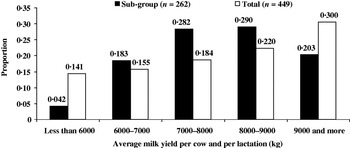
The farms included in the sub-sample came from the Sarthe and Mayenne départements, which together accounted for almost two-thirds of the total farms surveyed (Table 1). The Normandy and Monbéliarde breeds were more common than Holstein breed in the sub-sample, compared to the total sample population. Most of the other criteria did not differ in scale or distribution between sample and sub-sample. It is reasonable to assume that the quantitative figures for this sub-sample give a suitably representative picture of the panel of farms surveyed. The quantitative analysis of the 262-farm sub-sample shows that mean farm size was close to the national average (46·6 v. 47·3 dairy cows per farm), ranging from 18 to more than 137 adult animals. Only two farms had over 100 producer cows (Table 3). The mean production yield, at 7953 kg milk/cow/lactation is slightly lower than the national reference level (−150 kg), even if the production range within the sample varied by a factor of two. Although mean yields were lower than the national average for Holstein cattle (−460 kg), they were higher than the national average for Normandy and Montbéliarde breeds (+170 and +1557 kg /cow/lactation, respectively). Mean age at first service was close to 20 months (range: 15–31 months). Farm distributions according to mean yields also differed from the national averages, with the extreme min–max yielding farms (<6000 and >9000 kg/cow/lactation) under-represented and median classes over-represented (Fig. 2).
Farm distribution according to mean dairy cow milk yield: total sample population (n=449) v. sub-sample population (n=262).

Herd size, mean production level and age at breeding: subsample v. national averages

* Source: Institut de l'Elevage (2010).
† Number of complete lactations/number of farms that provided figures.
Breed, turnover and first calving objectives
Holstein cows were kept on 0·82 of the farms, but only 0·64 had exclusively Holstein herds. Farms rearing purebred Normandy or Montbéliarde cattle represented 0·14 and 0·03 of the sample population. The other farm herds were mixed breed (mainly Holstein–Normandy or Holstein–Montbéliarde crossbreeds). Almost four out of five farmers (0·80) conserved and reared all of the heifers born on-farm, although 0·12 stated that they kept less than half.
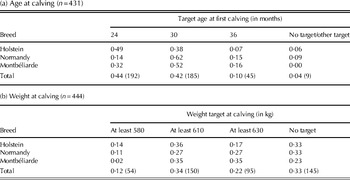
Only 0·02 of farmers declared that they had no clear target for age at first calving. Over 0.80 of the farms surveyed had set a target age at first calving of 24 (0·44) or 30 months (0·42), while 0·10 of farms targeted 36 months at first calving. Around two-thirds of farms also set weight objectives, with target values of ‘at least 580 kg’, ‘at least 610 kg’ or ‘at least 630 kg’ liveweight at first calving in 0·12, 0·34 and 0·22 of dairy farms, respectively. Cross-tabulating the ‘target age at calving’ and ‘breed’ datasets (Table 4) shows earlier age targets at calving for Holstein than for Normandy and Montbéliarde breeds. Focusing on weight objectives, cross-tabulating the ‘target weight at calving’ and ‘breed’ datasets showed few between-farm differences in Holstein, Normandy or Montbéliarde herds. Cross-analysing ‘body weight’ against ‘age at calving’ criteria (only for farmers who had stated objectives) showed that 0·73 of the farmers calving heifers at 24 months had a body weight target of ‘at least 580 kg’ or ‘at least 610 kg’. This figure dropped to 0·69 for calving at 30 months and just 0·21 for calving at 36 months.
Selected farmer objectives according to breed (proportion of answers)

In brackets, heifer headcount in each age class.
Calving strategies
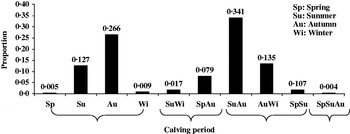
Considering the 449 farms surveyed, calvings were seasonally grouped on 0·52 of farms, with clear-cut variations according to months and seasons (Fig. 3). Calvings grouped over 3 months (recorded in 93 farms) primarily concerned summer- and autumn-season calvings (0·31 and 0·66 of calvings). Only three farms ran spring- and winter-season calving. In cases where calving strategy was based on two separate 3-month periods, only four farms worked to a summer–winter split, whereas 18 farms opted for a spring–autumn split. Farmers electing to group calving batches into two successive 3-month periods were more common, with 78 farms working to a summer–autumn split, 31 farms working to an autumn–winter split and four to a spring–summer split. Only one farm grouped calvings over 9 months.
Distribution of calving periods for farms employing a batched calving strategy (n=229).

Rearing the calves
Management of the colostrum phase
Calves were separated from the mother immediately after birth by 0·53 of the farmers, while 0·47 waited for the calf to suckle. Calves that were not separated were left to suckle for an average of 14 h (±11·7), ranging from 1 h to over 60 h. Only 0·04 of farmers separated calves at later than 24 h of age. The majority of dairy farmers, including those who leave the calf to suckle (319 out of 449), milked off some colostrum, taking around 2·2 litres. According to the farmers, this first colostrum milking was then rapidly administered to the calf. The colostrum was fed to the calf using either a bucket (0·48 of farmers) or a bottle (nursing bottles or multi-teat calf buckets, 0·50). The remaining 0·01 of farmers surveyed systematically fed the colostrum via a stomach tube. As a back-up measure, almost two-thirds of farmers (0·60; n=269) banked colostrum for later use. Selection was based mainly on visual considerations.
The milk feeding phase
In the milk feeding phase, 0·75 of the farmers surveyed used whole milk. The whole milk used is generally (258 out of 336 farmers) the non-marketable milk collected from the first 13 milkings (banned from sale in France). While 149 farmers used milk powder, only 36 used a combination of milk powder plus whole milk. Almost 0·98 of the milk was given in its raw natural form, with the remaining 0·02 delivered as yoghurt or as acidified calf milk. During the milk feeding phase, the calves were mostly housed on straw bedding (0·97 of farms), with other bedding formats (partial or full-shed slatted flooring) accounting for just 0·03 of rearing conditions. Only two farmers then went on to rear their heifers on slatted flooring-based systems.
Dehorning as a case apart
Livestock were generally dehorned before weaning, although 0·04 of farms surveyed did not dehorn their heifers. Most of the 0·96 farms that dehorned their calves used hot iron dehorning (0·87 of dehorner farms), with only 0·11 using chemical dehorning paste. One farmer used a wire saw on the older calves, while four farmers used a combination of different techniques. Calves were dehorned at an average age of 1·6 months (±0·95). Eight farmers stated that they used a local anaesthetic.
Weaning
For 0·72 of the dairy farmers, age (2·9 months±0·7) was the key criterion guiding calf weaning decisions. The survey found that 0·31 of farmers weaned their calves before 2·5 months, 0·38 at between 2·5 and 3·5 months and 0·31 at after 3·5 months of age. Four farmers continued to milk-feed beyond 5 months of age. Animal weight was used alone or with age as a decision criterion to determine when to wean (0·37 of farmers), in which case the farmers stated that body size was also integrated as a factor. The declared mean calf weight at weaning was 105 (±16) kg, but since few farmers actually routinely weighed their calves, the stated weight figures remain unreliable. Among the farmers who stated that they regularly or occasionally weighed their animals, 15 weaned calves before they reached 100 kg liveweight at 2·6 months (n=8 answers stating age), 29 weaned at between 100 and 110 kg at 3 months (n=13), eight weaned at between 110 and 120 kg and a further ten weaned at over 120 kg. For these last two weight bands, age at weaning averaged 3 months of age. Other weaning decision criteria were cited by 0·18 of farmers, with 36 farmers using intake of concentrate in the run up to weaning, where the targeted mean daily intake averaged 2·1 (±0·6) kg per pre-weaning calf.
Heifers management from weaning to calving
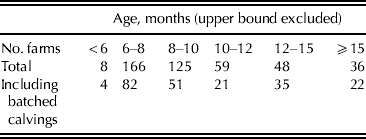
At weaning, almost 0·82 of dairy farmers batched calves into groups, 0·75 of which were based on age alone. Animal batches were first turned out to pasture at an average age of 8·9 (±3·1) months, although with strong between-farm variation (Table 5). One farm never turned heifers out to pasture but kept them permanently housed. In 0·79 of cases, the plots grazed by the heifers were exclusively set aside for this use. In 0·58 of cases, these plots were those furthest away from the main farm business building. At 260 farms, during the rearing period, the animals were mixed with other cattle at different growth stages, such as other heifers, dry cows or sucklers.
Farm distribution according to mean heifer age at turn-out to pasture (n=442)

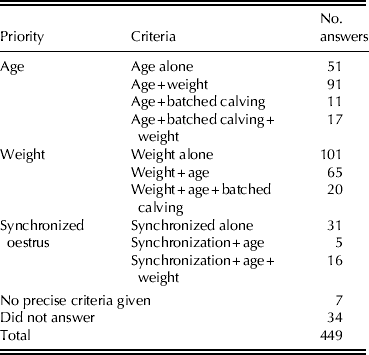
The criteria governing first servicing differed between farms, and the survey responses generally cited several criteria (Table 6) often culminating in ‘multi-criteria decision-making’. Almost half of the farmers surveyed cited weight, either alone or in combination with other criteria (310 answers), as the critical key criterion. Weight was followed by age or age-plus-other (265 answers), and a strategy based on managing homogeneous heifer batches (59). Combinations of the leading two criteria (i.e. age plus weight and weight-plus-age) stood out the most. Looking at reproduction, 21 farmers stated that they began breeding heifers earlier than 15 months of age, which translates into very early calving targets (under 24 months of age). A total of 246 farms aimed to start breeding at an age between 15 and 18 months, with the remaining farmers starting to breed their heifers for the first time at after 18 months of age. Over 0.98 of farmers detected heifer oestrus visually (primarily mounting), although 28 farmers also exploited visual markers for further guidance. Only five farms used a bull that had been specifically surgically prepared for the task. Only 46 farmers used hormone treatments to synchronize oestrus, with significant between-farm disparity, since only three farmers claimed total synchronization across the entire heifer herd. Over 0.98 of the total farm sample used artificial insemination (AI), with only nine farms refusing this practice. A total of 50 farmers combined AI and servicing, in which case the service bull was often a beef breed (Charolais, Limousin or Blonde d'Aquitaine) used to ‘remedy’ certain heifers that were not pregnant after AI or when approaching the end of the planned breeding period (e.g. December–February). All nine breeders committed to total servicing used purebred male service bulls from the same genetic background as the herd females (Holstein or Montbéliarde). Pregnant heifers rejoined the dairy herd at calving on 0·71 of farms, which means that the other 131 farms (0·21) re-introduced them in late gestation, i.e. after an average of 8·3 (±0·4) months into pregnancy, although with a strong range of variation between re-introduction at 2 months to just a few days before calving.
Main criteria guiding farmer decisions to breed heifers

Of the 449 farmers interviewed, 155 performed non-compulsory vaccinations, in 93 cases as preventive care designed to prevent newborn calves suffering from diarrhoea. Vaccination programmes aimed at preventing respiratory disorders were delivered on 67 farms, whereas treatment to prevent mucosal disease (BVD) or Q fever infection was only delivered at 16 and four farms, respectively. However, in most cases, herd vaccines against diarrhoea or respiratory disorders were coupled with other vaccinations. Anti-parasitism treatments were delivered by 432 farms, 288 of which deployed a dual anti-ectoparasite (insect) and anti-lungworm treatment programme. An anti-lungworm treatment alone was used on 110 farms. Other treatments were recorded in rarer cases, although significantly in specific local geographic and/or health settings (four farms reported using anti-liver fluke treatments). Ultimately, the mean number of vaccines/treatments received per animal was 1·95 (±0·9), with strong variation from 0 to 6, generally tied to different practices for animals of different ages.
Working hours
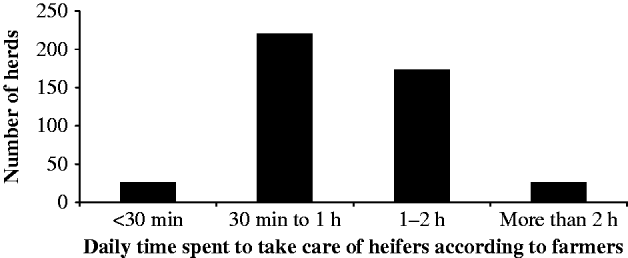
While the animals are turned out at pasture, daily herd visits were made on 0·80 of farms, while 0·18 made herd visits every 2 days. Two farms checked up on the herd once a week. An average of over 30 min per herd visit per day was found for 0·11 of farms, whereas the other farms did not spend more than 30 min/day (Fig. 4). When questioned on their perception of this on-farm work activity (with several possible answers available), 0·62 of farmers interviewed were of the opinion that heifer rearing was first and foremost a necessity, whereas 0·36 claimed that the enjoyment factor was equally and/or most important. Only 0·02 (n=11) experienced heifer rearing as nothing but a chore. Explanations put forward by these farmers included relatively dysfunctional building facilities. Time devoted to heifer care and rearing work ultimately varied strongly from herd to herd, but almost half of the farmers surveyed (154 of 322 respondents) assessed the total at less than 1 h/day. In the majority group of farmers who considered heifer rearing a necessity, 0·09 spent over 30 min/day checking their heifers at pasture v. 0·14 in the group who considered heifer rearing enjoyable. Two of the 11 farmers who experienced heifer rearing as nothing but a chore spent over 30 min out checking on grazing heifers.
Farmer-estimated daily time spent on heifer care and rearing (n=445).

Feed and diet
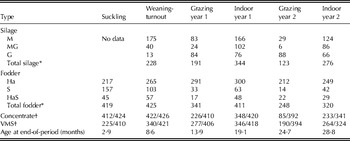
The majority of farmers fed calves on concentrate and fodder (hay and/or straw) straight from the suckling phase (Table 7) between weaning and first turnout to pasture, and 228 farms-fed heifers silage in addition to the hay and concentrate base diet. For calvings at a later age (such as 36 months), animals did not generally receive food supplementation in addition to the pasture, and were fed a diet of grass silage, hay and mineral supplements in winter. A high proportion of farmers gave vitamin and mineral supplements during the first grazing season. Except for the case of age at weaning, which fits the data collected on the weaning period (2·9 months), all the other growth phase end dates cannot be considered robust due to a high degree of variation. For example, calves were first turned out to pasture (except at the one farm that never pastured their herd) at an average of 8·6 months, but within a range of 4–15 months, certainly tied to whether farms employed a batched or a non-batched calving strategy and to the calving season.
Main feed source given according to growth phase

M, maize silage; G, grass silage; MG, maize and/or grass silage; Ha, hay; S, straw; HaS, hay and/or straw; VMS, vitamins and mineral supplement.
* Total number of farmers who give silage or fodder to their animals respectively (could be both).
† Number of positive answers (give concentrate or VMS)/total answers for this question.
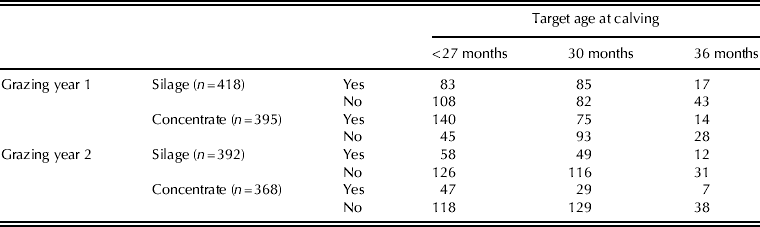
A final analysis was run to cross-tabulate feed and diet management practices against age at calving (Table 8). Focusing on heavily pasture-based diets, farms whose policy was to begin breeding early (24 months) used more concentrate than farms that worked to a late first calving strategy. In the first year of grazing, 0·76 of farms gave concentrate to heifers calved at 24 months whereas 0·42 of farms gave concentrate to heifers calved at 30 months or older. These figures dropped in the second year of grazing, although concentrate was still fed in 0·29 of early-calving farms v. 0·18 of later-calving farms. There were no calving age-related differences in the use of stored feed or corn silage while stalled.
Diet management (supplements) at pasture and target age at calving (no. answers)

In brackets, number of answers.
DISCUSSION
General considerations
Many recommendations published in France during the last 20–30 years about heifer rearing are based on weight-age targets, such as for example, 180–200 kg body weight at 6 months of age when first calving occurs at 24 months of age (Le Cozler et al. Reference Le Cozler, Lollivier, Lacasse and Disenhaus2008, Reference Le Cozler, Peccatte, Porhiel, Brunschwig and Disenhaus2009). However, because of required investments, labour and/or costs, monitoring dairy heifers growth and/or development is not very common and not a priority for many farmers. At the same time, there is growing concern for better efficiency in rearing heifers and increasing knowledge on on-farm procedures. The current study, which aimed to give an overview of the procedures used to rear dairy heifers in low-lying plain regions, gives valuable information about these procedures.
Although the sample may not be representative of the relative importance of each separate département in the production zone, the majority of the Mayenne (0·57) does underline the significant scale of dairy production in the northwest of this region of western France (0·35 of herds and 0·31 of collected milk in the ‘Pays de la Loire’ region; Le Maignan et al. Reference Le Maignan, Blourde, Moret, Labzae, Amprou, Goscianski and Souday2007; CNIEL 2011). In contrast, the Maine-et-Loire département is under-represented, if not virtually non-existent (0·002 of the selected sample, 0·18 in reality; CNIEL 2011). Most of the farms ran another operation, mainly livestock, and according to Perrot & Chatellier (Reference Perrot and Chatellier2009), farm activities secondary to livestock production form one of the common defining features of western-French dairy farms.
Holstein was the most common breed in the sample (0·64), but the distribution pattern is somewhat different to national figures, where the breed distribution breakdown is 0·69, 0·16 and 0·10 for Holstein, Montbéliarde and Normandy breeds, respectively (Institut de l'Elevage 2010). As the ‘Pays de la Loire’ region is close to the Normandy region and because the Montbéliarde breed originates from the eastern part of France, such a distribution is not surprising.
Based on the farmers’ statements, a mean animal turnover of 0·329 (range: 0·10–0·50) was calculated, which is consistent with the values reported in the literature (The Netherlands – Mourits et al. Reference Mourits, Van Der Fels-Klerx, Huirne and Huyben2000; France – RECP 2010). According to Mourits et al. (Reference Mourits, Van Der Fels-Klerx, Huirne and Huyben2000), culling at first lactation is mainly due to reproduction issues (0·32 of cases) or below-average production yields (0·29). Although the present survey did not collect data on this point, the reasons for culling were probably similar, in agreement with the findings recorded by Seegers et al. (Reference Seegers, Beaudeau, Fourichon and Bareille1998) in 84 French Holstein farms.
First calving strategies
Most of the farmers surveyed (0·80) declared that they had a target age at first calving of 30 months or less. There are no national figures published for the mean age at first service, but estimates calculated based on age at first calving proved fairly coherent. This offers a good illustration of in-field practice, since 2009 data on the Mayenne results give age at first calving as 29, 32 and 32 months for Holstein, Montbéliarde and Normandy cows (Institut de l'Elevage 2010). National figures are quoted at 30, 33 and 33 months (s.d.=5 months in all cases). A study led in The Netherlands by Mourits et al. (Reference Mourits, Van Der Fels-Klerx, Huirne and Huyben2000) found that close to 0·80 of farmers surveyed had age targets at first calving of less than 27 months, most of them stating that they begin breeding after 15 months of age, age being the chief criterion dictating the decision to begin breeding (0·91 of cases). The major factor explaining these results is almost certainly the fact that Holstein heifers reach sexual maturity earlier and are better adapted to early calving (Le Cozler et al. Reference Le Cozler, Peccatte, Porhiel, Brunschwig and Disenhaus2009). Mourits et al. (Reference Mourits, Van Der Fels-Klerx, Huirne and Huyben2000) also found lower target ages at first calving for Holstein-type breeds than for crossbred dairy cattle. The effects of age at first calving have been extensively studied (Le Cozler et al. Reference Le Cozler, Lollivier, Lacasse and Disenhaus2008, Reference Le Cozler, Peccatte, Porhiel, Brunschwig and Disenhaus2009 for reviews). A lower age at first calving is widely associated with lower livestock management costs, lower on-farm cow headcounts, higher milk yield per day of productive life and other advantages. Data from an economic study of 110 Swedish dairy farms (Hultgren et al. Reference Hultgren, Svensson and Persson2011) recommended calving heifers at around 24 months. But another study in Sweden noted that for 0·37 of farmers, age was their sole criterion (Pettersson et al. Reference Pettersson, Svensson and Liberg2001), while 0·17 of them used body weight only, and 0·27 of them integrated height at the withers as a factor.
These later results indicate in fact that the economic efficiency of a given heifer rearing practice cannot be reduced to age criteria alone (Mourits et al. Reference Mourits, Dijkhuizen, Hiurne and Galligan1997). Weight, body condition and growth development are also important factors, but there is little available data on these points. Even at late-age calving, between-animal weight differences at calving can explain broad variations in production yields, especially at first lactation, and in carcass weight at culling (Le Cozler et al. Reference Le Cozler, Peccatte and Delaby2010, Reference Le Cozler, Gallard, Dessauge, Peccatte, Trommenschlager and Delaby2011). This is a significant factor for a majority of French livestock farmers, as they generally also look to draw added value from culled animals.
Consequently, it is logical to find that most of the farms surveyed set weight targets, even if the investigators reported that farms rarely actually weigh their animals. Mourits et al. (Reference Mourits, Van Der Fels-Klerx, Huirne and Huyben2000) also found this same contradiction in Dutch dairy farms, where 0·43 of farms stated they set weight objectives at first calving, yet less than 0·02 regularly weighed their heifers. These target objectives, regardless of whether or not they are achieved, are thus mostly based on a rough visual assessment, often involving size gauging and liveweight estimates. Finally, the current study also confirms that farmers opting for early-age-at-calving strategies appear more sensitive to their animals’ body weight at calving. This also illustrates a readiness to reach a sufficient threshold of animal body development and/or size for early in first lactation.
Group calving systems
Seasonally grouped calving was used by 0·52 of surveyed farmers, over 3 or 6 months. The summer- or autumn-season calving policy reflects a commitment to achieve peak production during the winter periods when cows are housed indoors (which in France translates into better per-litre milk revenue) and/or minimum use of conserved forage during the summer period. It is likely then that the two herd batch splits (autumn–spring) are designed to either produce milk in winter to cash in on higher milk prices, or to exploit cheaper feed resources (spring-season pasture grass). When calving season duration reaches 9 months, it is difficult to pinpoint whether this extended interval is the result of bad reproduction management decisions or a conscious effort to spread out the calvings.
The split-period scheme is a system that not only enables the milk herd to be split into two batches, but also enables greater flexibility in terms of servicing/insemination management. Farmers have options for delaying dates for certain animals and extending to longer lactations, for integrating heifers into AI batches (if animals show slower body development or growth weight), while placing less pressure on the need for space for housing calves than when grouping the herd into a single 3-month calving batch. One clear conclusion of the current analysis was that farms employing seasonally grouped calving strategies actually made surprisingly little use of tools (hormone treatment) for synchronizing oestrus and subsequent AI. The benefits and efficiency of hormone treatments are outlined and discussed in Grimard et al. (Reference Grimard, Humblot, Ponter, Chastant, Constant and Mialot2003). Furthermore, on top of the potential direct benefits on reproductive performances, hormone treatments also offer the advantage of more efficient monitoring of returns to oestrus and consequently more efficient workflow organization.
Rearing the young animals
At first calving, calves have not fully completed growth and development and their body weight is often only 0·85–0·95 of their full adult weight. In many cases, they will not reach their final size until 1–2 years later. However, it is widely understood that the first few months of life are more or less decisive in shaping the animal's final body size, which doubtless explains why this early phase of heifer rearing is also one of the most comprehensively understood by farmers and described in the literature.
The colostrum phase
Most farmers are aware that rearing practices around birth are critical to calf survival and ongoing health. This explains why they put special emphasis on this critical period of life.
Nearly, half of the farmers left calves with their mother after birth, for an average of 14 h. This figure is higher than in the USA or Canada, where 0·37 and 0·16 of farmers, respectively, allow calves to remain with their mothers at birth (USDA 2008; Vasseur et al. Reference Vasseur, Borderas, Cue, Levebvre, Pellerin, Rushen, Wade and De PASILLé2010), but lower than 0·57 was reported by Pettersson et al. (Reference Pettersson, Svensson and Liberg2001). Vasseur et al. (Reference Vasseur, Borderas, Cue, Levebvre, Pellerin, Rushen, Wade and De PASILLé2010) reported that in 0·73 of Canadian farms, calves are separated in the first 12 h, with almost a third separated within the first 2 h of birth. In the present survey, 0·035 of the farmers separated the calves later than 24 h of age, which is less than 0·04–0·07 cited in North-American studies (USDA 2008; Vasseur et al. Reference Vasseur, Borderas, Cue, Levebvre, Pellerin, Rushen, Wade and De PASILLé2010). Guidelines occasionally recommend separating the calf immediately at birth to minimize the risk of exposure to pathogens, facilitate initial veterinary care and keep control over colostrum feeding (Windsor & Whittington Reference Windsor and Whittington2010). In contrast, a European Food Safety Agency (EFSA) report released in 2006 suggests that, in the interests of animal well-being, the calf should not be separated from the mother too quickly (EFSA 2006). According to Flower & Weary (Reference Flower and Weary2001), calves separated from the mother after 14 days of age showed better weight gain performances, better socialization behaviour and fewer health problems than early removals at just 1 day old.
Even when left with their mother, calves usually received extra colostrum. The newborn calf needs to take in quality colostrum quickly, at least within the first 4 h of life, as research shows a swift decline in ability to absorb colostrum after the first 12 h (Weaver et al. Reference Weaver, Tyler, Vanmetre, Hostetler and Barrington2000). The aim of adding colostrum to the suckling milk is generally to ensure that the calf gets the optimal amount of colostrum. Franklin et al. (Reference Franklin, Amaral-Phillips, Jackson and Campbell2003) claimed that the majority of calves who only ingest maternal colostrum by natural suckling are unable to get enough colostrum to receive an adequate transfer of immunity. Given less immune protection, they are expected to be more vulnerable to bouts of diarrhoea than calves that are artificially fed maternal colostrum. These results fit with data reported by Svensson et al. (Reference Svensson, Lundborg, Emanuelson and Olsson2003). The majority use of nipple bottles was also found in Vasseur et al. (Reference Vasseur, Borderas, Cue, Levebvre, Pellerin, Rushen, Wade and De PASILLé2010). Hänninen et al. (Reference Hänninen, Hepola, Raussi and Saloniemi2008) reported that nipple-feeding produced calmer calves than bucket-feeding, probably due to the secretion of satiety hormones triggered in response to the suckling behaviour.
To further improve colostrum intake, a few farmers systematically fed the colostrum via a stomach tube. This procedure is equally uncommon in other countries, although it is used by 0·10 of breeders in Canada compared to 0·043 in the USA (USDA 2008; Vasseur et al. Reference Vasseur, Borderas, Cue, Levebvre, Pellerin, Rushen, Wade and De PASILLé2010). The procedure is designed to ensure adequate colostrum intake by all calves, as discussed above. Note that Vasseur et al. (Reference Vasseur, Borderas, Cue, Levebvre, Pellerin, Rushen, Wade and De PASILLé2010), studying Holstein cows, concluded that 0·22 of calves aged 2–6 h are unable to drink the 2 litres of colostrum generally recommended, which would thus justify the procedure. However, using a stomach tube is an invasive procedure that therefore carries a risk of subsequent health complications, as well as animal well-being issues.
Colostrometers are used to determine the quality of the colostrum and require stringent implementation conditions in order to select good-quality colostrums. Although using a colostrometer appears simple (Vasseur et al. Reference Vasseur, Borderas, Cue, Levebvre, Pellerin, Rushen, Wade and De PASILLé2010), in practice this technique is seldom used by the surveyed farmers and as a result, colostrum quality is generally estimated visually. In the USA, 0·013 of dairymen check colostrum quality before feeding, whereas Canadian dairymen virtually never perform these checks (USDA 2008; Vasseur et al. Reference Vasseur, Borderas, Cue, Levebvre, Pellerin, Rushen, Wade and De PASILLé2010). In addition to the selection difficulties involved, the transfer of immunity can still prove highly insufficient – even when good-quality colostrum is available (Le Cozler et al. unpublished data). The net result is that in practice, many dairy farmers have stopped using colostrometers, instead opting to bank colostrum based on visual assessment of colour and/or density alone.
The milking phase
Whole milk was used in most farms to feed growing calves, but it is a less popular option in the USA, being used on only 0·28 of farms, a similar proportion to The Netherlands (Mourits et al. Reference Mourits, Van Der Fels-Klerx, Huirne and Huyben2000; USDA 2008). In contrast, the majority of Canadian dairy farms elect to feed whole milk, as it is easy to feed (0·70), makes use of non-marketable milk (0·43) or surplus milk production (0·37) and/or is claimed to contribute to better growth (0·23). Note that, according to Mourits et al. (Reference Mourits, Van Der Fels-Klerx, Huirne and Huyben2000), 0·37 of Dutch farmers give milk collected from sidelined cows (cows with mastitis problems or given antibiotics). This is generally discouraged, since calves-fed milk from cows with clinical mastitis show lower growth performances (Troccon Reference Troccon1984), and the presence of antibiotics in the milk can disturb digestive tract function.
Dehorning usually occurs before weaning, at around 1·6 months old. In Canada, the median age at dehorning was 6·4 weeks, but 0·25 of farms debudded calves after 3 months of age, despite the fact that at this growth stage the process should be performed surgically (Vasseur et al. Reference Vasseur, Borderas, Cue, Levebvre, Pellerin, Rushen, Wade and De PASILLé2010). Surveys conducted in Canada shows that between different geographic regions, 0·22–0·45 of farmers use a local anaesthetic, although without painkillers. Combining local anaesthetic plus painkillers is recommended as a positive pain management solution (Stafford & Mellor Reference Stafford and Mellor2005). In France, the dehorning of calves is governed by article 17 of the European Convention Standing Committee Recommendations dated 21 October 1988 (Standing Committee of the European Convention for the Protection of Animals Kept for Farming Purposes 1988), which states that after 4 weeks of age, farms should opt for surgical disbudding and ideally use an anti-inflammatory agent. At earlier than 4 weeks old, calves can be dehorned without anaesthetic if the procedure is performed by experienced farmhands. From the 1st of January 2012, the article 5.4 of the Charter of Good Livestock Breeding Practices also recommends dehorning earlier than 4 weeks of age (6 weeks previously; Dockès et al. Reference Dockès, Godefroy, Fourdin and Frappat2012) .
In more than 0·70 of the herd, weaning occurs before 3 months old. In Canada (Vasseur et al. Reference Vasseur, Borderas, Cue, Levebvre, Pellerin, Rushen, Wade and De PASILLé2010), median age at weaning is less than 2 months, whereas in the USA and The Netherlands, mean age at weaning is 8·2 and 10 weeks, respectively (Mourits et al. Reference Mourits, Van Der Fels-Klerx, Huirne and Huyben2000; USDA 2008). However, although the Dutch national average is 10 weeks, two-thirds of Dutch farmers wean calves earlier than 10 weeks (Mourits et al. Reference Mourits, Van Der Fels-Klerx, Huirne and Huyben2000). According to surveyed farmers, calf weight then is c. 100 kg. Canadian figures reported by Vasseur et al. (Reference Vasseur, Borderas, Cue, Levebvre, Pellerin, Rushen, Wade and De PASILLé2010) give mean weight at weaning as 82 kg for a concentrate intake of around 2 kg/day/calf. In the USA, the mean weaning age of 8·2 weeks (USDA 2008) is similar to that found in the present survey. In Sweden, although age is the main criterion guiding decision to wean (for 0·46 of farmers), 0·29 of farms use composite weight/age/concentrate intake criteria (Pettersson et al. Reference Pettersson, Svensson and Liberg2001).
Other considerations about rearing heifers
In a large majority of surveyed French farms, heifers are first turned out to pasture before 1 year of age, but a strong variability in age at turnout to pasture was noted. This is directly connected to calving management practices, and particularly whether farms employ a batched or a non-batched calving strategy. Since, over 0.60 of farms employ seasonally batched calvings grouped into the autumn/winter period, the animals will generally be turned out to pasture the following spring/summer, i.e. at an average age varying from 6 to 9 months. Plot management is generally adapted to heifer age, with the youngest animals kept close to the main farm building while older heifers graze the meadows furthest away. In line with the other countries where heifer feed practices have been studied (Mourits et al. Reference Mourits, Van Der Fels-Klerx, Huirne and Huyben2000; USDA 2008; Vasseur et al. Reference Vasseur, Borderas, Cue, Levebvre, Pellerin, Rushen, Wade and De PASILLé2010), the present study indicates that most farms give concentrate and fodder just after birth. This indicates a policy designed to ensure strong growth and development throughout this early life phase. Studies show that sustained growth over the first 6 months is beneficial for future body development regardless of subsequent reproduction strategy (Le Cozler et al. Reference Le Cozler, Peccatte, Porhiel, Brunschwig and Disenhaus2009). No data were collected on silage distribution pre-weaning, which Vasseur et al. (Reference Vasseur, Borderas, Cue, Levebvre, Pellerin, Rushen, Wade and De PASILLé2010) claimed was never practised in Canada. Vitamins and minerals procedures were very similar to those practised in other countries (Pettersson et al. Reference Pettersson, Svensson and Liberg2001).
The particular case of working hours
There are very few studies on farmers’ perception regarding heifer management. However, labour considerations have been put forward as a priority by many farmers during the last 20 years, and this also included time devoted to rearing heifers. The present survey found that some farmers preferred not to rear their animals and these ‘chore’ farms also posted a high turnover–replacement rate (0·40–0·50). This illustrates that at the time they were surveyed, these farms were struggling to survive. In addition, these farmers spend more time per day visiting and taking care of heifers while grazing. It would seem logical to expect this longer herd visit to be considered as a further burden.
Farmhands may have overestimated the time spent on heifer rearing tasks. However, working with an example of a herd of 60 dairy cows, i.e. around 30 heifers to be reared each year with first calving at 24 months old, this work would account for 300 h of work per year. For employees, the legal duration of work is 1607 h/year in France. The estimated value of 300 h of work per year corresponds to practically 0·20 full-time equivalent per farmhand. On a per-heifer basis, the schedule would amount to roughly 12–15 h of work per animal, i.e. slightly less than the 18 h/heifer reported by Porhiel (Reference Porhiel2002) in Brittany-based farms. In cases where working time runs over 2 h/day (23 farms), this work would amount to a 0·50 part-time job dedicated to the heifer farming activity. This appears a viable option for exceptionally large herds, but in any other scenario, this labour time-budget dedicated solely to heifer rearing is unfeasibly high, making it necessary to investigate the possibilities for cutting down and/or optimizing this work process.
CONCLUSION AND PERSPECTIVES
The present survey results confirm a broadly diverse range of practices that sometimes diverge from the recommended practices, underlining a need to address the issue of how to improve this livestock rearing activity. The conclusions echo the findings of other studies conducted abroad, i.e. that heifer farming warrants more appropriate management follow-up that would almost certainly bring improvements in terms of production, breeding and even productive life. Animal growth and body development, even if more or less costly, can be monitored by basic methods (such as tape weighing) or more accurately (by weighing on a scales), either by the farmer or by outside services. The integration of new technologies (converting 2D images to 3D models) could enable the future development of more comprehensive tools for estimating animal weight and body scores. Other options for better heifer weight monitoring include the use of scales at the milk parlour exit and sorting gate exit. However, some farmers are not interested in rearing their heifers, because they want to focus only on dairy production or because they are too busy. An interest in specializing some herds devoted to rearing is increasing. These herds existed at the end of the 1970s, but most of them disappeared after CAP reform in 1984. The new reform in 2013 puts special emphasis on this way of rearing heifers in France and other European countries. This could result in the development of a kind of ‘heifers hotel’ in the future, despite possible problems such as risks in health management or costs.
Finally, greater insight into the heifer rearing practices in other French or European heifer farming zones (mountains, grasslands, harsher winter conditions, etc.) would help to provide a more comprehensive picture, taking into account the broad diversity of rearing practices encountered.
The authors thank all the technicians, technologists and farmers for their kind and co-operative participation in this survey. This work was made possible by significant support and backing from the Grand-Ouest branch of the Groupe Inter-Regional Génisses. The authors are also grateful to M Kloareg for providing the methodology and statistics support needed to efficiently complete this study. Finally, they thank the ATT staff for English reviewing. The results of present paper were partially presented during session 32 of the 62nd Annual Meeting of the European Federation of Animal Science held at Stavanger (Norway), 29 August–2 September 2011.