Introduction
Emotion regulation is a goal-oriented process by which individuals attempt to change their emotional experience to one that is more desirable (Gross, Reference Gross1998), by controlling the intensity, duration, expression, or occurrence of the emotions in a specific context (Gross, Reference Gross2015). The emotion regulation literature has gained momentum over the last two decades (Webb, Miles, & Sheeran, Reference Webb, Miles and Sheeran2012) with maladaptive emotion regulation strategies (e.g., chronic suppression) shown to be a reliable predictor of psychopathology in adults (Aldao, Nolen-Hoeksema, & Schweizer, Reference Aldao, Nolen-Hoeksema and Schweizer2010) and children (Compas et al., Reference Compas, Jaser, Bettis, Watson, Gruhn, Dunbar and Thigpen2017). Consequently, many psychological interventions target emotion regulation skills to improve psychological well-being. For example, consistent research demonstrates that Cognitive-Behavioural Therapy (CBT) is an effective treatment for depression and anxiety disorders, and these improvements are mediated by enhanced cognitive reappraisal ability (e.g., Goldin et al., Reference Goldin, Ziv, Jazaieri, Werner, Kraemer, Heimberg and Gross2012; Levy et al., Reference Levy, Worden, Gilliam, D'Urso, Steketee, Frost and Tolin2017). Similarly, the effectiveness of treating chronic pain with CBT has been shown to be mediated by increased use of acceptance (Akerblom, Perrin, Fischer, & McCracken, Reference Akerblom, Perrin, Fischer and McCracken2016).
To date, research has primarily focused on the consequences of maladaptive (vs. adaptive) emotion regulation strategies (Aldao et al., Reference Aldao, Nolen-Hoeksema and Schweizer2010) in distinguishing between individuals who do and do not meet criteria for psychological disorders including depression and anxiety. However, what factors contribute to the development of poor emotion regulatory skills, and what factors may hinder the acquisition of adaptive regulatory skills, are less frequently investigated in context of psychotherapy treatment outcomes. Given that improvements in emotion regulation mediate the outcomes evidenced in well-established therapies, including CBT-based interventions (e.g., Arch, Wolitzky-Taylor, Eifert, & Craske, Reference Arch, Wolitzky-Taylor, Eifert and Craske2012; Levy et al., Reference Levy, Worden, Gilliam, D'Urso, Steketee, Frost and Tolin2017), it follows that an understanding of factors that may facilitate the reduction of the rigid use of maladaptive strategies associated with psychopathology (e.g., rumination, denial), as well as enhancing the use of more adaptive emotion regulatory strategies associated with reduced levels of psychopathology, such as reappraisal and acceptance (e.g., Aldao, Sheppes, & Gross, Reference Aldao, Sheppes and Gross2015; Conklin et al., Reference Conklin, Cassiello-Robbins, Brake, Sauer-Zavala, Farchione, Ciraulo and Barlow2015), may have important clinical implications for individuals who are struggling to learn and/or enhance the use of core emotion regulatory skills during psychotherapy. One such factor proposed to impact the use of more adaptive emotion regulatory strategies is beliefs about emotions (BEs). That is, individuals’ beliefs about managing their emotions, may be one key factor related to whether they are inclined to use more adaptive strategies and less maladaptive strategies in coping with situational/life stressors. Hence, the objective of this review is to investigate the association between BE and use of specific emotion regulation strategies.
Conceptualisation of Emotion Regulation
Gross's (Reference Gross1998, Reference Gross2015) Process Model of Emotion Regulation is used to inform the conceptual framework of this review. In this model, emotion regulation is conceptualised as a goal-directed behaviour that involves continuous monitoring of outcomes to ensure that the emotion regulation goal is being met. The process model is a strategy-based framework for emotion regulation, allowing for the identification of specific strategies which are often targeted in psychological treatments.
Recently, this model was updated in Gross’ (Reference Gross2015) Extended Process Model of Emotion Regulation to better address gaps regarding the selection of specific ER strategies, the initiation and discontinuation of the emotion regulation process, and the success or failure of the emotion regulation process. Gross (Reference Gross2015) posits that there are three stages in the process that are repeatedly cycled through until the emotion regulation goal is met. Valuation, the act of determining what is ‘good’ and ‘bad’, is crucial in each stage of the process. First, in the identification stage, the individual identifies the emotion(s), determines the value of the emotion in their given context, and activates an emotion regulation goal if necessary. Second, in the selection stage, the individual considers a range of regulatory strategies, evaluates the utility of each strategy in their context, and activates a goal to use their selected strategy. Finally, in the implementation stage, the individual translates their strategy into tactics, evaluates the effectiveness of the tactics, and selects a tactic to implement their strategy. The emotion regulation goal is considered achieved when the individual's perceived emotional state in the identification stage is congruent to their desired emotional state.
Following the Process Model of Emotion Regulation (Gross, Reference Gross1998, Reference Gross2015), difficulties in any of the three stages of the regulatory process will lead to unsuccessful emotion regulation. When individuals continue to be unsuccessful in their emotion regulation goals, their emotion regulation abilities are deemed maladaptive. What is uncertain in the literature is what leads to difficulties in the emotion regulation process. According to Gross’ (Reference Gross2015) updated model, valuation plays a vital role across all stages of the emotion regulation process. Valuation, the discrimination between what is ‘good for me’ and what is ‘bad for me’, is highly subjective and it can be argued that it relies on one's BEs. Hence, it is possible that individuals who hold stronger beliefs that they are capable of managing their emotions, particularly when confronted with challenging and/or stressful situations, are more prone to utilising more adaptive and less maladaptive regulatory strategies to help them cope and adapt to stressors. This proposition aligns with Gross’ extended process model (Reference Gross2015). In line with this model, when an individual's desired emotional state (or goal) is consistently achieved, the individual is considered to be using adaptive emotion regulation skills. In contrast, if the individual's emotional state is disconcordant with one's desired emotional state due to failures in one or more of the valuation phases, then they are considered to be relying more so on maladaptive strategies. Hence, if the valuation process is inclusive of an individual's beliefs about managing their emotions, then this is expected to play a role in the use of more adaptive versus maladaptive strategies. To this end, there is currently a small but growing literature examining individuals’ BEs in relation to individuals’ emotion regulation abilities (Ford & Gross, Reference Ford and Gross2019).
Beliefs about Emotions (BEs) and Emotion Regulation
Two core, independent, yet conceptually related BEs have emerged (Dweck, Reference Dweck2017; Ford & Gross, Reference Ford and Gross2019): (1) beliefs about the goodness of emotions (goodness BEs) and (2) beliefs about the controllability of emotions (controllability BEs). These beliefs are hypothesised to be the foundational basis that informs how individuals interact with their own emotions, and thus influences their emotion regulation process (Ford & Gross, Reference Ford and Gross2019). In line with the Process Model of Emotion Regulation, Ford and Gross (Reference Ford and Gross2019) hypothesised that goodness BEs will influence the valuation of emotions in the identification stage, and in turn, dictate the formulation of their emotion regulation goal. Controllability BEs are hypothesised to influence the strategy selection and implementation stages and determine the initiation or cessation of emotion regulation.
These hypotheses are further supported by social cognitive theories of self-regulation which propose that one's values, morals, and beliefs about the controllability of one's behaviours, determine the individual's actions (Bandura, Reference Bandura1991). In a meta-analysis, examining the relationship between implicit theories (i.e., belief that human attributes are controllable) and self-regulation, Burnette, O'Boyle, VanEpps, Pollack, and Finkel (Reference Burnette, O'Boyle, VanEpps, Pollack and Finkel2013) identified that stronger beliefs that human attributes are malleable, predicted greater success in self-regulation through goal-setting, goal-operating, and goal-monitoring. Minimal research has focused on the influence of one's values on one's actions. One study found that health values, such as maintaining physical health, preserving positive body image, and having a feeling of physical well-being, had a strong influence on self-regulation behaviours in adults living with Type-2 diabetes (Oftedal, Karlsen, & Bru, Reference Oftedal, Karlsen and Bru2010). Research has further shown children who value achievement are better able to engage in self-regulated learning (Wigfield, Reference Wigfield, Schunk and Zimmerman1994). It is, therefore, hypothesised that ER, a specific form of self-regulation, may be influenced by one's beliefs about the controllability of emotions and one's beliefs about the value of emotions.
Despite the strong theoretical underpinnings, the aforementioned hypotheses are not well researched. Recent non-systematic reviews have focused on discussing the important role of BEs in shaping emotion regulation patterns, and the need to continue to explore this relationship (e.g., Edwards & Wupperman, Reference Edwards and Wupperman2019; Ford & Gross, Reference Ford and Gross2018, Reference Ford and Gross2019). However, there have been no systematic or meta-analytic reviews to systematically examine the significance of this relationship. In a recent meta-analysis, individuals’ attitudes towards negative emotions, in particular, holding strong cognitive and affective evaluations towards negative emotions was significantly associated with depressive symptoms (Yoon, Dang, Mertz, & Rottenberg, Reference Yoon, Dang, Mertz and Rottenberg2018). These scholars acknowledged that it is possible that holding a negative attitude towards one's affective state may be related to how one regulates their emotions. Specifically, it is possible that negative beliefs may influence depression via the use of more maladaptive strategies such as avoidance (Yoon et al., Reference Yoon, Dang, Mertz and Rottenberg2018). This further supports the hypothesis that BEs are likely related to emotion regulatory processes. However, Yoon et al. only examined beliefs about negative emotions in response to depressive symptoms and did not directly evaluate emotion regulation strategies more broadly.
Given the gap in the existent literature, it is timely to conduct a systematic review evaluating the relationship between controllability and goodness BEs in relation to emotion regulation. This line of inquiry has the scope to further our understanding of factors that contribute towards maladaptive emotion regulation, as well as factors that contribute to non-responsiveness to psychological treatments which focus on emotion regulation strategies.
Present Review
The objective of the present review was to systematically examine the association between goodness and/or controllability BEs and emotion regulation strategies in adult samples. Goodness BEs are operationalised to include one's beliefs about the acceptability, utility, desirability, and/or value of specific and/or general emotions. Controllability BEs are operationalised to include one's beliefs about the malleability, changeability, and controllability of specific and/or general emotions. Emotion regulation is operationalised to include specific emotion regulation strategies (e.g., suppression) or general emotion regulation (based on self-reported success or difficulty ratings). The focus of this review was on adult samples, given that research has shown that emotion regulation is often less stable in children as they are still developing cognitive control (Tottenham, Hare, & Casey, Reference Tottenham, Hare and Casey2011).
Method
Search Strategy
A systematic search was conducted on 4 March 2020 using PsycINFO, EMBASE, PubMED, CINAHL, and Cochrane. MeSH headings and keywords, in titles and abstracts, related to the terms ‘belief’ (e.g., attitude, mindset, value, desirability), ‘emotion’ (i.e., affect, feeling, mood), and emotion regulation (e.g., self-regulation, affect regulation, emotion dysregulation, coping) were combined in each database. Reference sections and other relevant review papers were additionally reviewed to identify relevant articles.
Studies were included in the review if they met the following criteria: (1) published in a peer-reviewed journal in English; (2) used validated emotion regulation measure (which was defined as measures that the psychometric properties have been published); (3) quantitatively assessed BEs; (4) statistically evaluated the relationship between emotion regulation and BEs; and (5) participants were 18 years and older. Studies were excluded if they (1) focused on the effect of parent's BEs for the child's emotion regulation tendencies; (2) treatment outcome studies that did not report eligible baseline data; and (3) only available via the grey literature (e.g., dissertations).
Study Selection
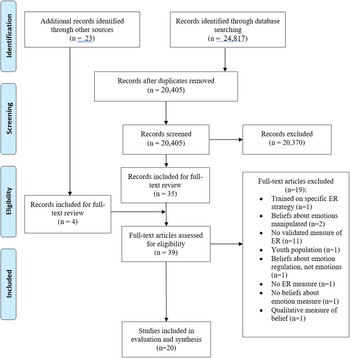
Studies identified across the five databases were initially screened using title and abstracts. Studies were then screened by reviewing the full-text based on the eligibility criteria. To ensure reliability, a random sample of 16 papers (41%) that passed initial title and abstract screening were independently reviewed by two independent reviewers (the first- and co-authors) for full-text screening to confirm eligibility for the current review. Full agreement was obtained at this stage of full-text screening. Figure 1 shows the Preferred Reporting Items for Systematic Reviews and Meta-Analyses (PRISMA) flowchart of study selection.
PRISMA flowchart of systematic search and selection procedure.

Data Extraction
Full data extraction was conducted by the first author. The data extracted from studies comprised, country of authors/sample, study aim/s and design, demographic information of sample, tools used to measure each target variable, correlational data between variables, and study limitations. Data extraction for 32% of articles was randomly checked by the second author, and 89% agreement was obtained. Disagreements were resolved through discussion.
Quality Assessment
The Quality Assessment Tool for Studies with Diverse Designs (QATSSD) (Sirriyeh, Lawton, Gardner, & Armitage, Reference Sirriyeh, Lawton, Gardner and Armitage2011) was used to assess the quality of each study included in this review. This scale has been shown to have good inter-rater reliability (k = 71.5%), strong test–retest reliability, and good face validity when used by health-service researchers assessing papers in psychology, sociology, and nursing (Sirriyeh et al., Reference Sirriyeh, Lawton, Gardner and Armitage2011). The QATSSD is a comprehensive rating scale that examines 14 methodological elements. Items of the QATSSD are rated on a 4-point scale (0 = not at all to 3 = complete). The overall scores ranged from 0 to 42, with higher scores indicating greater methodological quality. Quality assessment was completed by the first author, and the second co-author independently rated 32% of articles chosen at random. Reliability agreement was 97% for quality assessment evaluations and disagreements were resolved through discussion between authors.
Results
Study and Sample Characteristics
The database searches provided a total of 24,817 papers, with 20,405 papers remaining after duplicates were removed. After title and abstract screening, 35 papers were identified for full-text screening. After screening references for relevant articles, a further four papers were identified for full-text review. A total of 39 papers underwent full-text review, with 19 papers excluded and a total of 20 published papers included for full review (see Figure 1). From the 20 papers, 22 relevant studies were identified.
Table 1 provides a summary of the data extraction for the 22 studies comprising a total of 5974 participants. Of the 5974 participants, 2008 (33.6%) were male and 3952 (66.2%) were female, while 14 (.2%) participants identified as other or preferred not to respond. Twelve studies were solely based on university samples, four studies comprised community samples online, three included a combination of university students and members of the wider community, single studies recruited older adults (>65 years), a parent sample, and competitive athletes. Fourteen studies were conducted in the United States, two studies were each conducted in the United Kingdom and Germany, and there were single studies conducted in Iran, Australia, Israel, and Canada.
Overview and Outcome of Studies Examined

Note: ER = emotion regulation.
A majority of studies (n = 21; 95%) were cross-sectional, while one study was based on a longitudinal design (Kneeland & Dovidio, Reference Kneeland and Dovidio2020). All data extracted were based on self-report surveys. To assess BEs, 10 studies (45%) used the Implicit Theories of Emotion Scale (ITES); four studies (18%) used the Negative Mood Regulation (NMR) Expectancies Scales, and three studies (14%) used the Beliefs about Emotions Scale (BES) (see Table 1). The remaining studies used other forms of self-report questionnaires. Similarly, common scales for assessing trait ER tendencies were noted, with 13 studies (59%) using the Emotion Regulation Questionnaire (ERQ); three studies using the Difficulties with Emotion Regulation Scale (DERS); and three studies using the Coping Orientation to Problems Experienced (COPE) scale/brief-COPE.
Methodological Quality Assessment
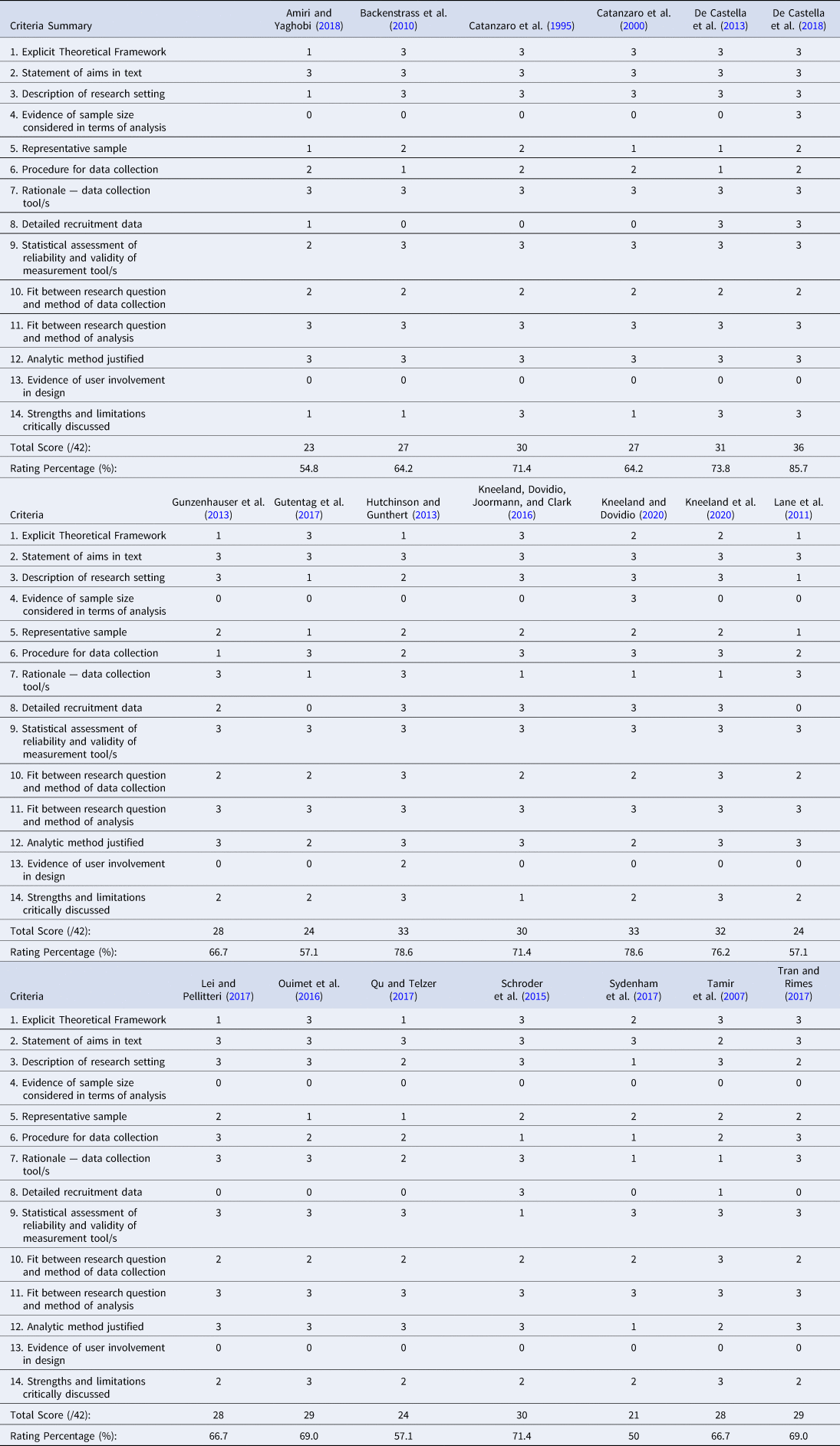
Significant variability in methodological quality across studies was found based on QATSSD scores, which ranged between 21 and 33 out of 42 possible points (see Table 2). The mean quality score was 28.25 (67.3%; SD = 3.60). These results are similar to a previous healthcare-related systematic review that used the QATSSD and found that a quality score of 65% indicated overall moderate methodological quality (Adam & Jensen, Reference Adam and Jensen2016). Therefore, to assist in the description and comparison of the methodological quality of reviewed studies, studies with scores below 65% were rated as ‘low-to-moderate’ quality, and studies with scores above 65% were rated as ‘moderate-to-high’ quality.
Quality Analysis Ratings
Beliefs about Controllability of Emotions
Sixteen studies (73%) examined controllability BEs. Ten of these 16 studies examined controllability BEs, generally, without differentiation between positive and negative emotions (De Castella et al., Reference De Castella, Goldin, Jazaieri, Ziv, Dweck and Gross2013; De Castella, Platow, Tamir, & Gross, Reference De Castella, Platow, Tamir and Gross2018; Gutentag, Halperin, Porat, Bigman, & Tamir, Reference Gutentag, Halperin, Porat, Bigman and Tamir2017; Kneeland & Dovidio, Reference Kneeland and Dovidio2020; Kneeland, Dovidio, Joormann, & Clark, Reference Kneeland, Dovidio, Joormann and Clark2016; Kneeland, Goodman, & Dovidio, Reference Kneeland, Goodman and Dovidio2020; Qu & Telzer, Reference Qu and Telzer2017; Schroder, Dawood, Yalch, Donnellan, & Moser, Reference Schroder, Dawood, Yalch, Donnellan and Moser2015; Tamir, John, Srivastava, & Gross, Reference Tamir, John, Srivastava and Gross2007). A further four studies examined controllability BEs of negative emotions only (Backenstrass et al., Reference Backenstrass, Joest, Gehrig, Pfeiffer, Mearns and Catanzaro2010; Catanzaro, Horaney, & Creasey, Reference Catanzaro, Horaney and Creasey1995; Catanzaro, Wasch, Kirsch, & Mearns, Reference Catanzaro, Wasch, Kirsch and Mearns2000; Hutchinson & Gunthert, Reference Hutchison and Gunthert2013), while two studies examined controllability BEs for both positive and negative emotions (Gunzenhauser et al., Reference Gunzenhauser, Heikamp, Gerbino, Alessandri, von Suchodoletz, Di Giunta and Trommsdorff2013).
Beliefs about controllability of emotions (in general)
All 10 studies which examined controllability BEs used the ITES. Most studies (n = 9) examined controllability BEs in relation to the use of cognitive reappraisal. The majority of these studies (eight out of nine) found that stronger emotion controllability beliefs were significantly positively associated with greater cognitive reappraisal tendencies (De Castella et al., Reference De Castella, Goldin, Jazaieri, Ziv, Dweck and Gross2013; Gutentag et al., Reference Gutentag, Halperin, Porat, Bigman and Tamir2017; Kneeland et al., Reference Kneeland, Goodman and Dovidio2020; Kneeland & Dovidio, Reference Kneeland and Dovidio2020; Qu & Telzer, Reference Qu and Telzer2017; Schroder et al., Reference Schroder, Dawood, Yalch, Donnellan and Moser2015; Tamir et al., Reference Tamir, John, Srivastava and Gross2007). Six of these eight studies were assessed to have moderate-to-high quality. Based on a longitudinal design and assessed to have moderate-to-high quality, Kneeland and Dovidio (Reference Kneeland and Dovidio2020) further found that controllability BEs predicted an increased use of cognitive reappraisal during a stressful transition period; although they did not find an association between controllability BEs and the use of cognitive reappraisal as an emotion regulation strategy.
Two studies from the same research group explored the relationship between controllability BEs and rumination and found conflicting results, with both studies assessed to have moderate-to-high quality. Kneeland and Dovidio (Reference Kneeland and Dovidio2020) found that stronger controllability BEs were statistically significantly related to lower baseline levels of rumination. They also found that stronger controllability BEs predicted reduced engagement in rumination during a stressful period (i.e., college transition). However, Kneeland et al. (Reference Kneeland, Goodman and Dovidio2020) did not find a significant relationship between emotion controllability beliefs and rumination based on a sample recruited from Amazon's Mechanical Turk.
Six of the 10 studies additionally examined the relationship between controllability BEs in relation to expressive and/or cognitive suppression (Gutentag et al., Reference Gutentag, Halperin, Porat, Bigman and Tamir2017; Kneeland, Nolen-Hoeksema, et al., Reference Kneeland, Nolen-Hoeksema, Dovidio and Gruber2016; Kneeland & Dovidio, Reference Kneeland and Dovidio2020; Schroder et al., Reference Schroder, Dawood, Yalch, Donnellan and Moser2015; Tamir et al., Reference Tamir, John, Srivastava and Gross2007). All six studies found no significant relationship between these variables; with five of these six studies assessed to have moderate-to-strong methodological quality.
De Castella et al. (Reference De Castella, Platow, Tamir and Gross2018) examined the relationship between controllability BEs and cognitive and behavioural avoidance and found that individuals with stronger controllability BEs engaged in less avoidance, and this relationship was stronger when examining one's beliefs regarding the controllability of personal emotions.
Beliefs about controllability of negative emotions
Of the six studies that examined controllability beliefs of negative emotions, four studies examined unspecified negative emotions (Backenstrass et al., Reference Backenstrass, Joest, Gehrig, Pfeiffer, Mearns and Catanzaro2010; Catanzaro et al., Reference Catanzaro, Horaney and Creasey1995, Reference Catanzaro, Wasch, Kirsch and Mearns2000; Hutchinson & Gunthert, Reference Hutchison and Gunthert2013). Hutchinson and Gunthert (Reference Hutchison and Gunthert2013) also examined beliefs about the automatic control of unspecified negative emotions. The other two studies examined anger and distress as negative emotions (Gunzenhauser et al., Reference Gunzenhauser, Heikamp, Gerbino, Alessandri, von Suchodoletz, Di Giunta and Trommsdorff2013). Four of these studies were assessed to have moderate-to-high methodological quality.
Stronger beliefs that negative emotions are controllable were consistently associated with increased ‘active’ emotion regulation responses. This included greater engagement in cognitive reappraisal, problem-solving, task-oriented solutions, and support-seeking (Backenstrass et al., Reference Backenstrass, Joest, Gehrig, Pfeiffer, Mearns and Catanzaro2010), as well as problem-focused and acceptance coping responses, such as increased planning and implementation of active solutions, positive reframing of situations, and greater desire for personal growth (Catanzaro et al., Reference Catanzaro, Wasch, Kirsch and Mearns2000; Hutchinson & Gunthert, Reference Hutchison and Gunthert2013). Hutchinson and Gunthert (Reference Hutchison and Gunthert2013) further found that beliefs that negative emotions are controllable were associated with greater use of emotional, religious, or instrumental support. Gunzenhauser et al. (Reference Gunzenhauser, Heikamp, Gerbino, Alessandri, von Suchodoletz, Di Giunta and Trommsdorff2013) found that across separate studies, both students and parents who believed that experiences of anger and distress are controllable, reported greater use of cognitive reappraisal. Only Catanzaro et al. (Reference Catanzaro, Horaney and Creasey1995) did not find a significant association between beliefs about the controllability of negative emotions and ‘active’ behavioural or cognitive emotion regulation strategies.
Findings regarding the relationship between the beliefs about the controllability of negative emotions and the use of ‘passive’ emotion regulation strategies were less consistent. There appears to be more support for the finding that stronger controllability BEs of negative emotions is associated with less engagement with passive responses. For example, stronger controllability BEs regarding negative emotions were found to be associated with reduced expressive suppression and ‘helplessness’ (Backenstrass et al., Reference Backenstrass, Joest, Gehrig, Pfeiffer, Mearns and Catanzaro2010), and with less avoidance, and mental and/or behavioural disengagement (Catanzaro et al., Reference Catanzaro, Horaney and Creasey1995, Reference Catanzaro, Wasch, Kirsch and Mearns2000; Hutchinson & Gunthert, Reference Hutchison and Gunthert2013). Hutchinson and Gunthert (Reference Hutchison and Gunthert2013) additionally found associations with reduced denial and self-blame. However, in a study examining controllability BEs in relation to anger, this was associated with increased expressive suppression in undergraduate students, although this outcome was not replicated in a second (parental) study conducted by the same authors (Gunzenhauser et al., Reference Gunzenhauser, Heikamp, Gerbino, Alessandri, von Suchodoletz, Di Giunta and Trommsdorff2013).
Finally, Hutchinson and Gunthert (Reference Hutchison and Gunthert2013) also examined individual's beliefs regarding the automaticity of emotion control. They found that stronger beliefs that negative emotions can be controlled automatically (without effortful control) were associated with reduced difficulties with emotion regulation due to greater acceptance of emotional responses, less difficulties with impulse control, and greater access to emotion regulation strategies. Contrary to previous findings, they further found that stronger beliefs that negative emotions are controllable via automatic means, resulted in reduced planning and active coping.
Beliefs about the controllability of positive emotions
In two studies (of moderate-to-strong quality), Gunzenhauser et al. (Reference Gunzenhauser, Heikamp, Gerbino, Alessandri, von Suchodoletz, Di Giunta and Trommsdorff2013) found that both students and parents who held stronger beliefs that positive emotions are controllable, engaged more with cognitive reappraisal and less with expressive suppression when regulating positive emotions.
Beliefs about Goodness of Emotions
Five studies examined the relationship between goodness BEs and emotion regulation. Four of these studies examined goodness BEs regarding negative emotions, with three studies examining acceptability (Amiri & Yaghobi, Reference Amiri and Yaghobi2018; Sydenham, Beardwood, & Rimes, Reference Sydenham, Beardwood and Rimes2017; Tran & Rimes, Reference Tran and Rimes2017) and one study examining the utility of negative emotions (Lane, Beedie, Devonport, & Stanley, Reference Lane, Beedie, Devonport and Stanley2011). One study examined the utility of emotions in general (Lei & Pellitteri, Reference Lei and Pellitteri2017).
Beliefs about the goodness of negative emotions
All three studies examining the acceptability of negative emotions used the BES to measure participant's beliefs. Stronger beliefs that negative emotions are acceptable to express and experience were consistently associated with the increased use of adaptive emotion regulation strategies and decreased use of maladaptive emotion regulation strategies. For example, Sydenham et al. (Reference Sydenham, Beardwood and Rimes2017) found less emotional avoidance and greater support-seeking within their social networks. Amiri and Yaghobi (Reference Amiri and Yaghobi2018) further found fewer general difficulties with emotion regulation, increased cognitive reappraisal, and less expressive suppression. However, two of these three studies (Amiri & Yaghobi, Reference Amiri and Yaghobi2018; Sydenham et al., Reference Sydenham, Beardwood and Rimes2017) were assessed to have low-to-moderate quality.
Finally, Lane et al. (Reference Lane, Beedie, Devonport and Stanley2011) was the only study that examined beliefs about the utility of specific putatively ‘negative’ emotions, specifically, anger and anxiety in competitive contexts. Lane et al. (Reference Lane, Beedie, Devonport and Stanley2011) found stronger beliefs that negative emotions are useful were associated with greater use of emotion regulation strategies aimed to increase unpleasant emotions, although the type of emotion regulation strategies was not specified.
Beliefs about the goodness of emotions (unspecified)
Only one study of moderate-to-strong quality examined the relationship between beliefs about the utility of emotions in general and in relation to emotion regulation strategies. Lei and Pellitteri (Reference Lei and Pellitteri2017) found beliefs that emotions are useful (and therefore, are valuable and good) and were associated with increased behavioural emotion regulation strategies, including engagement with religion or family, and meditation. However, no association between beliefs about the utility of emotions and avoidance behaviours were established.
Beliefs about Controllability and Goodness of Emotions
Only one study (Ouimet, Kane, & Tutino, Reference Ouimet, Kane and Tutino2016) examined both controllability and goodness BEs, although no interaction effects were explored. This was the only study that also examined the ‘goodness’ of emotions in a variety of ways, including the perceived utility, harmfulness, and acceptability (shamefulness), and was evaluated to have moderate-to-strong quality. Overall, greater negative beliefs about emotions (that is, beliefs that emotions are uncontrollable and ‘bad’ for you) were significantly associated with emotion regulation difficulties. Weaker controllability BEs were associated with emotion regulation difficulties due to poor impulse control, limited access to emotion regulation strategies, poor emotional clarity, non-acceptance of emotional responses, and difficulties engaging in goal-directed behaviour. Weaker goodness BEs (i.e., emotions are unacceptable, have no utility, are harmful) were similarly related to emotion regulation difficulties due to the lack of emotional awareness and clarity, limited access to emotion regulation strategies, and non-acceptance of emotional responses. Stronger beliefs that emotions are unacceptable and harmful were found to be significantly associated with poorer impulse control and goal-directed behaviour.
Discussion
The objective of this review was to systematically examine the literature on BEs and how they relate to emotion regulation strategies. The specific focus was on evaluating ‘goodness’ BEs, based on beliefs about the utility and acceptability of emotions, and individual's controllability BEs. The findings of the review revealed that, to date, there is a greater focus on controllability BEs in the literature (16 of 22 studies), and therefore, greater consistency in results could be established. A majority of these studies were evaluated to have a moderate-to-strong methodological quality. In contrast, only five of the 22 studies examined ‘goodness’ BEs, and the definition of ‘goodness’ varied across these studies. Interestingly, there was a higher rate of low-to-moderate quality studies examining ‘goodness’ beliefs. Finally, only one study, with a moderate-to-strong quality, examined both controllability and ‘goodness’ beliefs; however, no interaction effects of the two types of beliefs were investigated.
The findings indicated robust support that stronger beliefs that emotions, in general, are controllable are associated with greater use of cognitive reappraisal. However, the study by Kneeland, Dovidio, et al. (Reference Kneeland, Dovidio, Joormann and Clark2016) which was based on a relatively modest sample size (n = 89), and therefore may have been underpowered, failed to find this association between controllable BEs and cognitive appraisal tendencies.
Similarly, consistent evidence was found for stronger beliefs that negative emotions are controllable are associated with ‘active’ emotion regulation strategies, including cognitive strategies (e.g., reappraisal) and behavioural strategies (e.g., support-seeking). There was less consistent evidence for the relationship between beliefs about the controllability of negative emotions and ‘passive’ emotion regulation strategies. It should be noted that studies examining beliefs about the controllability of negative emotions varied in whether they examined general negative emotions (e.g., Lei & Pellitteri, Reference Lei and Pellitteri2017) or specific emotions, such as anger (Lane et al., Reference Lane, Beedie, Devonport and Stanley2011). Thus, the inconsistencies may indicate the need to examine specific emotions to find accurate patterns of emotion regulation responses.
The findings that stronger controllability BEs are associated with active regulation strategies is compatible with Gross’ (Reference Gross2015) Process Model of Emotion Regulation. As noted, in the selection and implementation stages of emotion regulation, an individual evaluates, selects, and implements emotion regulation strategies. Hence, when an individual believes they can successfully control their emotional experience, they are more likely to invest in ‘active’ and effortful strategies to achieve their emotion regulation goal. These ‘active’ strategies are associated with lower levels of psychopathology and generally considered to be adaptive (Aldao et al., Reference Aldao, Nolen-Hoeksema and Schweizer2010, Reference Aldao, Sheppes and Gross2015). Furthermore, inconsistent findings regarding ‘passive’ or maladaptive emotion regulation strategies, such as mental and/or behavioural disengagement, may suggest that individuals engage in passive strategies regardless of their emotion beliefs. Individuals who do not believe emotions are controllable likely use passive emotion regulation strategies as they evaluate low utility in effortful ‘active’ strategies in the ‘selection’ phase. In contrast, individuals who believe that they can control emotions may find utility in passive strategies to reduce the intensity of an emotion temporarily, to better implement their active strategies. This is consistent with current research that indicates that the adaptiveness of specific emotion regulation strategies is highly context-specific (Aldao & Nolen-Hoeksema, Reference Aldao and Nolen-Hoeksema2012). In particular, ‘passive’ strategies, such as suppression, may be useful in the short-term during high intensity contexts (Dixon-Gordon, Aldao, & De Los Reyes, Reference Dixon-Gordon, Aldao and De Los Reyes2015) and act as a buffer in high-stress situations (Schraub, Stegmaier, & Sonntag, Reference Schraub, Stegmaier and Sonntag2011). However, the use of these strategies in the long-term is associated with poor well-being (Haga, Kraft, & Corby, Reference Haga, Kraft and Corby2009). To further support this argument, there is evidence that the belief that emotions are uncontrollable is associated with greater psychological distress (De Castella et al., Reference De Castella, Goldin, Jazaieri, Ziv, Dweck and Gross2013). In addressing ‘goodness’ BEs, the review findings indicated relatively consistent evidence that individuals who believed emotions are ‘good’ because they are useful, engaged in more ‘active’ emotion regulation strategies, although due to the limited number of studies this evidence is preliminary. There was also provisional evidence demonstrating that beliefs that negative emotions are acceptable to express and experience were significantly associated with reduced engagement in ‘passive’ emotion regulation strategies, including emotional and behavioural avoidance, and greater engagement in ‘active’ emotion regulation strategies, such as support-seeking or cognitive restructuring. According to Gross’ (Reference Gross2015) Process Model of Emotion Regulation, the first identification stage is where an individual identifies the emotion that they are experiencing and formulates an emotion regulation goal. Therefore, it follows that the beliefs about the ‘goodness’ of an emotion is highly influential in this stage of the emotion regulation process, as it will inform the goal of the process. For example, if an individual believes that an emotion is ‘useful’, this will not only help to formulate the goal to increase the experience of the emotion, but also motivate them to actively participate in the emotion regulation process.
Strengths, Limitations, and Future Directions
Overall, this review is the first to provide a comprehensive evaluation of the relationship between beliefs about emotions and emotion regulation. Although this field of research is continuing to grow, encouragingly, there appears to be relative consistency in the findings emerging from this body of literature.
The findings from this review also need to be considered in context of some methodological limitations. First, most studies (16 out of 22) included university samples, with 13 studies based solely on university students. While this is convenient and cost-effective in confirming a theorised relationship within a non-clinical population, it diminishes the generalisability of results as varying socio-economic status, education levels, and cultural backgrounds are generally not well-represented in university samples. For example, Kneeland and Dovidio (Reference Kneeland and Dovidio2020) and Kneeland et al. (Reference Kneeland, Goodman and Dovidio2020) found conflicting results regarding the relationship between beliefs about controllability of emotions and rumination. Kneeland and Dovidio utilised first-year university students, while Kneeland et al. recruited adults from the general community with at least moderate depressive symptoms via an online recruitment service, which allowed recruitment from a greater age range (19 to 60 years). Additionally, two studies demonstrated significantly different BEs between culturally different groups, specifically, Asian-Americans and White-Americans (Lei & Pellitteri, Reference Lei and Pellitteri2017; Qu & Telzer, Reference Qu and Telzer2017). Therefore, future research in this field needs to extend to include more diverse samples, to further determine whether some of the mixed outcomes from this review are indeed due to sampling issues. Moreover, there is a need to extend this body of work to examine clinical samples given only two studies were based on potentially clinical samples (Kneeland et al., Reference Kneeland, Goodman and Dovidio2020; Ouimet et al., Reference Ouimet, Kane and Tutino2016).
Additionally, self-report measures used across the 22 studies to examine BEs were often inconsistent or limited in scope, which made it difficult to establish clear patterns of findings in some areas. Notably, inconsistencies in the conceptual definition of ‘goodness’ BEs were identified across studies. Only one study included multiple validated conceptualizations (Ouimet et al., Reference Ouimet, Kane and Tutino2016), while the remaining studies examined only one aspect of ‘goodness’, such as the utility (e.g., Lane et al., Reference Lane, Beedie, Devonport and Stanley2011) or acceptability (e.g., Amiri & Yaghobi) of emotions. Similarly, self-report measures for emotion regulation also demonstrated variability in strategies assessed. For example, three studies using the long- and brief-versions of the same measure, the COPE, categorised questionnaire items into different subscales (Catanzaro et al., Reference Catanzaro, Horaney and Creasey1995, Reference Catanzaro, Wasch, Kirsch and Mearns2000; Hutchinson & Gunthert, Reference Hutchison and Gunthert2013); therefore, specific patterns in emotion regulation responses could not be established across studies. While the current review found support for a general association between beliefs about emotions and emotion regulation, there is a need for future studies to establish consistent conceptual definitions regarding ‘BEs’ and ‘emotion regulation’, in order to allow for more accurate and comprehensive patterns of responses to be evaluated.
A further limitation was that 21 of the 22 studies were based on cross-sectional, survey designs; hence, causality could not be determined between BEs and emotion regulation strategies. Although there is preliminary evidence to show that controllability BEs predict the trajectory of emotion regulation during a stressful transition for university students (Kneeland & Dovidio, Reference Kneeland and Dovidio2020); there is a need to conduct further longitudinal studies and which extend these findings by including both controllability and ‘goodness’ BEs; examining the trajectory during more variable ‘stressful’ and ‘non-stressful’ periods; and examining the relationship in both community and clinical populations.
The limitations of the current review should also be considered. First, the review was limited to studies published in peer-reviewed journals in English. Additionally, a meta-analysis could not be conducted due to the heterogeneity of measures used across the 22 studies. Notwithstanding these limitations, the findings have important implications in informing future research in this field, as well as in clinical settings.
Clinical Implications and Conclusion
The findings from this review have several clinical implications. Focusing on strengthening ‘active’ emotion regulation strategies is a target in many psychological treatments. For example, CBT programmes aim to increase the use of cognitive reappraisal through the skill of cognitive restructuring (e.g., Goldin et al., Reference Goldin, Ziv, Jazaieri, Werner, Kraemer, Heimberg and Gross2012). The findings of the review suggest that certain BEs may act as a barrier to such treatments. For example, individuals who do not believe emotions are controllable will be less inclined to use skills such as cognitive restructuring (e.g., Kneeland & Dovidio, Reference Kneeland and Dovidio2020), as they will assess the strategy to be ineffective in their selection stage of emotion regulation. Additionally, controllability BEs also impacts the likelihood of treatment-seeking (Schroder et al., Reference Schroder, Dawood, Yalch, Donnellan and Moser2015). Therefore, BEs may be an important initial target in treatment to increase treatment efficacy for those who are struggling to engage or benefit from current psychotherapeutic approaches.
To conclude, the findings from this review revealed stronger evidence for the relationship between controllability BEs and ‘active’ emotion regulation strategies; although less consistent results emerged regarding ‘goodness’ BEs and emotion regulation tendencies. While the field of BEs is growing, there is a clear need for consistency to be established in conceptualising and measuring BEs. There is also a need to extend this line of research to evaluate more culturally diverse samples across the lifespan, as well as using clinical samples. Research in this field is also warranted based on multiphase and longitudinal designs to further examine how BEs shape emotion regulation strategies in relation to psychological functioning over short and longer intervals of stressful versus non-stressful experiences. This line of inquiry has the scope to further our understanding of how BEs influence psychological functioning over time.
Funding
The authors have no funding to disclose.
Declaration of Interest
The authors declare they have no conflict of interest.