Introduction
Before the discovery of submarine hydrothermal vent systems (SHVS) (Corliss et al., Reference Corliss, Dymond, Gordon, Edmond, von Herzen, Ballard, Green, Williams, Bainbridge, Crane and van Andel1979), some scientists pointed out the importance of high temperatures in the first steps along the formation of life. Markedly, R. B. Harvey suggested the thermal spring environments as probable scenarios for the emergence of life (Harvey, Reference Harvey1924). On the contrary, Fox (Reference Fox, Kimball and Oró1971) and Ingmanson and Dowler (Reference Ingmanson and Dowler1977) suggested that temperature gradients would be important for the generation and evolution of organic compounds under high-temperature environments (e.g. brine pools associated with the axes of plate spreading, and hot springs associated with submarine volcanism). A few years after, Corliss et al. (Reference Corliss, Baross and Hoffman1981) and Baross and Hoffman (Reference Baross and Hoffman1985) suggested that these environments ‘provide all conditions necessary for the creation of life on Earth’ as consequence of the discovery of the first SHVS, the ‘Clambake 1’ (Ballard, Reference Ballard1977). These authors proposed the possibility that life could have originated in a Precambrian hydrothermal oceanic system, based on a kind of chemosynthesis processes, as a result of reactions through the gradients of temperature, pH and chemical composition.
As soon as these proposals permeated, several scientists tried to test them experimentally. The first approximations showed that the organic molecules (e.g. amino acids, carboxylic acids and nitrogen bases) are mainly decomposed at high temperatures (>100°C) (Povoledo and Vallentyne, Reference Povoledo and Vallentyne1964; Vallentyne, Reference Vallentyne1964; Bernhardt et al., Reference Bernhardt, Lüdemann, Jaenicke, König and Stetter1984; White, Reference White1984; Miller and Bada, Reference Miller and Bada1988; Qian et al., Reference Qian, Engel, Macko, Carpenter and Deming1993; Bell et al., Reference Bell, Palmer, Barnes and Drummond1994; Bada et al., Reference Bada, Miller and Zhao1995; Larralde et al., Reference Larralde, Robertson and Miller1995; Kohara et al., Reference Kohara, Gamo, Yanagawa and Kobayashi1997; Levy and Miller, Reference Levy and Miller1998). Hence, Miller, Bada and Lazcano (Miller and Bada, Reference Miller and Bada1988; Bada et al., Reference Bada, Miller and Zhao1995; Miller and Lazcano, Reference Miller and Lazcano1995; Bada and Lazcano, Reference Bada and Lazcano2002) argued that submarine hydrothermal conditions, still considering thermal gradients, are hostile environments because the organic molecules are essentially decomposed after their synthesis. In addition, these authors considered that the most probable contribution of those environments was rather the chemical regulation of the ocean–atmosphere system during the early Earth (e.g. contribution of metals and dissolved ions). However, they did not discard that ‘some protective mechanisms’ may have been available in hydrothermal systems and they could have improved the stability of the organic molecules. In this way, considering that in a high pressure–temperature environment the organic molecules are essentially decomposed, what could be the importance of submarine hydrothermal systems for chemical evolution?
Nowadays, several researchers have taken into account some previous ideas and they have proposed interesting hypotheses about the steps that could have led to the formation of first-living organisms in submarine environments (Wächtershäuser, Reference Wächtershäuser2006; Martin et al., Reference Martin, Baross, Kelley and Russell2008; Lane and Martin, Reference Lane and Martin2012; Herschy et al., Reference Herschy, Whicher, Camprubi, Watson, Dartnell, Ward, Evans and Lane2014; Sojo et al., Reference Sojo, Herschy, Whicher, Camprubi and Lane2016; Barge and White, Reference Barge and White2017). However, although these environments harbour the basic requirements for life to emerge (i.e. energy, water and organic molecules; Omran and Pasek Reference Omran and Pasek2020), there are several questions that still need to be resolved. For example, the decomposition of biomolecules versus their polymerization in aqueous medium; or the formation and stability of lipid membranes under high salt concentration (Cleaves et al., Reference Cleaves, Aubrey and Bada2009; Deamer and Georgiou, Reference Deamer and Georgiou2015). However, recent experiments have shown that vesicular structures (i.e. decylamine : decanoic acid) can be formed and remain stable under different conditions (e.g. acidic pH, high salinity and/or high temperature) (Maurer, Reference Maurer2017; Maurer et al., Reference Maurer, Tølbøl Sørensen, Iqbal, Nicholas, Quirion, Gioia, Monnard and Hanczyc2018).
In consequence, whether or not life originated in environments such as SHVS, a possibility so far unproven, it is necessary to constrain the most feasible submarine hydrothermal vent scenarios for chemical evolution to occur. In this sense, our goal in this paper is not to justify the emergence of life in these environments; the idea is to describe, according to our experience, what could be the physico-chemical scenario in primitive SHVS that could have boosted chemical evolution and how this knowledge can be useful to the development of experiments in prebiotic chemistry.
Early earth environment
The Earth was and still remains as a dynamic system. New evidence, supported by detrital zircons, suggest: (1) the probable presence of liquid water on planet surface along the first 1000 Ma of the Earth's history, (2) a proto-continental crust composed by granitic rocks (TTG), (3) the presence of fluvial erosion processes and (4) continental crust recycling during subduction events (Cavosie et al., Reference Cavosie, Valley and Wilde2007; Harrison, Reference Harrison2009; Kemp et al., Reference Kemp, Wilde, Hawkesworth, Coath, Nemchin, Pidgeon, Vervoort and DuFrane2010; Sleep, Reference Sleep2010; Arndt and Nisbet, Reference Arndt and Nisbet2012; Trail et al., Reference Trail, Watson and Tailby2013; Boehnke et al., Reference Boehnke, Bell, Stephan, Trappitsch, Keller, Pardo, Davis, Harrison and Pellin2018). In consequence, it is highly probable that an intense hydrothermal activity was present during the Hadaean and the early Archaean and led to great changes in the geochemical processes on Primitive Earth, such as: (1) a great hydrothermal mineral deposit formation (Schulte et al., Reference Schulte, Blake, Hoehler and McCollom2006; Hazen et al., Reference Hazen, Papineau, Bleeker, Downs, Ferry, McCoy, Sverjensky and Yang2008; Papineau, Reference Papineau2010; Schrenk et al., Reference Schrenk, Brazelton and Lang2013; Wang et al., Reference Wang, Ouyang, Zhuo, Zhang, Zheng and Wang2014; Morrison et al., Reference Morrison, Runyon and Hazen2018), (2) the synthesis of organic molecules (Novoselov and Silantyev, Reference Novoselov and Silantyev2010; Konn et al., Reference Konn, Charlou, Holm and Mousis2015; McDermott et al., Reference McDermott, Seewald, German and Sylva2015), (3) an enrichment of gases and dissolved ions in a neutral–alkaline ocean (Sleep et al., Reference Sleep, Meibom, Fridriksson, Coleman and Bird2004; Shibuya et al., Reference Shibuya, Yoshizaki, Sato, Shimizu, Nakamura, Omori, Suzuki, Takai, Tsunakawa and Maruyama2015) and (4) the formation of oligomers and polymers as a prelude to the development of biomolecules (Villafañe-Barajas et al., Reference Villafañe-Barajas, Ruiz-Bermejo, Rayo-Pizarroso and Colín-García2020b, Reference Villafañe-Barajas, Ruiz-Bermejo, Rayo-Pizarroso, Gálvez-Martínez, Mateo-Martí and Colín-García2021). Therefore, it is very likely that SHVS were present and abundant on early Earth, so they could have acted as niches of chemical evolution (Kelley, Reference Kelley2005; Golding et al., Reference Golding, Duck, Young, Baublys, Glikson, Kamber, Golding and Glikson2011; Stüeken et al., Reference Stüeken, Anderson, Bowman, Brazelton, Colangelo-Lillis, Goldman, Som and Baross2013).
In the next section, we explain how the dynamism of SHVS could affect the chemical evolution process. Similarly, in an overall way, we justified the necessity to perform prebiotic chemistry experiments that consider the spatial scales of venting.
Submarine hydrothermal vent systems: dynamic systems
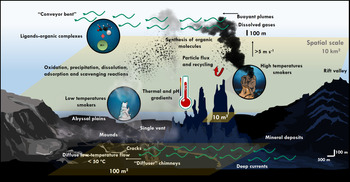
The complexity of SHVS is intrinsically linked to a highly dynamic environment. The convection processes in SHVS can be separated into three spatial scales of venting: (1) the flow coming from a single hydrothermal chimney (smokers) (10 m2), (2) the vent field that includes all active hydrothermal fluids (both at low, <100°C, and high temperatures, <400°C) (100 m2) and (3) the active ridge segment (10 km2) that include hydrothermal deposits and venting sites (Little et al., Reference Little, Stolzenbach and Von Herzen1987). Thence, it is possible to consider hydrothermal fields, in an overall way, as dynamic systems resulting from a constant interaction among the hydrothermal fluids coming from several sources (e.g. rich array of plumes, poly-metallic mounds, chimneys, buoyancy fluxes and currents along topography). The hydrothermal field can be dominated by one single vent, by several vents with enough separation, or by clusters of vents that can interact with each other (Lupton et al., Reference Lupton, Delaney, Johnson and Tivey1985; Tao et al., Reference Tao, Rosswog and Brüggen2013) (Fig. 1). This is crucial because a change in spatial scale should affect the nature and number of geochemical variables involved and that must be incorporated in simulations. As an example, it is important to be clear if the experiments attempt to study the conditions in the chimney or in the surroundings of the systems, this would affect the design of the experiments and the outreach of it. The extrapolations cannot be applied to all system conditions.
SHVS are highly dynamic environments. Any experiment intended to that simulate some of the conditions present in these systems should be clear in the scale of the venting (e.g. smokers, diffuse and low-temperature vents or the active ridge segment) as well as in the scope of their results. The details are fully described in the text.

As we mentioned before, a significant number of prebiotic experiments, simulating submarine hydrothermal vent conditions, only focus on the stability and decomposition of organic molecules at high temperatures and high pressures (i.e. >100°C and >10 bar) (Larralde et al., Reference Larralde, Robertson and Miller1995; Levy and Miller, Reference Levy and Miller1998; Alargov et al., Reference Alargov, Deguchi, Tsujii and Horikoshi2002; Sato et al., Reference Sato, Quitain, Kang, Daimon and Fujie2004; Abdelmoez et al., Reference Abdelmoez, Nakahasi and Yoshida2007; Cox and Seward, Reference Cox and Seward2007a, Reference Cox and Seward2007b; Klingler et al., Reference Klingler, Berg and Vogel2007; Balodis et al., Reference Balodis, Madekufamba, Trevani and Tremaine2012). Despite the tremendous complexity of submarine hydrothermal environments, only recently a few experiments have studied the role of different variables, such as minerals (Andersson and Holm, Reference Andersson and Holm2000; McCollom and Seewald, Reference McCollom and Seewald2003; Ito et al., Reference Ito, Gupta, Masuda and Kawahata2006, Reference Ito, Yamaoka, Masuda, Kawahata and Gupta2009; McCollom, Reference McCollom2013; Burcar et al., Reference Burcar, Barge, Trail, Watson, Russell and McGown2015; Dalai et al., Reference Dalai, Pleyer, Strasdeit and Fox2016), dissolved ions and gases (Marshall, Reference Marshall1994; Yamaoka et al., Reference Yamaoka, Kawahata, Gupta, Ito and Masuda2007; Franiatte et al., Reference Franiatte, Richard, Elie, Nguyen-Trung, Perfetti and LaRowe2008; Chandru et al., Reference Chandru, Imai, Kaneko, Obayashi and Kobayashi2013; Estrada et al., Reference Estrada, Mamajanov, Hao, Sverjensky, Cody and Hazen2017), the quenching effect (350 –2°C) (Ogasawara et al., Reference Ogasawara, Yoshida, Imai, Honda, Hatori and Matsuno2000; Ogata et al., Reference Ogata, Imai, Honda, Hatori and Matsuno2000; Islam et al., Reference Islam, Kaneko and Kobayashi2003; Kawamura and Shimahashi, Reference Kawamura and Shimahashi2008), the pH effect and the redox state (Yamaoka et al., Reference Yamaoka, Kawahata, Gupta, Ito and Masuda2007; Sakata et al., Reference Sakata, Kitadai and Yokoyama2010; Lee et al., Reference Lee, Foustoukos, Sverjensky, Cody and Hazen2014) on the stability and transformation of different organic compounds (for a detailed review, see Colín-García et al., Reference Colín-García, Heredia, Cordero, Camprubí, Negrón-Mendoza, Ortega-Gutiérrez, Beraldi and Ramos-Bernal2016, Reference Colín-García, Villafañe-Barajas, Camprubí, Ortega-Gutiérrez, Colás, Negrón-Mendoza and Kolb2018) and have improved the understanding of the role of physicochemical variables (coupled or individually) on the fate of organic molecules in these environments. However, it should be mentioned that most of the experiments are focused on a small fraction of the SHVS. In other words, although they have considered different variables in the same simulation, they are focused on the first scale of the venting (i.e. single hydrothermal chimney; smokers), and they do not take into account the dynamism of the environment. As we will explain later, the process of chemical evolution must have been presented in a wide space throughout these systems. In the next sections, we will explain some of the parameters that should be considered and have repercussions in the fate or organic molecules along submarine systems. Notably, the dynamism in these systems suggest that chemical evolution phenomena could be more prominent in the surroundings of the vents, where diffuse low-temperature flows and interactions between organic molecules and minerals could be abundant, and not in the single hydrothermal chimneys as it has been widely considered.
Flow and spread
Because SHVS are very dynamic, the hydrothermal fluids can have different properties in their temperature and composition as a consequence of differences in topography (Stein et al., Reference Stein, Stein, Pelayo, Humphris, Zierenberg, Mullineaux and Thomson2013).
The hydrothermal fluids can be released and transported by several ways: either by localized hot vents (up to 400°C, 22–119 cm s−1 for fluid temperatures between 200 and 300°C), or by diffuse flow warm plumes (<100°C) from other discharge sites (e.g. cracks in lava flows and seafloor around the vent field, breccia, collapse pits, lava rubble, mineral deposits and faults) at low flow rates (e.g. vertical velocities of diffuse effluent rage between 0.9 and 11.1 cm s−1 for fluid temperatures between 3 and 33.5°C) (Lupton et al., Reference Lupton, Delaney, Johnson and Tivey1985; Little et al., Reference Little, Stolzenbach and Von Herzen1987; Bemis et al., Reference Bemis, Lowell and Farough2012; Mittelstaedt et al., Reference Mittelstaedt, Escartín, Gracias, Olive, Barreyre, Davaille, Cannat and Garcia2012). This warm diffuse flow could represent the most important part of SHVS from a chemical evolution point of view (Fig. 1). For instance, the physicochemical conditions in this area could favour the accumulation of organic material due to low temperatures as well as sorption phenomena in several minerals, phenomena that are not possible at higher temperatures. In other words, these surroundings can extend for kilometres, and represent a continuous heat output fraction. Some authors have reported that these diffuse flow warm plumes can represent up to 90% of the total heat fraction of the system (Ramondenc et al., Reference Ramondenc, Germanovich, Von Damm and Lowell2006; Bemis et al., Reference Bemis, Lowell and Farough2012).
The simplest model about the dynamic flux from hydrothermal fluid is the buoyant flow. Depending on the variables used (e.g. ambient sea water buoyancy frequencies, source diameters, source velocities, dissolved ions, density gradient, hydrographic conditions, convection and conduction of heat and sea water stratification), the vertical thermal diffusion can be different (Wilcock, Reference Wilcock1998; Coumou et al., Reference Coumou, Driesner, Geiger, Heinrich and Matthai2006; Kadko et al., Reference Kadko, Baross, Alt, Humphris, Zierenberg, Mullineaux and Thomson2013; Tao et al., Reference Tao, Rosswog and Brüggen2013). Some models suggest that the maximum plume rising height can be ~300 m (Tao et al., Reference Tao, Rosswog and Brüggen2013) and that it can spread laterally through diffusion and advection mechanism (Thomson, Reference Thomson2005). These models match the measured values height of the plume Trans-Atlantic Geotraverse (TAG) hydrothermal site, for example (German and Sparks, Reference German and Sparks1993).
When the vent water and sea water reach an equilibrium density, they form a plume named conveyor belt. This plume can spread laterally up to 100 km along the basement relief through and driven by abyssal currents (Dymond and Roth, Reference Dymond and Roth1988; Khripounoff et al., Reference Khripounoff, Vangriesheim, Crassous, Segonzac, Colaço, Desbruyères and Barthelemy2001). In this way, several reactions among plume constituents and seawater can occur at different timescales (e.g. oxidation, precipitation, dissolution, sorption and scavenging reactions; Kadko et al., Reference Kadko, Rosenberg, Lupton, Collier and Lilley1990). The organic matter suffers the most important changes in the conveyor belt, not in the source (i.e. chimneys) (see below).
Bottom currents
Another factor that should not be underestimated is bottom currents. They influence the turbulent mixing and venting activity, and result in environmental thermal gradients (5–10°C cm−1 at timescales of hours and days). Bottom currents also contribute to the lateral transport of the fluids over a large region, on kilometres’ scale (Bates et al., Reference Bates, Lee, Tunnicliffe and Lamare2010; Mittelstaedt et al., Reference Mittelstaedt, Escartín, Gracias, Olive, Barreyre, Davaille, Cannat and Garcia2012). These low temperatures could induce the precipitation of minerals from the suspended particles in hydrothermal clouds at distances until 100 km from the ridge crest (Baker et al., Reference Baker, Lavelle and Massoth1985; Hannington et al., Reference Hannington, Herzig, Stoffers, Scholten, Botz, Garbe-Schönberg, Jonasson and Roest2001). In consequence, suspended mineral particles can favour the retention of organic molecules on their surfaces and, together with low temperatures, allow concentration mechanisms to prevail over decomposition reactions on a considerable spatial scale.
Thermal gradients
Organic matter is easily destroyed at high temperatures, so thermal gradients present in SHVS could be fundamental for assuring the formation of more complex organics. The variations of temperature can be associated with several phenomena. For instance, it could be the result of changes in the porous diffusive system in the chimney, tidal cycles, hydrothermal fluid discharge or the turbulent mixing with the environment (Chevaldonné et al., Reference Chevaldonné, Desbruyères and Haître1991; Khripounoff et al., Reference Khripounoff, Vangriesheim, Crassous, Segonzac, Colaço, Desbruyères and Barthelemy2001). Other phenomena such as thermophoresis, on the micro-scale, can result in the accumulation of organic molecules on the convection chamber (Braun and Libchaber, Reference Braun and Libchaber2004; Mast et al., Reference Mast, Osterman and Braun2013). It has been reported that fluids, associated with turbulences and that were mixed between sources, exhibit high temperature differences (e.g. 50°C) on the centimetre scale (Fornari et al., Reference Fornari, Shank, Von Damm, Gregg, Lilley, Levai, Bray, Haymon, Perfit and Lutz1998). Some models suggest that the rise of a plume until maximum height of rise is reached in ~1 h and that quenching phenomenon occurs in about 30 s (Mcduff, Reference Mcduff, Humphris, Zierenberg, Mullineaux and Thomson2013). Other models suggest important thermal gradients along the chimney wall (McCollom and Shock, Reference McCollom and Shock1997). As we can see, thermal gradients can be crucial in the organic molecules spreading, but again, the discharge of the turbulent fluids seems to be so powerful that the most important temperature differences could be more representative along the plume (100 m2).
Chemical interactions along plume and sea water
Hydrothermal fluids can be considered as multicomponent electrolytes with high metal concentrations, and an important amount of organic and volatile components (Lemke, Reference Lemke2013). The ability to form ligands, among metal and organic matter, can have important repercussions on the fate of molecules. For instance, the interaction of organic compounds with dissolved metals forms very high stable complexes, and they can be widely distributed along hydrothermal systems (Sander and Koschinsky, Reference Sander and Koschinsky2011). Klevenz et al. (Reference Klevenz, Sumoondur, Ostertag-Henning and Koschinsky2010) mentioned that 90% of metals in hydrothermal fluids can be present as metal-organic molecules complexes (e.g. amino acids) and that the turbulent mixing may result in different thermal stabilities of the amino acids. These complexes eventually precipitate, enriching the amino acid concentration of the low temperature (5−100°C) hydrothermal sedimentary environments, compared to the high-temperature vent fluid habitats (T > 150°C).
In this way, the study of organic-metal complexes is crucial to understand the fate of organic compounds in hydrothermal environments. On the one hand, the complexation reactions in hydrothermal brines (i.e. rich in Na+, Ca2+, Cl−) suggest that they depend on the solubility of organic salts, their concentration and the pH conditions (Hennet et al., Reference Hennet, Crerar and Schwartz1988). On the other hand, it has been shown that supercritical water enhances the solubility of organic compounds and reduces solvation properties for ionic species due to its loss of aqueous hydrogen bonding (Simoneit, Reference Simoneit and Holm1992). In addition, the ability of hydrothermal fluids to transport ions and other aqueous species, into and away from alteration zones, is strongly correlated with changes in the electrostatic properties of the fluid (Shock, Reference Shock and Holm1992).
Another fundamental aspect to consider is the chemical reactions along the plume because oxidation/reduction reactions can be kinetically slow for some metals (e.g. Fe and Mn) (McCollom, Reference McCollom2000). For example, dissolved Mn(II) has residence times close to 1 month; although, it is highly dependent on precipitation mechanisms (e.g. coordination polymers with sodium azide) (Mandernack and Tebo, Reference Mandernack and Tebo1993). Some species (e.g. H2S) can be removed by their precipitation as oxides (Mottl and McConachy, Reference Mottl and McConachy1990; Gartman et al., Reference Gartman, Yücel, Madison, Chu, Ma, Janzen, Becker, Beinart, Girguis and Luther2011). Other chemical species, such as methane, remain in dissolution for 1 week before their complete oxidation. The latter can represent an important carbon source to the surroundings of the vent field (10 km) (De Angelis et al., Reference De Angelis, Lilley and Baross1993). Considering the previous information, it is clear that organic molecules are not isolated in the systems, so the experiments that have reported their high decomposition rates should be complemented by the analysis of metal-organic complex formation. This will result in more consistent simulations.
One of the most discussed problems in chemical evolution is the concentration and the availability of organic molecules on early Earth. Since the SHVS are open systems, it seems extremely difficult to reach high-organic concentrations in them. On the one hand, to delimitate the amount of organic carbon along the hydrothermal plumes is very difficult, due to the biological production and consumption. In present day systems, the concentration of amino acids reported can be affected by in situ production of microbial biomass in the sediment (Haberstroh and Karl, Reference Haberstroh and Karl1989). Some differences among the dissolved organic carbon (DOC) and the particulate organic carbon (POC) concentrations (DOC: 38–47 μM and POC: 0.16–3.81 μM), in the mid-ocean ridge hydrothermal systems, have been reported. These differences are associated with the heterogeneous physical conditions of the system (i.e. subsurface biological production, sorption onto mineral surfaces, thermal decomposition, etc.). Essentially, DOC is depleted both at high-temperature ridge-axis vents as in warm off-axis vents (<10 μM) (Lang et al., Reference Lang, Butterfield, Lilley, Paul Johnson and Hedges2006; Bennett et al., Reference Bennett, Statham, Green, Le Bris, McDermott, Prado, Rouxel, Von Damm and German2011). On the other hand, the distribution of organic species can be controlled by the seawater mixing, temperature and cooling effects and the CO2–CO–H2 thermodynamic equilibria (Foustoukos et al., Reference Foustoukos, Pester, Ding and Seyfried2009). Although some amino acids have been detected in hydrothermal fluids (directly collected from deep-sea hydrothermal systems), it is necessary to consider several things to calculate the real concentration of this molecules in these scenarios. First of all, it is not easy to distinguish between the amino acid contribution of organisms (direct biological origin), and those produced by hydrolysis of polymeric forms (i.e. derived from organisms and bio-debris) (Horiuchi et al., Reference Horiuchi, Takano, Ishibashi, Marumo, Urabe and Kobayashi2004). Similarly, it is also unclear which part of a hydrothermal area (i.e. the chimney (hot spots) or the low-temperature hydrothermal fluids) is the most important source for amino acids (Fuchida et al., Reference Fuchida, Mizuno, Masuda, Toki and Makita2014). Nonetheless, it has been suggested that low-temperature hydrothermal fluids can be an important source of amino acids, and not the hydrothermal plume per se (Svensson et al., Reference Svensson, Skoog and Amend2004; Lang et al., Reference Lang, Früh-Green, Bernasconi and Butterfield2013).
Finally, it is essential to consider the gas and particle distribution in SHVS. As we can expect, gas diffusion should be very quick. For instance, hydrogen (H2) is removed from the plume within hours while manganese (Mn) is removed after 2 weeks (Kadko et al., Reference Kadko, Rosenberg, Lupton, Collier and Lilley1990). The particle distribution will depend on mineral phase and solubility (e.g. sulphate and sulphite particles have a slower process of dissolution than hydrous iron) (Lilley et al., Reference Lilley, Feely, Trefry, Humphris, Zierenberg, Mullineaux and Thomson2013). Similarly, some data suggest that the particle recycling and re-entrainment in the plume can occur over a length of 1–10 km (German and Sparks, Reference German and Sparks1993). Besides, this dissipation of material could be replaced by a continuous input from low-temperature water-rock reactions (Mayhew et al., Reference Mayhew, Ellison, McCollom, Trainor and Templeton2013). In addition, the scavenging processes could impact these processes and affect the ocean geochemical cycles (German et al., Reference German, Colley, Palmer, Khripounoff and Klinkhammer2002).
A consistent submarine hydrothermal vent scenario?
As we can deduct from the previous arguments, a more comprehensive submarine hydrothermal scenario includes not only high pressures and high temperatures as main conditions. The fluids discharged by different sources from hydrothermal systems experience a chemical change as they interact with seawater (Kadko et al., Reference Kadko, Rosenberg, Lupton, Collier and Lilley1990) and hardly remain at high temperatures (>100°C).
Although the properties of water and chemical species are clearly affected by physicochemical gradients through the circulation in hydrothermal systems, they are often ignored in prebiotic chemistry experiments (Holm and Hennet, Reference Holm, Hennet and Holm1992). Over the last two decades, the scientific community has noted these ideas and developed more complete experiments related to the geochemical parameters available in SHVS.
For example, Seewald et al. (Reference Seewald, Zolotov and McCollom2006) reported the formation of reduced carbon compounds (e.g. HCOOH and CH3OH) as a consequence of thermal gradients and reversible reactions between dissolved gases (i.e. CO2, CO and H2). Additionally, theoretical models suggest that it is thermodynamically possible, considering temperature gradients and oxidation–reduction reactions, to synthesize organic molecules from some common gases (e.g. CO2 and H2) (Shock, Reference Shock1993; Shock and Schulte, Reference Shock and Schulte1998; Shock and Canovas, Reference Shock and Canovas2010; McDermott et al., Reference McDermott, Seewald, German and Sylva2015). These experiments seem to be consistent with the availability of organic compounds in SHVS. For instance, Lang et al. (Reference Lang, Butterfield, Schulte, Kelley and Lilley2010) reported, based in isotopic evidence, the abiotic production of organic molecules (i.e. formate: 158 μmol kg−1; acetate: 35 μmol kg−1) from alkaline hydrothermal vents (i.e. Lost City hydrothermal field). A recent experimental result suggested that HCO3/CO2 can be reduced to formate and trace amounts of acetate, using metal sulphides as catalysts, and H2S as a reductant at hydrothermal conditions (300°C, 3 h, basic pH) (He et al., Reference He, Hu, Zhong, Jin, Fan, Hu and Jing2019). On the other hand, Ying et al. (Reference Ying, Chen, Wu, Yang, Yan, Xu and Zhao2019) showed that the formation of dipeptides increase with rising pressure (300 bar, T < 50°C, amino acid, P3M, pH 10.7) because the high-hydrostatic pressure increases the equilibrium constant of the reaction. Also, the interaction among minerals (olivine and orthopyroxene) with amino acids during several days (147 days) at 200 bar with periodic thermal cycling (30–100°C) leads to the synthesis of dipeptide species and their chemisorption (Takahagi et al., Reference Takahagi, Seo, Shibuya, Takano, Fujishima, Saitoh, Shimamura, Matsui, Tomita and Takai2019). Other researchers have focused on the thermolysis and polymerization reactions of hydrogen cyanide under simple hydrothermal conditions (Das et al., Reference Das, Ghule and Vanka2019; Villafañe-Barajas et al., Reference Villafañe-Barajas, Colín-García, Negrón-Mendoza and Ruiz-Bermejo2020a, Reference Villafañe-Barajas, Ruiz-Bermejo, Rayo-Pizarroso and Colín-García2020b) and showed the formation of several organic compounds, suggesting that this kind of reactions could occur in the vicinity of hydrothermal vents. Moreover, other studies suggest that ferrocyanide solutions are stables at lower $p_{{\rm C}{\rm O}_{\rm 2}}$ , temperature <25°C and higher pH (6.9–9.3); for example, in environments saturated in carbonate or bicarbonate brines (Toner and Catling, Reference Toner and Catling2019). As we can see, there are many gaps in prebiotic chemistry studies simulating SHVS, and there is no clear knowledge about the role of geochemical variables present in them. Therefore, it is necessary to develop more experiments with a clearer idea about the conditions and variables that must be considered and replicated (Holm and Andersson, Reference Holm and Andersson2005).
Even though there are several proposals about submarine environments and their role in chemical evolution and the origin of life, it is necessary to be cautious with the assertions and extrapolations about these ideas. For example, some of these ideas have suggested the emerge of the first protometabolic pathway from the interaction of hydrothermal fluids (considering redox and pH disequilibria) with mineral, in an ancient submarine hydrothermal vent (Wächtershäuser, Reference Wächtershäuser1988a, Reference Wächtershäuser1988b, Reference Wächtershäuser2006; Cartwright and Russell, Reference Cartwright and Russell2019). Although these ideas have stimulated the thinking of the scientific community about the role of these scenarios, according to our point of view, we must be careful and gather more information before giving categorical answer to the role of these environments in the origin of life. Nevertheless, it is worth mentioning that these kinds of hypotheses have considered the dynamism of hydrothermal as the main argument to reach chemical complexity (i.e. the interactions of minerals with organic molecules where the pH has a dramatic role).
Until now, there is not a single proposal of a primitive environment that could have fulfil all the necessary conditions for the development of the three fundamental components of life (i.e. metabolism, genetic material and membranes). However, the dynamism presented in submarine hydrothermal systems seems to be a good starting point. It should be kept in mind that any experiment that tries to simulate some of the conditions present in SHVS must be clear in the scale it represents (e.g. smokers, diffuse and low-temperature vents or the active ridge segment), and thus, be consistent with the conditions prevailing on those scales. Also, it is necessary to be cautious and consistent with the scope of the results, to avoid overestimations about the role of these systems on chemical evolution and eventually, in the origin of life.
Acknowledgements
This research is part of SVB Ph.D. dissertation. He acknowledges the CONACyT (697442) for a scientific grant and the Posgrado en Ciencias de la Tierra. MCG acknowledges CONACyT for the financial support (A1-S-25341).
Conflict of interest
The authors declare no conflict of interest. The funders had no role in the design of the manuscript or in the decision to publish the results.